




Abstract
BACKGROUND:
Paternalistic leadership style has progressively intrigued organisational behaviour study in the last two decades. An abundance of research is integrating the existing literature on leadership and positive organizational culture to better understand the processes through which leadership leads to life satisfaction.
OBJECTIVE:
One such mechanism through which specific leaders influence life satisfaction is work-family conflict (WFC) and family-work conflict (FWC). Paternalistic leadership is a significant antecedent to develop subordinates’ life satisfaction because it integrates discipline with fatherly support. However, no research exists to date on the effect of paternalistic leaders on subordinate’ WFC and FWC, which in turn affects their life satisfaction.
METHOD:
The current study examines the impact of paternalistic leadership on employee life satisfaction using a sample of 198 nurses from public sector hospitals of Sindh province in Pakistan. The data was collected through survey questionnaires, and Smart-PLS-SEM was used to test the proposed hypotheses.
RESULTS:
The primary goal of this study was to investigate the relationship between paternalistic leadership and life satisfaction. At the same time, there were significant mediation effects on life satisfaction.
CONCLUSION:
The findings indicate that paternalistic leadership positively impacted life happiness through decreasing followers’ WFC. However, it has a detrimental influence on FWC, which mediates the effect on subordinates’ life satisfaction.
Keywords
Introduction
Today, cultural differences must be considered when studying leadership style [1, 2]. According to research, the characteristics affecting leadership effectiveness vary by culture. Paternalism is ingrained in all cultures [3], where individuals with a position of authority in social institutions (e.g., companies) are required to control, nurse, and set an example for those at the bottom of the hierarchy [4]. In exchange for this, these leaders are accorded reverence and deference [5], while those at the organization’s bottom give commitment and responsibility in return [6].
Leadership study has raised interest in recent decades to determine if all leadership theories can be applied in all nations or organizations of various origins [2, 7–11]. Paternalistic leadership (PL) is one of the leadership styles that stems from a certain cultural setting. The area of leadership studies not just leadership traits, but also dyadic dynamics and followers’ reactions, such as work attitudes and conduct [12]. It is crucial to investigate the link between leadership style and employee attitude [13]. On the contrary, because there is still a lot of conflicting or incomplete knowledge about different leadership theories in different cultural contexts, researchers are attempting to delineate the PL in order to provide useful information for the cross-cultural leadership literature [8, 13], The purpose of this study is to add to the leadership literature by looking into the link between PL and organizational attitudes through the emotional states of followers. Individual affectivity, PL, employee happiness, and organizational commitment are all areas where research is lacking [14].
Paternalistic leadership is a term that refers to the interplay and balance of authoritarian, benevolence, and morality [7, 15]. By adopting benevolent and moral behaviours, paternalistic leaders demonstrate concern for employees, serve as role models for other-oriented ideals, and give resources to them [16]. Paternalistic leadership is defined as “a type of leadership that integrates action” and “authority with fatherly benevolence” [15, 17], and it consists of three separate dimensions: authoritarianism, benevolence, and morality e.g. [18]. The three behavioural aspects paint a comprehensive portrait of paternalism [2]. Adler and Aycan, argue that paternalistic leadership is a coherent concept and that the behaviours of benevolent and authoritarian paternalistic leaders are not mutually exclusive. Leaders are genuine benefactors to their subordinates within a moral context while exercising rigorous power over them [1, 19].
Thus, by examining the role of leaders in differentially affecting the relationship between work–family conflict and life satisfaction, our study fills a significant gap in the literature by emphasizing the critical need for researchers and practitioners to adopt a paternalistic approach when analyzing work–family issues and working to develop interventions to manage work–family conflict efficiently. Work and family life can be thought of as two independent spheres of existence [11]. Work-family conflict occurs when work obligations obstruct performance in the family realm, whereas family-work conflict occurs when family requirements obstruct performance in the work domain [20]. Work-family conflict is an inter-role conflict that occurs when employees are subjected to excessive work pressures that impair their performance in the family domain [21]. When an employee is burdened by family responsibilities that adversely affect their performance in the family realm, family-work conflict occurs [22, 23]. Work-family conflict occurs when the dispute originates in the work domain and is received by the family domain, whereas family-work conflict occurs when the conflict originates in the family domain [22, 24]. Our study proposes that work-family conflict mediates the relationship between paternalistic leadership (PL) and life satisfaction (LS). In addition, family-work conflict mediates the relationship between paternalistic leadership (PL) and life satisfaction (LS) (see Fig. 1).
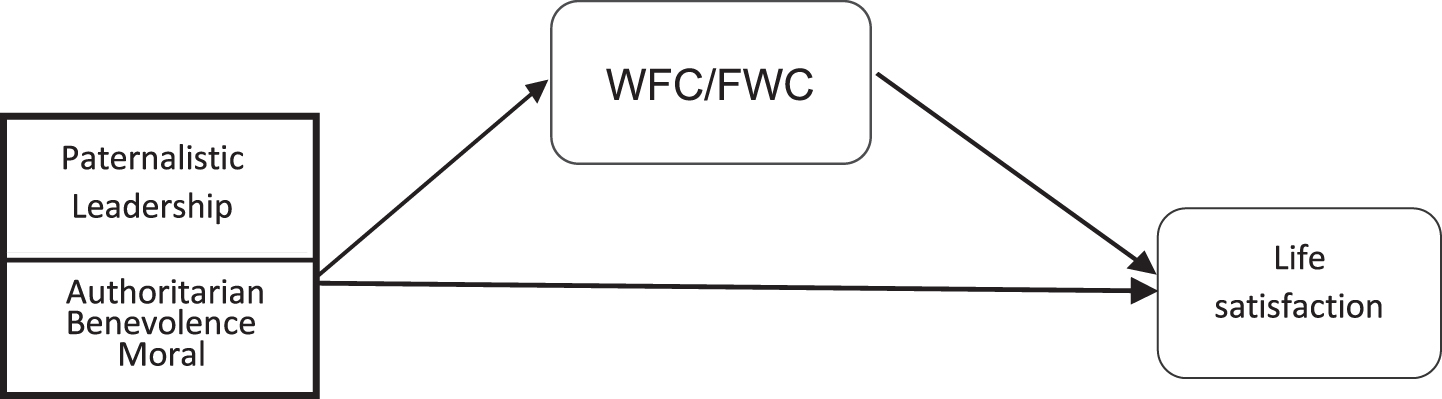
Study model.
Paternalistic leadership and life satisfaction
Paternalistic leadership demonstrates the connection and coherence of three aspects or components [7]: authoritarian, benevolence, and moral [2, 17]. Authoritarianism is seen as the major constraint in paternalistic leadership, referring to the authority the leader imposes on employees, ordering their conformity with the organization’s action to take and his orders, and enforcing rules violations [1, 18]. On the other hand, the benevolence and morality components of paternalistic leadership are soft characteristics [18]. Through benevolence, paternalistic leaders demonstrate their concern and care for employees’ success and growth by providing resources and expertise [6]. Benevolent leadership is concerned with their professional lives and the intersection of work and home life. Paternalistic executives also demonstrate moral behaviour [25], particularly in their interactions with the organization and its employees. In paternalistic leadership, the moral dimension is defined as “a leader’s behaviour that exhibits superior personal values, personality, and altruism” [11, 18]. It comprises establishing an example for subordinates by demonstrating integrity, adhering to one’s commitments, never taking advantage of others, and serving as a selfless role model [10]. This moral dimension of paternalistic leadership emphasizes the leader’s role as a moral figure who inspires employees to contribute to the organization above and beyond their own self-interests [1].
Paternalistic leadership has been linked to organizational identification [26], affective trust [19], team cohesiveness [27], and subordinate performance, such as organizational commitment [28], organizational citizenship behaviour [17], and empathetic leadership [29]. In China [17], Turkey [1], and other collectivist culture countries, there is some empirical support for Pakistan the paternalistic leadership–creativity link [11].
H1: Paternalistic leadership has a positive relationship with nurses’ life satisfaction.
Specifically, past research has discovered that work-family conflict is negatively associated with life satisfaction and family-work conflict is negatively associated with job satisfaction.
Paternalistic leadership and work-family conflict and family-work conflict
Resource outflow emphasizes that resources are limited and that in order to properly fulfil obligations in the work and family domains, individuals must manage their limited resources by shifting resources between the two domains [20, 21]. However, because to resource constraints, increasing obligations in one domain may have a detrimental effect on their ability to discharge those responsibilities and result in inter-domain disputes [24].
Work–family conflict has been proven to be negatively associated with work domain outcomes. Previous study has proven a negative correlation between work–family conflict and job involvement [30]. Work-family conflict is associated with reduced job satisfaction because individuals who experience high levels of work-family conflict may link their conflict to their jobs or organization, resulting in lower job satisfaction [22, 31]. Wiley, for example, discovered a negative correlation between work-related and non-work role conflict and organizational citizenship behavior (without distinguishing between the two directions of conflict).
Similar to authentic leadership, existing research indicates that work–family conflict has a detrimental effect on task performance. Additionally, some research implies that work–family conflict indirectly affects OCB via mediators such as job satisfaction and organizational commitment. Asghar et al. [20] discovered both direct and indirect correlations between work-related and non-work-related role conflict and OCB. We, therefore, hypothesize that WFC and FWC mediate the link between PL and LS based on the previous theoretical insights and prior empirical studies in other circumstances. In this section, we postulated that:
H2: Work-family conflict mediates the relationship between paternalistic leadership and life satisfaction.
H3: Family-work conflict mediates the relationship between paternalistic leadership and satisfacction.
Proposed study model
Methodology
This section is intended to accomplish the research objectives. The data were gathered from staff nurses employed at major public hospitals in Sindh, Pakistan. Sixteen large hospitals were chosen for this study based on their convenience and approachability. By adhering to the principles first, a formal permission letter was issued and sorted for approvals from responsible authorities. After obtaining approval, self-administered 300 survey questionnaires were given the public hospitals with a combined workforce of nurses. Participation letters were delivered in accordance with the confidentiality requirements of responding employees. Out of 290 questionnaires, 198 were completed and collected from employees, yielding a response rate of about 68%, which is highly satisfactory. The remainder of the questionnaires were never received from respondents’ employees, while some were received with incomplete responses, double responses, and even blank forms. Table 1 shows the demographics profile.
Demographics profile
Demographics profile
Aycan et al. [32] used a five-point Likert scale to assess paternalistic leadership (PL) (1 = strongly disagree; 5 = strongly agree). A sample item is “My leader acts as if he or she is a senior family member toward his or her employees”. Grzywacz and Bass [33] quantified work-family conflict and work-family conflict 4-items for work-family conflict and 4-items for work-family conflict total eight items on a 5-point Likert scale (1 = strongly disagree; 5 = strongly agree). A sample item is “Does my job limit the amount of effort I can devote to home activities?". From work-family conflict and family-work conflict, a sample item is “Do my domestic responsibilities reduce the amount of effort I can devote to my job?". Pavot and Diener [34] assessed life satisfaction and provided a five-item summary of life satisfaction using a five-point Likert scale (1 = indicating strong disagreement and 5 = indicating strong agreement). A sample item from Gull et al. [11] is “In the majority of ways, my life is very close to my ideal".
Results
Data analysis
The path modelling technique (partial least squares method, PLS-SEM 3.3.2) is widely used in organizational behavioural research to test hypotheses and construct measurement models [35, 36]. The PLS-SEM approach is based on the evolution of the dependent variables’ described variance and is most suitable for exploratory research [36, 37]. Additionally, the path model is constructed using PLS-SEM, enabling the relationship between construct variables and indicators to be validated [38]. The primary reason for using the PLS-SEM is that it is effective in exploratory studies, particularly when theory is poorly explained. PLS-SEM is more authentic in identifying relationships and operating efficiently within a complex model [14]. Additionally, it allows for greater flexibility regarding practical assumptions regarding data distribution [39]. When the sample size is small, there is no problem with identification [40]. Smart-PLS-SEM employs a more authentic approach to path modelling validation due to the sample size constraint and the absence of distributional assumptions [41]. The strength of the Smart-PLS and its distinguishing characteristics from SEM was determined in two steps [36]: assessment of the measurement model and assessment of the structural model.
We analyzed the variance-based method using the Smart-PLS-SEM 3.3.2 software [40]. The results (Table 2) demonstrated the model’s validity and reliability. We evaluated the measurement model first, and then the structural model [42]. The measurement model was assessed by examining the relationships between all indicators and constructs. The model’s reliability and validity have been considered, as shown in (Table 2), where the constructs’ reliability was determined using outer loading of indicators, Cronbach’s alpha, and composite reliability score (CR), as well as the values of average variance extracted (AVE) [36, 37]. Additionally, validity was assessed on two dimensions: discriminant validity was determined using the AVE score and outer-loadings, while convergent validity was determined using cross-loading, standards and HTMT [43]. All items of outer-loading value were greater than the 0.70 cut-off value [22], while the AVE and CR scores were more significant than the 0.50 and 0.70 cut-off values, respectively [36], indicating that the model’s measurement was internally reliable [38].
Each construct’s composite findings were calculated by averaging the values of indicators indicating those variables. At the first level of the reflective measurement model, “all construct variables have a Cronbach’s alpha value greater than 0.70”. The values of the measurement model (rho-A) are extremely near to Cronbach’s alpha, with the same threshold levels applied. Simultaneously, the reliability and consistency of each indicator were evaluated using outside loadings. Rather than convergent validity, data were assessed using outer loadings, composite reliability, and (AVE) average variance, whereas discriminant validity was determined using cross-loadings, criteria, and HTMT [40]. All coefficients of alpha, CR, average variance extracted AVE, and rho-A values were greater than the threshold limit, indicating the reflective measurement model’s reliability and validity.
Convergent validity was determined by examining the AVE value, which represents the amount of variance obtained by a construct from its indicators in comparison to the amount of variance due to dimension error. Table 2 shows that the AVE value is greater than 0.50, indicating that the model is valid, and that one item was deleted from the LS due to being less than the cut-off point; these findings indicate that the measurement model’s convergent validity is highly acceptable. Predictable methodology is a prerequisite for convergent and discriminant validity [37].
Items cross-loading
Items cross-loading
This study confirmed the structural model assessment as suggested by (43)s. VIF values were less than the 5 to 10 point cutoff. Thus, multicollinearity between all predictors was not a concern in the structural model. Additionally, they recommended that collinearity had no effect on the structural model’s results. The structural model was evaluated by calculating the coefficients of determination (R2) for all endogenous variables. The variance explained (R2) values for WFC (0.401), FWC (0.373), and life satisfaction (0.592) were greater than the 0.1 suggested by [36], confirming the structural model’s in-sample analytical power. Three approaches were used to assess discriminant validity in this study. a) The Fornell-Larcker test; b) discriminant validity as determined by the heterotrait-monotrait-ratio (HTMT); and c) cross-loadings. As shown in Table 3, the (HTMT) values in all of the preceding cases were less than the 0.85 cut-off point. Cross-loading analysis revealed that all individual indicators loaded more strongly on their corresponding constructs than on others. The blindfolding method is intended to produce predictive relevance (Q2) values. This approach is used for path modelling, and while the cross-validated redundancy (Q2) is greater than zero, this study recommends predictive relevance. All endogenous variables listed in Table 4 have a predictive relevance (Q2) value.
Convergent validity and discriminant validity
Note: Paternalistic Leadership (PL), Work-Family Conflict (WFC), Family-Work Conflict (FWC), Life Satisfaction (LS). (*P < 0.001, **P < 0.05 2-tailed test).
Coefficients of determination (predictive relevance (Q2))
Note: Work-Family Conflict (WFC), Family-Work Conflict (FWC), Life Satisfaction (LS) (*P < 0.001, **P < 0.05 2-tailed test).
The current study examined the effect of paternalistic leadership on nurses’ life satisfaction. This study also checked out the positive effect of paternalistic leadership as a whole construct and in the presence of WFC/FWC as mediators in above mentioned relationship. Consistent with the prior studies, some leaders behave in such a way that results in good quality interpersonal relationships expose as supportive, giving services of a role model leader, giving importance to their followers, and being flexible. A bootstrapping method used in this study (5000 bootstrap samples; with no changes the sign) to create t-values with significance level, and, p-values as well as (95% CI in percentile and, bias-corrected CI) was shown to assessment hypothesis relationship among the variables in the study model. Table 5 describes that PL (β= 0.113, p < 0.05), has significant relationship with LS, PL (β= 0.106, p < 0.05) WFC, and also PL (β= –0.206, p < 0.05) has significant relationship with FWC. On the other hand, WFC (β= –0.102, p > 0.05) has significant relationship with LS and FWC (β= 0.183, p < 0.05) has a significant relationship with LS. The effect size f2 is represented to the small effects (0.02), medium effects (0.15), and the large effects (0.35), respectively.
Path analysis
Path analysis
Note: Paternalistic Leadership (PL), Work-Family Conflict (WFC), Family-Work Conflict (FWC), Life Satisfaction (LS). (*P < 0.001, **P < 0.05 2-tailed test).
This study analyses mediation using the variance-adjusted (VAF) method; this method is the most authentic compared to the Sobel test [14]. The VAF method is as follows for computing the mediation analysis. If the VAF value is greater than 80%, full mediation exists; if the VAF value is less than 80%, partial mediation exists; and if the VAF value is less than 20%, no mediation exists [44]. The results of this study demonstrate that WFC and FWC mediate the association between PL and LS in part. As a result, all hypothesis are accepted.
The findings of this study indicate that WFC and FWC mediate the relationship between PL and LS in part. Table 5 demonstrates that the WFC mediates the relationship between paternalistic leadership and life satisfaction significantly and partially, whereas the FWC partially mediates the relationship between paternalistic leadership and life satisfaction.
In this perspective, paternalistic leadership places a premium on their subordinates’ well-being [45]. To enhance employee performance emphasize the fundamental function of paternalistic leadership in conjunction with employee innovation [46]. To gain a deeper understanding of paternalistic leadership, it is necessary to view it holistically, as its elements are inextricably linked [22]. In a study conducted in Pakistan, researchers discovered that employees who work under paternalistic bosses experience less work–family conflict [11, 14]. As a result, paternalistic leaders are primarily advocates for an environment in which employees feel at ease and happy while performing their jobs, a conducive environment for the development of confidence and reinforcement of well-being [11].
The study’s findings imply several management consequences. To begin, they may use their employees’ efforts to create an environment conducive to employee contentment with their lives. The findings emphasize the concept of paternalistic leadership, in which firms may encourage individuals to perform well even when confronted with WFC. Second, the findings from the current study can be applied to organizations that perform leadership development training programmes. Leaders that assist their employees when they encounter WFC or FWC make them feel secure and encourage them to perform well, resulting in their satisfaction with their lives.
While this study adds significant value to the literature, it also has several limitations. The current study used a cross-sectional methodology, limiting findings about causation, and future research on this subject may employ a longitudinal design to investigate the correlations between the supplied factors, and our target will be also major private hospitals of Pakistan. It should be noted that the research environment and sample size constrain our findings. In this regard, the current research study employed a convenience sample technique, which raises some concerns about the generalizability of the findings. Additional research is required to validate this study paradigm. The generalizability of our findings should be examined in light of many cultural situations.
Moreover, the study model should be validated by the use of other variables, like as next study will be used polychronicity/multitasking behavior as a predictor variable. Following that, data collection can be undertaken in hospitals located in Punjab, Pakistan’s largest province. In addition, because this present research focused exclusively on nurses working in a hospital setting, future studies could expand the study to include other target populations.
Conclusion
The primary objective of this study was to determine the link between the paternalistic leadership and life satisfaction as a outcome and the mediating effect of work-family conflict and family work conflict. The findings reveal that paternalistic leadership has a strong positive correlation with subordinates’ life happiness. The findings emphasize the study’s importance because paternalistic leadership is used as a predictor, which implies that if someone has the ability to perform more work and his or her manager supports him or her, he or she will be more content in life satisfaction.
Footnotes
Acknowledgment
This research was supported by the “General Project of Humanities and Social Science Research of the Ministry of Education (18YJAZH079)” and the Hebei Provincial Education Department Scientific Research Project Humanities and Social Science Research Major Projects (ZD201905).
Author Contributions
Conceptualization, N.G. and A.S; Methodology, M.A. and N.G.; Software, M.A. and M.S; Validation, N.G. and M.A; Formal analysis, N.G. and M.S.; Investigation, N.G. and M.A.; Resources, N.G. and M.A, Data collection, N.G. and M.A.; Writing— original draft preparation, M.A, and N.G; Writing— review and editing, M.A. and M.S, Supervision S.Z.
Conflict of interest
The authors declare that there is no conflict of interest regarding the publication of this paper.