



Abstract
BACKGROUND:
Psychological distress affects between 5 and 27% of the general population [1]. Workers facing stressful work conditions are especially at high risk for experiencing psychological distress [1].
OBJECTIVES:
To evaluate the association between work organization conditions and work performance via psychological distress. While the individual contribution of work organization conditions to psychological distress and work performance has been examined in the scientific literature, their combined influence on work performance remains relatively unknown.
METHODS:
To adjust for design effects, we relied on cluster sampling (employees working in organizations). MPlus was used to conduct path analyses [2].
RESULTS:
While psychological demands, number of hours worked, and job insecurity were positively associated with psychological distress, job recognition was negatively associated with it. In the same vein, irregular work schedules and job insecurity seem to be negatively associated with work performance. On the one hand, skill utilization, decision latitude, recognition, and job promotion, all seemed to be positively associated with employee’s work performance. On the other hand, psychological demands, number of hours worked, and job insecurity were negatively and indirectly associated with work performance.
CONCLUSIONS:
Understanding the indirect association between work variables and workers’ psychological distress could promote their work performance. Understanding this association could help shed light on the difficulties employees with psychological distress face while meeting their job requirements. The results of this study should serve as a reminder to intervene on work organization conditions.
Introduction
Psychological distress affects between 5 and 27% of the general population [1]. Workers facing stressful work conditions are among those at high risk for experiencing psychological distress [1]. According to Marchand and Blanc, 46.4% of employees suffered at least one episode of psychological distress and 23.5% suffered multiple episodes [3]. Psychological distress is a nonspecific syndrome associated with feelings of anxiety, depression, irritability, anger, cognitive problems (e.g., memory and concentration) [4], somatic symptoms such as insomnia, headaches, lack of energy [1, 5] as well as excessive alcohol, drugs, or medication consumption [6]. In addition to these issues, psychological distress could lead to serious physical health problems such as high blood pressure and alcoholism [6] as well as cardiovascular disease, premature mortality and even suicide [6]. Psychological distress is generally the first sign of a more serious mental health issue and could be considered a marker for psychiatric disorders (e.g., major depression and generalized anxiety: [7, 8]). Because it often precedes more serious health problems, this prepathological state offers the opportunity to intervene early.
In terms of risk factors, both work-related (e.g., demands at work) and non-work-related variables (e.g., social support) seem to influence psychological distress [6]. The association between work-related variables and psychological distress has been examined in the scientific literature [3, 9–12]. Moreover, psychological distress could negatively impact work performance [13]. For instance, poor psychological health (e.g., depression) has been found to negatively impact work performance [14]. Those findings prompted the following question: Does the same finding hold for psychological distress? More specifically, can a prepathological state mimic the effect of depression on work performance? To address this question, we evaluated how work organization conditions influence work performance via psychological distress. Understanding this indirect association could help promote employees’ psychological health and improve their work performance [15]. In the context of limited financial resources, paying close attention to employee psychological distress is all the more important. From an ethical standpoint, worker mental health should not have to suffer in the wake of organizational performance [16]. As recently stated by Zivkovic et al., psychosocial risk factors (e.g., work organization conditions) are among the most complex and challenging problems organizations all around the world are facing [17]. Given this level of complexity, we propose a comprehensive model incorporating a large number of work organization conditions that have been found to be associated with work performance. In order to examine this research question, we relied on a large Canadian sample. While the individual contribution of work organization conditions to psychological distress (e.g., [11]) and work performance (e.g., [18]) has been examined in the scientific literature, their combined influence on work performance remains relatively unknown.
Empirical background
Psychological distress and work performance
Work performance is the effective and productive completion of work tasks. This work-related concept could be considered a self-evaluation metric that draws from both social and non-social successes at work. In this study, we relied on a measure of professional efficacy as a proxy for one’s evaluation of work performance. According to Schaufeli et al., emotional exhaustion is a primary dimension of burnout [19]. As such, we believe that professional efficacy should not only be considered a core dimension of burnout but rather one’s evaluation of job performance.
The impact of organizational variables (i.e., decision latitude, physical demands, gratifications social relationships at work) on work performance has previously been demonstrated [18, 20–23] while the impact of psychological distress on work performance remains less clear. A recent study conducted by Halonen et al. demonstrated that psychological distress is associated with lower job performance (i.e., sickness absence) [24]. Psychological distress also seems to be negatively associated with work ability [25]. A further investigation of the association between psychological distress and work performance could help shed light on the difficulties employees with mental health problems face while trying to meet their job requirements.
Previous studies found psychological distress to play a mediating role between work-related stressors and poor work performance. Several work organization conditions seem to negatively impact workplace productivity through poor mental health [15]. According to a longitudinal study by Montani et al., psychological distress mediates how an employee perceives an economic crisis and absenteeism rates the following year [26]. The association between low sense of control and workplace rewards with psychological distress and subsequent sickness presenteeism was also highlighted in a second longitudinal study [27]. Toxic work environments characterized by ostracism, incivility, harassment and bullying also seem to be associated with lower productivity because of their impact on psychological health (i.e., burnout, depression) [28, 29]. Lastly, psychological distress has been found to mediate the association between abusive leadership and job performance [30].
Work organization conditions
Work organization conditions are either resources or limitations placed on the worker that might exert mental or physical strain on them. Work organization conditions are usually classified in four categories: Task design, work demands, social relations and gratifications [31]. Task design, work demands, social relations and gratifications, as variables, are drawn from the following work stress models: Job demands-control model [32]; Job Demands-Control-support model [33]; Effort-Reward imbalance [34]; and the Demands-Resources model [35]. Because of their physical and mental strain, work organization conditions could play a role in worker well-being (e.g., low psychological distress) [36].
Task design
The first work organization condition we will discuss is Decision Latitude. This variable refers to the leeway an individual has in affecting their work, their group work, and company policies [37]. Decision latitude includes both skill utilization and decision authority. Skill utilization refers to the extent to which a worker can use their skills and the opportunity to develop new skills. As for decision authority, this concept refers to how much authority a worker has in structuring work tasks, pacing tasks, and deciding which procedures to use to complete tasks. Previous studies have usually considered those skill utilization and decision authority concurrently [37]. A high decision latitude has been found to be associated with a lower level of psychological distress [10, 38]. Lastly, decision latitude seems to be positively associated with work performance [23, 39].
Work demands
We will now explore variables that could exert physical or psychological stress on the worker. Physical demands refer to variables likely to exert physical stress on the individual. Those include variables associated with a health or a security risk such as noisy, dusty, hot or cold environments. Exposure to vibrations, smoke and toxic smoke, or any other antagonist at work are also considered physically demanding. According to Marchand et al., physical demands at work are associated with an increased risk of psychological distress [6]. Psychological demands refer to variables exerting mental strain on the worker, including work volume and pace to accomplish it. Doing one’s job while trying to reconcile opposing demands is also believed to exert psychological strain [32, 40]. Greater psychological demands were also associated with an increased risk of psychological distress [3, 38] and lower job efficacy [18, 21]. Lastly, work demands in general seem to be positively associated with work stress [17].
Social relations
An individual usually entertains social relationships with their co-workers and supervisors. Therefore, the quality of those social interactions is likely to play an important role concerning mental health [41]. Social support at work is usually a source of appreciation and care providing the worker with enjoyment and restitution for efforts exerted [42]. The protective role social support plays in psychological distress has been recognized in the scientific literature. For instance, low social support seems to be associated with stress [17], higher presenteeism and sick leave requests [43]. Lastly, both supervisor and peer support have been found to decrease worker’s risk of psychological distress [3, 45] while increasing job efficacy [23].
Gratifications
Lastly, we will explore rewards at work and their association with psychological distress. Work-related rewards usually refer to appreciation, incentive to work, recognition and assimilation in one’s job, career advancement and sources of safety. Rewards at work usually play a positive role in worker mental health. For instance, job insecurity seems to be associated with higher levels of psychological distress [3, 46] and greater stress [17]. Similarly, workplace appreciation seems to be positively associated with job performance [47]. That said, the associations between job uncertainty, job recognition, and career advancement with professional efficacy have yet to be determined. The same goes for the impact of job insecurity, job recognition, and job promotion on work performance. Job recognition seems to be positively associated with job performance [48]. Recognizing job performance is important due to its association with workers’ intention to stay in an organization (work performance indicator) [49]. Lastly, mutual recognition between leaders and their employees also seems to be associated with employees’ well-being and job performance [50].
Theoretical model
Occupational stress models informed our theoretical framework [32, 40]. The Job Demands/Resources model [35] relies on other well-established models [32, 40]. The theoretical model hereby adopted accounted for work organization conditions, employee psychological distress, and subsequent work performance. In addition to research demonstrating the importance of work-related variables in terms of worker mental health [6, 47], the inclusion of those variables in our model is based on the motivational hypothesis and the impaired health hypothesis. According to Demerouti et al., motivational hypothesis, work-related resources help motivate a worker by increasing engagement, enhancing job performance, and decreasing distrust in the employing organization [35]. Similarly, according to the impaired health hypothesis, demanding jobs exert strain on worker mental and physical resources, reducing energy levels and increasing health concerns (e.g., psychological distress) [35]. Based on those two hypotheses, we evaluated the mediating role employees’ psychological distress plays in work organization conditions and work performance.
Hypothesis
The association between work organization conditions and work performance is mediated by psychological distress. (See Fig. 1)
Notes. See Table 2 for the direct effects of work organization conditions on psychological distress and work performance. See Table 3 for the indirect effects of work organization conditions on work performance via psychological distress (Hypothesis).
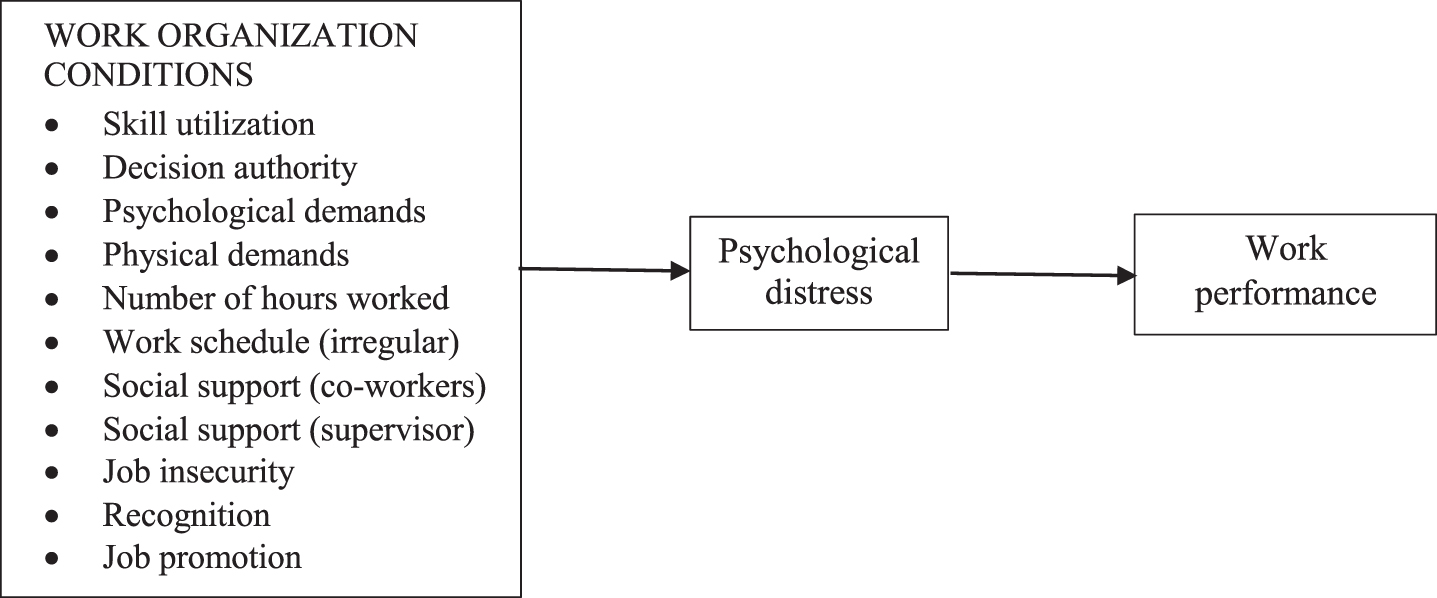
Hypothetical model.
Participants
This study relied on a sample from the SALVEO study [51] that received ethical approval from several committees (University of Montreal, McGill University, Laval University, Bishops University, and Concordia University). The SALVEO study included data from 63 Canadians workplaces chosen among 500 organizations insured by a large insurance company. This large insurance company shared the study objectives with its clients and those interested were referred to the research team. A random sample of workers were selected from each company. Before participating in the study, participants were explained the study objectives, instructions and confidentiality measures. After securing written informed consent, participants completed a questionnaire at work on a touch screen computer. An online version of the same questionnaire was sent to absent employees. Participants were not compensated for participating in this study. Following this debriefing, employees proceeded to sign the informed consent. In total, 2162 workers filled out the questionnaire (response rate = 73.1%). After deleting missing data, a sample of 1958 participants was obtained. In terms of socio-demographic information, 49% of the sample were female with a mean age of 40.6 years (SD = 10.8). In terms of organizations represented, the sample was quite diverse in terms of products sold, services offered or markets served (e.g., manufacturing, high technology, retail businesses). Some of those companies operated in the secondary sector (N = 19), others in the tertiary sector (N = 44), and some company’s employees were unionized (N = 22). Workplace included in the sample employed between 25 and 1900 employees with a mean of 247.1 employee per company (Median = 114 employees).
No statistically significant differences were noted between study participants and non-respondents in terms of age, gender, number of working hours per week, burnout, physical activity, alcohol and psychoactive drug consumption as well as health problems. One notable difference pertained to tobacco consumption and Body Mass Index (BMI). More specifically, participants remaining in the study smoked less (p < 0.01) and had a lower BMI (BMI; p < 0.01) compared to non-respondents.
Measures
Psychological distress
We relied on the General Health Questionnaire scale (GHQ-12) to measure psychological distress. This questionnaire is based on 12 items measured on a 4-point Likert scale (less than usual, no more than usual, rather more than usual, or much more than usual) querying the participant if certain symptoms or behaviors were recently present. An example of such an item is: Have you recently been capable of making decisions? (α= 0.80). Psychological distress was measured by summing those twelve items. The GHQ-12 has been shown to have strong psychometric properties in both the French and English versions of the questionnaire [1, 52].
Work performance
Work performance was based on the job efficacy component of the Maslach Burnout Inventory (MBI). This survey comprises six items evaluated on a 6-point Likert scale (0 = Never, 6 = Every day). An example of such an item is: I have accomplished many worthwhile things in this job (α= 0.80).
Work organization conditions
The Job Content Questionnaire (JCQ) was used to measure skill utilization, decision authority, psychological demands, and social support with a 4-point Likert scale (Strongly disagree/strongly agree) [53]. Skill Utilization consisted of six items (e.g., my job requires me to be creative, α= 0.80). Decision Authority was based on three items (e.g., my job allows me to make a lot of decisions on my own, α= 0.79). Psychological Demands were measured with nine items (e.g., I am free from conflicting demands that others make, reverse coded, α= 0.73). Social Support from Colleagues was measured with four items (e.g., the people I work with are friendly, α= 0.83), and Social Support from Supervisor was measured with four items (e.g., my supervisor is successful in getting people to work together, α= 0.89). The Effort-Reward Imbalance Questionnaire [34] was used to measure physical demands, career perspectives and job insecurity. Responses were based on a 4-point Likert scale (strongly disagree/strongly agree). Physical Demands were based on a single item (e.g., my work requires physical effort). Job Insecurity was measured with two items (e.g., my employment security is poor, α= 0.65). Job Recognition was evaluated with six items (e.g., I receive the respect I deserve from my colleagues, reverse coded, α= 0.82). Job Promotion included four items (e.g., my job promotion prospects are poor, α= 0.69). Number of Hours Worked was based on the summation of hours worked per week in all jobs. Lastly, Irregular Work Schedule was measured with a single item based on a 4-point Likert scale (Never/all the time) drawn from the Quebec Health and Social Survey (QHSS-98).
Control variables
The model used in the current study accounted for variables that have been shown to be associated with the dependent variables. According to VanderWeele [54], adequate control should be made for variables that confound the relationship between the independent variables and the outcome of interest. In order to fully grasp the impact of the independent variables on the dependent variables, we controlled for the following variables: Sex and age [3, 55–57], physical activity [58–60], marital status [57], parental status [45, 57], educational level, household income [23, 61], social support outside the workplace [62], marital and parental tensions [63], stressful childhood life events [3] as well as personality related traits such as self-esteem [44, 65], locus of control [3, 66], openness [3, 12], extraversion [67], agreeableness [68], conscientiousness [67], and neuroticism [68, 69].
Sex was coded as 0 = Male and 1 = Female, and Age coded in number of years. Physical Activity over the last 3 months was measured as the frequency of physical activities lasting 20 minutes or more. Marital Status was coded as 0 = Single, 1 = Living as a couple, and Parental Status as 0 = No, 1 = Yes. Marital Tension was measured using four items on a 2-point scale (Yes/no) [70]; e.g., in the past 12 months, did you have increased arguments with your partner?, α= 0.70). Parental Tension was measured with three items on a binary scale (Yes/no) [70]; e.g., a child’s behavior is a source of serious concern to you, α= 0.60. Educational Level was coded using the highest degree attained by the respondent on a 10-category scale and ranked based on the number of years necessary to obtain the degree (lowest to highest) (1 = None, 2 = High school, 3 = Professional school, 4 = College (General), 5 = College (Technical), 6 = University (Undergraduate certificate), 7 = University (Bachelor’s degree), 8 = University (Graduate diploma), 9 = University (Master’s degree), 10 = University doctorate). Household Income was coded using pre-tax household income for the preceding 12 months on a 12-category scale (1 = Less than $20,000, 12 = $120,000 or more). Social Support Outside the Workplace was derived based on four items evaluated on a binary scale (Yes/no); e.g., among family and friends, is there someone you feel close to, who shows affection for you? Lastly, Stressful Childhood Events (before the age of 18) measured using seven items evaluated on a binary scale (Yes/no) [70]; e.g., did something happen that scared you so much you thought about it for years after?).
Data analysis
Our methodological design resulted in cluster sampling (employees working in organizations). To adjust for design effects, Mplus was used to conduct path analysis [2]. The direct and indirect (mediation) associations between the variables were evaluated while accounting for the non-independence of the data. A two-tailed probability for rejection of the null hypothesis (p ≤0.05) was used to evaluate the variables’ individual and combined significance when included in a model. Preacher and Hayes guidelines were adopted to evaluate psychological distress’s mediation effect [71]. The first step consisted of evaluating direct associations. To do so, work-related variables, personality traits, and control variables were included in the model. This first step allowed us to evaluate the main effects of the independent variables on the dependent variables (work performance as well as psychological distress). More specifically, this first model allowed us to determine which work-related variable was significantly associated with work performance. This same model also allowed us to determine whether the independent variables were indirectly associated with work performance via psychological distress.
Results
Table 1 presents descriptive statistics and correlational analyses.
Descriptive and correlational statistics
Descriptive and correlational statistics
Note a: *p≤0.05 (coefficients≥0.05) and **p≤0.01 (coefficients≥0.05). Note b: M = Mean; SD = Standard deviation; 1. = Work performance 2. = Psychological distress; 3.=Skill utilization; 4. = Decision authority; 5. = Psychological demands; 6. = Physical demands; 7. = Number of hours worked; 8. = Work schedule (irregular); 9. = Social support from coworkers; 10. = Social support from supervisor; 11. = Job insecurity; 12. = Recognition; 13. = Job promotion.
Results pertaining to work organization conditions, psychological distress and work performance are presented in Table 2
Direct effects of work organization conditions on psychological distress and work performance
Note: *p≤0.05 and **p≤0.01.
Our findings indicate that psychological demands, number of hours worked, job insecurity and job recognition contribute to psychological distress. While psychological demands, number of hours worked, and job insecurity were positively associated with psychological distress, job recognition was negatively associated with it. Work performance, skill utilization, decision authority, work schedule, job insecurity, recognition, and job promotion all played a significant role in work performance. On the one hand, irregular work schedules and job insecurity seem to be negatively associated with work performance. For instance, feeling less secure in one’s job seems to decrease work performance. On the other hand, skill utilization, decision latitude, recognition, and job promotion seem to be positively associated with work performance. For instance, feeling appreciated at work (recognition) seems to increase work performance.
Results pertaining to indirect associations between work organization conditions and work performance are presented in Table 3.
Indirect effects of work organization conditions on work performance
Note a: *p ≤0.05 and **p ≤0.01. Note b: The following variables were controlled for in all models: gender, age, educational level, household income, social support outside the workplace, stressful childhood events, marital status, parental status, marital stress, parental stress, physical activity, self-esteem, locus of control, openness, extraversion, agreeableness, conscientiousness, neuroticism. (Unstandardised coefficients).
Psychological demands, number of hours worked, and job insecurity were negatively and indirectly associated with work performance.
In this study, we were interested in evaluating the mediating role psychological distress plays between work organization conditions and work performance. To pursue this objective, we examined both the direct and indirect associations between work organization conditions and work performance, via psychological distress.
As originally hypothesized, psychological distress mediates the contribution of psychological demands, number of hours worked, and job insecurity to work performance. The results obtained align with those of previous studies evaluating the association between psychological demands [3, 38] job insecurity [3, 46] and workers’ psychological distress. The results pertaining to skill utilization and decision authority also echo those of previous studies on work performance [23, 39]. To the best of our knowledge, we are not aware of any study having examined the contribution of job recognition and job promotion to work performance. The results obtained are consistent with our theoretical models. More specifically, job recognition and job promotion can enhance employees’ performance [35]. Psychological demands, number of hours worked, and job insecurity warrant our attention given their direct and/or indirect associations with work performance (via psychological distress). The contribution of work organization conditions to work performance is worth noting, as these conditions can still influence work performance indirectly. The findings obtained align with our hypothesis. Physically and psychologically challenging jobs that demand workers’ physical and mental capacities could lead to health problems such as poor mental health. This association could explain the association between work organization conditions, poor work performance and psychological distress [35]. According to the motivational hypothesis, using one’s skills at work (i.e., skill utilization) could improve motivation and job performance [35].
Practical Implications
The results of this study serve as a reminder to address certain work organization conditions. Because job insecurity plays a role in psychological distress, and subsequently impacts work performance, employers are encouraged to minimize job insecurity. To achieve this goal, employers may increase an employee’s perception of control at work [72]. Increasing communication, participation and employability are all possible solutions. Since the lack of communication regarding the company’s future could increase insecurity, company leaders should aim for clear communication [72]. Clear and timely communication about the vision of the organization is likely to increase employees’ perception of predictability and controllability [73]. Having a say in the company decision-making process is another way of reducing job insecurity. According to Probst, participative decision making can be implemented at a relatively low cost and help organizations reap benefits like better employee health, job contentment, and reduced absenteeism [73]. Relatedly, Mikkelsen et al. implemented a participatory organizational intervention by asking workers to identify ways of improving their work setting [74]. This participatory intervention involved employee meetings with supervisors to identify points of improvement, and had a positive, but limited effect on work-related stressors, job characteristics, learning climate, and management style. A similar intervention could be used to tackle job insecurity. As for skill utilization, decision authority, and career prospect interventions, taking proactive steps is recommended. Workplaces could help bolster employee skills, and access job counseling and training that are transferrable to other jobs. Such an intervention could help improve employees’ employability while communicating that the workplaces they work for are socially responsible [75]. Armed with stronger skill sets, employees are likely to face fewer hurdles in finding a new job. Employees’ bolstered confidence in their employability could increase their sense of control over their future while decreasing their job insecurity [76]. Making sure employees feel appreciated is also recommended. Workplace recognition programs, such as a “good morning round” by managers, pointing out employees’ right moves, holding employee recognition days, rewarding years of service with gifts, and tying job performance to remuneration are all worth considering. Options to reduce the negative impact of psychological demands and number of hours worked on psychological distress include, assigning more people the same tasks, allocating each person more time to accomplish the same jobs and reducing the number of tasks assigned per person [77]. If an organization has the financial means to do so, other intervention targets could include task revamping, remote work, and increasing leeway in work schedules and volume [78]. Peer support groups where workers are allowed to talk about difficulties faced [79] complemented with communication skills courses could help workers handle stress better while promoting conflict resolution [80]. Lastly, decision authority could be targeted by reducing the company hierarchy or increasing worker autonomy [77]. Offering employees the opportunity to develop their creativity, take initiative, and have latitude in choosing their work methods are all possible avenues. Increasing rewards offered at work could help decrease psychological distress [81]. Those initiatives consist of highlighting employees’ accomplishments, offering compensation for years of service, presenting them with performance incentives and management premiums [81].
Limitations and future recommendations
In the current study, the first limitation is the study design. The cross-sectional design impedes inferring causal relationships between the variables. However, some bias may be present in the estimation of the mediation model because we relied on cross-sectional data. According to Maxwell and Cole [82], indirect effects could be biased. Only longitudinal data can accurately estimate them. Future studies should replicate our findings using a longitudinal design. Additionally, because data was collected in Canada, the findings may not externally generalize to low and middle-income countries. Next, the current study relied on secondary data sources which limits the selection of the possible variables to study. The use of primary data would have allowed us to examine other variables such as somatoform disorders or personality disorders such as narcissistic personality. Other work-related variables like human resource programs such as those pertaining to mental health at work, the supervisor’s management style (i.e., hierarchical, transformational), and human resources policies could have also been of interest. Our measure of work performance is a subjective one. Including an objective and a subjective evaluation of work performance and evaluating their contribution to our dependent variables is also worth considering. The sample utilized also presents with limitations. Collecting data from the same source could result in a biased sample. We believe this variance remained small in previous studies conducted with the sample [51]. This variance also remained small due to the numerous sectors included, the different companies’ sizes and whether employees were unionized or not. Relatedly, the low response rate (41%) could suggest a selection bias. Employees struggling with mental health issues may be more likely to take part in such a study. This selection bias could potentially explain why workplaces with employees enjoying high levels of well-being could be underrepresented. In the same vein, workers with more mental health issues are more likely to rate their work-related variables negatively. Lastly, other work-related variables such as heavyweights, working with dangerous substances, or receiving many emails daily (as mentioned in the work contract) could have also been pertinent.
Conclusion
The current study sheds light on the association between work organization conditions, psychological distress, and work performance. Psychological distress differs from other psychological health afflictions in that psychological distress often precedes more serious psychological health complications. Psychological distress usually serves as a red flag since it is prepathological phase. From this standpoint, paying close attention to psychological distress could have important practical implications. A better understanding of the mechanisms at hand could help companies implement prevention strategies. We used a comprehensive model incorporating a large number of work organization conditions that have been found to be associated with work performance. While the individual contribution of work organization conditions to psychological distress (e.g., [11]) and work performance (e.g., [18]) has been examined in the scientific literature, their combined influence on work performance remains relatively unknown. The results of the study attempted to address this gap by simultaneously examining their contribution to work performance. Future research is warranted to evaluate the impact of other work-related variables on work performance. Considering other psychological outcomes and objective performance metrics are also recommended.
Conflict of interest
The authors have no competing interests to declare.
Footnotes
Acknowledgments
This study was supported by the Canadian Health Research Institutes (CHRI) and the Fonds de la Recherche en Santé du Québec (FRSCQ). The authors thank Standard Life Canada for their help with workplace recruitment, as well as Marie-Eve Blanc and Julie Dextras-Gauthier for the fieldwork.