



Abstract
BACKGROUND:
In most food companies, workers are constantly exposed to non-standard levels of noise. Also, food production processes require intense manual labor and repetitive movements, which may result in musculoskeletal disorders (MSDs). Noise and awkward posture are considered as two important physical factors in the industrialized world, which can related to perceived stress.
OBJECTIVE:
This study was conducted among food factory workers to investigate the impact of noise exposure and work posture on occupational stress.
METHODS:
A total of 200 workers were examined in this cross-sectional study. Individual noise exposure was measured by TES-1354 dosimeter (TES, TW) according to ISO 9612. Postural risk and job stress levels were assessed using Quick Exposure Check (QEC), and the Osipow occupational stress questionnaire, respectively.
RESULTS:
The level of noise exposure and awkward posture were significantly associated with work-related stress.The relationship of gender with occupational stress was also statistically significant.
CONCLUSIONS:
Considering that the noise exposure and work posture factors are important determinants of work-related stress, a combined approach to eliminate the levels of non-standard noise and inappropriate posture is essential for promoting psychological health in food companies.
Introduction
The nature of work has changed dramatically in many industrial sectors over the past few decades. Modern organizations now consider work-related stress among their employees as a major workplace concern. Job stress has been characterized as a harmful physical or mental symptom that occurs when worker’s abilities and skills do not fully meet the job requirements [1]. A significant number of employees are exposed to occupational stress during their professional lifetime. Work-related stress usually affects employee performance by reducing concentration levels and disrupting decision-making abilities, which could have a direct negative effect on organizational efficiency and effectiveness (e.g. absenteeism, productivity losses, fatigue from lack of sleep, and reduced performance, etc.) [2, 3].
Noise and posture, as two main workplace physical factors, may play an important role in generating occupational stress. Noise is defined as an unwanted sound that can create irritation or interfere with communication [4, 5]. Based on the National Institute of Occupational Safety and Health (NIOSH), at least 14% of employees are exposed to non-standard noise [6]. A North American study has also indicated that ranges between 30–60% of employees are exposed to noises of more than 85 dB(A), and this figure may reach as high as 70–95% in some industries [7]. In Iran, it can be claimed that approximately 2 million workers are exposed to harmful noise in the workplace [8].
Exposure to work-related noise can lead to a risk of hearing damage and various harmful effects upon well-being. In industrial manufacturers, for instance, it has been found that noise exposure is associated with a range of physical health problems, such as cardiac problems, self-reported fatigue, and hearing loss [9]. Moreover, noise exposure has several psychological effects, such as annoyance and mental stress. Several studies have shown a significant positive relationship between work-related noise and psychological distress factors in blue-collar workers [10, 11], and this direct causal relationship is probably as a result of activating the sympathetic nerve system [12].
Inappropriate work posture is another important factor which might be associated with job stress. Generally, in Iranian food factories, the production process is very labor-intensive, and the workers are directly involved in the production process. In these industries, workers often perform their work with bent postures and repetitive movements for a prolonged period of time [13]. It has been indicated that the awkward job postures are contributors to the development of work-related musculoskeletal disorders (WMSDs) among workers [14]. WMSDs is considered as an important occupational concern, associated with morbidity among a significant number of workers, which can lead to lower productivity, job-related absenteeism, low quality of life and psychological stress [15–17]. However, to our knowledge there is no study that investigated the impact of exposure to non-standard noise level and awkward posture as well as their interaction on work-related stress among workers of food companies.
In the food company studied, awkward working postures, such as prolonged standing and repetitive upper movements were very common among workers. In addition, most of these workers were constantly exposed to non-standard levels of noise arising from worn-out equipment. Given the above, our hypotheses in the present study were as follows: the first hypothesis sought to find out whether noise exposure and work postures have a significant effect on job stress and the second hypothesis sought to determine whether there is an interaction effect between noise exposure and work postures on the job stress. Therefore, this study aimed at investigating the impact of these factors on job stress, and secondarily, to determine their interaction on work-related stress.
Materials and methods
Participants
This cross-sectional study was conducted in an Iranian food company with 255 workers. The inclusion criteria for workers were: 1) age > 18 years, and 2) having at least 2 years of work experience. Exclusion criteria were: 1) having background diseases or accidents affecting workers’ musculoskeletal system, and 2) using sedatives. In total, 200 workers were selected by convenience sampling, including 69 males and 131 females, aged from 19 to 61 years (mean = 33.31, SD = 8.63). The workers’ age was classified into three categories (Table 1).
Descriptive data for demographic, physical factors variables and noise hearing loss (n = 200)
Descriptive data for demographic, physical factors variables and noise hearing loss (n = 200)
A demographic questionnaire was used for collecting demographic characteristics, including age (years), sex (male or female), education level (under diploma, diploma or AD, BSc or higher), marital status (single, married), work experience (years), and medical background.
The Osipow job stress questionnaire was used to evaluate the level of occupational stress. This questionnaire consisted of 60 questions in a 5-item Likert Scale (never = 1, sometimes = 2, usually = 3, often = 4, and very often = 5). These six scales are [18]: The first aspect was the role overload (lack of the needed support for heavier work tasks) related to how one responds to the demand of the workplace. The second aspect was the role insufficiency (the disparity between skills and what the individual expects from the job) which is related to the proportion of the skill, education, and experiential characteristics of an individual with workplace requirements. The third aspect was the role ambiguity (the ambiguity in the tasks expected of the individual to do and how it is evaluated) related to the individual’s awareness of workplace priorities, and expectations. The fourth aspect was the role boundary (the sense of doubt in expressing demands and the lack of clarity of the limits of authority) related to the individual’s contradictions in terms of work ethics and the expected roles. The fifth aspect was the responsibility (the feeling of pressure from work with problematic colleagues) related to the sense of responsibility of the individual in terms of the performance and welfare of others in the workplace. The sixth aspect was the physical environment (noise, humidity, dust, heat and cold, and so on) related to the unfavorable conditions of the physical environment that the individual is exposed to.
The total score from all the questions was interpreted as follows: score ranges 50–99, 100–149, 150–199, and 200–250 were referred to as low stress, low-moderate stress, moderate-high stress, and high stress, respectively. The validity and reliability of Osipow questionnaire have been determined in Iranian populations with a Cronbach’s alpha of 0.83 [18, 19]. The results of the Osipow questionnaire for job stress among the workers in this study are shown in Table 2.
The status of the six domains and the total job stress
The status of the six domains and the total job stress
Quick Exposure Check (QEC) was used for the assessment of work-related musculoskeletal risks, which is an observational method developed by Li and Buckle at the Roben’s Centre for Health Ergonomics [18]. QEC analysis provides scores for four main body parts (back, shoulder/arm, wrist/hand, and neck). This method assess movements (static/dynamic), frequency, time spent on observed task, weight handled, vibration /visual demands, and the stressfulness of the work [20]. There are four Preliminary Action Levels (PAL) for the QEC that are classified as: acceptable (≤40 %), further investigation (41–50 %), further investigation and change soon (51–70 %), urgent investigation and changes (>70%). Finally, the results are classified into four risk levels: low, moderate, high and very high risk level [21]. The Quick Exposure Check (QEC) results for work-related musculoskeletal risks among the workers in this study are shown in Table 1.
Measures
Personal noise exposure was measured by TES-1354 noise dosimeter (TES Electrical Electronic Corp., Taiwan), according to ISO 9612 [22]. Before the measurements, TES-1356 calibrator (TES Electrical Electronic Corp., Taiwan) was applied to calibrate the noise dosimeter. Noise dosimetry is a reliable method for measuring sound pressure levels in an environment with the aim of estimating the total amount of noise to which a worker is exposed over an 8-hour work shift [21, 23]. In the present study, workers had 30 minutes’ break during the 8-hour shift. Thus, exposure to noise was measured for 7.30 h (while they were working) and 30 minutes (while they were in the break room).
The measurement of workers’ exposure to noise and equivalent sound level during the 8-hour shift was calculated by the formula:
Measurement of the dose of workers’ exposure to noise:
Where D is the noise dose (%) and Ta is the permissible exposure time based on the environmental sound pressure level (hr).
The standard dose of noise exposure is calculated through the following equation, which is based on the Iran Occupational Exposure Limit (OEL):
Where D represents the received dose of noise, ti is the duration of noise exposure, SPLi is the noise pressure level and SPLstd is the standard threshold of noise exposure, which based on the occupational standards in Iran is 85 dB.
The following formula was used to measure 8 h equivalent sound level:
Where, Leq.8 h = the equivalent sound level for 8 h exposure [dB], ti is the exposure time (hr), and Lpi is the measured equivalent sound level in the rest room and the work environment (dB).
The number of participants who were exposed to standard noise levels (less than the threshold≤85 dB) and non-standard noise level (over the threshold > 85 dB) is shown in Table 1.
Statistical analysis
The data distribution normality was evaluated by the Kolmogorov–Smirnov test. Standard descriptive statistics (mean±standard deviation) and frequency (percentage) were determined for directly measured and derived variables. Statistical outliers were checked using Grubb’s test, which is based on the difference of the mean of the sample and the most extreme data, considering the standard deviation [24]. Two-way analysis of variance (ANOVA) was used to compare the mean of stress scores between levels of posture and noise conditions, and the interaction between them. Post-hoc LSD analyses were used for multiple comparisons between posture levels. Also, two-way ANOVA was used to compare the mean of stress scores between gender and age groups. All statistical analyses were performed with SPSS version 23.0 (IBM Corporation, New York, United States). P values smaller than 0.05 were considered statistically significant.
Results
Table 1 summarizes the distribution of participants in terms of age, sex, noise exposure, noise hearing loss, posture level and Table 2 shows the results related to job stress.
The first hypothesis: Noise exposure and work postures affecting the job stress
There were a significant main effects for noise conditions (F (1,194) = 6.90, p = 0.009, Power = 0.74) and posture levels (F (2,194) = 23.81, p < 0.001), indicating a significant differences between the two different noise conditions and three levels of posture on stress scores. A post-hoc pairwise comparison indicated that there is a significant difference in mean stress scores among the three levels of posture, such that the mean stress scores in the moderate risk level group (160.84 +–22.99) was lower than the same values in the other two groups [high risk (170.06 whether +–21.75), very high risk (203.0 +–21.57)].
The second hypothesis: An interaction effect between noise exposure and work postures on the job stress
The results demonstrated no significant interaction effects between “noise conditions” and “posture levels” (F (2,194) = 1.34, p = 0.26, Power = 0.28) in term of job stress (Fig. 1).
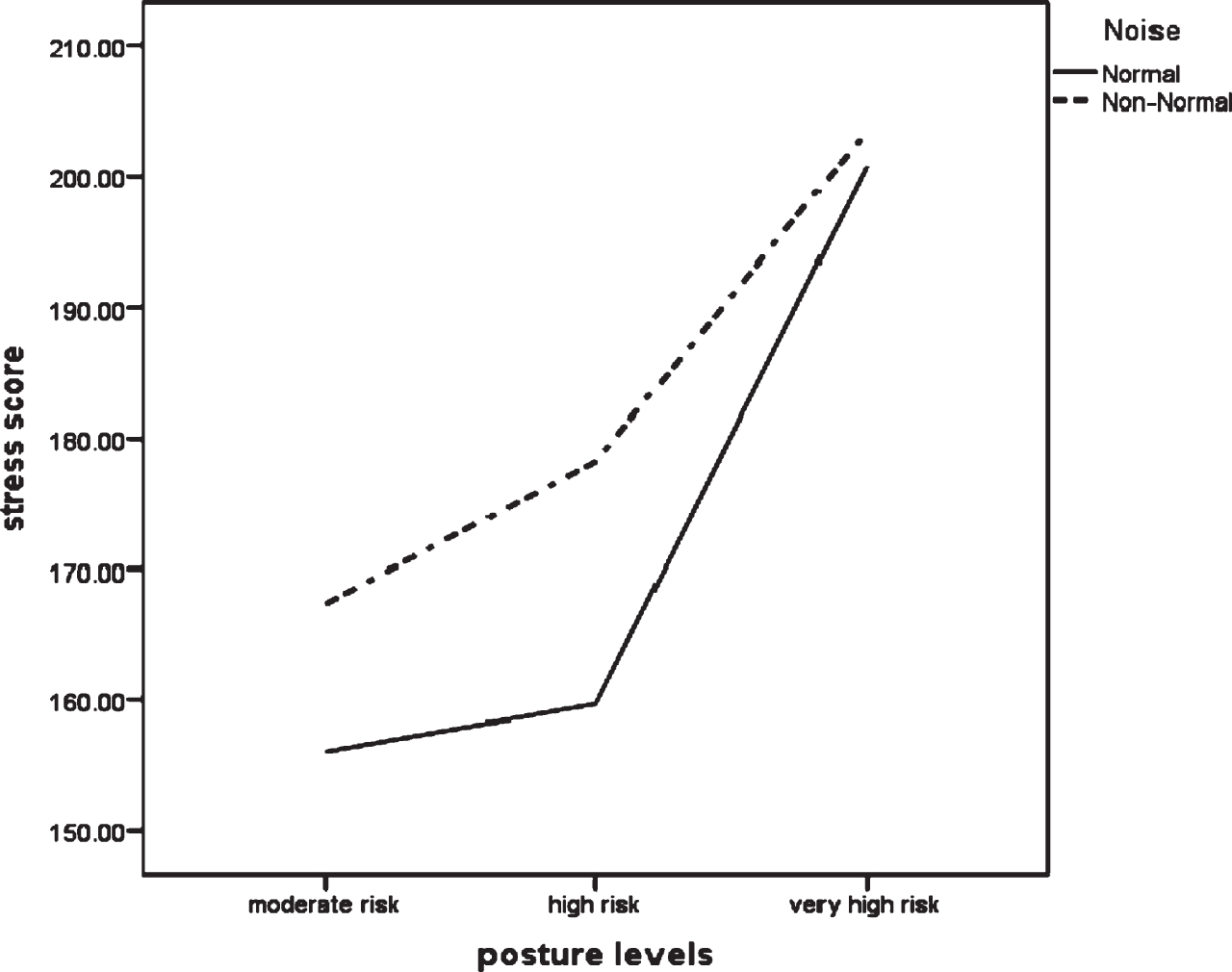
Interaction effect between posture levels and noise conditions on stress scores (non-significant interaction, p > 0.05).
Also, there was no significant main effect of “age group” on stress scores (F (2, 194) = 1.15, p = 0.31, Power = 0.25). However, there was a significant main effect for “gender” on stress scores (F (1, 194) = 11.10, p < 0.001, Power = 0.91), suggesting that the mean stress scores were significantly higher in females than males. Moreover, there was no significant interaction effect between “age group” and “gender” for stress scores (F (2, 194) = 0.61, p = 0.54, Power = 0.15).
General discussion
In line with our hypothesis, there is a significant relationship between occupational noise and job stress. In our study, 55.5% of workers were exposed to non-standard noise levels greater than 85 dB. According to Abbasi et al., exposure to these high levels of occupational noise have a positive significant effect on job stress over years of work experience [10]. This result is in keeping with Lazarus’s “Transactional Theory of Stress and Coping (TTSC)”. Based on this theory, stress arises from an imbalance between environmental demands and the person’s ability to cope with these demands. Therefore, it can be argued that prolonged exposure to non-standard ambient noise, as an adverse environmental factor, could exceed an individual’s tolerance threshold and cause stress [25, 26]. Another possible explanation is that exposure to excessive noise leads to the secretion of stress hormones, such as adrenaline, noradrenaline, and adrenal steroids as well as simulating the sympathetic nervous system by releasing epinephrine [27]. These processes could lead to elevated blood pressure, heart rate cardiac output, and thus increased stress levels in workers [28]. Although several studies have indicated the significant impact of noise exposure on job stress [10, 29], the outcome from the study by Nuaim et al. is in conflict with the result of this study. The study demonstrated no significant relationship between noise condition and stress. The main reason for this inconsistency is probably that in Nuaim et al. study workers were wearing ear plug or other hearing protection devices, and therefore were exposed to low noise intensity [30].
Also, the present results demonstrated a significant relationship between body posture during work and job stress. Candan et al. showed that the severity of musculoskeletal pain of hazelnut factory workers was associated with stress in the workplace. Bulduk also reported that job-related stress was significantly associated with moderate to severe upper back pain. Choobineh et al. found that job stress dimensions were predictors for musculoskeletal pain. De Almeida demonstrated that the prevalence of MSD symptoms among the workers was 66% and the symptoms were significantly associated with perceived stress [16, 31–33]. Consistent with mentioned studies, the significant association between the high levels of exposure to musculoskeletal risks (71.5%) and job-related stress in the present study could support that working in an improper sitting posture without a sufficient break time is a risk factor for prevalence of WMSDs and job stress [16]. Because the workers in the current study had to work for seven and a half hours in a day with only a half hour break in an awkward sitting position. In addition, lack of individual working adjustments of the bench and desks, the workers have to bend their neck excessively. It seems that awkward postures, as a physical risk factor, may affect psychological stress and vice versa. On the one hand, workers with musculoskeletal pain caused by inappropriate postures are more prone to job stress, presumably because pain renders workers less tolerant of the psychological demands of the workplace [34]. Furthermore, pain can possibly cause psychological stress by activating the sympathetic nervous system and the hypothalamic-pituitary-adrenal system [32]. On the other hand, stress might cause the continuous activation of small and low-threshold motor units, which are normally activated merely at low levels of contraction. This, in turn, may result in degenerative processes, damage, and pain in the muscles [35]. Stress may also elevate the awareness of musculoskeletal disorders symptoms, or decrease the ability to manage the symptoms [36]. Moreover, according to a hypothesis suggested by Schleifer and Ley [37], hyperventilation caused by psychological stress reduces peak CO2 levels and elevates the blood pH level (beyond 7.45 causing alkalosis), in a way which results in increased muscular tension and heightened sensitivity to sympathetic activity.
Although noise and posture independently have significant impact on job stress, the interaction effects between these physical factors does not cause a significant change in stress scores. In other words, with noise increasing, job stress scores similarly increased in all posture levels. It is worth noting that the non-significant result for the interaction is likely to be the reflection of a small sample size (Power < 0.8) in the present study; a significant difference may emerge with a larger sample.
Although many studies have found a significant relationship between age and job stress [38, 39], the present results did not show a significant relationship between these variables, which is inconsistent with the results of a study by Rauschenbach et al. Based on this study, it is likely that different age-related losses and gains may compensate for one another, and eventually nullify each other in the overall relationship between age and stress [38]. In the present study, gender had a significant correlation with job stress; female workers had significantly higher stress levels than male workers. This finding is in agreement with the results of previous studies [40–42]. According to these studies, females with lower-status jobs were more vulnerable to work-related stress. In similar job positions females usually paid less than males and experience greater challenges in order to obtain a higher job position. Thus, this effort-reward imbalance is likely to cause additional psychological stress [41]. Furthermore, in comparison to males, females are often responsible for largest amounts of unpaid work (childcare and household tasks), and they are more likely to be exposed to a greater total workload (unpaid duties + paid) than males. This extra burden could be a significant contributor to stress [40]. Finally, higher levels of work-related stress among females could also occur when there is a mismatch between demands at the workplace and general female physical characteristics.
Theoretical and practical implications
According to the findings, to reduce job stress levels in the food industry workers studied, the following corrective and supportive measures are recommended: Reducing non-standard noise in the workplace by applying engineering controls [place a barrier between the noise source and workers (e.g. sound walls or curtains) and enclose the noise source]. Designing sitting-standing workstations in the workplaces in order to reduce musculoskeletal problems. Providing training courses in order to identify workplace psycho-social stress factors with the aim of reducing workers’ job stress.
Limitations and suggestions for future research
There are a number of limitations in current study worth mentioning, and it is suggested that they will be considered in future studies. First, there is the possibility of selection bias, due to the cross-sectional nature of the study. Second, in addition to the studied variables, job stress is also affected by other physical environment factors (light, temperature), workload, psycho-social factors, workers’ health status, and lifestyle factors (smoking, alcohol consumption and eating habits) which are beyond the scope of this study. Additionally, in the present study, job stress was not assessed using objective methods. The findings of the study may be more conclusive if objective measures are considered.
Conclusion
The present study found that awkward posture and exposure to noise increase the risk of job stress. Furthermore, a non-significant interaction between noise and posture on occupational stress was obtained. The study also showed that job stress did not have a significant relationship with age, and was higher among women than men.
Conflict of interest
None to report.