



Abstract
BACKGROUND:
Years ago, the use of asbestos in construction materials was common. Although asbestos has been recently banned in many countries, exposure to asbestos during old building demolition is not unexpected.
OBJECTIVE:
The aim of this study is to assess the concentration of exposure to asbestos and estimate its cancer risk among old building demolition workers.
METHODS:
In this study, personal air samples were collected during building demolition. The number of asbestos fibers in collected samples were determined according to the NIOSH-7400 standard method. Chemical compositions of fibers were assessed using scanning electron microscopy (SEM). The carcinogenic risk of exposure to asbestos was determined based on the recommended United State Environmental Protection Agency (USEPA) method and Monte-Carlo simulation used to estimate the probability of cancer.
RESULTS:
Chemical analysis confirmed the presence of asbestos in collected air samples, and 67% of counted fibers were asbestos. In a number of buildings, workers had exposed to asbestos that was higher than occupational exposure limit (0.10 f/ml). Results of cancer risk estimation showed that cancer risk were considerable among workers.
CONCLUSION:
Implementation of asbestos risk management program such as separation of asbestos containing material, personal protective equipment’s and use of wet method in demolition could minimize asbestos exposure during old building demolition.
Introduction
Construction of new and advanced buildings in old urban contexts usually requires the demolition of existing old buildings. So, demolition of old or poorly constructed buildings in urban areas is one of the main challenges for developing countries [1]. There are several methods to demolish a building. In developed countries, these methods are less dependent on workers’ activities (using heavy equipment for 1 or 2 story buildings, crane and wrecking ball for more than one or two story buildings, or whole-building demolition using explosives) [2]. In developing countries, these methods are less commonly used, and building demolition is more dependent on workers’ activity. This increases workers’ exposure to a variety of occupational health hazards in building demolition process [1, 3].
The construction and demolition industry are one of the high risk industries. Noise, various safety hazards, and exposure to chemicals in building materials are some of these health hazards [4]. Exposure to airborne dust is the most prevalent health hazards in the process of building demolition. This dust could contain various substances such as lead, silica, cement, asbestos, and the variety of substances that may be harmful to human health [5, 6].
The attractive physicochemical properties of asbestos (fire and heat resistance, corrosion, electricity, and chemical solvents, etc.) have led to a tendency to use it in many different industries, including construction and automobile industry, despite laws to reduce and eliminate its use [7, 8]. Cement sheets containing asbestos fibers, fire proofing, chimney pipes, acoustical products, pipe insulations, ventilation ducts, floor tiles, and thermal insulations are some applications of asbestos in the construction industry [1, 9]. Demolition activities such as breaking, crushing, grinding, and cutting, may lead to of workers’ exposure to asbestos [1, 10].
Asbestos is categorized into two main classes: amphiboles and serpentines [11]. Amosite, crocidolite, tremolite, actinolite, and anthophyllite are amphiboles and chrysotile is the only serpentine [12, 13]. All types of asbestos induce mesothelioma in human. On the other hands, International Agency for Research on Cancer (IARC) has classified asbestos as a group 1 carcinogen (i.e. certain carcinogenic to humans) [14, 15]. Proven health effects of exposure to asbestos include asbestosis, mesothelioma and lung, ovary, and larynx cancers [16, 17]. Unfortunately, scientific sources suggested that no threshold can be considered for carcinogens and the only solution is to completely stop exposure with these substances [18]. In this line, 57 countries have begun to ban the use of asbestos from 1980 s to 2015 [19]. But in some developing countries in Asia and Latin America, the use of asbestos is still ongoing [20, 21]. It is estimated that in worldwide, 125 million workers are under exposure to asbestos, and 107,000 people die from asbestos related cancers each year [11, 19].
Although asbestos has been recently banned in many countries, exposure to asbestos during old building demolition is not unexpected. So, the current study examined cancer risk of exposure to asbestos during old building demolitions.
Method
Location and condition of research
This study was conducted in Tabriz city in northwestern Iran which has more than 1.5 million inhabitants and occupies a surface area of 244 km2 [22]. The selection criteria of buildings were demolition using typical practices and likely containing cement sheet and pipes, the demolition process was carried out by workers. The workers use tools such as hammers, drills, mortars, and daggers. First, workers demolish the upper part of the building, and then the walls are demolished. Demolition process approximately takes 2–3 month and dust generated in this process, water not sprayed during demolition and debris removal process [23]. The number of workers involved in each demolition process were approximately 2–4 workers and the workers age range were 15–60 years.
Air sampling and analysis
In this study, based on the previous study and surface area of Tabriz city, 35 samples were taken from 17 buildings [23]. The air samples were collected by a mixed cellulose-ester (MCE) membrane filter with a pour size of 0.45 micrometers and a diameter of 25 mm by an open-face filter holder. A calibrated personal sampling pump with a flow rate of 2 l/min was used for air sampling. Air sampling was performed during working hours, i.e. between 8 am to 5 pm in summer. Half of each filter was placed on a slide and prepared, then the fibers were counted according to the NIOSH 7400 method [24]. Briefly, the fibers were counted by a phase contrast microscope (PCM) at a magnification of 400x using the Walton-Beckett G-22 graticule. The other half of the filter was coated with a layer of gold for scanning electron microscope (SEM) analysis. To determine the fiber type, chemical compositions and optical properties, the samples were assessed by SEM (model WEGA/TESCAN. Czech Republic) with energy-dispersive X-ray analysis (EDXA). The SEM performance conditions were set for shooting at 2000x magnification or more from a 0.2μm diameter [25].
According to the NIOSH 7400 method, fiber concentration was determined using the following formula:
C: Concentration of asbestos fibers (f/ml), E: Fiber density (fiber/mm2), Ac: Effective filter area (385 mm2) [23], V: The volume of air sampled (L).
Cancer risk determination
Because of carcinogenicity of asbestos, the cancer risk was estimated based on the United State Environmental Protection Agency (USEPA) method [26]. Exposure concentration (ECinh) was specified by the Equation 1:
In this equation, C is a pollutant concentration (f/mL), ET is exposure time, EF is frequency of exposure, ED is exposure duration, and AT is average time [27]. The cancer risk variables are presented in Table 1.
Included variables and their value and units for estimate of health risk using EPA method
Finally, excessive lifetime cancer risk (ELCR) due to exposure to asbestos was calculated using the following equation:
ECinh is exposure concentration (f/mL) and IUR is inhalation unit risk (2.3×10⁻¹ (f/mL)).
When ELCR≥1.00×10⁻⁴ value, cancer risk (CR) is considerable but when ELCR≤1.00×10⁻⁶ value, CR is acceptable, also if ELCR is between 1.00×10⁻⁴ and 1.00×10⁻⁶ value, CR is probable [26, 27].
For calculating ELCR, Monte-Carlo simulation was used [28, 29]. Monte Carlo simulation is a probabilistic estimation, and one of the most common methods used to consider the uncertainties related to many risks [30]. Number of 10,000 replicates was conducted by Oracle Crystal ball software version 11.1.2 [29]. To define the input data of the asbestos concentrations, the lognormal distribution was chosen. Benchmark for determine health condition was percentile 95% of ELCR [31].
The results of study showed that old building demolition workers were at risk of exposure to asbestos. Based on PCM analysis, mean concentration of asbestos in 16 building was 0.047±0.035 f/ml that was lower than standard exposure limit (0.10 f/ml) (Table 2).
The geometric mean concentration (standard deviation) of asbestos based on SEM and PCM analysis
The geometric mean concentration (standard deviation) of asbestos based on SEM and PCM analysis
The SEM energy-dispersive spectrometry (EDS) analysis was used for determining chemical composition of the fibers (Fig. 1). The results showed nearly 67% of all fibers were asbestos and 33% were non-asbestos. The peaks of the elements including silica, magnesium, calcium, and iron have illustrated the type of asbestos. For example, the asbestos fibers with the Mg/Si ratio of about 1.25–1.75 and the distinct peaks of Fe and Ca impurities, is recognized as chrysotile fibers. Also, in amphibole fibers, the ratio of the Mg/Si is less than 1; for example, the acceptable ratio of Mg/Si for tremolite was 1 : 2 (with impurities of Fe), for actinolite 1 : 3 (with impurities of, Al, Na, Fe), for amosite 1 : 4 (with impurities of Fe higher than Mg), for crocidolite 1 : 7 (with equal impurities of, Al, Na, Fe) [32, 33]. Tremolite asbestos had maximum percent (25%) compared to others asbestos types (Table 3).
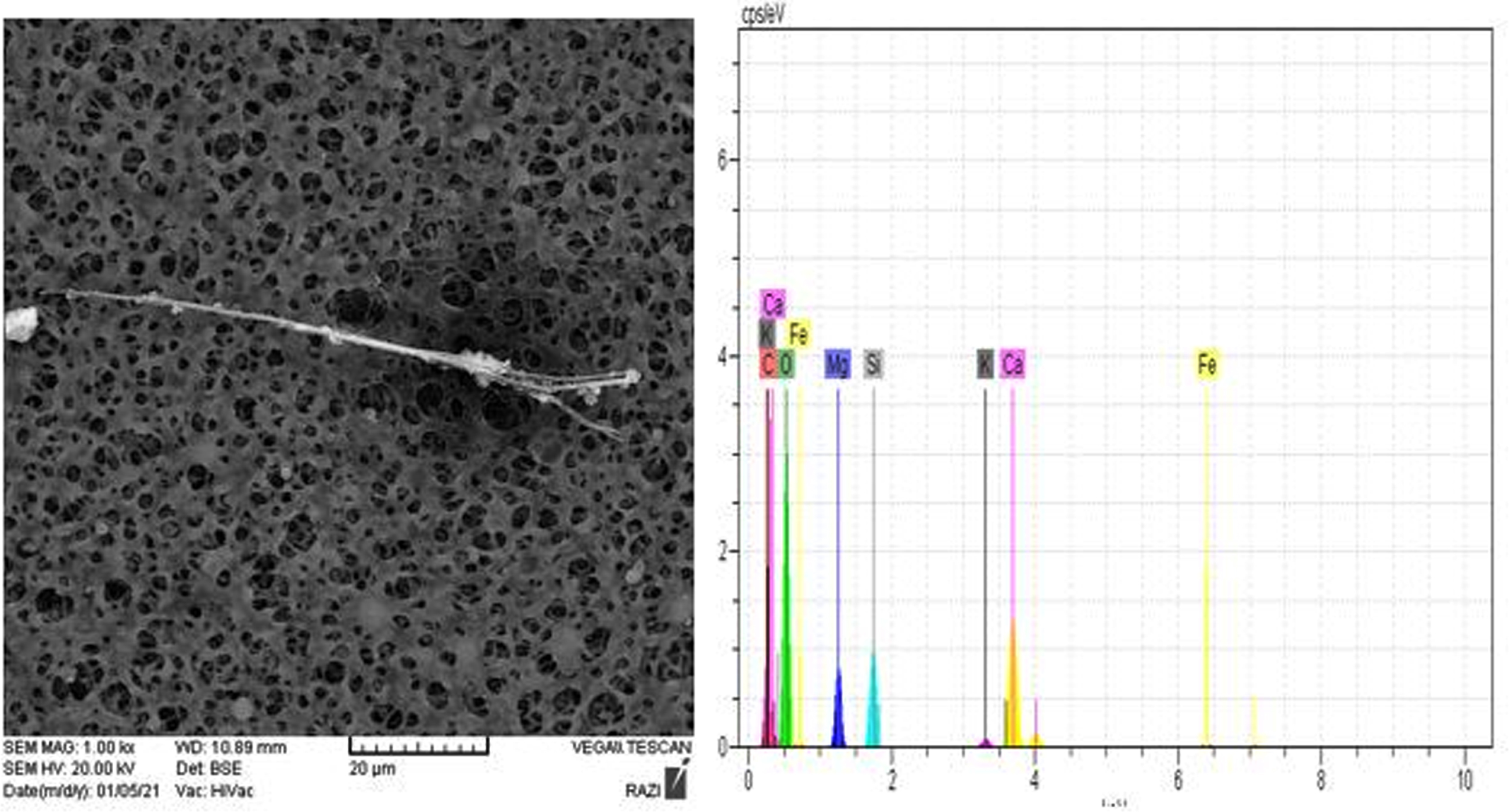
SEM image and EDS spectrum of the airborne chrysotile.
Frequency (Percent) of different type of asbestos in samples based on SEM (EDs) analysis
Based on SEM analysis, mean concentration of asbestos in 16 buildings was 0.031±0.023 f/ml (Table 2). Contrary to result of current study, Neitzel et al. found that emission of asbestos during demolition process appear to be negligible [34]. In line with result of our study, another study found that asbestos fibers observed in nearly 95% of the air sample that collected from abandoned residential dwellings [35]. Stevulova et al. reported that indoor asbestos concentration during the removal of asbestos containing materials did not more than the occupational exposure limit, except in three sampled stations, the use of demolition management system with the aim of protection workers could be reason for low concentration of asbestos [36]. Perkins et al. found that the concentrations of asbestos that measured by PCM method were generally well below than standard exposure limits [2]. In a study in Iran, concentration of asbestos fibers during demolition of old building was 0.07 PCM f/ml, which was more than mean concentration of asbestos fiber (0.022) in the current study [1]. In a study in Poland, concentration of asbestos during removal of asbestos-cement materials was 0.0652 fiber/cm3 and 0.0141 in inside and outside the buildings, respectively [37]. According to report of Centers for Disease Control and Preventions (CDCP), there are 1.3 million construction and industrial workers under exposure to asbestos in the United States during renovation or demolition. In a study in Thailand, the airborne asbestos concentration range during construction or repair of roof tiles was 0.02 to 0.1 fibers/cm3, and based on EPA mathematical method, the exposure to asbestos during construction or repair of roof tiles increases probability of developing cancer [38].
A possible reason for higher concentration of asbestos and its cancer risk in our study could be manual demolition of building, lack of separation of asbestos containing material before demolition of building, and lack of wet method during demolition process [39]. In a study in ambient air of Tabriz, a city in Iran, the average concentration of asbestos fibers in high traffic areas was more than the environmental standard exposure limits [40].
Results of cancer risk estimation showed that in all of studied buildings, cancer risk was considerable for exposed workers (ELCR≥1.00×10⁻⁴) except for three buildings (buildings number of 7, 8, and 9) (Table 4). The mean of estimated cancer risk was 2.009E-3 that means among 1000 building demolition workers, 2 person could develop cancer risk (Fig. 2). Contrary to the result of current study, Richard et al. found that health hazard due to exposure to asbestos during building demolition is negligible [34].
The ELCR due to exposure to asbestos among building demolition workers

The ELCR due to inhalation exposure to asbestos in different buildings.
In a recent review study in Iran, health risk assessment demonstrated that the cancer risk of exposure to asbestos was 1.01E-1. In this study all of studies in Iran from 2000 to 2021 were assessed [41]. Frost et al. showed that exposure to asbestos during asbestos removal from buildings, results in lung cancer, mesothelioma, and circulatory disease [42]. Lee et al., in a recent study in Korea, demonstrated that indoor mean asbestos concentration due to asbestos-cement slate and dismantling and demolition of asbestos-cement slate were 0.0032 and 0.0034 f/cc, receptively. They also reported that the ELCR of indoor exposure was less than 10–6, which means the low level of cancer risk [43].
Difficulty of air sampling was the limitation of this study, closing the sampling pump to the worker’s back restricted performance of worker and the possibility of damage to the pump during sampling was excited. Due to certain carcinogenicity of asbestos, alternative material such as man-made mineral fibers (MMMF) and man-made vitreous fibers (MMVF) should be used in construction industry [44]. Also, asbestos risk management program such as safe separation of asbestos containing material and safe landfilling asbestos containing wastes must be implemented in building demolition process.
Although asbestos has been recently banned in many countries, exposure to asbestos during old building demolition is not unexpected. The results of the study confirmed exposure to asbestos during demolition of building. Mean concentration of asbestos during building demolition was lower than occupational standard exposure limit, but due to high potency to cause cancer, building demolition workers are under considerable cancer risk. Therefore, we recommend that implementation of regulation of asbestos risk management such as separation of asbestos containing material, using of personal protective equipment, and use of wet method during demolition could minimize asbestos exposure during demolition of old buildings.
Ethical approval
This study was approved by the Ethics Committee of Tabriz University of Medical Sciences (IR.TBZMED.REC.1399.434).
Informed consent
Not applicable.
Conflict of interest
The authors have no conflict of interest to report.
Footnotes
Acknowledgments
The authors express their appreciation to the authorities of Tabriz University of Medical Sciences for their financial and moral support.
Funding
This study was financially supported by Tabriz University of Medical Sciences (Number: 64933).