



Abstract
BACKGROUND:
Human errors cause accidents in the workplace. Screening workers at employment can prevent future accidents from happening. Two important tools that can be helpful in screening are determining the emotional intelligence score and personality traits score of the workers.
OBJECTIVE:
The purpose of this study was to evaluate the relationship between emotional intelligence, personality traits and safety behaviors in metal industries workers.
METHODS:
This is a cross-sectional survey. Confirmatory factor analysis was performed to determine the relationship between the components of emotional intelligence, unsafe behaviors, and personality. To collect data for this study, Five-Factor Goldberg questionnaire, Bar-On Emotional questionnaire and Safety behavior questionnaire were used. The collected data were entered into software (SPSS version 22) and refined.
RESULTS:
The results of this study showed that there was a significant positive correlation between personality traits, emotional intelligence and safe behaviors (p-value = 0.000). The confirmatory factor analysis showed that personality traits influence safe behaviours. Also, studies have shown that emotional intelligence has a positive effect on safe behaviours. The amount indicators of goodness of fit (GFI), Comparative Fit index (CFI), Tucker-Lewis index (TLI) and root mean square error approximation (RMSEA) were 0.944, 0.970, 0.965 and 0.061, respectively.
CONCLUSIONS:
The results of this study suggest that personality traits and emotional intelligence influence safe behaviours in the workplace. Employers can use these two tools in the employment phase and prevent future human-related accidents.
Introduction
Most workplace accidents that cause damage to employees, equipment and properties, are estimated to be due to human errors [1]. A small group of workers causes human error accidents. In other words, this small group is responsible for a large number of human error accidents [2]. Screening workers in the early stages of employment can reduce the number of human error accidents in the workplace [3]. To do this, it is necessary to identify the individual difference factors that can predict future workplace accidents [2, 4]. Safety behaviors include the two areas of safety compliance and safety participation [5].
To maintain safety at work, people must do their work in a safe and secure manner and adhere to safety guidelines and legal requirements that define as safety compliance [6]. “Safety participation” is defined as behaviors that may not directly to contribute to the safety of individuals but also help create conditions that increase the level of safety and health in the organization (Participate in safety meetings, helping coworkers under hazardous conditions) [1, 7]. Safety behaviors are behaviors that are done to improve the safety of the workplace, teams. Safe work practices show us a vision of reducing future injuries (i.e the presence of safety) [8]. Whereas, unsafe work behaviors, whether intentionally or unintentionally, conflict with safe working practices [1].
Human behavior depends on many factors including emotions, attitudes, personality and motivation. Any error in any of these can causes people to engage in high-risk behaviors in the workplace. There is a strong relationship between emotional intelligence and occupational safety [9]. The concept of emotional intelligence (IE) was introduced for the first time in 1990 by Salovey and Mayer [10]. Emotional intelligence includes the proper assessment and understanding of emotions in oneself and others, the proper expression of emotions, and the regulation of emotions to improve intellectual and emotional development [10–12]. In another definition, Bar-on states that emotional intelligence is a set of non-cognitive abilities, worthiness and skills that make one succeed or fail to cope with environmental demands and pressures [13].
In addition to emotional intelligence, personality traits can also influence workers’ decisions and behaviors in the workplace. Personality traits are one of the most common predictors that reveal the relationship between individual differences and accidents in the workplace [1, 15]. Personality traits are defined as aspects of individual differences in a person’s willingness to exhibit consistent patterns of thoughts, feelings, and behaviors [16]. NEO personality traits include five factors called extraversion, agreement, working conscience, emotional stability, and openness to experience [17]. Openness to experience and extroversion increase motivation for risky behaviors [18]. Empathy and compassion in satisfied people are greater than risky and unpleasant people. Health risks are less common for the more compassionate and kind. People with a high level of conscience are less likely to engage in health risk behaviors. When people have high risk knowledge, they are less likely to engage in risk activities [19]. Many personality theories suggest that personality traits are correlated with affects and behaviors. For example, neuroticism is correlated with four main dimensions of negative emotion (guilt, hostility, fear, and sadness) and can therefore exacerbate any high risk behavior [20].
So far, very few studies have examined the relationship between personality traits, emotional intelligence, and safe behaviors among workers in the workplace. Since most accidents in the workplace are due to human error, it is necessary to identify high-risk people. One way to identify high-risk people is to have people take psychological tests. In this study, we examined the relationships between personality traits, emotional intelligence, and safe behaviors using confirmatory factor analysis among workers in a metal industry.
Material and methods
Target community
This was a cross-sectional study conducted on metal industry workers in Saveh, Markazi province, Iran. Since more than 200 samples were sufficient in structural equations [21], a total of 276 workers were selected as the target group. According to the study criteria (at least 3 years of work experience, absence of certain diseases, absence of serious problems of physical-mental health, and male gender) the workers were selected randomly.
Data collection tools
In this study, Big Five Personality Traits, Bar-On Emotional Intelligence and Safety behavior questionnaires were used to data collection.
The Big Five Personality Traits questionnaire developed by Costa and McCray has been extensively used as a means to evaluate personality over the recent years. This model has even affected the new DSM classification. According to this model, personality can be described by five big factors: Extraversion, Agreeableness, Conscientiousness, Neuroticism, and Openness to experience. As reported by Goldberg, the inventory is highly valid and reliable [22]. In Iran, Haghshenas has performed the validity and reliability of this questionnaire on 502 people in Shiraz. Cronbach’s alpha coefficients are respectively C = 0.83, A = 0.71, O = 0.75, E = 0.71, N = 0.81 and Reliability of retest at 6 months are A = 0.6, O = 0.76, E = 0.74, N = 0.53 [23].
Bar-On Emotional Intelligence questionnaire was presented in 1980. This questionnaire consists of 117 questions and 15 subscales, and has a five-point Likert scale scoring from a score of 5 to one (totally agree and totally disagreeing). The total score of each scale is equal to the total score of each question of that scale. The total score of the test is equal to the total score of 15 scales [13]. Dehshiri in 2003 determined the Cronbach’s alpha for this questionnaire to be 73%[24].
Safety behaviors questionnaire designed by Mehdi Nia et al. was used to investigate safety behavior. This questionnaire consisted of 23 questions, which was scored based on five-scale Likert. This questionnaire had two subscales of safety compliance and safety participation. Cronbach’s alpha coefficient of this questionnaire was equal to 0.902 [25].
Method
After determining the under study subjects, the Big Five Personality Factor Traits, Bar-On Emotional Intelligence and Safety behavior questionnaires were completed for participants. After completing the questionnaires, their information was extracted and analyzed by SPSS software. In order to achieve the objectives of the study, normalization of data was performed using Smirnov test. All tests were performed at 95%confidence level. Confirmatory factor analysis was used to investigate the relationship between the components of emotional intelligence variables and personality and safe behaviors. In the confirmatory factor analysis, the distribution of variables was first examined because it can affect the model fit index and the model estimation accuracy. AMOS is a statistical package that is used for verification.
Results
Demographic characteristics of workers
The demographic characteristics of participants are given in Table 1. This study examined the relationship between emotional intelligence, personality traits, and unsafe behaviors among 276 workers. The mean age of the subjects was 35.09±7.26 years. All subjects were male. The mean of work experience was 8.18±5.72 years. Table 1 shows demographic information.
Demographic characteristics of workers in the main study
Demographic characteristics of workers in the main study
Correlations between personality traits, emotional intelligence, and safe behaviors were investigated using Pearson’s correlation coefficient, which can be seen in Table 2. There is a significant positive correlation between personality traits, emotional intelligence and safe behaviors (p-value = 0.000). This means that workers who scored higher on the Goldberg Five-Factor Questionnaire and the Bar-On Emotional Intelligence Questionnaire performed more safety behaviors (safety compliance and safety participation).
Correlations between personality traits, emotional intelligence and safety behaviors
Correlations between personality traits, emotional intelligence and safety behaviors
**Correlation is significant at the 0.01 level (2-tailed).
Figure 1 shows confirmatory factor analysis of personality traits, emotional intelligence, and safe behaviors along with regression weights. Also, their direct and indirect standard effects are shown in this figure. The results for the fit indices of the factor analytic model are shown in Table 3. The model fit is considered to be good if (i) the goodness of fit (GFI), the Comparative Fit Index (CFI), and the Tucker-Lewis index (TLI) are > 0.90; (ii) if RMSEA is < 3.0 [26]. As can be seen from Table 3, the mentioned indicators were obtained in the appropriate defined range, so, the model prepared was validated. The Holter index used to check the suitability of the sample size and the suitability of the index was confirmed as the sample was present in the model.
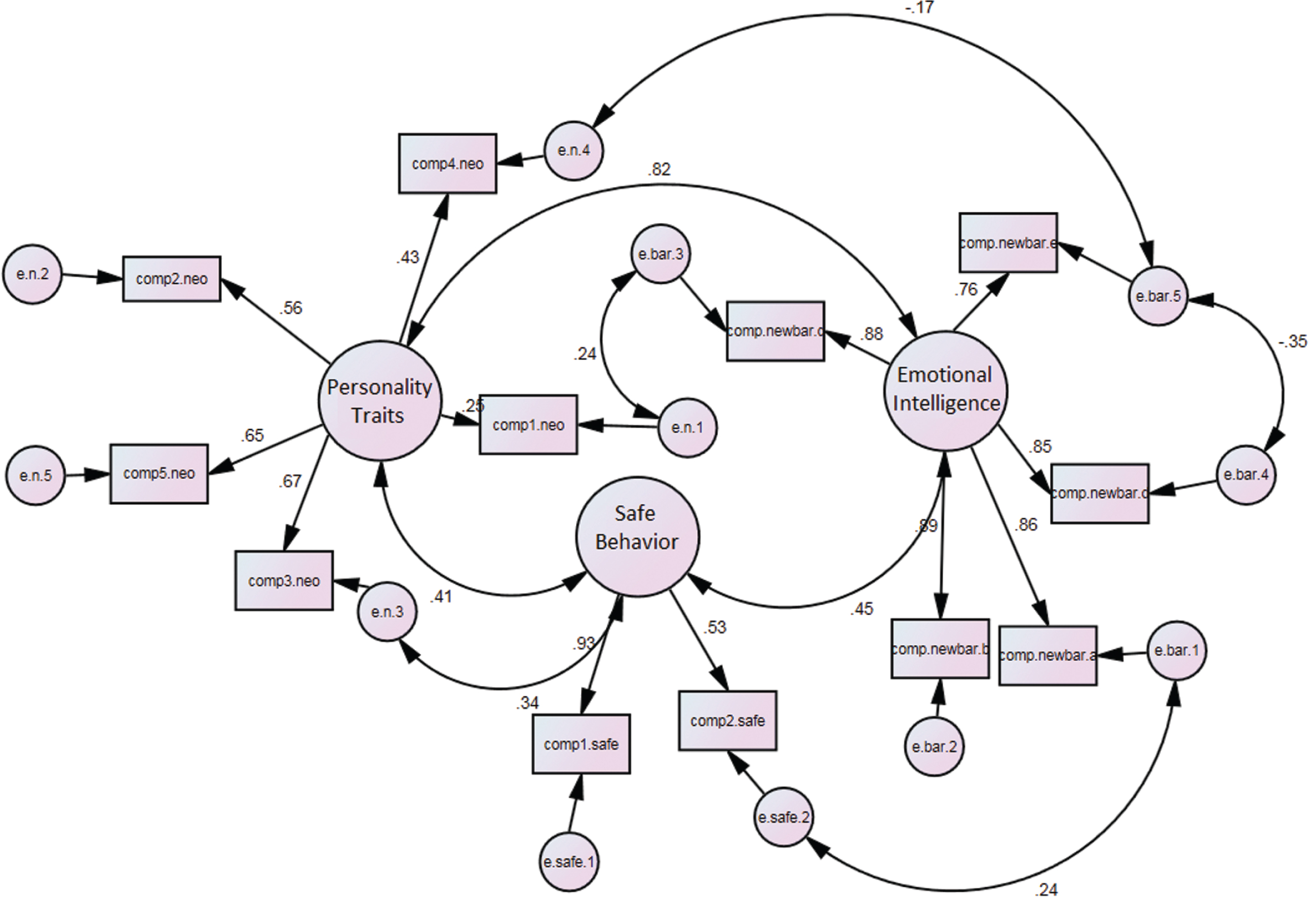
Confirmatory factor analysis between personality traits, emotional intelligence, and safe behaviors.
Model fit index in the main study
The results of confirmatory factor analysis showed that personality traits influence safe behaviours. Also, studies have shown that emotional intelligence has a positive effect on safe behaviours. Henning and colleague observed that extraversion, rather than negative dependence, had a positive relationship with safety factors (public attitude, workers and management should do and safety discipline) [27]. People with a high extraversion score, who have characteristics such as socializing, being energetic, joyful and adventurous, are less likely to experience accidents [28].
In another study Cellar et al. showed that conscientiousness and agreeableness scores had a significant negative correlation with total work accidents [29, 30]. It may be concluded that people with a high score of agreement and conscience are less likely to be involved in workplace accidents [30]. In a 2017 study by Pourmazaherian and colleagues, it was shown that the effect of agreeableness and conscientiousness on improving safety performance was very large [31].
Nervous workers with low emotional stability are at greater risk of slip hazards, and neuroticism can predict workers’ risk behaviors that lead to accidents. Neurotic consequences appear in individual reactions and decisions [32]. People with a high neuroticism score tend mistakes and are more likely to have an accident at construction sites [33].
In one’s behavior, emotions and emotional intelligence play an important role [34]. People who are more aware of their emotions have more skills in managing their emotional problems. These people have better mental health [35]. The components of emotional intelligence affect one’s ability to identify, perceive n and manage emotions, find the solution, and coping with stressful events. Asgarians findings suggest good features such as optimism, independence, responsibility, interpersonal relationships, and flexibility can be seen among non-accident drivers compared to drivers with a history of accidents [36]. Rapid detection of environmental changes and making adequate decisions is one of the important requirements of performing tasks in dynamic environments. Data processing in these sophisticated tasks requires perception of environmental elements and events with respect to time or space, the comprehension of their meaning, and the projection of their future status. These three stages of processing constitute Endsley’s Situation Awareness Theory [37]. According to Endsley’s theory, the first level of situational awareness (level 1) is based on the perception of environmental elements, such as color, size, position, speed, and etc. The second level of situational awareness is dependent on the first level of situational awareness and the ability to comprehend the situation and environment in general, and important objects and events in particular. The third level of situational awareness accounts for projection of the future status based on the first and second levels of situational awareness. This can only come to realization through comprehension of the current environment. According to situational awareness theory, defects at any level of situational awareness can lead to human errors [38, 39]. Personality and emotional intelligence can affect the level of awareness in each of the mentioned levels and cause the formation of workers’ behavior. Therefore, personality and emotional intelligence can be considered as predictors of safe or unsafe behavior of workers in the workplace.
Conclusion
The results showed that there was a relationship between personality traits, emotional intelligence and safe behaviors among workers. This study is one of the few studies that have focused on the effect of personality traits and emotional intelligence on safe behaviors. Therefore, the relationship between personality traits, emotional intelligence, and safe behaviors in this study requires investigation in other industrial environments, especially in workplaces with high accident statistics.
Footnotes
Acknowledgment
The authors are grateful for the financial support of this project by the Iran University of Medical Science. This study was registered at the Student Research Committee of the Faculty of Health of Iran University (97-04-15-14125, ethics code IR.IUMS.REC.1397.1148).
Conflict of interest
None to report.