




Abstract
BACKGROUND:
Rowing requires synchronized, forceful and repetitive muscular movement to propel the boat towards the finish point. This makes rowers prone to musculoskeletal discomfort. The etiology of such musculoskeletal discomfort is multifactorial in nature. Therefore, risk assessment is essential for encouraging enhanced performances.
OBJECTIVE:
The present study was undertaken to decipher the prevalent areas of discomfort, identify risk factors contributing to discomforts among young Indian rowers and propose a model for the causative factors of discomfort to monitor their performances.
METHODS:
A self-constructed questionnaire was framed and administered at state level competition. To identify the likely commonalities, the response matrix was subjected to Factor Analysis (FA). Subsequently, Principal Component Regression (PCR) was carried out to identify the influence of ergonomic risk factors with rowing performance parameters.
RESULTS:
The study identified three major factors: Imprecision Related Factors’ (ImRF), ‘Occupation Related Factors’ (ORF) and ‘Individual Related Factors’ (IRF). The study suggests changes to the training strategies for reducing discomforts from ergonomics risk factors.
CONCLUSIONS:
The study quantifies major risk factors with the highest loading and proposes an interpretive model. This will be beneficial for formulating the training frameworks and to prepare guidelines for rowers to refrain from discomforts consequently, enhancing performance.
Introduction
Ergonomics and Sports Sciences are closely related while considering human performances. Both workers’ and athletes’ performances are influenced by ergonomic risk factors [1]. Either of them are exposed to variety of musculoskeletal discomfort which are caused by multiple ergonomic risk factors consequently reducing their performances [2]. Like all other occupations, rowing is a sports occupation where it has been reported that rowers suffer from musculoskeletal discomfort. Among the variety of sports, rowing is an activity of sports and exercise for youngsters which require considerable technical proficiency to attain higher level of performance. The sport requires excessive training to propel the boat efficiently towards the finish point. Therefore, rowers in their first year of competition are prone to discomfort due to overtraining. The technique of rowing demands symmetrical movement of upper and lower body parts with synchronized muscular effort, repetitive technical motor skills and intensive aerobic activity. Achieving such synchronized activity requires adequate endurance and rigorous training [3]. Hume stated that in-spite of rigorous demand of appropriate training, there is no clear guideline for coaches to demonstrate to rowers [4]. This further leads to improper training strategies giving rise to various discomfort for young rowers.
Studies have endorsed that rowers, in order to attain the competitive level, undergo rigorous training sessions and in due course get prone to discomfort. There are studies reporting the prevalence of discomfort among rowers and more commonly among young rowers [5, 6]. It has also been found that the prevalence of discomfort is high on dry land as compared to water [7]. Budgett and Fuller found an injury rate of 0.4 per 1000 hrs. while on the water, compared with 4 per 1000 hrs. during dry-land training [9].
The evidence-based literature postulated various factors which made the rowers prone to discomfort. It had been found that one of the major contributing factors for injury was the overuse of muscles while training [9]. Buckeridge et al. stated that at higher stroke rates, loading increased at lumbar region and technique of rowing gradually turned faulty [11]. Other major factors were poor posture, practice time, racing time, technique of rowing, training and nutrition. Existing studies indicate the association of discomfort with various risk factors like training volume [10], practice time [11], nutrition [12] etc. Similar studies were found on athletes and triathlons. However, there is a paucity of studies that predicts various factors responsible for causing discomfort among young Indian rowers.
The etiology of discomfort is multifactorial in nature and literature suggests that these are more prevalent in young rowers [6]. Majumdar et al. conducted study on elite rowers and revealed significant correlation between rowing performance and rower’s height [14]. Muscles in young rowers are in developing; and therefore, demand appropriate training strategies for enhanced performance. To achieve the best individual performance, it is necessary to first understand the general relationships among various factors, map them and formulate relevant training models. Based on the review of existing literature, it was found that the issues in rowing are similar to discomfort in any other occupation. Therefore, the present study was undertaken to decipher the prevalent areas of discomfort, identify risk factors contributing to discomforts among young Indian rowers and propose a model for the causative factors of discomfort to monitor their performances.
Materials and methods
Participants
Data from 152 young Indian rowers, within the age group 16 to 25 years from state level rowing competition in Pune, India was collected for this study. The 152 rowers included 100 males and 52 females. Rowers who actively take part in competitive rowing were selected. Exclusion criteria were as follows: history of serious injury and recent illness. Inclusion criteria was minimum one year of experience in rowing. Signed consent was obtained from each participant. The study was approved by Institutional Ethics Committee, Pune, India.
Tools
A modified questionnaire supported by existing literature was constructed. Questions related to demographics, discomfort while and after rowing, risk factors on causation of discomfort etc. were included. Discomfort were graded on both Likert Scale and Visual Analogue Scale (VAS) (Appendix). The validity of the questionnaire was checked using Delphi Technique and the reliability of the questionnaire was assessed through Cronbach’s Alpha. The Cronbach’s Alpha value for the questionnaire was found to be 0.874 which is within the acceptable limits [15]. Data was collected at the state level rowing competition. Rowers who met the criterion of the study were asked to give responses to the questionnaire. From the data collected the mean height was 172.45(±9.71) cms and the mean weight was 64.97(±10.40) kgs. The mean years of experience was 2.71(±2.1) years. Mean regular hours of practice was 3.54(±1.65) hrs. The mean best performance time for 500 mtrs rowing was 1.60(±0.35) seconds.
Statistical analysis
Factor analysis was carried out to define the underlying structure in the data matrix. The results of the factor analysis were determined on factor loadings which imply the correlation between the original variable and factors. In this study, eigen values (represents the amount of variance accounted by factor) were greater than 1. Varimax rotation was chosen and 5 iterations were carried out. The cut-off point for item factor loading was 0.500. Sample adequacy was checked by the Kaiser Meyer Olklin (KMO) measure. According to the previously described measure, values greater than 0.5 are used for accepting the sample size. In this study, the KMO value was 0.867 which indicated that the sample size was adequate for carrying out the factor analysis. The result of Bartlett’s test of sphericity was 560.925 with an associated probability value of 0.000. Both tests indicated the variables are suitable for factor analysis [5]. Furthermore, regression was carried out on the components to develop a model to find an association between major factors and most complained areas of discomfort. Regression was carried out to predict the factors (variables) causing discomforts.
Results
Figure 1 depicts the major areas of discomfort reported by young Indian rowers. Major areas of discomfort were recorded for entire body (25 body parts) on a Likert scale of 0 to 5. Body parts with discomfort ranging from moderate to very high (3 to 5) were taken in to account. The prone areas which showed moderate values (3) were mid back (26.32%), right forearm (22.37 %), left forearm (21.05 %) and buttock (22.37 %). The prone areas which showed high values (4) were low back (34.21 %), left thigh (23.03 %) and right thigh (21.05 %). The prone areas which showed very high values (5) were low back (13.82 %), left thigh (11.18 %) and right thigh (11.18 %).
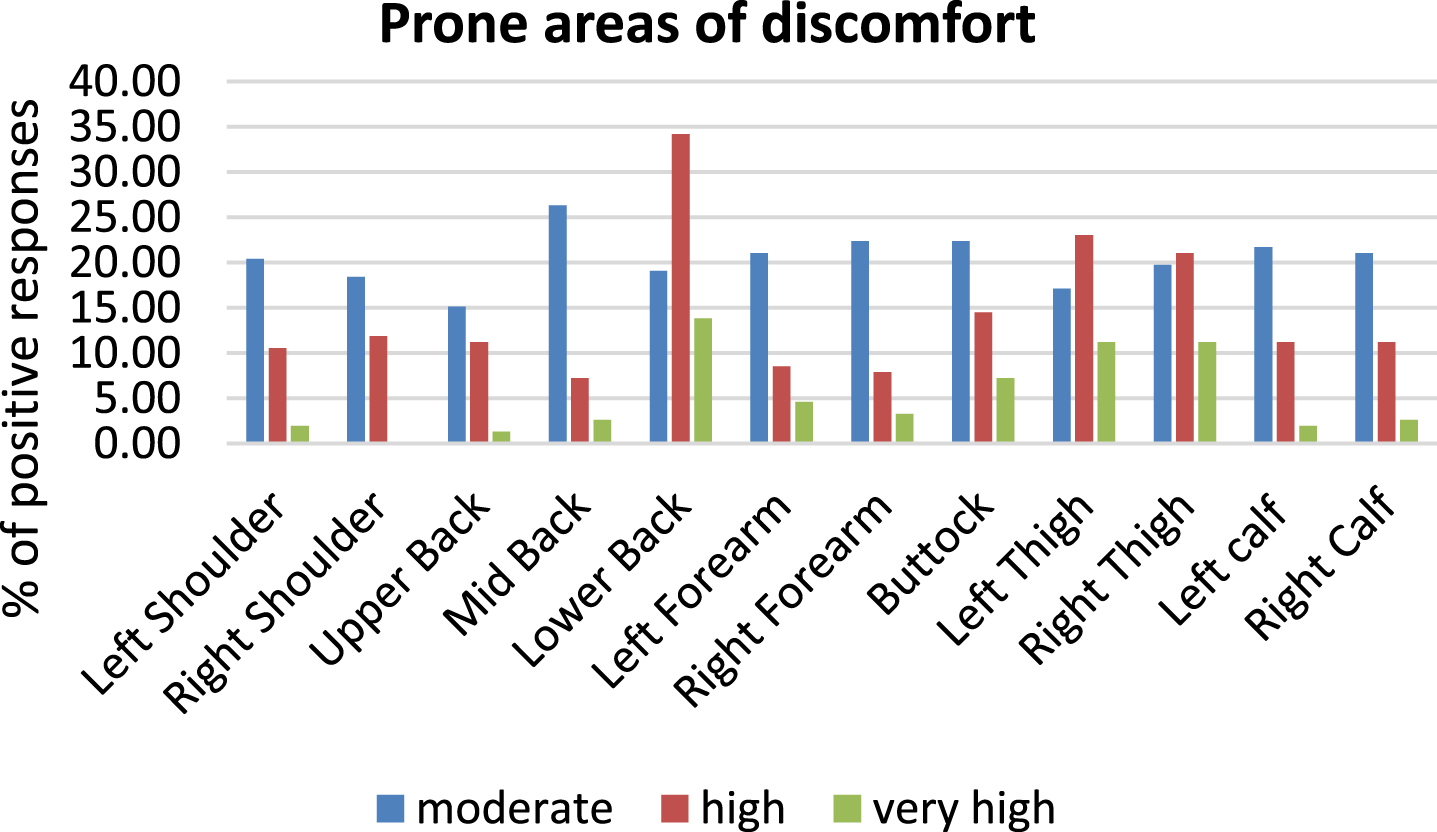
Body discomforts.
Table 1 shows three factors. Factor comprises of poor posture, lack of fitness and flexibility, technical flaws and stress. Factor 2 comprises of long practice session, insufficient rest and sudden performance increase. Factor 3 comprises of touring and dietary intake.
Factor loading table
As poor posture, lack of fitness and flexibility, technical flaws, and stress from Factor 1 are related to imperfections, it was named as Imprecision Related Factors (ImRF). Factor 2 comprised of long practice session, insufficient rest and sudden performance increase which were related to occupational factors. Thus, it was named as ‘Occupation Related Factors (ORF)’. Factor 3 comprised of touring and dietary intake which were individual habitual factors. Thus, it was named as ‘Individual Related Factors (IRF)’.
Table 2 shows the model summary. After computing ordinal regression, five models were proposed. The details of those models are:
Model summary
Where, ɛ is a constant
The study quantified prevalent areas of discomfort. The results obtained concurred with the literature. Perera and Ariyasinghe conducted a cross sectional study on professional rowers and observed lower back pain (21.4%, 37.5%), hand and wrist pain (7.1%, 3.1%), hip pain (14.2%, 0.0%) [17]. This study revealed back, thigh and forearm as major areas of complaints. The study was on young collegiate rowers where the discomfort areas were higher. Studies have revealed that the risk of injury is higher among young sportsmen than older sportsmen as musculoskeletal discomforts are more and varied in young than old individuals because of structural changes in the skeleton, muscles and tendons [17].
There are studies in literature identifying factors which makes the rowers prone towards discomforts. However, there is paucity of studies postulating major factors with factor loadings revealing the impact for causation of discomfort for young Indian rowers. This study deciphered three major factors namely Imprecision Related Factors (ImRF), Occupation Related Factors and Individual Related Factors (IRF).
Factor 1 which was Imprecision Related Factors (ImRF), comprise of first construct which is poor posture with highest loading. Our findings corroborated with previous studies. There are studies indicating that poor posture, lack of fitness and flexibility and technical flaws causes injury among rowers [18, 19]. The individual technique of rowing affects performance and contributes in causation of soft tissue injury [19, 20]. Another study suggested that there was a dose-response relation between training volume, resting cortisol level, and subjective assessments of stress and recovery [21]. Our finding supports previous studies where the factors constituting Factor 1 were reported individually. However, there is a dearth of literature in terms of associating the factors with the highest factor loadings.
Factor 2 which is Occupation Related Factors (ORF) comprise of long practice session, insufficient rest and sudden performance increase. Similar studies had been carried out on the impact of practice time, insufficient rest and excessive training as factors contributes to the causation of injury among rowers [10, 11]. However, there was scarcity of literature postulating collective impact of these factors on injury among young Indian rowers.
Factor 3 which was Individual Related Factors (IRF) comprised of touring and dietary intake. The first construct was touring. Literature suggests that touring causes injury in sportsmen [22]. However, there is paucity of studies indicating the impact of touring on injuries among rowers. Nevertheless, there were studies indicating the impact of dietary intake on rowers’ performance [12, 23].
Subsequently, Principal Component Regression (PCR) was carried out to propose interpretive models on causative factors. Jacobsson et al. conducted a study where he proposed a regression model for injuries for athletes [25]. The model showed association between training load rank index and prone injuries. However, there is scarcity of literature proposing interpretive models on causative factors. This study proposes (Table 2) two models.
Model I suggest that there was an association between Factor 3 i.e. IRF with daily hours of practice (Equation 1). Smith postulated that training hours have a linear relationship with performances [26]. However, scientific evidence associating daily hours of practice with the number of tours and dietary intake is missing. Nevertheless, rowers’ daily hours of practice vary when touring which also changes the dietary intake and dietary pattern. Therefore, this study associates daily hours of practice with touring and dietary intake.
Model II suggests that there was an association between Factor 2 i.e. ORF with best performance time (Equation 2). Studies suggest that there was a positive association between training volume and performance of rowers in competition. The major attributes for training were long practice session and work-rest cycle which vary with number of performances. Consequently, performance time is related to the amount of time spent in training sessions and also insufficient rest.
This study deciphers the factors and associates them with regular rowing parameters. Based on the findings, corrective measures can be taken on risk factors.
Limitation: The limitation of the study is that it needs to be carried out on larger sample size with adequate gender distribution for formulating training strategies largely. Also, longitudinal studies on various age groups will help to substantiate the study better.
Conclusion
Our study quantifies risk factors with highest loadings and integrates them in to three major factors. The three integrated risk factors were ‘Imprecision Related Factors (ImRF)’, ‘Occupation Related Factors (ORF)’ and ‘Individual Related Factors (IRF)’. The study proposed interpretive modelling of risk factors for the areas prone for discomfort which helps trainers/coaches to prepare guidelines and strategies to refrain from discomfort.
Conflict of interest
None to report.