



Abstract
BACKGROUND:
The use of home delivery services has expanded due to coronavirus disease – 2019, and couriers’ high level of work intensity has become a severe social issue in various nations.
OBJECTIVE:
This study investigates the risk factors of musculoskeletal disorders (MSDs) caused by frequent loading and unloading actions, known to be the most demanding tasks for couriers.
METHODS:
A self-report survey and post-hoc interview were employed to collect personal information, task frequency, and the incidence of MSDs. Frequent actions during loading and unloading packages were identified, and the Rapid Entry Body Assessment (REBA) and National Institute for Occupational Safety and Health (NIOSH) lifting equations were assessed.
RESULTS:
Approximately 29.5% of the 44 subjects suffered from MSDs, and identify the types of actions that frequently occur during loading and unloading packages. According to the REBA survey, 60% of the responses for both loading and unloading are distributed within the risk range of 8–13 points, suggesting a high risk (mean REBA score: 8.8 (loading), 8.5 (unloading)). In every case, NIOSH determined that the lifting index (LI) was harmful (mean LI: 1.62). Thereby, the bending or twisting posture of the hands and neck, long horizontal distance between the packages and the body, and high lifting frequency were identified as major problems.
CONCLUSION:
The study identified a very high level of musculoskeletal risk for couriers, and the detailed working methods and body parts vulnerable to MSDs.
Introduction
A musculoskeletal disorder (MSD) is an abnormality in the musculoskeletal system that occurs when a specific part of the body experiences long-term exposure to inadequate working conditions and intense physical labor [1]. It is critical to address musculoskeletal problems at an early stage since the injuries can become more serious over time; even after the injury is healed, the lasting effects can be chronic. For example, lower back pain is more than twice as likely to recur in people who have previously experienced it than in those who have not [2]. Moreover, people have become more vulnerable to MSDs after coronavirus disease -2019 (COVID-19), as their normal daily patterns of activity have been altered with the closure of exercise facilities and the rapid rise in sedentary lifestyles [3].
Owing to the development of digital platform companies, the delivery industry has become more active, and resultantly, the workload of delivery workers has increased [4]. The deaths of seven couriers in South Korea in 2020 is notable in this regard [5]. The high workload of couriers who perform both loading/unloading and delivery of packages, resulting from the isolation and social distancing during COVID-19, has become a serious issue. The Delivery Workers’ Overwork Countermeasure Committee published a report indicating that couriers in South Korea work 71.3 hours per week on average [6], which is significantly higher than the national average of 40.7 hours per week. Furthermore, after the outbreak of COVID-19, the rates of increase in package classification and delivery have been 35.8% and 26.8%, respectively, which are much greater than those before the outbreak of the pandemic.
This issue raises serious concerns not only in South Korea, but also worldwide [7]. In an international survey, 37% of the respondents reported musculoskeletal pain more than once a day, and more than 60% of the couriers said that COVID-19 aggravated their stress. The intensity of deliveries continues to gradually increase, raising the risk of lower back pain due to handling heavy packages. The risk of MSDs because of repetitive package classification is high, and loading and unloading packages carry the highest risk.
Most studies on MSDs in South Korea have investigated their incidence in occupational groups or the general patient population [8–10]. However, studies examining loading and unloading tasks have been insufficient. Although some studies in other countries have focused on similar occupations, such as warehouse workers [11], construction workers [12, 13], and parcel delivery workers [14–16], knowledge of the direct relationship between MSDs and the loading and unloading tasks of couriers are still lacking.
A previous study found that MSDs are the most common injuries in the truck industries [16]. Delivery workers are often thought to be strongly connected with driving trucks on the road, but driving is not their only duty. For example, a truck driver’s duties also include climbing or descending a height that reaches up to 1.5 m (i.e., the cabin, body, and platform of the truck). Moreover, the work of delivery workers, in many cases, involves handling goods. Tons of packages loaded onto a truck should be collected, loaded, unloaded, and delivered [15]. Therefore, the focus of studies on the causes of MSDs among delivery workers should not be limited to driving, but also include more intensive loading and unloading actions.
There are studies on musculoskeletal problems in manual workers [17] and studies analyzing MSDs in delivery workers when they load and unload packages [15, 19]. However, these studies did not consider the increased workload on couriers due to COVID-19. They also lacked a detailed analysis of the relationship between MSDs and the loading and unloading tasks using MSD risk evaluation methods, such as the Rapid Entry Body Assessment (REBA) and Rapid Upper Limb Assessment (RULA). Therefore, we investigate the changes in the work environment of delivery workers brought by COVID-19 and the resulting problems, and analyze the relationship between loading/unloading tasks and MSDs.
This study examines the self-reported symptoms of MSDs and frequency of actions during work to evaluate the risk factors of loading and unloading tasks. The REBA and National Institute for Occupational Safety and Health (NIOSH) lifting equation were implemented to analyze the relationship between loading/unloading actions and the musculoskeletal system. This study aims to suggest ideas for improving the work environment to effectively prevent disorders caused by loading and unloading by developing safety guidelines.
Methods
Questionnaire
The questionnaire included items regarding personal information and symptoms of MSDs, actions frequently performed during loading and unloading, REBA scores, and the NLE (NIOSH Lifting Equation).
Personal information related to MSDs
Personal information included age, sex, working hours, housework hours, average daily sleeping hours, smoking status, work period, work intensity, and regular exercise hours. Furthermore, the level of stress caused by the work environment was surveyed to account for social and psychological factors. Finally, the respondents were asked to report the body parts where they currently experienced MSDs.
Most frequent actions during loading and unloading packages
As shown in Fig. 1, the frequent actions performed during loading and unloading were investigated separately. The actions during loading consisted of receiving over the shoulder, receiving from the waist, receiving from below the waist, and lifting from the floor. The actions during unloading consisted of stacking higher than shoulder height, stacking at about waist height, stacking below the waist, and stacking on the floor. Consequently, the operation consists of 4×4 = 16 actions, that is, a combination of four loading actions and four unloading actions.
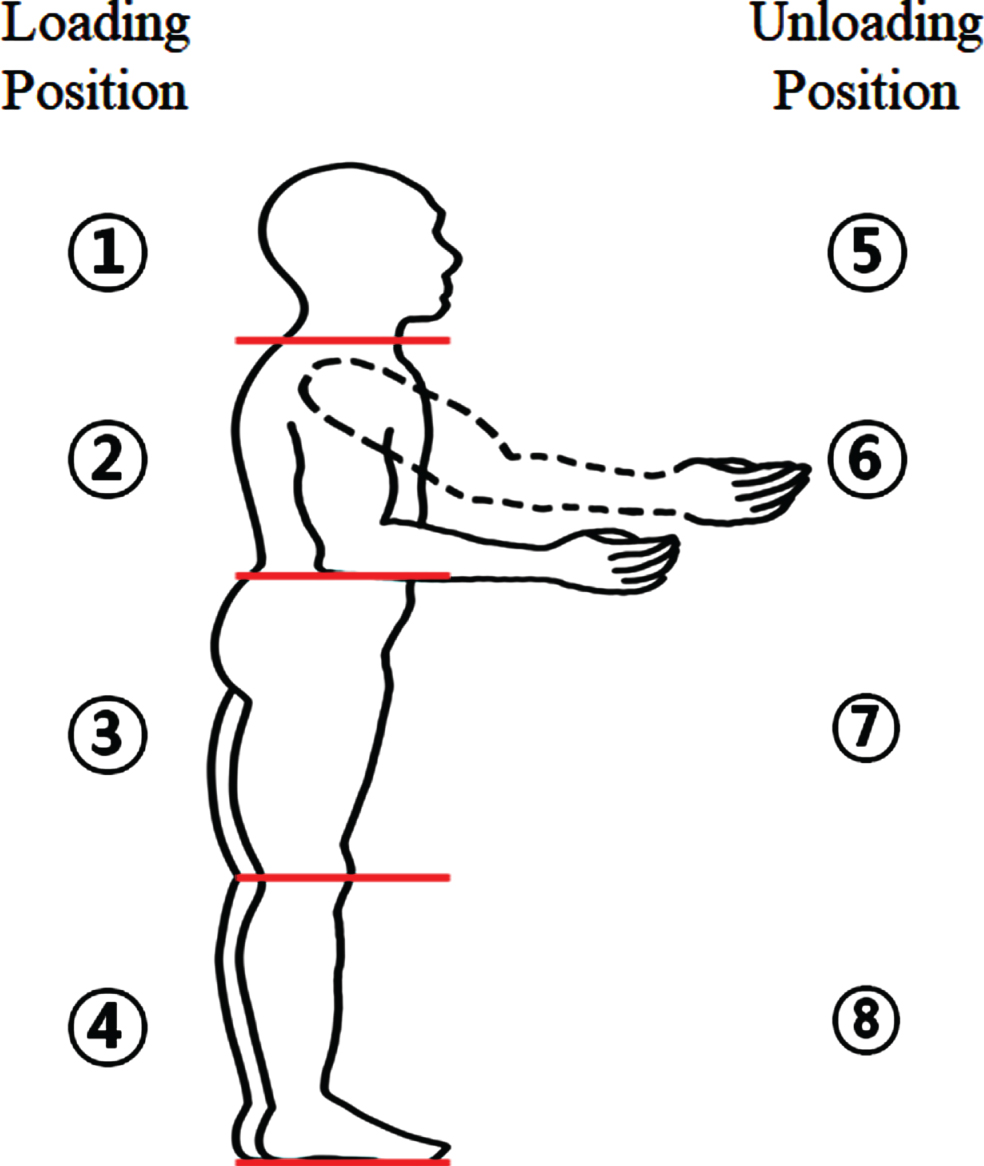
Classification of actions for loading and unloading tasks.
REBA was used to evaluate the extent to which individual workers are exposed to harmful factors that cause MSDs in the entire body. The results were given a total score between 1 and 15 points, and the score was then divided into five action levels. Action level 0 indicates that no special action is necessary, action level 1 indicates that action may be required, action level 2 indicates that action is required, action level 3 indicates that action is required soon, and action level 4 indicates that action is required immediately.
Evaluation items for the NLE
The NLE was used to evaluate the overall impact of the risk factors of loading and unloading tasks on workers’ spines. Tasks were categorized as risk factors if the score is higher than 1 and as non-risk factors if less than 1.
Survey method
Due to the increased workload caused by COVID-19 and the unique nature of work performed in various locations, it was difficult to investigate the actual environment. To supplement this, an online self-report survey about their working environment and postures in the situations they encountered most often was conducted. Regarding the self-report survey, there are opinions that problems exist in terms of reliability and validity [20], but it was found that validity and reliability could be secured to an acceptable level in jobs with durations longer than 35 minutes [21]. The total duration of the loading and unloading task, the subject of this study, is at least 1 hour and the workers have sufficient work experience; therefore, they would reasonably respond to frequent postures and their exposure levels. Further, through post-interviews, we checked whether workers understood the questions correctly and evaluated them appropriately. Subsequently, we examined the photos of where they worked and how they worked to confirm whether the self-reporting was appropriate. Through these methods, we tried to secure maximum validity and reliability of the self-report method. A total of 44 couriers participated in the online survey via Google Forms with questions regarding personal information, REBA, and frequent actions during loading and unloading. An additional NIOSH survey for skilled workers was conducted with eight couriers. The online survey was conducted from May 4 to May 31, 2021. For each survey, couriers working across South Korea were recruited, and training on how to fill out a survey and evaluate postures was conducted for the recruited subjects before the survey. The participants were fully informed of the study, and each participant provided informed consent.
Participants
Figure 2 shows the basic personal characteristics of the subjects who responded to the questionnaire. The subjects were recruited from the workers currently engaged in the delivery business in South Korea who perform both loading/unloading and delivery.
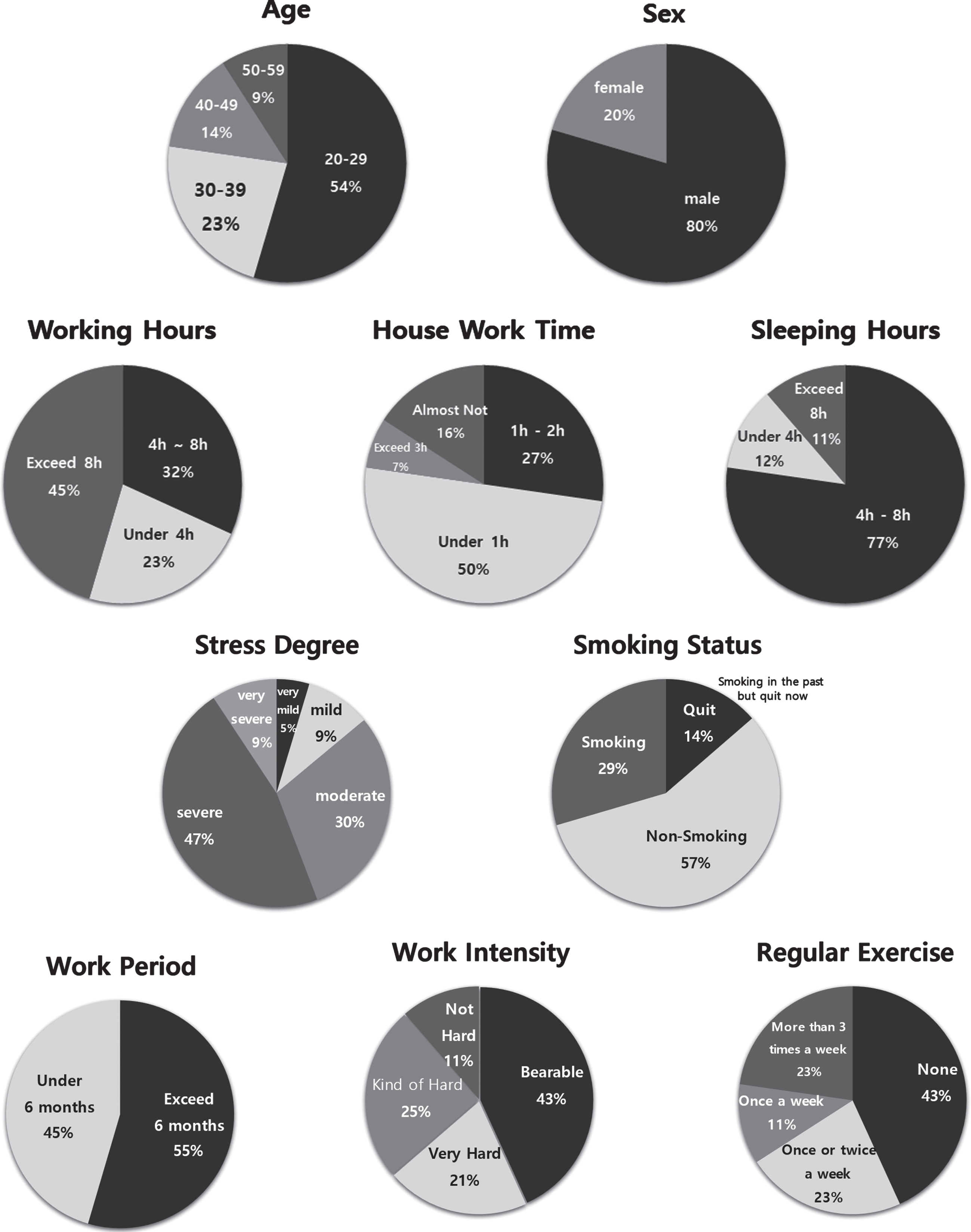
Participants’ personal and work-related information.
Musculoskeletal risk factors of couriers
Table 1 shows that 29.5% of the 44 subjects reported having MSDs. Shoulder topped the list of the aching body parts. Of the couriers, 13.6% responded that their pain persisted for one day to a week, and 15.9% reported that it persisted even after work. Regarding the frequency of pain, 22.8% reported that they experienced pain more than once a week. Further, 9.1% of the subjects’ disorders were untreated. The specific disorders included arthritis (2.3%), chronic lower back pain (4.5%), calcific tendinitis (2.3%), chondritis (2.3%), lumbar disc (2.3%), and others, including plantar fasciitis, lower back pain, rotator cuff disease, finger joint pain, swelling, and knee and shoulder complex pain (4.6%).
Statistics on the symptoms of musculoskeletal disorders
Statistics on the symptoms of musculoskeletal disorders
Table 2 lists the most frequent action types for loading and unloading. Among them, the 4-6 action ranked the highest (22.7%), followed by the 4-5 action (11.4%). For unloading, the 1-7 action was the most common (20.5%), followed by the 2-8 action (15.9%).
Results of action types for loading and unloading tasks
The data for the REBA survey items are presented in Table 3. In terms of loading, 61.4% of the cases had a neck slope greater than 20 degrees, with 34.1% having both a neck slope and twisting. Similar results were found for waist tilt, with 45.4% twisting or tilting the waist sideways. Leg tilt accounted for 56.8%, which is more than half, with one leg inclined forward, indicating excessive knee usage. The average weight of the packages was 5–10 kg, with a rating of 45.5%. The upper arm inclined between 45 and 90 degrees was present in 56.8%, while 68.2% had the upper arm folded, supported, or tilted and the shoulder tensed. In total, 52.3% said their lower arm slope had an action radius between 60 and 100 degrees, and the wrist slope was found to be unbiased at a specific angle. In addition, the wrist was significantly twisted.
Behavioral statistics of loading and unloading tasks for REBA
Table 3 also presents the results of the REBA score for unloading. The neck slope exceeded 20 degrees for 54.5% of the participants, while it was tilted or twisted for 43%. More than half of the couriers (65.9%) worked in a position with a waist tilt of 0–60 degrees, and 56.8% worked in a twisted or bent posture. Furthermore, 65.9% worked in the posture with one leg inclined forward, and 36.4% said that their angle of knee tilting exceeded 60 degrees. In terms of the weight of the package, the 5–10 kg category accounted for 47.6%. The most common upper arm tilt was that of 90–180 degrees (47.7%). The upper arm folded, supported, or tilted and the shoulder lifted posture accounted for 61.4% of the total. Next, 52.3% had a lower arm slope of 60–100 degrees. Regarding the wrist slope, 36.4% had a twisted wrist. In terms of action type, 38.7% worked repeatedly in a confined place (more than four times per minute), and 50% said that the coupling (grip condition) was not ideal.
Three types of working actions were observed in REBA, as shown in Table 4. More than half of the participants (52.3%) repeatedly worked in a narrow range (four times or more per minute); in general, the combination of coupling was said to be poor (43.2%).
Types of actions during loading and unloading tasks for REBA
The risk level was assessed based on the REBA results. The REBA scores for loading and unloading of all 44 subjects were 9.02 and 8.57 points, respectively. This indicates that the risk of loading was 0.45 points higher than that of unloading. As shown in Table 5, the most common score for loading was 8–10 points (36.4%), while more than one third of the subjects (34.1%) scored 11 points or higher. For unloading, 40.9% of the subjects scored 11 points or higher while 18.2% scored 8–10 points. Moreover, the risk was substantial enough to account for approximately 60% with 8–13 points for both loading and unloading.
REBA scores for loading and unloading tasks (N = 44)
In the REBA evaluation, the risk for each region is expressed, as shown in Fig. 3. In Fig. 3, the y-axis represents the average value of workers compared to the maximum REBA evaluation value for each part. The closer it is to 1, the closer it is to the maximum evaluation value, indicating that the work characteristics are not good. As a result, in both the upper and lower levels, all areas except force, load, and upper arm showed a value of 0.6 or more, and the values of the wrist and lower arm areas were relatively high.
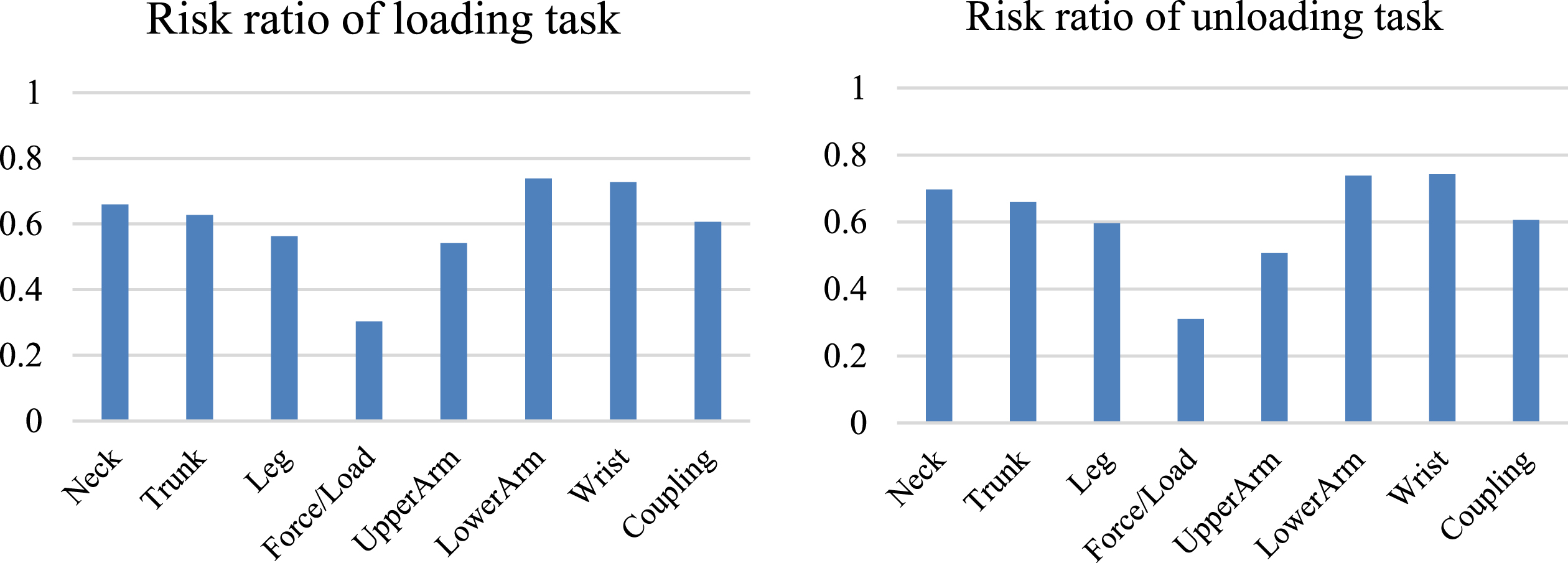
Risk of MSDs according to body parts based on the REBA results. The closer the value is to 1, the higher the risk of MSD.
Table 6 shows that three of the eight participants who responded to the NLE questions said that their average working weight was 10 kg or more, and the remaining said that their maximum weight was 20 kg or more, showing that the participants were carrying heavy loads on average. Furthermore, two participants answered “poor” for the question on the ease of handling, indicating that a high number of the workers were uneasy at work. Clearly, the participants worked for long periods of time since four subjects responded that their working time exceeded eight hours. Taken together, it appears that a large percentage of individuals painfully continue their work for long periods of time with heavy workloads. Finally, the NLE determines whether a given task is a risk factor. It is considered to be a risk factor when the score surpasses the threshold of 1, and all eight participants were deemed to be at risk.
Results of NIOSH lifting equation items
Figure 4 shows the results of averaging each multiplier value of the participants in the NLE and drawing it as a chart. In the NLE, the smaller the multiplier value, the worse the working environment. According to the results, the value of the horizontal multiplier, which is the height of the work, is 0.6. This shows that the far horizontal distance caused when lifting the package causes a burden.

Risk of MSD in spine by body parts according to the NIOSH lifting equation results. The lower the value, the greater the risk of musculoskeletal disease (HM, horizontal multiplier; VM, vertical multiplier; DM, distance multiplier; AM, asymmetric multiplier; CM, coupling multiplier; FM, frequency multiplier).
The relationship between the action types and symptoms, shown in Fig. 1, is recognized through the analyses of the musculoskeletal risk factors in Section 3.1. How the musculoskeletal complaints and disorders were linked to actions (1-5, 4-8) that are thought to load specific areas or actions (1-8, 4-5) with a vast operating radius was investigated.
As the package must be lifted above the head in 1-5, the shoulder joint is heavily utilized. One respondent indicated that the most common action for loading and unloading packages was 1-5 and that he had shoulder pain related to shoulder arthritis as an MSD. The case for 4-8 was an action to move the package while bending, and four participants said that this was the most frequent action. Two of them had symptoms; one of them had an arm and elbow disorder, while the other had shoulder, hand, wrist, finger, and back pain and calcific tendinitis.
This is the case for those who choose 1-8 as their most common action. Among the actions of unloading the package, this action had the largest width, and five subjects said it was utilized the most frequently. Four participants had symptoms; and all three symptomatic participants felt pain in their hands, wrists, and fingers. In addition, two participants experienced leg, neck, and shoulder pain. One patient (subject 19) was found to have arthritis; another (subject 18) had chondritis; and a third one (subject 8) had plantar fasciitis, lower back pain, rotator cuff injuries, and finger joint pain. Further, in the case of 4-5, which had the largest width among the actions to load the package, six subjects responded that they used this action most frequently. Two of them experienced disorders, and commonly had symptoms in their backs and legs. One of them (subject 22) had a herniated intervertebral disc (HIVD), while the other (subject 8) had plantar fasciitis, lower back discomfort, rotator cuff injuries, and finger joint pain.
Discussion
As a result of the high level of work intensity due to COVID-19, it is important to examine the risk factors of MSDs in couriers. The most demanding task during deliveries is loading and unloading packages, and this study used several inquiry methods to determine the dangers of loading and unloading, and the risk factors for MSDs.
The results indicate that 29.5% of the participants had musculoskeletal symptoms. The average REBA score was 8.8 points above and 8.5 points below, indicating a high overall risk. Furthermore, 60% of the participants were assigned a risk score of 8–13 points, indicating a significant need to improve the working conditions. In the case of NIOSH, all eight couriers with more than six months of experience had an LI score of 1 point or more, which was considered dangerous. Finally, a link was discovered between the type of loading and unloading action and MSDs.
In a study of MSDs in small-scale casting workers in India [22], only 27% had a REBA score of 11 or higher. However, in this study, the REBA scores for loading and unloading were 34.1% and 40.9%, respectively, and the REBA risk level was higher than that of similar general manufacturing jobs. In addition, in a study on the working posture of excavator industrial vehicle drivers with similar work behaviors, the REBA analysis showed that 58.25% of the 30 subjects were distributed at high-risk levels between 7–8. In this study, the average score was in the range of 8, and about 60% of the subjects were distributed between 8–13 points, and the risk of couriers seems to be very high. In comparison to the REBA results for the manufacturing industry or industrial vehicle drivers, the work risk of loading and unloading appears to be considerable.
The REBA results showed that both loading and unloading tasks caused high risk in the entire body area, and in most cases, risks of both loading and unloading were high for the same motion. This seems to be due to the many movements of bending or twisting the neck and waist during lifting or lowering the package [15]. In the process of lifting or lowering packages, bending or twisting the neck and waist is very dangerous for back- and neck-related MSDs such as those affecting the discs. In addition, the handle for lifting the package and the wrist-related area were also found to be poor. Factors affecting coupling are thumb width, wrist depth, palm depth, and indexation depth. This component was responsible for 37% of the load distribution [23]. Therefore, boxes with open sides should be universalized so that the grip can be increased, and the grip force can be less burdensome, or handles should be attached to heavy objects. In addition, the NLE results showed very high values (with an average of 1.62). Examining the multiplier value that lowers the RWL in NLE, HM and FM show very low values, indicating that the corresponding part has a problem. The average horizontal distance was 44 cm, indicating that the part is at a position relatively far from the center of gravity of the body when handling packages. This is because other packages inevitably become obstacles in the process of stacking or moving numerous packages. This can place a high burden on the lumbar region. Therefore, it is necessary to educate the workers so that the heavier the burden on them is, the closer it is to the center of gravity of the body. In addition, the number of lifts per minute is high. Owing to COVID-19, the number of loads per worker seems to have increased to a dangerous level. It seems that couriers’ risk of MSDs should be lowered with a systematic approach to allocate an appropriate level of work volume per person.
Another example of similar workplace can be found in a study that examined 63 delivery workers in Selangor, Malaysia [18]. Statistical analysis of the 90-item questionnaire in this study revealed that the following body parts experienced musculoskeletal problems: lower waist (60.8%), upper waist (39.2%), lower neck (21.5%), lower knee (16.5%), lower hip/thigh (11.4%), and lower ankle (11.4%). The body part with the least musculoskeletal problems was the elbow (3.8%). This is just a study that lists the MSDs that many couriers suffer from in order of frequency. Additionally, the focus of such studies has been limited to special situations, such as injuries [24]. This study seems to be the same in that it takes the loading and unloading of truck drivers as the risk assessment factor. However, it differs from other studies in that it aims to prevent MSDs in advance and identifies falls, slides, and defects in vehicles as the main causes of truck driver injuries. As such, studies that identify MSDs by carefully dividing the actions of workers by work type are insufficient. This study analyzed the loading and unloading REBA scores by investigating the slopes of the knees, arms, and waist, which are burdensome to the musculoskeletal system, by motion type. In addition, it was found that MSDs would occur in the arm/elbow part if the package was moved while bending down, the hand/wrist/finger in the movement of lowering the box, and the waist/leg in the movement of raising the box. In other words, it is meaningful in that it identifies diseases that are correlated with each type of action. In addition, unlike previous studies that reported shoulder discomfort affected by pulling, pushing, and lifting movements by industrial packaging companies [25], the actions taken in the process of loading (raising) and unloading (lowering) heavy packages were analyzed as the cause of diseases. In addition, decades of work history and shift work have been studied as the causes of shoulder and wrist pain [26], but this study is significant in finding that certain postures of loading and unloading workers cause MSDs in different parts of the body. Research on MSDs in truck drivers abroad [27–29] has mainly focused on the occurrence of diseases caused by driving. They focus on MSDs caused by long-term sitting, full-body vibration, and awkward posture during long driving rather than those caused when carrying packages. In contrast, this study investigated the factors and risks of MSDs caused by loading and unloading packages, which is the stage before and after driving. As a result, it was found that the musculoskeletal system to which the load is applied frequently causes pain in the shoulder joints, arms, and waist. The conclusion that truck drivers have a high incidence of MSDs is the same, but it is important to note that the cause occurs in the process of loading or unloading, and not driving.
Conclusion
This study investigated the degree of MSDs in couriers whose workload increased due to COVID-19 and the dangerous behaviors related to them. It is significant in that it focused on MSDs and the related risk factors in couriers during the COVID-19 pandemic and, in particular, identified its association with the behavioral characteristics of the task. In particular, it showed a very high level of musculoskeletal risk in terms of REBA and the NIOSH lifting guidelines, and that immediate supplementation in terms of work methods is required. The associated results on human body parts or risks analyzed in detail may help in the future correction and supplementation processes of these tasks.
Nevertheless, this study has several limitations. An online survey was conducted to understand the working environment of couriers, but due to their busy schedules, a large number of people could not be surveyed. As this study identified a high level of musculoskeletal risk for couriers, it is necessary to investigate maximum courier workplaces in future studies and improve the working environment based on the results. In addition, this study examined the most frequently encountered situations. However, some studies have shown relatively low reliability in the self-report method for specific information, such as exposure degree [20]. In future large-scale surveys, a more accurate investigation of the frequency of MSDs should be conducted to determine their risk. Further, this study conducted an online survey to analyze the overall working environment of couriers in various workplaces. To ensure the validity and reliability of this method, the subject was educated on the evaluation method, and an ergonomic expert also compared and reviewed it with the photos of the work site. However, this may have reliability and validity problems, because the analyst is not an ergonomic expert. In future large-scale surveys, the validity of such self-investigations should be verified for a more accurate analysis. In addition, couriers have a high workload in not only the loading and unloading tasks but also the delivery process. This study only considered the loading and unloading tasks that the workers subjectively reported having the highest load. Various difficulties in the future delivery process should be considered in future studies to identify the overall musculoskeletal risk of delivery work. Further, this study focused mainly on physical MSDs and behaviors, but the mental stress caused by COVID-19 could also affect work stress [30]. Research on the mental behaviors after COVID-19 could also be fruitful.
Ethical approval
The Institutional Review Board of Kyung Hee University provided an exemption determination for the study.
Informed consent
Informed consent was obtained from all individual participants included in the study.
Conflict of interest
None to report.
Funding
This research was funded by the National Research Foundation of Korea (Grant no. 2019R1C1C1011655).