



Abstract
BACKGROUND:
The aviation industry is a complex socio-technical system that has various parts which can be optimized by human factors and ergonomics.
OBJECTIVE:
The aim of this study was to provide insight into the collaborative ergonomic design process for an astronaut workstation within a small spaceship.
METHODS:
Having defined the project goals and other quantitative information such as anthropometric dimensions, the Catia software was then used for 3D modeling. Following the initial modeling, the RULA method was used to conduct the initial ergonomic analysis. Following the creation of a simple product prototype, other ergonomic analyses such as mental workload, perceived physical exertion, and usability were carried out.
RESULTS:
The results of the preliminary ergonomic analysis indicated that the RULA score was acceptable (the final scores were 2 and 3 for the nearest and the farthest controls). Furthermore, the secondary ergonomic analyses were all satisfactory. The mental workload, SUS, and Borg scores for Bedford were, respectively, 2.2, 85.1, and 11.4.
CONCLUSION:
The proposed product initially received an acceptable ergonomic store; nevertheless, in order to continue producing this product, ergonomic concerns must be taken into consideration.
Introduction
Various applications of ergonomics and human factors in the aerospace and aviation fields have been explicitly addressed over the last 40 years [1, 2]. The design of various aircraft components, including cockpits and passenger seats, can be considered as such [3–5]. Numerous studies have also been conducted on the wellbeing and performance of various flight personals [6, 7]. In addition, there has been a lot of interest in air traffic controllers and their profession which is to manage air traffic [8, 9]. On the other hand, ergonomics experts have recently viewed the aviation industry as a complex socio-technical system and sought to optimize these systems using holistic socio-technical system theories [10, 11]. The importance of human factors techniques in analyzing aviation errors also cannot be overstated [12, 13].
Some of the ergonomic assessment methods were developed specifically for the aerospace and aviationindustries, but their scope was later expanded to include other occupations. NASA-TLX is a well-known method for assessing cognitive workload; however, it is neither the first nor the last method [14]. As stated in the first section, this method refers to one of the largest space organizations. When it comes to NASA, it’s worth noting that sending humans to space is one of the most fascinating areas of aerospace and aviation. Various applications of ergonomics in human space exploration projects have been discussed in previous studies [15, 16]. Starting with physical ergonomics and its biomechanical and anthropometric assessment component [17, 18], the main concerns this area are astronauts’ range of motion, reach envelope, and strength assessment. Additionally, astronaut performance measurement is also regarded as a critical application domain [19]. Sensorimotor function, visual perception, and auditory perception of astronauts receive a lot of attention in this category. Numerous studies have also been conducted to investigate the effect of natural and induced environments on the performance of astronauts and space residents [20, 21]. The design of project architecture, hardware, and equipment is one of the many broad applications of ergonomics in the “sending human to space project” [22, 23]. In this regard, a number of researchers have addressed the ergonomic design of the astronauts’ workstation, including seats and cockpit displays. The relevance of these studies to the current study will be presented in detail in the state-of-the-art section.
In recent years, and especially after the successful project of sending a live monkey to space [24], the mission of sending a human space in Iran has been defined. This article is the results of a proactive approach to help this project in Iran. Given the variety of applications presented in the preceding lines, we believe that the integration of ergonomic principles from the beginning of the project can increase the probability of its success.
The aim of the current study was to design the workstation of a manned space capsule using a participatory design approach. The benefit of this study is that it considers a proactive approach to this design. In fact, ergonomic principles were applied throughout the spacecraft’s design process.
State of the art
A panel of human factors engineers and an astronaut who took part in the Orion spacecraft design process presented the design issues and human factors approaches used in the Orion spacecraft design process [25]. Based on the needs, safety, and performance of the Orion’s human crew, five distinct groups of activities have been completed, including: requirements and task analysis, modeling, design of displays and controls, crew accommodation, and anthropometry. In the first phase of the Orion project, the Human Factors practitioner used a functional and task analysis. The information gathered in the previous task analyses will be included in a discrete event simulation model in the following step (named as IMPRINT). Creating these models will help Orion designers understand how human capabilities/limitations interact with task characteristics. The next phase begins with the design of Orion’s controls and displays. The main concepts considered in this phase are usability, workload, and situation awareness. The following step is to consider crew accommodation factors such as acceleration, vibration, radiation, noise, extreme temperatures, and pressure differentials. The aim of this consideration is to ensure the pilot’s and other crews’ safety and performance. The final section investigates crew accommodation using anthropometric data, taking into account the effects of wearing a suit, pressurization, and both reduced and hyper gravity. One of the major challenges is to involve 99% of the prospective population in the design of the Orion. Another study looked at the broad application of human factors principles and Human-Systems Integration standards and recommendations to space vehicle design. A brief report on Applying Human Factors Methods and Principles to the Design of the Orion Vehicle was presented in the other section [22]. According to the authors, there are three major human activities that must be performed to ensure crew safety and performance: task analysis, modeling, and human in the loop evaluation. They also believe that each of these three activities can provide information help the Orion’s design process mature. Human Factors practices were significantly improved during the design process of the Orion’s seats, displays, and controls. A study is being conducted to present the Function Allocation Matrix Tool (FAMT) for designing Orion cockpit layouts [26]. The authors claim that the design of Orion’s displays and controls places an emphasis on human factor techniques and methodologies. They claimed that the use of this method guided the process of allocating displays and controls, and that it was the primary principle for designing the Orion’s display and control. The first step in using the FAMT is to derive a function and categorize it as one or more of several basic task types such as system management, navigation, flight control, communication, and so on. The following step is to decide whether the function requires displays and/or controls. The following section is devoted to collaborative teamwork. It all comes down to functional rankings. Each function is ranked by participants in four categories: hazard criticality, direct control of spacecraft, operational criticality, and frequency of use. For the aforementioned dimensions, they assign four numbers ranging from 1 to 5. Display area allocation was piloted based on the combination of these scores. A high score indicates that the function’s potential workload and relative importance are both high. Displays and controls should be placed in relation to the pilot’s resting line of sight for maximum ease of use. The area 1 with no head motion and little arm motion received a score of 16 to 20. Similarly, areas 2 and 3 are ranked second and third, with scores ranging from 11 to 15, as well as 10 and below. Hamblin et al. created a Cursor Control Device for the Orion Crew Exploration Vehicle and published their research procedure [27]. They implied that this cursor control is important for interacting between the astronaut and the vehicle the astronaut is restrained due to the dynamic flight phase. According to one section of this article, unlike the shuttle spacecraft, Orion’s deck has a fraction of the physical buttons as the shuttle spacecraft. Although this spacecraft uses Rotational Hand Controllers (RHC) and Translational Hand Controllers (THC), it also requires an additional controller to allow the operator to interact with the vehicle during the ascending/landing phases of the flight, which we call ‘dynamic phases’. During these phases, the operator’s reach capacity is limited, and they are unable to interact with the control panel due to the microgravity situation and the spacecraft’s acceleration. As the first step in designing this cursor control, the authors performed a functional requirements analysis. The operator’s workload and human error are the two main indicators for this step. They also stated that the most important requirement for the design of this product is that any automated functions be controlled manually by the operator. They assigned the new controller to the left hand of each Orion operator. As the design progresses, the anthropometric indices of the operator, such as palm breadth and finger length, become increasingly important. Another critical parameter that they adhered to during the design was the use of cursor control with pressurized gloves to accommodate any decrease in cabin pressure. Following the consideration of these functional requirements, which did not include all of them, it is now time to consider user requirements. Several astronauts assisted human factors engineers in translating their expectations into the design of the new cursor control in this step. The FMAT method, which was described earlier in this section, was also used in this study to determine functionality based on each attribute’s contribution to task, mission, and safety criticality. After considering these requirements, the initial prototype of the product was created. Then, some human performance evaluations were implemented, such as cursor behavior, cursor mechanism range of motion, cursor input/output ratios, and break out forces. In the final section of the article, the significance of the new cursor control’s participatory design is emphasized. A recent study has presented the Adaptive Process of Spaceship Cockpit Architecture Design [28]. The paper compared two vehicles, the Soyuz TMA and the STS Orbiter, in terms of cockpits, ergonomics, and overall human system integration. It also introduced the Adaptive Spaceship Cockpit Architecture design framework. The importance of paying attention to physical and cognitive ergonomic principles in the design of space systems was also discussed in the article. According to the authors, ergonomic recommendations on the display and controls layout were presented during the Orbiter’s cockpit design, but it was not highly prioritized. The Soyuz vehicle’s engineering design points are as follows. The results of an interview with three Shuttle commanders were presented in the middle of the article. Two of the three interviewees stated that some controllers are out of reach and that Displays should provide information relevant to the immediate context.
Seating is a critical stage in the design of a spacecraft. Gohmert presented the findings of a study in this regard [29]. The author believes that two specific aspects of a seat should be considered: seat layout and seat design. He also stated that seat layout will lead to the definition of the number, shape, and posture of the seats. This design must take into account safety, ergonomics, operability, and crew rescue. One of the most important parameters in this regard is the use of anthropometric measurements. The most important thing to remember when using anthropometric data, according to the author, is that the ranges are applied to each segment of the body individually. Also, when discussing ergonomics considerations in vehicle seat design, keep in mind that, as the author implies, bad seat layout and G acceleration will impair some of the commander’s cognitive abilities. In the aforementioned article, a conclusion was reached on the critical points in the design of a spacecraft seat, including ergonomic and anthropometric considerations that designers must adhere to. The name of a large project to add ergonomic design principles to Shuttle vehicles is Cockpit Avionics Upgrade (CAU) [30]. The project’s goal is to improve safety by increasing crew situation awareness, reducing workload, and improving performance. The findings of a study was presented by McCandless and his colleagues in this regard. Simulators were used in this study to evaluate the ergonomic parameters of a newly redesigned cockpit. To ensure the quality of the design, both subjective and objective data collection methods were used. They stated that the new cockpit’s design process included not only input from the end-user (potential commanders), but also input from engineers who had provided a realistic indication of the feasibility of implementing the new design. The researchers concluded that, despite their great success in optimizing the ergonomics of the new display versus the old display, these screens were never operational due to budget constraints. However, this project teaches a valuable lesson that can be applied to future designs.
A recent study by Chinese researchers suggested the importance of ergonomics in the design of a spacecraft’s control and display components [31]. They presented their research, which is based on user behavior data. The GOMS (goal-operators-methods-selection) method is used in part of this study to analyze the relationship between user factors and vehicle interface design. They used an eye-tracking technique to select the best cabin layout after proposing a new one. The average saccade amplitude and fixation points in the eye movement experiment were calculated and compared between two proposed layout designs in this regard. The authors combine the results of the GOMS method and the experimental section in the final section of the paper and propose an efficient display and control layout for the vehicle. As in the previous article, other researchers [13] emphasize the importance of user input in product design, which we call participatory design in this study. As mentioned in the reviewed state-of-the-art section, we believe that using ergonomics parameters, particularly physical and cognitive ergonomics, is an efficient path to achieve the best console design in our project. We defined our methodology section in the following section based on theseinputs.
Materials and method
With the methods of the reviewed papers in mind, we proposed a seven-step procedure for the current study. This research is a true development of a vehicle console and seat that will transport one person to space. For this study, we took a proactive approach to ensure that human factors and ergonomics principles were fully integrated from the beginning of the design of the vehicle. A prospective astronaut was also part of the vehicle design team, which used a participatory approach. Throughout the entire design process of this spacecraft, an ergonomist collaborated with the engineering team as a facilitator. The seven design steps are outlined in the sections below.
Determining the aim of the project
This mission is a sub-orbital deployment program based on the research institute’s policies, as well as budget and time constraints. In this project, a previously chosen and trained human will ascend to sub-orbital heights and return to Earth without interruption. Therefore, the effect of zero gravity will not be present in this project, and we will have some minor effects of microgravity along with acceleration in terms of dynamic flight phase. The first step in ergonomic design is to consider these points by creating a series of functional constraints. We discovered that in this mission, only one human will interact with the vehicle, and we only need one chair to keep him/her stable, especially during dynamic phases. Evidently, subsequent missions may be carried out for different purposes and with different numbers of humans, necessitating new ergonomicpoints.
Performing of the hierarchical task analysis technique
Previous research has shown that hierarchical task analysis is one of the most important early stages in space mission ergonomics [32–35]. The project’s ergonomist also had a track record of successfully completing a panel design project for a city train that used the same (but not identical) method for hierarchical task analysis [36]. The results of hierarchical task analysis are one of the important inputs for subsequent ergonomic analysis in the currentproject.
Allocation of visual/audial interface and controllers for each task
At this stage, the engineering team, design team, and prospective astronaut of the project were involved on one hand, and the allocation of display, sound alarm, controller, or a combination of them for each task or sub-task was completed on the other. It denotes that the requirements of each task were determined using the results of the hierarchical task analysis. In the following step, these requirements were met with the appropriate tool
Ranking the importance of sub-tasks based on three criteria
Following the identification of the console’s interfaces and equipment in the previous stage, the question of priority for placement of each of them arises.
NASA researchers have addressed this question in a variety of ways in previous articles [26]. A three-pronged criterion was established at this stage to prioritize the placement of displays and controllers based on mission objectives. Potential risks associated with the spacecraft’s main functions and the repetition of use during the mission are among the criteria mentioned, each of which was assigned a score from 1 to 5. As a result, each display or controller received a final score ranging from 3 to 15. The higher the score of a monitor or controller, the closer it was to the astronaut’s line of sight or comfort initial access zone.
Initial 3D modeling of the console considering the principles of anthropometry
The anthropometric dimensions needed to design the distances were obtained from domestic sources at the beginning of this stage. These indices were used to determine the primary and secondary access limits for the console in front of the astronaut as well as the main dimensions of the seat. The initial 3D design of this system was completed in collaboration with the design team and mechanical engineers using Catia software (V5-R20). The project’s ergonomist collaborated with the team at every step that required ergonomic information. In addition, the first ergonomic analysis of the initial product was performed using Catia software’s “Ergonomics Design & Analysis” work bench.
Preparation of a simple prototype of a 3D model using inexpensive equipment
In order to have a tangible simple product at the next level, we printed the 3D view of the product on foam board and used it with a chair to mimic the work station of an astronaut for the prospective user groups.
Use the prospective users and hold usability, workload, and Perceived Exertion tests
We used a chair in the orientation that the astronaut will sit during the mission in the final spacecraft to prepare the workstation for field tests. It was a horizontal seat platform with a 90-degree seat angle [37]. Based on the mentioned position, the initial product from the previous stage was installed in front of the user. We considered the best line of sight and access limitations when designing a comfortable workstation (Fig. 1).
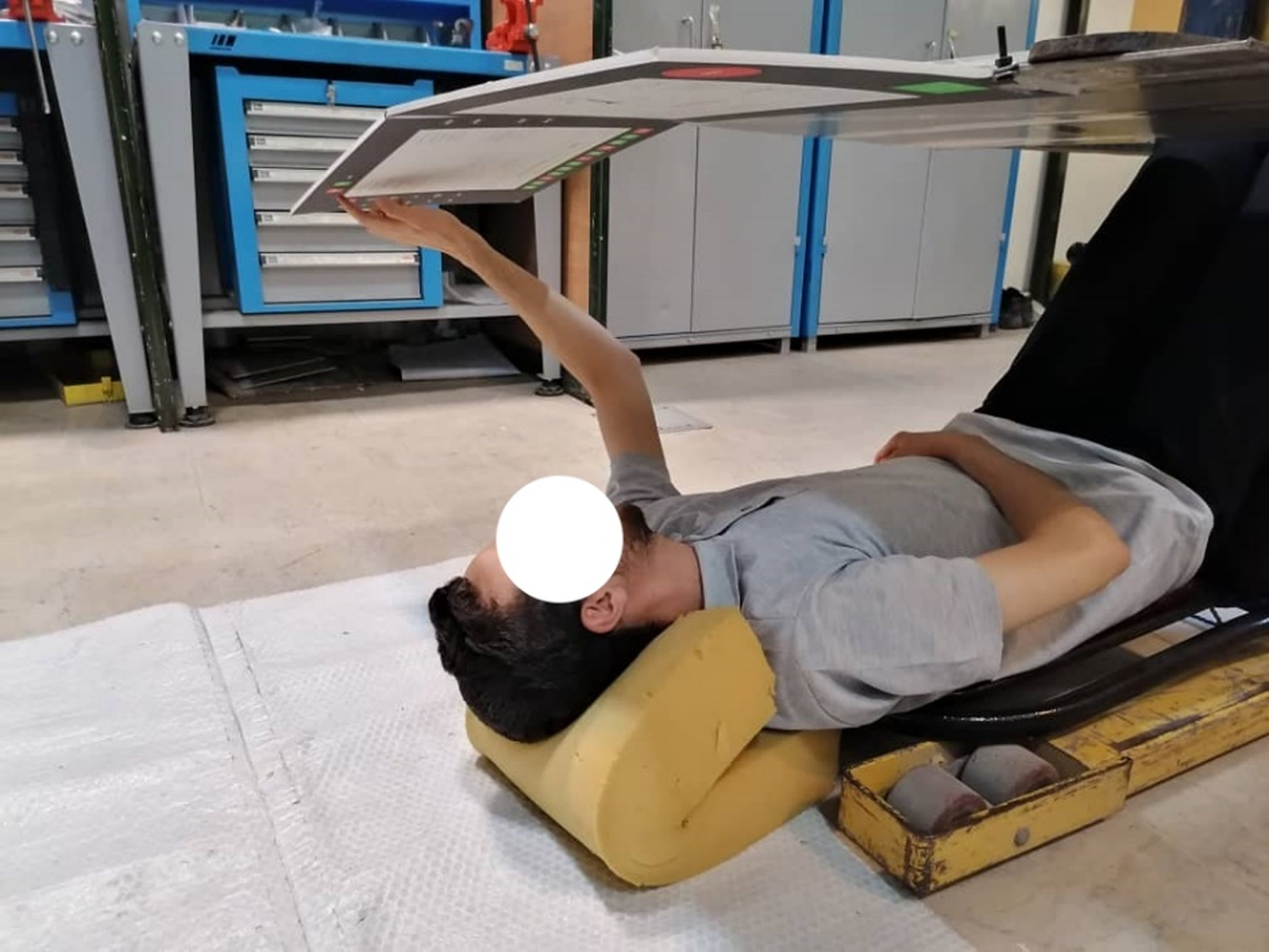
Prospective user test of the prototype.
To conduct the aforementioned ergonomic analysis, a fixed scenario was first defined for all participants (N = 10). Participants confirmed that they had read and understood the scenario completely at the end. In this scenario, the participants pretended to be on a space mission and had to use the specially designed control panel to obtain the necessary information for a successful mission and to intervene with the controllers. Following the scenario, the participants were asked about their perceived mental workload, product usability, and physical exertion. The Bedford workload scale [38], system usability scale [39] and Borg Rating of Perceived Exertion scale [40] were respectively used for this purpose.
The first tool is based on the Cooper-Harper rating scale. It is a one-dimensional scale that ranks whether the task could be completed, whether the workload was tolerable for the task, and whether the workload was satisfactory without any changes. The final result declared by the participants as their workload includes a number between 1 and 10. The second instrument is the SUS, which is a widely accepted method for assessing a product’s usability. It consists of ten questions, with a final score ranging from 0 to 100. The latter is a widely accepted subjective tool for assessing a participant’s physical efforts and exertion. The Borg scale has a range of 6 to 20 in one form.
Following the receipt of the written responses, a semi-structured oral interview was conducted to obtain additional comments about the panel layout and other ergonomic points from the participants.
Small changes were made to the initial product based on the analysis of the questionnaire results and the comments of the interview. As a result, the modified product was distributed to the manufacturing, production, and engineering teams so that the process could continue.
Results
HTA
The HTA was completed for both nominal and off-nominal situations. We defined 10 tasks and 35 sub-tasks for the first situation. Receiving the spacecraft for boarding, landing at the end of the mission, and exiting the spacecraft were among the tasks (see Fig. 2).
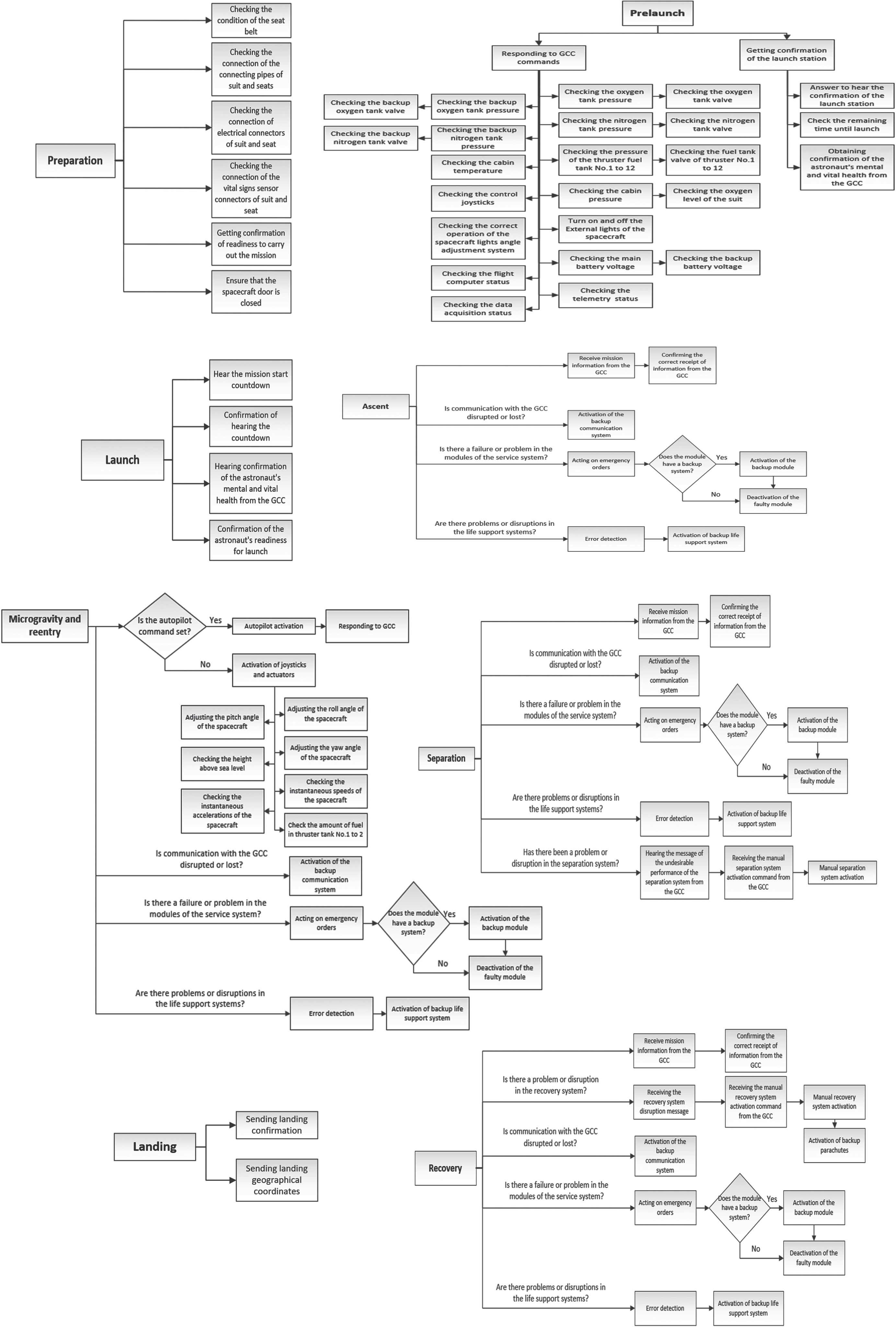
HTA of the mission.
We determined the priorities of various display sections and the location of the controllers based on the aforementioned criteria. The closer a visual information’s score was to 15, the closer it was to the participant’s line of sight, so there was no need to turn the neck for important and vital information. Furthermore, the closer a controller’s score was to 15, the closer the controller was to the user’s hand. The minimum and maximum visual information scores were 9 and 15. Two subtasks received 15 points, while five subtasks received 14 points. As a result, it was decided that accessing this information through their presence in the astronaut’s line of sight was necessary.
Initial 3D model of the product
Catia software was used to create the astronaut’s seat and front display panel. Based on the findings, the chair was designed as a horizontal seat platform with a 90-degree seat angle, and the information was presented to the user through two primary and secondary displays.
Ergonomic analysis
The proposed product underwent the necessary ergonomic analyses in two stages. The results of the RULA method in the first stage of the analysis in the Catia software showed that the score is acceptable in both modes of access to the nearest controllers and access to the farthest controllers. In static mode, the calculated score for close buttons was 2 and 3 for far buttons. The results of this analysis are shown in Fig. 3.

Results of the RULA assessment method.
According to the position of the controllers, the upper image corresponds to the score of the astronaut’s right hand and the lower image corresponds to the score of the astronaut’s left hand in the intermittent use. The ergonomic analyses in the following stage were linked to the final target group’s use of the initial prototype on foam board. After completing the 10-minute scenario, each participant completed questionnaires on mental workload, usability, and perceived physical exertion.
As presented in the Table 1, the mean score for mental workload, usability and physical exertion were 2.2, 85.1 and 11.4 respectively.
Ergonomic analysis of the prototype
1: Participant, 2: Year, 3: Centimeter, 4: from 1 to 10, 5: from 0 to 100, 6: from 6 to 20.
The goal of the current study is to create an initial prototype of a workstation in a space vehicle with one astronaut. To achieve this goal, a hierarchical task analysis was performed first, as in previous studies. [31]. The spatial priority of the visual information on the display and the priority of access to the controls relative to the astronaut’s location were determined in the following step, using a scoring system based on the project goals. For NASA’s Orion spacecraft, Olofinboba et al. used a function allocation matrix tool for the same purpose [41]. In contrast to our method (which had three categories), they used four: hazard criticality, direct control of the spacecraft, operational criticality, and frequency of use.
Tools previously used in aviation projects were used for ergonomic analysis [20, 42]. According to the results obtained for the ergonomic indicators, the results are within the acceptable range declared by volumes 1 and 2 of the NASA-STD 3001 [21, 43]. According to this handbook, mental workload should be less than 3 and usability should be greater than 85.
We think that the reason for the acceptance of these measures were the end user involvement in the design of this product, and in fact, the use of participatory design method. As a result, we concluded that it can pass the current step. This was the first step in incorporating ergonomic principles into this new product. As the steps towards the final product progress, various ergonomic tests must be performed on it.
One of the most serious limitations of the current study is the difference between the proposed product and other products in this family. As a result, an appropriate amount of innovation has been used in the project’s ergonomic evaluation methods, in accordance with the project’s goals. The small number of participants is the next major limitation. This is also insignificant given the product’s small potential user base.
Ethical approval
Not applicable.
Informed consent
All participants declared their participation in the final stage of the study.
Conflict of interest
The authors declare that they have no conflict of interest.
Footnotes
Acknowledgments
None to report.
Funding
This project was supported by the Aerospace Research Institute.