



Abstract
BACKGROUND:
Physical activity programs at the workplace have shown positive results on physical capacities and pain for several years. Due to the duration of the training session or the need for an instructor, these supervised programs are rather difficult to implement. For this reason, numerous companies, especially companies in manual sectors, are turning to another solution, i.e. warm-up intervention before the work shift. These interventions present various advantages such as short duration and the possibility to perform exercises in working clothes. Surprisingly, while the positive effects of warm-up interventions on pain, performance, and physical and psychological capacities are expansively reported in the sport context, effects of workplace warm-up intervention are lacking.
OBJECTIVE:
The aim of this study is to assess the acute effects of three different warm-up interventions on physical (pain, strength, flexibility) and psychological (workload) functions and also on work-related outcomes (work performance, readiness to work) among vineyard workers.
METHODS:
A cluster randomized study will be implemented among French vineyard workers. Four groups of 30 participants will be constituted; corresponding to four different conditions: (1) hybrid warm-up intervention (HWU); (2) dynamic warm-up intervention (DWU); (3) stretching warm-up intervention (SWU); (4) no warm-up intervention (NWU). A total of 120 vineyard workers will be recruited to participate in the study.
CONCLUSION:
The results will provide more evidence about the short-term effects of warm-up interventions at the workplace and will provide more evidence on which warm-up modality is the most effective on pain, performance, and physical and psychological capacities among vineyard workers.
Background
For the last few years, sport or, more broadly physical activity, has interfered in various occupational sectors. As an example, when some companies may offer a sports room to their employees [1], others provide workplace physical activity programs [2–4]. Interestingly, these programs have proven their effectiveness improving pain, muscle endurance, and strength among manual workers as well as among office workers [5–9]. To summarize, workplace physical activity programs may under specific circumstances (i.e. supervision, adapted program, and exercises durations) counteract job exposure overloading, or physical inactivity [10, 11].
With this in mind, it is not surprising to observe that many occupational sectors (e.g. agriculture, construction, industry) inspiring by sports offer workplace warm-up interventions to their employees [12–15]. Warm-up intervention preceding physical activities is widely adopted in a sport context and serves several objectives such as reaching optimal athlete physical and psychological potentials [16–18]. A simple and easy way to define warm-ups is to consider them as exercises preparing the body for subsequent physical activity [19]. In sports, warm-up interventions can be divided into three main categories: (1) dynamic, (2) stretching, and (3) hybrid warm-ups. Each of these modalities presents strengths and weaknesses [18–21]. For instance, dynamic warm-up interventions have positive effects on muscle force or performance [21] but no significant effects on pain or injury reduction [19]. At the opposite, stretching warm-up provides positive effects on muscle stiffness, range of motion, and pain reduction [22], whereas no significant effects or even negative effects have been reported on muscle force and performance [22, 23]. Finally, it comes as no surprise that hybrid warm-up, a combination of dynamic and stretching exercises, induces moderate positive effects both on performance and on muscular stiffness or pain [19].
Interestingly, a parallel can be draw between results observed in sports and workplaces. For instance, Di Stefano et al. [24] assessed the effects of a 6-weeks dynamic warm-up intervention on military recruits reported an increase in lower-leg muscle force. Gartley and Prosser [14] and Aje et al. [15] reported that 3 months of stretching warm-up intervention had positive effects on pain-related outcomes among tin mill and food factory workers. Holmström et al. [13], offering construction workers a 3 months hybrid warm-up intervention reported positive effects on both strength and muscle flexibility. However, there are considerable differences between the number and quality of studies implemented warm-up interventions in sports and at the workplace. To the best of our knowledge, the 4 studies [13–15, 24] described above are the only ones assessing the effects of warm-up intervention on physical capacities and injury in a workplace context. Furthermore, these 4 studies present major methodological limitations regarding heterogeneity or blinding and none of them compared the 3 warm-up modalities on physical and work-related outcomes.
The few studies on the subject of workplace warm-up exercises are inconsistent with the growing interest of numerous companies for such intervention. To address this gap, there is a need to design, implement and assess workplace warm-up interventions. This is of particular importance, especially among employees exposed to heavy physical workload. In this sense, agriculture is one sector of great interest. Agriculture and especially viticulture is known to expose workers to repetitive work, awkward postures, and high work pace [25, 26]. In France, viticulture is one of the top sectors affected by work-related musculoskeletal disorders (WMSDs) [27]. In this occupational sector, areas the most affected by WMSDs are the neck, the low-back, and the upper extremities [28]. Most of the time, such conditions may result in pain, fatigue or can lead to a decrease in muscle strength and flexibility. WMSDs may also be responsible for a lower productivity [28–30]. Thus, considering the aforementioned studies and the positive effects of warm-up on these outcomes, it seems relevant to experiment warm-up intervention among vineyard workers.
Therefore, the aim of the present study is to compare among vineyard workers the acute effects of 3 different modalities of workplace warm-up intervention on physical (pain, strength, flexibility) and psychological (workload) functions, and also on work-related outcomes (work performance, readiness to work).
Methods
Study design
A cluster randomized study will be implemented in 2022. Participants will be vineyard workers recruited from January 2022 among multiple vineyard companies located around Bordeaux (France).
Sample size calculation
The sample size calculation, using an alpha risk of 0.05 and a beta risk of 0.20 with an estimated follow-up loss of 15%, highlighted a need for 30 subjects per group. There will be four study groups corresponding to four different conditions: (1) hybrid warm-up intervention (HWU); (2) dynamic warm-up intervention (DWU); (3) stretching warm-up intervention (SWU); (4) no warm-up intervention (NWU); a total of 120 vineyard-workers will be recruited to participate in the study.
Recruitment and flow of participants
Inclusion criteria for participation will be being aged from 18 to 60 years, not to present previous surgery in the low back region in the last 12 months [31], working full time, and having at least 1 year of employment in the company [12]. Both men and women will be considered for inclusion. Subject recruitment started in January 2022 and, together with data collection, is estimated to last until January 2023. Participants who will meet all inclusion criteria will be offered the opportunity to participate in the study.
Randomization and blinding
At the beginning of this study, a pre-visit will be organized individually to collect potential participants’ characteristics. Randomization and allocation will be performed after this baseline data collection. A homemade computer program will be created to cluster and randomly allocate the 120 eligible participants in the four different groups (HWU, DWU, SWU, and NWU) presented above. Participants will not be aware of their allocated group. In this study, the research team members in charge of (1) data collection (NL) and (2) and the supervision of warm-up (NL, AJ, and SM) will know the treatment allocation. Another research team member blinded to the assignment will be responsible for data analysis (RB).
Ethics
All participants will be informed about the purpose and content of the project and will give their written informed consent to participate in the study. All data collected (written informed consent, baseline participants’ characteristics, tests \dots) will be stored for 15 years in a researcher’s office. The research plan has been approved by the CERSTAPS (registration number n°IRB00012476-2021-06-12-137), a national French ethics committee for research in physical activity. The study also follows the recommendations of the SPIRIT guidelines [32]. A SPIRIT checklist with references to the relevant page numbers of this protocol is provided (see Additional file 1).
Working activity
Pruning
During winter, pruning activity takes up most of the vineyard workers’ working time. During this period, usually from November to April, vineyard workers have to slightly reduce the size of the grapevine by removing branches. From the vineyard perspective, pruning is necessary to train the grapevine, maintain its health, improve the quality of the grapes, and restrict its growth. From the vineyard workers’ perspective, pruning leads to highly repetitive movements of the arms and forearms and the adoption of extreme postures of the back [26, 33] (Image 1).

Vineyard worker during pruning activity.
A warm-up intervention will be implemented and the acute effects of a single warm-up session will be evaluated. The three warm-up modalities will last 15 minutes and will be performed before the working day (8:00 am), in regular working clothes. Warm-ups will be supervised by one research team member in charge of (1) presenting the exercises and (2) enforcing exercise security instructions. The three team members (NL, AJ, and SM) who will present warm-up sessions to workers are graduated with a master’s degree in sport science and specialized in WMSDs prevention among vineyard workers. Exercises between each modality will be different but will target body regions highly solicited over participants’ working day, e.g. neck, low back, and upper extremities. Each warm-up intervention modality is described below. At the end of the 15 minutes of the warm-up session, vineyard workers will be invited to start as fast as possible pruning. Vineyard workers could stop warm-up at any time in case of unusual pain or discomfort.
Hybrid Warm-Up
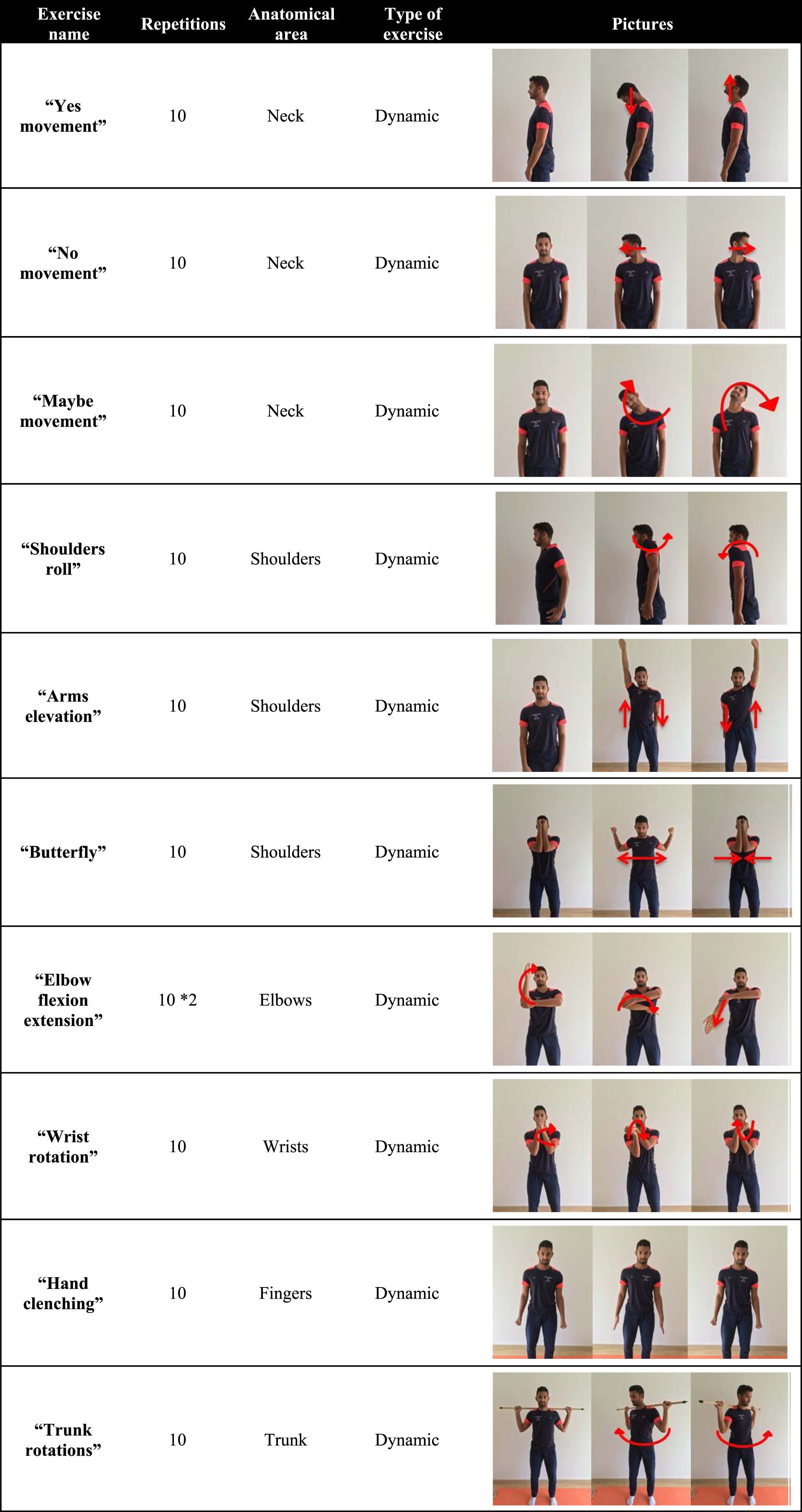
The HWU intervention will involve 20 exercises, presented in Table 1. These exercises will be a combination of dynamic exercises and stretching exercises. This warm-up intervention will be based on the one implemented by Holmström and Ahlborg [13] among construction workers.
List of the exercises included in the Hybrid Warm-Up
List of the exercises included in the Hybrid Warm-Up
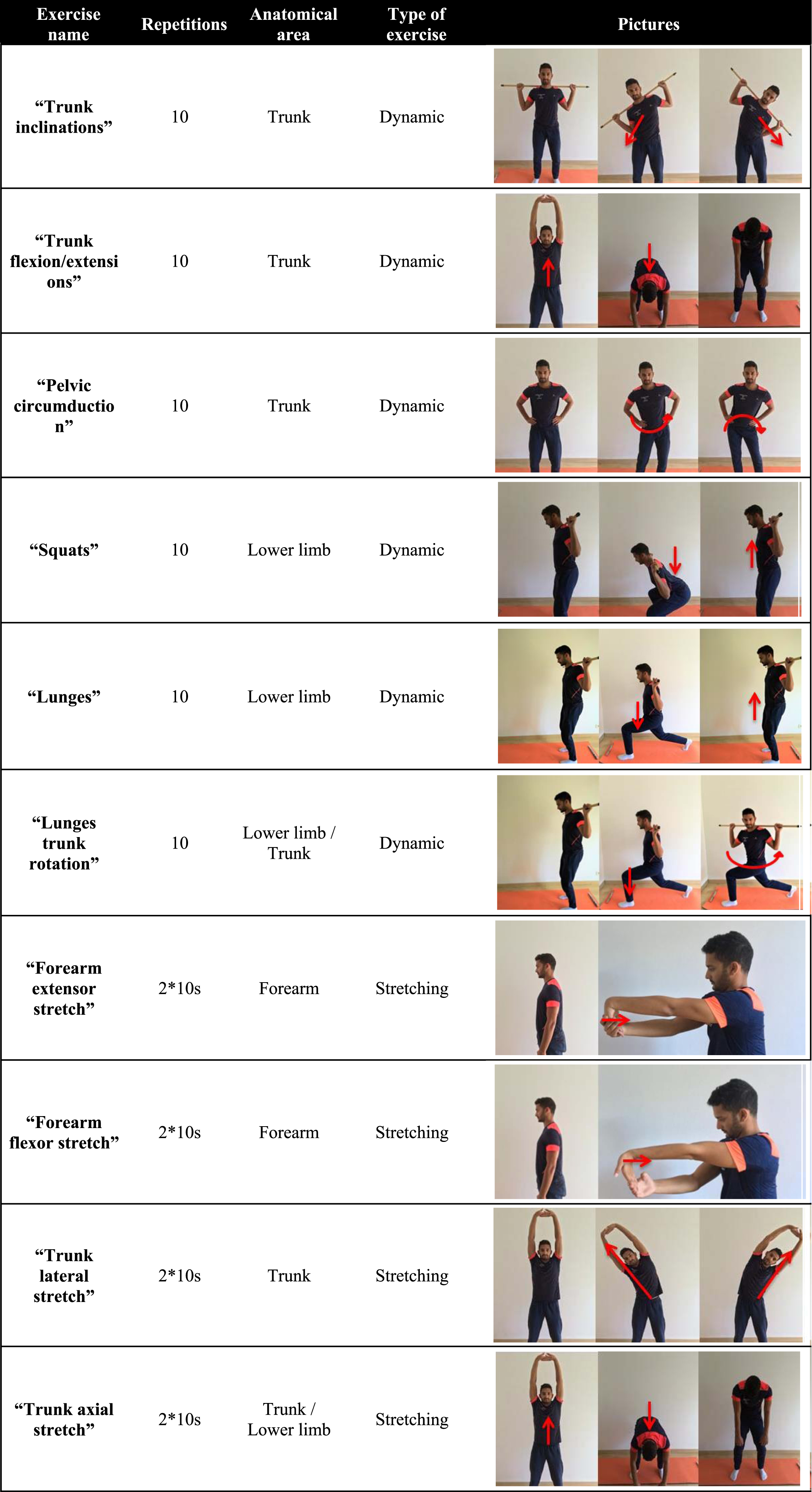
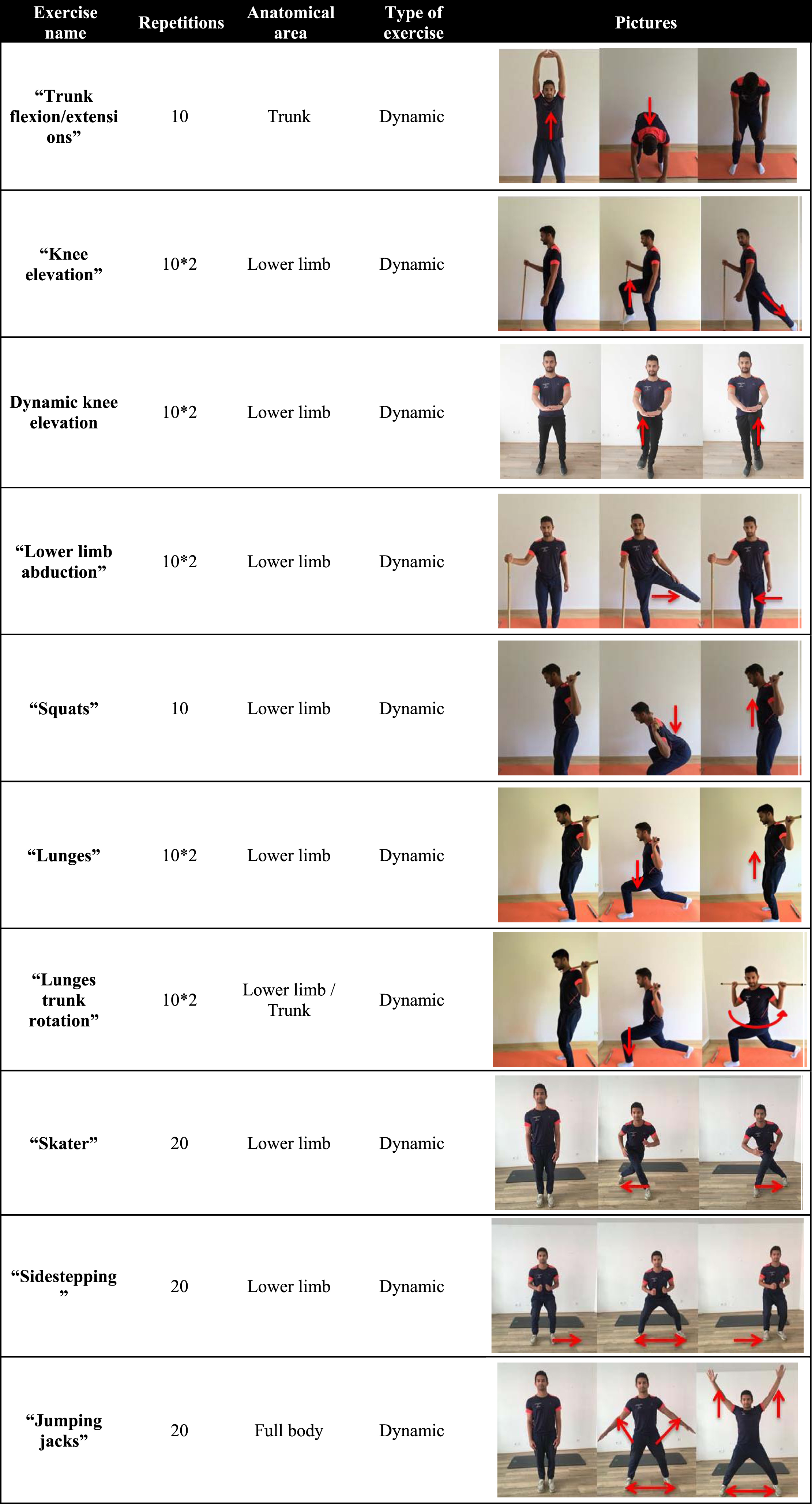
The DWU intervention will be divided into 20 exercises, presented in Table 2. These exercises are specifically designed to increase the heart rate and attain the intensity recommended by Bishop [34]. This warm-up intervention is based on the one implemented by DiStefano and colleagues [24] among military recruits.
List of the exercises included in the Dynamic Warm-Up
List of the exercises included in the Dynamic Warm-Up
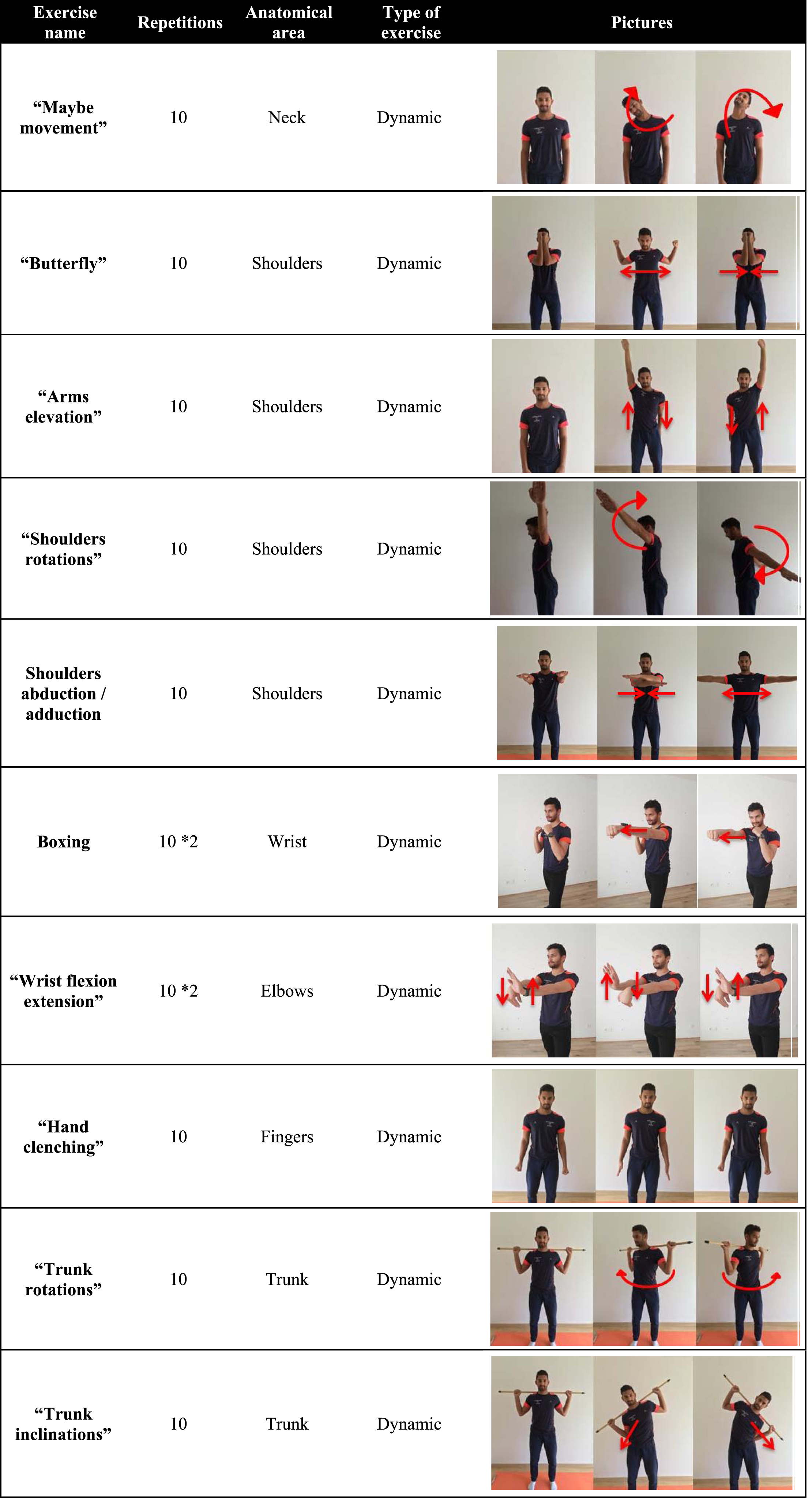
The stretching intervention consists of 20 exercises, presented in Table 3. These exercises will be a combination of stretching exercises, based on warm-up intervention implemented by Gartley and Prosser [14] and Aje et al. [15]. As stretching exercises were performed lying down in the studies by Gartley and Prosser and Aje et al., it was impossible to set up in vineyard workers working conditions and they were thus modified or replaced to perform all the exercises standing up [14, 15].
List of the exercises included in the Stretching Warm-Up
List of the exercises included in the Stretching Warm-Up
Each participant will perform a single warm-up session and all the measurements for a participant will be assessed the same day as the warm-up session. Participants will be observed 5 times, namely: before the warm-up intervention (T0), immediately after (T1), after the first hour of work (T2), after the second hour of work (T3) and after three hours of work (i.e. before lunch break) (T4).
Primary outcome measures
Perceived pain intensity
Pain intensity will be rated respectively for the last 3 months; and before the warm-up (T0), after the warm-up (T1), after 60 min of work (T2), after 120 min of work (T3) and after 180 min of work (T4). Participants will be asked to rate their pain intensity over 15 anatomical locations [35] using a 0–10 numerical rating scale (NRS), where 0 is used to indicate “no pain” while 10 indicates the “worst possible pain"[36, 37]. The 15 anatomical pain locations are illustrated in Image 2.
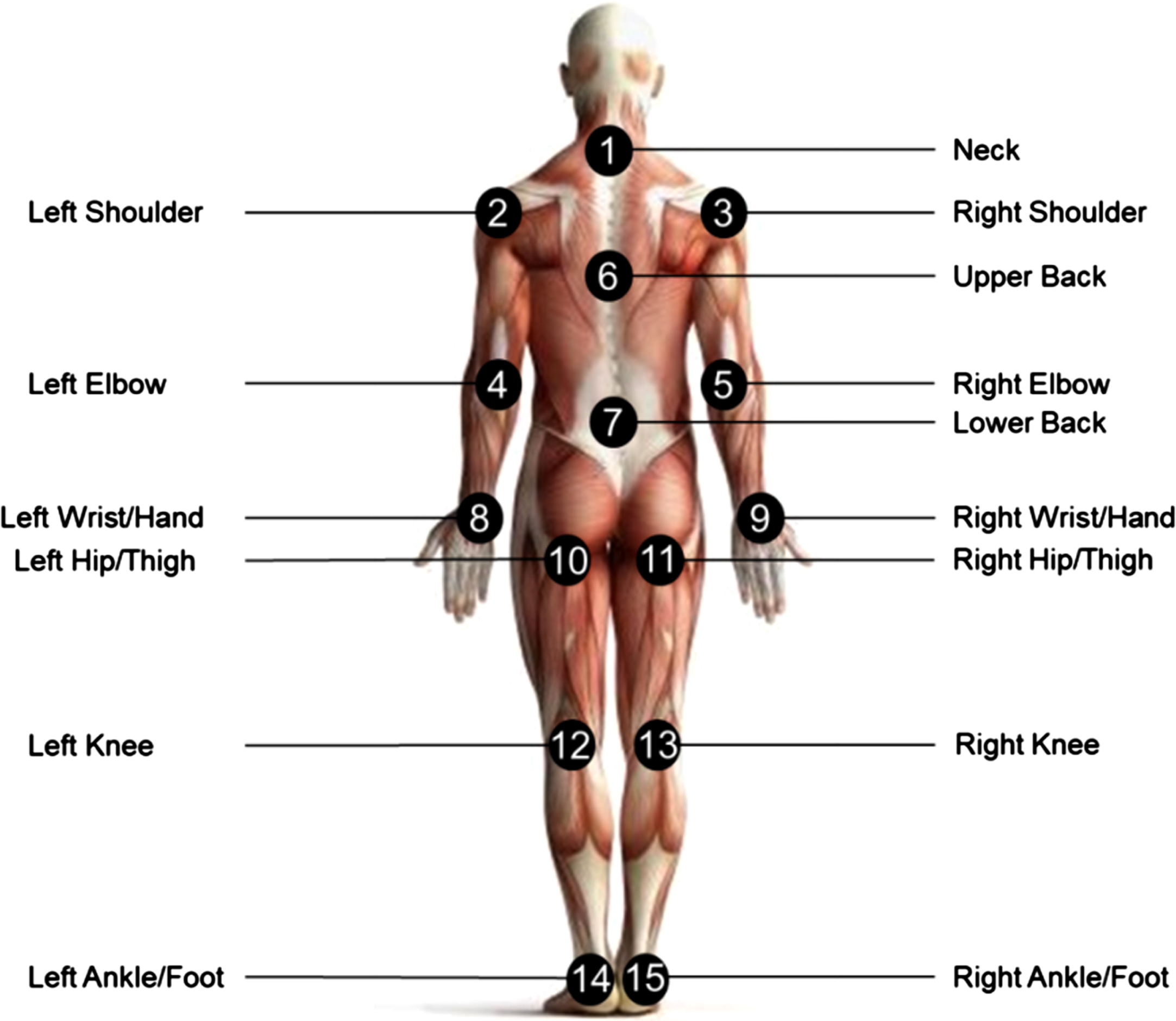
Pain location chart.
To assess work performance, the number of grapevines pruned after one hour, two hours, and three hours will be recorded by a research team member [38].
Secondary outcome measures
Handgrip strength
The handgrip strength will be measured using a Camry Electronic Hand Dynamometer (Model: EH101). The participant will sit with the elbow flexed at a 90° angle with the forearm and the wrist in a neutral position. Three maximum efforts will be performed with the dominant hand. A rest period of 30 seconds will be presented between each trial. Participants will be asked to press as fast and hard as possible with strong verbal encouragement. The best performance will be used for data analysis [39–41].
Flexibility
To assess the flexibility of the trunk and the hamstrings, the Fingertip-to-floor test (FTF) is a valid, reliable test and is used by many authors, especially in low back pain prevention [42]. For this test, the vineyard workers will stand on a 20 cm high box with their feet together [43]. Then, participants will bend forward as far as possible while keeping their knees straight. The distance (cm) between the floor and the middle finger will be recorded as an index of trunk forward bending flexibility [43]. Participants will perform two trials and the best one will be used for data analysis [42, 43].
The flexibility of the upper extremities will be evaluated with the back scratch test. This test gives an overall measure of the range of motion of the shoulders [44]. Participants will stand with one hand behind their back, stretching as far as possible up the spinal column. Participants will then extend the other arm behind the head with the elbow bent and they will try to reach the other hand. The distance between (positive values), or overlap of (negative values), the middle finger from both hands behind the back will be recorded [44].
Heart Rate
Each vineyard worker will be equipped with a heart rate (HR) monitor Geonaute Onmove 500, placed on the wrist. Due to the nature of the working task, participants will place the monitor on the arm they want. The HR will be continuously recorded during the entire duration of the supervised warm-up (between T0 and T1). Then, for each condition, HR will be recorded between the end of the WU and the beginning of the working activity (between T1 and T2) and during the working activity (between T2 and T5). For statistical analysis, HR data will be analyzed in original units (beats per minute [bpm]) [45]. The mean value of the first min of recording will be saved for T0 [46] and will be considered as the resting heart rate. For T1, the mean value of the 15 min of the warm-up will be retained. For T2, the mean value of the last min before the beginning of the working activity will be retained [46]. For T3, T4, and T5, the mean value of the last 15 min will be calculated.
Readiness to work
Readiness to work was rated subjectively using a 0–10 numerical rating scale, where 0 was used to indicate “not at all ready” and 10 “perfectly ready to work". This scale was adapted from the scale of readiness to play a match, used in different team sports such as football (soccer) or handball [47, 48]. Readiness to work will be asked at T1, after the warm-up, and at T2 just before the beginning of the working activity.
Work Quality
Work quality will be assessed by the workers’ supervisors, with the same 0–10 scale in every company [49], developed by the research team and a vineyard growing specialist. Perceived work quality will be measured at T5, after the end of the first three hours of the working day.
Workload
NASA Task Load Index (NASA TLX) is a multi-dimensional scale used to estimate the workload of a worker. The NASA TLX consists of six subscales: Mental, Physical, and Temporal Demands, Frustration, Effort, and Performance. The worker rates each subscale from 0 to 100 on the experience of a specific working task. The combination of these dimensions is the global workload score and can be between 0 (low workload) and 100 (high workload). This global workload score is likely to represent the workload experienced by workers[50, 51].
Visuomotor reaction time
The FITLIGHT Trainer (FITLIGHT Sports Corp., Ontario, Canada) will be used to measure visuomotor reaction time (VMRT). Fit lights are an innovative wireless system used in various sports to develop hand/eye coordination or assess reactive balance [52, 53]. Eight sensors, drawing a semicircle, will be placed on a table 1 m high. Sensors will be separated by 20 cm, with 40 cm from the central point. Participants will stand in front of it with hands in contact with the table and will be instructed to turn off 60 light stimuli as quickly as possible (green stimulus with dominant hand and red stimulus with non-dominant hand). Lighting sequences will be random [54, 55]. The total time required to turn of the sensors will be recorded as total VMRT. The mean time to turn off each light will be recorded as mean VMRT. The mean number of errors to turn off the lights will be recorded as mean error VMRT.
Time of measurement
The time of measurement for each outcome is presented in the following table (Table 4).
Time schedule of enrolment, interventions and outcomes assessment.
Time schedule of enrolment, interventions and outcomes assessment.
Descriptive statistics will be calculated to provide a summary of the demographic characteristics of vineyard workers. All results will be presented as mean and standard deviation with a 95% confidence interval. The assumption of normal distribution will be assessed using the Shapiro-Wilk test. In case of normality, a two-way repeated analysis of variance (ANOVA) will be conducted to compare study outcomes between groups (HWU vs DWU vs SWU vs NWU) and across time of measurements (T0, T1, T2, T3, and T4). All analyses will be performed according to the intention-to-treat principle and effect size could be computed for mean differences from baseline to follow-up measurements [56]. The statistical analysis will be performed using R for Windows and the significance level will be set at 0.05.
Discussion
Nowadays, warm-ups are a key component of a training session or a competitive event in sport [20] as numerous studies [18, 22] reported warm-up’s positive effects on performance or injury prevention in sports. In general, three main modalities of warm-up interventions are implemented in sports setting: (1) dynamic, (2) stretching, and (3) hybrid. Dynamic warm-up intervention previously has been shown to improve muscle force and performance [21], while stretching warm-up intervention has been reported to provide positive effects on muscle stiffness, range of motion, and injury prevention [19]. Hybrid warm-up interventions appear to be an interesting alternative by combining dynamic and stretching exercises benefits. For example, in the study by Fradkin et al., published in 2004, 10 golfers improved their performance after a warm-up intervention constituted by both dynamic and stretchingexercises.
Over the last decade, companies have shown a growing interest in the implementation of workplace warm-up interventions [13–15]. This observation can be explained by the advantages of implementing warm-up interventions, i.e. easy-to-use exercises, a reasonable duration (about 15 minutes maximum), and a minimum amount of equipment needed [57]. At this point, however, there is still no good evidence for the effectiveness of workplace warm-up interventions. In a systematic review we conducted (submitted)on the effectiveness of workplace warm-up interventions on work-related musculoskeletal disorders, physical, and psychosocial functions [58], only 4 studies met the eligibility criteria and were included [13–15, 24]. These 4 included studies offered employees one of the three warm-up modalities and reported different results. Di Stefano et al. [24] reported that a 6-week dynamic warm-up intervention among the military, lead to an increase in lower-leg muscle performance. Gartley and Prosser [14] and Aje et al. [15] reported that a 3 months stretching intervention, supervised by a trained worker, had promising effects on pain-related outcomes among tin mill and food factory workers. Both have reported a reduction in injury rates (ranging from –2.4% to –5.2%) after the stretching warm-up intervention. Holmström et al. [13] reported that after 3 months a daily 10 min hybrid warm-up intervention had positive effects on muscle strength and flexibility among construction workers. However, these results on the effectiveness of workplace warm-up interventions have to be taken with caution since the 4 included studies in the review [13–15, 24] present major methodological bias regarding heterogeneity and blinding. Furthermore, none of these 4 studies compared the 3 main warm-up modalities on physical and work-relatedoutcomes.
Our study was hence specifically designed to address this issue. For this reason, this study ambitioned to be the first to extensively examine the acute effects of these 3 workplace warm-up modalities on multiple outcomes in a workplace context and more precisely among vineyard workers. This study will give new insights into the effects of these 3 modalities on each outcome and will allow defining the most effective modality among this population. Finally, this study will help companies and public institutions with how to use warm-ups at the workplace.
Strengths
The design of this study could be considered a strength as participants will be randomly allocated to the 4 groups and will be blinded to their allocation. The research team member responsible for the data analysis will also be blinded to the participants’ allocation. This study further follows the SPIRIT guidelines. The team members who will present warm-up sessions to workers are graduated with a master’s degree in sport science and specialized in WMSDs prevention among vineyard workers. To the best of our knowledge, this study will be the first evaluating acute effects of a workplace warm-up intervention among vineyard workers.
Limitations
A number of potential study limitations may also be listed. First, blinding team members in charge of data collection will not be possible. Secondly, as vineyard-workers will come from the same geographical area (i.e. Bordeaux), the results may not be generalizable to other geographical areas (with other vineyard characteristics) or other occupational sectors. Thirdly, it has been shown that starting the activity as close as possible to the warm-up is important to maintain its effects. In this case, the measurement time required at T1 could lead to a decrease in the warm-up effects. To deal with this eventuality, a strict protocol will be followed to reduce the time needed to collect these measures. To assess flexibility, some methods as the modified sit and reach test correct for the length of the subjects’ limbs but are complicated to set up at the workstation (i.e. the vineyard). Hence, strength and flexibility will be evaluated with limited but practical methods. Outcomes will be focusing on several body regions, but these regions are the most concerned by pain and work interruption in tis occupation [25, 28].
Perspectives
We believe that the results of the present study will contribute to bridge the gap between the increasing interest from companies and the scientific evidence on the effectiveness of workplace warm-up interventions. In addition, results will indicate whether these interventions may supplement ergonomic or workplace strengthening programs as solutions to limit WMSDs. As this study will compare the 3 main warm-up modalities, it may highlight the most efficient warm-up intervention among vineyard workers. An upcoming study may also adopt a different design to maximize the warm-up effect on work-performance: it would be interesting to (1) assess the effects of the warm-up intervention on physical and psychological outcomes such as strength, flexibility, and reaction time on one day and (2) assess the work-related outcomes (i.e. work-performance) another day by starting the work immediately after the warm-up session. As this study aims to investigate the acute effects of a warm-up, it would be interesting to evaluate the effects of a warm-up intervention program lasting 6–8 weeks.
Ethical approval
The research plan has been approved by the CERSTAPS (registration number n°IRB00012476-2021-06-12-137), a national French ethics committee for research in physical activity. The study was registered on ClinicalTrials.gov on 06/16/2022 (NCT05425693).
Informed consent
All participants will be informed about the purpose and content of the project and will give their written informed consent to participate in the study.
Footnotes
Acknowledgments
Authors are grateful to the vineyard-workers and to the direction of the Château Calon-Ségur, the Château Camensac, the Château Clarke, the Château Haut-Bages Libéral, the Château Lynch-Bages, the Château Palmer, the Château Phélan Ségur, and the Vignobles de Larose for their active participation in this study.
Conflict of interest
All authors are members of Opti’Mouv, a company that provides workplace health promotion services as workplace physical activity programs.
Funding
This study is part of the PhD thesis of the first author Nicolas Larinier. The PhD thesis is promoted by the University of Grenoble Alpes and partially financed by the “Ministère de l’Enseignement Supérieur et de la Recherche” via the “Association Nationale Recherche Technologie” (ANRT) by means of the “Convention Industrielle de Formation par la Recherche” (CIFRE) grant (no. 2019/0488) with the Opti’Mouv company. The founding source has no role in the study design, data collection, results interpretation or manuscript writing.