




Abstract
BACKGROUND:
De Quervain’s tenosynovitis is upper-limb disorder, more frequent in women. It is rarely recognized as an occupational disease.
OBJECTIVE:
In this paper we reported work related de Quervain’s tenosynovitis in cow milker.
METHODS:
Ergonomic risk factors were assessed by utilizing assessment of repetitive tasks (ART) of the upper limbs method. Physical examination and imaging exams were used.
RESULTS:
We presented a 36-year-old female agricultural worker (workplace cow milker) exposed to work factors (forceful hand/wrist exertions, repetition, extreme postures) for 14 years. She was suffering the pain in the right hand, mainly near the thumb for few years. She was treated conservatively and surgically, however disability was permanent. Clinical examination showed slight edema of the right hand, increased palm’s sweating. Patient had reduced range of movements and grip strength.
CONCLUSIONS:
Report shows that work-related factors were strongly associated with diagnosed de Quervain’s tenosynovitis. Hand function plays an essential role in carrying out activities of daily living and this disorder pose a relevant burden of disease. Exposure to biomechanical factors should be an important initial target for the prevention of De Quervain’s tenosynovitis in the working population.
Background
Among the pain syndromes associate exposure to occupational factors affecting the hand is de Quervain’s tenosynovitis (DQT). The strength of the association between a specific syndrome and the putative pathogenic occupational factor is variable depending on the condition and the characteristics of the activity implicated. Up to 30% of workers experience wrist/hand pain and for most of them work activities are difficult or impossible [1]. There is disagreement in definition of musculoskeletal disorders (MSDs), distinction, relation and overlap between conditions. The variety of criteria used in research and lack of consensus hampers comparability across studies. It has been difficult to agree criteria for these heterogeneous disorders, which range from precise anatomical or pathological entities, such as bicipital tendinitis, to pains classified by presumed cause, such as “repetitive strain disorder” [2]. In order to address the issue of case definition in upper-limb disorders, United Kingdom Health and Safety Executive developed consensus criteria for some of the most common upper-limb disorders using a Delphi technique; DQT definition: Pain over the radial styloid and tender swelling of the first extensor of the wrist compartment and either pain reproduced by resisted thumb extension or a positive Finkelstein’s test [3]. However, epidemiological information in working population is still scant. In Europe, these disorders accounts for 40% of all occupational diseases [4]. The incidence of DQT is not well known. It affects most commonly middle-age women with prevalence rate of 3%, those who use repetitive hand motions in daily work activities including postures that maintain the thumb in abduction and extension [5, 6]. Agriculture is among the most hazardous sectors. Farmworkers face workplace hazards such as heavy physical load and repetitive movements [7]. Dairy farming is of particular interest in occupational medicine due to workers‘ exposure to a variety of biomechanical risks [8]. Their health remains a considerable occupational medicine problem [9, 10]. The association between biomechanical risks and musculoskeletal disorders in agriculture is evident, but data are scarce [11, 12]. Individual workplace characteristics have to be considered and analyzed when assessing biomechanical risks. This case report is addressed at fulfilling some of the knowledge gaps and at creating exposure and risk profiles for specific dairy workers activities in order to estimate the effects of repetitive hand motions of dairy workers and detect early musculoskeletal changes.
Case report
A 36-year-old-woman, right-hand-dominant presented after 7 years of chronic, intermittent right wrist pain mainly centered near the thumb and limitation of movements. She was unskilled worker, employed in agriculture as a cow milker for 14 years. Patient demographic data are presented in Table 1. The milking job was semi-mechanized, and she also performed the tasks of feeding, treating, washing, rearing calves and cleaning the barn after milking. The description of milking process was obtained from the worker and employer (Table 2). The milking require particular hand and wrist intensive efforts in terms of the repetitive physical exposures. Work tasks were assessed using self-administered questionnaire included work with force, pressing with the hand or fingers, pulling, pushing and holding in position. Worker was asked about a variety of work tasks and to indicate whether she did these motions high repetitively and often or not [13]. To determine workplace requirements we used the Assessment of Repetitive Tasks (ART) of the upper limbs [14, 15], based on the work process description such as manual handling, (heavy lifting, push-pull actions), awkward postures or frequency/repetition of movements, intensive work, force demands, work postures (hand) and other factors including work pace and task duration (Table 3). ART is a tool designed to help assess repetitive tasks involving the upper limbs. It assesses some of the common risk factors in repetitive work that contribute to the development of upper limb disorders. The exposure scores were classified into three exposure levels: low (0–11), medium (12–21), and high (22 and more) [15]. The results of the ART tool are presented in Table 4. The full ART assessment flowchart is added as supplementary material. We concluded that overall exposure score for manual handling tasks such as wrist bending and movements associated with the twisting fingers were the most significant work-related factors. Nevertheless, because of the large variation between work sectors and job characteristics between the work tasks, we consider the results can be useful for representing repetitive, forceful or ergonomically stressful hand motions jobs. After 7 years of work experience, symptoms appeared as mild diffuse pain at the base of the second and the third finger after a bout of hand overuse. During further exposure, the pain gradually increased in severity and later localized to the distal dorsal radial wrist. The pain progressed to the whole hand, but was pronounced near the thumb. There was no family history of musculoskeletal disease. Also, she noticed swelling and warmth of the hand. Rheumatoid factor, C –reactive protein, fibrinogen, sedimentation rate, complete blood count and cyclic citrullinated peptide antibody were normal. The first treatment included wrist bracing and anti-inflammatory drugs. She did not respond to analgesics and physical therapy treatment by rheumatologist and orthopedic surgeon, in the next few years. Surgical release of the first extensor compartment (Fig. 1.) 2 years later relieved her pain only for a few months. The physical therapy continued gradually over the next year but recurrent episodes of pain and stiffness had remained unresponsive to the treatment. She mentioned that there were intervals of reduced pain when she could use her hand minimally, but this would result in a flare up of work activity-triggered pain, swelling and warmth in the hand. Surgical treatment was performed again after the two years. Physical therapy after operative treatment resulted in slight reduction of pain. During disability assessment in our Institute, we found slight edema of the right hand; increased palm’s sweating, without disturbances of skin temperature and color (Fig. 2). Finkelstein’s test was positive. However, test is not diagnostic, other pathologies may be present [16]. Patient had reduced range of movements and grip strength. She could form the fist. Patient clinical data are presented in Table 5. Musculoskeletal ultrasonography showed fluid accumulation at the area of the most expressive tenderness along the proximal intersection of the first and the second extensor compartment tendons, degenerative enlargement and shortening of the flexor tendons. Magnetic resonance imaging (MRI) of wrist demonstrated no abnormal findings. Rheumatologist ruled out osteoarthritis of the affected thumb. However, disability was definitive and she had to leave her job (cow milker). She was unemployed last 3 years. Written informed consent
Patient demographic data –sex, age (in years), education level, occupation, job and work experience (in years)
Patient demographic data –sex, age (in years), education level, occupation, job and work experience (in years)
The process of milking
The milking task related factors
The assessment of repetitive tasks (ART) tool results

Surgical release of the first extensor compartment.
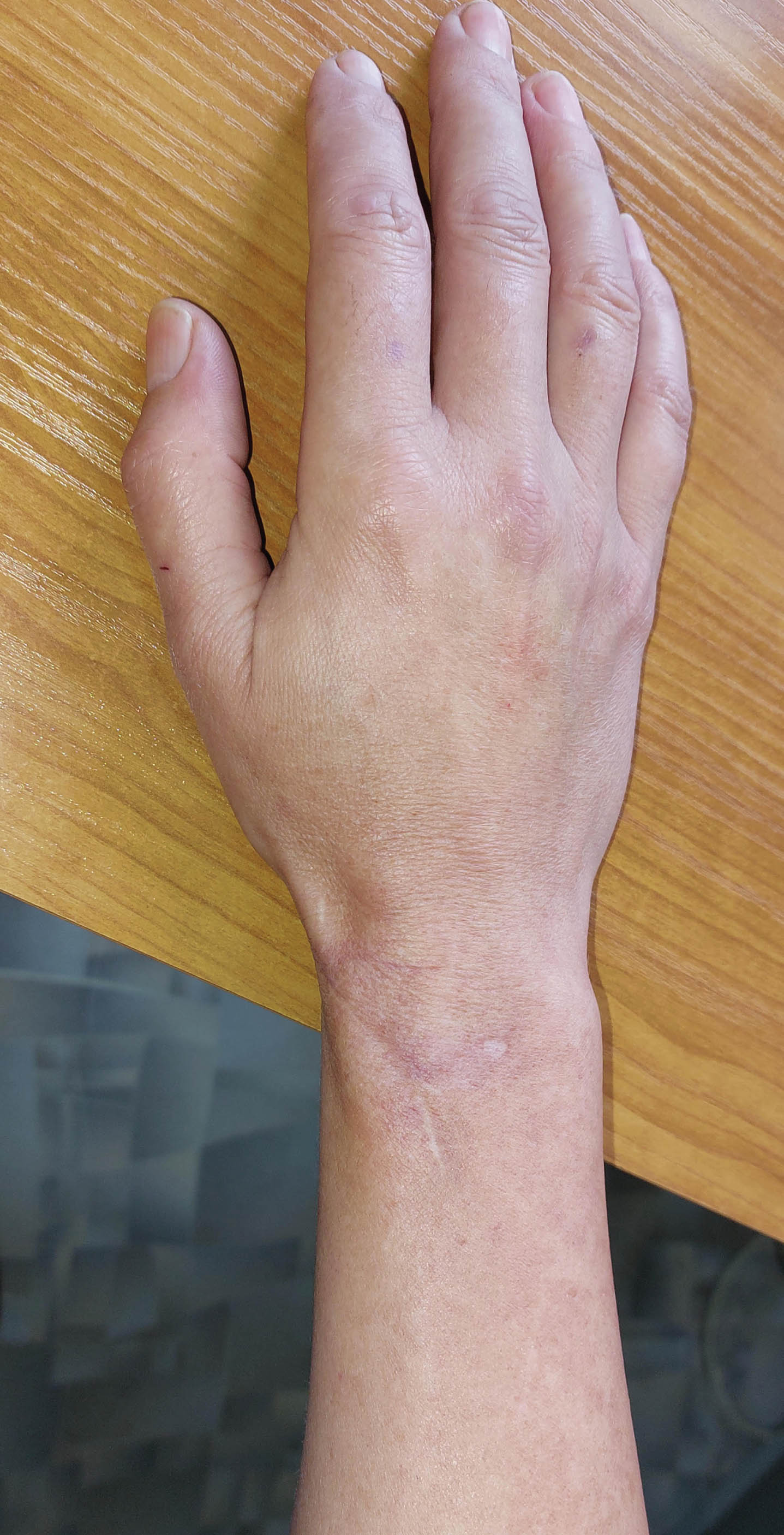
Slight edema of the right hand.
Patient clinical data –the range of hand movements (in degrees), grip strength and pain
Among agricultural work activities, dairy farming is of particular interest in occupational health because of the variability of tasks and exposure to a variety of biomechanical risks. Researchers have identified heavy lifting loads and repetitive motions contributing to adverse musculoskeletal effects on the hands and wrists in dairy workers [17]. Treatment of DQT involves few levels, starting with conservative and progressing to surgical intervention. More than 50% of cases can be resolve with conservative treatment in 3 to 4 weeks. There are reports that injections and physical therapy could be effective in some cases. Surgery is indicated for refractory and recurrent cases [18]. In our patient disease started earlier (29 years). It is usually diagnosed in age of 40 years and later [5]. In this case after both conservative and surgical treatment were not successful. It showed that DQT is a progressive disease characterized by continuous pain, motor impairment, swelling, temperature and trophic changes in the distal part of an extremity. All the clinical manifestations are actually manifestations of a mechanical tendinosis of the extensors the thumb. Tenosynovitis/tendinosis is responsible for the pain, vasomotor, and sudomotor manifestations. The pathophysiology, diagnostic investigations and treatment remain uncertain. Ultrasound examination seems to be highly sensitive for detecting abnormalities and helpful in therapy [19]. MRI could show tendon thickening and peritendinous acute edema. However, these changes may not be seen in chronic cases because of stenosing tenosynovitis [20]. The relationship between MSDs and work-related factors remains the subject of considerable debate. Uncertainty over classification and diagnosis for upper limb disorders, with inconsistent and inaccurate terminology is confounding for epidemiology studies. However, evidence suggests that most musculoskeletal cases are characterized by symptoms, for which it is often not possible to objectively demonstrate an underlying pathology and generally involve populations exposed to a combination of work factors (repetition, force and extreme postures), such as industrial workers manufacturing plants (electronics, sewing, appliance, bearing fabrication, bearing assembly and investment casting). There is evidence of an association between any single factor or job tasks that require a combination of risk factors (e.g., highly repetitious, forceful hand/wrist exertions) which increased risk for hand/wrist tendinitis based on currently available epidemiologic data [21]. Presumably, the actual numbers of this disorders in agriculture are higher than reported as family farms are excluded from occupational statistics, even in farms with ten or more employees where reporting is mandatory. Some workplace prevalence studies are prone to the problem of selection bias: the study sample selected for investigation differs systematically from those who are not included. This is of particular concern in occupational research, as individuals who have been worst affected by a disorder caused or aggravated by that occupation may select themselves out of employment and escape observation, resulting in an underestimate of the problem (the ‘healthy worker effect’) [22]. Some studies analyzed chronic hand disorders in agriculture workers and reported a statistically higher prevalence rate of exposure than all other occupations, with the biomechanical stresses such as (repetitive work requiring static muscle work, awkward positions of the fingers and wrist, and lifting the average of 5 kg daily and combinations of these factors) [23]. Hand disorders do affect capability for work, both short and long term. They can be caused or made worse by current or past work despite the lack of evidence for direct causation, (e.g. repetition, force and extreme postures as a principal occupational exposure), yet they vary inconsistently by occupation. The impact of this disorders is resistant to exposure reduction in occupational physical activities and increased access to healthcare [24].
Conclusions
In conclusion, case report showed that work-related factors were strongly associated with clinically-diagnosed DQT. Movements involving the hand and thumb have a more significant role than the other biomechanical work factors. Exposure to biomechanical factors such as repetitive hand movements should be an important initial target for the prevention of DQT in the working population.
In our patient disease started more than 10 years earlier than usual. Both conservative and surgical treatments were not successful. In this case disability was definitive and patient had to leave the job. This case also demonstrated that activities of dairy farming pose significant biomechanical risk. Hand function plays an essential role in carrying out activities of daily living. That‘s why DQT pose a relevant burden of disease and therefore is a priority for prevention. According to safety and health recommendations, regular risk assessments should be carried out to identify and prevent potentially harmful work tasks.
Ethical approval
The study was approved by Ethics Committee (Institute of Occupational Health, Novi Sad, Serbia, No 3/2023, Jan 9th, 2023).
Informed consent
Written informed consent was obtained from the patient.
Conflict of interest
None to report.
Footnotes
Acknowledgments
None to report.
Funding
None to report.