



Abstract
BACKGROUND:
The Ministry of Defence Police recognised the requirement to develop a Physical Employment Standard (PES) for the Authorised Firearms Officer –Counter Terrorism (AFO-CT) role profile.
OBJECTIVE:
The purpose of this study was to conduct a job task analysis to identify the most critical and physically demanding tasks performed by AFO-CT personnel.
METHODS:
A focus group and online survey were undertaken to identify a list of job tasks. The down-selected job tasks were objectively monitored during training events to determine the most physically demanding tasks. Tasks were ranked by physical demand and additional factors (e.g., operational load, primary physical actions). Down-selected tasks were then included in a Subject Matter Experts (SME) task scenario generation workshop. The physiological demands of the resulting standardised scenarios were determined.
RESULTS:
The focus group (n = 11) identified 13 physically demanding and critical role-related tasks. The subsequent survey (n = 907) down-selected eight tasks with a ‘moderate’ demand or greater. Thirty AFO-CT personnel completed the eight tasks as part of routine training events. From the observed tasks, four tasks were down-selected and combined into two operationally relevant, reasonable worst-case standardised scenarios during a SME workshop. The two scenarios, ‘Conduct Armed Search in the Open for an Active Shooter’ and ‘Victim Focussed Emergency Search’ were used in subsequent phases of the research to form the basis of the AFO-CT PES.
CONCLUSION:
This research elucidated the most physically demanding job tasks within the AFO-CT role profile to inform the development of a MOD armed policing PES.
Keywords
Introduction
The Ministry of Defence Police (MDP) is a specialist police force which delivers unique policing to protect sites, personnel, and assets that are essential to Defence and UK infrastructure. The MDP primarily consists of Authorised Firearms Officer –Counter Terrorism (AFO-CT) personnel, who perform a variety of specialist duties to maintain the security of Defence assets. Currently, AFO-CT personnel are required to complete an annual fitness assessment consisting of achieving 7 : 6 (level : shuttle) on the 15 m Multi-Stage Fitness Test (MSFT) based upon research reported in 2010 [1]. However, the utility and legitimacy of unloaded, aerobic fitness assessments have been questioned in physically demanding occupations that require carrying external loads (e.g. body armour, weapon system) and therefore demand contributions from other components of fitness (e.g. muscular strength, muscular endurance, mobility) in addition to aerobic fitness to maintain operational effectiveness [2]. The MDP recognised the requirement to develop a role-related Physical Employment Standard (PES) to ensure that the AFO-CT personnel physical capabilities were commensurate with the demands of the occupation.
Organisations that employ individuals in physically demanding occupations routinely implement a PES to safeguard the physical ability component of operational effectiveness and to mitigate occupational musculoskeletal injury risk. To be legally defensible, the development of a PES must conform to the relevant legislation, and therefore should be developed in accordance with an internationally accepted framework that is objective, evidence-based, and fully auditable [3–6]. The iterative PES process must demonstrate the proportionality and legitimacy of the PES developed via the complete and accurate reporting of four phases: Phase 1 –Subjective Job Task Analysis (JTA); Phase 2 –Objective JTA; Phase 3 –Translate Criterion Task(s) into a Prototype Test(s); and Phase 4 –Development of a Recruit Selection Test(s).
The purpose of the present study was to conduct Phase 1 and 2 of the PES development process and fulfil the following aims: 1) identify and down-select the most physically demanding, essential Criterion Tasks performed by AFO-CT; 2) generate standardised Criterion Task simulations which represent ‘reasonable, worst-case’ scenarios’ 3) examine the physical demands of those scenarios completed at a minimum acceptable pace; and 4) inform subsequent PES test development.
Methods
The study was conducted between 2020 and 2022. All procedures were administered in accordance with the Declaration of Helsinki 2013 [7]; participants provided informed consent following a written or verbal brief of study procedures. The study protocol was approved by the UK Ministry of Defence Research Ethics Committee (2091/MODREC/21).
Project governance
Following the recommended approach for developing a PES [6], a Governance Board was established with Terms of Reference to set the Scope of the AFO-CT PES programme, approve the evidence collected at the end of each Phase (and sub-Phases where appropriate) and make key decisions to direct the design of subsequent Phases. The Governance Board comprised stakeholders from the College of Policing (CoP), National Armed Policing, MDP, Civil Nuclear Constabulary (CNC) and the Defence Police Federation (DPF). Representation from Home Office and CNC stakeholders was paramount as the AFO-CT role profile is common across UK police forces. Upon establishing the Governance Board, the study encompassed four more elements (Fig. 1), all of which were informed by the preceding element.

Overview of study design.
All levels of the MDP (i.e. job performers, job supervisor, and senior leaders) were consulted in a ‘top down –bottom up’ subjective JTA that consisted of four parts: 1) Provisional Task List Development; 2) Provisional Task Down-Selection; 3) Numeric Task Characterisation; and 4) Criterion Task Down-Selection (Table 1).
An overview of the stage 2 subjective job task analysis process
An overview of the stage 2 subjective job task analysis process
Note: Where AFO-CT is Authorised Firearms Officer –Counter Terrorism.
An initial understanding of the physical requirements of AFO-CT role-related tasks was developed from consulting a range of AFO-CT documentation. In addition, informal discussions were held with experienced MDP Firearms officers. Following the document search, Eleven AFO-CT officers from the MDP (n = 4), CNC (n = 3) and Metropolitan Police Service (MPS) (n = 4) attended a focus group. Participants were (mean±SD) aged 45±7 years and had 23±9 years of Police service. Participant demographics provided a mix of sex (10 Male, 1 Female) and ranks. Eligible focus group participants were required to satisfy at least two (out of seven) pre-defined SME criteria. Collectively, the whole focus group was required to satisfy all seven of the SME eligibility criteria [7].
Prior to the focus group each participant independently listed up to 10 tasks that they believed were physically demanding, reflected the general duties of an operational AFO-CT officer and were essential to the successful completion of the role. A list comprising all tasks independently identified by focus group participants was sifted by consensus to secure group endorsement. Each task on the initial long list had one of four potential outcomes: 1) select; 2) group; 3) exclude; or 4) refer (Table 2). Subsequently, the Governance Board met to endorse the focus group evidence and down-select tasks that would progress to the online survey phase.
Focus group sifting outcomes of long-list tasks
Focus group sifting outcomes of long-list tasks
Note: Where SMEs is subject matter experts.
An anonymous online survey was distributed to all AFO-CT personnel in the MDP and CNC via email and social media communications. The survey was completed by 907 participants from the MDP (n = 642; 27% of population) and the CNC (n = 265; 24% of population). The sample comprised of males (n = 794) and females (n = 95); that were aged 44±11 years; had served in their current roles for 11±11 years; and 93% were currently operational. Only responses from AFO-CT officers, AFO officers, or officers with experience managing a portfolio that utilises AFO roles were included in the data analysis.
Tasks were rated across four domains on a 6-point rating scale that had descriptive anchors (Table 3) [9, 10]. Survey domains included task Physical Demand (i.e. how exerting) and task Criticality (i.e. in relation to preservation of life, injury avoidance, operational success, Crown property damage) [9], task Frequency (including training and operational scenarios), and task Duration (i.e. how long). Similar to others [10], a control task was incorporated into the task list to indirectly assess the quality of the responses (i.e. ‘strip, clean and assemble firearm’). This task was of indisputable, negligible physical demand and allowed inferences to be made on the respondents’ comprehension or diligence whilst completing the survey.
Online survey task dimensions and rating scales
Online survey task dimensions and rating scales
Note: Grey cells indicate the numeric task down-selection criteria applied.
‘Physically Demanding –Critical’ numeric task down-selection criteria were decided a priori. Down-selected tasks were those with a pooled median rating of ≥3 (out of 6) for task Physical Demand (i.e. ‘Moderate’, ‘Hard’, ‘Very Hard’, or ‘Maximum’ Physical Demand); and a pooled median of ≥4 (out of 6) for task Criticality (i.e. ‘Important’, ‘Very Important’, or ‘Critical’). Task Frequency and task Duration ratings characterised role-related tasks and were not part of the task down-selection criteria. Upon endorsement from the Governance Board, down-selected Criterion Tasks from the survey evidence would undergo an objective JTA.
Twenty-eight (25 Male, 3 Female) AFO-CT personnel (age 35±9 years; height: 177.6±8.8 cm; body mass 88.3±14.4 kg) completed the down-selected Criterion Tasks during routine training events. All tasks were completed under instruction from MDP and CNC Firearms Instructors. External assurance was provided by two Home Office AFO, and agreement that tasks were reflective of the job role was ascertained from Training Instructors and DPF observers.
During the Criterion Tasks, Officers were instrumented with physiological monitoring equipment to quantify cardiovascular strain (Heart Rate [HR], OBAN Heart Rate Monitor, US Army) and movement profile (GPS, Polar Vantage M; Accelerometery, GENEActiv Original). Accelerations are calculated as the square root sum of the squares of the accelerations (mg) for the three vector axes, x, y, and z with gravity subtracted (SVM (mg) = Cardiovascular Demand Compound Score = 0.5 * Ranking for Peak HR + 0.5 * Ranking for Time ≥80% Peak HR Movement Profile Compound Score = 0.5 * Ranking for Time ≥400 mg +0.5 * Ranking for Time ≥13 km·h–1
These variables were selected to focus on the most physically demanding elements of the tasks. Other factors including the additional load required, duration of task, distance covered and component of fitness required to complete the task were also assessed.
Task scenario generation workshop
Down-selected Criterion Tasks from the objective JTA were then included in a SME task scenario generation workshop. Five SME attended the task scenario generation workshop. Attendees had 26±6 years of armed policing experience and represented the MDP, CNC, Home Office and DPF. As mentioned, inclusion of Home Office and CNC representatives was important to ensure the scenarios generated reflected the AFO-CT national role profile. As per best-practice guidelines [6, 8], attendees met the following SME criteria: Experience performing the task. Experience directing the task from a position of leadership. Witnessed task being performed in an acceptable manner. Witnessed task being performed in an unacceptable manner. Experience delivering formal training on task.
Attendees were presented with data and observations from the objective JTA and were asked to generate standardised, reasonable worst-case scenario simulations whereby one individual’s effort could be monitored. Simulations were to reflect the ‘minimum acceptable’ physical role requirements; not higher than acceptable. The workshop aimed to provide the following: simulation descriptions; confirm distances, work-rates and rest periods; any additional considerations (e.g., PPE) and to combine Criterion Task into simulations as appropriate. Additional testing on the generated simulations was undertaken to: 1) discern the components of fitness required to complete each simulation by further objective physiological monitoring; and 2) examine whether elements of simulations were covered elsewhere (e.g. same movement profile in different simulation) and where appropriate combine, concentrate or eliminate those elements.
Simulation physiological monitoring
Thirty participants (16 Male, 14 Female) AFO-CT personnel volunteered to take part in the simulation physiological monitoring at MDP HQ Wethersfield across an 11-day measurement period. Prior to completion of the task simulations, participants were instrumented with HR monitors (OBAN Heart Rate Monitor, US Army) and completed a 15 minute period of supine rest to estimate minimum HR. The 20 m MSFT was used to estimate maximum oxygen uptake (VO2max) [11] and maximum HR. Simulations were scripted to ensure that the tasks completed and maintained work rates were commensurate with the occupational requirements. These were defined by the evidence-based established from the observations undertaken during the previous Phases and the guidance from SME during the task scenario generation workshop. Participants completed the simulations wearing an operational ensemble of ∼20.2 kg. The operational ensemble mass was discussed and decided upon during previous phases and endorsed by the Governance Board. Participants were instrumented with a HR monitor (OBAN Heart Rate Monitor, US Army) and portable breath-by-breath gas analyser (K5, COSMED, Rome, Italy) to quantify the physiological demands of each scenario (mean peak rolling 30 s average VO2, percentage VO2max [% VO2max], time in heart rate reserve (HRR) zones [light (20–39% HRR), moderate (40–59% HRR), vigorous (≥60% HRR)] [12, 13]. The mass of the monitoring equipment was included in the 20.2 kg operational ensemble, therefore did not add any additional physical demand. The order of completion of the Criterion Task simulation was alternated. Subject Matter Expert assurance was provided throughout scenario completion to confirm acceptable task performance.
Statistical analysis
Data were checked for normality by assessing skewness and kurtosis and, unless stated, are presented as mean±one standard deviation (or median and interquartile range), with statistical significance accepted at P < 0.05. Focus group and survey data from each Force were analysed separately and pooled. Regarding the objective JTA, to inform the down-selection of tasks for progression, each task simulation was ranked in order of task physical demand for each dependent variable (e.g. VO2, HR). However, the level of stringency (or leniency) to be applied to the number of tasks down-selected was a decision for the Governance Board. To explore the effects of the simulations on age and sex, a mixed design analysis of variance (ANOVA) explored the within-subjects (i.e. task physical demand), and between-subjects factor (i.e. sex) main effects. In addition, interaction effects (task physical demand vs. sex) were explored for the simulation physiological monitoring.
Results
Subjective job task analysis
Provisional task list development and down-selection
112 AFO-CT tasks were initially proposed by focus group participants during the provisional task list development, 10 of which were excluded for being too broad or being covered elsewhere. The remaining 102 tasks were collated into 13 provisional tasks (Table 4). The Governance Board down-selected 11 of the 13 provisional tasks. Two tasks were deemed to not reflect the AFO-CT National Role Profile, hence were excluded. These were ‘Method of Entry’ and ‘Officer Safety Training/Personal Safety Training’.
The provisional list of AFO-CT role-related tasks developed in the focus group
The provisional list of AFO-CT role-related tasks developed in the focus group
The characterisation of criterion tasks, expressed as a pooled median rating score from the survey, is shown in Table 5. Pooled (i.e. MDP and CNC) ratings indicated that two tasks (out of 11) had a ‘Hard’ Physical Demand (a score of 4 out of 6) (‘Casualty Evacuation’ and ‘Conduct Armed Search in the Open’); six tasks a ‘Moderate’ Physical Demand (a score of 3 out of 6); and three tasks a ‘Light’ Physical Demand (a score of 2 out of 6). No tasks had a ‘Very Hard’ or ‘Maximum’ Physical Demand (a score of 5/6 out of 6). The control task had the lowest Physical Demand rating of ‘Very Light’ (a score of 1 out of 6). Pooled ratings indicated that one task (‘Casualty Evacuation’) was ‘Critical’ (6 out of 6), nine tasks were ‘Very Important’ (5 out of 6) and one task (‘Routine Armed Foot Patrol’) was ‘Important’ (4 out of 6). All 11 tasks satisfied the Criticality down-selection criterion (≥4 out of 6; ≥ ‘Important’). However, three tasks (i.e. ‘First Aid’, ‘Taser’ and ‘Static Armed Guarding’) did not satisfy the Physical Demand criterion (≥3 out of 6; ≥ ‘Moderate’) and therefore were removed from the process.
A characterisation of the eight criterion tasks down-selected by the governance board. Expressed as a pooled median rating score from the survey
A characterisation of the eight criterion tasks down-selected by the governance board. Expressed as a pooled median rating score from the survey
Note: Superscript numbers refer to the numeric 1 to 6 rating scale.
Table 6 provides the objective assessment of the cardiovascular demand and movement profiles of the eight Criterion Tasks. Using the compound score to provide a rank order measurement of maximal demand and time in a state of high energy demand, ‘Conduct Armed Search in the Open’, ‘Deal with Subjects in Buildings and Structures’, and ‘Fleeing Subject’ had the highest demand and therefore were down-selected into the next phase of research. Additionally, as Casualty Evacuation required the greatest external load demand and had a unique primary physical action (i.e. pull, locomotion with external load), that task was also down-selected.
Overview of objective job task analysis down-selection process
Overview of objective job task analysis down-selection process
Note: *Additional loads greater than PPE required; bold tasks were down-selected.
A decision was made by all attendees that combining the down-selected tasks presented the most physically demanding and job relevant scenarios to be included in the next Phase of the research. The panel discussed the two scenarios in a logical order, considering the context of the scenario, the number of officers in attendance, and the expected end point of officer involvement. Due to the operational context, the SME workshop identified that the required combination of tasks should be termed: 1) Conduct Armed Search in the Open for an Active Shooter (CASIO), and 2) Victim Focussed Emergency Search (VFES) (Table 7). During discussions, the SME observed that the casualty, in the context of VFES, would more likely be a member of the public rather than an officer. As such, the casualty weight (in terms of required load) should reflect the UK civilian population demographics.
Additional testing on the generated simulations was undertaken to discern the minimally acceptable speeds of completion. Subject Matter Experts and stakeholders (representatives from MDP, CNC, Home Office, CoP and the DPF) attended a one-day event whereby scenario simulations –and each element of the scenario–were completed at various speeds by MDP Firearms Instructors. The aim was to facilitate discussions and enable decisions to be made with regards to work-rates (Table 8 and 9).
Overview of the combination of tasks and task descriptions
Overview of the combination of tasks and task descriptions
Minimal acceptable time to complete conduct armed search in the open for an active shooter
Minimal acceptable time to complete victim focussed emergency search
All 30 participants completed CASIO and VFES within the standardised time (217±4 s and 118±4 s, respectively). The mean (95% CI) peak VO2 measured during CASIO was 39.1 (95% CI = 37.5 to 40.7) ml·kg–1·min–1 (94.7 [95% CI = 89.8 to 99.7] % VO2max), which was greater (P < 0.001) than during VFES; 33.70 (95% CI = 32.3 to 35.1) ml·kg–1·min–1 (83 [95% CI = 79 to 87.1] % VO2max) (Fig. 2). No interactions between sex and age were found for either simulation.
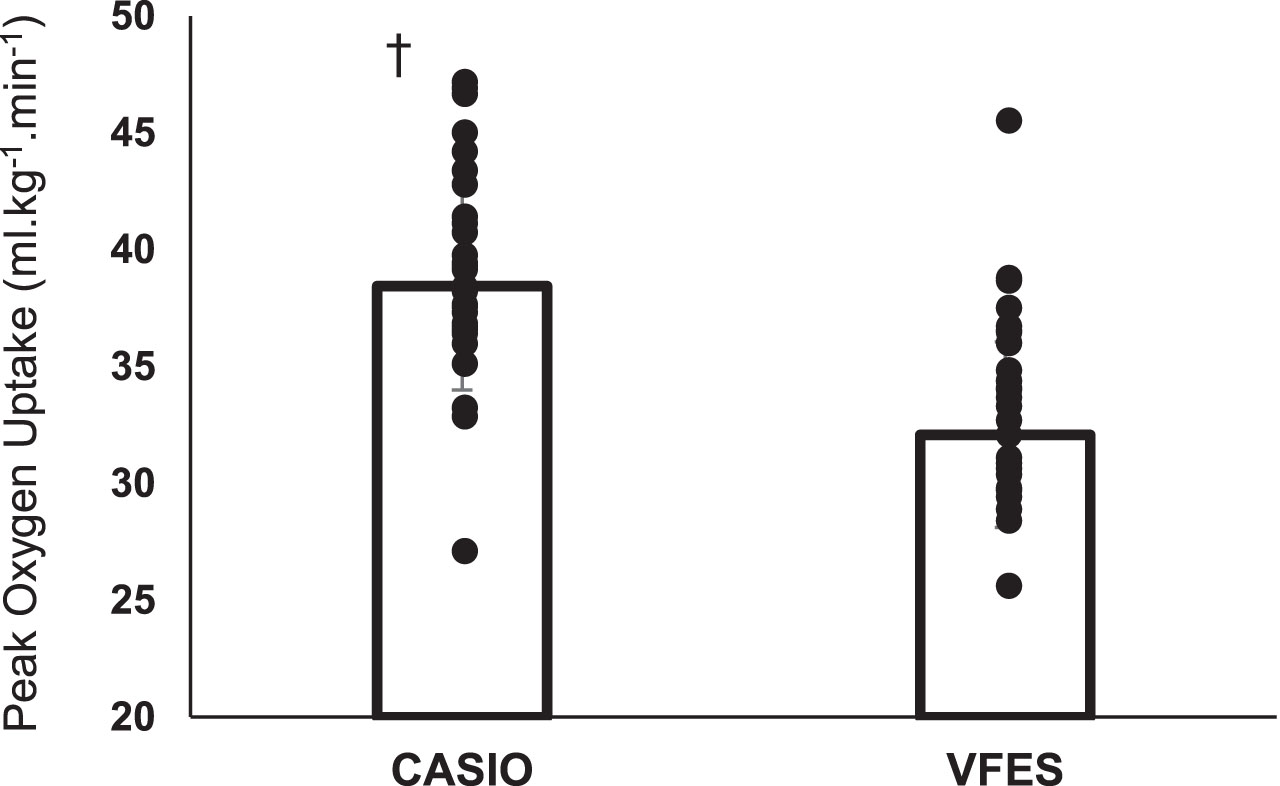
Mean peak oxygen uptake measured during CASIO and VFES. Where CASIO is Conduct Armed Search in the Open for an Active Shooter and VFES is Victim Focussed Emergency Search; †Significantly greater (P < 0.001).
Mean time in light, moderate, and vigorous HRR zones during CASIO was 2±4, 21±23, and 197±26 seconds, respectively, and during VFES was 4±7, 29±23, and 64±39 seconds, respectively. No interactions between sex and age were found for either simulation.
The purpose of the present study was to conduct the initial phases of the PES development process and fulfil the following aims: 1) identify and down-select the most physically demanding, essential Criterion Tasks performed by AFO-CT; 2) generate standardised Criterion Task simulations which represent ‘reasonable, worst-case’ scenarios’; 3) examine the physical demands of those scenarios completed at a minimum acceptable pace; and 4) inform subsequent PES test development. The multi-method approach of the study was in accordance with international best-practice guidelines [6], utilising both a subjective and objective JTA to identify the most physically demanding, critical tasks within the role profile, then subsequently using SMEs to generate standardised scenarios. This resulted in the systematic and evidence-based down-selection of two scenarios, encompassing four job tasks, which will form the basis of the MDP AFO-CT PES.
Subjective job task analysis
It is well established that a task analysis provides the foundation for developing a legally defensible PES [3, 14]. From the 11 tasks down-selected from the Focus Group, survey data revealed that just two tasks (18%) were rated to have a ‘Hard’ (or greater) physical demand. Comparatively, an identical scale applied to Royal Marines [9] and Royal Navy [10] personnel reported that 76% and 46% of role-related tasks were of a ‘Hard’ (or greater) physical demand, respectively. Due to the nature of the role and day-to-day responsibilities, this result is not entirely surprising, however down-selected tasks would go on to be objectively verified. It is important to note that the control task that was included in the survey (due to its undisputable negligible physical demand) was rated as the least physically demanding task, providing confidence in the validity of survey responses and assurance that the rating scale was understood and completed diligently.
All 11 tasks had a criticality rating of ‘Important’ (or greater), which was expected. The essential nature of many role-related tasks within physically demanding occupations means that failure to perform these tasks to an acceptable standard could result in: operational failure; death/injury; or significant damage to Crown property [9]. Unsurprisingly, the task Criticality data in the present study would appear to reflect the essential nature of Police firearms tactics. The Frequency of most AFO-CT tasks was ‘Rare/Annual’. The infrequent nature of critical/emergency-based tasks is a common characteristic in physically demanding occupations [6]. However, this does not undermine the presence, validity, or legitimacy of these tasks in a job task analysis; as employers must be assured that personnel selected, trained and retained are physically capable of performing critical tasks when most required [3].
Whilst all 11 tasks satisfied the Criticality down-selection criterion, three tasks (‘First Aid’, ‘Taser’ and ‘Static Armed Guarding’) did not satisfy the Physical Demand criterion (≥3 out of 6; ≥ ‘Moderate’) and therefore were removed from the process resulting in eight Criterion Tasks being down-selected to undergo an objective Job Task Analysis. It is important that the AFO-CT PES reflects the most demanding tasks in the most critical of circumstances, hence ratings of task Physical Demand and task Criticality formed the basis of the numeric task down-selection. Little would be gained from exploring tasks with a low Physical Demand. In addition, Critical tasks are often time-critical (hence potentially elevate task physical demand) and impose significant threat consequences if not performed to an acceptable standard.
Objective job task analysis
Objective monitoring of the eight Criterion Tasks included the measurement of cardiovascular strain, movement profile and notational analysis. In doing so, compound scores for both cardiovascular strain and movement profile were used to rank tasks in order of the greatest physical demand to inform down-selection. Regarding cardiovascular strain, ‘Routine Armed Foot Patrol’ ‘Intercept Subjects on Foot’, and ‘Deal with Subjects in Vehicles –Vehicle Extraction’ had the lowest demand and had primary physical actions (locomotion and push/pull) that were present in other, more physically demanding tasks. Therefore, it was recommended that these tasks were removed from the process. Of the remaining tasks, ‘Casualty Evacuation’ presented with the lowest demand regarding movement profile. However, due to the unique, significant strength requirement (∼76 kg drag), evidence suggested the task should remain in the process. ‘Armed Containment’ was removed from the process due to similarities in movement patterns with ‘Conduct Armed Search in the Open’ and a lower physical demand. Additionally, whilst ‘Armed Containment’ required handling a 12 kg operational shield, the strength requirement of ‘Casualty Evacuation’ was greater. The objective JTA corroborated results found in the subjective JTA and provided an evidence-base to down-select ‘Conduct Armed Search in the Open’, ‘Casualty Evacuation’, ‘Deal with Subjects in Buildings and Structures’, and ‘Fleeing Subject’. Prior to the task scenario generation workshop, the Governance Board stated that scenarios could be generated for each task individually, or combined into two scenarios to reflect a real-world, reasonable, worst-case scenario. One scenario being based on the ‘Conduct Armed Search in the Open’ task with the running element of ‘Fleeing Subject’, and the second scenario being based on ‘Deal with Subjects in Buildings’ whilst incorporating of ‘Casualty Evacuation’.
Task scenario generation workshop
In accordance with the International PES framework [6], SME included in the task scenario generation workshop met SME criteria and represented varying levels and organisations. As per Governance Board guidance, both options for scenario generation were considered, but it was deemed more operationally realistic to combine the Criterion Tasks into two scenarios. These were termed 1) Conduct Armed Search in the Open for an Active Shooter (CASIO), and 2) Victim Focussed Emergency Search (VFES). Completion of these scenarios would encompass a range of components of fitness including aerobic capacity, anaerobic capacity, muscular strength, muscular endurance and mobility and were deemed to be reflective of the most physically demanding elements of the AFO-CT role profile.
The CASIO scenario generated within the present study was similar to the ‘Open Area Search Cover and Move’ scenario developed within previous AFO PES research in 2015 [15]. Whilst the overarching task (Conduct Armed Search) is the same across both the 2015 research and the present study, the present study focussed on the most physically demanding elements of the task, in accordance with best-practice guidelines [6]. The scenario within the 2015 research included prolonged periods of patrolling activity (130–290 m) alternated with cover and movement activities of 10–15 m, totalling ∼190 m, resulting in a longer total duration. Eliminating the elements of low demand, whilst ensuring the task represented a reasonable, worst-case scenario, provided a better representation of the likely physiological demand of the scenario and better informed the PES.
The VFES scenario generated aimed to focus on the muscular strength requirement of the AFO-CT role profile. In accordance with the direction from the Governance Board, the scenario generated included an insertion into a building, ascent of stairs, tactical advance, identification of casualty, and casualty evacuation from immediate danger. Findings from both the subjective and objective JTA suggested this to be one of the most critical and physically demanding tasks. Therefore, whilst there is not currently a strength element within the job-related fitness test [1], officers would be better prepared for their job role if they were able to meet the requirements of this task.
It is often difficult to identify a minimum performance standard for such scenarios. As such, a systematic approach to standard setting was used to facilitate SME discussion and distinguish the minimum acceptable performance. Subject Matter Experts watched the completion of both tasks live to facilitate discussion and allow a more dynamic and flexible determination of the minimum speed standard. By observing the tasks live, SME were able to more precisely confirm whether completion was too fast or too slow. This enabled more iterations at different speeds to be completed and ensured a greater confidence in the minimum acceptable performance standard. Stakeholders from the CoP and the DPF were present for assurance. The Governance Board endorsed both the scenario generations and the respective minimum performance standards.
Simulation physiological monitoring
Regarding CASIO, it is important to note that all participants completed the scenario within the standardised time and with assurance from SME. The mean (95% CI) aerobic demand of CASIO was 39.1 (95% CI = 37.5 to 40.7) ml·kg–1·min–1 (94.7 [95% CI = 89.8 to 99.7] % VO2max). This is greater than the demand reported in the previous AFO PES research [15], likely due to the greater distances covered within each bound of the cover movements, and the omission of any low-demanding patrolling activity. Additionally, there was no statistical indication of sex or age bias regarding the demand of CASIO, though further examination of this should be completed in subsequent phases with a greater sample size.
All participants completed VFES to an acceptable pace and this was verified by SMEs. It should be noted that the mean completion time was ∼4 s slower than the minimum performance time set by SME during the task scenario generation workshop. However, the primary reason for the additional time was the time taken to stow the weapon prior to the casualty drag within the ‘identification of the casualty’ element. The mean (95% CI) peak VO2 during VFES was 33.70 (95% CI = 32.3 to 35.1) ml·kg–1·min–1 (83 [95% CI = 79 to 87.1] % VO2max). Additionally, similarly to CASIO, there was no statistical indication of sex or age bias in relation to the physiological demand, however this should be examined further in future work.
The aerobic demand across all variables was greater during CASIO compared with VFES, therefore, an aerobic PES should be developed in accordance with the demands of the former scenario. However, VFES required a greater strength requirement (76 kg over 20 m in 22 s) than CASIO. Therefore, a strength PES should be developed for this scenario. To be consistent with the International PES framework [6], additional research into the potential effect of the low-demanding elements of VFES (i.e. insertion, pause at door, ascent of stairs, advance across corridor) on casualty drag performance should be conducted. Concentrating on only the physically demanding element of VFES (i.e. casualty drag) may enable the development of a more distinguishable strength PES. As previously detailed, it is important for a PES to reflect the components of fitness required for physically demanding, relevant job tasks. Other PES examples across Defence and Emergency Services have implemented both aerobic and muscular strength assessments to ensure incumbents are fully prepared for their job role [6, 16].
The current UK aerobic fitness standard for policing roles is assessed using the 15 m MSFT [1] and there is no strength assessment. To provide context to the findings within the present study, the equivalent 15 m MSFT (level:shuttle) for the aerobic demand of CASIO based upon these initial findings would be 6 : 9 (95% CI = 6 : 5 to 7 : 6) [17]. It was not a primary aim of the study to provide an equivalent MSFT standard based upon the measured aerobic demands; this would require further measurements on a larger representative sample of AFO-CT personnel. It should be noted that all field-based aerobic fitness tests have prediction error, and it is recommended that error is acknowledged when estimating the oxygen utilisation during such tests. Moreover, the utility and legitimacy of unloaded, aerobic fitness assessments have been questioned in physically demanding occupations that require carrying external loads (e.g. body armour, weapon system, etc.). Therefore, such roles demand contributions from other components of fitness (i.e. muscular strength, muscular endurance, mobility, etc.) in addition to aerobic fitness to maintain operational effectiveness [2].
This study is not without limitation. As mentioned, during the simulation physiological monitoring the participants completed VFES ∼4 s slower than the minimum performance time set by SME, therefore the measured demand may have been lower than if the simulation was performed at the desired speed. However, this will not impact the next phases of the research, or the final PES, as the purpose was for additional task analysis and to compare the demand with CASIO.
Conclusion
Using a multi-method subjective JTA, this study identified eight critical, physically demanding Criterion Tasks completed by AFO-CT personnel. Of those eight tasks, the objective JTA identified four of which had the greatest physiological demand and/or included unique primary physical actions or components of fitness. Those four tasks were then combined into two operationally relevant scenarios by SMEs, termed CASIO and VFES and minimal acceptable performance was defined. Subsequent physiological monitoring of the scenarios was completed on a sample of AFO-CT, demonstrating CASIO had a greater aerobic demand, therefore should form the basis of the aerobic PES. However, VFES demonstrated the greatest demand from a muscular strength perspective, therefore should form the basis of the strength PES.
Ethical approval
The study was approved by the UK Ministry of Defence Research Ethics Committee (2091/MODREC/21).
Informed consent
All participants provided informed consent.
Conflict of interest
There are no conflicts of interest.
Footnotes
Acknowledgments
The authors would like to thank the College of Policing, Defence Police Federation, Ministry of Defence Police, Civil Nuclear Constabulary, and all participants for their involvement in the study.
Funding
The study was funded by the UK Ministry of Defence Police (no fund number assigned).