



Abstract
BACKGROUND:
The current in-service Royal Naval Fitness Test has two elements to test the aerobic endurance and muscular strength of Service Personnel through generic field-based tests and a short job task simulation. However, in 2017 the Royal Navy (RN) identified a requirement to update their in-service fitness test to align with international best practice.
OBJECTIVE:
The purpose of this study was to conduct an Objective Job Task Analysis on critical, physically demanding tasks that could be undertaken by RN sailors during sea deployments
METHODS:
Twenty-one training exercises were observed across a range of contexts; Type 23 Frigates, Type 45 Destroyers and at shore-based training facilities. A total of 203 RN personnel (age 27.8±7.1 years) were observed undertaking 36 job related tasks (e.g., ‘firefighting’, ‘damage control’, ‘abandon ship’ and ‘casualty handling’). Tasks were evaluated by cardiovascular response, primary functional movements and contextual factors to aid a Military Judgement Panel in task list down-selection.
RESULTS:
14 Criterion Tasks (e.g., ‘firefighting’, ‘two-person magazine stowage’ and ‘casualty handling’) were selected to progress to the next stage of the process. Five tasks were selected based on cardiovascular responses and a further nine tasks selected based on task ergonomics and other factors.
CONCLUSION:
This research has identified and quantified the most physically demanding, critical roles undertaken by RN sailors on sea deployments and will inform the development of the RN Physical Employment Standard.
Introduction
The Royal Navy (RN) is the United Kingdom’s maritime fighting capability, able to conduct complex operations on and from the sea. Operations range from small scale security patrols and humanitarian missions to multinational combat exercises [1]. British maritime doctrine stipulates a requirement for a suitably staffed and trained Navy to provide the means to fight at sea. As such, the RN routinely undertakes sea deployments and training activities to ensure personnel are duly trained and combat ready. These deployments utilise a variety of platform sizes dependant on the individual mission objectives and are often undertaken in isolated and sometimes austere settings. Deployments can last many months, and are often carried out at far reach, with limited opportunity for resupplies or crew changes. Therefore, RN personnel are required to possess complex knowledge and technical skills, in addition to the physical and mental capacity to undertake their roles. The RN expects it sailors to be physically capable of undertaking a wide variety of sea-faring tasks requiring a range of physical attributes. At present the RN tests the physical capacity of its sailors on an annual basis with the Royal Navy Fitness Test (RNFT), detailed in Table 1.
A description of and rational for the in-service Royal Navy Fitness Test (RNFT)
A description of and rational for the in-service Royal Navy Fitness Test (RNFT)
The utility and legitimacy of the current RNFT has been questioned [4]. In particular the use of an unloaded aerobic assessment for an occupational task requiring load carriage (firefighting breathing apparatus) represents a potential limitation. The most recent Subjective Job Task Analysis of critical and demanding RN seafaring tasks failed to identify any single task that was wholly dependent on unloaded endurance, and as such a fitness standard which predominantly tests this aspect of fitness is likely inappropriate [5]. A review by Taylor et al., [6] suggests a better approach than generic, unloaded field-based tests is the implementation of a test which would allow the simultaneous assessment of multiple components of fitness (i.e., muscular and aerobic endurance). Furthermore, it is suggested that the clothing worn during such tests should reflect the occupational specific clothing within the criterion task.
Under the U.K. Health and Safety at Work Act 1974 [7], employers, including defence organisations, have a duty of care to ensure their personnel possess the physical capacities to undertake their work safely. Organisations with roles requiring individuals to engage in physically demanding tasks will routinely develop and implement job specific Physical Employment Standards (PES) to safeguard workforce health [8]. As previous work has highlighted the importance of physical endurance and physical strength in role-related tasks undertaken in physically demanding occupations, including military service [9, 10], the RN PES should ensure consideration is given to both these attributes.
Several frameworks have been proposed to assist organisations in developing new PES [11–19]. These frameworks have many similarities, where they generally seek to; 1) correctly identify the critical job-tasks, 2) ascertain the minimum acceptable job performance criteria (often using subject matter experts (SMEs); and 3) provide an auditable evidence base to support the findings. As such, the development process for PES must ensure legal defensibility through appropriate demonstration of the proportionality and legitimacy of the conditions of service being assessed and their associated minimal performance standards. In 2019 the Human Factors and Medicine Panel of the North Atlantic Treaty Organisation (NATO) published advice for designing and implementing PES, providing agreed definitions and terminology, establishing a standardised, evidence gathering framework, which would minimise inherent sex bias [19]. The RN has adopted the NATO methodological approach to provide an iterative, auditable trail of the research and military decisions that will form the cornerstone of the new RN fitness standard (RN PES). Thus, the research programme comprised four phases (Fig. 1).
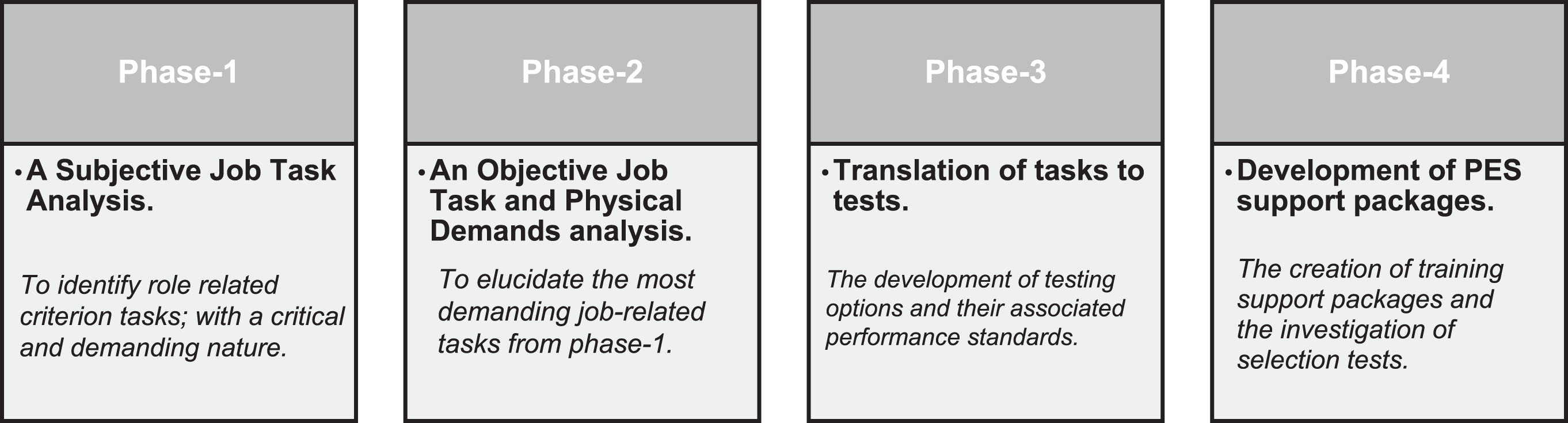
An outline of the Royal Navy Physical Employment Standards Work Programme.
Phase-1 in the RN PES process generated a descriptive task list of 14 Criterion, role-related tasks using focus groups and surveys [5]. The generated task list reflected the most critical and physically demanding tasks that any sailor, irrespective of rating/rank or specialisation, might undertake during a sea deployment. To further refine the job task list, the present study aimed to; 1) quantify the most physically demanding tasks undertaken by RN sailors, 2) further refine and define the generic task descriptions into specific role-related tasks, and 3) identify the most demanding and important tasks to progress to the next phase of the RN PES research programme.
A between-subjects, Objective Job Task Analysis was performed on 14 Criterion Tasks as part of a Service Evaluation in accordance with Ministry of Defence Research Ethics Committee policy [20]. Written informed consent to take video and photographic evidence during each observation was received from participants prior to undertaking observations. The 14 Criterion Tasks from the Subjective Job Task Analysis were clustered into eight groups; ‘ammunition ship’, ‘humanitarian assistance’, ‘ship embarkation’, ‘damage control’, ‘firefighting’, ‘casualty handling’, ‘abandonment’ and ‘generic –other’ (Table 2). Each task-group was evaluated separately during RN training exercises.
Criterion Tasks brought forwards from the Subjective Job Task Analysis
Criterion Tasks brought forwards from the Subjective Job Task Analysis
Following the NATO PES framework, the RN established a Military Judgment Panel (MJP) to act as final authority, approving and endorsing findings a teach stage of the programme. The MJP consisted of a Chair (1-star rank; RN Commodore) who was advised by SMEs and RN stakeholders, including representatives from Frigates, Destroyers, Submarines, Force Generation, RN Executive, Navy People, Medical Staff, Employment Law, Navy Safety, Chemical Biological Radiological and Nuclear Centre and scientific domains. The outcome for each task was agreed via consensus, following advice provided from the relevant advisors and stakeholders.
Objective job task analysis
Twenty-one task observations were performed during training exercises across RN Type 23 Frigates, Type 45 Destroyers, and shore-based training facilities. All observations reflected the business-as-usual training activities. In total, 203 RN personnel (age 28±7 years) were observed with between 1–49 service personnel undertaking each task or task variant. The sample was diverse in terms of sex (16% females) and ranks (56% Able Seaman; 15% Leading Hand; 7% Petty Officer; 8% Chief Petty Officer; 2% Warrant Officers; 2% Sub Lieutenant; 5% Lieutenant; 5% Lieutenant Commander).
Cardiovascular demand
Cardiovascular demand was quantified during tasks from a chest-worn heart rate (HR) monitor (Polar Team 2, Polar Electro Ltd, Warwick, UK) supplied and fitted by the research team before each observation. Data were downloaded to Polar proprietorial software and inspected for artefacts; suspect (non-physiological) data were cleansed via a lower and upper boundary filter. Due to limited access to personnel undertaking the training activities, maximum HR (HRmax) was estimated from a previously published equation (Equation 1 [21]).
Equation 1. Calculation of predicted maximal heart rate (HRmax).
Due to the large variation in Criterion Task duration, summary data were calculated and expressed as percent time spent in six zones based on estimated % HRmax (i.e., <50% HRmax, 50–59% HRmax, 60–69% HRmax, 70–79% HRmax, 80–89% HRmax, ≥90% HRmax). In addition, mean HR and peak HR were calculated for each task and expressed as a percentage of HRmax. Mean and peak HR were defined as the average and the highest values obtained from a rolling 30 s average, respectively.
Similar to work by others [16, 23], three HR metrics were used to rank tasks based on their cardiovascular demand. These included mean HR, peak HR, and the percentage of time spent above 80% HRmax. Tasks were ranked individually for each HR metric and the compound rank score for the three HR metrics determined the overall task rank (Equation 2).
Equation 2. Calculation of Cardiovascular Demand Compound Score:
Task characterisation
Task characterisation and observational movement analysis (e.g., primary physical action, mass moved and distances) were conducted during and after task observations. The masses of equipment and objects were measured with digital scales to the nearest 0.1 kg (Seca 770, Seca Ltd, Birmingham, UK) after each observation. The mass of Personal Protective Equipment (PPE) ensembles (e.g., firefighting equipment) were measured by subtracting the participants body mass from their total mass whilst wearing the PPE before each observation. Similarly, the object mass carried during team-based tasks (e.g., two-person casualty carry) was measured by subtracting the participant’s body mass from their total mass whilst lifting an object during static trials after observations of the dynamic task. The height of objects and the dimensions of spaces were measured with a laser distance meter (CP-100 S) or a tape measure to the nearest 0.01 m after each observation. The ship environment precluded the use of Global Positioning Systems (GPS) to measure distance and speed of movement. Consequently, horizontal distances were measured following each task observation by re-tracing the route taken with a laser distance meter. Video (Sony HDR –CX405; MUVI K-Series K2) and photography (Sony DSC WX350) were used in combination with hand notation to capture task ergonomics and analyse task speed, distances and volume (repetitions). The speed of movement was calculated retrospectively by reviewing the video recordings and timing movement over known (measured) horizontal distances. A hand notation proforma was completed by researchers for each task observation to detail the: exercise, scenario, Criterion Task, participants, clothing/PPE and equipment, as well as start and finish times, number of personnel involved, distances moved, compartment dimensions and repetitions performed.
Task characterisation was based on previously published methods [22]. The metrics used to characterise the tasks included: duration; object mass; number of personnel involved; number of hands used to handle the object; clothing/PPE worn; time-criticality; vertical lift height/distance; number of decks transited; horizontal carry distance; number of lift/carry repetitions; work: rest ratio; ambulatory speed; and repetition rates. Following task observations, each task was classified into one of four, primary physical actions, which included: ‘vertical lift’; ‘locomotion with load’; ‘push/pull’; and ‘other’ [22]. Subsequently, tasks were clustered into sub-groups, which served two purposes: first, to ensure the entire continuum of role-related functional movements were represented in the subsequent phase of the programme (i.e. physical demands analysis); and second, to identify common, fundamental physical actions to generate generic role-related PES assessments that could be modulated for different RN trades, or fighting arms in the future. Task sub-groups are highlighted at Step 2 in Fig. 2.
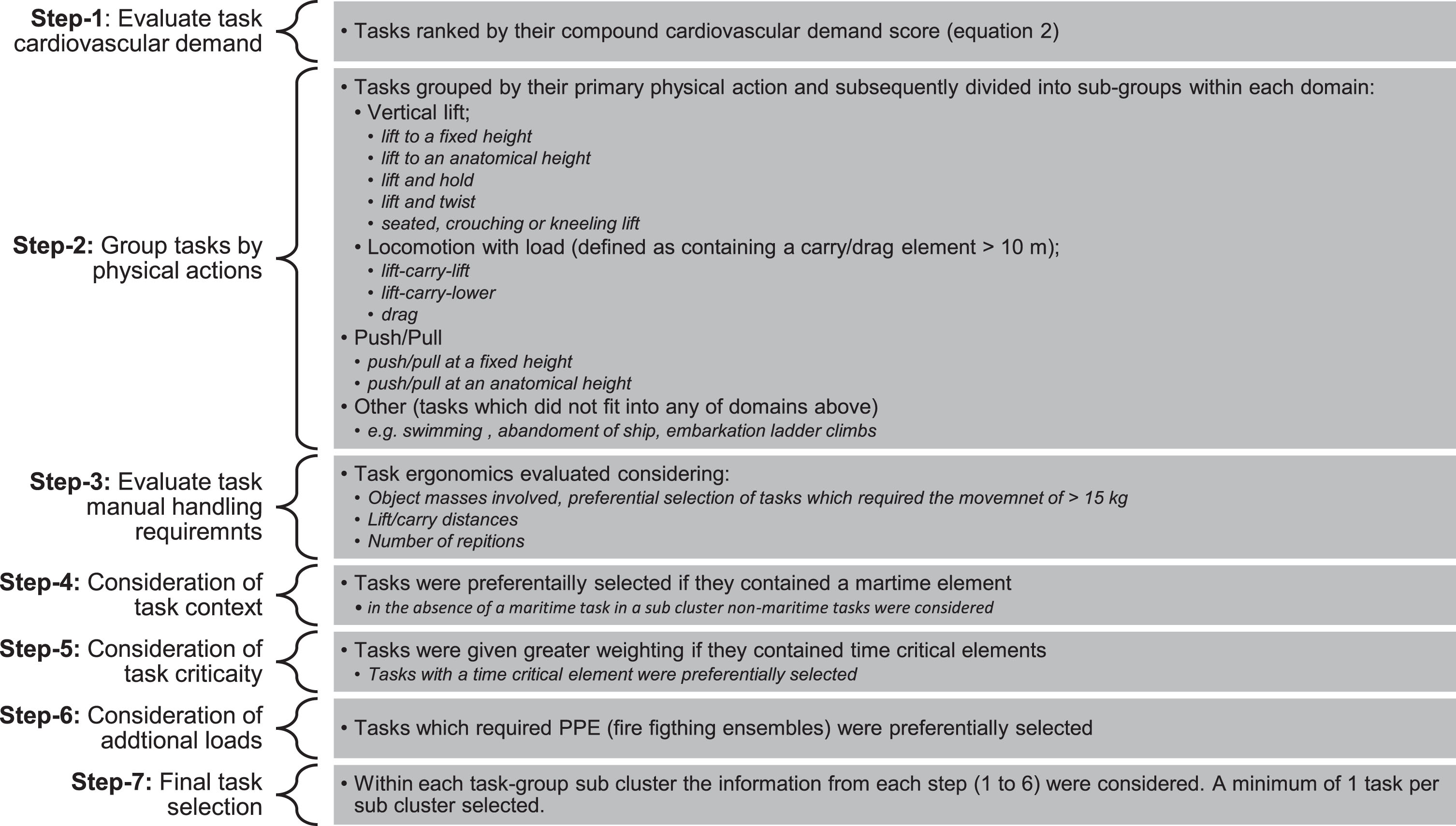
The Seven Step Algorithm used to Down-Select Criterion Tasks.
A separate Service Evaluation was conducted on RN Physical Trainers (PTs) (n = 72), who were invited to complete a questionnaire that aimed to elucidate which components of physical fitness (i.e., aerobic endurance, anaerobic endurance, muscle strength, muscle endurance and mobility) were influential in determining Criterion Task performance. Definitions of each component of physical fitness were provided, and for each Criterion Task were ranked by PT staff in order of importance on a 5-point Likert scale. An example of the questions asked, and rating scale can be found at Table 3.
An example of the PT branch questionnaire – which was used to establish the most important component of fitness within each Criterion Task
An example of the PT branch questionnaire
The final tasks selection was made by the MJP and was based on a logical stepwise approach considering all aspects of task physiological demand, task ergonomics and organisational requirements (Fig. 2). The final task outcome (selection or exclusion) was reached by a consensus view of the MJP members once all relevant information had been discussed. Each task sub-group (Fig. 2; Step 2) was considered independently to ensure a wide breadth of movement profiles were included in the final task list.
Statistical analysis
Physiological data were checked for normality by assessing skewness and kurtosis, and unless stated presented as a mean±one standard deviation (SD). Where data were available for a singular task across multiple observations, data were pooled into a single sample. Descriptive statistics on task ergonomics were generated for each of the 36 tasks and were presented to the MJP to aid decision making.
Results
Task list
Following observations, the Criterion Job Task list increased from the 14 tasks identified by the Subjective Job Task Analysis to 36 when all variants of each task were considered (Table 4).
Criterion Tasks and roles observed as part of the Objective Job Task Analysis
Criterion Tasks and roles observed as part of the Objective Job Task Analysis
Table 5 shows the summary cardiovascular demand data for all task observations that were presented to the MJP. Data were ordered based on the HR compound score of the three HR metrics of interest. For the top-five ranked tasks HR metrics ranged from 71% to 87% (mean HRmax), 85% to 98% (peak HRmax) and 28% to 86% (% time above ≥80% HRmax). Comparatively, the HR metrics of the five lowest ranked tasks ranged from, 50% to 64% (mean HRmax); 66% to 74% (peak HRmax); and 0% to 2% (% time≥80% HRmax). Due to logistical or safety reasons 5 task observations were made without HR measures.
Rank Order of Criterion Tasks Based on Heart Rate Responses
Rank Order of Criterion Tasks Based on Heart Rate Responses
The MJP endorsed the evidence and agreed that the five tasks with highest cardiovascular demand should be down-selected and progress to the next phase of the research programme (Step 1; Fig. 2). All remaining tasks progressed to Step 2 in the selection process. In addition, the MJP endorsed that the task ‘brisk movements around ship’ should be nested within other time-critical tasks in future research and not as an independent task. Furthermore, for safety reasons the MJP confirmed that tasks should be conducted as a ‘brisk walk’ (and not a run) in future work to better reflect the real-world job tasks, where safety restrictions preclude running on ships.
Lifting tasks
Of the lifting tasks, one task which encompassed the physical action ‘Vertical lift to fixed height’ was selected by the MJP. This task, ‘lift 30 mm ammunition box into the magazine’, involved the movement of a 42 kg mass across an approximate vertical distance of 1.35 m. During observations, the task was conducted as part of a 2-person lift (57% of the time). The MJP endorsed the selection of this task under the caveat that it should be undertaken as part of a two-person lift in future stages of the PES development.
One task in the category ‘Lift to Anatomical Height’ was also selected. This task, ‘lift, carry, lower a WEDA pump’, involved the movement of an ∼82 kg mass (WEDA pump and rope) along a ship’s deck and up and down ladders to the scene of a flood. The MJP endorsed the selection of this task under the caveat that, for safety reasons, the task should be carried out as part of a three-person team, as this would be the case when performed on a ship.
Two tasks in the category ‘lift and hold’ were selected, having already been highlighted in the cardiovascular demand analysis in Step-1. Both tasks related to the use of firefighting hoses and involved the repeated lifting and manipulation of either the firefighting hose and nozzle or the waterwall hose and nozzle, undertaken as part of the fire support party.
Locomotion with load
In the category ‘lift, carry, lift’, two task were already highlighted to progress based on their cardiovascular demand. The first of these tasks, ‘carry fresh water to the local community’, required the movement of up to 38 kg mass across land to a storage area. The second task, ‘carry loads up a ladder in an emergency’, required personnel to carry drums containing aqueous film forming foam (AFFF, ∼21 kg each) from a storage area to the scene of the fire on ship. The MJP endorsed the selection of this task and defined carrying two AFFF drums (total mass ∼42 kg) and the lifting of a single AFFF drum (∼21 kg)up ladders multiple times, as the essential components of this task.
In the category ‘lift, carry, lower’, three tasks were selected which covered three variants of a two-person casualty carry. The task, ‘casualty search and rescue in a smoke-filled building’, had already been highlighted due to its high cardiovascular demand. This task included a casualty carry whilst wearing additional PPE and as such was automatically selected. The task, ‘carry the deceased to a temporary morgue’, involved the longest observed carry distances (∼169 m) and the ‘two-person casualty carry’ was the only task which was undertaken in an embarked context. As such, all three tasks were selected by the MJP to progress.
Drag tasks
Both tasks involving dragging were included in the final selection. The first, ‘fire support party –hose handler’ involved the manoeuvre (including dragging) of charged and uncharged firefighting hoses across the ship’s decks. The second, ‘one-person casualty drag/lift’ was also included as it represented the task with the highest individual strength requirement (manipulation of ∼87 kg by an individual). The MJP endorsed the selection of these two tasks and directed that future development should focus on a standardised casualty mass at the 50th percentile of a RN sailors’ body mass.
Push/pull tasks
One push/pull task was selected by the MJP. This task, ‘casualty hose lift’, involved the movement and rescue of a casualty from a lower to an upper deck via a hose lift technique. It was endorsed by the MJP that one individual should be capable of manoeuvring the casualty to the base of a ladder, at which point they should be able to assist in a two-person hose lift out of the compartment. As with the previous casualty handling task, the MJP endorsed that a standardised casualty mass at the 50th percentile should be used in future stages of the PES development.
Other tasks
Despite a lack of objective data to support their inclusion, the MJP endorsed the selection of two miscellaneous tasks; ‘climb embarkation ladder’ and ‘abandon ship’. This was due to their unique physical requirements –climbing a rope ladder and swimming, respectively.
Questionnaires
From the PT questionnaire data ‘muscle endurance’ was ranked as the most important component of physical fitness to underpin Criterion Task performance. Being ranked highest in eight out of the 20 tasks reported. This was followed by ‘aerobic endurance’ rated highest in five tasks out of 20 tasks and ‘muscle strength’ in two out of 14 tasks. ‘Mobility’ was ranked the most important component of physical fitness in one task (‘climb embarkation/disembarkation ladder’), both ‘mobility’ and ‘anaerobic endurance’ were consistently rated the least important components of fitness in all other tasks (Table 6).
The Components of Physical Fitness Ranked in Order of Importance to Criterion Task Performance.
The Components of Physical Fitness Ranked in Order of Importance to Criterion Task Performance.
Note. Data shown are Mean (SD) from a sample of 72 Royal Navy Physical Trainers. Ratings were compiled as an average ranking from a questionnaire which used a 5-point Likert scale with 1 being the least important and 5 being the most important component of fitness for each Criterion Task.
The purpose of this present study was to complete an Objective Job Task Analysis of Criterion Tasks performed by RN personnel. The overall aim of the study was to identify only the most physically demanding and critical tasks undertaken by RN sailors, but which would still provide a wide breadth of movement profiles and physical demands to be tested. This work provides an evidential record of the physical demands of 36 ship-board activities undertaken by RN sailors and has elucidated a list of the 14 most physically demanding and unique tasks.
The combination of task observation HR responses, task functional movements and a MJP resulted in the down-selection of 14 Criterion Tasks to progress on to the physical demands analysis phase of the programme. Consequently, six Criterion Tasks from the Subjective Job Task Analysis and 22 task variants from the Objective Job Tasks Analysis were excluded and will no longer be considered in the development of the RN PES.
During observations new task variants and roles emerged, as such, the size of the task list was not reduced following completion of this phase of work. This outcome will add complexity and challenge to the next phase of the research, as it is customary for a PES task list to reduce as the PES process develops, allowing greater focus to be placed on the most relevant tasks from which a PES will eventually derive [19]. The increase in the task list can be explained by the varied, complex and team-based nature of the tasks observed. For example, the task ‘ammunition ship’ varied depending upon the type of ammunition handled (e.g., 4.5 shells, 30 mm boxes) and the location of the ship the activity was performed (e.g., upper deck, deep magazine). Furthermore, five physically demanding tasks were observed during the task ‘disaster relief’, which included tasks such as casualty handling/rescue and movement of essential equipment and provisions.
Comparatively, in the development of the Royal Australian Navy PES, 29 tasks were observed (38 task variants), versus 20 tasks (36 variants) in the present study [23]. A process of down-selection and task combination resulted in the Royal Australian Navy PES task list reducing from 29 tasks to four scenarios (i.e., ‘storing’, ‘fighting a fire’, and two variants of ‘toxic hazard teams’). Each scenario comprised one to six tasks from the original task list. Consequently, in the next stages of the RN PES development, scenarios should be developed combining multiple tasks from the current task list. This will reduce the required number of observations and promote greater ecological validity –especially in terms of task duration and aerobic demands.
Muscular endurance and aerobic endurance were rated as the most important components of fitness across all the essential Naval tasks. Furthermore, muscular strength was also identified as an important attribute. It has been previously shown that physical endurance and physical strength influence performance in many tasks undertaken in physically demanding occupations [9] and are important in the development of military readiness [10], which the RN PES data support. Additionally, a recent Royal Marines job task analysis also reported a breadth of physical fitness components (e.g., aerobic, anaerobic, muscle endurance, muscle strength, mobility) that underpinned role-related performance [24, 25]. Hence, in military occupations there is a justification to test a broad range of fitness components. Muscle endurance appears to be highly influential in RN role-related task performance, and therefore should be central to the future RN PES. The importance of other components of fitness should not be overlooked, particularly when considering the eventual configuration of the test(s).
The task down-selection in the present study was performed with a ranking system that considered both task HR responses and a full spectrum of role-related task functional movements. This has ensured that both cardiovascular and a breadth of manual material handling role requirements are considered in the next phase of the programme. The placement of tasks in a rank order meant that the stringency (or leniency) of the task down-selection could be modulated so that an appropriate number of tasks were taken forward to the next phase. A bespoke approach ensured that the tasks down-selected exhibited: the highest cardiovascular demand; a breadth of functional movements/requirements (e.g., vertical lift, locomotion with load, push/pull); embarked tasks; the prioritisation of ‘time-critical’ tasks; and tasks that included the additional burden of firefighting PPE.
Of the 14 tasks down-selected, five were selected based on HR responses; three based on the functional movement of ‘vertical lift’; eight involved ‘locomotion with load’; one ‘push/pull’; one ‘climb’; one ‘swim’ and one ‘unloaded locomotion’. Crucially, a comprehensive representation of the different functional movements performed on a sea deployment emerged from the task down-selection. Clustering the Criterion Tasks into different types of functional movement has strategically prepared the RN PES programme to implement a PES that should be able to predict role-related performance amongst different RN trades, fighting arms and specialisations [22]. The adoption of this approach may allow the final RN PES to contain modular aspects, where simple adjustments or additions to the generic assessment (e.g., a greater mass lifted) may better reflect the enhanced or unique physical requirements of RN specialisms (e.g., Navy Divers).
There were several limitations in this study. First, a between-subjects design was undertaken, which meant that within-subjects, repeated measures comparisons of task HR responses could not be performed. Second, the sample size of the task observations varied considerably. However, this was in-part an unavoidable consequence of the size of courses/training exercises and the nature of the tasks (e.g. one-person task versus team-based task). Third, certain training exercises appeared to have an unrealistically low physical demand that was due to: at times a surplus of available personnel to perform tasks; a casualty dummy that was unrealistically light (i.e., 37 kg); and the use of uncharged firefighting hoses during ship-based training exercises. Lastly, due to health and safety or for public health reasons it was not possible to measure HR in all tasks, meaning the cardiovascular demands of these tasks could not be appraised. Despite the limitations, significant data were gathered and presented to a MJP to evidence the physical demands and physical requirements of generic tasks performed by RN personnel to progress the development of the RN PES.
Conclusion
This Objective Job Task Analysis identified 14 critical and demanding tasks that could be undertaken by a RN sailor during a sea deployment. The task list encompasses a wide breadth of physically demanding tasks (e.g., ‘firefighting’, ‘casualty handling’ and ‘response to flooding’), across a range of unique movement profiles. Further, we have demonstrated that it is feasible, and ecologically more valid to establish the demands of naval seafaring tasks in their occupational context –where we have been able to measure a number of different components of fitness to inform the RN PES. Future work will look to exploitthis task list, to develop job related scenarios that comprise several tasks, to yield scenarios which have greater ecological validity with respect to a ‘reasonable worst case’.
Ethical approval
This work was undertaken as a service evaluation in accordance with the Ministry of Defence Research Ethics Committee regulations. As such there is no ethical approval number.
Informed consent
Participants provided written informed consent in accordance with the Ministry of Defence Research Ethics Committee regulations.
Conflict of interest
None to declare.
Footnotes
Acknowledgments
The authors would like to thank the Royal Navy Fitness Test staff at HMS TEMERAIRE and the Royal Navy personnel and establishments who gave their time as both participants and facilitators.
Funding
This study was funded by the UK Ministry of Defence, who had no involvement in the study design, data collection, analysis and interpretation of the data, or writing of the report.