



Abstract
BACKGROUND:
Within individual policing organisations, there are a wide variety of units and job roles.
OBJECTIVE:
To profile the occupational tasks performed by Australian mounted police officers, aiming to offer conditioning insight into this unique job role.
METHODS:
Thirteen fully qualified and operational mounted police officers (n = 11 females), who served in the mounted police unit for ∼3.3 (±2.3) years, participated in this observational cohort study. Participants completed a survey outlining common occupational tasks and were monitored throughout four consecutive shifts. Participants’ heart rate (HR), respiratory rate (RR), and skin temperature (ST) data were collected via wearable monitoring (Equivital EQ-02, Hidalgo, UK) and body position, physical activity undertaken, task effort, and load carriage were recorded by researchers. A one-way ANOVA was used to assess mean differences in physiological measures between the three most reported tasks.
RESULTS:
Survey identified 130 tasks, with 38 listed as most common. The three most reported mounted police tasks were: ‘horse riding’ (n = 13, 34%), ‘mounted patrols’ (n = 10, 26%), and ‘horse care’ (n = 10, 26%). These were also reported as the most physically demanding. HR during ‘horse care’ and ‘horse riding’ were significantly higher than when ‘mounted patrolling’ (27±7bpm, p = 0.001 and 33±8bpm; p = 0.001, respectively). Mean RR was higher when ‘horse riding’ when compared to ‘horse care’ (5.3±1.6brpm) and ‘mounted patrol’ (8.5±1.9brpm).
CONCLUSION:
Mounted police officers experience unique physiological challenges throughout their routine occupational tasks. This study highlights the significance of understanding occupation-specific tasks and stressors undertaken by mounted police to develop relevant conditioning, rehabilitation, and monitoring procedures.
Introduction
Employed in a tactical occupation, police officers are responsible for upholding the law and safeguarding the well-being, freedom, and belongings of individuals, while also deterring criminal activity and maintaining societal order. It is imperative for police officers to exhibit their actions with rationality, honesty, and sound judgement [1, 2]. To fulfill such duties, police officers perform a variety of different tasks [3]. Some of these tasks are generally sedentary in nature (e.g., desk work, communications, car patrolling) while others are highly dynamic and physically demanding (e.g., chasing an offender on foot, grappling with an uncooperative offender, pushing a vehicle to the side of a road) [2, 4]. A police officer may need to shift from one type of task to another instantly [5], adding to the challenges of police job roles.
Within a single policing organisation, there are a wide variety of units and, consequently, different job roles [3]. These include, but are not restricted to, general duties, patrol officers, water police, mounted police, public order riot squad, and specialist police tactical groups. As such, within one police organisation, the tasks performed by officers can differ [3]. For example, general duties officers have reported that checking bona fides of an individual was one of the most frequently occurring tasks followed by attending a domestic incident [3]. In a specialist police tactical group, the most frequently reported tasks include warrant execution [5], firing a semi-automatic weapon, and deploying from vehicles whilst performing close personal protection and/or high-risk escorts [6]. Therefore, policing organisations must have a clear understanding of each unit’s distinct range of occupational tasks to ensure optimal recruitment, training, and return-to-work programs.
To select, train, and retain the best officers for these different roles and units, fitness screening is often one of several pre-requisites [7, 8]. The application of exercise science methodology and rigour to the development of occupational fitness screening tests is becoming increasingly prevalent, sophisticated, and standardized [9], particularly for physically demanding occupations [10]. The importance of fitness screening is highlighted in several studies which have identified an increased risk of injury in police officers with lower levels of fitness [11–14]. More concerningly, Bonneau and Brown [2], conducting research with the Royal Canadian Mounted Police, found that, on average, the fitness capacity of a police officer was well below the average fitness capacity of the criminals they were required to subdue. With these lower fitness capacities, adding more equipment load onto the police personnel during their job tasks has been shown to pose an increased risk of musculoskeletal injuries [2]. Therefore, in order to reduce this risk and preserve performance, occupationally relevant physical training plays a role in matching the physical capacity of personnel with their job task demands [4].
Developing a robust and comprehensive understanding of occupational roles requires the completion of a job task analysis, which identifies the physical capacities inherent to the tasks performed by incumbent personnel [4]. Once an accurate understanding of the police profession’s roles and requirements are established, the application of appropriate screening tools can be used to expedite the recruitment process and ensure the best possible individual is chosen for service in each unit.
At face value, the requirements of a mounted police unit could be expected to be vastly different to that of a general policing unit: a main notable difference being the use of a police horse incorporated into their daily tasks. For a mounted police unit, a police horse can provide the riding officer with a 360-degree view of their surroundings from a much more advantageous height compared to an officer on foot. Furthermore, the speed and agility of the highly trained horse would allow a mounted police officer to cover more ground, on a wider range of terrain, and fit into confined areas with civilian populations present [15, 16]. However, with the addition of a police horse comes the skills required to ride and perform tasks whilst working with the horse as well as the responsibilities of caring for the horse. As such, the physical requirements of a mounted police officer may differ substantially from those of a general duties police officer. Therefore, prior to determining any physical screening requirements for a police unit, it is imperative that the key tasks undertaken are determined and examined. The conduct of such research provides may benefits from establishing specific job-entry and return-to-work following injury requirements to the prescription of suitable physical conditioning and rehabilitation protocols. Therefore, the aim of this study was to establish the nature and contexts of occupational tasks performed by mounted police officers from an Australian state police force.
Methods
This study used two study designs to address its aim: a cross-sectional survey and an observational cohort study design [17]. The survey allowed for information on tasks performed to be captured directly from the Australian state mounted police officers recruited, even when they were on leave or not rostered for duty. The observational cohort component consisted of physiological data monitoring throughout each shift as well as a notational analysis of tasks performed during these shifts (i.e., job task analysis) in a three-day period.
Current active officers within an Australian state’s only mounted police force were recruited for this study. The two inclusion criteria were: a) the officer was a fully qualified and operational member of the unit, and b) the officer was serving in a full-time capacity. Officers were excluded from the study if: a) the officer was on a return-to-work plan following injury, or b) the officer was unable to complete mounted job tasks during their shift. Ethics was approved through Bond University Human Research Ethics Committee (BUHREC Protocol Number BS02126) with gatekeeper approval obtained through the relevant state police force. Of the 13 mounted police officers that participated in this study, 11 (84.6%) were female (mean age = 33.5±5.2 years, height = 171.8±6.2 cm, and body mass = 69.2±10.3 kg) and two were male (mean age = 47.5±0.7 years, height = 187±2.8 cm, and body mass = 83.7±8 kg). The mean length of service among all participants was 3.3±2.3 years for mounted police duties and 8.8±6.3 years for general duties.
The cross-sectional, paper-based survey questions were designed to elicit responses that would elucidate key aspects of the daily occupational tasks and their corresponding frequency and duration. The questionnaire contained a total of six open-ended questions. Two questions aimed to identify the officer’s employment history at the police force and specifically the mounted unit. Four questions were used to discern between the most common tasks performed by general duties police and tasks specific to mounted police. Participants were requested to list three tasks for each of the following: (a) most common general duties task, (b) most common mounted police task, (c) least common mounted police task and (d) most physically demanding mounted police task. Participants were also required to report on the frequency and duration of the tasks they listed in each question.
After completing the survey, but prior to the observational data collection, all volunteering officers completed a familiarization session (<30 minutes). The familiarization session involved collecting (a) descriptive information such as age and self-reported height and weight, which have been shown to be accurately reported within this population sample [18] and (b) baseline physiological data. For such, participants were fitted with a physiological monitoring device (EQ02, Equivital, Hidalgo, UK). This device was used to collect a range of measures throughout the course of two to four daily shifts, depending on their roster. Continuous heart rate (HR) in beats per minute (bpm), respiratory rate (RR) in breaths per minute (brpm), and skin temperature (ST) in degrees Celsius (°C) were recorded throughout each shift to allow insight into the physiological responses to the occupational tasks.
Researchers shadowed selected participants during their shift, noting events for the job task analysis. The researchers manually recorded the participants’ body positions (e.g. lying down, sitting, kneeling, squatting, upright on feet), physical activity engaged in (e.g. stationary sitting, stationary standing, walking, running, leading, riding, horse care, menial/admin tasks, lifting/lowering objects, carrying objects), effort (resting, light 10–30% HR, moderate 40–60% HR, high 70–90% HR, maximal 100% HR) and load carrying capacity (0–2 kg including boots, 3–5 kg, 6–10 kg, 11–20 kg, >20 kg) during each task completed. This approach to documenting physical tasks has been drawn from previously validated research [19, 20]. At the end of each shift, these observations were transformed into an electronic datasheet (Microsoft Excel) where each task was time coded and aligned with data obtained from the physiological monitoring devices.
Statistical analysis
Data from the survey and observations were first cleaned, with missing data simply recorded as missing and not replaced by interpolation or any other method. Survey data reporting occupation tasks, frequency, and duration were tallied to determine the top three tasks in each category. Observational data were tallied and then collapsed into naturally occurring groups consisting of tasks completed during shifts: for example, washing horse, tacking up/down, feeding horse were merged into ‘horse care’.
Data from the individual physiological monitors were imported to the Equivital Manager software (Version 2.5.3.130) for analysis. Physiological measures (HR, RR, and ST) for participants across each occupational task, were analysed using the JASP Statistical Software [21]. Manual cleaning of the data removed notable cell errors (e.g. non-numeric entries). Data points that were improbable or impacted by artifacts (i.e., distorted signals), for example, HR below 40 bpm or above 230 bpm were excluded [22]. The range, mean, and standard deviation for each variable were then calculated.
The top three most common mounted police tasks and three most physically demanding mounted police tasks reported by police officers within the study were identified based on the number of survey responses and their frequency per week. These were then subjected to further analysis. Differences in HR, RR, and ST between these tasks were investigated through a one-way ANOVA. Effect size of ANOVA was reported through partial eta squared. Post-hoc Bonferroni correction was performed to identify pairwise significance. Means (
Results
Survey responses of the 13 participants, considering all four survey categories combined, yielded 130 tasks, outlined in Table 1 with their reported frequencies. Of these, 38 task instances were listed under ’most common mounted police tasks’, 31 under the ‘most common general duties tasks’, and 25 under ‘least common mounted police tasks’. The three most common tasks specific to mounted police were: ‘horse riding’ (n = 13, 34%), ‘mounted patrols’ (n = 10, 26%) and ‘horse care’ (n = 10, 26%). ‘Horse riding’ was defined as riding tasks undertaken as training, drills, horse warm-up and exercise, often performed in the confines of the mounted police station or on an adjacent training field. This task differs from the ‘mounted patrol’ task, where officers are in full gear, out in the public, performing patrolling police duties. ‘Horse care’ included lifting gear, tacking, washing, and grooming (e.g., picking out hoofs). A total of 36 task instances were listed under the ‘most physically demanding mounted police task’ category. Of these, the three most physically demanding mounted police tasks were ‘horse riding’ (n = 17, 68%), ‘mounted patrols’ (n = 7, 28%) and ‘horse care’ (n = 6, 24%).
Tasks reported on survey
Tasks reported on survey
*Frequency of 1–4/week are tasks noted to occur at least once every shift. Weekly number of shifts are roster-dependent and can range from 1 to 4 shifts/week.
The three most observed tasks were as follows: ‘Horse care’ (n = 14, 31%), ‘horse riding’ (n = 7, 15%), and ‘mounted patrol’ (n = 7, 15%). The complete list of all 45 tasks observed is detailed in Table 2. The self-reported frequency ranges of these same tasks were ‘mounted patrol’ 2 to 15 occasions per week, ‘horse care’ 2 to 15 occasions per week, and ‘horse riding’ 2 to 18 occasions per week (Table 1).
Tally of observed tasks
The participants’ body position and physical activity being conducted were typically standing or sitting. ‘Horse care’ involved being upright on their feet, with occasions of bending/squatting to clean hooves and wash the horse. ‘Horse riding’ consisted of leading the horse (upright on feet while holding horse reins), with most of the task completed while sitting on the horse. Of note, sitting in this instance is not a passive action as the officer needs to respond to the proprioceptive input received from the horse’s movements. Further, depending on the speed of the horse (e.g., trot, canter, or gallop), the officer was required to shift their weight and either alternate constantly from a sitting to rising position or stand on the stirrups, in a semi-squat position, matching the rhythm of the horse. Body position and physical activity varied from each patrol, dependent on the requirement to engage or interact with the public. For instance, during a patrol, an officer was required to complete a high dismount off their horse to engage in a body search of a member of public and then remount. This requires end ranges of motion at the hip joint as well as upper and lower limb strength and power for the officer to pull themselves up to the saddle, particularly if no mounting block is available.
Lifting and carrying loads of 6–20 kg (inclusive of saddle, stirrups, grooming utensils, and protective helmet), was completed during each occasion of ‘horse care’. One participant engaged in ‘horse care’ on six occasions in a single shift, resulting in an estimated 32 kg of cumulative load lifted and carried per each grooming session; an approximate cumulative total of 192 kg lifted and carried across the 8-hour working day. Worn loads also differed depending on the task to be completed. On average, the participants’ uniforms, inclusive of riding boots, weighed approximately 2.4 kg. When donning the patrol uniform (inclusive of accoutrements belt, weapon, radio, and handcuffs), there was an average increase of 4.5 kg absolute weight worn resulting in a total worn load of 6.9 kg.
Results of the survey indicated that duration between the common tasks varied. ‘Horse care’ was reported to range 20–600 min per week, ‘horse riding’ 40–600 min per week and ‘mounted patrol’ 120–1,200 min per week. Of note, lower ranges may indicate officers that were only rostered for one shift/week and may have only completed that task once. Monitored mean durations of these tasks during the observed shifts ranged from 6–41 min for ‘horse care’, 18–168 min for ‘horse riding’, and 61–180 mins for ‘mounted patrol’. There were significant differences between the mean duration of each task (F (2,25) = 18.813, p < .001, η2 = 0.601). As shown in Fig. 1, significantly less time was spent performing single instances of ‘horse care’ (19.5±10.3 min) when compared to ‘horse riding’ (76.1±64.1 min; p = 0.008; ES = 1.549) and ‘mounted patrol’ (120.4±35.2 min; p < 0.001; ES = 2.760).
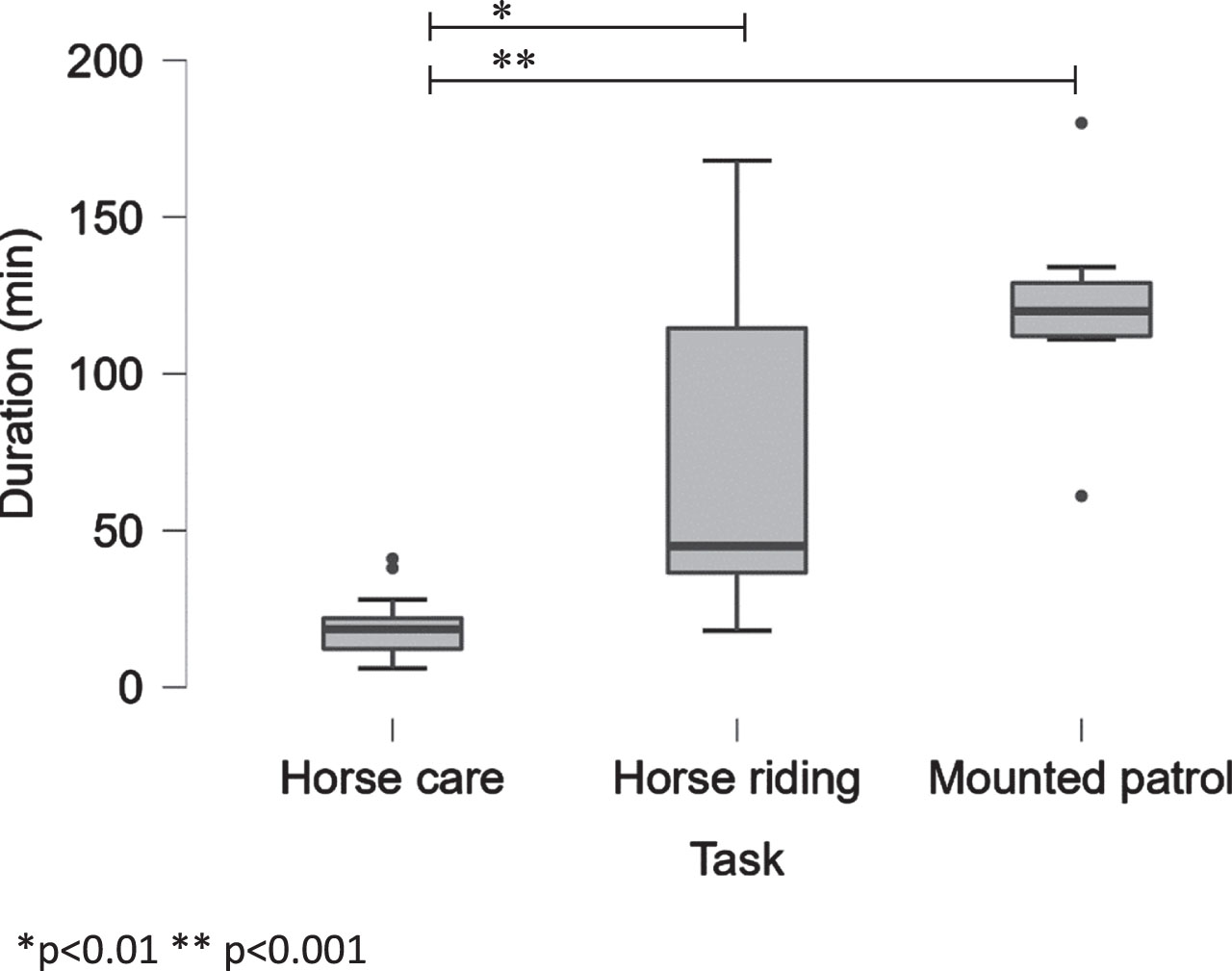
Average duration of the three most common occupational tasks.
Similar to the duration, physiological demands for each task also varied. These are presented below.
Heart rate readings varied depending on the task completed. Significant differences in mean HR between ‘horse care’, ‘horse riding’ and ‘mounted patrol’ were noted (F (2,25) = 10.818, p < 0.001, η2 = 0.464). Pairwise post-hoc analysis demonstrated that HR recorded during ‘mounted patrol’ (87±16 bpm) was on average lower than the HR recorder for both ‘horse care’ (115±9 bpm; p = 0.001, ES = 1.862) and ‘horse riding’ (120±20 bpm; p < 0.001, ES = 2.260) (Fig. 2). These averages, when considered as percentages of age-calculated HRmax, [24] indicate that officers are working at 66% HRmax, 63% HRmax, and 46% HRmax during ‘horse riding’, ‘horse care’, and ‘mounted patrol’, respectively.

HR during the three most common occupational tasks.
Across all observed tasks, the lowest and highest RR was identified in ‘loading horses onto the float’ with a RR range of 9 to 46 brpm. Amongst the three most common tasks, significant differences in mean RR between ‘horse care’, ‘horse riding’, and ‘mounted patrol’ were noted (F (2,25) = 10.120, p < 0.001, η2 = 0.447). RR recorded during ‘horse riding’ (31.1±5.5 brpm) was, on average, higher than the RR recorder for both horse care (25.8±1.0 brpm; p = 0.011, ES = 1.477) and mounted patrol (22.6±2.2 brpm; p < 0.001, ES = 2.369) (Fig. 3).
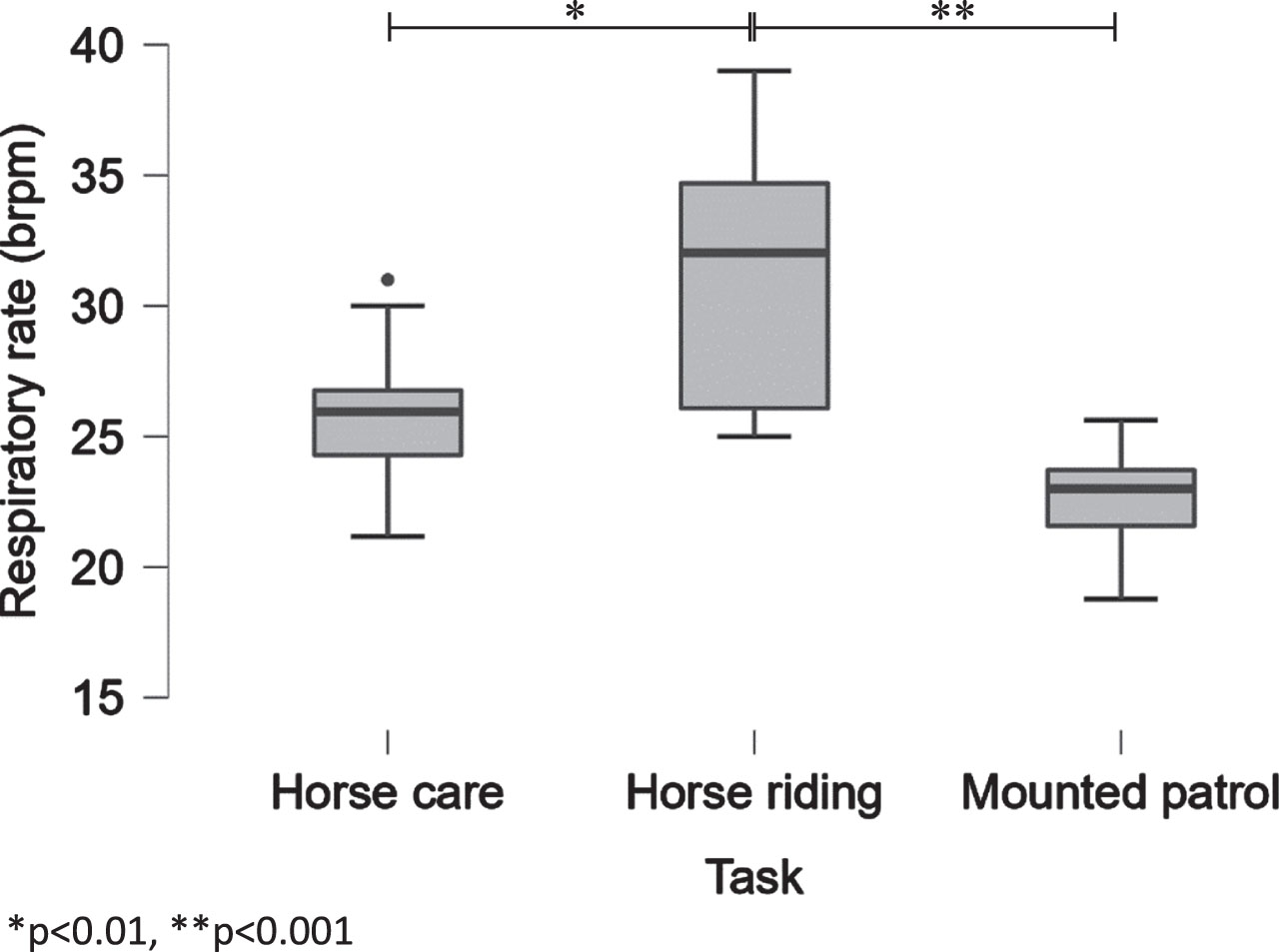
RR during the three most common occupational tasks.
ST did not differ significantly between the most common mounted police tasks (F (2,14) = 0.080, p = 0.924, η2 = 0.011). The widest ST range was recorded during horse riding tasks (34.6–37.4°C).
Discussion
This study aimed to profile the occupational tasks performed by Australian mounted police officers from a state police force across two-four consecutive shifts. A secondary aim was to investigate the physiological demands experienced by this cohort during these routine daily tasks. A total of 130 tasks were reported in the survey with ‘horse riding’, ‘mounted patrols’, and ‘horse care’ being the most common. These were also reported as the most physically demanding. Forty-five tasks were observed, and further analysis of the most common tasks identified different physiological demands between them. HR during ‘horse care’ and ‘horse riding’ were significantly higher than when patrolling. Mean RR was higher whilst riding the horse when compared to ‘horse care’ and ‘mounted patrol’.
Bonneau and Brown [2] suggested that police work is mainly a sedentary job alternated with physically highly strenuous peak moments. However, consideration of the findings of this study suggest that mounted police officers are continually physically active from the commencement through to the cessation of their shift. During shifts, there were minimal instances where officers were standing or sitting in a stationary manner, besides designated break times. As such, mounted police work appears to be notably different to that of general duties policing, a supposition supported by the survey in which there was no cross-over reported by officers between the most common mounted duties performed and general duties performed.
Much of the research pertaining to police officers has only focused on general police work such as the nature and frequency of occupational activities, which suggest that police tasks are highly varied in terms of type and, notably, duration and add operational context to the current literature focusing on physical activities and postures [3, 25]. While previous research has noted the more seated, sedentary nature of general duties policing, it is important to note that while mounted police officers are ‘seated’ for a common task (riding and patrol), the physiological demands resulting from the task may be vastly different to that of sitting at a desk, as made evident by the mean HRs of officers while riding and patrolling. Similarly, general duties officers create postural adaptations to driving tasks by changing limb posture while torso posture remains largely unaffected [26]; whereas mounted police officers are required to make dynamic, full body postural adaptations when riding or patrolling.
A notable finding from this current study was the mounted police officers most common completed tasks were also the most physiologically demanding. This finding was not only expressed in self-reported survey, but also confirmed in the task observation and physiological data collected. During their most common task of ‘horse riding’, officers were sustaining an average HR of 120±20.5 bpm and RR of 31±5.5 brpm. This would equate to working at 65% of age-predicted HRMAX, [24] considered a moderate intensity exercise, [27] for up to 170 minutes, in one instance of this task. Sainas et al. [28] demonstrated that a 20 min riding exercise with incremental increase in horse speed (walking, trotting, and cantering) elicited a light to moderate demand to riders’ metabolic and cardiovascular systems, with reported maximal oxygen consumption of 34.7±7.1 mL/kg/min and HR of 169.1±19.1 bpm. These findings are in similar to those presented by Westerling [29] and the current study. Consistent with increased HR, O’Reilly et al. [30] reported that a 45 min walk-trot-canter session resulted in a total energy expenditure of 194.7±3.8 Kcal and average energy requirement of 3.8±0.2 MET. Together these studies indicate that the metabolic and HR demands of riding are at almost those of ‘moderate physical activity’ outlined in the ACSM position stand [31]. The cardiovascular demands of this mounted police task, surpasses those typically, but not always, observed in the most common general duties police tasks such as checking bona fides, driving urgently, and attending domestic incidences [5]. Physiological demands of mounted police identified in this study suggest that mounted police are required to have and maintain their physical fitness to fulfil occupational requirements safely and competently.
The requirement of physical fitness is also made evident by the load carried by police officers, such as specialised equipment and protective clothing [15]. In this study, the researchers identified instances of repeated loads lifted throughout a routine 8-hour shift. Most of this external load carried was during the task ‘horse care’ which required officers to repeatedly lift the saddle, stirrups, reins, and grooming utensils weighing up to 20 kg. With some saddles requiring a step ladder to be reached, completing ‘horse care’ tasks could potentially create a precarious environment for the officers and as such, it is not surprising that animal handling makes up the vast majority (65%) of mounted police officer injuries with manual handling also in the top five activities causing injuries in mounted officers whilst neither of these two activities are in the top 10 activities associated with causing injuries in general duties officers [32]. Working in precarious environments can lead to increased risks of injury, which can impact on work capacity. Identifying these situations and ensuring individuals have the required physical capabilities can lead to interventions increasing officer safety. Preventing injuries in this population is vital to ensure occupational performance and, as one of the biggest predictors of injury is previous injury [33].
Similarly, during patrols, the mounted police officers were wearing, on average, a total of 6.5 kg in required operational equipment. With previous research noting the typical weight of personal protective equipment worn by police officers being 10 kg, [1] the additional burden imparted by load carriage during occupational tasks can increases the physiological demand of a task significantly. Given the possible effects of load carriage on task performance such as increasing thermoregulatory and cardiovascular demands, [34] there is also a need to establish what the minimum physiological requirements for such tasks are, to ensure individuals have the capability to perform these tasks safely and effectively.
Loads lifted, carried, and worn are also associated with injury risk. In this study the worn loads ranged from 2–6.5 kg and those lifted and carried of up to 20 kg, sometimes in awkward positions. Long periods of seated load carriage have been found to result in decreases in mobility [35] and cause specific injuries, like meralgia paresthetica [36]. A study by Roberts et al. [37] also showed that static load carriage increased postural sway, with carrying as little as 5% of body weight increasing anterior-posterior centre of pressure displacement. This could particularly effect mounted police officers who, like general duties police, are seated for long periods, but do so in different positions and while having to work with, and control, a horse. This is of note as horses have to adapt their movements to account for the riders shifts in posture, which can impact synchronicity between the rider and horse and potentially lead to injury [38]. Future research is necessary regarding this specific population and the impact of load carriage on job performance and injury risk. It is important to understand the load carriage requirements of mounted police officers to assist development of relevant physical training and rehabilitation programs. Occupationally relevant physical training can therefore play a role in matching the physical capacity of personnel and job task demands to preserve performance and reduce injury risk [39].
A final observation identified in this study the lack of significant findings for skin temperature between the three most common and physically demanding tasks. It may be the case that the observed tasks did not provide enough stimulus to cause a detectable change in skin temperature. It is important to note that during one shift, temperature at the mounted police facility reached over 40°C, resulting in rescheduling of rides and patrols. Researchers can infer that temperature protocols, in place to minimise risk of heat exhaustion for both officers and horses, may have contributed to this result.
Despite providing new and much required evidence on a specialist police cohort, the current study has some limitations. Firstly, the short duration of data collection period may not account for possible seasonal variation of tasks or the demands of certain events such as protests. Secondly, the more sedentary tasks, while not often performed were not included in the data capture to allow for comparison to less typical tasks. Future research should focus on monitoring mounted police officers for a longer timeframe to endeavour to capture possible seasonal variations in the types, durations and frequency of tasks performed.
Conclusion
The duties of mounted police officers appear to differ notably from those of general duties officers reported in the literature. The three most reported mounted police tasks were ‘riding’, ‘patrols’ and ‘horse care’ which are not typical of general duties police. These tasks were also the three most demanding mounted police tasks suggesting that mounted police officers experience numerous physiological challenges throughout their routine working day and perform tasks with significantly increase their HR and RR. Considering this, even within the three most coming tasks significant differences were found in mean durations, HR, and RR. The results of this study could be used to inform future fitness assessments and return-to-work screening and guide appropriate rehabilitation protocols for injured mounted police officers to ensure they encompass the job task context and physiological demands required of their occupation.
Ethical approval
The study was approved through the Bond University Human Research Ethics Committee (BUHREC Protocol Number BS02126) with gatekeeper approval obtained through the relevant state police force.
Informed consent
Informed consent was obtained from each participant in accordance with ethical requirements.
Conflicts of interest
None of the authors have a financial or personal relationship with other people or organisations that could inappropriately influence or bias the content of the study.
Footnotes
Acknowledgments
The researchers would like to thank the police officers who participated in this research and state police force for their efforts in making this research possible.
Funding
This research received no external funding.