



Abstract
BACKGROUND:
Dairy industry workers face numerous ergonomic risk factors in their workplace, including improper posture, manual material handling, and musculoskeletal disorders (MSDs). Fewstudies have been conducted on the correlation of postural stress, MSDs, and chronic fatigue among workers in the dairy industry.
OBJECTIVE:
This study aimed to investigate the relationship between the level of postural stress, MSDs, and chronic fatigue in a dairy company.
METHODS:
In this cross-sectional study, 260 male workers were included in the research based on specific inclusion criteria. The Cornell Musculoskeletal Discomfort Questionnaire, Chalder Fatigue Scale, and a researcher-made demographic questionnaire were used to collect data. The posture of workers was evaluated using RULA and REBA software, and the evaluation of the manual lifting of loads was assessed using the WISHA lifting calculator. Finally, the collected data were entered into the SPSS software version 26.0 and analyzed.
RESULTS:
The findings revealed a significant statistical relationship between the level of postural stress and chronic fatigue and a significant positive correlation between MSDs and chronic fatigue. Furthermore, a statistically significant relationship was observed between MSDs, chronic fatigue, and ergonomics training experience.
CONCLUSIONS:
The results obtained in this study support the notion that high levels of postural stress and MSDs can produce an increase in chronic fatigue among workers, and lack of ergonomics training for workers can increase both MSDs and chronic fatigue. Therefore, it is necessary to carry out intervention measures in the field of ergonomics management in similar industries through the implementation of ergonomic intervention programs with a focus on proactive and preventive measures and the use of participatory ergonomic programs and educational demands assessment.
Keywords
Introduction
Considering that human resources play a crucial role in every organization, paying attention to studies that can improve the health of workers and reduce work-related stress is of great importance. Ergonomics aims to optimize organizational performance and increase the health and well-being of workers by matching work environment conditions with individuals’ physical and mental abilities [1, 2]. The main ergonomic risk factors in the workplace include awkward postures, repetitive movement, excessive force, inappropriate manual lifting activities, and contact stress. Among the named risk factors, improper posture while performing tasks is one of the most important risk factors that can lead to musculoskeletal disorders (MSDs) [3–5].
MSDs are considered a cause of disability worldwide and can affect different parts of the body such as the neck, back, and upper limbs [6, 7]. MSDs refer to injury to bones, joints, muscles, tendons, ligaments, nerves, and blood vessels, which can cause various types of pain and discomfort in different body organs [8]. By delving into the statistics of work-related injuries and diseases, it is possible to better identify and understand the effects of work on workers’ health. According to studies conducted by the National Institute for Occupational Safety and Health, work-related MSDs are the second most common disorder after occupational respiratory diseases [9]. Additionally, these disorders are one of the main reasons for absenteeism from work and the increase in work-related compensation costs in developed and developing countries. According to statistics from Association of Workers’ Compensation Boards of Canada, 15 billion dollars has been spent yearly on the costs associated with MSDs in Canada from 2004 to 2013. In British Columbia, about 80% of absenteeism from 2004 to 2013 and over 65% of complaints and compensation claims by workers are due to these disorders in 2013 [10]. In the United States, according to the account of the Bureau of Labor Statistics, 31.8% of diseases and injuries involving days of absence from work are related to MSDs from 1992 to 2010. These statistics are higher in developing countries, including Iran, due to the existence of old industries [11].
According to research, MSDs rank fourth in terms of disability in Iran and these injuries occur more frequently in jobs with manual load handling. In dairy industries in Iran, many workstations with improper posture and inappropriate manual load lifting are seen, which is one of the main causes of musculoskeletal problems [12, 13].
Fatigue is described as a sense, subjective feeling, or experience. Chronic Fatigue can be defined as a decrease in physical, mental, and cognitive energy that significantly impairs a person’s activities. Chronic fatigue is one of the diseases associated with excessive work. Also, chronic fatigue can cause temporary or permanent disability to work and may reduce the quality of life and work effectiveness [14]. Chronic Fatigue Syndrome (CFS) is a debilitating disorder that can cause workers various physical and mental problems [15]. The main symptom of this disease is persistent fatigue that does not improve with rest and may worsen with increased activity [16]. People with CFS experience symptoms including muscle and joint pain, headaches, weakness, and impaired memory and concentration [17]. CFS can lead to negative consequences for workers, such as increased absenteeism, and decreased performance and motivation. Most research on CFS has been done in the United States and Britain, and very little research has been conducted in Asian countries. To date, the estimated prevalence of CFS is around 9% and is higher in women (1.5 to 2 times) than in men [18].
The dairy industry in the United States has consistently had a higher incidence of work-related nonfatal illnesses and injuries compared with the national average for all industries [19]. Also, a study conducted in the dairy industry in Iran showed a high prevalence of working postures that were harmful to the musculoskeletal system [12]. Therefore, due to the significance and spread of the dairy industry which employs a notable portion of the workforce, and given that very limited studies have been conducted on the correlation of postural stress, MSDs, and chronic fatigue among workers in the dairy industry, this research was conducted to investigate the relationship between the level of postural stress, MSDs, and chronic fatigue in an important dairy company in Iran.
Materials and methods
This descriptive-analytical and cross-sectional study was conducted in a dairy products company in Iran in 2022. The types of products produced in the studied industry included types of pasteurized milk, cheese, cream, ice cream, and yogurt.
The statistical population of this research included all workers of the production halls of the company (n = 350). The sample size in this study was related to determining the estimation of the correlation between two variables, which was calculated to be 250 samples with a confidence level of 95%.
Among the workers in the production halls who were all men, 350 workers were selected by simple random sampling method to participate in this study. Finally, 260 people entered the study. The studied workers were selected from different departments of production lines (n = 140), packaging (n = 60), and warehousing and distribution (n = 60). The criteria for inclusion in the study were having at least one year of work experience in the current job, not having a second job, not suffering from non-occupational MSDs, not suffering from diseases that affect the psychological status, and not using medications that affect the mental state of individuals (information regarding this section was obtained through a complete examination of occupational examinations files of workers and related questions in the demographic questionnaire). Before completing the questionnaires and taking pictures and videos of the workstations, explanations about the research were provided to the workers, and then with their informed consent, questionnaires were completed and pictures and videos were taken.
The combination of two methods, survey and posture analysis was used for data collection in this research. The Cornell Musculoskeletal Disorder Questionnaire (CMDQ), the Chalder Fatigue Scale, and a researcher-made demographic questionnaire were used in the information-gathering process. The questionnaires were completed by the workers at their workstations. The posture analysis of these workers was performed using REBA and RULA software, and the risk level assessment of the manual lifting of loads by workers who were involved in manual handling tasks was performed using the WISHA Lifting Calculator.
The cornell musculoskeletal discomfort questionnaire (CMDQ)
The CMDQ is an effective tool for assessing musculoskeletal discomforts and it is structured in three aspects: the frequency of discomfort and pain, the severity of discomfort and pain, and the effect of discomfort and pain on workability. This questionnaire has a body map and provides information about the three aspects of the 12 parts of the body. The CMDQ is scored as follows: frequency of discomfort: never = 0, once or twice a week = 1, 3 or 4 times a week = 2, once a day = 3, several times a day = 4, the intensity of discomfort: slightly uncomfortable = 1, moderately uncomfortable = 2, very uncomfortable = 3, effect of discomfort on the ability to work: not at all = 0, slightly interfered = 1, substantially interfered = 2. This questionnaire has been tested in various studies and has been reported to have acceptable results. Currently, this questionnaire is used as a valuable tool for the evaluation of musculoskeletal discomforts in many countries around the world [20]. The reliability and validity of this questionnaire have been determined with a Kappa coefficient of 0.828–0.96, a Spearman correlation coefficient of 0.836–0.941, and an Alpha Cronbach coefficient of 0.986 [21].
The Chalder fatigue scale
The fatigue scale used in this study is a questionnaire designed to measure the extent and severity of fatigue, developed and presented by Chalder et al. in 1993. The questionnaire consists of 11 questions, which have been answered on a Likert scale from “less than usual” to “much more than usual”. Each item is scored 0–3 : 0 for less than usual, 1 for no more than usual, 2 for more than usual, and 3 for much more than usual. The Chalder Fatigue Scale (CFQ 11) has two subscales of physical fatigue and mental fatigue. Questions 1 to 7 are related to physical fatigue and questions 8 to 11 are related to mental fatigue. The Cronbach’s alpha of this questionnaire has been reported as 0.88 to 0.92, indicating good diagnostic ability. A score of 29 on this scale predicts chronic fatigue with an accuracy of 95% [22].
Demographic questionnaire
The personal information of the participants was collected using a researcher-made demographic questionnaire in this research. The information includes age, height, weight, marital status, education level, employment status, work experience in the current job and work experience in the previous job, ergonomics training experience (yes or no), smoking, sports activity, second job, any history of non-occupational MSDs, any history of diseases and medication use.
Postural stress analysis
The rapid entire body assessment (REBA)
The REBA is a type of observational method used to assess the entire body in various postures. This method comprehensively analyzes the upper limbs, neck, trunk, back, and legs. This method is useful for investigating work postures in industries [23, 24]. In the present study, after taking photographs and 3-to-5-minute videos of the workers while working, the worst postures were selected for assessment, and finally, the information was analyzed in the REBA software.
The rapid upper limb assessment (RULA)
The RULA is also one of the methods for evaluating the risk of musculoskeletal discomfort which is used for analyzing postures that primarily involve the individual’s upper body [24, 25]. In the present research, the RULA method was used to analyze seated postures and tasks that mostly involved the workers’ upper limbs, neck, and trunk. The worst postures of the workers were selected and the information was analyzed in the RULA software.
The WISHA lifting calculator
The WISHA Lifting Analysis is a derivation of the NIOSH lifting equation which is used to assess lifting tasks. The free and online WISHA Lifting Calculator was used to assess the manual lifting of loads in this study, and the variables evaluated included: the weight of the load, the vertical and horizontal position of the hands while lifting, the frequency of lifting, the duration of the lifting activity, and the amount of trunk rotation during lifting [26].
Statistical analysis
After entering the data into the SPSS statistical software version 26.0 and refining using the skewness and kurtosis indices as well as the Kolmogorov-Smirnov test, the normality of the data was confirmed. The data analysis was performed using descriptive statistics and statistical tests at a meaningful level of 0.05. Independent t-test was used to examine the relationship between the level of postural stress and quantitative variables (age, height, weight, body mass index, current work experience, previous work experience, MSDs, and chronic fatigue) in the samples under study. Fisher’s exact test was used to examine the relationship between the level of postural stress and qualitative variables (marital status, education level, ergonomics training, smoking, and sports activity). Pearson’s correlation test was used to examine the correlation between MSDs, chronic fatigue, and quantitative variables as well as the correlation between MSDs and chronic fatigue. Independent t-test was used to examine the relationship between MSDs and chronic fatigue with marital status, smoking status, and ergonomics training experience. One-way ANOVA was used to examine the relationship between MSDs and chronic fatigue with educational level and sports activity in the study samples.
Ethical considerations
The present study was conducted according to the Declaration of Helsinki and was approved by the ethics committee of the Iran University of Medical Sciences in 2022 (ethics code: IR.IUMS.REC.1401.043).
Results
The descriptive indicators of the demographic characteristics of the studied workers are presented in Table 1.
Demographic characteristics of the study workers (n = 260)
Demographic characteristics of the study workers (n = 260)
In this study, 85.3% of the studied workers were married and 14.7% were single. The education level of the workers was in four levels: middle school 17.7%, high school 20.8%, diploma 53.8%, and associate’s degree and bachelor’s degree 7.7%. Only 15% of the studied workers smoked. 55% of the individuals had no form of physical activity, 28.1% of the individuals followed regular weekly exercise, 10.0% followed daily exercise, and 6.9% followed professional exercise. 68.1% of the individuals studied had no previous training in ergonomics, and only 31.9% had received ergonomics training. The employment status of all workers under study was contractual and all participants in this study were male.
In evaluating the manual lifting of loads by workers who were engaged in manual handling activities, 100% of the workers examined using the WISHA Lifting Calculator (33 people) had a higher risk level than the permissible limit, and therefore, it was not possible to perform statistical tests and comparisons with other variables.
The frequency distribution of the level of postural stress based on the REBA for evaluating standing or standing-seated situations, in which the whole body of the person was involved in the activity (191 people), and the frequency distribution of the level of postural stress based on the RULA for evaluating seated situations, in which mostly the upper body parts of the person were involved in the activity (36 people), are shown in Figs. 1 and 2, respectively.

The frequency distribution of postural stress levels based on the REBA in the samples under study.
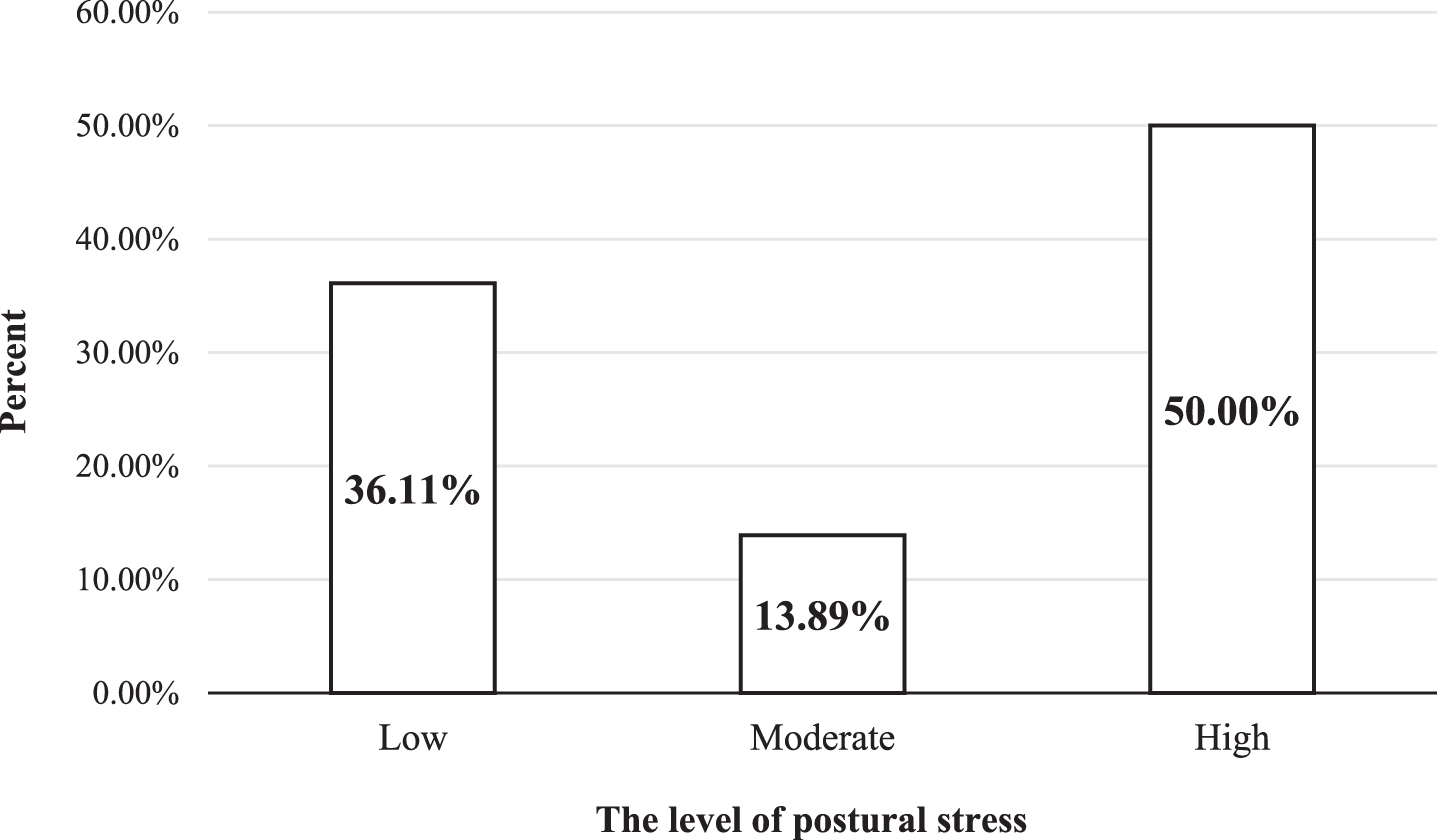
The frequency distribution of postural stress levels based on the RULA in the samples under study.
The data analysis results showed no statistically significant relationship between the level of postural stress and the variables of age, height, weight, Body Mass Index (BMI), previous job history, marital status, education level, smoking, and exercise. No significant statistical relationship was observed between work experience, ergonomics training, and the level of postural stress based on the RULA. However, a statistically significant relationship was saw between the level of postural stress based on the REBA and current work experience (P-value = 0.049). The average work experience of workers with a high postural stress level (10.54 years) was higher than that of workers with a moderate postural stress level (7.88 years). Additionally, a significant statistical relationship was observed between the level of postural stress based on the REBA and ergonomics training experience (Table 2). All of the workers with a high level of postural stress did not have any training experience in ergonomics.
Comparison of postural stress levels with ergonomic training experience
In evaluating MSDs in this study, 26.15% of the study workers had a high frequency of pain, 52.31% moderate frequency of pain, and 21.54% low frequency of pain. In terms of the severity of pain, 50.38% of the studied workers had severe pain, 32.31% moderate pain, and 17.31% slight pain. In assessing interference in workability, 34.23% of the studied workers experienced substantial interference, 8.08% experienced slight interference, and 57.69% did not experience any effect on their workability. 35.77% of the studied workers received a score lower than 29 on the Chalder Fatigue Scale, and 64.23% of the workers received a score of 29 or higher. The average scores of the pain frequency, pain severity, interference in workability, and chronic fatigue in this study were 28.38±25.595, 32.90±11.797, 10.30±10.053, and 13.81±12.545, respectively.
Our findings showed no statistically significant correlation was saw between MSDs, chronic fatigue and age, height, weight, BMI, previous job history, marital status, smoking, and exercise. However, a significant positive correlation was observed between MSDs and current job experience (pain frequency, P-value = 0.031, pain severity, P-value = 0.012, and interference in workability, P-value = 0.004) and between chronic fatigue and current job experience (P-value = 0.037). As the work experience of individuals in their current job increased, the pain frequency, pain intensity, interference in workability, and chronic fatigue increased. A significant statistical relationship was observed between MSDs and ergonomics training as well as between chronic fatigue and ergonomics training. The average scores of MSDs and chronic fatigue in workers without ergonomics training experience were about one and a half times higher than those who had received ergonomics training (Table 3). A significant relationship was observed between MSDs, chronic fatigue, and the educational level of workers (pain frequency, P-value = 0.029, pain intensity, P-value = 0.026, interference in workability, P-value = 0.019, and chronic fatigue, P-value = 0.045). As the educational level of workers increased, MSDs and chronic fatigue decreased.
Comparison of musculoskeletal disorders and chronic fatigue with ergonomic training experience
The independent t-test results to investigate the relationship between MSDs, chronic fatigue, and the level of postural stress are presented in Tables 4 and 5.
According to Tables 4 and 5, the average scores of MSDs and chronic fatigue in workers with a high level of postural stress were significantly higher than in workers with a moderate level of postural stress.
Comparison of postural stress levels based on the REBA with musculoskeletal disorders and chronic fatigue
Comparison of postural stress levels based on the RULA with musculoskeletal disorders and chronic fatigue
Pearson’s correlation test was used to investigate the correlation between MSDs and chronic fatigue, the results are presented in Table 6. According to the table, a significant positive correlation was observed between MSDs and chronic fatigue.
Comparison of Musculoskeletal disorders with chronic fatigue
The objective of the present study was to investigate the relationship between the level of postural stress, MSDs, and chronic fatigue in the dairy industry.
The results obtained in this investigation showed that no significant relationship was saw between the level of postural stress and the variables of age, height, weight, BMI, previous job history, marital status, education level, smoking, and sports activity, which contradicts the results of the study by Eyvazlou et al. The level of postural stress was significantly correlated with age and exercise in their study, such that as the age of individuals increased, their posture analysis score increased, and in samples with regular exercise, a lower level of postural stress was observed [27]. This discrepancy may be due to the lower average age of the workers participating in this study compared to the study by Eyvazlou et al. and also the difference in variable dispersion in the study samples. The present research showed that workers with more current work experience had higher levels of postural stress based on the REBA which is consistent with the results of the study by Hong et al [28]. One reason for this correlation may be that workers with higher work experience who had more skills and experience in this company were engaged in more difficult workstations and improper postures, such as workers in cream packaging and yogurt collections before and after shrink packaging who had the highest level of postural stress and current job experience among workers. Individuals who did not receive any ergonomics training had higher postural stress which is consistent with the results of the study by Aaron et al. In their study, 91 samples were evaluated using the REBA, and the results showed that most individuals had undesirable postures and only 23.8% of workers had received ergonomics training [29]. Lack of awareness about the harmful effects of improper posture on the musculoskeletal system can be considered one of the most important reasons for the repeated experience of undesirable body positions. Ergonomics training as a continuous and effective program can largely address this defect.
No significant statistical relationship was saw between job history, ergonomics training, and postural stress based on the RULA. This could be due to the low number of samples evaluated using the RULA method which was only used to evaluate the level of postural stress of workers whose upper body parts were involved in performing work and were in a seated position.
In this study, as the current work experience of workers increased, MSDs increased which is consistent with the results of the study by Hokmabadi et al. In their study, the frequency of people with MSDs increased with increasing work experience [30]. Also with increasing current work experience, chronic fatigue increased, while with increasing the level of education, chronic fatigue decreased, which is consistent with the results of the study by Dopolani et al. In their study, the intensity of fatigue had increased with an increase in job history, and with a higher level of education, postural stress at the relevant workstation had improved, and the fatigue of individuals had decreased [31]. In the present research, with increasing the level of education, MSDs decreased. This result is consistent with the study by Krishnan et al [32]. It can be stated that with increasing the level of education of workers, the likelihood of their awareness of ergonomic issues increases, which leads to a reduction in their level of postural stress.
Our study’s results showed that workers with higher levels of postural stress had higher MSDs (pain frequency, pain intensity, and pain effect on work performance). It can be inferred that inappropriate positioning of various body parts and limbs in different positions, lifting and carrying heavy loads, prolonged standing and sitting, and repetitive movements may cause static muscle contractions, leading to increased pressure on the spinal column, intervertebral discs, and other body parts, ultimately increasing the risk of MSDs [30]. The results of Das and Singh’s study showed that improper posture of workers during work significantly increased the risk of MSDs [33]. According to Thamrin et al.’s study results, MSDs in workers increased as the final score of the posture analysis increased [34]. Das et al. also stated that the workers’ posture during work significantly affected their musculoskeletal complaints [25]. In the studied company, workers engaged in yogurt collection workstations before and after shrink packaging due to facing inappropriate postures, prolonged standing, neck and back bending, working with hands above shoulder height, and contact stress had high levels of postural stress and severe pain with high frequencies. Moreover, workers in the pallet jack movement section, loading in the truck loading zone, and loading in the raw material warehouse experienced high levels of postural stress, and severe discomfort which had a significant effect on their workability. At the loading station of the raw material warehouse of this company, manual handling of bags is carried out. Workers empty 50-kilogram bags from the truck and place them on pallets. The workers’ waists, shoulders, and arms are the most important parts involved in the work. In such tasks where the weight of the load is high and the work is repetitive, the installation of a manipulator to pick up bags and transfer them to pallets can reduce the level of postural stress and ensure that the work is done with quality [35]. It seems that using a manipulator to pick up packaged products from the conveyor is a suitable solution to reduce the level of postural stress in yogurt collection workstations. Hydraulic pallets can also be used, which adjust the pallet height according to the weight of the load and reduce operator bending/rotation.
In this research, MSDs and chronic fatigue in workers without training in ergonomics were significantly higher than in trained workers. In the study by Khoshakhlagh et al. on 1243 male workers, education in ergonomics was significantly related to the score of posture analysis and the prevalence of MSDs in all parts of the body [36].
The results of Innes et al.’s study also showed that the rate of doing repetitive tasks and manual material handling in dairy industries in Australia was high, and men and women working in these industries face with high physical demands of work, which is consistent with the results of the present study [37]. Moreover, the results of Thinius et al.’s study in German dairy farms also revealed that 94% of the female and 71% of the male workers suffered from WRMSD. The work place analysis revealed that women regularly worked above shoulder level and had to tort and bend more often than men because of the gender specific anthropometrics and the workplace design. The survey took into consideration that not only milking is considered strenuous but other farm tasks as well. The results also demonstrated that there is a need to take action to improve modern milking parlors, which is in line with the results of the present study [38].
Considering that one of the main symptoms of individuals with chronic fatigue is feeling weak and tired after physical activity [16], it was stated that this may be caused by inappropriate physical activity and undesirable postures. According to the results of the present study, workers with higher postural stress had higher chronic fatigue. The correlation between postural stress and chronic fatigue in this study is consistent with the results of the study by Liu and Guo [39]. In addition, in a study by Wada et al. on prolonged fatigue, the results showed that with the prevalence of MSDs and improper postures during work, employee fatigue increased [40]. Regarding this issue, it can be said that performing physical activities such as manual handling of heavy loads, having inappropriate physical conditions, and consequently increasing the level of postural stress can lead to a decrease in muscle strength, workability, and performance of individuals [8], and ultimately the possibility of chronic fatigue. It is also possible that in some cases, feeling fatigue may cause the worker to assume an undesirable physical condition. It can be said that when the worker’s muscles are not tired at the beginning of work, the conditions of the limbs are better compared to the end of work when the worker is tired.
A significant positive correlation was saw between MSDs and chronic fatigue in this study. The presence of high levels of postural stress in the samples under study which can lead to pain and discomfort in the musculoskeletal system of workers can be attributed as a reason. The neck and back were among the body parts that had the highest score in posture analysis and prevalence of pain and discomfort in the present study, given that back pain is a leading cause of disability and one of the most common MSDs that many people worldwide suffer from [41], and as one question in the Chalder fatigue scale is related to lack of muscle strength, there is a possibility of increasing fatigue following the occurrence or increase of pain and discomfort in the musculoskeletal system.
Finally, the present study confirms the necessity of creating a participatory ergonomic program to improve the occupational exposure to ergonomic risk factors. Previous studies have also shown that the use of participatory ergonomics programs can be an effective step in improving the ergonomics of the workplace in the dairy industry [42].
Strengths and limitations
Some of the strengths of this study are the investigation of a wide range of individual and occupational parameters in relationship with the increase of MSDs and chronic fatigue in one of the largest dairy companies in the country. The findings of this study can create a novel scientific insight in the field of different risk factors in the occurrence of chronic fatigue, as well as the necessity of determining the level of postural stress in workers in same industries.
Some of the limitations of this study were conducting research during the COVID-19 pandemic conditions and time constraints in performing corrective interventions and evaluating the effectiveness of intervention measures. Therefore, it is suggested that in the future, researchers conduct intervention studies and report the effectiveness of each intervention measure.
Conclusion
The results of this research showed that the working postures of most workers studied in this company need to be corrected. Our findings shed light on the significant statistical relationship between the level of postural stress and MSDs and between the level of postural stress and chronic fatigue. A significant positive correlation was observed between MSDs and chronic fatigue. Additionally, a statistically significant relationship was observed between the level of postural stress based on the REBA, MSDs, chronic fatigue, and ergonomics training experience. Hence, the results from our study support the notion that high levels of postural stress and MSDs can produce an increase in chronic fatigue among workers, and lack of ergonomics training for workers can increase both MSDs and chronic fatigue.
Therefore, it is necessary to carry out intervention measures in the field of ergonomics management in similar industries through the implementation of ergonomic intervention programs with a focus on proactive and preventive measures and the use of participatory ergonomic programs and educational demands assessment.
Ethical approval
The present study was conducted according to the Declaration of Helsinki and was approved by the ethics committee of the Iran University of Medical Sciences in 2022 (ethics code: IR.IUMS.REC.1401.043).
Informed consent
Informed consent was obtained from all subjects involved in the study.
Conflict of interest
The authors declare that there is no conflict of interest with respect to the research, authorship, and/or publication of this article.
Footnotes
Acknowledgments
The authors express their gratitude to the participants in the study. They furthermore thank the Occupational Health Department and Research Deputy of Iran University of Medical Sciences.
Funding
This study was financially supported by the Research Deputy of Iran University of Medical Sciences.