



Abstract
BACKGROUND:
In the context of smart mine construction, coal mine safety management is imposing stringent requirements on the safety competence of miners. To meet these demands, coal mine enterprises have initiated proactive measures to recruit a new generation of knowledge-based miners who possess high qualifications and specialized backgrounds.
OBJECTIVE:
This study aims to explore the underlying mechanisms of identity conflict (IC) and its influence on unsafe behavior (USB) among KBMs within the context of China’s smart mining initiatives, as well as to identify the role of potential mediating and moderating variables in this relationship.
METHODS:
An empirical study was conducted on a sample of 304 KBMs with a college degree or above, selected from multiple coal mines in Shanxi Province, China. Hierarchical regression analysis and the Bootstrap method were employed for data analysis. This model incorporated IC as the antecedent variable and meticulously investigated the mediating effects of role breadth self-efficacy (RBSE) and psychosocial resources (PSR), along with the moderating effect of positive explanatory bias (PEB).
RESULTS:
The findings indicate a significant positive correlation between IC and USB among KBMs. RBSE and PSR were found to mediate the relationship between IC and USB. Moreover, this mediating effect further influenced the relationship between IC and USB through a chain mediating effect. Additionally, PEB strengthened the positive impact of KBMs’ RBSE on PSR.
CONCLUSION:
These results provide a broader perspective on the antecedent variables associated with KBMs’ USB and provide valuable insights and practical management strategies enhancing the safety management practices within coal mining enterprise.
Keywords
Introduction
Research background and objectives
Since the inception of the concept of intelligent mining was proposed, the Chinese coal industry has made significant strides in deepening its layout, technologies such as the Internet of Things, big data, artificial intelligence, and drones have been seamlessly integrated into various facets of coal mine operations including production, transportation, and management systems [1]. The gradual transformation from centralized control to monitoring, automation to initiative, human management to machine management, and intelligence to wisdom has been achieved. Consequently, the coal mine production environment has witnessed considerable enhancements, leading to a substantial reduction in the workforce and a remarkable surge in overall efficiency. Nevertheless, these novel production methodologies have also rendered the root causes of coal mine accidents more intricate, accident prevention and handling more difficult [2]. Smart mine safety management has elevated the requirements for miners’ safety competence to unprecedented levels [3]. In the context of smart mining construction, coal mines are proactively embracing the recruitment of knowledgeable miners possessing a profound understanding of the industry and a specialized background [4].
In instances where middle managers in enterprises are unable to reconcile the expectations of different roles, it can give rise to conflicts between roles or clashes between values and role responsibilities. Consequently, this may lead to the development of negative emotions, ultimately impacting their job performance [5]. In coal mining, the positive correlation between the role conflict of safety supervisors and unsafe behavior (USB) has also been confirmed [6]. Unlike traditional experienced-based miners (EBMs), knowledge-based miners (KBMs) rely on a wealth of theoretical knowledge and specialized skills as their foundation. However, they concurrently possess strong individuality traits, emphasize fairness, disregard authority, and prioritize the pursuit of self-actualization within their work values [4]. The intense conflict that arises from the misalignment of job requirements and work values, coupled with the issue of overqualification, some KBMs have experienced a profound sense of dissonance, gradually manifested as a conflict of identities. Furthermore, the job demands-resources (JD-R) theory posits when individuals confront heightened job demands, their level of work engagement substantially decreases, giving way to negative psychological consequences such as emotional exhaustion and physical fatigue which further impact on USB [7]. Currently, the study of USB within the realm of KBMs remains relatively underexplored. Consequently, further investigation is warranted to ascertain whether the aforementioned identity conflict of KBMs can indeed affect safety competence.
In light of this, this paper intends to conduct a thorough analysis of the pathways through which identity conflict among KBMs impacts USB. Additionally, the study aims to investigate the roles played by role breadth self-efficacy, psychosocial resources and positive explanatory bias within this specific mechanism. The objective is to explore what requirements the distinctive characteristics of knowledge- based miners put forward for coal mine safety management, endeavoring to provide valuable theoretical insights and practical guidance for intelligent mining safety development.
Research assumptions
Identity conflicts (IC) and unsafe behaviors (USB) of knowledge-based miners (KBMs)
The JD-R theory [8] posits that irrespective of occupational types, work conditions can be classified into two primary categories: job demands and job resources, which are two dimensions that significantly impact the psychological well-being of employees. Job demands [9] necessitate employees to exert sustained efforts in terms of psychological, emotional, and physical aspects within the work environment, which are associated with certain physiological and psychological costs. Consequently, an excessive burden of job demands may lead to work burnout, identity conflicts, role overload, thereby posing a threat to employees’ job security. In contrast, job resources [9] act as positive factors, encompassing the support employees receive in terms of physical, psychological, or organizational aspects in their work, such as job security, organizational support, and performance feedback, etc.
Identity conflict (IC) is the sense of identity imbalance when individuals perceive a fundamental mismatch between their personal values or behaviors and certain social identity norms they possess [10]. Individuals constantly seek to integrate and balance their personal values with their social identities within the complex social environment. On the one hand, miners may find themselves caught in a dilemma where the organizational culture, policies, and systems in their work environment, along with their own psychosocial resources and interpersonal skills, clash with the values they hold dear, leading to a conflict between their “assigned work identity” and their “long-standing self-consistent values”. On the other hand, highly educated miners may perceive their qualifications to surpass the requirements of their positions, creating a subjective perception of an overqualification. IC can result in significant physical and mental exhaustion for miners, ultimately influencing their decision-making processes [10].
Miners with less than 5 years of work experience and a college degree or higher are classified as KBMs, while miners with more than 5 years of work experience and a high school diploma or lower are classified as EBMs [11]. In comparison to EBMs, KBMs possess a more comprehensive theoretical framework in terms of job abilities and have higher self-value and achievement expectations. Consequently, the dissonance in the work environment of coal mining or the perception of overqualification may lead KBMs to oscillate between their ideal identity and their actual identity during their interactions with the environment. Failure to appropriately address this dilemma may result in the escalation of IC of KBMs, which can have adverse effects on their occupational mental health and subsequently influence their safety behavior. Drawing from the JD-R theory [8], IC, as an obstructive job demands, has the potential to diminish the level of work engagement among KBMs, resulting in negative consequences, including emotional exhaustion and physical fatigue. Consequently, it may give rise to job burnout and positively affect USB. Based on the above, the following hypothesis is proposed:
H1: There exists a significant positive correlation between IC and USB among KBMs.
The mediating effect of role breadth self-efficacy (RBSE)
Role breadth self-efficacy (RBSE) refers to employees’ perceived ability to effectively perform tasks beyond the scope of their designated job responsibilities, encompassing a broader and more proactive range of work duties. Different from self-efficacy focused on individual specific capabilities, RBSE bases on the perspective of active behavior, emphasizing employees’ capacity to voluntarily undertake integrative tasks beyond the limitations of work roles, namely, to address macro-level issues [12]. Employees with high levels of RBSE demonstrate heightened sensitivity to their role positioning [13] and exhibit a propensity to actively leverage additional resources in order to engage in tasks beyond their assigned roles [14]. By breaking through the shackles of roles to achieve psychological equilibrium, they effectively mitigate negative cognitive effects arising from IC. Drawing on this premise, it is hypothesized that when KBMs encounter IC, the presence of RBSE can facilitate the active reconstruction of their cognitive structures, thus enhancing their safety competence. Consequently, the following hypotheses are posited:
H2: RBSE mediates the impact of IC on USB among KBMs.
H2a: IC has a negative impact on RBSE.
H2b: RBSE has a negative impact on USB.
The mediating effect of psychosocial resources (PSR)
Psychosocial resources (PSR) which originates from the field of positive psychology, refers to the collective term encompassing individual psychological resources (PR) and interpersonal social resources (SR) that enhance the individual’s ability to cope with stress [15]. The resource perception model emphasis [16], PSR play a pivotal role in promoting an individual’s sense of self-security through various means, such as facilitating the enhancement of self-worth and fostering positive interpersonal relationships, enabling individuals to make informed decisions when confronted with the adverse consequences of stress. The possession of abundant PSR allows individuals to reduce subjective interference and effectively manage adaptive responses in the face of adversity. Furthermore, based on the JD-R theory, PSR as a work-related resource provide valuable support for KBMs, assisting in the enhancement of their occupational mental well-being. The buffering characteristics inherent in PSR play a vital role in alleviating the conflicting feelings arising from IC among KBMs and mitigating the emergence of insecure psychological states. Further exploration is needed to understand the specific effects of these processes. Consequently, based on the two dimensions of PSR, the following hypotheses are posited: H3: PR mediate the impact of IC on USB among KBMs. H3a: IC has a negative impact on PR. H3b: PR have a negative impact on USB. H4: SR mediate the impact of IC on USB among KBMs. H4a: IC has a negative impact on SR. H4b: SR have a negative impact on USB.
The chain mediating effect of role breadth self-efficacy (RBSE) and psychosocial resources (PSR)
Individual behavioral intentions are influenced by perceived control, and the strength of perceived environmental control behavior positively affects the prediction of their behavior [17]. Consequently, it can be inferred that IC weakens the PR and SR of KBMs, thereby diminishing their safety competence in the workplace. Moreover, RBSE is posited to enhance the level of PSR through dual pathways of PR and SR. From the dimension of PR, RBSE can effectively address overqualification and positively impact employees’ psychological well-being. KBMs, when actively engaged in performing external role tasks, are able to enhance their self-worth and augment their PR, thus effectively managing the stress brought about by IC, evoking positive emotions in employees and strengthening their safety competence. On the dimension of SR, supervisor support, organizational support, and social support among interpersonal social resources are regarded as effective mechanisms for individuals to alleviate negative emotions arising from IC [18]. RBSE can promote employees’ psychological sense of safety within the group [19], thereby enhancing SR and alleviating employees’ negative emotions. Based on these arguments, the following hypotheses are posited:
H5: RBSE and PSR play a chain mediating role between IC and USB among KBMs.
H5a: RBSE has a positive impact on PR.
H5b: RBSE has a positive impact on SR.
The moderating effect of positive explanatory bias (PEB)
In group situations, individuals demonstrate a tendency to interpret ambiguous information with either positive or negative biases, thus indicating the presence of an explanatory bias in their information processing [20]. According to the social cognitive theory, both social and individual cognitive factors play a significant role in determining individual behavior, different group information processing biases lead to varying individual behaviors. Specifically, positive explanatory bias (PEB) acts as a catalyst for instilling positive emotional perceptions among employees, contributing to an enhanced sense of psychological safety within the group [13]. From the vantage point of positive psychology, this paper aims to investigate the underlying mechanisms through which information processing biases influence USB among KBMs.
In situations characterized by ambiguity, individuals’ positive or negative explanations of event meaning have a profound impact on their acceptance within a group. When facing ambiguous information, employees who exhibit a tendency toward positive explanations tend to give positive interpretation to the fuzzy situation, indicating that individuals are more inclusive of group information [21]. The tendency effectively reduces the interference of subjective judgment in their work. When KBMs are required to undertake broader tasks and responsibilities, it becomes imperative for them to possess the confidence to transcend the limitations imposed by their respective work roles and engage in proactive behavior. On the one hand, PEB serves to enhance the perception of work safety among KBMs [13], enabling them to approach ambiguous situations with greater self-assurance, thereby enriching their PR; On the other hand, in scenarios involving ambiguous communication and interaction with superiors and organizations, KBMs with PEB tend to perceive predominantly positive information from their peers. This perception serves to foster psychological integration between individuals and the group [21], thereby further augmenting their SR. Consequently, PEB emerges as a critical moderating factor that influences the relationship between RBSE and PSR. Based on these considerations, the following hypotheses are posited:
H6: PEB moderates the impact of RBSE and PR.
H7: PEB moderates the impact of RBSE and SR.
Methods
Research sample
A survey was conducted among KBMs from 11 large and medium-sized coal mines in Shanxi Province, China. A total of 350 questionnaires were distributed on-site, with 327 questionnaires returned. After excluding invalid questionnaires, a total of 304 valid questionnaires were collected, resulting in an effective recovery rate of 86.9%. The research subjects consisted exclusively of male participants from underground production auxiliary teams, coal preparation plant workshops, and administrative institutions. In terms of age distribution, 63 participants were below the age of 30, accounting for 20.7%; 132 participants aged between 30 and 40, accounting for 72.7%; and 20 participants above the age of 40, accounting for 6.6%.Regarding educational background, there were 180 participants with a college diploma, accounting for 59.2%; 119 participants with a bachelor’s degree, accounting for 39.1%; and 5 participants with a graduate degree, accounting for 1.6%. Overall, the sample exhibits highly representative of Chinese miners’ characteristics.
Research measures
This paper uses the maturity scales as references. In consideration of the characteristics of KBMs’ work and expert insights, the questionnaire was appropriately adjusted to suit the specific context of coal mines. A pre-test was conducted before the formal distribution of the questionnaire, and the questionnaire contents were revised based on the feedback received. The Likert 5-point scoring method was utilized for all the questions in the questionnaire, ensuring uniformity and accuracy in the data collection process.
IC: Referring to Rizzo’s [22] developed identity conflict scale, key terms were adjusted based on the characteristics of KBMs. This included 6 items such as “I find my job somewhat simple or boring.”, Cronbach’s = 0.888.
RBSE: Using the scale developed by Parker [23], the context was modified to fit the work environment of coal mining units. This scale included 7 items such as “I am willing to communicate with employees from other positions and provide them with advice.”, Cronbach’s = 0.880.
PSR: PSR were measured through two dimensions PR and SR. For PR, the PCQ-24 Psychological Capital Questionnaire developed by Luthans [24] was used as a reference. It consisted of three structural elements: “hope” “realistic optimism” and “resilience”. After modification, this scale included 6 items, Cronbach’s = 0.871. For SR, the Sense of Social Support Scale (SSS) developed by Wang [25] was used as a reference. It consisted of three structural elements: “social support”, “organizational support” and “supervisor support”. This scale included 6 items, Cronbach’s = 0.888.
PEB: Using the fuzzy scenario paradigm [26], the questionnaire included 4 scenario sentences, such as “You provide suggestions to your supervisor regarding a certain aspect of your work, but it seems that your supervisor does not adopt them.”, Cronbach’s = 0.775.
USB: Referring to Li [27] developed Miner’s Unsafe Behavior Psychological Scale, this scale included 6 items such as “After working in the mine for a long time, I have become accustomed to other people’s violations.”, Cronbach’s = 0.879.
Results
Correlation analysis and common method bias examination
Descriptive statistics and correlation analysis were conducted on the variables. Table 1 shows that there is a significant negative correlation between KBMs’ IC and RBSE (r = –0.756, p < 0.01), as well as with PR (r = –0.745, p < 0.01) and SR (r = –0.717, p < 0.01). Additionally, there is a significant positive correlation between IC and USB (r = 0.816, p < 0.01). Furthermore, there is a significant negative correlation between RBSE and USB (r = –0.720, P < 0.01), PR (r = –0.680, P < 0.01) and SR (r = –0.661, P < 0.01) are significantly negatively correlated with USB. These findings provide robust support for the hypotheses proposed in this research.
Results of correlation analysis
Results of correlation analysis
Note: ***indicates that the coefficient is significant at the level of 0.001; ** indicates that the coefficient is significant at the level of 0.01.
To address the issue of common method bias, Harman’s single-factor test was employed in this paper. The results indicate that there are four factors with eigenvalues greater than 1, and the first factor accounts for 46.53% of the variance, surpassing the standard critical value of 40% but not exceeding 50%. This suggests that the common method bias is within an acceptable range and has a minimal impact on the study.
In terms of reliability, Cronbach’s values were calculated using SPSS 26.0 software to assess the internal consistency of the core variables. The results indicated that IC had a Cronbach’s α value of 0.847, RBSE had a Cronbach’s α value of 0.833, PR had a Cronbach’s α value of 0.846, SR had a Cronbach’s α value of 0.845, PEB had a Cronbach’s α value of 0.769, and USB had a Cronbach’s α value of 0.833. All variables met the research standard for reliability.
In terms of validity, confirmatory factor analysis was conducted using AMOS 28.0 software. The results, as shown in the Table 2, indicated that the six-factor model had the best fit indices. The χ2 value was 513.356 with 51 degrees of freedom, resulting in a χ2/df ratio of 1.801. RMSEA was 0.016, CFI was 0.992, and TLI was 0.992. These results indicated a good fit for the model, suggesting good construct validity.
Model fitting index
Model fitting index
After conducting hypothesis testing on the hypothetical model using AMOS 28.0 software, the relationship between KBMs’ IC and USB was illustrated in Fig. 1, where “e” represents the residual term. The results indicate that there is a significant positive correlation between IC and USB (β= 0.81, p < 0.001), supporting hypothesis H1. Additionally, IC has a significant negative correlation with RBSE (β= –0.76, p < 0.001), supporting hypothesis H2a. IC has a significant negative correlation with PR (β= –0.75, p < 0.01), supporting hypothesis H3a, and SR (β= –0.72, p < 0.01), supporting hypothesis H4a. Furthermore, there is a significant negative correlation between RBSE and USB (β= –0.23, p < 0.001), supporting hypothesis H2b. There is a significant negative correlation between PR and USB (β= –0.10, p < 0.01), supporting hypothesis H3b, as well as SR and USB (β= –0.11, p < 0.01), supporting hypothesis H4b.
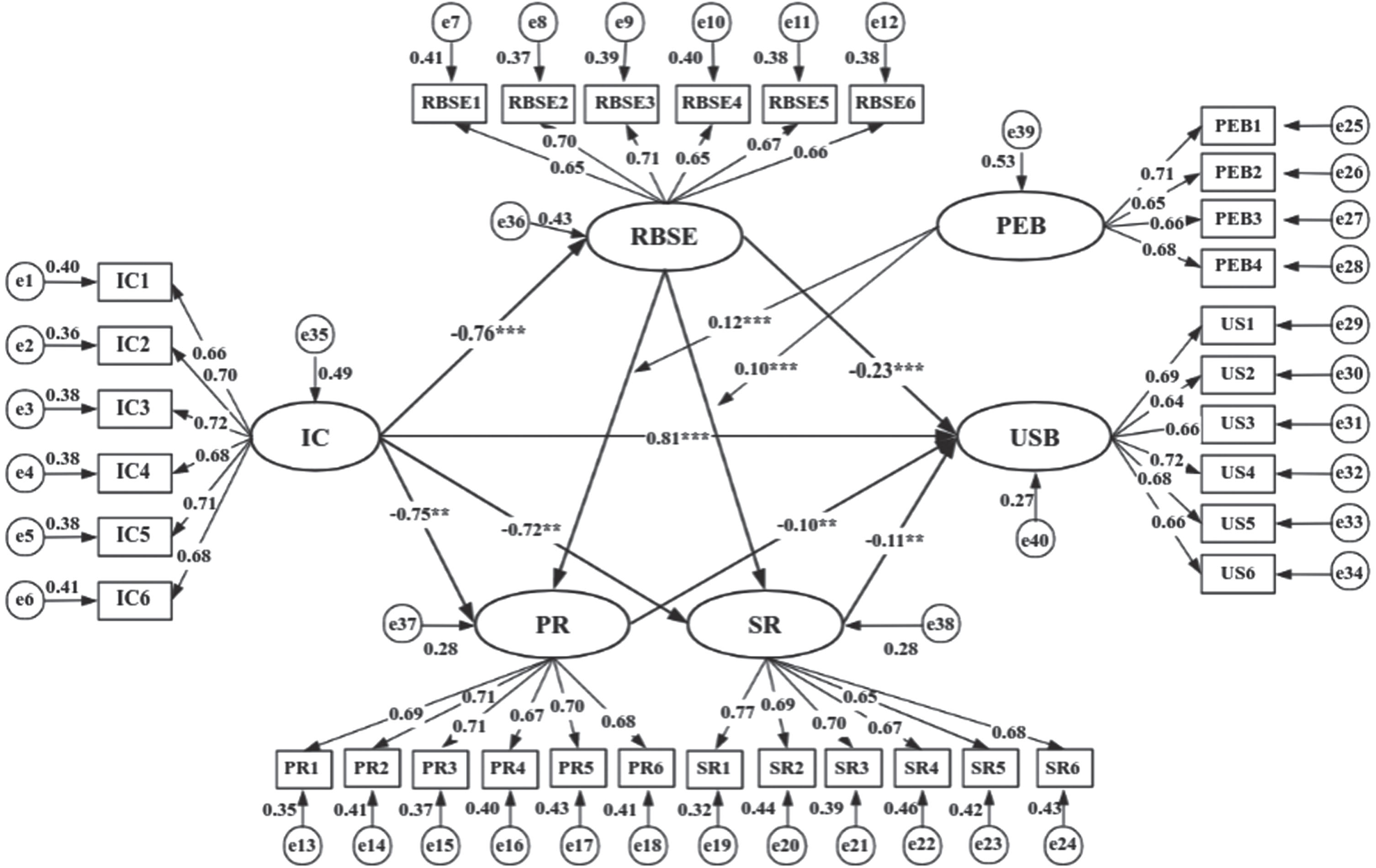
The chain mediation model.
This study posits a model comprising two mediating variables, namely RBSE and PSR (specifically measured as PR and SR), forming five mediation paths. The mediating effects were assessed utilizing the Bootstrap method, and the outcomes are presented in Table 3. Firstly, the aforementioned tests reveal a significant direct effect of KBMs’ IC on USB. Secondly, the 95% confidence intervals of each mediation path do not encompass zero, indicating that each mediating variable plays a partial mediating role in the relationship between KBMs’ IC and USB. Therefore, hypotheses H2, H3, H4, and H5 are supported.
Mediation effect test by Bootstrap
Mediation effect test by Bootstrap
The moderation effects were tested using the PROCESS module Model 91. The results are presented in Table 4. After incorporating PEB into the mediation model, the interaction between RBSE and PEB was found to have a significant positive effect on PR (Coeff = 0.12, p < 0.001) and SR (Coeff = 0.10, p < 0.001). This indicates that PEB can moderate the predictive effect of RBSE and PSR. Therefore, hypotheses H6 and H7 are supported.
Moderated mediation model testing
Moderated mediation model testing
To illustrate the moderation effects, the Edwards & Lambert moderation effects plot was employed, wherein PEB was categorized into high and low groups. Figure 2 demonstrates that when KBMs exhibit a strong PEB, the positive impact of RBSE on PSR becomes more significant.

“RBSE-PR” and “RBSE-SR” were moderated by PEB.
Findings and analysis
Our study primarily explores the impact of IC on USB among KBMs and examines the mediating role of RBSE and PSR in this relationship, as well as the moderating effect of PEB. The findings suggest that IC significantly predicts USB among KBMs, echoing previous research [10] that links IC to increased psychological stress and subsequent USB. The presence of IC has a significant impact on the psychological well-being of miners potentially resulting in occupational burnout, decreased job satisfaction, and increased turnover intention. When KBMs perceive a discrepancy between their work roles and personal identities, they may experience internal tension and conflict, with these inconsistent emotional experiences not only posing a threat to individual well-being but also potentially affecting their job performance and safety behaviors. A further issue is that when KBMs encounter IC, they may adopt coping strategies such as work avoidance or role redefinition to reduce the stress caused by IC. However, such strategies may lead to diminished attention to safety norms and procedures, thereby increasing the risk of accidents and injuries [28]. Moreover, faced with IC, KBMs may have to make sacrifices and compromises at work, which may further weaken their safety compliance and motivation.
At the individual level, KBMs must confront the disparity between their ideal and actual identities during their work process. On one hand, they can break out of the inherent framework of understanding the mining profession by reconciling cognitive differences, stepping beyond the limitations of work roles, and exploring a broader range of competencies. On the other hand, they can adapt their ideal identity to the established work environment to ensure occupational psychological health and enhance safety practices. At the organizational level, it is crucial for managers to understand and address the impact of IC among KBMs on promoting individual well-being and organizational safety and mitigate these conflicts by providing resources and support. For example, adjusting work design to better align with employees’ professional identities and values, or organizations can conduct identity integration training to help employees understand how to better integrate and balance their different work identities. Future research should explore different types and sources of IC and how they impact employee behavior and organizational safety culture, providing theoretical and empirical foundations for developing effective intervention measures.
Our study found that RBSE plays a mediating role between IC and USB. This demonstrates that if KBMs believe they can effectively expand their responsibilities and adapt to changing work situations, they may be able to mitigate the negative effects of IC [29]. This highlights the potential of enhancing employees’ RBSE to reduce USB, for example, through training and providing career development opportunities.
Additionally, the mediating role of PSR in the relationship between IC and USB emphasizes the importance of a strong social support network and quality mental health resources in reducing risk behaviors in high-pressure work environments [30, 31]. This may provide organizations with a means to protect employees from the negative effects of IC by enhancing group support and providing psychological counseling.
The chain mediation model further emphasizes the synergistic effect of RBSE and PSR, indicating that when KBMs expand their responsibilities in their careers and confront challenges, managers must provide support at the PSR level to enhance their safety competence. As demonstrated by resource theory [32], which suggests that employees with abundant resources are less susceptible to experiencing stress. To meet the multifaceted needs of KBMs, it is imperative to implement a comprehensive support system that incorporates individual and organizational interventions at multiple levels.
Finally, the findings regarding PEB provide us with a new perspective. The moderation analysis reveals that KBMs who exhibit PEB can more effectively utilize their RBSE and PSR to diminish USB when confronted with IC. This emphasizes the role of cognitive factors in promoting behavioral safety [33], as well as the possibility of changing individuals’ response to stress through psychological training.
In conclusion, this study provides new insights into the issue of IC among KBMs and its impact on safety behaviors. The results highlight the importance of providing psychosocial support in the workplace and the moderating role of a positive mindset in dealing with IC. These findings provide valuable guidance for designing psychosocial interventions and developing strategies to foster a positive safety culture among KBMs.
Limitations and future directions
Our study represents an important step in understanding the complex dynamics of IC among KBMs and its effect on USB. However, several limitations warrant consideration. Firstly, the impact of IC on USB has been examined within the context of China’s rapidly advancing coal industry, with a specific focus on Shanxi Province, a major coal-producing province in China. This geographical limitation may restrict the generalizability of our results. Future research should broaden the participants base by including KBMs from diverse regions and countries, thereby validating and extending our findings within varied intelligent mining contexts.
Secondly, the reliance on self-reported data in our study may be susceptible to biases, such as social desirability or inaccurate self-assessments. To enhance the robustness of our findings, future studies could integrate objective measures of safety behaviors. Methods such as physiological monitoring or electroencephalography could supplement self-reports, offering quantitative data that would provide a more comprehensive understanding of KBMs’ experiences and their coping mechanisms when faced with IC.
Furthermore, while our study has concentrated on the psychological dimensions of KBMs’ IC, it has not thoroughly examined the physical and cognitive demands arising from technological advancements in the industry. Future research should delve into the relationship between these demands and KBMs’ safety behaviors by incorporating the JD-R theory, which may offer valuable insights into how various job demands can be balanced with available resources to enhance safety performance.
Conclusion
Amid the societal backdrop of increased higher education accessibility and the growing demand for talent in the establishment of intelligent mines in China, coal mining workforces are gradually tending towards being younger and more highly educated. This study investigates the possibility of USB among KBMs in the context of inexperience in handling emergencies. Our analysis pinpoints the interaction between RBSE, PSR, and PEB as key determinants of safety performance. The findings illuminate pathways to enhance KBMs’ safety competencies, which are vital for advancing occupational health and safety in the intelligent mining sector.
Footnotes
Acknowledgments
The authors would like to sincerely thank Professor Li Jizu for his invaluable assistance in conducting the empirical research, as well as the respondents who dedicated their valuable time to complete the questionnaire survey.
Ethical approval
Not applicable.
Informed consent
Not applicable.
Conflict of interest
None of the authors have any personal, financial, commercial, or academic conflicts of interest to report.
Funding
This study was supported by the Humanities and Social Sciences Planning Fund Project (23YJA630054) of the Ministry of Education.