



Abstract
BACKGROUND:
This study stands for the first Spanish investigation that rigorously evaluates the compliance regarding the use of biological protection gloves as essential personal protective equipment (PPE) in companies with exposure to biological agents in workplaces.
OBJECTIVES:
This study aims to analyse the degree of use of biological protection gloves as personal protective equipment (PPE), the factors that influence its use, and the profile of workers exposed to occupational biological agents in Spanish companies in the health sector, farms, meat industry, waste treatment plants, food industry and veterinary centers.
METHODS:
We conducted a cross-sectional descriptive study involving 590 Spanish workers from 51 companies. We developed a 34-item questionnaire to assess workers’ risk perception related to exposure to biological agents in their workplaces. Among the questions, three were designed to find the degree of use of key protective equipment in sectors with biological agent exposure: protective gloves, goggles or face shields, and respirators. We performed various statistical analyses, including Cronbach’s alpha, frequency of endorsement, Content Validity Ratio (CVR) using Lawshe’s method, Varimax rotation, Kaiser-Meyer-Olkin (KMO), and Bartlett’s sphericity test, to assess the internal consistency and reliability of the questionnaire. Additionally, we employed a CHAID segmentation analysis, using workers’ responses regarding their attitude toward glove usage as PPE for protection against biological risks, with demographic variables as independent factors.
RESULTS:
The CHAID analysis yielded a segmentation diagram, revealing five distinct groups or profiles of workers based on their use of protective gloves.
CONCLUSION:
Our study, through CHAID analysis, highlights that workers tend to use protective gloves more frequently when there is an internal Health and Safety department within the company.
Introduction
The proper use of personal protective equipment (PPE) plays a pivotal role in enhancing working conditions and mitigating workplace accidents. As per the Spanish Regulations, PPE encompasses any equipment specifically designed and manufactured to be worn or held by an individual, providing protection against one or more health or safety risks.
It is crucial to acknowledge that PPE should be regarded as a last resort in preventing occupational hazards [1]. In other words, PPE should only be employed when engineering controls (collective protective measures) or work practice controls (methods and procedures) fail to adequately manage the risks. Without these elements, PPE may lose its efficacy or even introduce new hazards for workers [2].
In workplaces where there is exposure to biological agents, such as closed environments, discomfort can lead to improper PPE use or low compliance rates [3]. These biological agents encompass a wide range of microorganisms, including bacteria, viruses, fungi, and parasites. Ensuring proper protection against these agents is critical to safeguarding workers’ health and well-being [4].
However, even when used correctly, PPE requires proper management, training, and information for workers. Without these elements, PPE can lose its effectiveness or even create new hazards for workers [1]. This is especially true in closed workplaces with biological agent exposure risks, where discomfort can lead to misuse or low rates of PPE use [6].
International Labour Organization (ILO) are defined as many agents as possible, substances and circumstances which can be biological hazards in the working environment and there are different methods to determine which they are [2]. Biological agent exposure risks refer to the probability of a worker experiencing adverse health effects due to contact or exposure with microorganisms in the occupational setting. These microorganisms include bacteria, viruses, fungi, and parasites, along with their associated toxins.
In the report from the European Agency for Safety and Health on “Priorities for Research on Security and Health in the EU-25” that research on Health and Safety at Work can be highlighted and should contribute to achieving the objectives set by the Europe 2020 strategy as globally, more than 300,000 workers die each year from diseases caused by microbial or animal-related biological hazards. There is a pressing need to safeguard workers across various work environments from emerging health risks due to new occupational hazards in the healthcare sector or the travel industry [7]. Additionally, some biological agents have the potential to cause cancer. At least 15% of new cancer cases worldwide are attributable to biological agents such as viruses or bacteria [8], and that most of them could be prevented by using PPE.
Biological agents can affect the skin of workers’ hands in various ways, causing anything from mild irritations to serious diseases such as dermal absorption, contact dermatitis, allergic reactions, or infections. Therefore, it is necessary to use appropriate gloves that will serve to prevent occupational exposure, in the absence of existing data from similar studies, the aim of this work is to evaluate and analyse the degree of gloves as
Materials and methods
Preparation of the questionnaire
A 34-question questionnaire, developed by the authors based on various sources of Spanish legislation regarding worker exposure to biological agents in occupational settings, emphasizes the key aspects that workers should consider protecting themselves from biological hazards [10].
The questionnaire uses a closed-ended format with single-choice, dichotomous answers (“yes” or “no”) to facilitate completion. In cases where a question is not relevant to the specific company or industry being evaluated, a third option of “not applicable” is provided.
An initial section was included in each questionnaire, consisting of eight items related to demographic data. These items covered sex, age, sector of activity of the company, and company size (categorized as micro, small-sized, or medium-sized companies). Additionally, we assessed the preventive system chosen by the company (whether they had an internal Health and Safety department or used external Health and Safety services) and the group classification of biological agents.
Utilizing hazard detection techniques and following the guidelines set up in Spanish regulations, we assessed response rates in the questionnaire using categories such as ‘very poor,’ ‘poor,’ ‘improvable,’ and ‘acceptable.’ Additionally, we evaluated workers’ exposure to occupational biological agents, considering levels such as ‘occasional,’ ‘irregular,’ ‘frequent,’ ‘very frequent,’ and ‘continuous.’ Questionnaire compliance is classified as ‘very poor’ when overall compliance is 25% or less, ‘poor’ when between 25% and 50%, ‘improvable’ when between 50% and 75%, and ‘acceptable’ when exceeding 75%. Worker exposure to biological agents depends on duration and frequency. Exposure is considered ‘casual’ if workers are exposed at least once a month (0.1–1% of working time), ‘irregular’ if exposed weekly (1–5% of working time), and ‘common’ if exposed more frequently.
Regarding the exposure of workers to biological agents in the workplace, it is essential to recognize that a threat or risk exists only when workers come into contact with these agents. Exposure is assessed based on the duration and frequency of such contact. In this context, casual exposure occurs when workers are exposed at least once a month or for 0.1–1% of their working time. Irregular exposure refers to situations where workers encounter biological agents at least once a week or between 1% and 5% of their working time. Common exposure happens when workers are exposed daily or for 5% to 10% of their working time. Quite common exposure occurs when workers face exposure at least once an hour or for 10% to 50% of their working time. Finally, exposure is considered continuous when it persists throughout the entire workday or exceeds 50% of working time.
Validation questionnaire
We conducted a descriptive analysis of the demographics of the companies taking part in the study. We analysed the frequency distribution (endorsement frequency) to find the proportion of unanswered items that were not understandable or interpretable. Fortunately, no item showed a low percentage of non-response, so removal was unnecessary.
Before conducting the factor analysis, we assessed the item-scale correlation by considering those items with a Pearson correlation coefficient greater than 0.30 [12].
For content validity, we employed the (CVR) proposed by Lawshe. Among the items, 11 obtained a CVR value of 0.8, while 23 of the remaining items achieved the maximum CVR value of 1.0. Consequently, no questions needed deletion from the questionnaires. Overall, the questionnaire showed a suitable level of content validity, with a mean CVR of 9.67 [12].
We employed principal components exploratory factor analysis, utilizing Varimax rotation to uncover the underlying factor structure. To validate the appropriateness of factor analysis, we assessed the Kaiser-Meyer-Olkin (KMO) measure and conducted Bartlett’s sphericity test. Items meeting specific criteria were considered: communalities greater than 0.5 and factor loadings greater than 0.25. Furthermore, we evaluated the internal consistency of items within each resulting factor using Cronbach’s Alpha coefficient ensuring that relevant Alpha values exceeded 0.70 [10]. Additionally, we assessed item stability through a test-retest trial, analysing correlations using Pearson’s test and calculating the weighted kappa coefficient with quadratic weights, along with their respective 95% confidence intervals. These rigorous assessments contribute to the robustness and reliability of our findings.
We conducted a segmentation analysis to facilitate the selection of variables in explaining responses to specific questions, with the dependent variable in focus. This statistical technique evaluates the dependence between variables, considering both the variable to be explained and other independent predictor variables. By grouping these variables effectively, we aim to generate the best possible associations [10].
In our study, we employed multivariate analysis using decision trees, specifically the Chi-square automatic interaction detector (CHAID) method [15]. We used three survey questions as dependent variables, capturing workers’ attitudes toward the use of personal protective equipment (PPE) for biological hazards. As independent variables, we considered sector activity, preventive systems, company size, age, gender of workers, overall compliance with the questionnaire, extent of worker exposure, and the group of biological agents to which workers are exposed.
All calculations were performed using the SPSS 21.0 statistical package for MAC.
CHAID analysis employs Automatic Interaction Detection using the χ2 (chi-square) statistic. The outcome of this analysis is visually represented in a tree diagram, illustrating the successive segmentation process. At each node of the tree, the predictor variable that drives segmentation or shows the strongest interaction with the dependent variable is highlighted. Within each branch, the category defines a subgroup, along with its size. Additionally, each box displays the percentage distribution of the dependent variable within that subgroup [16].
The CHAID algorithm systematically selects the most significant predictor variables, prioritizing their order. By creating distinct population groups, it sheds light on the underlying causes of the dependent variable’s behaviour.
Inclusion/exclusion criteria
In our study, we investigated 51 Spanish companies where participants were included. These companies were selected based on their risk assessment, which showed potential exposure to biological risks for workers. We ensured that the companies were informed about the study’s purpose and the possibility of receiving relevant information.
A total of 518 participants (forming 193 women and 325 men) aged between 18 and 65 years were involved in the research. Data collection was carried out using a paper questionnaire, which was distributed by Occupational Risk Prevention Technicians from the participating companies. The questionnaire included informed consent details to ensure ethical participation.
Results
About the total employees of the participating companies in the study were answered 62.7% by men and 37.2% by women with a mean age of 39.9 years (SD: 9.4). The sample, based on the size of the company, included 24.5% workers in micro-enterprises (businesses with 1 to 9 employees), 56.3% workers in small-sized enterprises (firms with 10 to 49 workers) and 19.1% workers in medium-sized enterprises (firms with 50 to 250 workers) (SD: 0.6). No company with more than 250 employees participated in our study.
The sample consists of 24 workers (12 women and 12 men) between 18 and 25 years, 135 workers (65 women and 70 men) aged 26–33 years, 136 workers (90 men and 46 women) aged 34–41 years, 130 workers (51 women and 79 men) aged 42–49 years, 74 workers (16 women and 58 men) aged 50–57 years and 19 workers (3 women and 16 men) aged 58–65 years.
According to the preventive system chosen by the company, the sample includes a 53.4% workers from companies with an External Health and Safety Service (company that develops preventive activities by outsourcing activities) and a 46.5% workers from companies with Internal Health and Safety Department (SD: 0.4).
Segmentation analysis
In the analysis of segmentation obtained, was considered the dependent variable to the question “Do you wear biological protection gloves (latex or equivalent) when handling potentially contaminated material? which has three categories: 86,5% yes, 11,0% no and 2,5% response is not appropriate.
About 8 variables considered in the study, four have been significant in this analysis: compliance with containment measures after analysis of workers, the size of the company, the time of exposure to biological agents and preventive system chosen by the company.
The compliance of questionnaire had greater significance. In this first division shows that the group of workers with a degree of compliance assessment in the questionnaire “improvable”, “poor” and “very poor” (Node 1), have a lower positive response (76,7%) in the use gloves than those with an acceptable degree of compliance (91,3%) (Node 2) having more workers with the latter group as they are 66.8% of the total.
From Node 1, two groups differ, the first (Node 3) about of workers who work in small-sized companies, in which moderate response rate affirmative use of gloves (73,4%), and the group formed is observed by workers in micro and medium-sized companies (Node 4), with a percentage of response to the question raised (82,5%), although with fewer workers in total (12,2%).
From Node 2 also differ two groups, the first (Node 5) formed by working with a degree of exposure to very frequent, frequent or irregular level to biological agents, in which a high percentage of positive response is observed to wear gloves (94,9%) and the group of workers with a degree of continuous exposure to biological agents (Node 6), with a percentage of response to the questions raised (78,1%).
Preventive system chosen by the company is the variable with the greatest discriminating power in the group of workers exposed to biological agents with very frequent, frequent or irregular level, obtaining the response to the use of gloves comes in a higher percentage (97,9%) for employees of undertakings with Internal Health and Safety Department (Node 8), the percentage (91,6%) of the employees of undertakings with External Health and Safety Service (Node 8).
Sorting the segments found it according to the degree of positive response on the variable “Using protective gloves,” an analysis with useful results are obtained to evaluate aspects related to the degree of use of PPE necessary for adequate protection against biological agents.
Table 4 shows that the first post is related to segment 4, where the groups of workers in enterprises with Internal Health and Safety department who are exposed to occupational biological agents very frequent, frequent or irregular shape and who have obtained a level of compliance questionnaire with acceptable result, with a glove use of 97,9%. The second shows that segment 3 is corresponding to the groups of workers in enterprises with External Health and Safety Service who are exposed to occupational biological agents very frequent, frequent or irregular shape and who have obtained a level of compliance questionnaire with acceptable result, with a use rate of 91,6%. In position 3, corresponding to segment 2, the groups of workers in medium-sized and micro-enterprises who have obtained a level of compliance questionnaire with “improvable”, “poor” or “very poor” result, with a use rate of 82 result 5%. The fourth, corresponding to segment 5, is the groups of workers exposed to occupational biological agents continuously and who have obtained a level of compliance questionnaire with acceptable result, with a percentage of 78,1%. In the last post Segment 1 corresponds to groups of workers in small-sized enterprises who have obtained a level of compliance questionnaire with “improvable”, “poor” or “very poor” result, where gloves use rate of 73,4% is observed.
Demographic data
Demographic data
Questionnaire
CHAID model analysed
Use gloves as segments of the tree diagram
In the specific study presented here, the hierarchical segmentation technique using the CHAID algorithm has allowed us to identify the key variables that describe the level of positive response regarding the use of gloves among the worker population in Spanish companies exposed to biological agents. Additionally, this approach enabled us to define distinct worker profiles or groups based on these variables.
The left branch of Fig. 1 reveals a decline in glove usage percentages, particularly among companies with compliance questionnaire results categorized as “improvable,” “poor,” or “very poor.” This trend is more pronounced in small-sized companies. Conversely, micro and small-sized companies exhibit increased glove usage percentages.
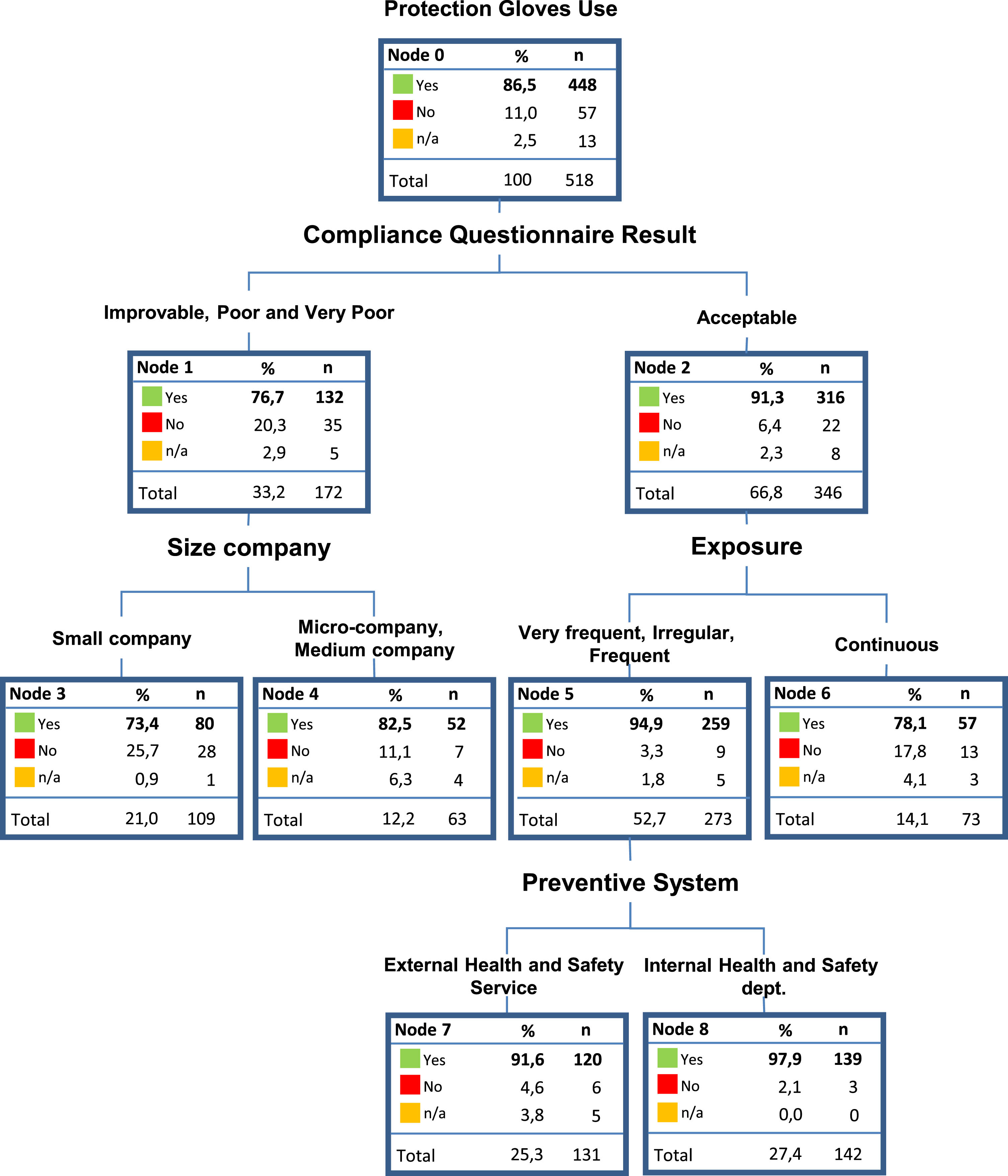
Tree diagram with the dependent variable “Protection gloves use”.
Turning to the right branch of Fig. 1, we observe a progressive increase in glove usage percentages among workers in companies with an acceptable level of compliance. This trend is particularly evident when workers are exposed to biological agents very frequently, frequently, or irregularly. Notably, workers from companies with an Internal Health & Safety (H& S) Department also demonstrate heightened glove usage. However, the percentage decreases among workers continuously exposed to biological agents.
Workers in companies with continuous exposure tend to use gloves less frequently compared to those in other settings. This phenomenon can be attributed to several factors. Firstly, prolonged exposure to risk throughout the workday leads to fatigue, making workers less inclined to consistently wear protective gloves (typically made of vinyl or latex). Discomfort or wear and tear of gloves over extended hours may contribute to their removal, resulting in reduced usage.
Conversely, workers with intermittent exposure demonstrate greater conscientiousness in adhering to glove usage guidelines. Notably, differences emerge between companies with External Health & Safety (H& S) Services and those with Internal H& S Departments. The former, overseen by employers or middle management, tends to exhibit higher usage rates. In contrast, companies with Internal H& S Departments rely on prevention technicians for control and oversight.
Enhancing control measures, providing additional training sessions, and emphasizing proper glove usage instructions can contribute to improved compliance. Studies in the health sector highlight the availability of disposable gloves in diverse sizes and materials, tailored to specific working procedures (such as handling blood or body fluids). Clear instructions on glove changes and hand hygiene further enhance safety practices.
As discussed in earlier sections, companies with an Internal Health & Safety (H& S) Department, overseen by experts, demonstrate greater control over the use of protective equipment compared to companies relying on External H& S Services. Notably, when workers are exposed to biological agents very frequently, irregularly, or frequently, they tend to use masks more often. Interestingly, this trend reverses for workers continuously exposed, possibly because they perceive protective masks as the most cumbersome form of Personal Protective Equipment (PPE).
Furthermore, the study results underscore that workers in companies with an internal H& S department prioritize the use of protective gloves more than the other four analyzed groups or profiles. In conclusion, this study validates the applicability of CHAID analysis for assessing PPE usage among the worker population exposed to biological agents.
As final conclusion, the study findings underscore the importance of establishing comprehensive workplace safety protocols, including the correct use of personal protective equipment (PPE) such as biological protection gloves. The segmentation analysis revealed distinct groups of workers based on their utilization of protective gloves, highlighting the influence of internal Health and Safety departments in promoting compliance with PPE usage. This emphasizes the pivotal role of organizational support in enhancing workers’ risk perception and adherence to safety measures. Effective training on biological hazards and proper equipment use is crucial for mitigating occupational risks and improving overall workplace safety. Moving forward, companies in various sectors need to prioritize the implementation of robust safety measures to safeguard employee well-being in the face of occupational biohazards.
This pioneering study in Spain evaluated the compliance with the mandatory use of gloves as personal protective equipment (PPE) against biological hazards. A survey was conducted among 519 employees from various Spanish firms where exposure to biological materials is common. It’s essential to acknowledge that corporate participation might introduce certain limitations, especially considering potential instances of non-adherence to Spanish regulations.
The insights gained from this research could be instrumental in advancing the safety and health of workers by highlighting key protective practices. Our research aimed at contributing to the diminishment of biological risk factors and bolstering the overall safety protocols through the examination of glove usage as PPE.
Conflicts of interest
The authors declare that there are no conflicts of interest to report. This article represents original work and has not been submitted for consideration elsewhere. All authors actively took part in designing the study, collecting data, analysing data, and drafting the manuscript.
Ethical approval
Not applicable.
Informed consent
Not applicable.
Conflict of interest
The authors have no conflicts of interest to declare.
Footnotes
Acknowledgments
Not applicable.
Funding
Not applicable.