



Abstract
BACKGROUND:
Occupational accidents remain a critical challenge for healthcare professionals.
OBJECTIVE:
In the present study, using the Bayesian network (BN) approach association among resilience, job satisfaction, stress, and occupational accidents among healthcare professionals is examined.
METHODS:
Data was gathered using several valid questionnaires. The BN approach was utilized to analyze the r5/31/2024ionships between the variables of the current study. The performance of BN analysis was evaluated using related indexes.
RESULTS:
In total, 300 healthcare professionals participated in this study. Results showed that almost 23% of healthcare professionals had experienced occupational accidents. Results of the sensitivity analysis demonstrated that job satisfaction had the most significant influence on occupational accidents in healthcare settings. The belief updating analysis results showed that by increasing job satisfaction and decreasing stress of healthcare professionals the occurrence of occupational accidents decreased 9.8% and 6.4%, respectively. Moreover, decreasing the stress of healthcare professionals can lead to an increase in the level of job satisfaction. Evaluation indexes showed that the performance of the developed BN was acceptable (error rate: 16.09).
CONCLUSION:
The Findings reveal that both job satisfaction and stress had a significant influence on occupational accidents in healthcare professionals. Moreover, by influencing job satisfaction and stress, resilience can indirectly affect occupational accidents.
Introduction
Occupational accidents in healthcare professionals are a major concern to the health system and have attracted great interest in research on this subject. Healthcare professionals are exposed to a range of physical, chemical, biological, psychological, and ergonomic hazards. The most frequent type of occupational accidents among nurses is needlestick and sharps injuries (NSIs) [1]. Personal hardships and economic burdens can arise from occupational accidents [2]. A systematic review study concluded that NSIs impose momentous direct, indirect, potential, and intangible costs to healthcare settings [3]. Therefore, the occurrence of occupational accidents should be reduced as much as feasible.
Occupational accidents are multifactorial, and several factors can contribute to them. Job satisfaction is one of the most cited factors that influence occupational accidents [4, 5]. Job satisfaction is regarded as a positive attitude towards one’s work [6]. The increase in employee satisfaction leads to a higher degree of safety motivation, knowledge, and compliance [7]. Holcom et al. [8] demonstrated that job satisfaction can predict the potential occupational accidents of municipal employees. Lack of communication between workers and lack of support from supervisors are associated with low job satisfaction [9].
Occupational stress is another factor that impacts occupational accidents. Occupational stress can be defined as a negative experience of emotions that adversely affects workers’ physical and mental health due to inadequate coping with stressful situations in the workplace [10]. In developed countries, occupational stress is affects more than half of workers [11]. Occupational stress is mainly due to how individuals evaluate the occupational stressor and there are individual differences as regards their behavior in this assessment process [12]. McCann et al. [13] showed that healthcare professionals’ physical and psychological well-being may be negatively influenced by prolonged stress in the workplace. Barkhordari et al. [14] showed that occupational stress had a positive direct effect on the occurrence of accidents. On the other hand, some studies [15, 16] showed that occupational stress had a negative effect on job satisfaction of healthcare professionals. Studies show that job satisfaction and stress of healthcare professionals are significantly related to resilience.
To describe organizations or individuals that have the capacity for dealing with stress and disturbances without having significant effects on stability and functioning it generally refers to resilience [17]. Individual resilience is a personal trait that enables one to flourish against hardship. In recent years, resilience has become a key element of the workplace. Resilience is an important feature of a successful worker in today’s bumpy workplace [18]. Resilient people tend to exhibit accommodative behavior, notably in the fields of social functioning, spirit, and physical health. Resilient people can identify and manage stressful situations [19]. The ability, capacity, characteristics, outcomes, process, behavior, strategy or approach, and type of performance were also considered to be organizational resilience [20]. Resilient organizations develop competence, restitute efficacy, and encourage growth through the behavioral processes of mindful organizing enacted by frontline workers [21].
Zheng et al. [19] and Piotrowski et al. [6] demonstrated a positive and significant relationship between resilience and job satisfaction. This means that individuals with a high level of resilience have higher job satisfaction. Waddimba et al. [22] found a strong association between resilience and job satisfaction among medical professionals. Resilience is one of the most powerful protective factors against stress. Several studies have demonstrated the relationship between resilience and stress in healthcare professionals [23–25]. A lower level of stress is experienced by nurses with a higher degree of resilience [26]. In a sample of medical students, resilience is a partial mediator of stress and life satisfaction [27].
Examining the variables impacting occupational accidents helps manage and decrease them in the workplace. Although the impact of some above-mentioned variables on occupational accidents was examined individually, conducting a comprehensive analysis involving all these variables simultaneously using a powerful method can provide us with a different insight into their concurrent impact on occupational accidents. Recently, the Bayesian network (BN) has attracted the interest of researchers as a powerful tool for analyzing causal relationships. This approach has been widely used in the analysis of occupational accidents in different settings. Mirzaei Aliabadi et al. [28] applied the BN approach to analyze the severity of occupational injuries in the mining industry. In this study, several control strategies were identified to reduce occupational accidents. In another study, Ghasemi et al. [29] used Fuzzy-BN and human factors analysis and classification system (HFACS) framework to analyze a toxic gas leakage accident in a process industry. They concluded that conflicts among several units, unsatisfactory safety culture, and using low-quality equipment are the most important variables contributing to the accident. Akbari et al. [2] developed a BN model to predict NSIs using HFACS framework. In this study, safety motivation, supervisors’ attitude toward safety, and management commitment were the most important factors in predicting NSIs in various levels of HFACS.
According to the previous review, in the current study, the relationships among resilience, job satisfaction, stress, and occupational accidents in healthcare professionals using the BN analysis are investigated.
Methods
Participations
This cross-sectional study was carried out in 2023. The participants consisted of healthcare professionals including general physicians, specialists, nurses, and nurse assistants from four teaching hospitals in Semnan, Iran.
Using the Morgan and Krejcie method the number of participants was calculated. The number of healthcare professionals working in the four hospitals was 1275, so the number of participants was determined to be 296. The participants were selected using a multi-stage random cluster sampling method. Each hospital was selected as a cluster. In the following, for each hospital, based on the number of employees in each group, the number of participants was assigned. The participants were selected randomly. Before gathering the data, participants were informed about the aims of the study.
Measures
Individual resilience
Individual resilience was assessed using the Connor-Davidson Resilience Scale CD-RISC questionnaire [30]. CD-RISC assesses five dimensions of individual resilience (personal competence, trust in one’s instincts, positive acceptance, control, and spiritual influence) using 25 items on a five-point Likert scale. CD-RISC is one of the most popular questionnaires to measure individual resilience [31]. The reliability and validity of the Persian version of this questionnaire were assessed by Mohammadi et al. Cronbach’s alpha, CVI, and CVR were calculated as 0.89, 0.82, and 0.99, respectively [32].
Organizational resilience
Organizational resilience was measured using a questionnaire developed by Prayag et al. [33]. This questionnaire measures two dimensions (planned resilience and adaptive resilience) of organizational resilience using 10 questions on a five-point Likert scale. The reliability and validity of the Persian version of this questionnaire have been confirmed by Rostgar et al. Cronbach’s alpha was 0.84 for planned resilience and 0.82 for adaptive resilience. Moreover, based on convergence analysis, the minimum values of CR and AVE were 0.79 and 0.57, respectively [34].
Occupational stress
Occupational stress was assessed using a six-item questionnaire. This questionnaire measures occupational stress in the past 3 months. Two example items are: “Is your job emotionally demanding?” and “Does your job require persuasion?” [35]. The Persian version of this questionnaire has already been used in the Iranian population [36].
Job satisfaction
Job satisfaction was evaluated using a questionnaire developed by Brayfield and Rothe [37]. This questionnaire consists of six items on a five-point Likert scale. Two example items are: “I feel fairly well satisfied with my present job” and “Most days I am enthusiastic about my work”. The Persian version of this questionnaire has already been used in the Iranian population [38]. Also, the employees were asked, “Have you had an occupational accident in the last 12 months?”. The hard copy of the questionnaires was distributed. The data collection process took 1 month.
Data analysis
BN approach
Data analysis was performed using the BN approach. The BN is a robust probabilistic graphical approach for analysis of the cause-and-effect relationships between random variables. This approach has two quantitative and qualitative sections. The qualitative section shows variables and the causal relationships between them. The quantitative section consists of conditional probability tables (CPTs) that allow for analysis of the BN [39].
BN analysis
2.3.2.1. Graphical structure In this stage, the graphical structure of BN that illustrates causal relationships between variables was developed. For this purpose, five dimensions of individual resilience were connected to job satisfaction and stress. Also, stress was connected to job satisfaction and occupational accidents and finally, job satisfaction was connected to occupational accidents. Moreover, the states of each variable were defined.
2.3.2.2. Training process After developing the graphical structure of the BN, using the expectation-maximization algorithm the BN was trained and CPTs were calculated. CPTs show the quantity relationships among the variables of a BN [40].
2.3.2.3. Performance evaluation of BN In this study, indexes such as error rate, spherical payoff, and logarithmic loss were used to evaluate the performance of BN. In this regard, 40 cases from the data were randomly selected and utilized to evaluate the performance of BN.
2.3.2.4. Sensitivity analysis and belief updating In this stage, using Equation 1 [39, 40] and mutual information, the sensitivity of “occupational accidents” to individual resilience, job satisfaction, and stress was assessed.
Finally, utilizing belief updating, a special feature of BN, the impact of changes in some variables on others was assessed. Belief updating enables researchers to perform inter-causal, diagnosis, and predictive reasoning [28]. Moreover, this feature is useful in choosing the best strategies to manage occupational accidents. The BN analysis was carried out using Netica software. Figure 1 illustrates the study steps.
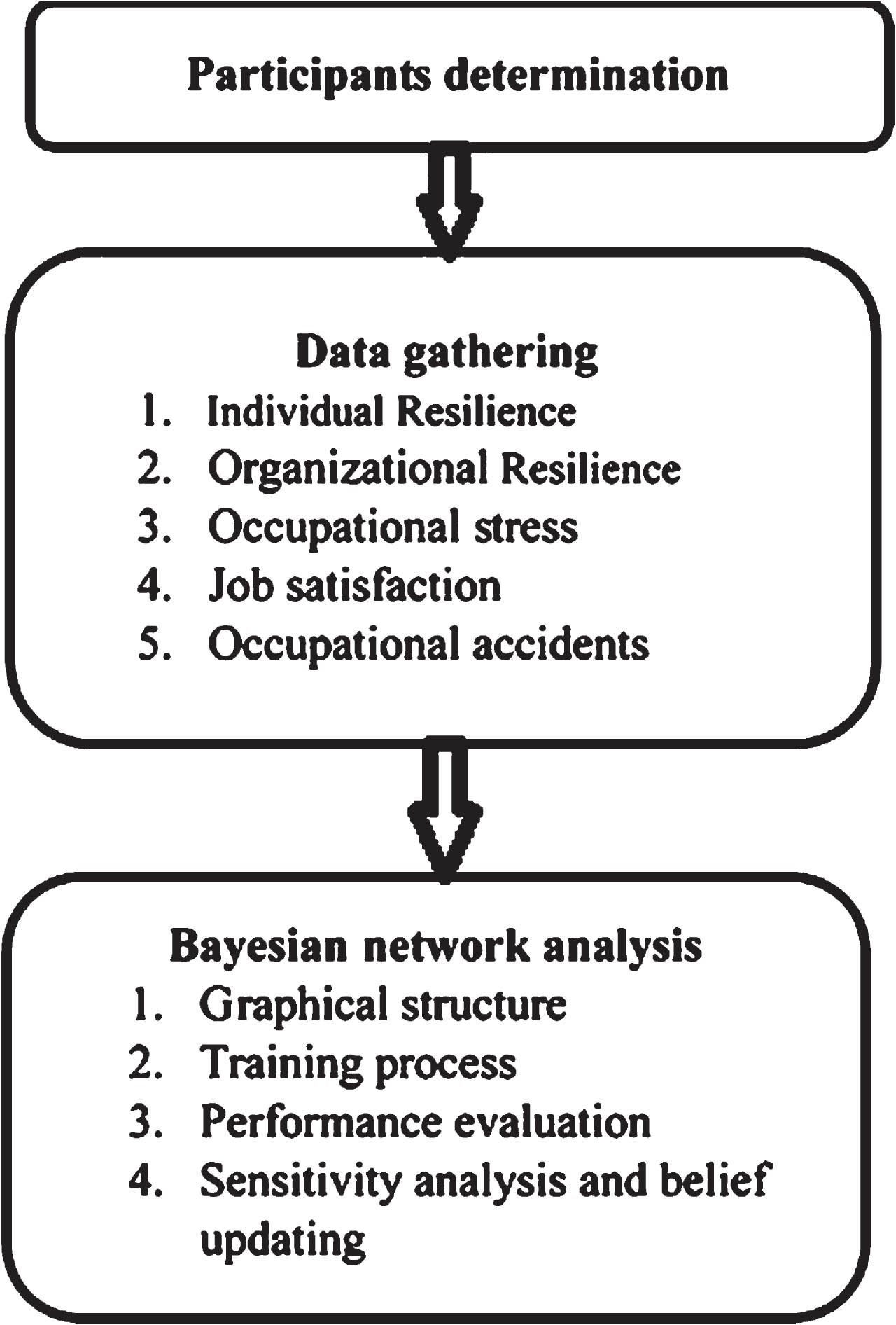
The study steps.
Table 1 shows the demographic characteristics of the participants. The study included a total of 300 healthcare professionals. The mean age and work experience of participants were 37.1 (±7.7) and 12.2 (±7.8) years, respectively. The majority of them were female (68.7%), married (80.0%), bachelor (68.7%), and nurse (56.7%). The reliability analysis demonstrates that all four questionnaires had good internal consistency (0.87 < Cronbach’s alpha).
The demographic characteristics of the participants
The demographic characteristics of the participants
Figure 2 shows the prior probability of the variables and the graphical structure of BN. The prior probability reflects the current status of the hospitals with concerning occupational accidents, resilience, job satisfaction, and stress. As illustrated in this figure, 22.8% of healthcare professionals had experienced occupational accidents, almost 59% of them had very high and high job satisfaction, and only 39.5% of them had very low and low stress.
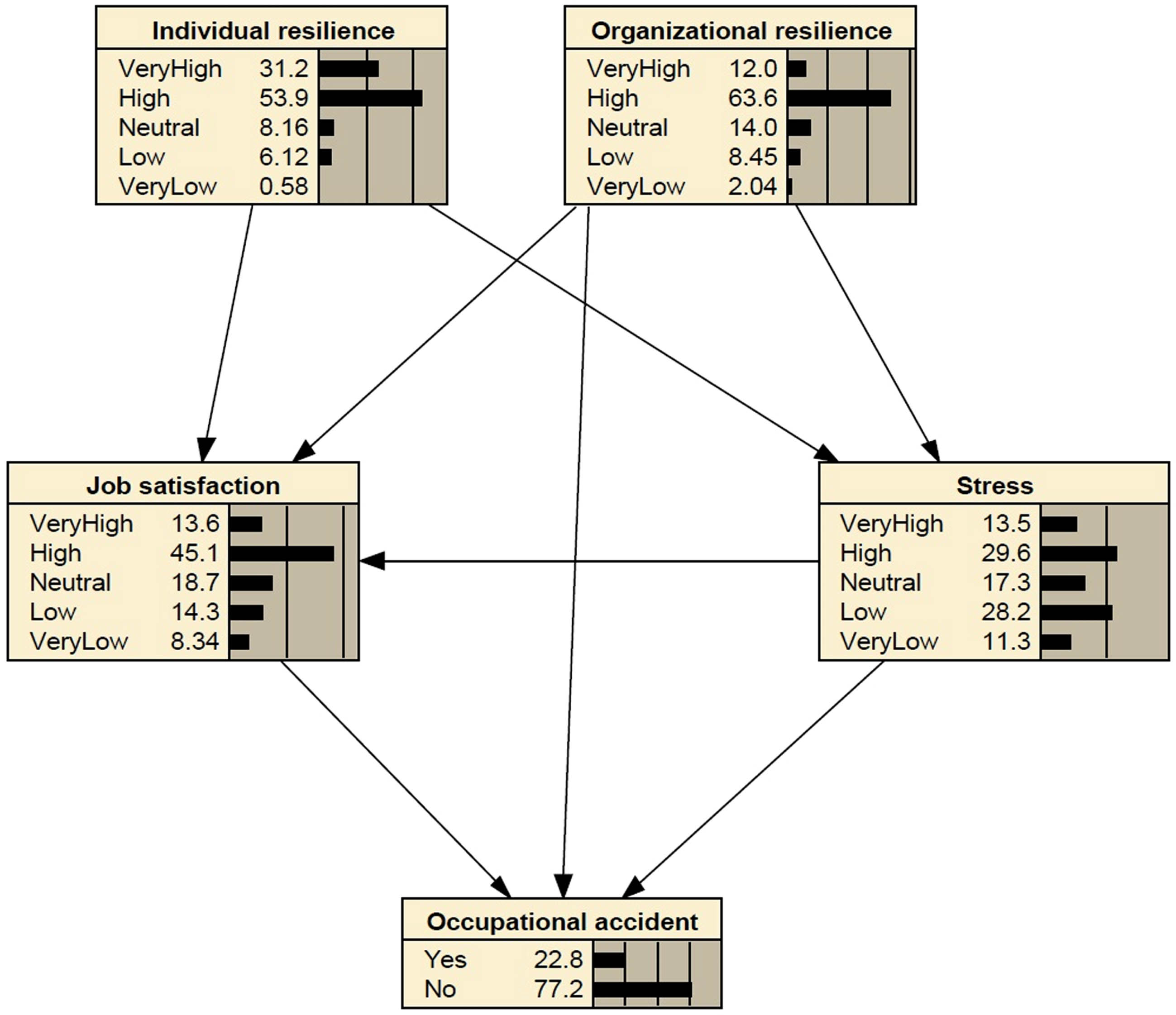
The graphical structure of BN and prior probability of variables.
Table 2 shows the results of the performance evaluation of BN. The error rate of the BN was 16.09%. The values of spherical payoff, logarithmic loss, and quadratic loss were 0.8879, 0.3325, and 0.2178, respectively.
Performance indexes of the BN
As mentioned in the materials and methods section, the sensitivity of “occupational accidents” to other variables was assessed. The sensitivity analysis would allow the researchers to rank the independent variables by the magnitude of their impact on a dependent variable. Tables 3 and 4 show sensitivity analysis results using Equation 1 and mutual information, respectively. According to Table 3, job satisfaction and stress had the strongest impact on occupational accidents. On the other hand, organizational resilience and individual resilience had the weakest effect on occupational accidents. As shown in Table 4, the mutual information method shows the same results as Equation 1.
The relative variation in probability of < “occupational accidents”=no>corresponded to other variable states
Sensitivity of “occupational accidents” to a finding at another variable
The current study used prediction reasoning to find the best strategies to reduce occupational accidents. Figures 3 and 4 show the results of the belief updating analysis. In Fig. 3, the evidence is set to the job satisfaction node. When the job satisfaction node is set in the “very high” state, the probability of state “no” of the occupational accidents node increases by 9.8%. Also, regarding Fig. 4, when the stress node is set in the “very low” state, the probability of the state “no” of the occupational accidents node and the probability of the state “very high” of the job satisfaction node increased by 6.4% and 7.9%, respectively.
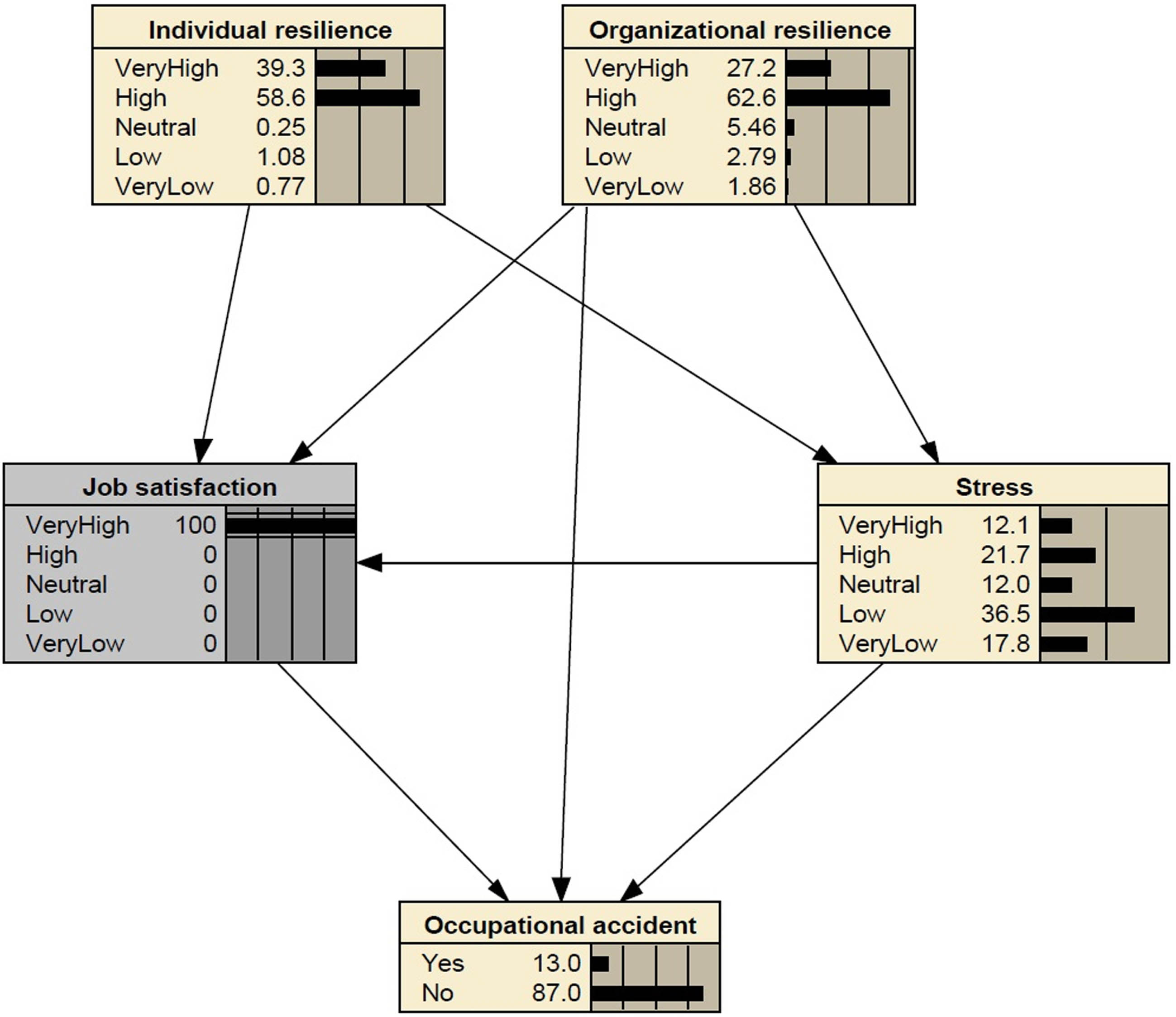
Setting evidence to the “job satisfaction” variable and the posterior probability of “occpational accidents”.
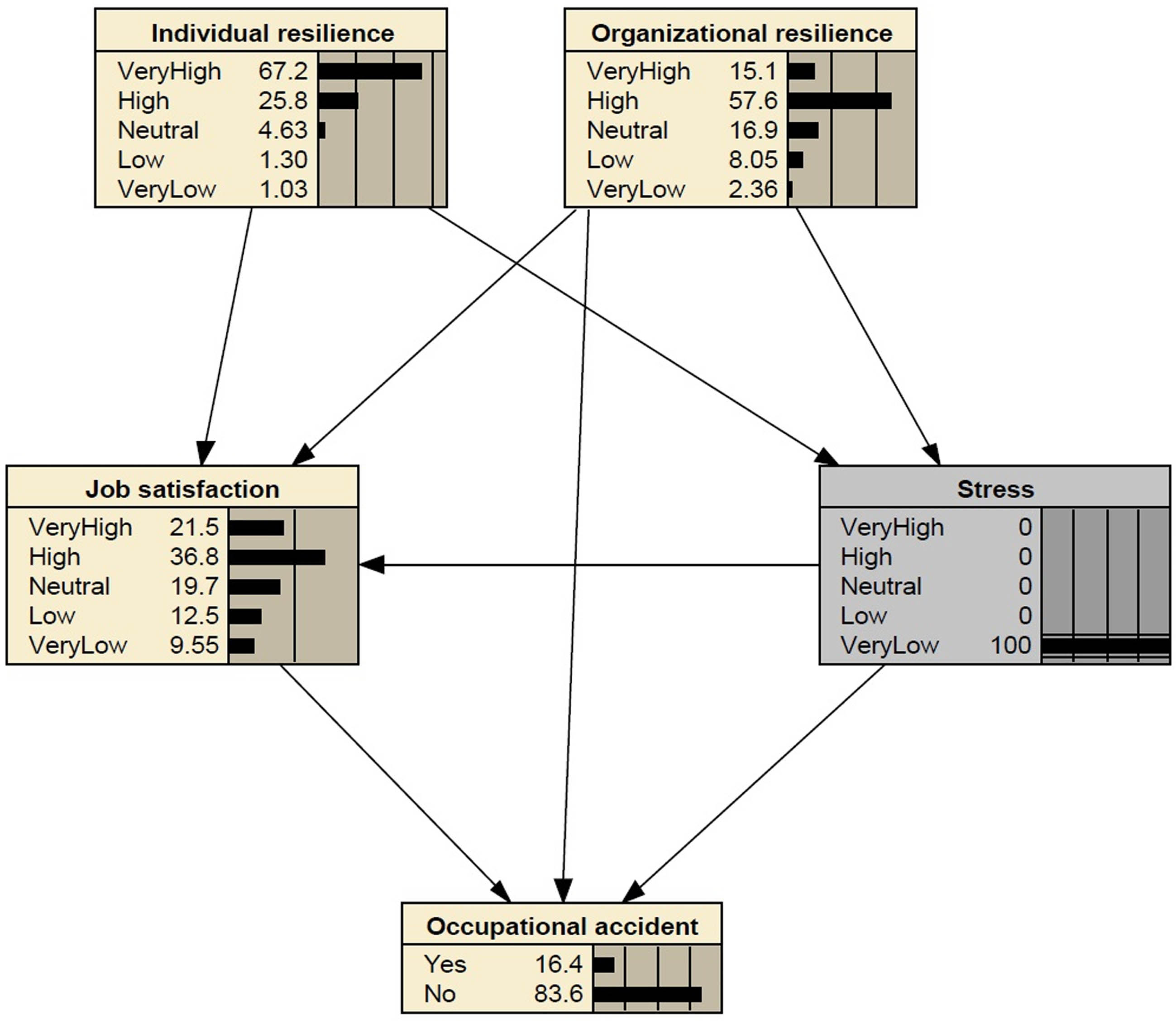
Setting evidence to the “stress” variable and the posterior probability of “occpational accidents”.
Table 5 shows the effectiveness of various joint strategies to reduce occupational accidents among healthcare professionals. Accordingly, improving organizational resilience and decreasing stress is the best joint strategy.
The joint strategies with the highest effect to reducing occupational accidents (based on prediction reasoning)
Occupational accidents are one of the considerable challenges in healthcare settings. In this study, the BN approach was utilized to analyze causal relationships among resilience, job satisfaction, job stress, and occupational accidents in healthcare professionals. The results illustrated that the performance of the presented BN is good.
According to sensitivity analysis results, job satisfaction had the strongest influence on the probability of occupational accidents in healthcare professionals. Furthermore, belief updating analysis results showed that if the job satisfaction of healthcare professionals is at the highest level, the occupational accidents rate decreases by 9.8%. Previous studies showed that job satisfaction is one of the main causes of occupational accidents. Eskandari et al. [41] found that employees with high job satisfaction have better safety performance and experience fewer occupational accidents. In another study, Mosesman [42] demonstrated that injured and uninjured employees had a significant difference in job satisfaction. Khoshakhlagh et al. [43] concluded that there are significant relationships between accident occurrence and job satisfaction in Iranian male employees. Herzberg’s two-factor theory well explains ways to improve job satisfaction and alleviate job dissatisfaction at workplaces [44]. According to this theory, hygiene factors such as salary, work conditions, paid insurance, and vacations, are associated with less job dissatisfaction, while factors such as job identity, job control, and participation in decision-making are motivators associated with higher job satisfaction. Both sets of factors need enhancement among Iranian nurses.
Additionally, sensitivity analysis revealed that occupational stress had a significant influence on occupational accidents. Also, results showed that when healthcare professionals had the lowest level of occupational stress, the occupational accidents rate was reduced by 6.4%. The impact of occupational stress on accidents has been shown in several studies. Kim et al. [45] found that firefighters with high levels of occupational stress experience more occupational injuries. Goldenhar et al. [46] demonstrated that job-task demands, physical and chemical hazards and protection, and organizational stressors play a significant role in injury and near-miss outcomes in construction workers. In a prospective cohort study, Julia et al. [47] demonstrated that there is a significant positive association between occupational stress and occupational accidents. Occupational stress by decreasing concentration, distraction, and memory impairment can cause unsafe act which ultimately leads to occupational accidents [48]. In this regard, Jozani et al. demonstrated a significant relationship between stress symptoms and cognitive failures [49]. Examples of stress factors in healthcare settings are high workload, interaction with patients, aggressive behavior from patients, the need to conceal unpleasant emotions, and role conflicts at work. Person-work interface and organizational interventions can be used to decrease and manage stress in healthcare professionals [50].
Sensitivity analysis showed that among the variables of present studies resilience had the lowest effect on occupational accidents. However, studies showed that by mediating job satisfaction and stress, resilience can indirectly have a significant effect on occupational accidents. Piotrowski et al. [6] revealed that resilience can influence job satisfaction through the mediating role of stress. Nurses with high levels of resilience had a high level of job satisfaction and low levels of stress [6]. A study among Chinese healthcare professionals showed that resilience is positively associated with job satisfaction and negatively associated with injuries in healthcare settings [51]. Resilience is influenced by personal, biological, and environmental factors [52]. McAllister and McKinnon [53] recommended three strategies to increase resilience in healthcare professionals, including: (1) all training programs should include the concept of resilience, (2) make opportunities for healthcare professionals to reflect and learn from experience and other healthcare professionals, and (3) experienced healthcare professionals share lessons from experiences, mentoring, and leading to others.
Organizational resilience, on the other hand, focuses on the adaptive capacity of organizations, helping them to overcome predicted and unpredicted disturbances. It has been regarded as a nearly new paradigm for managing safety by concentrating on desired and undesired experiences. It intends to minimize the rate of accidents by promoting flexibility, awareness, learning culture, just culture, and emergency preparedness within organizations. According to Hollnagel [54], organizations need four abilities for their resilient performance, including the ability to monitor, to learn, to anticipate, and to respond. In this study, we found that the effects of occupational stress and job satisfaction on occupational accidents are higher than that of organizational resilience. This finding can be because that resilience engineering aims to reduce the rate of systemic accidents, instead of occupational mishaps, by optimizing the performance of sociotechnical systems. Although there is no doubt that organizational resilience can be effective in reducing occupational accidents, classic safety interventions are still the most commonly used strategies for reducing such undesired outcomes. These strategies include enhancing safety climate, monitoring safety behavior, using safety incentives, and also improving the psychosocial environment at workplaces.
The current study had some limitations that should be addressed. Although various job groups were included in the present study, factors such as cultural differences, healthcare system variations, and workforce characteristics could impact the generalizability of the findings to other contexts. There are also other factors contributing to occupational accidents. It is not possible to include all of them in one model. However, future studies are recommended to address the mediating role of job burnout, fatigue, and perceived workload on the relationship between organizational and individual resilience and occupational accidents. Furthermore, cross-sectional studies suffer from a number of limitations, including various kinds of biases such as common method bias. Collecting data at different points in time is an accepted way to deal with such a bias, however, it is not possible to implement this strategy in all situation mainly due to the difficulties regarding data collection. Another risk associated with such studies is the influence of uncontrolled confounding variables. Consequently, the results of such studies should always be interpreted with great caution.
Conclusions
The Findings reveal that job satisfaction and, to a lesser extent, stress had a significant influence on occupational accidents in healthcare professionals. Moreover, by influencing job satisfaction and stress, resilience can indirectly affect occupational accidents.
Ethics approval
The study protocol was approved by the ethics committee of Semnan University of Medical Sciences (Ethic code: IR.SEMUMS.REC.1401.266).
Informed consent
Informed consent was obtained from all participants.
Conflict of interest
The authors have no conflict of interest to report.
Footnotes
Acknowledgments
The authors thank the participants in the four hospitals involved in this study.
Funding
This study was supported by Semnan University of Medical Sciences (grant no: 2074).