



Abstract
Introduction
Today, many clinical diagnoses and treatments depend on CT images. The metallic implants or other high density artificial prostheses usually degrade CT quality in form of metal artifacts [1–4]. The beam hardening artifact is one of most important modalities of metal artifacts, which is very difficult to be removed by general approaches for improving CT quality such as higher dose scans [5–9]. When the effect of beam hardening has not been suppressed efficiently, for example, FBP algorithm is employed directly, the beam hardening artifacts will become very serious in the form of dark and bright streaking artifacts in reconstructed images, which impair the image quality and thereby hamper the correct diagnosis.
Since more and more artificial prostheses and metallic implants are used along with an aging society is drawing near, many researchers have made great efforts to reduce metal artifacts [10–14]. The major challenge for metal artifact reduction (MAR) roots in the highly-nonlinear variation of attenuation coefficients of metallic objects along with beam energy. The proposed approaches include dual energy correction [15], projection completion and statistical iterative correction schemes (iterative image reconstruction algorithms). The latter two do not need extra dose of radiation and become more common choices. In the projection completion approach, the missing projections are synthesized from neighboring projections using linear or polynomial interpolations [16–20], Poisson inpainting [21], wavelet interpolation [22, 23], adaptive filtering, tissue-class model techniques [24–27]. The performance of these algorithms depends on the redundancy of available projection data and/or a priori information about missing projections. Recently, the iterative model-based image reconstruction methods are proposed to estimate missing or incomplete data using statistical methods [28–31]. However, numerous study results show these approaches cannot solve the problem very efficiently. For example, these algorithms cannot entirely compensate for severe projection corruptions, or might blur the image details, or induce new artifacts sometimes, and some need huge calculation power, or need other extra techniques [32].
In this paper, the idea behind the proposed approach is to work out the synthetical geometry projections from the (original) projections. The synthetical geometry projections are the nearly linear weighted sums of element geometry projections with respect to mean of each attenuation coefficient, where the element geometry projections are the theoretical projections that are produced only by density distribution of certain element(component) in underlying images. According to Lambert-Beer law, the projections can be expressed as monotonic nonlinear functions of synthetical geometry projections. Newton-Raphson algorithm is employed to work out the solutions, the synthetical geometry projections, from the projections. In the process, Newton-Raphson formula is modified to make Newton-Raphson function satisfy the convergence conditions of FPI so that the solutions are fine approximations of the synthetical geometry projections. In theory, since the element geometry projections or their weighted sums, the synthetical ones, are free or almost free from beam-hardening effect, the beam-hardening artifacts would be suppressed efficiently.
Method: Obtaining the synthetical geometry projection from original projection
According to Lambert-Beer law, for X-ray source at energy level E,
In order to simplify analysis calculation, the equation (2) has to be discretized. Suppose a polychromatic X-ray source consists
of K energy levels (marked by i = 1, ⋯ ,
K), and an object consists of M components (metals and
other organic tissues, marked by j = 1, ⋯ , M), which
occupy certain regions in the underlying image. Let
f
j
denote an image that only consists of
j-th component, i.e, if a pixel (n, m)
is of j-th component,
f
j
(n,
m) =1, f
j
(n,
m) =0 otherwise. For example, let f1 denote
an image that only consists of copper, f2 an image that only
consists of calcium. In this paper, is named as the element
geometry projection of component j, which is the theoretical projection and
produced by the pixel intensities (component density distribution) only. Let
αi,j denotes the attenuation coefficient of
j-th component at i-th energy level, the normalized
X-ray beam intensity passing through a two-dimensional object can be approximately expressed
as
Generally, the metallic objects consists of few elements, such as only titanium or calcium or copper, which are all known. Except the large difference of the attenuation capacities between organic tissues and metals (or other high attenuation components), the variation pattern of attenuation properties are similar: the higher the X-ray beam energy, the smaller the attenuation coefficient. The attenuation properties of metals in common use, such as titanium, calcium, iron and copper are rather similar to each other, and are much bigger than that of organic components such as water [33], which are depicted in Fig. 1. Although the attenuation coefficients per unit volume among the metals make a huge difference, the variation rule are rather same, which can be demonstrated by Fig. 2. In Fig. 2, when the attenuation coefficients are multiplied by proper numbers, they vary similarly.
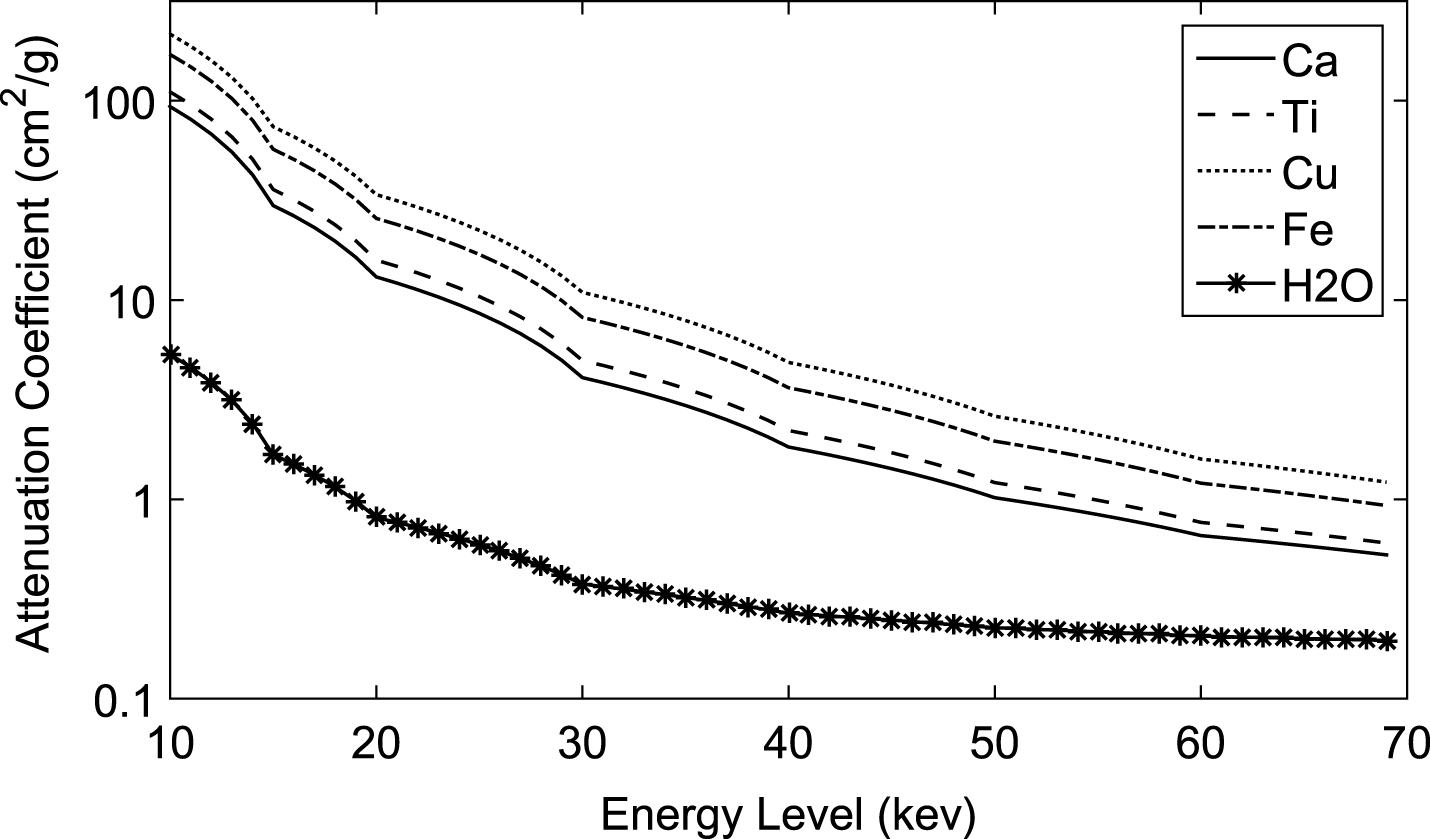
The attenuation coefficients of titanium, calcium, iron, copper and water.
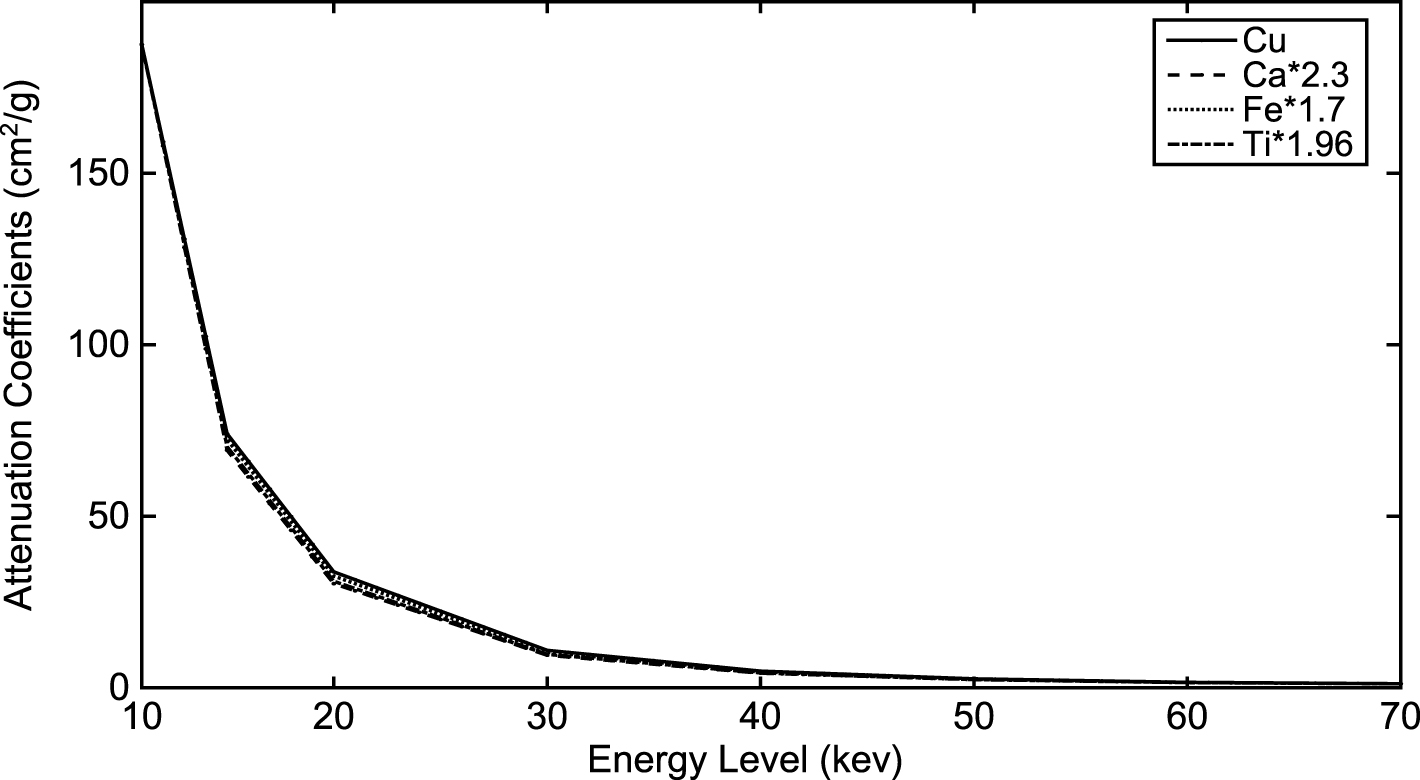
The attenuation coefficients of titanium, calcium, iron, copper, where are multiplied by some numbers.
The mechanisms of beam hardening artifact for metals and organic tissues are similar except
the huge difference in magnitude. For organic tissues, the variations of attenuation
coefficients are slight and can be ignored, however, for metallic objects, the variations
cannot be ignored, or serious beam hardening artifacts will arise. For the convenience of
further analysis, an averaged or representative attenuation coefficient takes the place of
several attenuation coefficients, i.e., the equation
(3) is simplified as the followings
It is reasonable to think that the beam hardening effect in will be much smaller than
that in projections P (φ, s) (i.e.
- ln
Obviously, Newton-Raphson Theorem can be extended to high dimension problems when variables are independent of each other. Since the elements of in the equation (4) are independent each other, Newton-Raphson algorithm is available for these questions.
For convenience, let ,
the equation (4) becomes
According to Newton-Raphson Theorem, the convergence depends on the initial approximation
p0 and radius of convergence δ. The former
should be selected carefully so that the initial approximation is near the convergence
center p. The latter depends on the properties of function
f (x). According to our experience on using
Newton-Raphson Theorem, it is quite difficult to select the initial approximations so that
the proper solutions are obtained finally. In order to extend the convergence region, i.e,
enlarge δ to ensure the proper solution p is obtained
finally, a skill is necessary. According to FPI theorem [34], for Newton-Raphson iteration function
g (x) = x - f (x)/f′ (x),
if |g′ (x) |<1, i.e. satisfy the convergence conditions
of FPI, δ becomes sufficiently large. Consider (6), Newton-Raphson
iteration function can be rewritten as
For the initial
Consider the similarity of attenuation coefficients among the metals and the large
difference of attenuation coefficients in magnitude between organic and metals, we think the
error caused by the simplification in (4) will be limited. For example, there are four
different metallic objects and organic tissue in the second example of Example
1 in the next section, the simulation results show the normalized error between
two
When it is reconstructed using the synthetical geometry projection , the underlying image
f should be adjusted to obtain proper CT numbers. Suppose the grayscale
of an image is in [0, 1], the CT number of pixel with intensity
p
i
will be transformed as
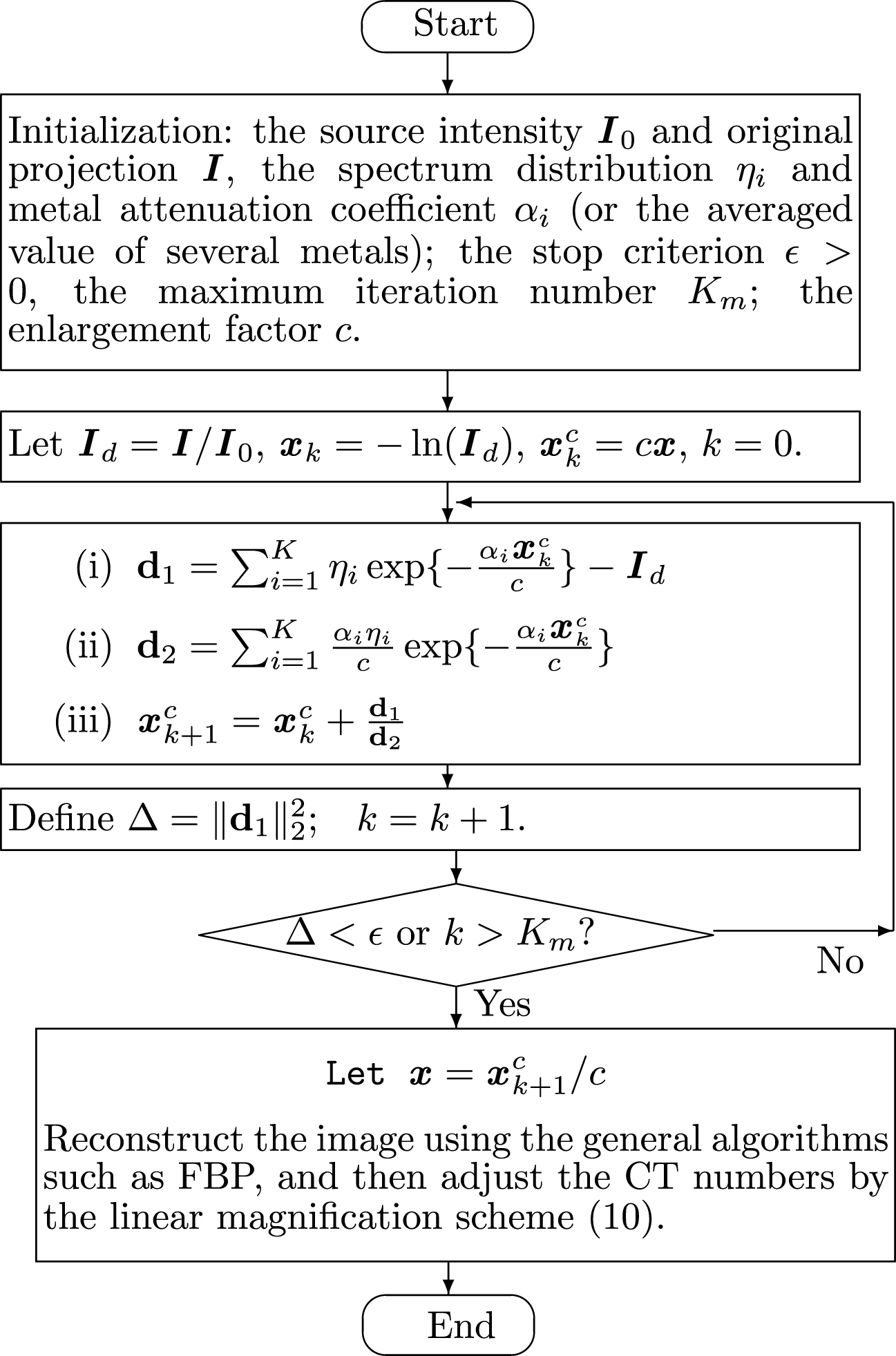
The flowchart for calculating the synthetical geometry projection from polychromatic projection.
The performance of the proposed approach is evaluated by two numerical simulation and one practical experiment examples. All examples are achieved on a Windows machine with Intel Xeon E5-2620 2.1GHz CPU (2 processors) and 32GB RAM.
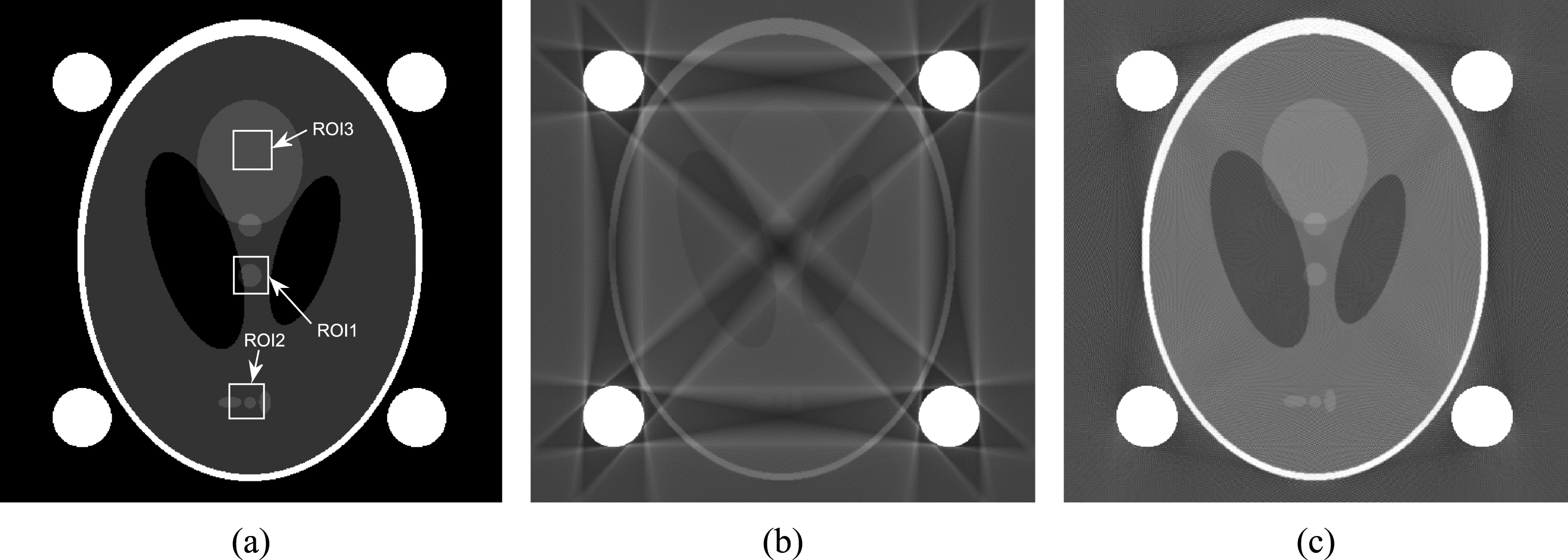
The original and reconstructed images. (a) The original image, which is the head phantom image together with four circles(copper), (b) and (c) are the images reconstructed by FBP and the proposed algorithm, respectively(WW/WL=200HU/100HU).
Since the mean of mass attenuation coefficient of copper in 8 ∼ 80kev (the valid spectra range of Siemens tube) is 32.78 times of H2O and the mass density of copper is 8.9 times of that of H2O, the intensity of copper is set as 291.7 times of H2O, so does the CT number. The synthetical geometry projection is calculated by the flowchart in Fig. 3.
When the image is reconstructed by FBP directly, the reconstructed image is shown in Fig. 4 (b). When the proposed approach in Fig. 3 is employed, the reconstructed images are shown in Fig. 4 (c), where the stop criterion is selected as ε = 1.0E - 8.
The normalized root mean square difference (NRMSD) and mean absolute deviation(MAD) are
employed as criteria in accessing the correction performance [4, 22]. The NRMSD in certain
region between the reconstructed and reference image (the original image) is computed
according to following formula
The quantitative evaluation, NRMSD and MAD, for Example I using NRIT and no using NRIT (directly using FBP)
In the second part of this example, the elements of four circles are supposed to be copper, iron(7.8 gram/cm3), calcium(1.5 gram/cm3) and titanium(4.5 gram/cm3), respectively. The image is shown in Fig. 5 (a). At the first, the five components (one tissue and four metals) are performed parallel projection transform to produce five versions of element geometry projection separately. Then the simulation projections are calculated by equation (3). When the image is reconstructed by FBP directly, the reconstructed image is shown in Fig. 5 (b), while the reconstructed image using the proposed approach is shown in Fig 5 (c). In the latter process, the mean of attenuation coefficients of four metals is employed in working out the synthetical geometry projection. The criteria results are also shown in Table 1.
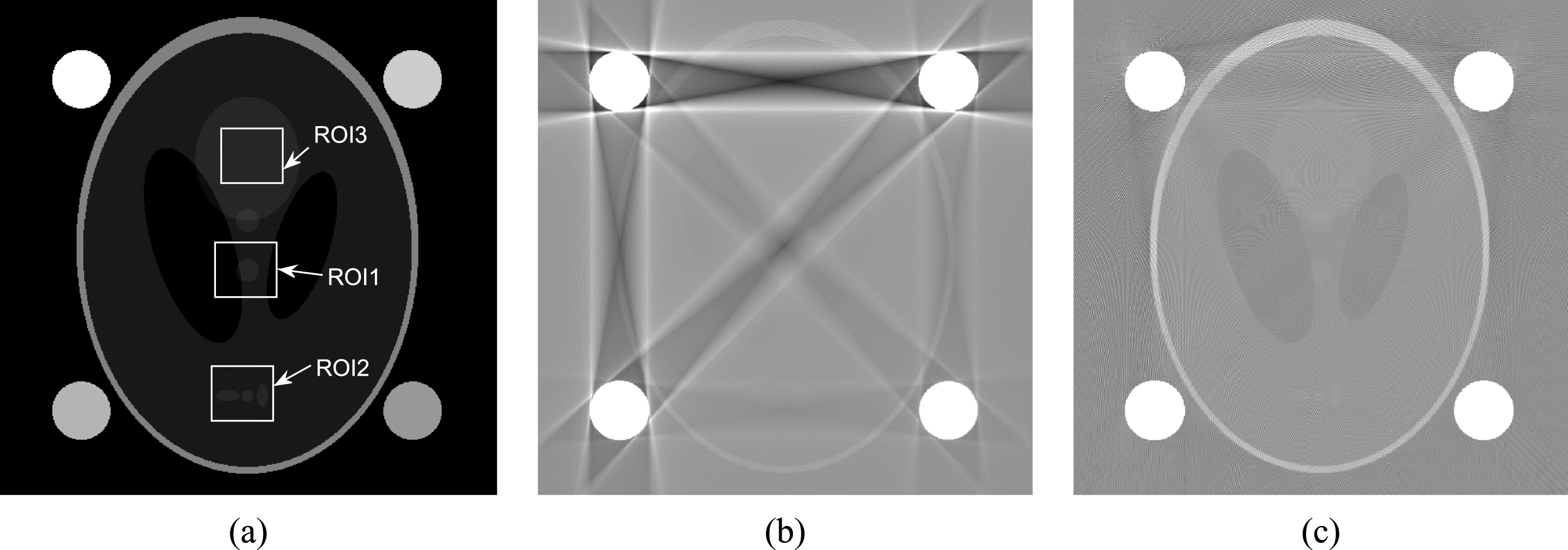
The original and reconstructed images. (a) The original image, which is the head phantom image added with four circles of different metals. The circles at left-top, right-top, left-bottom and right-bottom corners are supposed to be of copper, iron, titanium and calcium, respectively. (b) and (c) are the images reconstructed by FBP and the proposed algorithm, respectively. (WW/WL=200HU/100HU).
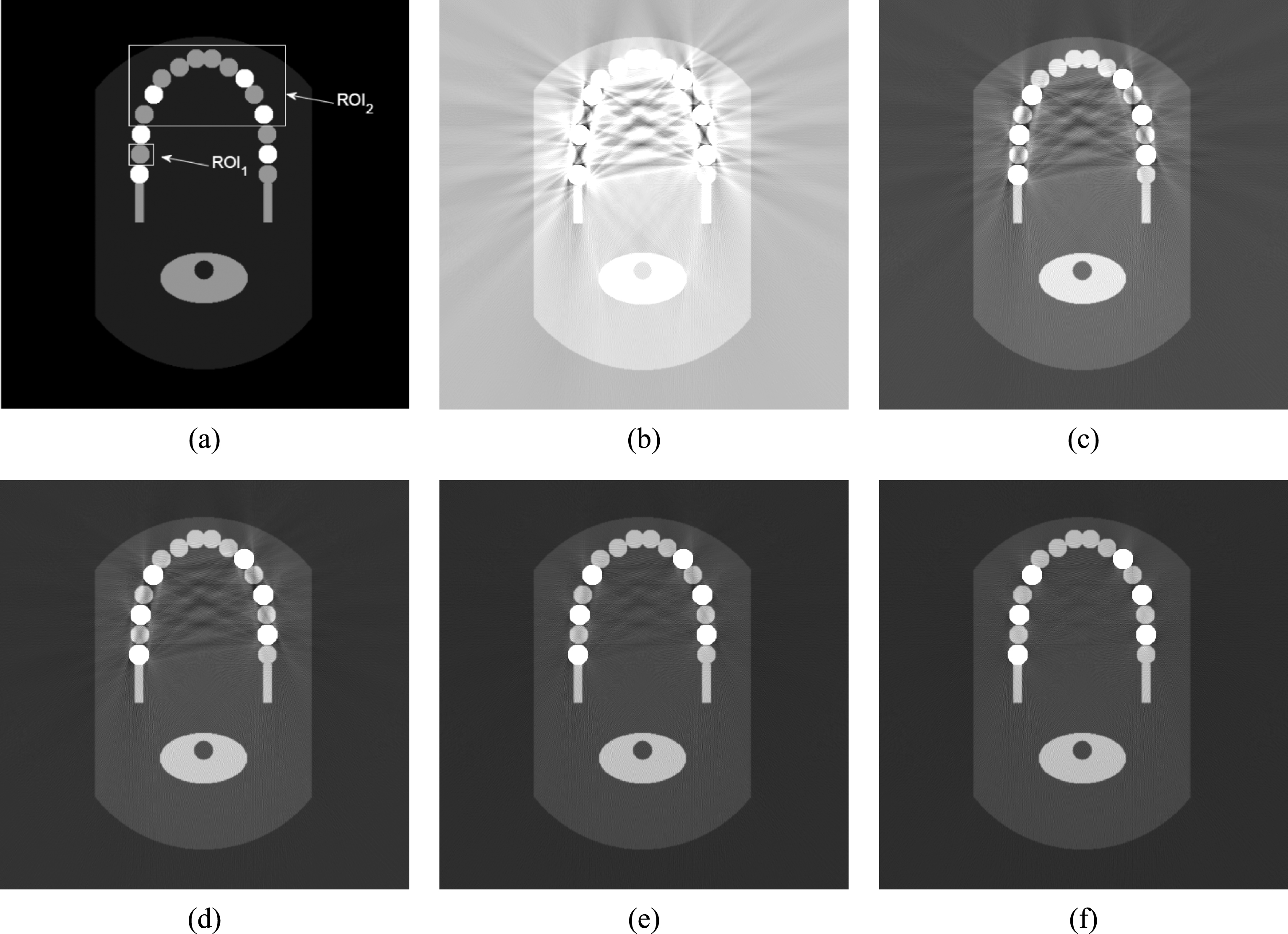
The reconstructed images using different approaches. (a) the original image, (b), (c), (d), (e) and (f) are the images reconstructed by FBP, LI, NMAR, the approach in [4] and NRIT, respectively. (WW/WL=600HU/200HU).
NRMSD and MAD are also employed in accessing the correction performance. The regions of interest (ROIs) for calculation is shown in Fig. 6 (a) marked as ROI1 and ROI2 (excludes the metal regions by threshold segmentation). All results of accession criteria are shown in Table 2. The results demonstrate the proposed approach has satisfactory performance. For example, it shows NRIT has reduce NRMSD 3.49(%) compared to the algorithm in [4], or NRMSD has been reduced by 17.52% compared to [4].
The quantitative comparison of correction performance among LI, NMAR, the approach in Reference [4] and NRIT using NRMSD and MAD
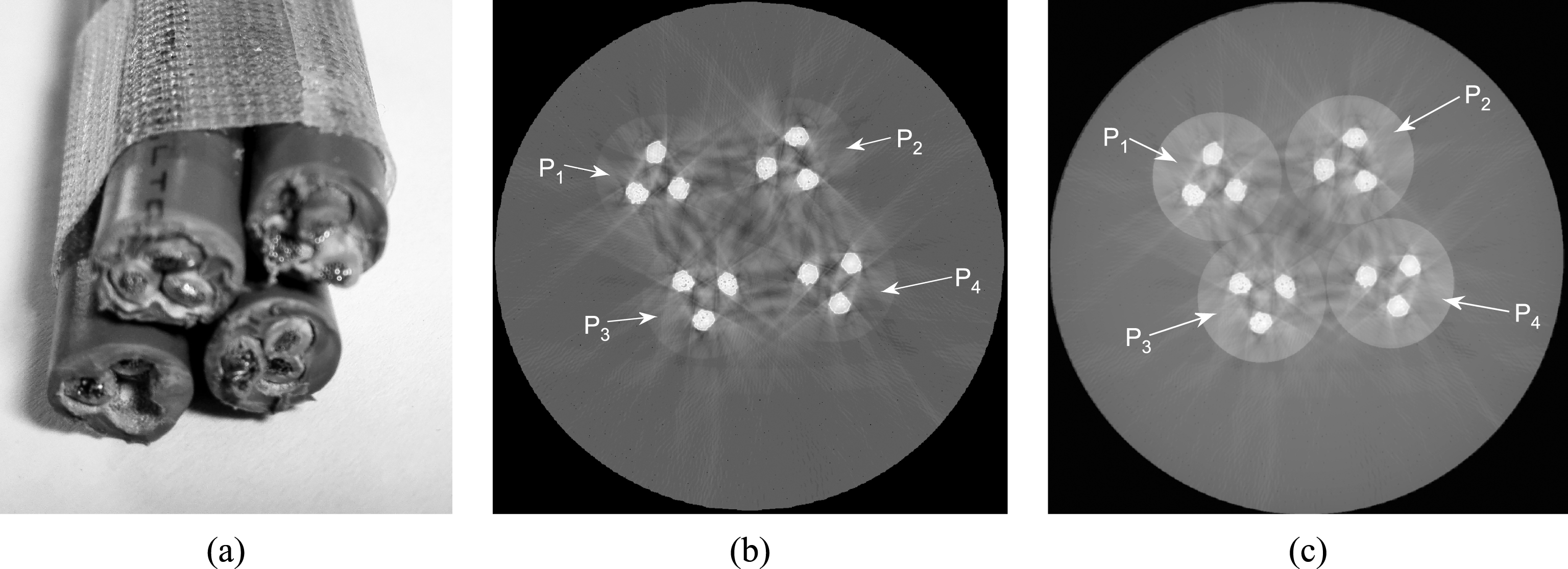
The object, the initial and postprocessing images. (a) The object, four power cables bound together, (b) the initial (WW/WL=2000HU/1000HU), (c) the image after NRIT postprocessing. (WW/WL=2000HU/1000HU).
The results show the image quality has been improved effectively, for example, the contour of PVC material become more clear and full. However, it is still not enough satisfactory and need to be improved furthermore. We think the reason is twofold: (1) there might are some extra processing procedures that are hidden by the machine, which make the reprojection data is different from the true original projections; (2) the scatter (might comes with Compton effect) and Poisson noise are also the causes of metal artifacts, which should be represented by some different models other than (8), so do the MAR algorithms. In the future study, we will focus on these questions.
In this study, an iterative approach is proposed for reducing beam hardening artifacts in the sinogram domain. In the approach, the idea of element geometry projections and synthetical geometry projections are introduced. An element geometry projection is the theoretical projection of certain component, the Radon transform of the image that only consists of the component, and the synthetical one is the linear weighted sum of element geometry projections with respect to means of attenuation coefficients in certain energy range. As a result, the projections can be expressed as monotonic nonlinear functions of synthetical geometry projections. With help of prior knowledge on spectrum parameters and attenuation coefficients, the functions have explicit expressions. Newton-Raphson algorithm is employed to work out the synthetical geometry projections. By some techniques, Newton-Raphson functions can satisfy the convergence conditions of FPI, which ensures the solutions will be obtained steadily.
Since the similarity of attenuation coefficients among metals and the large difference of attenuation coefficients in magnitude between organic and metals, the solutions (the approximations of synthetical geometry projections) are nearly linear weighted sums of the element geometry projections with respect to means of attenuation coefficients, which has been demonstrated by the numerical simulation results. The underlying images are reconstructed using the solutions by general algorithms, and then are adjusted by linear magnification to obtain proper CT numbers. Some examples demonstrate the proposed approach is efficient in reducing beam hardening artifacts and has satisfactory performance. When the original projection is absent, the approach can also alleviate metal artifacts somewhat. The essential conditions for the approach consist of the spectrum parameters and energy-dependent attenuation coefficients, which are usually available in the practical applications. Therefore, the approach has the potential applications in practical CT systems, or can be used in postprocessing CT images.
Footnotes
Acknowledgments
This work have been supported by National Natural Science Foundation of China (NSFC) under Grant No. 60972156, Beijing Natural Science Foundation under Grant No. 7142022 and Scientific Research Common Program of Beijing Municipal Commission of Education No. KM201410025011.