Other
Select search scope: search across all journals or within the current journal


Is it sex discrimination when bars or taverns offer a "ladies-night" beverage discount to women only? The Supreme Court of California has ruled that such discounts constitute sex stereotyping prohibited by California's Unruh Civil Rights Act. The court found that a violation of the Act was in and of itself injurious, making it unnecessary to prove actual damages. Moreover, the court ruled that sex-based price discounts tend to perpetuate harmful sex stereotypes. The court made reference to scholarly commentary and the decisions of other states' courts in similarly finding such discounts to violate their respective civil-rights acts.
Transformational leadership is a way to convey to employees where the organization is going and their role in that journey. Transformational leaders in this study demonstrated a clear sense of direction, emphasized organizational objectives
The primary operator of condominium hotels in Hawaii is Aston Hotels. Its owner, Andre Tatibouet, began focusing on condominium management when those construction projects boomed in 1978. By paying attention to multiple owners' financial needs, Tatibouet's firm has prospered. Aston maintains its own training programs and selects the GM at each property. He depends on travel agents and wholesalers for nearly 90 percent of this business. Other than on Oahu, Hawaii's tourism is down compared to the mid-1980s, although Waikiki remains relatively strong.
As hotel owners closely monitor their investments and apply strict criteria to selecting and evaluating management companies, management contracts are being rewritten to be performance-based. This article sets forth the criteria established by owners and asset managers to select and monitor third-party hotel-management companies (including chains), and details the type and timeliness of information (reports) expected of management companies. A survey of 43 owners using management companies showed that the selection and evaluation processes give leverage to owners. Management companies are being held accountable and pressured to focus their efforts on a particular asset to satisfy owners or risk losing contracts.
To determine whether gender is an important variable in management success, a survey of male and female general managers explored which personality traits these individuals believe contributed to their own career development The survey showed that male and female managers' self-reports conform only marginally to stereotypes of gender-linked characteristics. In regard to characteristics generally associated with women, compassion and flexibility were reported equally by the two groups, while women described themselves as enthusiastic more often than did the men. Regarding typically male traits, about the same percentage of men and women reported that their goal orientation contributed to their career advancement, while a smaller percentage of men than women described their behavior as ambitious. The high number of all respondents who believe that honesty and integrity contributed significantly to career advancement indicates that, in the end, success may be foremost a matter of character, not gender.
Travel agents book more than 90 percent of airline tickets but are responsible for only 25 percent of hotel reservations. Although there is some negative history to overcome, hotel companies and travel agents are coming to recognize the advantages of collaboration over competition. With the advent of new computer-based distribution systems, travel agents can negotiate with hotel clients for volume contracts, recommend hotels to individual travelers, and consult with corporate travel planners. The partnership is mutually beneficial: travel agents constitute a large and relatively inexpensive labor force for the hotel industry, and booking hotel reservations helps to bolster travel agents' bottom lines as airline fare wars have meant lower commissions.
This article explores gender-based differences in hotel-selection and service-use preferences, based on a survey of 250 male and female business travelers. As one might expect, both men and women consider basic services, such as clean, comfortable rooms and free local phone service, to be important. But businesswomen consider security, in-room services and amenities (such as hair dryers and minibars), and low price to be more important selection criteria than do businessmen. Male business travelers are more likely to value business-related services and facilities (such as fax machines and suites). One intriguing finding of the study is that, although businesswomen take an average 7.4 domestic trips per year compared to businessmen's 11.1, women take more international business trips than men and their stays tend to be nearly twice as long.
A well thought-out crisis plan can help management respond and control damage to the organization's reputation, financial condition, market share, and brand value. Everyone, from senior management to receptionists, will have a predetermined role to play in an anticipated crisis. A facility crisis-training program should familiarize employees with the plan, including deployment of resources, notification and protection of guests, communication with the media, and clean-up procedures. Portions of a sample crisis-management plan are included to help readers design their own plans, on their own or in conjunction with a crisis-management consultant.
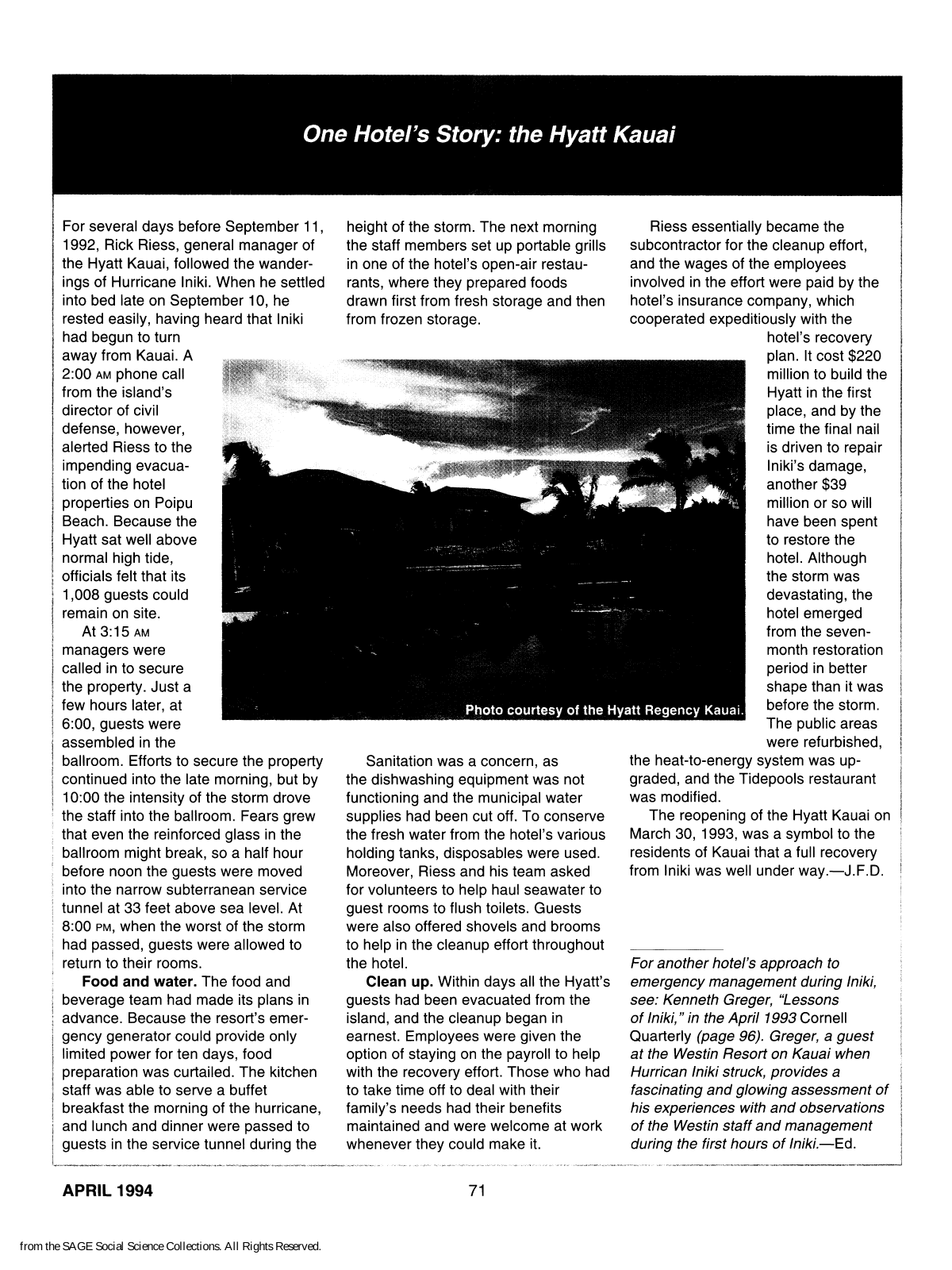
Tourism recovery after a natural disaster depends on the extent of damages, the efficiency with which facilities are brought back on-line, and the effectiveness of marketing to advertise the destination's status. Several valuable lessons can be learned from the way tourism partners reacted during the first critical months after Hurricane Iniki struck Hawaii: be flexible; plan for action; see the big picture; get the word out as soon as possible when you're open and ready for business; install a telephone hot line; keep members of the media informed; update travel agents and other travel partners on the status of the recovery effort; and make sure travel agents and the media get to see the extent of the recovery.

Traditionally, public-assembly facilities (stadiums, arenas, convention centers) are built with public funds and thereafter managed by some municipal authority or governmental agency and subsidized by taxes. The benefits that may derive from breaking out of that traditional mold by hiring a private management firm include increased profitability, a more experienced staff, simpler purchasing procedures, faster decision-making, focused marketing, better accountability, and increased flexibility in negotiating contracts and rental rates. In general, those municipalities that have contracted for private management are pleased with their decisions, will continue to support privatization in their districts, and wholeheartedly recommend it to others.
The opening of South Korea's tourism industry has affected that nation's economy and societal structure. The government fosters tourism as a method of improving the country's economic health by bringing into balance outgoing and incoming tourism. Although Korea's tourism industry has grown, the nation faces substantial but surmountable barriers to continued tourism growth. Among them are certain aspects of the government's frugality campaign, meager lodging and transportation facilities outside of Seoul, and inflation.
South Koreans have emerged as enthusiastic and relatively high-spending international travelers. The United States is currently the second most popular destination for Koreans, but other nations are bidding for Koreans' business, notably Australia. To encourage more Koreans to visit the United States, American travel-related companies and agencies should reflect Koreans' specific cultural preferences. Those preferences include traveling as groups, speaking Korean, and eating Korean food, notably