Other
Select search scope: search across all journals or within the current journal


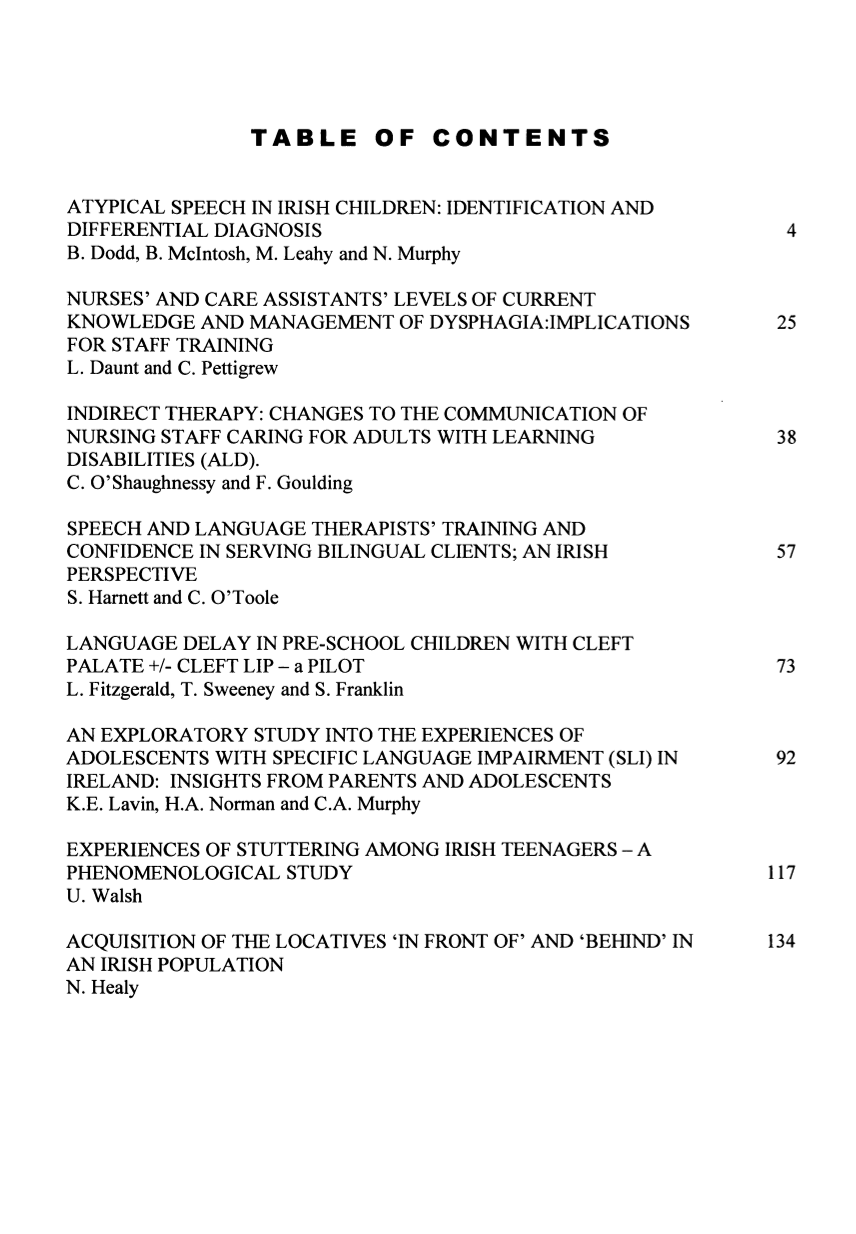
An assessment for children with speech difficulties (Diagnostic Evaluation of Articulation and Phonology: DEAP), currently being standardised on an Irish population was evaluated. A clinical population of 57 children, aged between three and seven years, was assessed. The participants were either currently attending therapy or attending a review appointment to determine future clinical management. Children’s performance was compared with normative data and the proportions of children belonging to subgroups characterised by the nature of surface speech errors was compared with previously published data. The results indicated that 14% of the children were performing within normal limits according to the DEAP’s normative data. Children scoring outside the normal range could be differentially diagnosed as having an articulation disorder (2%), phonological delay (44.9%), consistent (30.6%) or inconsistent phonological disorder (22.5%). Qualitative analyses describe the nature of the error patterns observed. The proportion of the children shown to perform below the normal range (86%) is argued to be appropriate for the population assessed, and the ranking of subgroups of speech disorder reflect previous research. The findings suggest that the DEAP is a clinically useful assessment that facilitates valid clinical management decisions in the Irish clinical context.
In the community hospital setting, the long-term management of individuals with dysphagia is habitually the responsibility of nurses and care assistants. The purpose of this study was to determine the knowledge base of normal swallowing, dysphagia and its management, amongst nurses and care assistants in the community hospital setting, as well as the influence of dysphagia training programmes. A 41-item questionnaire was administered to 30 nurses and 18 care assistants. Based on the study, the lack of resources and time and staff support, were seen as key factors in hindering service delivery. The results also indicated that nurses have a stronger knowledge base and understanding of the management of dysphagia than care assistants, however all participants who had received training had more extensive knowledge about dysphagia and its management (p<0.01), than those with no training, and were more likely to make an appropriate referral to the Speech and Language Therapist (p<0.05). The results suggest that dysphagia training programmes may be an effective means of establishing a concrete knowledge base for both nurses and care assistants to work from.
Within the care of ALD there are changes occurring in relation to the context of care with services moving from residential to community care settings, and in intervention moving from direct to indirect approaches. There is limited documented research on these interventions.
The aim of this paper is to report on the implementation of indirect therapy and to report on the attempts made to evaluate its usefulness and effectiveness as an intervention. A further aim is to contribute to the evidence base for carer training within the area of learning disability in the Irish context.
11 participants (nursing staff) attended two days training which focused on enhancing communication for ALD. Quantitative measures of their communicative interactions with their clients were recorded pre and post intervention. The participants also provided written feedback.
The findings were analysed and comparisons were made between the participants’ interaction skills pre and post intervention. The majority of participants improved in their use of communication strategies, allowing the client to lead communication and responding more appropriately to their clients. They were more aware of the communication needs of the client and had an increased awareness of their own communication and its effects on others. Changes in use of appropriate eye-contact (p=0.090) and use of appropriate questions (p=0.063) revealed borderline significance.
The purpose of this investigation was to determine the level of training and confidence of speech and language therapists in serving bilingual clients. Questionnaires were completed by twenty-eight speech and language therapists working in the Munster region of Ireland. Participants worked in community care, hospitals or centres for individuals with learning disability or autism. Results revealed that most (89%) of the participants received undergraduate training in bilingualism. However, of the fifteen topics possible, participants only received training on an average of 5.4 (SD 4.589). Results also revealed that there is a strong desire among the participants for further training on bilingual and multicultural issues. Therapists who trained outside the Republic of Ireland had slightly more undergraduate training than those who had trained in the Republic of Ireland and were reported to be significantly more confident in working with families who don’t speak English and with interpreters (U=46.5, p<0.05 & U=54, p<0.05, respectively). The implications of the study for the profession are discussed.
To ascertain if preschool children with cleft palate +/- cleft lip (CP +/- L) present with a delay in language development and, to determine the nature of the delay in terms of language content, structure and modality.
Twelve preschool children with CP +/- L participated in the study.
A standardised language test, CELF Preschool UK – 2nd Edition, was administered and spontaneous utterances were informally analysed using LARSP and MLU scores. Z tests were used to compare participants’ scores with a standardised scoring regime of a known population.
Z scores revealed a significant difference between all five composite scores of language development of participants in this study and those of the known population. Descriptive statistics corroborated these findings.
Preschool children with CP +/- L may be at a higher risk of delays in language development than their non-cleft peers. However, language delay is not a necessary concomitant in this population. This study highlights the possibility that the consequences of preschool children with CP +/- L are more than speech and isolated craniofacial anomalies.
Recent literature has demonstrated the long-term nature of SLI, which impacts on an individual’s educational, social, and emotional experiences (Brinton et al., 2005). There is limited service provision for adolescents with SLI and little is known about their experiences in Ireland.
To qualitatively explore the experience of adolescents in Ireland.
The study used qualitative methodology in the form of focus group and semi-structured interviews to explore the experiences of adolescents with SLI in Ireland from their own and their parent’s perspectives.
Five descriptive themes relating to the experiences of adolescents with SLI were identified, including: The impact of SLI on relationships, intrapersonal experiences, service provision at secondary school level, future concerns, and variability.
This study appears to reflect the emergence of similarities between the experiences of adolescents with SLI in an Irish context and their international counterparts. Parent and adolescent reports provide limited evidence supporting the growing literature indicating the long-term nature of SLI with difficulties widening with age.

The aims of the present study were (a) to investigate production of the spatial locatives ‘in front of’ and ‘behind’, using fronted objects (those with a distinct front and back), with a view to discovering in which order they typically emerge; and (b) to ascertain whether there is a difference between the emergence of production of these locatives when the referent is the child’s own body and when it is another fronted object. Eighteen typically developing children between the ages of 2;0 and 4;11 years were recruited at 3 childcare centres in the Cork City area. The participants were included in 3 age groups, with 6 in each group. Participants were tested individually at the childcare centres. Each participant underwent two locative elicitation procedures. The first procedure was designed to elicit the target locatives, using the child’s own body as the object of reference, while the second procedure involved the use of another fronted object (a teddy bear) as the referent. The results indicated that there was a significant difference between performances on the locatives ‘in front of’ and ‘behind’, with performance on ‘in front of’ being poorer. There was no significant difference between performances on these locatives when the object of reference was the participant’s own body, and when it was another fronted object. The first conclusion of the present study was that production of the locative ‘behind’, using fronted objects, appears to be acquired before ‘in front of’. Secondly, it would appear that acquisition of both locatives, when the object of reference is the child’s own body, occurs at approximately the same time as when the referent is another fronted object. These findings have possible clinical implications. Firstly, the results would suggest that, when targeting locatives, production of ‘behind’ should be facilitated prior to ‘in front of’. Also, it might be concluded that one may begin to facilitate production of these locatives using either the child’s own body or another fronted object as the referent. Future research might aim to investigate the acquisition of intrinsic ‘behind’ and ‘in front of’ with regard to comprehension.