Editorial
Select search scope: search across all journals or within the current journal

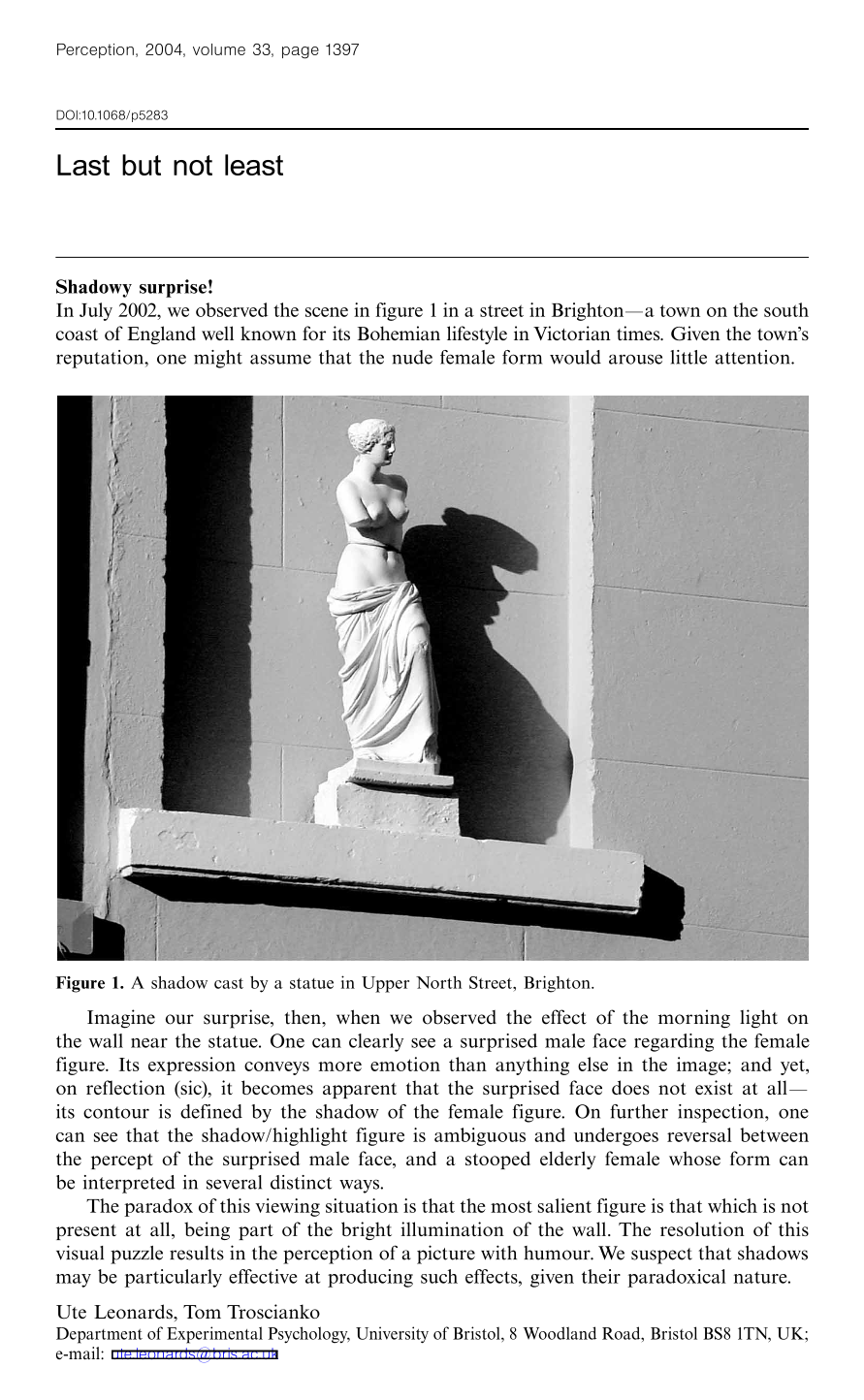
Shadows cast by objects contain potentially useful information about the location of these objects in the scene as well as their surface reflectance. However, before the visual system can use this information, it has to solve the shadow correspondence problem, that is to match the objects with their respective shadows. In the first experiment, it is shown that the estimate of the light source position is affected by a gradual luminance ramp added to the image. In the second experiment, it is shown that observers process impossible shadow images as if they ignored the local features of the objects. All together, the results suggest that the visual system solves the shadow correspondence problem by relying on a coarse representation of the scene.
In two experiments we investigated the effects of cast shadows on different real-life tasks. In experiment 1, participants were required to make a speeded verbal identification of the target object (perceptual task), whereas in experiment 2 participants were required to reach for and grasp the target object (motor task). In both experiments real three-dimensional (3-D) objects were presented, one at a time, either with their own natural cast shadow (congruent condition) or with the cast shadow of a different object (incongruent condition). Shadows were cast either to the left or to the right of the object. We asked whether the features of the shadow (ie whether it is congruent or incongruent with the object, and whether it is cast to the left or to the right of the object) could influence perception and action differently. Results showed that cast shadows did not influence identification of real 3-D objects (experiment 1), but they affected movement kinematics, producing distractor-like interference, particularly on movement trajectory (experiment 2). These findings suggest a task-dependent influence of cast shadows on human performance. In the case of object-oriented actions, cast shadows may represent further affordances of the object, and as such compete for the control of the action.
Kersten et al (1997
We used a visual-search method to investigate the role of shadows in the rapid discrimination of scene properties. Targets and distractors were light or dark 2-D crescents of identical shape and size, on a mid-grey background. From the dark stimuli, illusory 3-D shapes can be created by blurring one arc of the crescent. If the inner arc is blurred, the stimulus is perceived as a curved surface with attached shadow. If the outer arc is blurred, the stimulus is perceived as a flat surface casting a shadow. In a series of five experiments, we used this simple stimulus to map out the shadow properties that the human visual system can rapidly detect and discriminate. To subtract out 2-D image factors, we compared search performance for dark-shadow stimuli with performance for light-shadow stimuli which generally do not elicit strong 3-D percepts. We found that the human visual system is capable of rapid discrimination based upon a number of different shadow properties, including the type of the shadow (cast or attached), the direction of the shadow, and the displacement of the shadow. While it is clear that shadows are not simply discounted in rapid search, it is unclear at this stage whether rapid discrimination is acting upon shadows per se or upon representations of 3-D object shape and position elicited by perceived shadows.
We show that cast shadows can have a significant influence on the speed of visual search. In particular, we find that search based on the shape of a region is affected when the region is darker than the background and corresponds to a shadow formed by lighting from above. Results support the proposal that an early-level system rapidly identifies regions as shadows and then discounts them, making their shapes more difficult to access. Several constraints used by this system are mapped out, including constraints on the luminance and texture of the shadow region, and on the nature of the item casting the shadow. Among other things, this system is found to distinguish between line elements (items containing only edges) and surface elements (items containing visible surfaces), with only the latter deemed capable of casting a shadow.
The intersection between an illumination and a reflectance edge is characterised by the ‘ratio-invariant’ property, that is the luminance ratio of the regions under different illumination remains the same.
In a CRT experiment, we shaped two areas, one surrounding the other, and simulated an illumination edge dividing them in two frames of illumination. The portion of the illumination edge standing on the surrounding area (labelled contextual background) was the contextual edge, while the portion standing on the enclosed area (labelled mediating background) was the mediating edge. On the mediating background, there were two patches, one per illumination frame. Observers were asked to adjust the luminance of the patch in bright illumination to equate the lightness of the other. We compared conditions in which the luminance ratio at the contextual edge could be (i) equal (possible shadow), or (ii) larger (impossible shadow) than that at the mediating edge. In addition, we manipulated the reflectance of the backgrounds. It could be higher for the contextual than for the mediating background; or, vice versa, lower for the contextual than for the mediating background. Results reveal that lightness constancy significantly increases when: (i) the luminance ratio at the contextual edge is larger than that at the mediating edge creating an impossible shadow, and (ii) the reflectance of the contextual background is lower than that of the mediating one. We interpret our results according to the albedo hypothesis, and suggest that the scission process is facilitated when the luminance ratio at the contextual edge is larger than that at the mediating edge and/or the reflectance of the including area is lower than that of the included one. This occurs even if the ratio-invariant property is violated.
The kinds of visual cues artists choose to use or not use in their work can offer insight into perceptual processes. On the basis of the observed paucity of the use of cast shadow in pictorial art, we hypothesized that cast shadows might be relatively expendable as pictorial cues. In this study, we investigated two potential reasons for this expendability: first, viewers might be insensitive to much of the information that cast shadows provide; and, second, ambiguities about what is shadow and what is pigment can often be resolved only through motion—something that static media are ill-equipped to deal with. In experiment 1, we used a visual-search paradigm in which viewers had to determine if there were odd cast shadows in sets of 4, 8, 16, and 32 objects. In experiment 2, viewers had to discriminate between shadow/pigment ambiguities in both still and moving images. Our results demonstrate that viewers are neither particularly sensitive to static cast-shadow incongruities, nor are they able to disambiguate cast shadow from pigment without continuous motion information. Taken together, these results may help explain why cast shadows are relatively rare in static pictorial work.
I list relevant properties of cast shadows that the visual system could exploit (although it may not exploit). The study concerns the various types of information that can be extracted from shadows by systems that are significantly like ours (including embodied artificial systems) in an environment that is significantly like ours.