Editorial
Select search scope: search across all journals or within the current journal

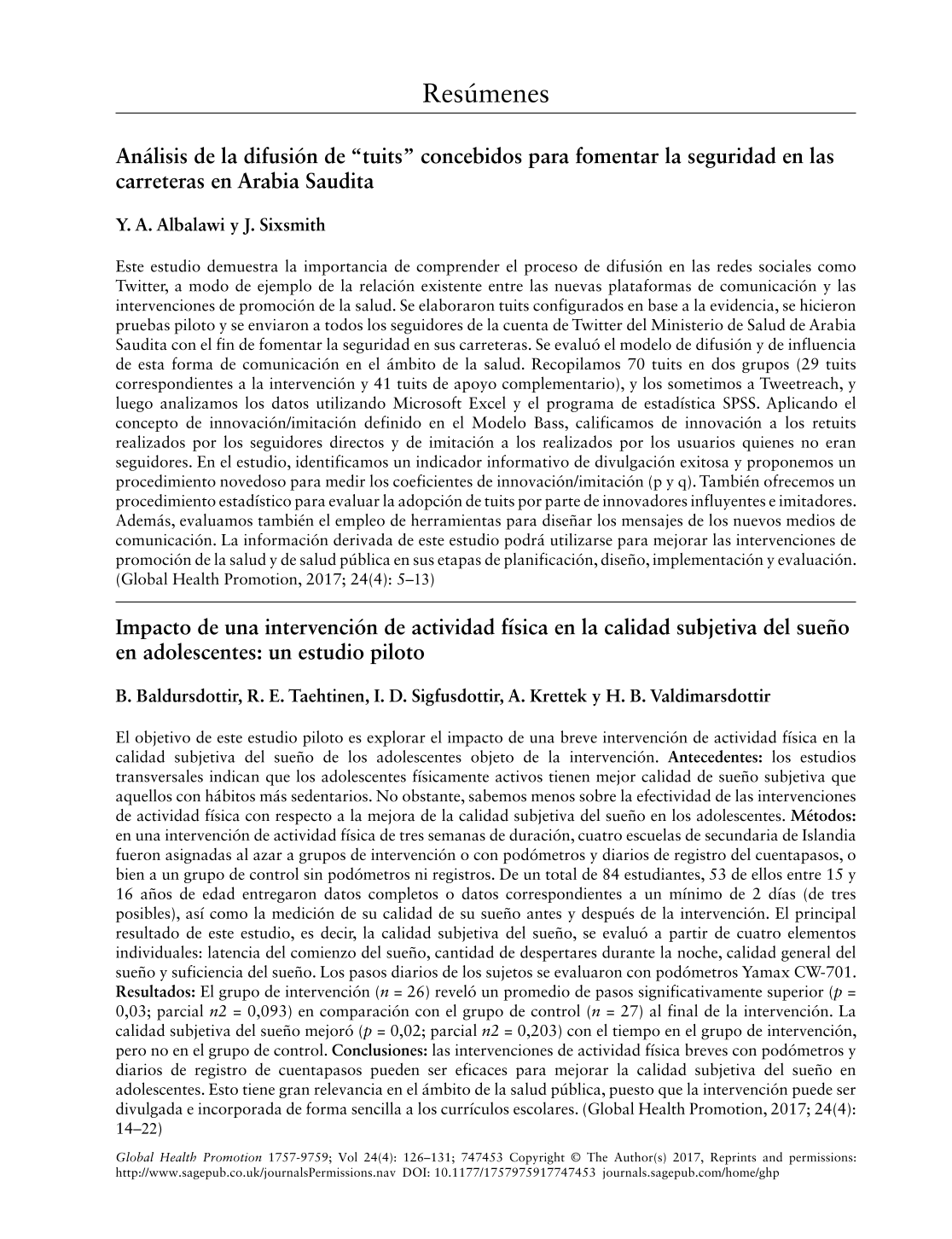
This study demonstrates the importance of understanding the diffusion process in social media such as Twitter as an example of the relationship between new media platforms and health promotion interventions. Evidence-informed tweets were developed, pilot tested and distributed to all followers of the Ministry of Health’s Twitter account with the aim of influencing the agenda on road safety in Saudi Arabia. The dissemination pattern and influence of this health communication was assessed. We collected 70 tweets into two groups (29 intervention tweets and 41 additional supported tweets) extracted from the Tweetreach data set and then analysed them using Microsoft Excel and SPSS.
Using the concept of innovation/imitation as defined in the Bass Model, we classified retweeting by direct followers as innovation and retweeting by users who were not followers as imitation. In the study, we identify an informative indicator of successful diffusion and propose a novel procedure to measure innovation/imitation coefficients (
The aim of this pilot study was to examine the impact of a brief physical activity intervention on adolescents’ subjective sleep quality. Cross-sectional studies indicate that physically active adolescents have better subjective sleep quality than those with more sedentary habits. However, less is known about the effectiveness of physical activity interventions in improving adolescents’ subjective sleep quality.
In a three-week physical activity intervention, four Icelandic upper secondary schools were randomized to either an intervention group with pedometers and step diaries or a control group without pedometers and diaries. Out of 84, a total of 53 students, aged 15−16 years, provided complete data or a minimum of two days step data (out of three possible) as well as sleep quality measures at baseline and follow-up. Subjective sleep quality, the primary outcome in this study, was assessed with four individual items: sleep onset latency, nightly awakenings, general sleep quality, and sleep sufficiency. Daily steps were assessed with Yamax CW-701 pedometers.
The intervention group (
Brief physical activity interventions based on pedometers and step diaries may be effective in improving adolescents’ subjective sleep quality. This has important public health relevance as the intervention can easily be disseminated and incorporated into school curricula.
Understanding social conditions prior to intervention design can enhance tobacco control interventions. This paper describes formative research conducted in 2010 about tobacco use in eight economically disadvantaged Dominican Republic communities, four of which participated in a previous intervention study (2003–2008). A combined US-Dominican team used a rapid assessment process to collect qualitative social and cultural data on tobacco use, knowledge and attitudes; plus observations about social and policy factors, such as exposure to secondhand smoke (SHS), tobacco regulations, pregnancy, health care provider (HCP) practices and sustainability of the 2003–2008 intervention. This assessment found that tobacco use varied by age. While all ages typically used cigarettes, older adults used relatively more unprocessed tobacco, which is seen as less harmful and less addictive. Middle-aged smokers typically used commercial cigarettes, which are viewed as dangerous, addictive, expensive and offensive. Young adults reported avoiding smoking, but using relatively more smokeless tobacco. Smoking during pregnancy has reportedly decreased. SHS was viewed as harmful, although smoke-free homes were uncommon. HCPs discussed tobacco issues mostly for patients with tobacco-related conditions. Sustainability of the 2003–2008 intervention appeared to be linked to active Community Technology Centers with strong leadership, and community social capital. This information could be used to design better targeted interventions in these communities.
Couples HIV counselling and testing (CHCT) is a key preventive strategy used to reduce the spread of HIV. In Uganda, HIV prevalence among married or cohabiting couples is 5.6%, compared to 2.2% among those never married. CHCT can help ease disclosure of HIV positive status, which in turn may help increase opportunities to obtain social supports and reduce new infections. The purpose of this study was aimed at exploring the possible reasons for the low uptake of CHCT in Mukono district, a rural in setting in Uganda.
The study was conducted in two sub-counties in a rural district (Mukono district) using a descriptive qualitative research design. Specifically, we conducted four focus group discussions and 10 key informant interviews. We also interviewed 53 individuals in couple relationships. Data were collected mainly in the local language Luganda and English, all data were transcribed into English and coded for emergent themes. Ethical clearance for this study was obtained from the Mengo Hospital Research Review Board and from the Uganda National Council of Science and Technology.
Fear of a positive HIV test result emerged strongly as the most significant barrier to CHCT. To a lesser extent, perceptions and knowledge of CHCT, mistrust in marriages and culture were also noted by participants as important barriers to the uptake of CHCT among couples. Participants offered suggestions on ways to overcome these barriers, including peer couple counselling, offering incentives to couples that test together and door-to-door CHCT testing.
In an effort to improve the uptake of CHCT, it is crucial to involve both females and males in the planning and implementation of CHCT, as well as to address the misconceptions about CHCT and to prioritise CHCT within health care systems management.
A focus group session, using the Theory of Planned Behavior to guide questions and discussion, was conducted at midpoint of a 12-month cooking skills program in a rural Appalachian food desert. The purpose of this qualitative study was to determine the attitudes, subjective norms and perceived behavioral control beliefs that influenced participation in these classes. Participants viewed the classes as opportunities for social interaction and to have new experiences. Subjective norms were influenced by family members and traditional cooking. Perceived behavioral control was influenced by the opportunity to try new foods without concern of food waste, acquisition of the knowledge to introduce healthy foods into family meals and enhanced food preparation skills. During the evaluation, a strong sense of participant appreciation of researcher presence was discovered. This unexpected positive component of the program will be promoted using motivational interviewing techniques to enhance adherence to healthy eating behaviors during and after cooking skills programs.
This study was conducted to investigate the relationship between perceived insufficient milk and breastfeeding self-efficacy levels among Turkish mothers.
The study was conducted on 200 mothers whose infants were hospitalized and under treatment and who could breastfeed their infants in the newborn clinic of a university hospital in eastern Turkey between June 2013 and February 2014. A sampling method was not applied in the study, so the sample consisted of the population of the study. The ‘Personal Information Form’, ‘Breastfeeding Self-Efficacy Scale’ and ‘Perception of Insufficient Milk Questionnaire’ were used to collect the data. Data were analysed by using percentage distribution and arithmetic average; independent sample t test, Mann–Whitney U test, Kruskal–Wallis variance analysis, Pearson correlation analysis and Cronbach alpha reliability coefficiency in the SPSS 18.0 package program.
The study determined that advanced age, higher education level and higher income status, male gender of the child, planning of the pregnancy, many births, receiving breastfeeding education and the length of time that mothers planned to exclusively breastfeed affected breastfeeding self-efficacy and perception of milk sufficiency positively (
The study concluded that some factors related to the mother, infant, pregnancy and breastfeeding affected breastfeeding self-efficacy and the perception of milk insufficiency. As the breastfeeding self-efficacy level increased, the milk was perceived to be more sufficient.
Evidence-based medicine (EBM) is well known in medical practice. Although health promotion (HP) is promoted worldwide, there is still some debate as to whether EBM is needed or useful in the teaching of health promotion.
To assess the perceived usefulness of EBM in the teaching of HP among medical students and faculty members.
A comparative study was conducted between two groups of fourth-year medical students in the academic year 2012 during the five-week Health Promotion Teaching Block at Prince of Songkla University, southern Thailand. A one-week EBM course was conducted with half the students in the first week of the block and the other half of the students in the last week of the block. All activities in the HP block were similar except for the different periods of the one-week of EBM teaching. The effect on knowledge, ability and perceived application of EBM in future practice was assessed by student self-evaluations before versus after taking the EBM course, and by faculty member evaluation of the students’ end-of-block presentations. All evaluation items were rated from 1 (lowest) to 5 (highest). Data were analyzed using a
The students’ self-evaluations of knowledge and ability on EBM between the two groups were similar. The perception that teaching EBM is beneficial in health promotion and future practice increased significantly (
Medical students and faculty members perceived that EBM is useful in the HP context. Future studies to evaluate the effect of using evidence-based teaching for health promotion are needed.
Health literacy is related to health inequality, health behaviors, and health status. Globally, health literacy has primarily focused on adults and has been based on the medical model. It is necessary to understand children’s life experiences as they relate to health; thus, this study attempted to evaluate and describe the health literacy abilities of sixth-graders in Taiwan.
Interviews were conducted with 10 teachers and 11 caregivers, and focus groups were conducted with 32 children. Health literacy abilities corresponding to real-life situations were identified from life skills and the Taiwanese Curriculum Guidelines for health education. Three expert meetings were held to redefine children’s health literacy using a health promotion perspective and confirmed indicators.
An operational definition of three aspects of children’s health literacy and 25 abilities was proposed: 11 functional health literacy abilities (e.g. understands the connection between personal health care behaviors and health); seven interactive health literacy abilities (e.g. obtains and understands information from various channels); and seven critical health literacy abilities (e.g. analyzes the relationship between personal needs and diet choices for a balanced diet). These indicators cover 10 health education categories.
These findings highlight the importance of understanding Taiwanese children’s health literacy, and the urgency of developing an appropriate measurement tool. The definition and indicators in this study were identified using a child-centered approach focusing on children’s real-life experiences. The result serves as a solid basis for the development of the Taiwan Children’s Health Literacy Scale, and provides information for the decision-making sector on health education.
The purpose of this article is to examine the effect of a school-based nutrition intervention using an ecological approach to improve adolescents’ nutrition-related knowledge, attitudes and behaviour in rural China.
A cluster-randomised intervention trial design was employed. Two middle schools were randomly selected and assigned to the school that was conducting a holistic school-based intervention using health-promoting school (HPS) framework, ‘HPS School’, or to the ‘Control School’ in Mi Yun County, Beijing. From each school we randomly selected 65 seventh-grade students to participate in the study. Their nutrition-related knowledge, attitudes and behaviour were measured by pre- and post-intervention surveys with the same instrument. The nutrition intervention lasted for six months.
Adolescents in the intervention school were more likely to know the nutrition knowledge items, with an odds ratio (OR) ranging from 1.86 (95% confidence interval (CI): 1.11–3.09) to 6.34 (95% CI: 3.83–10.47); more likely to think nutrition is very important to health, developing healthy dietary habits is very important, and that expired foods should be thrown away, with ORs of 3.03 (95% CI: 1.60–5.76), 2.76 (95% CI: 1.66–4.59) and 2.35 (95% CI: 1.33–4.17) respectively, and more likely to consume no soft drinks, desserts or fried food, and to eat vegetables every day of the last week, with ORs of 1.99 (95% CI: 1.31–3.04), 3.96 (95% CI: 2.43–6.46), 3.63 (95% CI: 2.26–5.85), and 2.51 (95% CI: 1.41–4.48) respectively, as compared with those in the control school after interventions.
Our intervention using the HPS framework, an ecological approach, was an appropriate model to promote nutrition among adolescents in rural China and its use should be advocated in future school-based nutrition promotion programmes for adolescents.
This study was conducted to investigate the electronic waste workers’ knowledge about the potential health hazards associated with their work as well as the livelihood alternatives that they would prefer if they were given the opportunity.
A qualitative cross-sectional study was conducted to gather empirical information on e-waste workers’ knowledge about the potential hazards associated with their work and the livelihood alternatives to e-waste recycling with a sample consisting of twenty all-male electronic waste workers at the Agbogbloshie scrap metal yard in Accra, Ghana.
Electronic waste workers at Agbogbloshie were found to be exposed to a variety of injuries and illnesses. The workers’ knowledge of the association between their health status and their work was generally poor. Apart from the physical injuries, they did not believe their work played any negative role in their health conditions. They preferred occupations such as farming or professional driving located in the northern region of Ghana to be closer to their families.
The study concludes that the low knowledge level of the workers on the hazards that are associated with their work has implications for them accepting technologies to protect them and the natural environment from contamination. It is therefore imperative for any intervention to consider the current low level of knowledge and actively educate the workers to raise their awareness level, taking into account the provision of opportunities for workers to acquire applicable skills for future employment in other fields.
Today, one important challenge in developed countries is health inequalities. Research conducted in public health policy issues supply little evidence for effective interventions aiming to improve population health and to reduce health inequalities. There is a need for a powerful tool to support priority setting and guide policy makers in their choice of health interventions, and that maximizes social welfare. This paper proposes to divert a spatial tool based on Kulldorff’s scan method to investigate social inequalities in health. This commentary argues that this spatial approach can be a useful tool to tackle social inequalities in health by guiding policy makers at three levels: (i) supporting priority setting and planning a targeted intervention; (ii) choosing actions or interventions which will be performed for the whole population, but with a scale and intensity proportionate to need; and (iii) assessing health equity of public interventions.


En este artículo presentamos el proyecto de capacitación llevado a cabo en comunidades de la sierra y costa de Oaxaca, México, desde 1991, por el Centro de Capacitación Integral para Promotores Comunitarios (CECIPROC). La decisión de hacer este trabajo en Oaxaca responde a que ese estado ocupa uno de los primeros lugares de marginación y de desnutrición en menores de 5 años. El objetivo es describir un modelo de capacitación y compartir parte de las experiencias derivadas, tanto del modelo como del trabajo realizado en las distintas áreas (nutrición y alimentación, salud comunitaria, ecología y etnobotánica, y educación y organización), por promotores mujeres y hombres en sus comunidades.
La experiencia obtenida en 24 años muestra la factibilidad técnica y social del proyecto en el ámbito de la salud, el reconocimiento social del proyecto del CECIPROC como un organismo civil que ha aportado alternativas como solución a la problemática de salud, el hacer suyo el proyecto por algunos promotores y los diferentes obstáculos a los que se ha enfrentado. Enfatizamos el hecho de que la situación socioeconómica y política prevaleciente en el estado de Oaxaca es una limitante para el buen desarrollo de los programas colectivos de salud, e insistimos en la necesidad de compartir nuestras experiencias para que puedan ser utilizadas en la planificación y ejecución de otros proyectos.