Other
Select search scope: search across all journals or within the current journal


The lecturer examines present practice in steam turbines for ship propulsion and describes some of the high-temperature marine installations in Great Britain and overseas. High-temperature land installations are considered and particular note is made of high-temperature high-pressure turbines used. Properties of materials available are given in Appendix I and are used in the main text of the lecture to determine the upper limit of temperature to be explored. Reheating by steam, gas, and liquid metal, are mentioned, and the latter is recommended. Temperatures are then examined at various pressure levels up to 1,500 deg. F. without reheat and with up to two stages of reheat. The maximum gains are assessed and the possible type of future marine propulsion-turbine is discussed. Some of the problems of uncooled gas turbines are described in particular relation to the Pametrada 3,500 s.h.p. unit. The possibility of cooled gas turbines is discussed and calculations are made as to the efficiency attainable in relation to cooling at various temperatures. The results are contrasted with those possible with high-temperature steam-turbine machinery. The cooled gas turbine would appear to have the greater potentiality for improvement. The argument is summarized by stating that the alloy materials required for high-temperature operation amount to under 2 per cent of the ‘steam up’ weight, but that the fuel used during the lifetime of the ship is 25,000 per cent of this weight.
This lecture deals with the design and construction of nuclear reactors, and particularly of types suitable for the generation of power. To introduce this a detailed description is given of the British Experimental Pile (BEPO) at Harwell. This is a typical ‘thermal’ reactor on a small scale, using natural uranium as fuel and graphite as moderator; it is air-cooled and the shielding and control arrangements illustrate general practice. There follows an account of some of the engineering and construction problems met in the erection of the Windscale piles, and the solutions achieved.
The problems involved in designing power-producing reactors are discussed. The choice of materials in the reacting core is restricted by nuclear physical considerations; large absorbers of neutrons cannot be used. There is a conflict between the demand for high temperatures to give satisfactory thermal efficiency and the limitations imposed by the metallurgical properties of the fuel elements and by the coolants employable. The safety aspect of design is considered and the influence of the coolant described; certain types of reactor can be designed to be inherently safe even in the event of a coolant failure but with others there is the risk of reaching a supercritical condition, and the effect of this is discussed.
The possible reactors may be divided into two groups: those which use ‘thermal’ neutrons and are similar in principle to BEPO, and those which use ‘intermediate’ or ‘fast’ neutrons and have a much smaller core size. Within each group are alternatives provided by differences in fuel, moderator, and coolant. A number of these are reviewed with general indications of their size, and some of the more detailed problems associated with their design are considered. The large reduction in core size resulting from the use of ‘fast’ neutrons leads to acute problems of heat transfer and, though the fuel investment is much less, the fissile material content of the fuel used must be much higher. One or two possibilities for the more distant future are briefly mentioned.
Prospects for the large-scale development of nuclear power are discussed, and it is argued that the replacement of coal-fired boilers by nuclear reactors as the heat source at power stations should, before many years have passed, be economically sound and is further justifiable as it would help to reduce the recurrent shortage of coal. A possible national scheme is outlined in which thermal reactors would be built in the first stage; these would produce supplies of fissile material as well as power, and this material would later be used in ‘breeder’ or ‘converter’ reactors in the second stage; these reactors should be self-sustaining in fuel after the initial charge.
An Appendix is included which gives a simple explanation of the underlying theory of atomic energy and of the terms used in the lecture.
In recent years a considerable volume of research has been carried out to improve the techniques employed in the most widely used metal machining processes. An essential preliminary to all these experiments in turning, milling, drilling, tapping, etc., was accurate control of tool shapes. This necessitated the development of adequate tool-measuring equipment and a comprehensive nomenclature. The nomenclature has resulted from an analysis of tool geometry, and an examination of applicable tool grinding methods and inspection equipment. The nomenclature has been extended to take account of factors which were proved by research to be of considerable practical significance in the ultimate tool performance.
Nomenclatures for the most commonly used types of tool are presented as a basis for discussion together with typical examples of tool geometry, tool grinding methods, and tool inspection equipment which should be taken into account when developing improved nomenclatures. Reference is also made to some of the British, European, and American standards, which have an important place in these discussions. Some of the problems involved in the workshop application of cutting tool nomenclatures are also considered.
Recently, significant advances have been made in tool nomenclature as a result of the increasing co-operation between manufacturers and users of tools, but the nomenclature used for development work in research stations, colleges, universities, and industrial research laboratories, needs to be more comprehensive and precise than that at present used in general engineering practice.


The author summarizes the well-known theory of surges in surge tanks, dealing chiefly with the fundamental equations and introducing some preliminary remarks on the stability of surges. He then describes the different types of surge tanks, ordinary cylindrical tanks, tanks with variable section and expansion or reservoir chambers, tanks with restricted orifices, and differential surge tanks, with special mention of surge tanks in conjunction with underground power stations.
The loading conditions to be adopted are discussed and the reason why load changes on the electrical grid are the prime cause of surges is explained. The basic assumptions adopted for surge calculations by Italian, Swiss, French, and British engineers are reviewed, and it is shown that, in spite of many apparent disparitiés on special points, there is widespread agreement on fundamental questions. The interaction of surges, water hammer, and turbine governing is discussed in the light of the most recent tests on large power stations and of the results of modern theories, and the importance of the influence of water hammer on surge tank design is considered together with the special case of surge tanks connected to feeder canals.

The effect of V2O5 and mixtures of V2O5 and Na2SO4 on turbine fouling and corrosion is discussed. Laboratory tests have shown that none of the commercially available alloys is immune from attack when these mixtures are molten, that is, at temperatures above 650 deg. C. Nickel base heat resisting alloys of the Nimonic type offer higher resistance to attack than the austenitic steels and some degree of protection is afforded by electro-deposited coatings of chromium.
Steels and heat resisting alloys are not attacked to any significant extent at temperatures below the melting point of the ash, but copper base alloys suffer considerable corrosion at temperatures as low as 500 deg. C.
A detailed investigation of the effect of additives on the corrosion rate of V2O5-Na2SO4 ashes indicates that corrosion can be considerably reduced, and that such a method of approach is promising. Suitable additions may be made by a mixture of oil or water soluble materials with the fuel, by suspension in the fuel, or by separate injection into the combustion chamber with the object of reducing corrosion and deposition.
Laboratory corrosion tests, using ash additives such as ZnO, Al2O3, and kieselguhr, have shown that the rate of attack can be greatly accelerated if the additive is present in certain critical proportions, but when this is exceeded, corrosion is considerably reduced. With MgO, however, no such increase in attack was noted. Rig tests have confirmed some of the beneficial effect of additives.
In this paper a brief résumé is given of the important lessons learnt from the operation of oil-fired water-tube boilers at sea since 1925. These are linked with the shipowners' requirements—particularly those pertaining to the post-war merchant service—and the development of two designs of boiler from these requirements is shown. In this way it is possible to accept fundamentally different designs of boiler for application in the same ship.

It is emphasized that reliability is by far the most important requirement in the control system of a marine power plant. The controls of the Pametrada 3,500-h.p. gas turbine, which is taken as a typical marine unit, are then discussed. The sprayers, control blocks, fuel system, transmission, reversing mechanism, and governors are described in turn, and the reasons are given why various features were adopted in preference to the possible alternatives. There is an account of test-bed experience concerning these items.
Probable future developments in the field of controls are then considered, but these are found to depend mainly on the way in which the gas turbine itself is developed for marine purposes. The paper therefore concludes with a discussion of the type of gas turbine most likely to be installed in merchant vessels, and the means whereby it will be controlled.
In order to obtain operating experience with a main propulsion gas turbine under service conditions at sea, the Diesel electric oil tanker
A description is given of the set which operates on the simple open cycle with a heat exchanger and independent (low pressure) power turbine. The set thus has one compressor and two turbines in series, the high-pressure turbine driving the compressor and the low-pressure turbine driving the alternator which supplies power to the propeller motor.
In the design the emphasis was laid on high component efficiencies which necessitated the use of multi-stage uncooled turbines. A moderately high initial gas-temperature was adopted in order to ensure adequate length of life.
The experience during test operation, which covered a running time of 680 hours, is fully recorded, and complete performance figures for all conditions are given.
The set was operated with some success on heavy (residual) fuel oil. The total running time on heavy fuel oil was 363 hours, which included a continuous run of 270 hours, mainly at full load.

Equations are derived for the normal roll pressure, specific roll load and torque in hot rolling mills, using the condition for plastic deformation in rolling derived by Orowan, together with von Kármán's equation of equilibrium. Although applying strictly to the rolling of ideal plastic-rigid materials, these equations may be applied to the rolling of materials which strain-harden by using a mean value of the yield stress in the pass.
The equations have been checked against measurements made when rolling pure lead at room temperatures, and against the results of the experiments on steel at elevated temperatures carried out at Holfors. There is close agreement between the calculated and measured roll loads, but the roll torque is over-estimated slightly by the theory, above reductions of about 30 per cent in thickness.
Instruments for measuring rolling loads have been constructed for insertion between the screw and the top bearing chocks of a heavy plate mill. They have been accommodated in a limited space and designed to attempt the measurement of non-uniformly applied loads.
The load indications during the rolling of a varied programme for plates of different size have been analysed and compared with three roll-load formulae. That due to Sims seems to give the best agreement, and the majority of the calculations for reductions over 10 per cent lie within ±25 per cent of the measurements, whereas the other formulae show discrepancies often exceeding 50 per cent. For reductions less than 10 per cent all three formulae show similar trends, giving values in general very much lower than those obtained with the instruments.
Although the instruments have proved satisfactory for short trials, certain features will be modified in models which are now being designed with a view to more permanent installation.
Part I of this paper reviews the changing outlook during the past forty years on methods of training the mechanical engineers of the future.
Industry and universities have reviewed and amended traditional methods and outlook in significant ways and, in particular, in ‘bridging the gap’ between those responsible for training in industry and those responsible for policy and curricula in the universities.
The effects of two world wars and the incidence of military service are indicated.
Financial considerations concerning fees and maintenance during both university training and apprenticeship are related to opportunity. The influence of the present conditions of more jobs than there are suitable applicants is considered in relation to long-term planning of the training of the mechanical engineer of the future.
The general lines of procedure usually required for those who include a full-time university course as a part of their education and training are considered, and particular attention is given to the increasingly accepted view that pre-university practical training has many advantages which are now recognized by professors and others who teach in the universities and senior technical colleges.
The need for work and play which educate and relax the young man during his post-school five-year formal engineering training period is explained and examples are given; and reference is made to the fact that those least interested in ‘outside’ activities usually benefit most if encouraged and helped to participate in such activities.
It is pointed out that the common good of the individual, the university, the firm, and the nation is most likely to be achieved if a long-term view is always given preference, and that, while time is all important and must not be wasted, time must be given to the preparation for a future career—preparation ample enough to fulfil the demands that opportunities and responsibilities in later life will make.
Essentially, Part II of this paper recommends planned interweaving of theoretical and workshop practice throughout the period of training.
A plea is made for industry's side of training to include some experience in non-engineering, but essential and ancillary branches of the industry, e.g. production and stock control, costing, sales, and general office work.
It is emphasized that the larger the organization, the more need there will be specifically to provide this external experience.
The potentialities of a graduate spring from the theoretical and fundamental nature of an academic training. This develops power of analysis, judgement, and initiative, which should be remembered when planning the complementary training course which is mainly practical and technological.
The course should not attempt to make the graduate a skilled craftsman but rather to train him in the application of machine tools to production processes. The fully-trained graduate is expected to fill a vacancy in the production, sales, or research and development departments, and although the training can be slightly biased for those apprentices expressing a wish for a particular branch of engineering, early specialization should be avoided.
The training programme should be flexible to suit the needs and progress of the graduate, always provided that sufficient time is spent in each department for him to make a useful contribution to output, but without wasting time on needless repetition. In every department, the period of instruction should be as intensive as possible, leaving more time for responsible duties.
He is expected to add to his store of experience by analysing the bad things he notices as well as the good. These should not, of course, be reported, but he should be expected to make a weekly report on progress in order to help him crystallize his thoughts.
The works training should be supplemented by post-graduate courses in technology and management studies. At the end of the training period, the next phase should rest with a high-ranking committee responsible for executive development.
Engineering is not only a science but also an art. With the ever-increasing scientific content of an engineering graduate's training, less and less time is devoted to workshop practice, machine drawing, and design. The engineering graduate leaving the university today is much less an engineer than his counterpart was in 1910. In fact, universities do not produce engineers, they train students in engineering science and it is left to industry to complete the graduate's training.
The common pattern of training for the graduate engineer is direct from school to the university for three years followed, after graduation, by two years' practical training. The author suggests an alternative scheme of one year in industry after leaving school to be followed by three years in a university, the graduate's training being completed by a further year's training in industry. The scheme is called ‘the thick sandwich’. Its main advantages are that (1) the undergraduate knows what engineering is when he joins a university, (2) it will tend to produce men with a stronger bias towards the production side of the industry, and (3) men who commence their training in the shops will be, after graduation, more acceptable to the personnel of the engineering industry.

This paper discusses the new British Standard for limits and fits for Engineering (B.S. 1916), outlining in particular the technical features and explaining how the system has been built up. A brief historical review of other systems is made, their faults being referred to. The prospects of adoption of an equivalent system by the United States and a corresponding decision already taken by Canada are mentioned.
The paper goes on to discuss the theoretical requirements of a good tolerance system and then compares the new standard with the theoretical desiderata. The technical reason for each particular diameter step, tolerance value, or shaft or hole allowance is given, supplementing the necessarily bare data given in the standard itself.
Indications are given of the future extensions of the system which are likely to be made following international discussions in relation to tolerances for small diameters as used in the horological industry, tolerances for precision fits and fine quality gauges, and tolerances for large diameters up to about 6 feet. The practical difficulties in determining and using tolerances in diameters above 20 inches are considered in some detail, and a plea is made for discussion and information on this matter.
This paper suggests methods by which the new British Standard system for limits and fits can be most efficiently applied in industry, and proposes a method of approach by which series of fits for various purposes can be selected from those shown in the British Standard. It refers particularly to Part II of the Standard which gives data on the application of various types of fit.
The choice of tolerances is discussed in relation to machine capabilities and fit requirements, and a series of fits for general engineering requirements is proposed. Methods of assisting the correct application of tolerances and fits in the design stage of a piece of equipment are suggested, and the use of methods of selective assembly is shown to be practicable, using standard limits. Assembly fits for ball and roller bearings are discussed, and it is suggested that a standard series of such assembly fits should be established.

The investigation arose from a programme of research into the means of reducing combustion noise and engine roughness in a compression-ignition engine. Information on pre-flame reactions in spark-ignition engines from published literature indicates that these reactions, which yield active partial products of combustion that finally lead to the auto-ignition of the end gas, or ‘knock’, may reduce the ignition delay in a compression-ignition engine and contribute to the smooth running of the engine.
Preliminary tests with part of the fuel introduced with the intake air in the form of spray confirmed such a view. They showed how, by slow oxidation of the aspirated fuel, the compression pressure is increased and the ignition delay of the main fuel is reduced with consequent smoothing of the pressure diagram and elimination of combustion noise. The effects on combustion and performance under various loads and speeds are presented, it being found that overall thermal efficiency is improved at high load but made worse at low load.
Further investigations were then carried out on the various factors that may have effects on the result of introducing fuel with the intake air. Among these were the types of fuel used for the aspirated as well as the main charge, combustion chamber design, compression ratio, and timing of both parts of the charge. An analysis is made of the processes of combustion under such conditions and a theory advanced to account for the phenomena observed. It is concluded that the lean aspirated mixture does not proceed to complete combustion. The use of intake spray was found particularly effective when the main fuel was of low ignition quality.
The technique of using the slow oxidation of the aspirated fuel was then applied to study the ignition of various hydrocarbons in a compression-ignition engine. It is shown that the differences in ignition delay of various fuels lie chiefly in the chemical part of the delay while the physical part remains essentially constant in spite of widely different physical properties of the fuel. It is shown also that with the use of intake spray, the compression-ignition engine can run on any fuel irrespective of its cetane number and with only small differences in thermal efficiency.
Finally, the effect of some additives on the reactions of the aspirated fuel and the ignition of the main fuel were studied. The results showed that the reactions were suppressed by the addition of formaldehyde and tetraethyl lead and slightly accelerated by nitrogen peroxides. The indication was that the reaction is of the ‘low-temperature’ mode. This is discussed in relation to the recently published works on oxidation of hydrocarbons in general and the reactions leading to knock in the spark-ignition engine.
It is well known that one of the factors Limiting the power output from Diesel engines is the tendency to produce exhaust smoke. In consequence only some 65–70 per cent of the available air can be burnt. By reducing the full-load quantity of Diesel fuel injected and aspirating a volatile fuel, such as gasoline, into the intake air, power outputs of 20 per cent or more above the maximum rated load can be obtained without producing more smoke than when the engine is operated at full load under normal conditions. About 80 per cent of the available air can then be utilized.
The effect of octane number of the auxiliary fuel is important, maximum smoke-limited powers being obtained with the higher octane number fuels, while with fuels of low octane number, power increase may be limited by the occurrence of knocking when the air-fuel ratio is too low. By limiting the power on Diesel fuel alone to about 80 per cent of the normal maximum and aspirating gasoline into the intake, it is possible to obtain a power increase of about 12 per cent at all speeds between that of maximum torque and maximum power without increased smoking or the occurrence of knock.
Owing to improved economy, the fuel cost per brake horsepower per hour using gasoline aspiration, is not increased. Modifications required to the engine are slight and the fuels required to operate are readily obtainable; even if the auxiliary fuel should run out no damage would be done to the engine.

Phase-plane methods have been used with great success in the theory of non-linear mechanics. They have also been applied to a different class of problems;
A survey is made of the literature covering the twenty years since these constructions were introduced. This relates to: (1) the transient disturbance of single-degree-of-freedom systems (which may include damping, non-linearity, hysteresis, etc.) and of multi-degree-of-freedom systems; (2) the deflexions of beam columns in the theory of elastic stability; and (3) Jacobsen's general method of graphical integration.
Some new additions to the theory are given. These are: (1) a method of graphical differentiation; (2) a simplified approach to multi-degree-of-freedom systems leading to the treatment of transient loading of beams by moving and moving-and-varying loads (damping may be contemplated in these beam problems and the method that is devised easily carries over to certain plate problems); and (3) a demonstration that the graphical method can be used for deflexions—as well as bending moments —in the theory of beam columns.
It is suggested that these constructions are of real importance, not only for practical engineering problems, but also for teaching purposes.


In this paper are considered the free transverse vibrations of rectangular plates with all possible boundary conditions obtained by combining free, freely-supported, and fixed edges. The Rayleigh method, assuming waveforms similar to those of beams, is used to derive a simple approximate frequency expression for all modes of vibration. The terms in this expression depend on the nodal pattern and the boundary conditions; they are tabulated for fifteen boundary conditions—all four edges free, freely-supported, or fixed and the twelve cases in which some of the edges have one condition and the rest another. The expression can also be used to obtain frequencies for a plate which has a combination of all three boundary conditions. The effect on frequency of an edge being supported and partially restrained is discussed.
For some boundary conditions it is possible to compare derived frequencies with those obtained by various methods of accurate analysis and by experiment; except for a few cases, the results from the approximate expression and accurate analysis agree closely.
For rectangular plates and for most boundary conditions and modes of square plates, the nodal pattern consists of lines approximately parallel to the sides of the plate. The exceptions are discussed and the gradual transition from these non-parallel patterns characteristic of a square plate to those of a rectangular plate is traced.
The frequencies of extensional vibrations of rectangular plates are derived for two boundary conditions.
A description is given of some model experiments undertaken to resolve problems occurring in the design of special control valves for use in the Hydraulic Machinery Laboratory of the Mechanical Engineering Research Laboratory.
Four types are dealt with: (1) a valve to control flows varying from 1 to 30 cu. ft. per sec. in a flow-meter calibrating system; (2) a valve to control flows of up to 30 cu. ft. per sec. in an open pump testing rig with a maximum input of 350 h.p.; (3) a valve to control flows varying from 1 to 20 cu. ft. per sec. in a closed pump research rig with a maximum power input of 350 h.p.; and (4) a hydraulically-balanced in-line valve to control flows varying from 1 to 15 cu. ft. per sec. in a service supply.

The paper deals with some technical activities which are of particular importance in relation to production, but which are not always recognized as having a direct bearing thereon. Simplification of product, functional development and production research provide means by which existing facilities may be made to yield greater output, that is, to increase production efficiency. They also make it certain that industry will in the future employ those processes which ensure the maximum economic gain.
The attitude of the mechanical engineer to production techniques as a part of design also receives consideration, together with the desirability of infusing designers and draughtsmen with a greater interest in new methods. The responsibility of industry in affording training for this purpose is also discussed.
The lack of adequate support for production research is emphasized, while attention is drawn to the difficulties of small firms in benefiting from the results of research and development work on new processes.

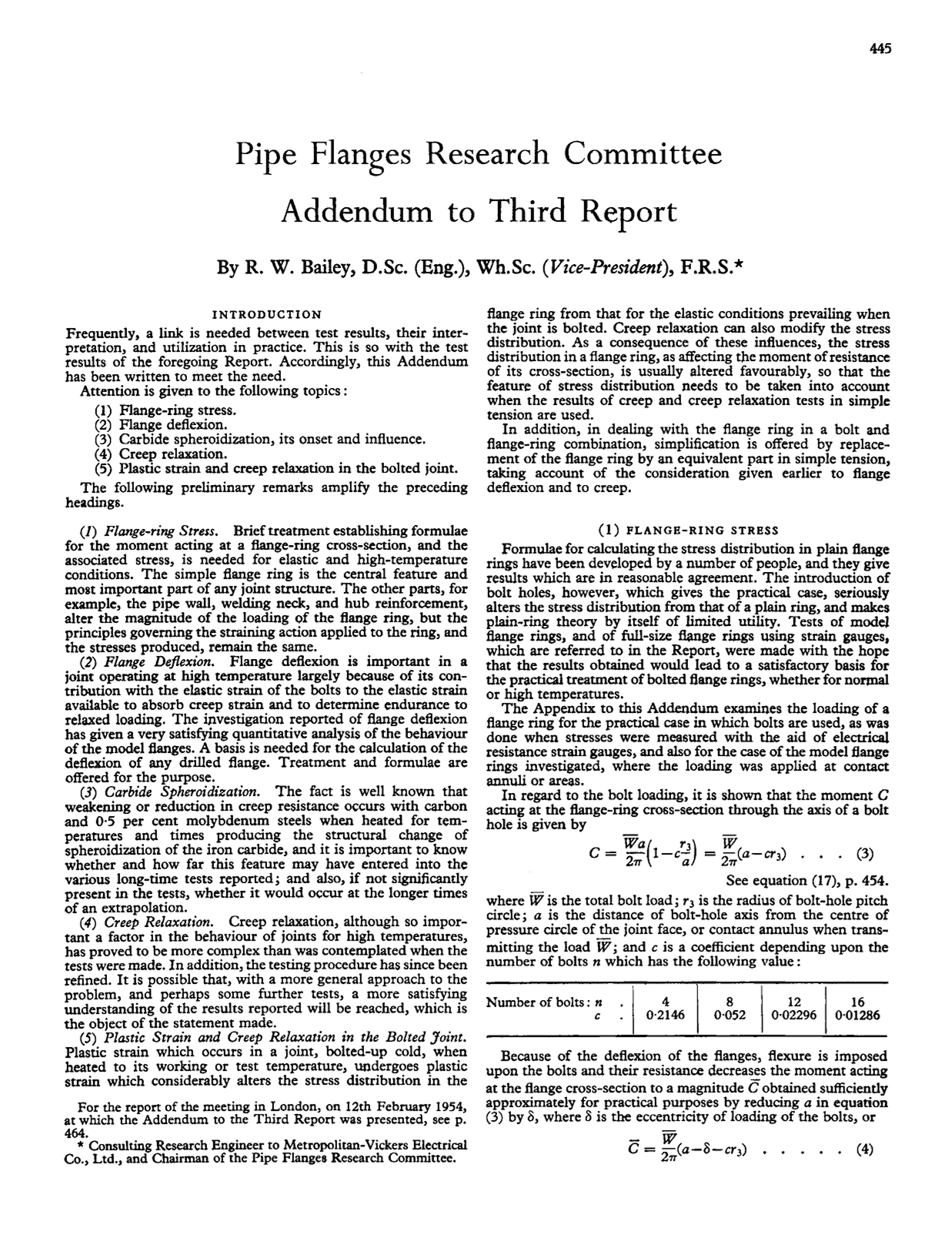
The Third Report of the Pipe Flanges Research Committee is concerned, with the exception of elastic resistance strain gauge measurement of stresses of two standard flange rings, with the results of a programme of investigation, projected by the Committee in being when the Second Report was made, into the elastic and plastic (creep relaxation) behaviour of flanges, drilled and undrilled, by means of model flanges, and of certain bolt materials.
Execution and completion of the programme and attention to its results, was interrupted and delayed by the 1939–45 war. Subsequently examination of the creep relaxation data showed that the phenomenon, and the interpretation of the results, involved difficulties unknown at the time the tests were made, and the need for further investigation became evident. The results, however, have important bearing upon the behaviour of flanged joints and also as a contribution to the subject providing a base for further advances.
An Addendum to the Report refers to matters which arise in connexion with utilization of its results for engineering needs.
The Committee wishes to record its indebtedness to the Reporter, Dr. A. E. Johnson, now of M.E.R.L., East Kilbride, and formerly of the N.P.L. Engineering Division, who has been chiefly concerned with the investigations at elevated temperatures, and to Mr. H. L. Cox, now of the N.P.L. Engineering Physics Section, and formerly of the N.P.L. Engineering Division, who has been principally interested in the investigation of elastic properties, and who was responsible for the automatic strain control equipment of the relaxation unit.


Some rather substantial differences are found in creep data on similar steels published in various countries. In view of the importance of these differences in relation to design stresses, arrangements were made for an exchange of specimens between The Timken Roller Bearing Co., of Ohio, and The United Steel Companies in order to determine whether the results from the two laboratories, on the same steel, would be in agreement, and to compare the creep resistance of selected steels.
Five representative high-temperature steels were chosen comprising three commonly used ferritic steels and two austenitic steels. For each composition, four creep curves were obtained, two by each laboratory. Stress, temperature, and time adopted in the tests in the two laboratories were the same and no attempt was made at standardization of test procedure. A high degree of reproducibility was shown by the test results for the two laboratories on the ferritic steels but those on the austenitic steels showed generally substantial differences.
Only two British steels, both of ferritic type, showed similar creep behaviour compared with the corresponding American steels, the remaining three steels showing appreciable differences, which are discussed.
The operating life of land power plant being far longer than allowable testing times for the constructional metals, the selection of a material, or the determination of its appropriate working stress, is dependent in an important degree upon the procedure followed in utilizing the creep test results obtained. Different procedures practised both in Britain and in the United States can result in different views regarding the potentialities of a material, and also about the working stress allowable. The paper examines the more commonly used procedures and focuses attention upon the factors present which would operate to introduce uncertainty and error as between the probable behaviour in the long time of actual service, and as yielded by a test procedure.
The principal disturbing factor in altering the resistance to creep of the material is thermal action. In some procedures, especially where the creep tests are made at working temperatures, the influence of this factor may be small or negligible in the procedure, compared with its magnitude in service. The need is emphasized for thermal action to be taken adequately into account by the test procedure. Next in importance as a possible source of error is the method of extrapolation beyond the test times to the time of the operating life.
The factor of thermal action and of its representation in the several procedures examined is considered. The circumstances of extrapolation are similarly investigated, especially in regard to whether the result would over-estimate or underestimate the safe working stress.
Satisfying comparisons of working stresses using different procedures cannot at present be made. The position is therefore disappointing, and one which it is very desirable should be rectified.

The new British Standard No. 308 is a comprehensive work which should go far to bring unity to drawing procedure. The standard has been long in preparation and at various stages in its compilation has been presented to British industry for comments. It has been discussed internationally, and particularly in American and Canadian committees, which have been giving considerable study to the same subject; the object has been that of reaching a common international understanding of the fundamental principles involved. In preparing the standard, reference has been made to the ‘Dimensional Analysis of Engineering Designs’, an important contribution to the subject published by H.M. Stationery Office in 1948.
Recommendations of the standard fall into two main groups: those which relate to general practice, and those which deal with dimensioning and tolerancing.

The problem of scavenging of naturally aspirated, two-stroke cycle engines by utilization of wave effects in the exhaust and induction system is treated theoretically and investigated experimentally by systematic variation of the exhaust and induction system, as well as engine speed.
In the theoretical treatment accuracy is achieved with a minimum of numerical computation by the adoption of the theory of waves of finite amplitude and the use of charts, wherever possible. These two features constitute the most significant departure from List's very thorough analysis (List 1949/50)‡, which is based throughout on the small-wave theory and in which little attention appears to have been paid to the simplification of numerical work.
The theoretical section is divided into two parts dealing with (1) the analysis of cyclical pressure fluctuations in the engine cylinder and pipe system, and (2) the treatment of the gas-exchange process in the cylinder on the basis of ‘perfect mixing’ and the derivation of the conditions for dynamic similarity.
A novel experimental technique is used, air from an external compressor being admitted to the cylinder of the motored engine through a rotary valve. In this manner release pressures comparable with those obtaining in the firing engine are attained, while the effects of high temperatures, which are of secondary importance in relation to wave phenomena, are eliminated.
The experimental work is divided into two parts: (1) tests corroborating the wave theory; and (2) systematic air-consumption trials with variable induction-pipe lengths and exhaust systems, incorporating (
The general conclusions are: (1) good agreement between observations and analytical results is obtained, (2) high air-consumption is possible with natural aspiration provided that effective use is made of wave action by correctly designed exhaust and inlet systems; and (3) satisfactory scavenging is only achieved if not only the external pipe system but also the engine speed and geometry conform to certain requirements conveniently expressed in the form of dimensionless groups.
Mass transfer processes are shown to be capable of description in terms (a) of an equation, which is the same for all types of mass transfer, relating the mass transfer rate to the Reynolds number and other conditions; and (6) of a driving force, called the transfer number, which appears in the common equation but has a different form for each type of mass transfer. Transfer numbers for absorption, vaporization, condensation, and the combustion of carbon, metals, and liquid fuels are derived. The mass transfer rates predicted in combustion are compared with experimental data.
Tests have been carried out on a model rotary air heater in an attempt to study, on a laboratory scale, corrosion phenomena under conditions similar to those experienced in industrial practice.
The acid dew-point of the combustion gases used varied from 240 to 320 deg. F. and maximum corrosion occurred at surface temperatures within the range 215–240 deg. F. The results confirm previous conclusions as to the influence of the acid dew-point and of the sulphur trioxide content of the gases on corrosion.
A new form of dust control has been devised for portable grinders. The method has been developed on a study of the aerodynamics of the system, as shown by cine-photographs of the moving dust clouds produced when grinding. It was known from earlier work that the dust of respirable size range did not follow the sparks thrown off by a grinding wheel. In consequence, the present work, which represents the first attempt to control dust through the portable wheel-guard, was directed to the control of dust of the respirable size range. Still photographs of the dust clouds are included in the paper.
For many years pneumatic chisels have been used without any method of dust control, although an increasing volume of medical evidence has shown that these tools produce dangerous dust in certain industries. In some cases stone masons have fitted small local exhaust ventilation hoods in front of the chisel, and a recent paper described an exhausted dressing bench for use in steel foundries. There are, however, many instances where the work cannot easily be placed on such a bench, and so a new dust-control system has been fitted to a pneumatic chisel. In this design local exhaust ventilation is applied through a hollow chisel, and the dust is extracted through the pneumatic hammer.
The main effort has been directed to the control of dust within the respirable size range, and the whole system was evolved as a result of the observation of the paths taken by the airborne dust produced by chipping. The moving dust clouds observed during the development stages have been photographed by a cine-camera, and the paper includes still photographs taken from the 35-mm. film negative.

Activity in the field of air pollution in the United States has reached tremendous proportions. Any attempt to summarize this effort, even superficially, would require space beyond the present limits. As an illustration, the proceedings of only one three-day meeting (United States Technical Conference on Air Pollution, 1950) at which ninety-seven technical papers were presented occupies a book of almost 850 pages. Since that meeting, the amount of technical thought and effort devoted to the problem of air pollution has grown apace, so that the developments and accomplishments in the field occupy the complete attention of several special publications, as well as resulting in frequent articles in the general technical Press.
Therefore, the present discussion will attempt to cover only those areas in the United States and Canada where definite accomplishment or significant developments have been made in air-pollution control. In addition, its scope is limited by the special interests and opportunities of the author.
The legislative developments of the important areas are treated rather fully, because in most instances of reduced air pollution it was an effective ordinance backed by public opinion which brought about the result.
The influence of meteorological factors upon the dispersion or accumulation of air pollutants has long been apparent, but an understanding of the fundamental factors, other than wind, is just being reached. These principles are discussed generally, and in specific application.
The highlights of the Donora (Pennsylvania) smog of 1948 are covered, primarily to illustrate how the present warning system has been developed. A description of the control procedures and equipment presently in use there is given, together with a statistical analysis of the air sampling and meteorological data which had been collected.
In the light of recent findings on the synergic effect upon laboratory animals of sulphur dioxide and sulphuric acid mist, both of which are believed to be frequent air pollutants, some speculative thoughts are presented. If further research bears out these findings, there will then be available the basis for an explanation of the physiological mechanisms acting in acute smog episodes such as Donora and London. Controls to prevent the emission of sulphur gases would then become necessary.
The current air-pollution activity has stimulated the development of instrumental methods for the detection, determination, analysis and recording of atmospheric contaminants, and factors influencing their accumulation or dispersal, many of which are described or illustrated. A corresponding stimulation in the control-equipment field has resulted from stringent local demands. Specific examples of successful application are given, but emphasis is placed upon the enormous cost and technical difficulties which such installations present.
A concluding section deals with the socio-economic aspects of the air-pollution problem in which an attempt is made to visualize the future of the air-pollution control movement.

This paper presents results of an experimental investigation into the way in which water-hammer pressures are transmitted through various types of surge tank. Orifice and differential surge tanks are subject to special scrutiny as in those instances the validity of the assumptions of the plane-fronted wave theory has frequently been subjected to doubt. Experimental results, however, confirm with good accuracy that the simplest and obvious assumptions are correct, and an adaptation of the Schnyder-Bergeron method is presented which allows transmitted pressures to be accurately estimated for most surge tanks. Some general formulae together with solutions of particular examples are included.
The historical development of iron having graphite present in the nodular form as cast, is traced from the patent application by Morrogh and the British Cast Iron Research Association (1946)† to its selection as a crankshaft material by the Ford Motor Co. in 1952. The economics of the production of nodular iron by various methods is discussed and it is concluded that material produced by the magnesium-nickel process now in use cannot compete in price with established materials such as carbon steel and malleable iron. Methods for direct addition of magnesium to molten iron are described, and it is concluded that application of these methods to low-sulphur irons from basic cupolas may completely alter the situation.
The engineering properties of nodular cast iron are compared with those of other ferrous metals. It is concluded that nodular irons in the as-cast condition may be used instead of high grade flake-graphite irons for components not subject to shock loading, and instead of malleable irons in applications where 2–4 per cent elongation at fracture is adequate. The annealed nodular cast irons may be used, where their extra ductility and impact resistance are considered essential, to replace malleable irons and cast or forged carbon-steels. Their chief advantage over malleable irons lies in the shorter heat-treatment they require, which becomes economically more important as the size of a casting increases and as its selling price per lb. falls. As a replacement for carbon steel, nodular cast iron will be attractive for components which are difficult to cast or which require high surface-hardness with medium strength and impact resistance. However, the extent to which nodular cast iron replaces any of these materials will be determined largely by the price at which it can be produced; this will have to be decreased very considerably before it becomes competitive. Ultimate output of nodular cast iron in Britain in peace time is likely to be limited by the high cost of the low-phosphorus ore which is necessary for its production; in war time, its output might be severely restricted by the difficulty in importing this ore.
The particular application of nodular cast iron to crankshafts is discussed in detail. It can replace alloy flake-graphite irons with a gain in ductility and impact resistance, and is already replacing graphitic cast steel, chiefly because of its better founding properties, and because its lower pouring-temperature facilitates the use of mass-produced shell moulds. It seems doubtful whether its fatigue properties will permit of its replacing the forged low-alloy steel which is used for most British automobile crankshafts, unless some reduction in engine specific-power output is accepted.


This paper has been written in an attempt to provide an improved scale formula for Kaplan turbines, which has theoretical justification as well as offering reasonable results in practice.
A survey is made of all the important water turbine scale formulae since 1909 and their merits are compared.
The Ackeret formula is one of the most interesting because it considers the kinetic and friction losses separately, and it is widely used on the Continent. By means of a simplified theory the formula was made to apply to both Francis and Kaplan turbines. It is now shown that the theoretical basis can be improved if the argument is restricted to the Kaplan turbine. A more comprehensive analysis suggests a modified formula offering better agreement with full-scale results and, moreover, a useful guide to efficiency away from the optimum.
At optimum efficiency it is suggested that about 70 per cent of the losses are frictional, and therefore affected by Reynolds number, instead of 50 per cent as in the original Ackeret formula. The actual proportion will depend on the design and operating conditions of the machine, but the need for dividing the losses into frictional and kinetic parts and the method of calculating their proportions is demonstrated. The theory also shows that between 0.5 and 1.5 times the normal flow the proportion of runner to total losses may decrease from 90 to 50 per cent, and due allowance should be made for this when scaling-up performance away from the optimum.
The value of the theory and the formula can be assessed only after comparison with reliable experimental data, but in the light of the limited evidence quoted here it seems worthy of further examination.
Alternating-stress-fatigue tests have been carried out at several speeds of between 10 and 8,000 cycles per min. on a normalized 0.17 per cent carbon steel at air temperature, 400, 450, and 500 deg. C. and on the aluminium alloy R.R. 58, in a fully softened condition, at 200 deg. C. It has been shown that for the mild steel the fatigue strength at air temperature depends mainly on the number of cycles of stress irrespective of the cyclic speed, but at 400–500 deg. C. failure at a given stress range occurs after a certain time which is approximately independent of the speed. For the aluminium alloy at 200 deg. C. there is evidence of a small speed effect, but fatigue failure depends mainly on the number of stress cycles applied and not on the time of the application.
In addition, a study has been made of the dynamic stress-strain relations, and these are shown to be useful as a guide to the variations of fatigue strength with temperature and speed. They also provide a means for the determination of the stress redistribution when plastic strain occurs in bending fatigue, and it is shown how this, together with the effect of size of test piece may account for the difference between bending and direct-stress fatigue strengths.
A description is given of the special apparatus designed for the work.
Measurements have been made of the heat transfer from air jets, with temperature differences of up to 400 deg. C. (750 deg. F.) and velocities of up to 250 ft. per sec., impinging on a plane surface at various angles.
It has been found, that for flow parallel to the surface, the recommended mean formula Nu =0.036(Re)0.8(Pr)0.33 is still valid over this extended range of velocity and temperature. For flow perpendicular to the surface, the formula Nu =0.1810(Re)0.7(Pr)0.33 expresses the results if the velocity and temperature are calculated from free jet formulae. A series of multiplying factors has been obtained for this formula for angles of gas impingement down to 15 deg., at which angle the heat transfer is approximately half that at 90 deg.
Where a gas jet impinges on a relatively large plane surface, it has been found that the heat-transfer contours for any one angle are identical for all jet sizes at all cross-sections situated more than ten nozzle diameters downstream. This result holds even where the temperature of the gas at the orifice exceeds that of the ambient air by more than 500 deg. C. (930 deg. F.).
This extension of the jet similarity theory to impinging gas jets provides a simple method of calculating the total convective heat transfer from such a jet.
In previous investigations (Gough, Pollard, and Clenshaw 1951)§ under the same general research programme, determinations were made of the intrinsic and vee-notched fatigue strengths of the first seven steels here investigated, under various combinations of bending and torsion. The intrinsic fatigue limits were found to fit reasonably to an ellipse quadrant, and the notched fatigue limits to a two-constant displaced ellipse or ‘ellipse arc’.
The bulk of the present paper concerns the behaviour under combinations of bending and torsional stresses of test pieces with transverse holes, for the same seven steels. The fatigue limits under the various stress combinations have been found to fit reasonably to an ellipse arc of the same form as for the vee-Notched Specimens.
The similarity in form of the ellipse arcs for the seven materials supports the theoretical conclusion that the shape of the curve is dependent only on the shape of the hole, and is independent of the nature of the material.
The information given on strength reduction factors under various combinations of bending and torsion, together with the tables of results of supplementary static tests, should be of use in such problems as crankshaft design.
The paper also includes the results of flexural and torsional fatigue tests on an aircraft crankshaft steel, with other forms of stress concentration. These results are compared with those on two other steels of similar composition.
This paper presents the results of experimental investigations on shrink-fit effects in full-scale crankshaft webs and of ancillary studies of the behaviour of simple ring-and-plug arrangements and model two-pin web assemblies.
These small-scale tests allow such variables as surface conditions and fit allowances to be more fully and systematically examined; the range of surface finish used is from superfine to dry-scrape standards; mating surface conditions from lubricated to chemically dry; and fit allowances from 0.5 to 4.0 mils, per inch diameter. Three methods of dismantling are used: trepanning, axial force, and torsion. The first allows the most accurate determination of the permanent distortion and the others provide evidence as to the effectiveness of the grip. The coefficients of friction deduced therefrom depend on the bore pressures. Experimental bore pressures are obtained by assuming that the measured relief of bore strain on removal of the pins is elastic. In addition, all results are compared with available theory. For this purpose the thick-cylinder equations of Lame, and Allen and Sopwith, are used for the elastic and over-strained conditions respectively. Some degree of experimental verification of theory was sought through the medium of a special preliminary experiment on bore strains under fluid pressure conditions. This experiment is included.
In the full-scale investigations, webs from marine Diesel-engine crankshafts before and after service are examined. The fit allowances are necessarily limited in number but vary between 1.0 and 2.0 mils, per inch diameter. The procedure involves the measurement, by means of electrical-resistance strain gauges patterned over the surface of the web, of the relief of stress when the pins are cut out and again when the web is cut through. The variations of radial and circumferential stresses are shown and compared for different fits and with certain theoretical considerations. Dismantling of selected ‘after service’ webs, by axial forces up to 2,000 tons, provides information on coefficients of friction and loss of fit due to plastic flow.
The main findings from the experimental work are summarized and reviewed. Experimental results are found to agree with theory in all cases where the ring or web was stressed within the elastic range. Where overstraining has occurred, however, experiment and available theory are, in general, not in agreement; with rings unexpectedly high permanent strains are revealed. The stress patterns obtained for overstrained webs are complex; yielding in the bridge-piece between the pins results in uneven radial pressures at the bore which, in turn, are low relative to the circumferential stresses at the bore; loss of fit is again excessive. There are definite indications that one explanation of the divergence is the inadequacy of overstrained thick-cylinder theory as at present established. In the large webs, a further complication is provided by the evidence of an additional stress system owing, presumably, to uneven flame heating of the webs in preparation for shrinking.
Data on derived coefficients of friction at the mating surfaces are summarized.
The investigation has been confined to the static effects of shrink fitting, but evidence of bell-mouthing in the bores of the used crankwebs indicates that the dynamic effects of service stresses also require examination. It is considered that one cause of this bellmouthing is the excessive fit allowances used in current marine engineering practice.

The availability of a boiler is an indication of its reliability and effective performance, and may have as important an influence on the total cost of steam and power (including capital charges) as the efficiency. There are, however, no generally accepted definitions of availability and, in consequence, many of the figures quoted in the literature are useless for comparative purposes. The paper, therefore, puts forward definitions of availability on both gross and net bases.
In addition, two other factors are required completely to evaluate boiler performance, and definitions of these, which are called ‘service’ and ‘output’ factors, are also put forward.
All these factors have been used with advantage in an industrial concern for some years now and, after discussing them, it is suggested that they should be adopted generally.
The resistance to the flow of air through different assemblies of wire gauzes has been correlated to a common basis. Single gauzes, closely-packed assemblies, sintered packs, and assemblies of spaced gauzes have been considered, although the actual correlations have been restricted to square-mesh gauzes with a single-wire diameter, as these are used most in practice. Experimental data for the sintered packs are presented and compared with the published data for the other types of assembly.
The flow of air through a gauze is considered as analogous to flow through passages or pipes, and the resistance as being due mainly to the friction between the flow and the surfaces of the voids in the gauze, in contrast to the previous approaches of treating the resistance of a gauze as being due to a combined drag of the wire cylinders. The range of Reynolds number (based on hydraulic mean diameter) covered by the correlation is from 0.1 to 5,000.

Results are given of experiments into the variation, with chordwise position, of the heat transfer between the surface of a typical gas-turbine blade in cascade and in the air stream. The principal variables investigated are the blade's Reynolds number and the incident angle of the air stream, while the air/temperature ratio of the blade is kept near unity. It is shown that, with certain provisions, the results should be broadly applicable to similar blades under normal operating conditions.
The extent of the correlation of the results with values obtained by available theoretical methods is shown. The laminar boundary-layer heat-transfer theory due to Squire (1942)‡ gives good agreement, but the predictions of heat transfer in the regions of turbulent boundary-layer flow, particularly under negative pressure gradients, leave much to be desired. In addition, knowledge of conditions at transition to turbulence and at laminar separation of the boundary layer is scanty, with consequent uncertainty in any overall heat-transfer forecast. Minor suggestions in this respect have resulted in slightly improved correlations.
The experimental method employed involved the manufacture of a wind tunnel having a form of contraction based on the theoretical work of Cheers (1945), which gave excellent results; also a novel process was developed for the manufacture of the cascade blade which, it is considered, possesses certain advantages over the more traditional methods.


This paper describes an investigation undertaken to determine whether fluid pressure has any effect on the shear properties of several metals. An apparatus is described in which it is possible to carry out torsion tests under fluid pressure of up to 20 tons per sq. in., and up to 40 tons per sq. in. if another torque bar is used. A simple high-pressure intensifier and secondary pressure gauge are also described.
The results show that pressure has no significant effect on the shape of the stress-strain curves of the metals tested, though it does increase the strain-to-failure in some instances. The strain-to-failure appears to increase linearly with pressure, except with zinc and Mazak which give no increase in ductility with pressure. Numerous cracks, which formed in the specimens during test, were found to be inclined to the transverse plane of the specimen and at an angle slightly greater than 45 deg. to the direction of the tensile component of the shear stress.
This paper was read before a meeting of the South Wales Branch Graduates' Section, Institution of Mechanical Engineers, on 24th February 1953, and was awarded a Viscount Weir Prize.