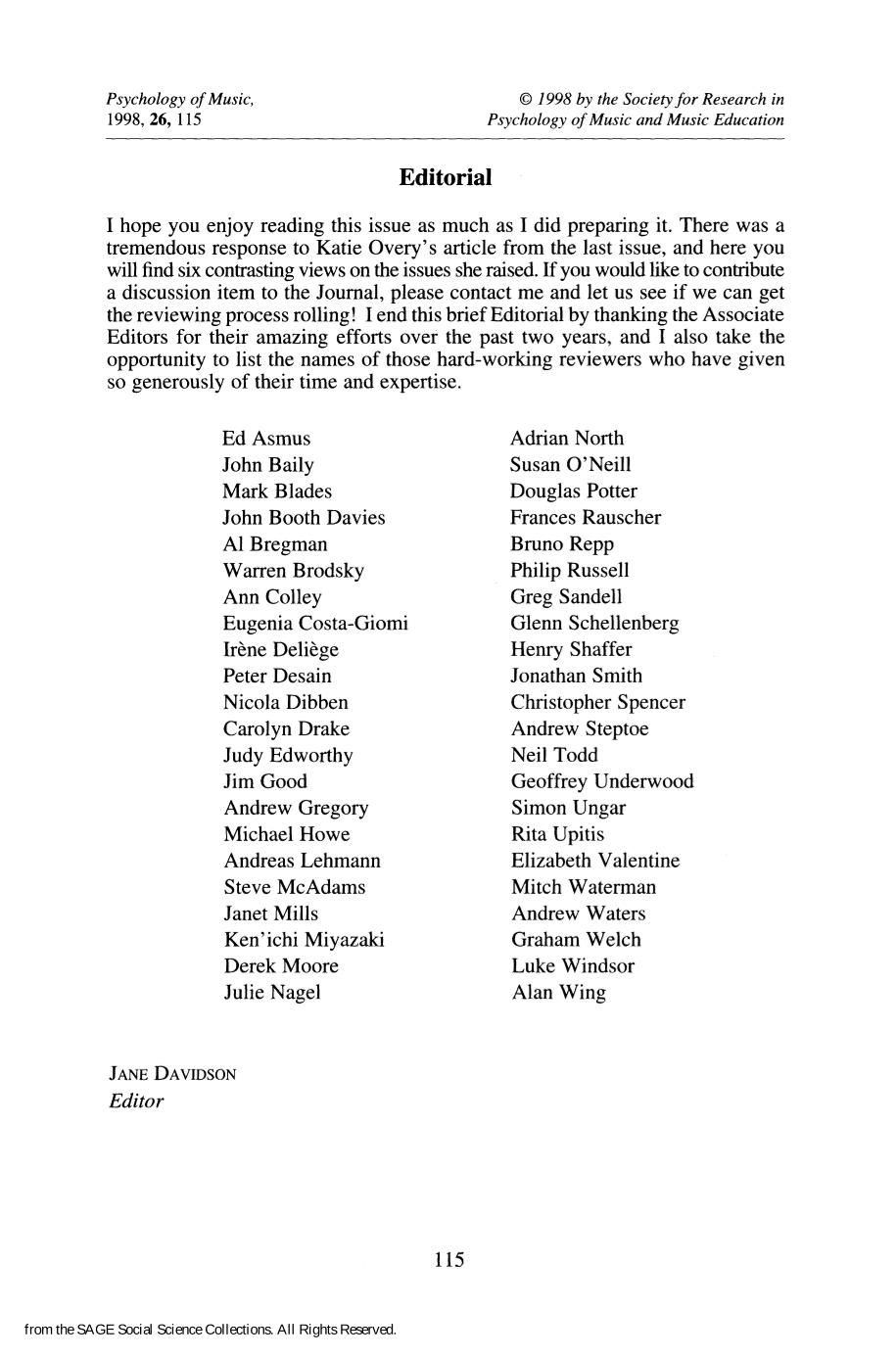
Editorial
Select search scope: search across all journals or within the current journal

This study, using Carroll's (1963) model of learning as a framework, considers the relative importance of time spent practising in determining learning outcomes in instrumental tuition. Carroll's model states that degree of learning is a function of time spent learning, divided by time required for learning. One hundred and nine violin and viola pupils aged 6-16 years took part in the study. Multiple regression revealed that length of time learning (beta weight .78) and ability to understand instructions (.23) were the best predictors of level of achievement (R = .88), while the quality of achievement was best predicted by the teachers' rating of musical ability (5). Dropping out was best predicted by a range of ability and attitudinal measures. The findings are discussed in relation to the ways in which the quantity and quality of attainment may be determined by different presage and process factors and the importance of developing explanatory multivariate models in the field of instrumental tuition.
Children 4-12 years of age (N = 160) were recorded (audio and video) as they sang two versions of a familiar song, once in an attempt to make an adult listener happy and once to make her sad. Coding of gestural, vocal, linguistic and musical devices revealed that children used all of these means to portray contrastive emotions. Regardless of age or singing skill, children relied primarily on expressive devices used in interpersonal communication
We illustrate a technique for eliciting and exploring the constructs involved in the adjudication of music performance. Five trained musicians with extensive experience in performance adjudication evaluated six expert performances of Chopin's
This study describes a methodology for documenting listeners' conceptions of musical structure. The method uses digital technologies that allows precise identification of musical structure, together with a word-processing feature that allows the researcher to capture listeners' interpretations of the piece. In the study, inexperienced listeners (N = 19) and experienced listeners (N = 13) were asked to identify structural events when listening to an intact musical example (last movement, Symphony No. 34 in C major, K. 338 by Mozart). The data collected using this method showed that inexperienced listeners were significantly poorer than the experienced listeners at recognising formal structural events. Most experienced listeners used perceptual attributes or musical labels to describe the structural units that they had identified; many of the inexperienced listeners did not. Eight inexperienced listeners reported psychoacoustic labels, two reported affective labels, four reported sporadic imagery and five reported sustained action involving imagined characters. Thus, this method demonstrated its ability to capture data at each of Umemoto's (1990) four dimensions for analysing compositions.
Cognitive psychologists have recently questioned the role of similarity in categorisation. Results inferred from classification errors in a previous study (Thorisson, 1995) indicated that novices base their categorisation of Classic and Romantic piano exemplars primarily on texture and to less extent chord progression. The study examined (a) the relationship between similarity and style categorisation, (b) whether multidimensional scaling (MDS) of subjects' similarity ratings support the salience of texture and chord progression, (c) whether similarity clustering better reflects classification errors of subjects given explicit or implicit style training and (d) subjects' open-ended written comparisons concur with dimensions identified by