Other
Select search scope: search across all journals or within the current journal

This article describes the effects of interpersonal problem-solving training with maladjusted boys aged from 11 to 13 years. The training consisted of a two-phase programme. The first phase consisted of a six-unit package designed to teach problem-solving skills using modelling videotapes, cartoons and role-playing. This was taught for 1 hour per week to classes of maladjusted children. The second phase involved three individual sessions of about 15-20 minutes per week using a booklet entitled
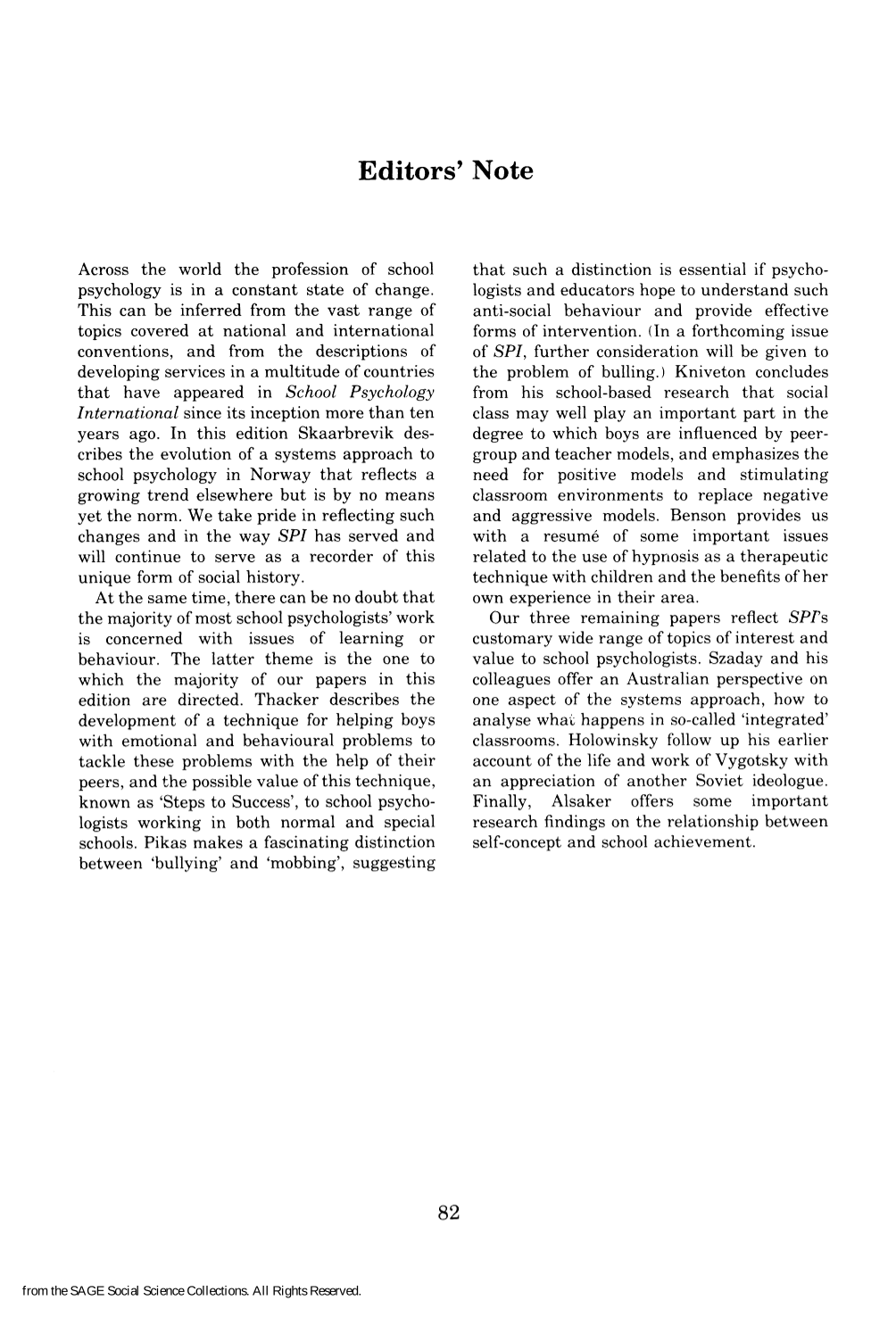
The author presents a method for the treatment of mobbing (defined as group violence among schoolchildren) and discusses social/psychological needs discovered while teaching this method.
With increasing problems of misbehaviour in the classroom affecting ever younger children, the present study examined the interaction between peer models and 5- to 6-year-old boys from middle-and working-class socioeconomic backgrounds. There was a significant difference in likelihood of copying behaviour between the classes. Working-class boys were influenced by the first peer model presented, but not the second. This latter had to compete with the influence of the first. Middle-class children, on the other hand, were not influenced by the first, but were by the second peer model. This was interpreted as a reaction to boredom. It was therefore suggested that teachers need to manipulate the classroom environment to avoid peer models of misbehaviour and, secondly, to ensure sufficient stimulation to avoid boredom occurring.
Hypnotherapy is now an acceptable technique used by school psychologists in the UK. This paper looks at the rapid growth of interest over the last decade and offers a working definition of hypnosis avoiding the theoretical controversies. An overview of hypnosis with children is provided together with a description of a structured treatment approach using guided imagery which can be used with more resistant children to deal with a wide range of problems. Case studies are discussed.
School psychological and special educational practices in Australia, in common with other elements of its culture (Graubard, 1985; Terrill, 1987), have been strongly influenced by those of Britain and America. The most widely read professional journals, the most commonly used psychological and educational tests, the most popular intervention strategies, and the structure of suipport services and facilities are those originating from British and American sources. Australian school psychologists and special educators are more likely to be familiar with the recommendations and provisions of the Warnock Report and Public Law 94-142 than they are with the various government reports and research studies conducted in states of Australia other than their own.
Historical trends of the school psychological services in Norway has been exemplified by the service in the municipality of Aalesund and by the clients referred to the service in this community. From being a service that was influenced by mental health clinics with a psychodynamic approach, it has developed into a more school- and education-orientated service. The service has also developed from an individual, diagnostic-treatment approach to clients, toward a systems approach where the learning environment and co-operation with teachers and school administrators is becoming more important. The service now covers all age groups from infancy to the age of 20, and in some instances beyond that age. The clients of the service in the school year of 1985/ 86 are further described with regard to age, gender, referring agencies, reasons for referral and initiatives taken by the school psychological service.
Antin S. Makarenko has been hailed in the Soviet Union as a leading educator and theoretician. His
The relationships between school achievement, global (negative) self-evaluations and the more specific academic facet of self-evaluations (Perceived Academic Competence: PAC) were examined in four cohorts of children in grades six through nine. The entire sample included 1102 girls and 1207 boys. The analyses lead to the following results and conclusions. (1) School achievement was only weakly related to global negative self-evaluations (r around -0.20). However, the correlations between PAC and achievement were somewhat higher than previously reported results (r around 0.65). (2) We found little or no support for the widespread assumption that perceived importance of school achievement moderates the relationship between perceived academic competence and global self-esteem (interactive hypothesis). (3) We found perceived importance to be moderately correlated with PAC (r around 0.30). The correlations were somewhat higher in higher grades. Our main conclusion was that time is ripe to question the usual model for the relation between global self-esteem and other dimensions of self.