
Editorial
 Restricted accessEditorialFirst published August, 2026pp. 321-322

Select search scope: search across all journals or within the current journal


 Restricted accessEditorialFirst published August, 2026pp. 321-322Restricted accessResearch articleFirst published August, 2026pp. 323-329
 , Kunihisa Yamaguchi, Kohei Kamoi , [...]
In living donor kidney transplantation, recipient surgery is often performed concurrently with donor nephrectomy, limiting preoperative understanding of graft anatomy before graft arrival. This study evaluated the feasibility, safety, and perceived usefulness of intraoperative application of sterilized three-dimensional (3D) printed donor kidney models for surgical planning.
Patient-specific 3D kidney models were created from preoperative contrast-enhanced computed tomography using SYNAPSE VINCENT software, printed with a Cara Print 4.0 Pro, and gas sterilized for intraoperative use. Ten consecutive transplants using 3D models (June 2024–July 2025) were compared with the most recent 10 without models (June 2022–May 2024). Surgical outcomes were analyzed, and eight surgeons completed a 5-point Likert scale questionnaire on accuracy, handling, and usefulness.
The models reproduced donor kidney anatomy with reasonable accuracy. Surgeons reported benefits for graft orientation, anastomosis, and graft bed preparation, especially for less-experienced surgeons. Handling was satisfactory, although vessel rigidity was noted. No intraoperative complications, graft damage, or contamination events were attributable to model use, and overall surgical outcomes were comparable between groups.
Intraoperative use of sterilized 3D-printed donor kidney models is feasible, safe, and cost-effective. These models may serve as practical adjuncts for surgical planning, anatomical visualization, and education in living donor kidney transplantation. Further multicenter studies are warranted to validate their broader clinical and educational impact.
Restricted accessResearch articleFirst published August, 2026pp. 330-337Colorectal surgery stapling misadventures are fairly common, potentially leading to serious complications. Although artificial intelligence (AI)-driven chatbots have shown promise as educational tools in various medical fields, their utility in real-time surgical decision-making remains unclear. This study assessed the ability of two chatbots, ChatGPT-4 and Google Gemini, to suggest management strategies for various stapling misadventures.
In this exploratory study, 21 stapling misadventure scenarios were developed based on a literature search and expert input. The scenarios were uploaded to both chatbots with a prompt asking about the management strategies for each scenario. ChatGPT-4 and Google Gemini’s suggestions for the scenarios were independently evaluated by 3 colorectal surgeons. The main outcome measures were appropriateness, comprehensiveness, and justification quality assessed on a 0-2 Likert scale.
ChatGPT-4’s suggestions for all scenarios were rated as fully or partly appropriate and comprehensive, compared to 85.7-90.5% for Gemini’s suggestions. The median appropriateness and comprehensiveness scores were higher for ChatGPT-4 (2 vs 1), and was statistically significant according to one assessor (
Both ChatGPT-4 and Google Gemini provided appropriate and comprehensive suggestions for colorectal stapling misadventures, with ChatGPT-4 showing marginally better performance. These findings support the potential role of AI-driven chatbots as decision-support tools in surgery.
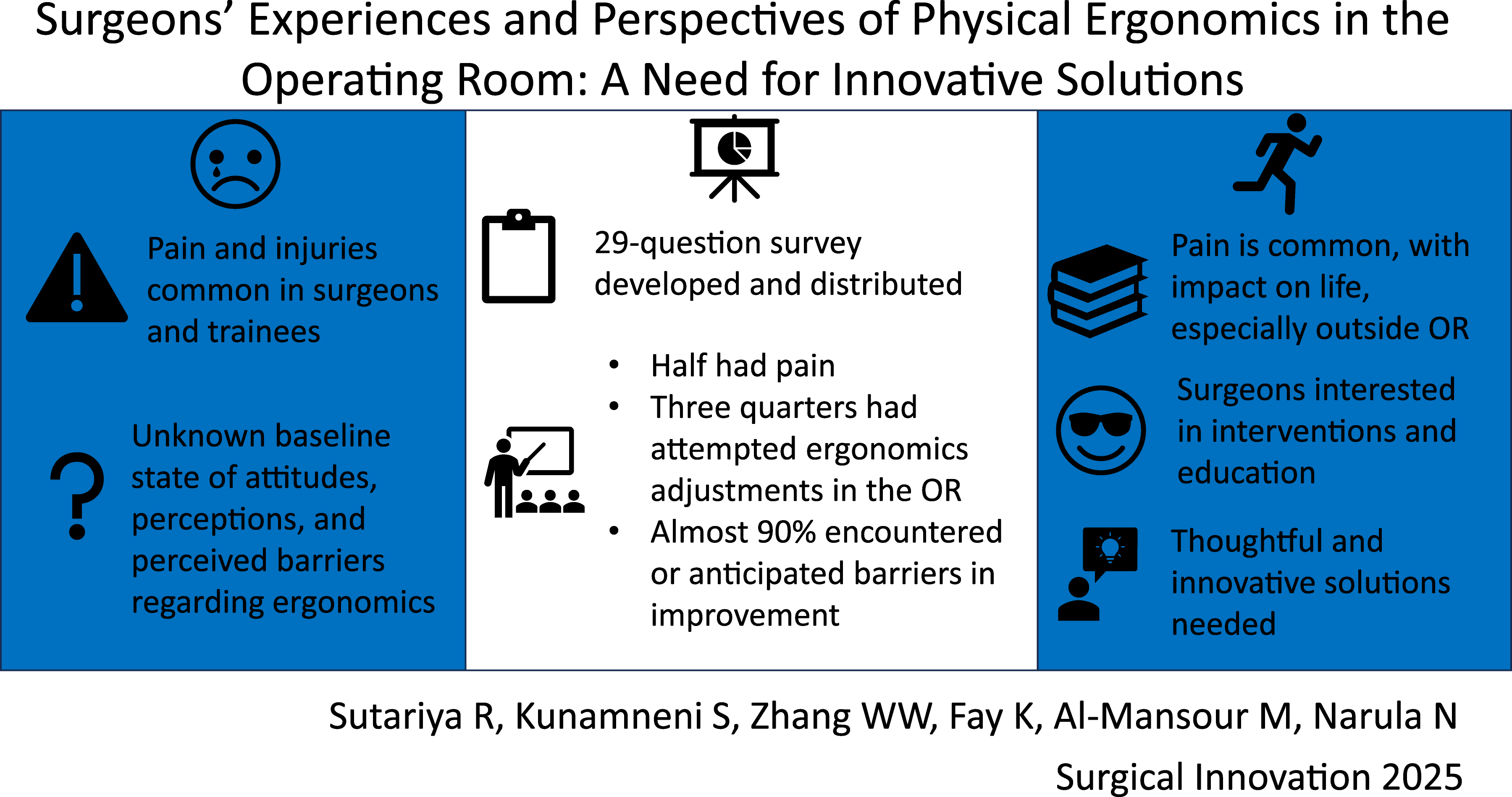
Restricted accessResearch articleFirst published August, 2026pp. 338-346Pain that impacts professional and personal life are prevalent among surgeons due to poor ergonomics. The objective of this study is to determine the attitudes, perceptions, and real-world practices of ergonomics with the ultimate goal of deriving novel solutions.
A survey was distributed to surgical faculty/trainees at a single institution. 43 attendings and 116 trainees were invited to participate. Data on demographics, pain experiences, ergonomic practices and attitudes, and perceived barriers to implementing ergonomic principles were ascertained.
Of surveyed surgeons, 18 attendings and 11 trainees responded. 46.7% of surgeons experienced pain, particularly in the neck and back. Although most respondents made adjustments, challenges such as insufficient training, lack of proper equipment and/or instruments, and resistance from others were frequently encountered or anticipated. Most believed ergonomics improves outcomes and an interest in ergonomic training was noted.
Many surgeons experience pain and are interested in improving ergonomics. Addressing barriers to improvement could potentially foster better practices, reduce strain on surgeons, decrease pain and injuries, increase surgeon well-being, and potentially improve patient outcomes. Further studies and innovative solutions are needed to address this problem.
 Open accessResearch articleFirst published August, 2026pp. 347-354
Precision suturing in confined surgical fields poses ergonomic and visibility challenges, particularly in minimally invasive and reconstructive procedures. A novel Vertical Needle Holder (VNH) was designed to enhance control, angle precision, and accessibility in restricted spaces.
This proof-of-concept study evaluated the VNH’s ergonomic design and suturing performance compared with a standard Mayo-Hegar needle holder. Thirty surgeons and surgical trainees participated in simulated suturing tasks using both instruments. Surgeon-reported outcomes were assessed using standardized synthetic-tissue suturing tasks and a structured Likert-scale questionnaire focusing on perceived precision, ergonomics, and ease of use.
Surgeons reported improved perceived precision and maneuverability of the VNH in confined spaces compared with conventional needle holders. Participants reported reduced wrist strain and greater visibility. The majority of participants (87%) rated the VNH as ergonomically superior to conventional needle holder designs.
These findings suggest that the VNH offers an innovative, practical enhancement to traditional surgical tools, potentially improving safety and efficiency in complex operative fields. Further clinical validation is underway to confirm translational applicability.
Restricted accessResearch articleFirst published August, 2026pp. 355-362, Timothy G. White , [...]How clinicians conceptualize artificial intelligence reveals underlying assumptions about professional authority and decision-making. This study examined whether surgical and medical specialties frame AI differently in research and if such differences reflect divergent professional norms.
1561 AI-related research abstracts published between January 1, 2019, and March 27, 2025, in 30 high-impact journals. Abstracts were identified through a structured PubMed query and analyzed using a large language model (DeepSeek Reasoner) trained to classify along three dimensions: the human-AI relationship, the impact on professional autonomy, and the locus of decision control. A stratified validation sample was independently coded by a human rater. Chi-square testing and logistic regression were used to assess differences by specialty and publication year.
Surgical abstracts more frequently framed AI as assistive (69.8% vs 54.9%;
Surgical and medical specialties exhibit distinct patterns in how they conceptualize AI, reflecting established perspectives on authority, expertise, and the human-machine relationship. These framings have implications for AI tool design, clinical implementation, and healthcare governance. Recognizing conceptual differences on AI is critical as healthcare transitions toward algorithmically mediated decision-making, as they may shape the future culture of clinical care.
Restricted accessResearch articleFirst published August, 2026pp. 363-370This study aims to assess the feasibility and effectiveness of a disposable sterile syringe-derived cannula for endoscopic carpal tunnel release (ECTR) in the treatment of carpal tunnel syndrome (CTS) and to evaluate the clinical outcomes of this technique in patients undergoing ECTR.
ECTR was performed on patients with CTS. A 2.5 mL disposable sterile syringe was modified into a cannula with an upper calibrated section and a transparent lower portion. A skin incision, approximately 1 cm in length, was made on the ulnar side of the palmaris longus tendon at the proximal wrist crease level. Following blunt dissection, the cannula was inserted into the wound, and both the arthroscope and a spade knife were introduced simultaneously. The instruments were advanced with the spade knife cutting the transverse carpal ligament (TCL) from proximal to distal under direct visualization. The wound was closed using silk sutures. All patients were followed for a minimum of 6 months postoperatively. At the final follow-up, the Boston Carpal Tunnel Syndrome Questionnaire’s symptom severity score (SSS) and function status score (FSS), along with the visual analogue scale (VAS) for pain, were recorded and compared to preoperative values.
A total of 16 patients (19 wrists) with a mean age of 52.5 years were enrolled between May 2024 and December 2024. All patients completed the follow-up, with a median duration of 8 months. At the final follow-up, VAS scores, SSS-BCTSQ, and FSS-BCTSQ demonstrated significant improvements from baseline (
The use of a 2.5 mL disposable sterile syringe to create a cannula for ECTR in CTS treatment is a safe, and feasible approach.
Restricted accessResearch articleFirst published August, 2026pp. 371-382Early innovations are often disruptive but gain traction when the benefits become evident. EXtended Reality (XR) has recently gained momentum for surgical training. XR involves a head-mounted display (HMD) blending physical and digital worlds for enhanced visualization, communication, and understanding. To understand its potential impact, the receptiveness of plastic surgeons was assessed for its usefulness and usability.
Plastic surgeons watched XR interventions and completed a survey assessing applications for remote consultation, intra-operative education, and pre-operative planning. Responses were analyzed using descriptive statistics and categorical inferential testing, with group differences assessed using Fisher’s exact test on dichotomized Likert responses.
Eleven attending and ten resident physicians (21/44, 48%) responded to the survey. Attendings perceived greater usefulness of XR for virtual consultation than residents (91% vs 50%), with a near-significant trend (
Attendings were more receptive than residents to integrating XR in plastic surgery training with residents reporting greater cognitive load. Residents valued improved intra-operative visibility and noted the Hawthorne effect. Selecting high-value, usable XR applications while minimizing trainee role stress is essential for advancing residency education.
Restricted accessResearch articleFirst published August, 2026pp. 383-402, Juan S. López-McCormick, Juan Pablo Ávila Madrigal , [...]Within the competencies in education for general surgery residents, the development of Laparoscopic Surgery Skills is of the utmost importance. We evaluated the usefulness of cadavers preserved with a formaldehyde-free solution in the acquisition/development of Skills for Laparoscopic Surgery once basic skills have been developed.
This is a single-center, single-blind, randomized educational intervention clinical trial. Participants took a theoretical and practical module on the acquisition of skills in laparoscopy and took a pre-test focused on intracorporeal enterorrhaphy. Subsequently, they were randomized by blocks into 3 branches continuing their training in skill acquisition models, silicone models, or Formaldehyde-free solution preserved corpses, and finally they performed a post-test. Two blind experts evaluated participants using the GOALS and OSATS scales for laparoscopic surgery.
N = 37 participants were obtained. No relationship was found between the branch and the results of the GOALS and OSATS tests in pre and post-test, which implies comparability between the training methods. Also, the Pillai’s Trace statistical test for the MANOVA (0.95, F(12, 54) = 4.0988,
Education and development of laparoscopic surgery skills using cadavers preserved with the presented formaldehyde-free solution is comparable to other simulation models for the acquisition of skills in minimally invasive surgery. Also, this tool improves the learning curve in subjects with no prior experience.
Restricted accessReview articleFirst published August, 2026pp. 403-412The aim of this study was to summarize the current evidence regarding the role of dorsal genital nerve stimulation (DGNS) in the management of fecal incontinence (FI).
This study was conducted in accordance with the Cochrane Handbook for Systematic Reviews of Interventions and the Preferred Reporting Items for Systematic Reviews and Meta-Analyses (PRISMA) guidelines. A literature search was performed (Medline, Scopus, CENTRAL, Web of Science, CORE, medRxiv Repository, SciELO, AJOL, and Google Scholar) to identify and retrieve the eligible studies. The last search date was 13/12/2025. The primary endpoint was the pooled complication rate of DGNS in patients with FI. Both prospective and retrospective studies were considered. Quality evaluation was performed via the ROBINS-I tool.
Overall, 6 non-randomized studies and 90 patients were included. The overall complication rate was 1.9% (95% CI: −1.1%, 4.9%; I2 = 0%;
We emphasize the need for prospective randomized controlled trials to determine the exact role of DGNS in the management of FI.
Restricted accessResearch articleFirst published August, 2026pp. 413-416Endovascular aneurysm repair (EVAR) is widely used for treatment of abdominal aortic aneurysms (AAA), but 1-5% of grafts require explantation due to complications such as endoleak or infection. Current techniques rely on modified non-FDA approved techniques that risk vessel trauma. We have designed and constructed the EVAx device to support the efficient and non-traumatic retrieval of AAA endografts that rely on suprarenal barb fixation.
We designed a single-use, handheld EVAx device for open endograft removal. It features a cylindrical base, diameter-reducing clamp, and variable constraining arms with tapered tips. Activation collapses the graft and disengages suprarenal barb elements. Prototypes were 3D printed and iteratively refined to facilitate future verification and validation testing.
Benchtop testing demonstrated successful engagement of the proximal endograft and suprarenal barbs. Endografts were successfully constrained with adequate reduction of the endograft diameter, disengagement of the barbs, and subsequent retrieval.
EVAx is undergoing further design optimization with high-fidelity bench-top models and preclinical animal testing. Future use will be intended for the efficient and non-traumatic extraction of aortic endografts with suprarenal fixation.
Open accessResearch articleFirst published August, 2026pp. 417-421, Raphael Lioz, Tal Levin-Harrus , [...]Uncontained power morcellation during laparoscopic gynecologic surgery risks intra-abdominal dissemination of benign or malignant tissue, a significant safety concern highlighted by FDA warnings. This has created a critical need for robust and reliable tissue containment systems that can be easily integrated into surgical workflows to mitigate this risk.
The LapBox Power Tissue Containment System is a single-use device featuring a dual-walled inflatable chamber designed to create a secure environment for morcellation. We conducted a Good Laboratory Practice (GLP)-compliant toxicology study in three female domestic pigs to assess its safety under simulated worst-case conditions. The device was inserted laparoscopically, and the internal dual-walled chamber of the device was inflated to a high pressure (∼160 mmHg) to simulate a localized worst-case compressive scenario, while the overall intra-abdominal insufflation was maintained at a standard 15 mmHg. Postoperative monitoring included clinical observation, bloodwork, and, at day 13, necropsy and histopathology.
All procedures were completed without mortality, morbidity, or device-related complications. The LapBox maintained full structural integrity. Postoperative clinical, hematological, and biochemical parameters showed no adverse effects. Gross necropsy and detailed histopathology confirmed the absence of device-related ischemia, necrosis, thrombosis, or foreign-body reaction.
This preclinical study demonstrates that the LapBox Power system has an excellent safety profile and biocompatibility, even under extreme conditions. The device is ready for the next stage of evaluation. These findings support its translational potential and warrant further investigation in human clinical studies to confirm its safety and efficacy.
Restricted accessResearch articleFirst published August, 2026pp. 422-425Customizable positioning devices for endocrine surgery are scarce, and existing solutions often rely on improvised supports. This technical report introduces 3 patented 3D-printed devices developed to enhance precision, ergonomics, and safety during endocrine procedures.
The required devices were designed using available software and printed via Fused Deposition Modeling with ABS filament. Post-processing involved acetone smoothing and the addition of an EVA lining for enhanced patient comfort. Specifically, a 3D-printed neck pillow and arm sling were applied during thyroidectomy, while a 3D-printed prone mattress was utilized for adrenalectomy. These devices incorporated modular cushions and magnetic fasteners to facilitate rapid assembly.
The thyroid surgery yielded optimal neck extension, a 73-minute operative time, and 50 mL blood loss without complication. Adrenal surgery was completed with a 105-minute operative time and 50 mL of blood loss, followed by an uneventful recovery. Both patients were discharged on postoperative day 2. The surgical devices allowed stable intraoperative positioning in the reported cases, without observed positioning-related adverse events.
These lightweight, modular 3D-printed devices were designed to support ergonomic and stable positioning in endocrine procedures. Despite their preliminary success, broader adoption will require addressing challenges related to cost, regulation, and process integration.
Restricted accessResearch articleFirst published August, 2026pp. 426-429, Guoqiang Zhang, Yingjie Zhang , [...]