




Abstract
Abstract
Benzoic acid (BA) is a common pollutant in industrial wastewater. It has high toxicity and is a threat to human health and the ecosystem. Mg-Al-CO3 hydrotalcites (HTs) and their calcined products (CHTs) are good ion exchangers/adsorbents for removal of toxic anions from contaminated water. In this study, HTs with different Mg/Al molar ratios were prepared by coprecipitation method, and CHTs were obtained by calcining at 500°C. Adsorption of BA by HTs and CHTs at different pH values was first investigated. Taking HT and CHT with an Mg/Al molar ratio of 2:1 as an example, adsorption kinetics and adsorption isotherms of BA by HT and CHT were analyzed, and impacts of adsorbent dosage and adsorption temperature on equilibrium adsorption quantities were studied. Results indicated that the maximum adsorption of HTs and CHTs could be obtained when the initial pH value of BA solution was 4.5, and equilibrium adsorption quantities significantly decreased with increase of pH value. Kinetic data of the adsorption of BA by HT and CHT with an Mg/Al molar ratio of 2:1 under an ambient temperature of 293 K could be fitted by pseudo-second-order equation. It was found that adsorption isotherms obeyed the Freundlich equation. Equilibrium adsorption quantities of BA by HT and CHT gradually decreased with increase of adsorbent added. Values of thermodynamic parameter (ΔH°) indicated that the adsorption of BA was endothermic on HT and was exothermic on CHT. Different adsorption mechanisms of BA on HT and CHT were revealed. Results showed that CHT could be used as an effective adsorbent to remove BA from waste water. This not only provides a new way to remove BA, but also enlarges the application field of CHT.
Introduction
HTs calcined at 500°C are transformed to the Mg-Al mixed oxides (CHTs), which are capable of adsorbing anions from aqueous solutions through the reconstruction of their layered structure and by their ability to be recycled by recalcining at 500°C (Pavlovic et al., 2005). The mixed metal oxides can take up anions from aqueous solution, with concomitant reconstruction of the original layered structure, as expressed by the following two equations (Lv et al., 2006):
As adsorbents, HTs and CHTs are receiving greater interests in the environmental community because of their high anion retention capacity and simple thermal regeneration procedure. Until now, the adsorption behaviors of HTs and CHTs have been studied by many researchers. The adsorbed materials mainly included heavy metal ions (Goswamee et al., 1988), pesticide (Inacio et al., 2001), inorganic anions (Toraishi et al., 2002), colored organics (Orthman et al., 2003), dyes (Lazaridis et al., 2003; Zhu et al., 2005; Ni et al., 2007), etc.
Benzoic acid (BA) is well known to have been widely used as a preservative or reaction intermediate. But, wastewater containing BA has many harmful effects on receiving water bodies if it is not treated before discharging (Chern and Chien, 2001). Also, BA is regarded as a model compound in studies on the elimination of anionic trash from papermaking white water (Huang et al., 2004). Several studies have been reported in the literature on the adsorption of BA by various materials such as activated carbon (Chern and Chien, 2003; Ayranci et al., 2005; Iqbal et al., 2006), metal(hydr)oxides (Horányi, 2002), modified loess soil (Zhou et al., 2003), mesoporous materials (Huang et al., 2004; Tozuka et al., 2005), polymeric adsorbents (Liu et al., 2003), and organo-montmorillonite (Yıldız et al., 2005; Yan et al., 2007). However, no information is available regarding the adsorption of BA by HTs and CHTs.
In the present work, the sorption experiments of BA by HTs and CHTs were carried out, the influences of solution pH, initial BA concentration, adsorbent quantity, and adsorption temperature were investigated, and the kinetics and equilibrium of removal of BA by HTs and CHTs were studied.
Experimental Protocols
Synthesis of the HTs and CHTs
Mg(NO3)2 · 6H2O, Al(NO3)3 · 9H2O, Na2CO3, NaOH, BA, HNO3, and CH3CH2OH were of AR grade and used as received without purification. All the water used was deionized. The standard BA solutions were obtained by dissolving BA in 20 mL of 95% ethanol (AR grade) and then diluting to a certain degree of concentration with deionized water.
HTs with Mg/Al ratios of 1:4, 1:1, 2:1, 3:1, and 4:1 were prepared by coprecipitation at a constant pH of 10 (Kulamani and Jasobanta, 2000). In this method, two solutions, A and B, were added at the same rate (50 mL/h) to a beaker containing 100 mL of deionized water while stirring. Solution A was prepared by mixing solutions of Mg and Al metal nitrates (200 mL) with Mg(NO3)2/Al(NO3)3 molar ratios of 1:4, 1:1, 2:1, 3:1, and 4:1, respectively. Solution B was prepared by dissolving 14 g sodium hydroxide (0.35 mol) and 15.9 g sodium carbonate (0.15 mol) in 200 mL deionized water. The precipitates were aged at 65°C for 18 h in a thermostatic bath. The resulting products were filtered, washed thoroughly with deionized water, and subsequently dried at 90°C for 24 h. Part of the samples were heated at 500°C for 5 h in a muffle furnace for further characterization and adsorption study.
Characterization
X-ray diffraction (XRD) patterns were obtained with a Rigaku D/max2200 X-ray diffractometer using Ni-filtered Cu Kα radiation (40 kV and 30 mA) at a scanning speed of 4°/min. FTIR spectra of KBr pellets in the range 4,000–400 cm−1 were recorded with a Nicolet Avatar 360 ESP spectrometer. Scanning electron microscopy (SEM) observation and energy dispersive X-ray (EDX) analysis were performed using an FEI Quanta-200 environment scanning electronic microscope. The specimens were not coated with gold before the observation and analysis. Brunauer-Emmet-Teller (BET) surface area, pore volume, and average pore diameter of the HTs and CHTs samples were determined by N2 adsorption–desorption technique (Automated Surface Area and Pore Size Analyzer, ASAP2020).
Adsorption experiments
The adsorption experiments were carried out in a 50-mL sealed centrifuge tube by mixing a 40 mL BA solution of appropriate concentration and 0.02 g adsorbent and shaking immediately in the constant-temperature water bath. Suspension system was vibrated for 24 h to ensure adsorption equilibrium had been reached. The initial pH values of BA working solution were adjusted by addition of 0.1 mol/L HNO3 or KOH solution. After adsorption, the mixtures were centrifuged for 40 min at 5,000 rpm, and the supernatants were analyzed for the presence of BA by UV–vis analysis.
Determination of BA
The concentration of BA was determined in a TU-1901 UV–vis spectrometer (Beijing Purkinje General Instrument Co., Ltd.) at 268 nm. The reference solution for each measurement was obtained as the supernatant from the corresponding HT or CHT suspension centrifuged without BA addition. Efficiency of BA removal was determined by relating the intensity of the supernatant spectra to the standard work curve of BA.
Results and Discussion
Characterization of HTs and CHTs
The XRD patterns of the carbonate forms of HTs and CHTs are shown in Fig. 1. The XRD spectra of the original HTs in Fig. 1a indicated that the HTs with lower Mg/Al molar ratio (1:4 and 1:1) were not pure, and the main component of the HT with 1:4 of Mg/Al molar ratio was Al(OH)3, whereas the HTs with higher Mg/Al molar ratio (2:1, 3:1, and 4:1) were pure and showed sharp and symmetric peaks, which gave clear indication that the samples were well crystallized and the peaks corresponding to (003), (006), (009), (110), and (113) planes were characteristics of HT having layered structure (Cavani et al., 1991). The aculeate diffraction peaks of (003), (006), and (009) indicated that the HT sample had a perfect crystal structure and also had the structure of brucite layers because of the relation d003 = 2d006 = 3d009 (Table 1). The basal spacing values were calculated by the Bragg equation from (00l) peaks using the average 1/3(d003 + 2d006 + 3d009) (Dos Reis et al., 2004). The thickness of the layer of HTs was about 0.48 nm (Mohanambe and Vasudevan, 2005) and so layer spacing (d) = base layer spacing −0.48. Therefore, layer spacing increased with increasing the Mg/Al molar ratio. As the increase of Mg/Al molar ratio led to decrease in positive charge density on the layer, the interactions between layer and interlayer anions weakened, and the layer spacing increased. Diffraction angle (θ) decreased with the Mg/Al molar ratio increasing. According to the Bragg equation: 2d sin θ = nλ, where diffraction series (n) and incident wavelength (λ) are constants, and the increase of layer spacing (d) led to decrease in θ. Crystal sizes of HTs were estimated by means of the Scherrer equation based on the measurement of full-width half maximum of XRD (003) reflection.

X-ray diffraction (XRD) patterns of
Data inside brackets are for calcinated hydrotalcites.
In the case of calcined samples (Fig. 1b), the (003) and (006) reflections, which give the basal spacing d(003), practically disappeared, indicating that the HT structure was mainly destroyed after calcination at 500°C and only MgO peaks appeared in 43.35° and 62.90°. However, for the CHT with 1:4 of Mg/Al molar ratio there were some additional peaks present (presumably Al2O3).
The specific BET surface areas of the synthesized HTs and CHTs were determined by N2 adsorption–desorption method, and the values are listed in Table 1. The results clearly showed that the surface areas of CHTs were larger than those of HTs. Through SEM observation, the particle sizes of HTs and CHTs were estimated to be about 5–50 μm. The measured Mg/Al molar ratios of HTs and CHTs by SEM-EDX analysis were consistent with those targeted in the syntheses.
Effect of initial pH
Generally, the pH is an important variable that controls the adsorption at water–adsorbent interfaces. Because the pKa of BA is 4.2, the investigated pH range was from 4.5 to 9.5. The adsorptions of BA on the HTs and the CHTs at different initial pH values are depicted in Fig. 2. The adsorption of BA on the HTs and the CHTs was found to be pH dependent. The equilibrium adsorption quantities of BA on the HTs and the CHTs were maximum at pH 4.5, and the equilibrium adsorption quantities reduced in the range of pH 5.5–9.5. Because the pKa of BA is 4.2, BA is not fully ionized at pH 4.5. Assuming that the adsorption belonged to ion exchange adsorption, the maximum value of adsorption would be obtained at pH 6 or above (rather than at pH 4.5). Therefore, this showed that the adsorption of BA on the HT belonged to surface adsorption. This conclusion could also be drawn from the fact that the equilibrium adsorption quantities of BA on the CHTs were higher than those on the HTs.

Adsorption of BA on
In addition, as shown in Fig. 2, there was no clear relationship between BA adsorption on HT and Mg/Al molar ratio (i.e., layer charge), indicating that the Mg/Al molar ratio is not the determinant factor of the adsorption on these samples. From the viewpoint of layer charge, Mg/Al molar ratio of HT would significantly affect the amount of BA adsorbed if the adsorption belonged to ion exchange at interlayer of HT. However, the higher adsorption quantity of BA on the CHT with the higher Mg/Al molar ratio was obtained, which is because the adsorption of BA on CHT belonged to both anion intercalation and surface adsorption. Therefore, in the subsequent studies, we chose the HT and CHT with an Mg/Al molar ratio of 2:1.
Adsorption kinetics
The adsorptions as a function of contact time were conducted at 293 K, and the results are shown in Fig. 3. The curves showed that the adsorption quantity on HT increased rapidly in the first 180 min and increased slowly within 600 min; it basically reached adsorption equilibrium after 600 min. The adsorption quantity on the CHT increased rapidly in the first 180 min and reached adsorption equilibrium.
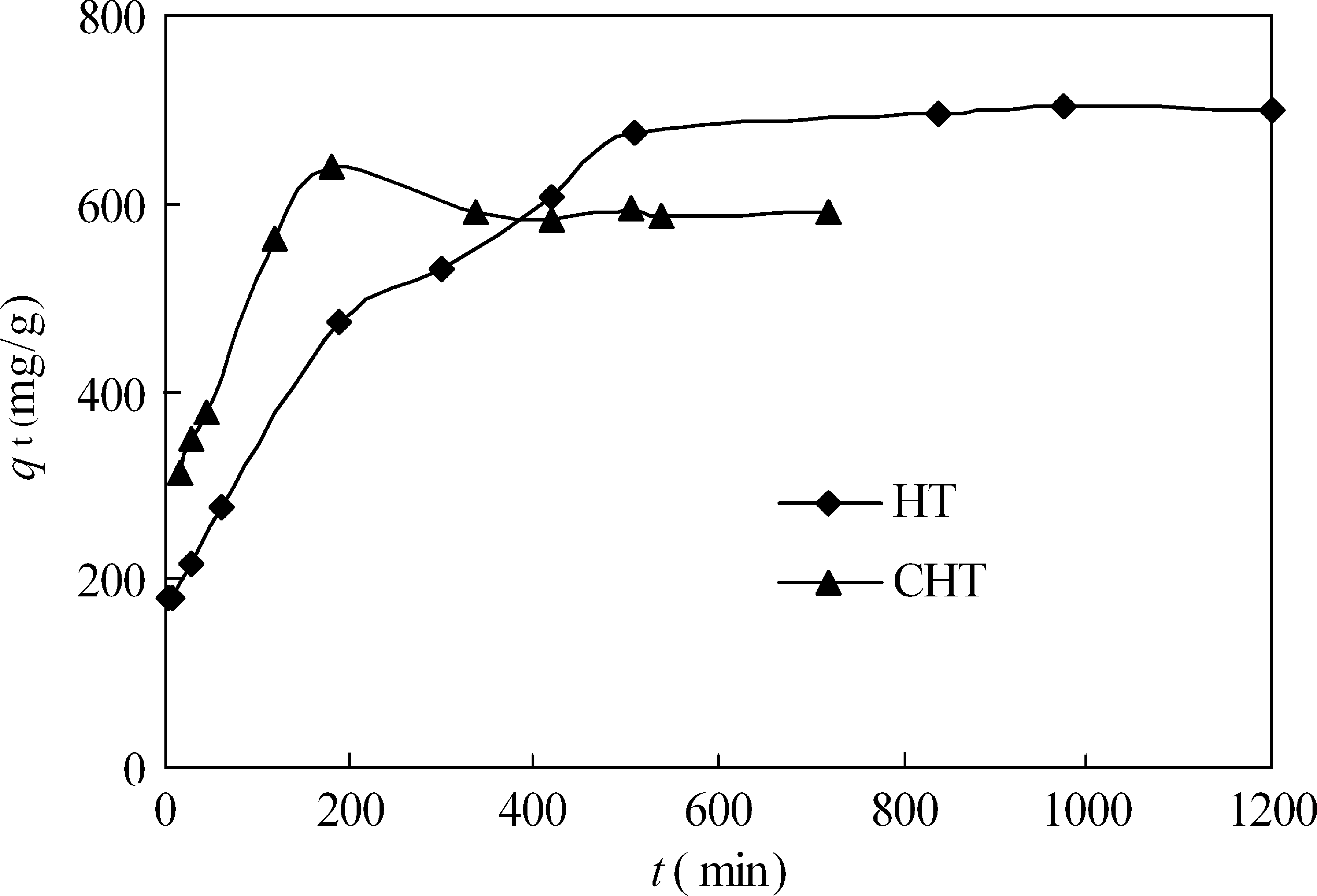
Adsorption of BA on HT and CHT with an Mg/Al molar ratio of 2:1 as a function of contact time (initial pH 4.5).
Kinetic analyses were performed by using the following pseudo-first-order rate expression Lagergren equation (1), pseudo-second-order rate expression equation (2) (Ho and McKay, 2000), and intraparticle diffusion model (3) (Lin et al., 2009):
where qe and qt (mg/g) are the adsorption quantity on the adsorbents at equilibrium and at time t (min); k1 (min−1) and k2 [g/(mg · min)] are the rate constants of pseudo-first-order and pseudo-second-order kinetic models; C is the intercept (mg/g); and kp is the intraparticle diffusion rate constant [mg/(g · min1/2)].
Both parameters and the correlation coefficients are given in Table 2. The table shows that the correlation coefficients R2 of pseudo-second-order rate expressions were much higher than those of pseudo-first-order expressions and intraparticle diffusion models. And the theoretical uptakes qe,cal were in good agreement with the experimental uptakes qe,exp for the pseudo-second-order expression. So the adsorption of BA by HT and CHT conforms to the pseudo-second-order kinetic model.
HT, hydrotalcite; CHTs, calcinated hydrotalcites.
Adsorption isotherm
The equilibrium adsorption quantities of BA on the HT and CHT as a function of equilibrium concentrations of BA are illustrated in Fig. 4. The equilibrium adsorption quantities increased considerably with an increase in the lower initial concentrations. The equilibrium sorption experimental data obtained in this study were analyzed using the commonly used Freundlich and Langmuir isotherm models.
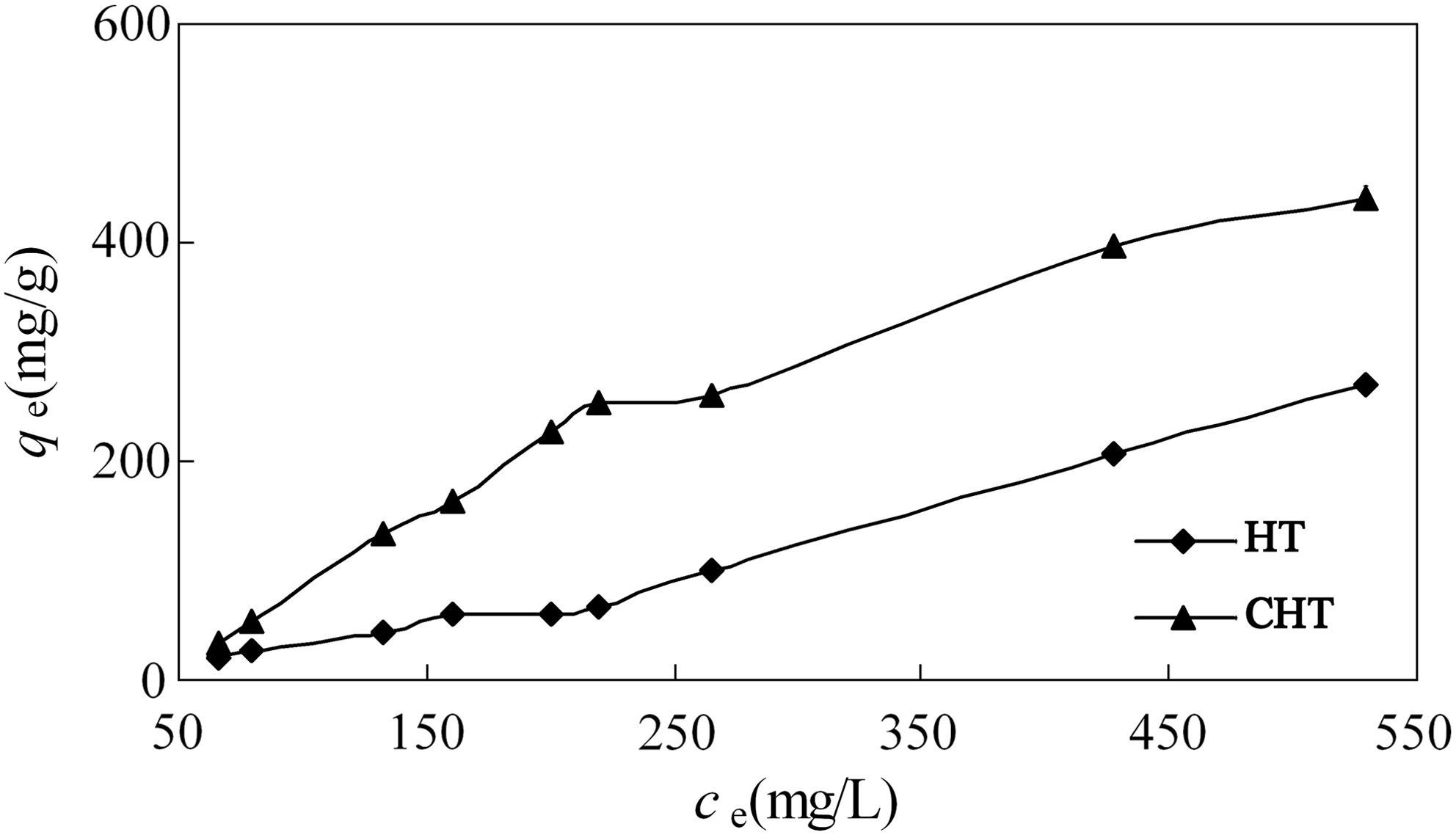
Equilibrium isotherm of the uptake of BA by HT and CHT with an Mg/Al molar ratio of 2:1 at 293 K (adsorbent dose: 0.02 g; initial pH 4.5).
The Freundlich isotherm model is described by the following equation:
where qe is the adsorption quantity on the adsorbents at equilibrium (mg/g), ce is the equilibrium concentration of BA in the solution (mg/L), and K [(mg/g)/(mg/L)1/n] and n are the Freundlich temperature-dependent constants.
Note that equation (4) is often used in the linearized form of equation (5):
The Langmuir isotherm model is described by the following equation:
where qe is the adsorption quantity on the adsorbents at equilibrium (mg/g), Qmax is the maximum sorption quantity (mg/g), ce is the equilibrium concentration of BA in the solution (mg/L), and b (L/mg) is the Langmuir constant related to the adsorption energy. For convenience of plotting and determining the Langmuir constants, the Langmuir equation can be rearranged to linear form as below:
The apparent equilibrium constants of Freundlich isotherm equations and Langmuir isotherm equations are given in Table 3. Based on the correlation coefficients (R2), the adsorption data were much better fitted with the Freundlich equation than the Langmuir equation. Therefore, the adsorption process was considered to obey the Freundlich isotherm. The equilibrium adsorption quantities of BA on the CHT were much higher than those on the HT at the same temperature. It could be explained that the CHT owned a larger specific surface area and pore volume and underwent rehydration and incorporation of BA in aqueous medium to regain the HT structure (Erdem and Ozverdi, 2006). Through measuring by an automated surface area and pore size analyzer, the specific surface areas of the HT with 2:1 Mg/Al molar ratio and its CHT were 87.82 and 127.67 m2/g, respectively, and the pore volumes were 0.435 and 0.509 cm3/g, respectively.
Effect of adsorbent dosage
The effect of adsorbent dosage on the adsorption is shown in Fig. 5. The equilibrium adsorption quantities decreased with increasing amount of adsorbents. Many factors can contribute to this adsorbent concentration effect. The most important factor is that adsorption sites remain unsaturated during the adsorption process (Lin et al., 2009). The decrease in the adsorption quantity of BA with the increase in the adsorbent dosage was mainly attributed to the unsaturation of the adsorption sites.
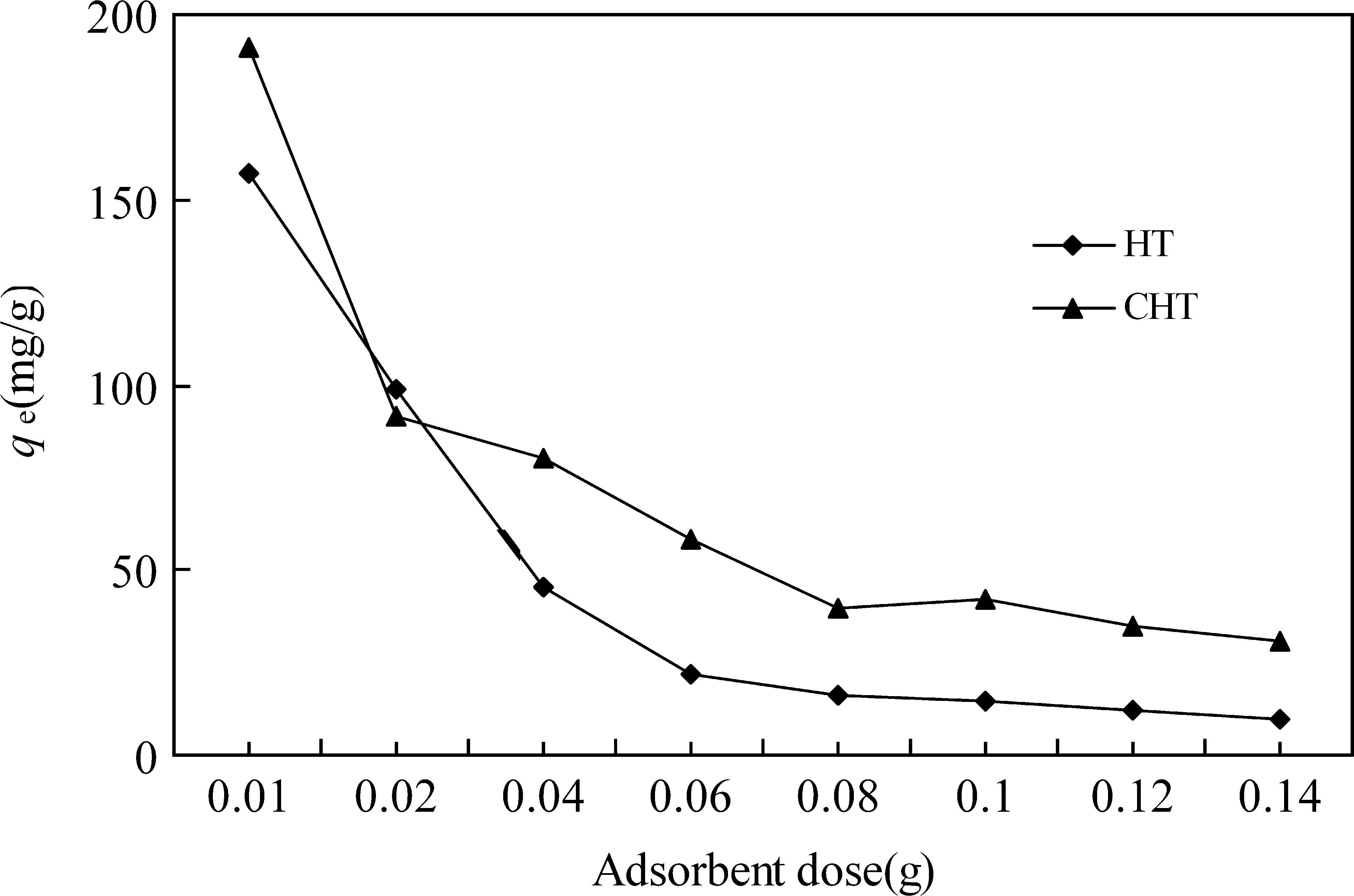
Adsorption of BA on HT and CHT with an Mg/Al molar ratio of 2:1 as a function of adsorbent dose at 293 K (initial concentration: 250 mg/L; initial pH 4.5).
Effect of temperature
The effect of temperature on the adsorption is shown in Fig. 6. The equilibrium adsorption quantities increased with elevated temperature for adsorption of BA on the HT. On the contrary, the equilibrium adsorption quantities decreased with elevated temperature for adsorption of BA on CHT. Because adsorption isotherm on HT and CHT belonged to Freundlich model, adsorption enthalpy change was calculated according to Van't Hoff equation (Carcia-delgado et al., 1992):
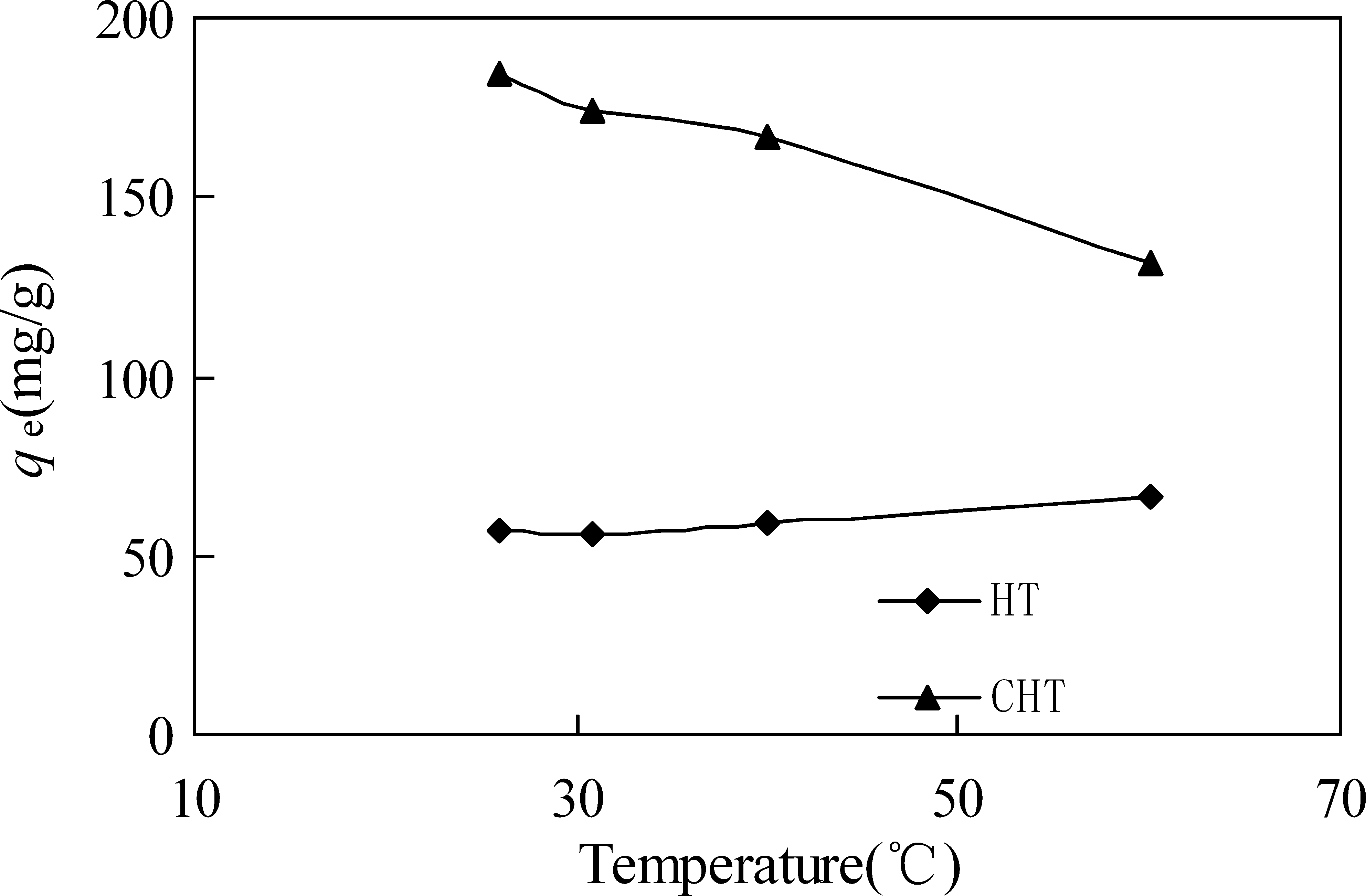
Adsorption of BA on HT and CHT with an Mg/Al molar ratio of 2:1 as a function of temperature (adsorbent dose: 0.02 g; initial concentration: 200 mg/L; initial pH 4.5).
where ce is the equilibrium concentration of BA in the solution (mg/L), KF is the empirical constant of Freundlich isotherm (L/mg), R is the universal gas constant [8.314 J/(mol · K)], T is temperature (K), and ΔH° is adsorption enthalpy change (kJ/mol). The values of ΔH° were evaluated from the slope of the Van't Hoff plot (ln 1/ce vs. 1/T). The values of ΔH° for the HT and CHT were 0.716 and −5.154 kJ/mol, respectively. The positive value of ΔH° for HT confirmed the endothermic nature of adsorption of BA on HT, whereas the negative value of ΔH° for CHT indicated the exothermic nature of adsorption of BA on CHT.
Mechanism of removal of BA
Figure 7 shows the XRD patterns of the original HT (Fig. 7a), the CHT with the diffraction peaks characteristic of a Mg-Al mixed oxide (Fig. 7b), and the regenerated HT after adsorption of BA (Fig. 7c). The regenerated HT exhibited a d003 basal spacing of 0.759 nm and showed little increase of the basal spacing compared with that of the HT with the carbonate anion in the interlayer (0.755 nm). As the size of the C7H5O2− anion is 0.8 nm (Li et al., 2002) in vertical position, this spacing should indicate that C7H5O2− was oriented in a flat position in the regenerated HT interlayer. Similar results had been reported for the adsorption of the acidic pesticides (2,4-D, clopyralid, and picloram) in CHT (Pavlovic et al., 2005). The XRD pattern of the HT after uptake of BA (data not shown) was the same as that of the original HT, which indicated that the adsorption of BA on HT belonged to surface adsorption and the ion exchange of interlayer exchangeable anions was not carried out. Because the molecular diameter of CO32− is less than that of C7H5O2−, and the negative charge number of CO32− is greater than that of C7H5O2−, CO32− in the interlayer is difficult to be replaced by C7H5O2−. Therefore, C7H5O2− is not easy to enter the interlayer.
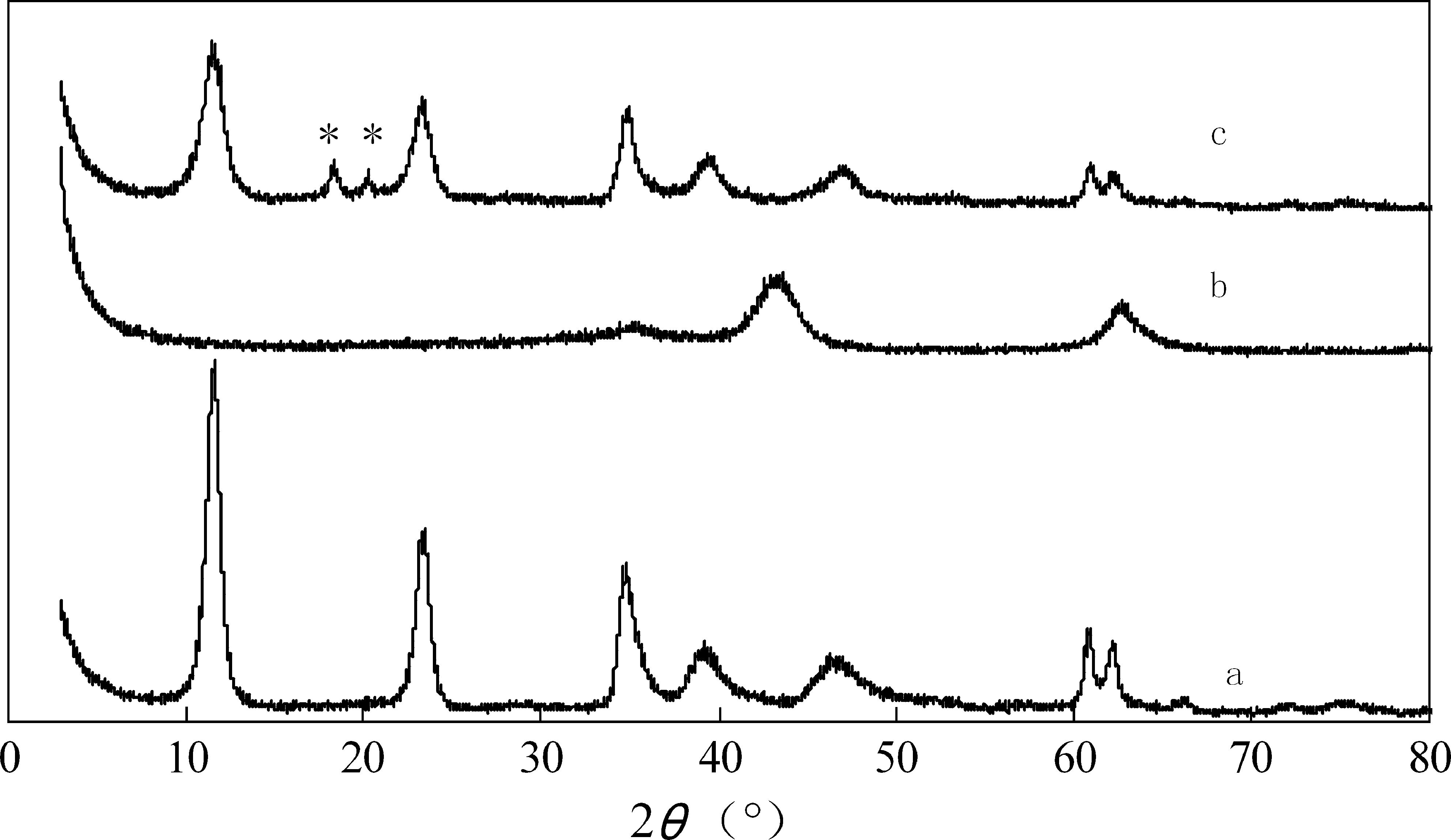
XRD patterns of
Adsorption products were studied by FTIR spectroscopy to confirm the adsorption of BA on CHT by the mechanism of reconstruction; the results are shown in Fig. 8. Figure 8b and c shows that BA had been adsorbed on HT and CHT. The FTIR spectrum of the HT in Fig. 8d displayed a wide band at 3,461 cm−1 attributed to the vO–H vibrations of free and H-bonded hydroxide groups. The low-intensity band at 1,616 cm−1 was due to the water-bending mode δO–H. The stretching-vibration band of carbonate anion was located at 1,360 cm−1. The FTIR spectrum of the CHT in Fig. 8e displayed a wide band at 1,369 cm−1 attributed to the surface adsorption of carbonate anions. The band between 400 and 800 cm−1 could be attributed to the superposition of the characteristic vibrations of magnesium and aluminum oxides. The FTIR spectrum of the BA-adsorbed and cleaned CHT in Fig. 8f displayed a wide band at 1,723 cm−1 attributed to the C = O vibration of carboxyl group. This indicated that C7H5O2− was inserted between the layers of the regenerated HT, because the CHT after uptake of BA had been cleaned with a mixture of ethanol and water (1:1, v/v) to remove all weakly physisorbed BA. However, the FTIR spectrum of the BA-adsorbed and cleaned HT (data not shown) was the same as that of the original HT, which also indicated that the adsorption of BA on HT belonged to surface adsorption.

FTIR spectra of
Conclusion
The HT and CHT can be used effectively for adsorption of BA from aqueous solution. The equilibrium adsorption quantities of BA on HTs and CHTs were the largest at a pH value of 4.5, and the equilibrium adsorption quantities reduced in the range of pH 5.5–9.5. The adsorption equilibrium times for the HT and CHT were 600 min and 180 min, respectively. The adsorption processes followed pseudo-second-order kinetic model. Experimental data were fitted well with the Freundlich adsorption isotherm equations. The equilibrium adsorption quantities of BA on the CHT were much higher than those on the HT at the same temperature. The equilibrium adsorption quantities decreased with increasing amount of adsorbents. The ΔH° were calculated from the experimental data, and these values showed that the adsorption of BA was endothermic on HT and exothermic on CHT. A mechanism of the adsorption phenomenon had been proposed on the basis of X-ray diffraction and FTIR data; the results indicated that the adsorption of BA on HT belonged to surface adsorption, and the adsorption of BA on CHT resulted from the “memory effect” of CHT and inevitable surface adsorption.
Footnotes
Acknowledgment
The authors acknowledge the support by the Fundamental Research Funds for the Central Universities (DL09AB07).
Author Disclosure Statement
No competing financial interests exist.