




Abstract
Abstract
Widespread applications in various industries will inevitably result in the release of a substantial amount of carbonaceous nanoparticles into the environment. Much research has been conducted to assess their health and environmental impacts. However, few studies have been carried out to examine the complex interactions of carbonaceous nanoparticles with co-existing environmental pollutants in complex environmental systems. Current work investigated the potential impacts of nC60 fullerene nanoparticles on the fate and uptake of trichloroethylene by plants in phytoremediation systems. Addition of 2–15 mg/L fullerene nanoparticles did not result in any acute toxicity to plants in terms of phenotype, water transpiration, and plant biomass in batch hydroponic studies. Plant uptake of trichloroethylene was increased by ∼26% and 82% by the addition of 2 and 15 mg/L of fullerene nanoparticles synthesized through solvent (toluene) exchange. This is the first time that fullerene nanoparticles were shown to significantly affect the fate and uptake of an organic contaminant in phytoremediation systems.
Introduction
In addition to direct interactions with various components of the ecosystem, ENPs can interact with co-existing contaminants, affecting their fate and transport in the environment (Sun et al., 2009). Trichloroethylene (TCE) is a colorless chlorinated solvent widespread in the environment. In phytoremediation systems, organic compounds such as TCE are primarily removed through enhanced rhizosphere degradation, uptake, and phytovolatilization and phytodegradation (Pilon-Smith, 2005). Plant uptake is a pivotal process in determining the fate of TCE in phytoremediation. Large specific surface area of carbonaceous nanoparticles renders them excellent adsorption materials for organic compounds (Pan and Xing, 2008; Oleszczuk et al., 2009). Carbonaceous nanoparticles laden with organic compounds could act as contaminant carriers and dramatically change the fate and transport of organic compounds in various environmental systems (Hofmann and von der Kammer, 2009). A recent study showed that carbon nanotubes (CNTs) can penetrate the cell walls of plant root cells and provide a new mechanism for enhanced uptake and accumulation of phenanthrene in root tissues and cell cytoplasm (Wild and Jones, 2009).
Buckminsterfullerene C60 is a carbonaceous ENP widely used in industrial and scientific applications due to its unique icosahedrally symmetrical structure and surface properties (Mauter and Elimelech, 2008). In plant systems, the phytotoxic effect of fullerene C60 has not been reported, but a study has demonstrated that fullerene C70 can be taken up by rice (Oryza sativa) roots and transported to shoots (Lin et al., 2009). The objective of this study was to assess the impact of C60 fullerene nanoparticles on the fate and uptake of TCE in phytoremediation systems.
Materials and Methods
Fullerene nanoparticle synthesis and characterization
Fullerene nanoparticles were synthesized with the solvent exchange method (Chen and Elimelech, 2006). Briefly, 0.05 g of 99.9% fullerene powder was dissolved in 20 mL high-performance liquid-chromatography-grade toluene, forming a magenta-colored solution. This solution was mixed with 100 mL de-ionized (DI) water and 3 mL ethanol, and the mixture was then sonicated with a probe sonicator for ∼8 h, resulting in a yellowish fullerene nanoparticle suspension (SON/nC60). DI water was added periodically to compensate for the water loss in sonication. The synthesized fullerene nanoparticles were examined under a Hitachi H7650 transmission electron microscope at 60 kV following established protocols to determine the size and shape of synthesized nanoparticles (Ma et al., 2010). The synthesized nanoparticles were used directly without further treatment.
Plants and experimental setup
Twelve-inch eastern cottonwood (Populus deltoides) cuttings, with diameter at around 1 cm, were purchased from Segal Ranch Hybrid Poplars. The plant cuttings were grown in a greenhouse where temperature ranged from 20.7°C to 36.2°C and the humidity from 39% to 80% during the period of this experiment. The cuttings were planted in 500-mL wide-mouth glass jars fitted with Teflon lined lids and filled with ¼-strength-modified Hoagland solution (Ma and Burken, 2003). For each reactor, a cottonwood cutting was inserted through the hole in the center and a Teflon tube was inserted through the other hole on the lid. The hole in the center with plant cutting was sealed with Teflon tape and acrylic caulk, and the plant cutting was positioned such that the cutting was about 1 cm above the jar bottom. Evapotranspiration of Hoagland solution was replenished as needed through the Teflon tube. The jars were wrapped with aluminum foil to prevent algal growth. A similar configuration of the experimental setup can be found in literature (Burken and Schnoor, 1998).
After cuttings showed strong signs of sprouting and root development, Hoagland solutions were replaced with new solutions containing designated concentrations of fullerene nanoparticles. Afterward, 10 mL of TCE stock solution (450 mg/L) was added slowly through the feeding tube to obtain a final TCE concentration of 10 mg/L. The tube was sealed immediately with Teflon tape after TCE feeding. Three or four replicates were prepared for each dosing scenario and the specific dosing scenarios were as follows: 10 mg/L TCE only, 10 mg/L TCE + 2 mg/L nC60, and 10 mg/L TCE + 15 mg/L nC60. The targeted fullerene concentrations were obtained by diluting the stock solution with DI water, assuming that the loss of fullerene in the synthetic process was insignificant. Two viable cottonwood cuttings dosed with DI water were used as controls. Two dead cuttings in the same setting were also included to account for water evaporation from the reactors. The exposure lasted for 4 days and the feeding solution was not replenished during the experiment. Transpiration ranged from 123.7 + 10.3 mL for reactors with TCE only, 132.5 + 28.7 mL for reactors with TCE + 2 mg/L of nC60, and 121.7 + 17.6 mL for reactors with TCE + 15 mg/L of nC60, respectively.
Sample analysis
At termination, plants were sacrificed and separated into different sections including roots, stems under the lid, stems above the lid, and new stems and leaves. Plant tissues were placed into 22-mL vials, which were immediately sealed with a Teflon rubber septum and crimp top seal. Stems were cut into 1–1.5-inch smaller sections along height before they were placed into 22-mL vials. The sealed vials were heated at 90°C for 4 h to vaporize TCE to the headspace. TCE concentrations in the headspace were determined using a Perkin–Elmer Autosystem Gas Chromatograph equipped with an electron capture detector. The mass recovery rate of TCE was about 82%–93% (Gopalakrishnan et al. 2009).
Results and Discussion
SON/nC60 suspension is polydisperse and the size and shape characteristics of fullerene nanoparticles are in agreement with literature (Brant et al., 2006). SON/nC60 is mostly spherical and the average size based on the measurement of a 100 nanoparticles is about 39.1 + 11.7 nm. Fullerene particles with diameter >100 nm were also observed. The average nanoparticle size was slightly smaller than reported in literature using the same preparation method, likely due to the prolonged sonication period in this study. Four days after synthesized nanoparticles were exposed to plants and TCE, both individual and aggregated nanoparticles could be detected. Individual fullerene nanoparticles became slightly larger and the average size of fullerene nanoparticles was 61.4 + 13.2 nm and 66.1 + 12.5 nm in systems containing 2 and 15 mg/L fullerene nanoparticles, respectively. The aggregation of nanoparticles could partially result from the coagulation and flocculation process as a result of double layer compression by ions in Hoagland solutions. Fullerene nanoparticles in plant treatments became slightly more angular and the surface was not as smooth as freshly prepared. Typical fullerene nanoparticles after sonication and after exposure to plants and TCE are shown in Fig. 1. The transmission electron microscope image clearly indicated the attachment of certain materials on the surface of fullerene nanoparticles. The attachment could be microorganisms, TCE molecules, and/or water molecules. Exact composition of the attachment, however, needs further investigation.
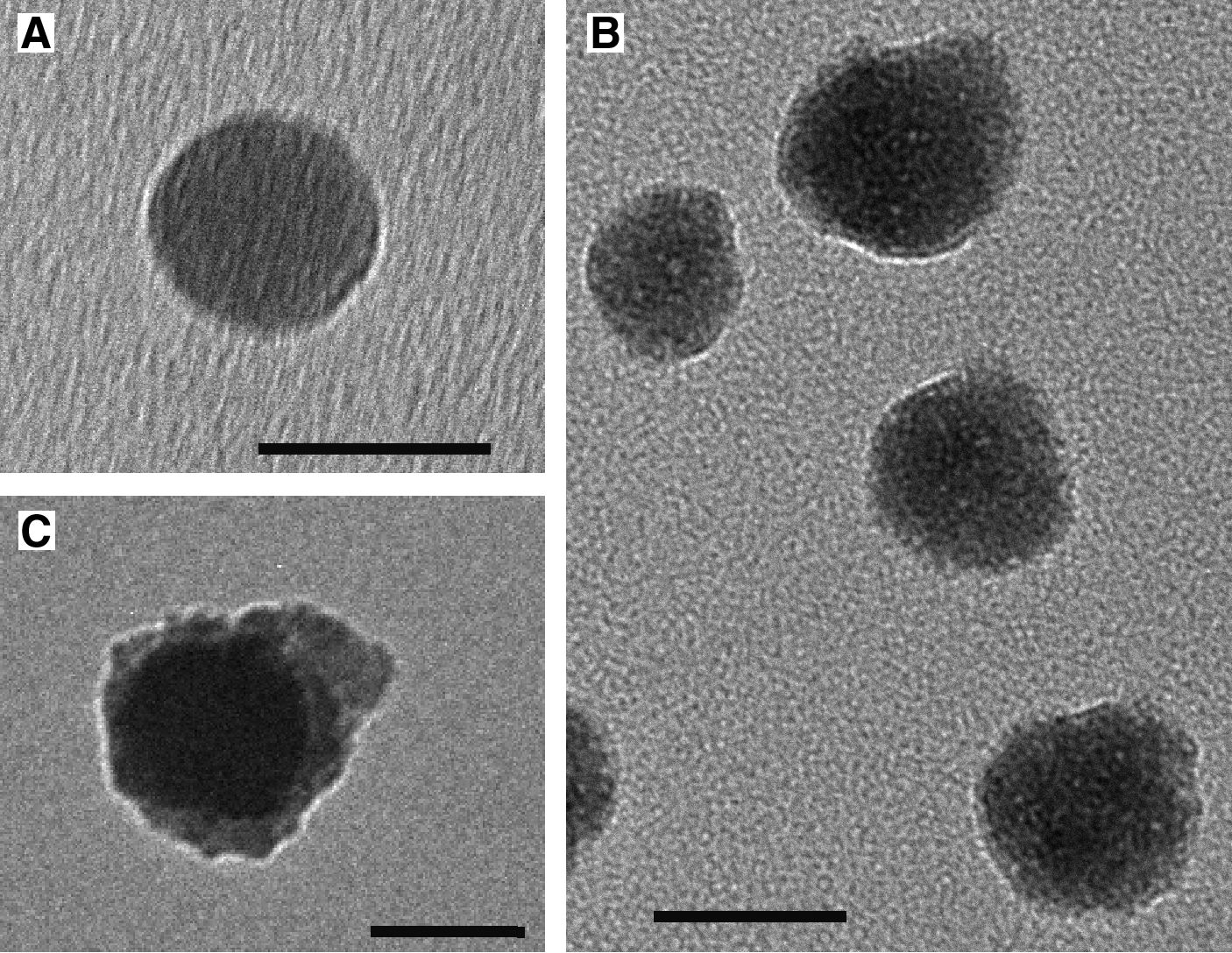
Representative SON/nC60 fullerene nanoparticles of (
The addition of up to 15 mg/L of fullerene nanoparticles did not result in any significant differences in plant morphology and water transpiration compared with reactors containing 10 mg/L of TCE only. In reactors containing SON/nC60, TCE concentrations or mass in plant biomass positively correlated with fullerene concentrations in solution, with higher SON/nC60 resulting in more elevated TCE concentration or mass in plant tissues. Similar trend was observed in the growth media, with higher SON/nC60 resulting in higher TCE concentrations or mass in the Hoagland solution (Fig. 2). It is probable that C60 dispersed in water provided a new phase of partitioning for TCE, rendering higher concentrations of TCE in solution. To evaluate whether elevated concentration of TCE in plant tissues could be explained by increased concentration of TCE in solution, the ratio of TCE in plant biomass and TCE in solution was calculated. The ratio became higher with increasing concentrations of SON/nC60. Even though the differences between the ratios are statistically insignificant (p = 0.05), the steady trend may still indicate that the presence of SON/nC60 facilitated plant uptake of TCE. Even though fullerene lacks the tubular structure of CNTs to pierce through plant cells to facilitate contaminant uptake, the unique structures of fullerene probably make it easier to be taken up by plants. Lin and colleagues (2009) demonstrated that nC70 aggregates with the size from 40 to 70 nm can be taken up by rice roots and transported to shoots and leaves through vascular tissues while CNT uptake was not observed. The same study also indicated that C70 in vascular systems could leak into surrounding cells and intercellular spaces. Uptake of fullerene nanoparticles laden with TCE on the surface may be a possible reason for enhanced uptake of TCE by plants. The fullerene nanoparticle aggregates were generally <70 nm.
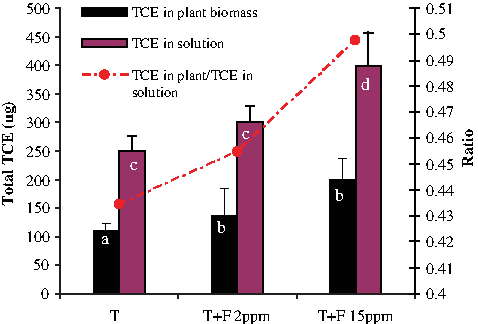
TCE in plant biomass and in growth media 4 days after plants were exposed to TCE and TCE + SON/nC60 fullerenes. Initial TCE concentration was 10 mg/L in all treatments. Theoretical concentrations of fullerene nanoparticles are 2 and 15 mg/L. The reported results are the average of three or four replicates; error bars represent standard deviation. Bars with different letters are significantly different. Red dots represent the ratio between the average TCE in plant biomass and TCE in solution. T, TCE; F, fullerene nanoparticles.
The concentration of TCE in different plant compartments (e.g., roots and stems) demonstrated similar trends as in whole plant seedlings in the presence of SON/nC60 (Fig. 3), indicating that TCE-SON/nC60 complex was transported to all these compartments. Examination of the distribution of TCE in plant compartments showed that SON/nC60 enhanced the accumulation of TCE in the stems below lid but reduced the accumulation of TCE in other sections. The results could be ascribed to (1) the enhanced adsorption of TCE-fullerene complex on the surface of stems below lid and (2) the transport kinetics. It is likely that transport of fullerene-TCE complex was faster in fresh roots than in stems. A previous research indicated that transport of fullerene nanoparticles in mature plants is relatively slow and fullerenes are predominant in and near the vascular tissues of plant stems (Lin et al., 2009).
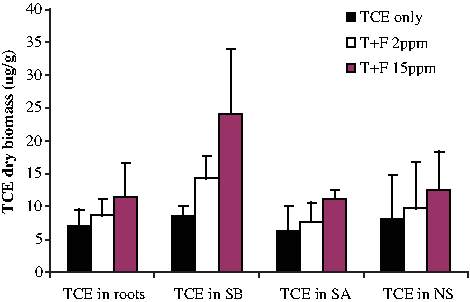
Average dry biomass concentration of TCE in different compartments of eastern cottonwood exposed to TCE or TCE + SON/nC60. Error bars represent standard deviation. n = 3, 4. T, TCE; F, fullerene nanoparticles; SB, stems below the lid; SA, stems above the lid; NS, newly developed stems.
Similar experiments were conducted with a bush plant, Redosier dogwood, and the results were similar to what was observed with eastern cotton wood. The results could be attributed to the similar xylem structures of these two plant species. How plant species with varying xylem anatomy affect the interactions of TCE, fullerene nanoparticles, and plants needs further investigation. We repeated the experiment with aqu/nC60, fullerene nanoparticles synthesized through prolonged mixing of fullerene and DI water in the dark for 2 months at room temperature (21°C ± 2°C). The addition of 15 mg/L aqu/nC60 resulted in lower ratio of TCE in plant biomass over TCE in solution. The result could be due to the much larger size of aqu/nC60, which was on average 250 nm. The shape was angular and irregular. Observation of plant roots under a Leica 6D light microscope indicated that some fullerene aggregates were retained in the crotch area of primary and secondary roots because aqu/nC60 as large as 250 nm is unlikely to be taken up by plants. Even though aqu/nC60 fullerene aggregates were not thoroughly characterized in this study, literature information on the surface property, shape, and structure and size of fullerene nanoparticles synthesized through different methods is abundant (Brant et al., 2006). A recent publication showed that fullerene nanoparticles synthesized through the methods employed in this study are negatively charged and behave differently in environmental conditions (Chen and Elimelech, 2009). The preliminary result with aqu/nC60 suggested that synthesis methods may be an important parameter affecting the fate and impact of fullerene nanoparticles.
To summarize, the presence of fullerene nanoparticles significantly changed the fate and uptake of TCE in phytoremediation. The impact depends at least partially on the physiochemical properties of fullerene nanoparticles, which are in turn a function of the synthesizing methods. The adsorption of TCE to fullerene surface to form fullerene-TCE complex is most likely one of the main mechanisms for fullerene nanoparticles to affect the fate and uptake of TCE in phytoremediation systems. If this is true, it can be expected that the impact will be more dramatic for compounds with stronger affinity to carbonaceous nanomaterials such as polychlorinated biphenyls. These compounds are generally not susceptible to plant uptake due to their high water-octanol partitioning coefficient. The organic-fullerene complex could provide a new pathway for highly hydrophobic organic compounds to enter into plant tissues. The enhanced uptake and accumulation of these highly hydrophobic and aromatic compounds in plants has serious environmental and safety implications, and the complex interactions between ENPs, plants, and contaminants warrant further investigation.
Footnotes
Author Disclosure Statement
No competing financial interests exist.