




Abstract
Abstract
In Taiwan, four alternatives have been considered for final disposal of food wastes; they are pig feed, anaerobic digestion, feedstuff production, and composting. However, an optimal method has not been determined. This research applied multivariate factor analysis and cluster analysis to analyze the information collected using the Likert scale questionnaires so that reliable and effective quantitative results can be obtained for more robust decision making. Composting stands out as the most acceptable method through the analysis of the quantified degrees of preference and the grades of acceptability. Additionally, a quantified strength, weakness, opportunity, and threat (SWOT) analysis was compiled through the original questionnaires. Comparison of the results obtained using the multiple-variable statistical analysis and the SWOT analysis confirms that SWOT results are valuable references for general decision making. However, whether results are consistent or not depends on the conditions of individual cases studied.
Introduction
Strength, weakness, opportunity, and threat (SWOT) analysis is a commonly used tool for analyzing internal and external environments to attain a systematic approach and support for a decision situation (Kotler, 1988; Wheelen and Hunger, 1995). The internal and external factors most important to the enterprise's future are referred to as strategic factors and they are summarized within the SWOT analysis. The final goal of strategic planning process, of which SWOT is an early stage, is to develop and adopt a strategy resulting in a good fit between internal and external factors. SWOT can also be used when strategy alternative emerges suddenly and the decision context relevant to it has to be analyzed.
To assist in finding an optimal method for food waste recycling, strategic management skill was referred. Strategic management has been widely used by all enterprises to challenge fierce market competitions. The strategic management process consists of three stages: strategy formulation, strategy implementation, and strategy evaluation (David, 1998). The SWOT analysis of external opportunities and threats as well as internal strengths and weaknesses of the enterprises are of great importance for conducting strategy formulation. However, because of lacking the support of quantitative results, the traditional qualitative SWOT method has seldom directly relied on for strategic decision making. If used correctly, SWOT can provide a good basis for successful strategy formulation. Most literature published on SWOT analysis emphasized a literal description of the analysis and few presented results of conducting quantified analyses. As the planning process is often complicated by numerous mutually interdependent criteria, the traditional qualitative SWOT may be insufficient for making a proper decision.
Some examples of weighting and subdividing SWOT have been presented in literature. Kotler (1988) showed that external factors could be classified according to their attractiveness and success probability (opportunities) as well as seriousness and probability of occurrence (threats). Internal factors could be rated by their performance and importance. Wheelen and Hunger (1995) summarized the external and internal strategic factors into synthesis of external strategic factors and synthesis of internal strategic factors. They revealed how internal and external factors could be weighted and rated to illustrate how well a management responded to these specific factors (rating) in light of the reviewers' perceived importance or weight of the company. Weighting was carried out using Likert scale (Kurttila et al., 2000; Srivastava et al., 2005) with rating from 1 (poor) to 5 (outstanding). The mathematical product of rating scales and weighting factors is a weighted score that indicates how well the company is responding to current and expected strategic factors in its environment. A study by Hill and Westbrook (1997) found that none of the 20 companies in the case study prioritized individual SWOT factors. One company grouped the SWOT factors further into subcategories; only three companies used the SWOT analysis as an input for a new mission statement. In addition, individual SWOT factors were briefly expressed in a very general nature. Thus, the result of SWOT analysis is often a superficial and imprecise listing, or an incomplete qualitative examination, of internal and external factors (Kurttila et al., 2000).
In this study, the above weighting concepts were adopted for selecting the strategy to recover resources from food wastes. Multivariate factor and cluster analyses were applied to produce quantified scores of preference and grades of acceptability. Along with the “quantified SWOT” that was compiled by incorporating the quantifying results obtained with Likert scale questionnaires, a more robust decision-making process is suggested for an holistic engineering future.
Methodology
The four types of food waste disposal methods, that is, pig feeding, anaerobic digestion, feedstuff production, and composting, were selected for evaluation. The so-called “quantified SWOT” was implemented to evaluate the aforementioned four food waste disposal methods currently practiced in Taiwan with respect to the internal and external environments of the related food waste processing plant. The evaluation was based on the information collected through questionnaire that was developed and distributed to professionals and experts currently employed by environmental protection agencies and industries, public and private sectors employees involved in food waste resource recovery plants, researchers and faculty engaged in research on food waste resource recovery, and other relevant personnel engaged in the general environmental protection industries. The questionnaire results were analyzed using multivariate statistics with factor analysis followed by cluster analysis. Finally, the quantitative SWOT analytical method was applied to study the competitiveness and appropriateness of these food waste resource recovery methods. All statistical analyses were carried out with SPSS for Windows, version 14.0.
Factor analysis
The objective of factor analysis is to explain most variations by means of a few variables. Using the exploratory factor analysis, variable grouping is implemented to transform one set of factors into another set of factors with orthogonal rotation of geometric axes in a process known as “axis-rotation,” thus allowing the factors to be properly named. The naming process is made easier by setting only one element in a factor loading matrix [lij] to “1,” whereas all other elements in the same matrix to “0.” Subsequently, the factor analysis is based on the assumption that the data confirm to a certain specific structure that does not contain unique factors so that the results are not questionable. The process of factor analysis is sometimes made complicated if negative eigenvalues or different conditions occur during the analysis. Because only four variables are involved in this study, these problems are not expected to occur. This study uses internal and external environmental indices to conduct factor analysis; the internal and external assessment for the above four food waste resource recovery methods are defined below.
Ten internal environment indices (Srivastava et al., 1995) that affect the food waste resource recovery factors were used to evaluate the internal influences on the strength and weakness of the methods. These include maturity of operational techniques (A1), stability of food wastes supply (A2), energy and manpower consumption (A3), odor problem (A4), difficulty to implement (A5), disposal time required (A6), value added (A7), effectiveness in utilizing fat, grease, and oil content (A8), stability of product (A9), and market requirement of product quality (A10). Six external environment indices (Lei et al., 2005) were used for evaluating the external influences on the opportunities and threats of the methods. These include market acceptability (B1), operational and maintenance costs (B2), space requirement (B3), environmental quality improvement (B4), marketability (B5), and policy stability (B6). For quantitative surveying, the Likert scale (Srivastava et al., 2005) was used in the questionnaire to quantify the degree of preference of each method with respect to each internal and external indices (highly unacceptable = 1; moderately unacceptable = 2; average = 3; moderately acceptable = 4; highly acceptable = 5).
Based on the description of the central limit theorem, there must be >30 questionnaires for collecting effective answers. In this study, there are 16 internal and external environmental assessment indices and 5 Likert scale items. Thus, the minimum number of questionnaires must be >80 (16 × 5) to maintain reliability and validity. To ensure enough number of recoveries, 110 questionnaires were distributed and 85 responses were received.
As the internal environment assessment indices are concerned, an example question concerning the “maturity of operational techniques (A1)” was that “How do you evaluate the maturity of pig feeding operational technique currently applied in Taiwan? Please rate the scale from 1 to 5, with 1 being poor and 5 being excellent.” After receiving the responses, the index scores of each questionnaire were organized into a matrix (4 variables × 16 indices each) and we can find out the common factors by means of factor analysis. The results are listed on Table 1, where the number of eigenvalues that are >1 was used to determine the number of main factors. Followed by the orthogonal rotation, the component matrix (Table 2) was used for selecting the variable of various factors, explaining the characteristics of individual factor, and describing the differences among the four food waste resource recovery methods.
Cluster analysis
The objective of cluster analysis (Hill and Westbook, 1997) is to analyze the degree of similarities on how the participants responding to the four food waste resource recovery methods. The analytical results can then be used to deduct the degree and characteristics of acceptance of these four methods. Through factor analysis, relevant factors can be simplified for conducting the subsequent cluster analysis. The similarity among objects to be grouped in the same cluster is tested to assure the reliability of the data grouping, and thus, all samples in the same cluster have relatively small differences, whereas those in different clusters show greater differences.
The two-stage clustering method adopted by Huang (1995) was implemented in this study. The first step in cluster analyses was to group the 85 recovered questionnaires (or respondents) hierarchically for suggesting the initial number of clusters, followed by the K-means method (Huang, 1995) to test the most appropriate number of clusters. When the cluster analysis is carried out, individual elements in each cluster must be moved but there must be k number of clusters being maintained (k = 4 in this study). Through continually iterative testing, the four clusters have been finally finalized for differentiating the four food waste resource recovery methods.
During the process of factor analyses, the data matrix generated a normalized factor score coefficient matrix to yield factor score coefficients (Table 4). The latter was then subject to linear combination in which the factor score coefficient was multiplied by the quantified index scores (i.e., 1–5) to yield factor scores (Fig. 1) that were relied to assess the degree of preference for the four food waste resource recovery methods. Additionally, the accumulated classified (high or low acceptance) index scores were multiplied by the factor score coefficients (Table 4) to obtain the quantified grades of acceptability (Table 5). Higher grades indicate that a disposal method and its internal and external assessment scores are highly accepted and endorsed and vice versa.
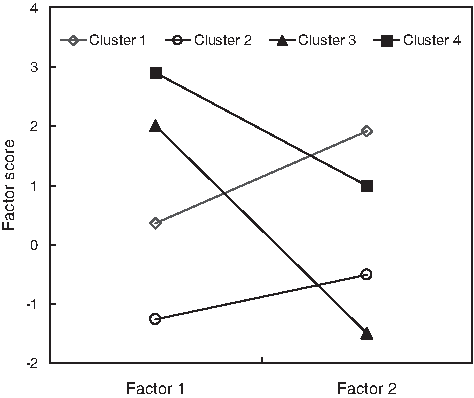
Factor scores of the four clusters.
Finally, individual index scores for each of the internal and external indices were compiled and summarized (Table 6) to reflect the SWOT for each of the four recycling methods and to assist in understanding the final quantitative conclusion of the grades of acceptability of the four food waste resource recovery methods.
Scope and limitation
This research was focused on comparison of the aforementioned four food waste resources recycling technologies currently implemented in Taiwan. Other countries with different food waste compositions and properties and different resources recycling alternatives were not considered. Basically, a successful use of multivariate statistical analysis for investigating the correlations among and characteristics of the four food waste resource recovery methods depends on sufficient sampling sizes. Insufficient number of responses will limit the dimension of the statistical analysis and hence adversely affect the accuracy and representativeness of the SWOT analytical results. In this study, the survey covers a wide variety of responses with little discrepancies in their expertise, knowledge, and background in food waste recycle and disposal. Although one may have the concern that the number of sampling is not high and that the various environmental assessment indices may not cover all aspects, the results obtained in this investigation is expected to provide an alternative method for evaluating and determining the best strategy that may be referenced by regulatory agencies for policy making in the future.
Results and Discussion
The questionnaires were mailed out in May 2009, and 85 of 110 were returned (77% recovery rate). The scores (1–5) were organized into 85 score matrices (4 variables × 16 indices each) and then subjected to factor and cluster analyses.
Results of factor analysis
After Likert scale quantification, the factors were subject to orthogonal rotation to yield the total variable explained matrix (Table 1) and the component matrix (Table 2). As shown in Table 1, the Kaiser–Meyer–Olkin measure of sampling adequacy (Chen, 2000) was applied to keep the two main factors with eigenvalues greater than “1,” that is, 1.631 and 1.103, with cumulative variance of 68.346%. Table 2 lists component matrix results and the characteristic differences for the two main factors. Factor 1 mainly consists of feedstuff production, composting, and anaerobic digestion, with the explained variance of 40.763% (Table 1). The common characteristics of the above three resource recovery methods are the need of mature technology to carry out the numerous physical, chemical, and biological processes. Thus, factor 1 may be grouped and regarded as the “food waste processing factor.” Factor 2 consists of a single pig feeding activity, with the explained variance of 27.583% (Table 1). During the earlier years, there was no other method to recycle food waste except direct pig feeding. Thus, this method is naturally easy to implement in Taiwan. This factor emphasizes a direct use of food wastes to feed pigs and requires no complicated procedures to process the wastes. Thus, it can be regarded as the “food waste direct reuse factor.”
Results of cluster analysis
On the basis of the results from factor analysis, only the two main factors were kept in the cluster analysis for lowering the dimension and increasing the accuracy. Through repeated testing, four clusters that are the most capable of differentiating how participants responded to these four food waste resource recovery methods in questionnaire were selected for discussion later. Figure 1 shows variations of the factor score that indicate the relationship between the clusters and factors. These clusters are converted back to the degree of preference according to the original questionnaire. The results, listed in Table 3, will “quantitatively” assist the surveyors (or decision makers) in understanding the comparative acceptances of the four food waste resource recovery methods among the four clusters of the questionnaire responds.
Likert scales are defined as follows: 1 = highly unacceptable; 2 = moderately unacceptable; 3 = average; 4 = moderately acceptable; and 5 = highly acceptable.
O & M, operational and maintenance.
Table 3 shows that the questionnaire respondents of cluster 1 had the highest degree of acceptance to pig feeding among all methods. Figure 1 also demonstrates that cluster 1 in factor 2 has the highest factor score, indicating that many experts participating in the survey consider pig feeding being highly or moderately acceptable based on the internal and external assessment indices. In Table 3, the index scores representing “negative” choices (scales 1 and 2) for factor 2 (pig feeding) are “zero,” whereas the index scores representing “positive” choices (scales 4 and 5) for factor 1 (processing) are not high. Thus, pig feeding is a preferred resource recovery method in this cluster that is categorized as “high acceptance for pig feeding.”
For cluster 2, most questionnaires pick “average” as the main response. According to Table 3, the index scores of selecting both factor 2 and factor 1 as highly acceptable are nearly zero. However, the total index scores of selecting factor 1 and 2 as negative choices (scales 1 and 2) seem to be somewhat high (96 and 390), with the negative scores for factor 2 constituting relatively higher percentages. Thus, this cluster can be classified as “low acceptance for pig feeding.”
Similarly, cluster 3 can be categorized as “high acceptance for food waste processing cluster.” It implicates that the questionnaire respondents believe the technology and that various environmental aspects for factor 1 have been well developed and accepted, with emphasis on composting as the relatively preferred method.
Further, cluster 4 can be categorized as “high acceptance for all food waste disposal methods cluster.” It implicates that the questionnaire respondents show positive attitude toward all of the current food waste recycling methods practiced in Taiwan. This is also shown by Fig. 1 that cluster 4 has the highest overall factor score. This cluster represents proenvironmentalist. As long as there is a recycling practice, they do not really care what the method is.
Analyzing the quantified acceptability
The questionnaire results on the 16 indices can be further processed to assess the acceptability of the four food waste resources recovery methods via grades of acceptance. According to the aforementioned methodology, factor score coefficients are calculated as shown in Table 4. The calculated grades of acceptance are presented in Table 5; the quantified grade of acceptance can then be referenced for determining the degree of advantages and disadvantages of the various methods.
Table 5 indicates that the grades of high acceptance (scales 4 and 5) for composting (331) are the highest among these four methods; feedstuff production (305) has the next high grades of high acceptance followed by pig feeding, and anaerobic digestion has the lowest grades of acceptance. In terms of the grades of low acceptance (scales 1 and 2), it is also clear that pig feeding (498) is the highest among these four methods. Such observations indicate that composting is the most recommendable food waste resource recycling method. On the other hand, although pig feeding is currently the most practiced method in Taiwan, it is the most unacceptable practice to the experts who responded to the survey. Note that such influential conclusion will only become obvious when the quantified grade of acceptance multivariate analysis method is adopted.
Quantified SWOT analysis results
In addition to the advantages of the quantified grades of acceptability, another strong point of the proposed multivariate analysis method is to produce the quantity-based SWOT results in assisting decision making. To proceed, we begin with compiling the original questionnaires. The internal indices corresponding to highly and moderately acceptable scales (5 and 4, respectively) are designated as “strength”; those corresponding to highly and moderately unacceptable scales (1 and 2, respectively) are considered as “weakness.” The external environmental indices corresponding to highly and moderately acceptable are designated as “opportunity” and those corresponding to highly and moderately unacceptable as “threat.” Considering the accountability and significance of the content in Table 6, the internal or external indices were only categorized as “strength” or “opportunity” if the respondents who chose scale 5 or 4 exceeded two-thirds of the questionnaire population. Accordingly, it was categorized as “weakness” or “threat” if those who chose scale 1 or 2 exceeded two-thirds of the questionnaire population. It was not included in Table 6 whether those who chose scale 3 exceeded two-thirds of the questionnaire population. The results, which are compiled and listed in Table 6, will be used for subsequent comprehensive evaluation.
Pig feeding
The results of SWOT analyses as shown in Table 6 indicate that the major “strength” of pig feeding is its short treatment time (A6), ease of implementation, and general acceptance by pig farms (A5). Additionally, pig feeding will effectively consume large quantities of fat, oil, and grease found in food wastes; therefore, it is an effective process to utilize nutrients (A8). However, as the “weakness” is concerned, the process of high-temperature (90°C) cooking of food waste for 90 min utilizing electricity is energy consuming (A3). Some pig farmers may avoid the operation costs by skipping or skimpily carrying out the cooking process, leading to the concern that this method is not easy to supervise by regulatory agencies (Lin, 2008). Additionally, the extended odor problem (A4) caused by pig wastes is troublesome for the regulatory agencies to regulate. Moreover, the food waste composition and its nutrient contents are not always stable; it may also contain impurities or nonhealthy components, and thus, the products may not be generally accepted by the public (A10).
As the external environmental indices are concerned, the greatest “threat” of pig feeding is the difficulty of controlling infectious diseases, for example, foot and mouth disease; the disease-associated risk is very high, thus causing poor policy stability (B6). Additionally, only the cooked food wastes (not the raw ones) can be recycled for pig feeding, which requires the bothersome prior separation during collection. As the overall improvement of environmental quality is concerned, allowing food wastes for pig feeding will stimulate the growth of medium- and small-sized pig farms, but the pipe-end control of pig wastes is difficult for management, leading to additional environmental pollution problems (B4). As the “opportunity” is considered, the questionnaire results indicate that the operation and maintenance costs are considered to be less expensive because pig feeding does not require expensive equipment or high capital investment as designated by “low initial and operational and maintenance costs (B2).” When the space requirement is concerned, the food waste cooking device will only occupy 5–10 m2 and the pig farm is generally located in remote villages where the space is not a major concern, and thus, the pig feeding practice does not have space problem (B3).
“Pig feeding” is done by feeding the cooked and thermally disinfected food waste to pigs. Although pig feeding is currently the most popular and easiest recycling practice, the possible risks associated with the use of food waste as pig feed, for example, infectious diseases, is causing a great concern. There have been various opinions expressed by experts in different fields on how to practice resource recovery from food wastes.
Anaerobic digestion to produce methane gas
As the “opportunity” is considered, results of the SWOT analyses in Table 6 indicate that effective recovery of the anaerobically produced gas (i.e., CO, CH4, H2S, and NH3) is technically achievable; hence, odor does not have much impact on the environment (A4). As the “weakness” is considered, anaerobic digestion requires a long reaction time (A6), and the technology of converting food wastes into methane gas is not well developed (A1) or implemented with successful full-scale example operation in Taiwan (A5). Hence, the process must be carefully operated by following strict procedures and controls for producing high-quality methane gas. Additionally, the pretreatment to remove fat, oil, and grease from food waste (Lin and Chen, 2001) prior to proceed with the subsequent treatment is a weakness and will further increase the treatment time (A6).
As the external environmental indices are concerned, the anaerobic digestion technology has been well developed in other countries, importing international advanced anaerobic technology to raise the efficiency and recycle the methane gas as bioenergy will create a valuable market (B5). These possibilities favor the “opportunities.” However, insufficient regulation supports on reuse of recovered bioenergy in Taiwan (B6), low gas production rate, and high investment risks may intimidate most potential investors. These are the “threats” of this method.
Feedstuff production
The results of the SWOT analyses (Table 6) show that no odor problem (A4) will occur if the food wastes have been dried to produce foodstuff for animal feed and the reuse of nutrient contained in food wastes will be high, thus adding additional value (A7). As the technology for the conversion has been well developed, the quality of final products should be stable (A9). All these can be considered as the “strength” of this method. However, the sources of food wastes are not quite consistent and the nutrient contents are not evenly distributed (A2); additives are sometimes needed to make up the nutrients that do not exist in the food wastes being processed. The recycling process involves complicated cracking, dewatering, removing fat, oil, and grease, drying, and fermenting (A5). These concerns can be considered as the “weakness” of this method.
As the external environmental indices are concerned, this method does not require a large area (B3) as does the composting method and is almost free from odor problem (B4). If a market can be developed, implementing this method will contribute significantly to the overall improvement of the environmental quality (B4). This is the “opportunity.” As the overall cost (B2) for promoting the use of food wastes as animal feed is higher and the nutrient of the resulting product is not as good as that contained in commercial feed, the market yet needs to be developed (B5). This is the “threat” to promoting this method.
Composting
The results of the SWOT analyses (Table 6) reveal that composting technologies have been well developed in Taiwan (A1) and that mature compost is stable. Both raw and cooked food wastes can be used for composting, which does not require the bothersome prior separation during collection. Thus, implementing this method will not concern too much about the stability of food waste sources (A2) to interfere with its operation. The mature compost is used as soil conditioner to improve the soil quality for increasing the organic food production, and thus, the value added is high (A7). Therefore, this method is gradually emphasized by regulatory agencies for further promotion (Lin, 2008). These are the “strengths” of this method. However, the composting time is usually long (A6) and there is a possibility of breeding pest insects during the composting process let alone the possibility of odor problem (A4) that will cause nuisance to the neighboring residents. Hence, the processing plant should be located far away from residential area.
As the external environmental indices are concerned, the compost is effective in improving the soil quality and reducing the use of chemical fertilizer (B1). It enables organic wastes to be completely recycled to eliminate waste incineration, which causes air pollution and greenhouse effect; thus, its implementation contributes to the overall improvement of environmental quality (B4). The composting method is a traditional and relatively simple technology; the time to establish a process plant is relatively short. If the odor problem can be effectively controlled (Pagans et al., 2006), promoting this method will be a stable and effective policy (B6). These are the “opportunities” of the composting method. Finally, the practice of composting requires a large space to turn over the composting pile and carry out pretreatment. Hence, the composting plant is usually established in remote rural areas for savings on land cost. As in urban areas, acquiring a large tract of land has become more difficult. The land requirement (B3) is the “threat” of composting technology in Taiwan.
Conclusions
The multivariate statistical factor and cluster analyses were used to analyze four food waste disposal methods, that is, pig feeding, anaerobic digestion, feedstuff production, and composting. The factor analysis resulted in two major factors; they are “food waste processing factor” including fertilizing, anaerobic digestion, and composting, and “food waste direct reuse factor” consisting of only pig feeding. The cluster analysis identifies four major clusters of the questionnaire respondents; they are “high acceptance of pig feeding,” “low acceptance of pig feeding,” “high acceptance of processing food wastes,” and “high acceptance of all food waste disposal methods.” Among the four disposal methods, “composting” has the highest acceptance followed by “feedstuff production” and “anaerobic digestion,” and “pig feeding” has the lowest acceptance. The statistical results and the SWOT analysis results are consistently similar in this study. This indicates that the pioneer application of the concept of “grades of acceptability” is a more robust tool and that the quantified SWOT analysis results provide a strong support for decision making.
Footnotes
Acknowledgments
The authors deeply appreciate the editor and the anonymous reviewers for their insight, comments, and suggestions.
Author Disclosure Statement
No competing financial interests exist.