




Abstract
Abstract
The objective of this study was to evaluate the effects of Fenton's oxidation combined with biological aerated filer process on advanced treatment of the citric acid wastewater. The effluent of an existing citric acid production wastewater treatment facility was collected and used to study the chemical oxygen demand (COD) removal efficiency of an advanced treatment process including Fenton's oxidation combined with a biological aerated filter. The bench-scale study on a batch reactor indicated that the COD removal by Fenton's oxidation increased with increase in H2O2 dosage from 0.3 to 0.9 mL/L, but decreased with further increase in H2O2 dosage from 0.9 to 1.7 mL/L. At an H2O2/Fe2+ molar ratio of 8, the optimized H2O2 dosage at pH 3.5 was 0.9 mL H2O2 per liter wastewater. Under these conditions, about 75% COD was removed by Fenton's oxidation. COD removal using Fenton's oxidation may be described with pseudo-first-order kinetics. The COD of the wastewater after Fenton's oxidation in a pilot-scale system was similar to the theoretical values calculated according to the kinetics equations. To reduce the operating cost caused by high chemical dosages in Fenton's oxidation, lower dosages of H2O2 was used for the pilot-scale studies. Decreasing the H2O2 dosage to 0.42 mL of 30% H2O2 per liter wastewater resulted in a 33% COD removal by Fenton's oxidation. Further treatment using a biological aerated filter reduced the COD in the final effluent to about 13 mg/L. Results indicted that Fenton's oxidation combined with biological aerated filter is efficient for COD removal of the citric acid wastewater. Small amount of chemicals may be used in Fenton's oxidation process for partial COD removal. After oxidation, the biological processes may further decrease the organic pollutants to very low levels. This article reported for the first time that the dosages of chemicals used for Fenton's oxidation of wastewater may be significantly decreased when it is used in combination with biological processes. The study provides a technically feasible way to use advanced oxidation processes in combination with biological processes for advanced treatment of industrial wastewater.
Introduction
Advanced oxidation processes (AOPs) have been well studied in the recent years as efficient technologies to remove organics from water or wastewater (Zhou and Smith, 2002; Canizares et al., 2009; Lucas and Peres, 2009). Fenton's oxidation is one of the easy-to-apply AOPs for wastewater treatment (Perez et al., 2002; Meric et al., 2004; Zazo et al., 2009). In this process, H2O2 catalytically decomposes by means of Fe2+ ion at acidic pH, forming hydroxyl radicals (•OH) as shown in Equation (1) (Perez et al., 2002; Meric et al., 2004; Zazo et al., 2009).
OH is a strong oxidant that can mineralize a wide range of organic compounds. As a chemical process, Fenton's oxidation is not influenced by the biodegradability, toxicity of the substrate, or the salinity of the wastewater. It can be applied to a wide range of water and wastewater treatment systems. In general, Fenton's oxidation process consists of four stages: pH adjustment, oxidation reaction, neutralization, as well as coagulation and precipitation.
However, the operating cost of AOPs is usually higher than the cost of biological processes because of the use of costly chemicals. A practicable way is to use AOPs combined with biological processes (Christensen et al., 2009; Lu et al., 2009; Martin et al., 2009a, 2009b; Wang et al., 2009). It has been widely accepted that the biodegradability of the wastewater may be improved after AOPs (Kitis et al., 1999; Kotsou et al., 2004; Tekin et al., 2006). As such, decreased amount of chemicals or electricity may be used in AOPs with main purpose for destruction of recalcitrant compounds or only partial chemical oxygen demand (COD) removal. After AOPs, biological processes can be used to decrease the COD to very low levels. Generally, the biological processes are more economical than chemical treatment.
Biological aerated filter (BAF) functions as both a bioreactor and also a filter. It is appropriate as an advanced treatment for removal of organic components as well as suspended solids (Mann and Stephenson, 1997; Farabegoli et al., 2009). In this article, the Fenton's oxidation followed by a BAF process is studied as the advanced treatment of the citric acid production effluent. The effects of H2O2 dosage on Fenton's oxidation are studied on a bench-scale testing system. A pilot-scale system has been established to study the BAF performance when decreased amount of H2O2 is used in Fenton's oxidation.
Experimental Protocols
Wastewater source and characterization
The wastewater was collected from the effluent of an existing wastewater treatment facility of a citric acid plant in Yixing Industrial Park, Jiangsu Province of China. The industrial wastewater discharged from the citric acid production workshops contained high contents of organic component as well as a great amount of calcium and dissolved solids. The existing wastewater treatment facility consisted of an equalization tank, an internal circulation (IC) anaerobic reactor, an aerobic tank, and settling tanks. The typical characteristics of the wastewater collected from the effluent of the existing treatment facility are presented in Table 1.
COD, chemical oxygen demand; BOD, biological oxygen demand.
Chemicals and materials
Chemically pure 30% (wt.%) H2O2, FeSO4·5H2O (with purity higher than 99%), NaOH (with purity higher than 96%), and 98% sulfuric acid (with purity of) were obtained from Beijing Chemical Plant and were used in both bench- and pilot-scale studies. Deionized water prepared at the plant through an ion exchanger was used in bench-scale studies. Tap water was used in pilot-scale studies. Ceramic media with particle size ranging from 1 to 3 mm was used as the biofilm packing material of the BAF.
Experimental procedures
The bench-scale study of the Fenton's oxidation of the citric acid effluent was conducted on a batch reactor. The effects of experimental conditions for the Fenton's oxidation of this wastewater have been studied in our previous research (Lu and Wang, 2010). The results indicated that the optimum pH for Fenton's oxidation of this wastewater was pH 3.5 when the pH was varied from 2 to 6. The optimum H2O2/Fe2+ molar ratio was about 8 to achieve efficient COD removal. The Fenton's oxidation was performed at room temperature. Two hours was selected to be the reaction time, because only little COD removal was achieved after 2 h. In this study, the pH of the wastewater was adjusted to about 3.5 with sulfuric acid. Then, known amounts of 30% H2O2 and FeSO4 were added to start the Fenton's oxidation. The solution was mixed on a magnetic stirrer at room temperature. After a certain period, the reaction was stopped by adding NaOH solution to adjust the pH of the wastewater to 8–9. After the pH adjustment, the solution was then settled for about 1.5–2 h. The supernatant collected was heated to about 50°C, simultaneously aerated to remove the residual oxidants, and then used for analysis of COD. All of the bench-scale tests were performed, at least, in duplicate. The data reported in this study represent the average of the duplicate tests, with a standard deviation less than 10%.
The pilot-scale study was performed on a continuous flow-through system, which included a pH adjustment tank, a Fenton's oxidation reactor, a settling tank, and an intermediate tank followed by a BAF. The system is depicted in Fig. 1. The dimensions and key operating parameters of the pilot-scale system are shown in Table 2.

Schematic flow chart of the pilot-scale system. 1, pH adjustment tank; 2, Fenton's oxidation reactor; 3, pH adjustment and setting tank; 4, down-flow biological aerated filter.
HRT, hydrolic retention time.
The wastewater flow rate in the pilot system was about 4 m3/day. The effluent of the existing wastewater treatment facility was pumped to the pH adjustment tank in which sulfuric acid was added to adjust wastewater pH. After pH adjustment, the wastewater flowed into the Fenton's oxidation reactor. Fenton's reagents and H2O2 and FeSO4 solutions were continuously injected into the Fenton's oxidation reactor. Agitators were installed in the pH adjustment tank and Fenton's oxidation tank for mixing purpose. After oxidation, the wastewater pH was increased using NaOH or Na2CO3 to 8.5. The sludge generated at alkalic condition settled in the settling tank, and the supernatant after settling flowed to the intermediate tank, from which the wastewater was transferred to the subsequent downflow BAF for further COD removal. The influent of the pilot system, the effluent of settling tank (considered as effluent of Fenton's oxidation), as well as the effluent of BAF were sampled for COD analysis. Reported results in this study are the average of duplicate sample analysis. The BAF was started with the mixed liquor collected from the activated sludge tank of the existing wastewater treatment facility. Backwash of the BAF was performed every other day.
Analytical methods
COD analysis was performed using KCrO4 method and HACH test kits on a HACH 1226812 dissolver and a 752 UV-Vis spectrometer. The biomass density on the packing materials in the BAF was analyzed using a lipid-P method (Yu et al., 2002), which tests the molar concentration of phosphate to quantify the biomass on the packing materials.
Results and Discussion
Effect of H2O2 dosage on Fenton's oxidation
As shown in Table 1, the BOD/COD ratio of the wastewater collected from the effluent of the existing treatment facility was less than 0.1, meaning very poor biodegradability of the effluent after the existing biological processes. This has been also proved in a sole-BAF trial in which the wastewater passed through a BAF with the empty bed contact time (EBCT) of about 4 h. After more than 2 weeks of continuous aeration, the COD removal of the BAF was not more than 10%, indicating that the sole biodegradation is not effective for COD removal of this wastewater.
Fenton's oxidation was studied on a bench-scale system to remove COD of the wastewater. Previous studies have shown that COD removal using Fenton's oxidation is strongly dependent on the solution pH as well as H2O2/Fe2+ ratio (Mater et al., 2007; Rozas et al., 2010). Our study indicated that the optimum pH for Fenton's oxidation of this wastewater is 3.5 and the optimum H2O2/Fe2+ molar ratio is about 8. At this condition, the effect of H2O2 dosages on COD removal of this wastewater is shown in Fig. 2.
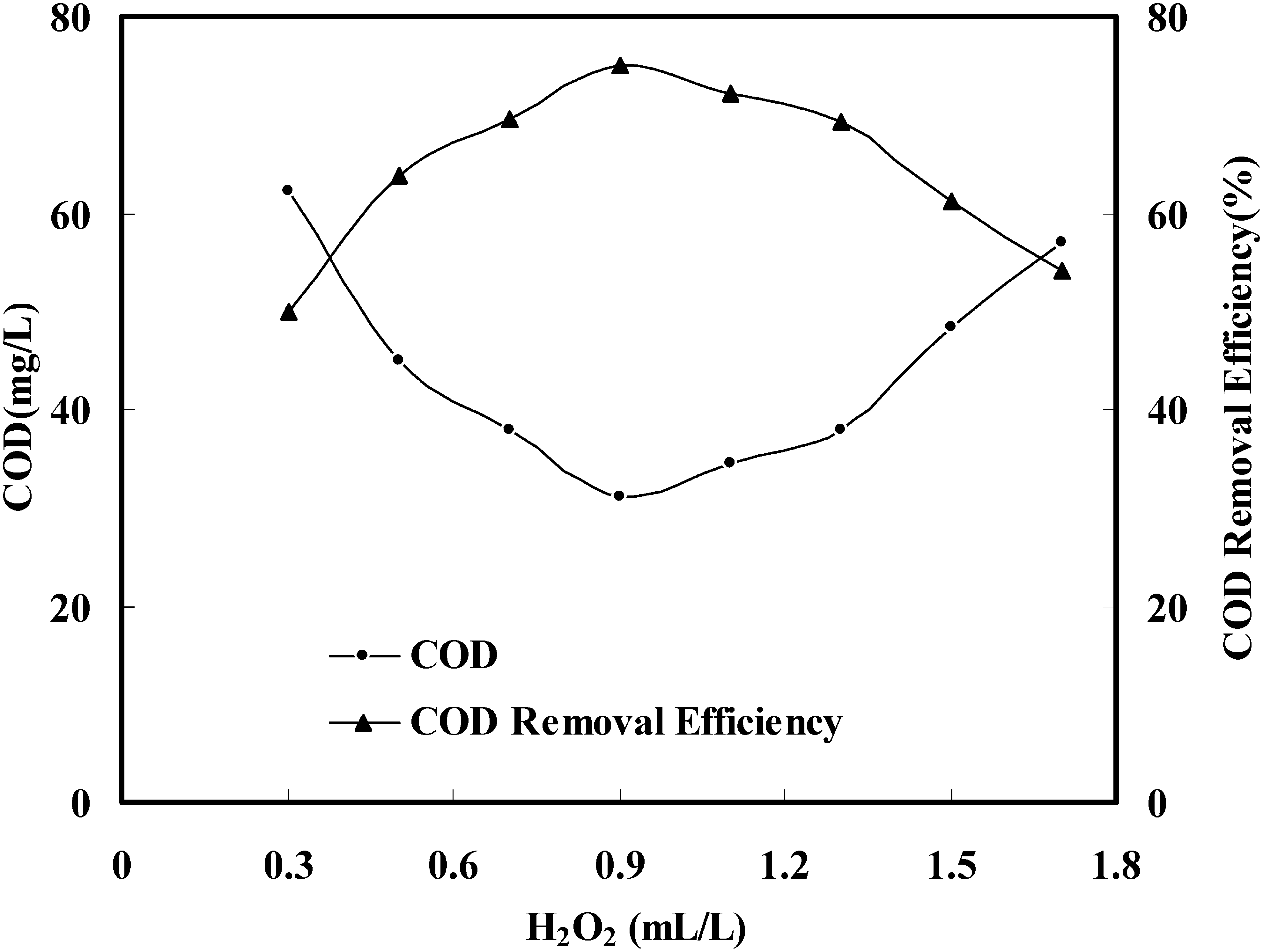
Effects of H2O2 dosage on COD removal in Fenton's oxidation of the citric acid production effluent. Batch reactor: initial COD, 120 mg/L; pH 3.5; H2O2/Fe2+ molar ratio, 8; reaction time, 2 h.
According to Fig. 2, the COD removal efficiency by Fenton's oxidation increased with increase in H2O2 dosage but decreased with further increase in H2O2 dosage. H2O2 reacts with Fe2+ ions as in Equation (1). If small amount of H2O2 is used, hydroxyl radical concentration would be low, and hence, COD removal efficiency would be small. However, if the H2O2 dosage is too high, H2O2 may further react with hydroxyl radical according to Equations (2) and (3) and compete with the organic substances for hydroxyl radicals. Thus, high dosage of H2O2 may inhibit the oxidation effects. Such H2O2 effects on Fenton's oxidation have been previously reported (Wang et al., 2009).
As shown in Fig. 2, at pH 3.5, the optimized H2O2 dosage was 0.9 mL per liter of wastewater and the dosage of Fe2+ ion was 55 mg per liter of wastewater. At this condition, about 75% COD in the wastewater was removed by Fenton's oxidation within 2 h.
Fenton's oxidation kinetics
The kinetics of COD removal in the Fenton's oxidation of this wastewater was studied on the bench-scale system at the aforementioned optimized conditions. According to Fig. 3, the kinetics of COD removal by Fenton's oxidation may be described with pseudo-first-order kinetics as in Equation (4). Similar first-order kinetics has been reported in other studies (Lucas and Peres, 2009).
In Equation (4), COD0 is the initial COD of the solution before Fenton's oxidation, and k is the pseudo-first-order rate constant. It may be seen from Fig. 3 that the observed pseudo-first-order rate constant is 0.0125 min−1 under the optimized conditions.

COD removal kinetics in Fenton's oxidation. Batch reactor: pH 3.5; 30% H2O2, 0.9 mL in 1 L wastewater; H2O2/Fe2+ molar ratio, 8.
The pilot-scale study on Fenton's oxidation of this wastewater was performed on a completely mixed flow-through reactor. At steady state, the first-order kinetics on the completely mixed flow-through reactor may be described in Equation (5).
where Q is the flow rate and V is the reactor volume. CODi and CODe are the influent COD and effluent COD, respectively. In this case, Equation (5) may be written as follows:
where τ is the residence time of the wastewater in the pilot-scale Fenton's oxidation reactor.
The COD removal effect of the pilot-scale Fenton's oxidation is shown in Fig. 4. The residence time in the Fenton's oxidation reactor was 2 h. The theoretical effluent COD was calculated according to Equation (6) on the basis of the experimental influent COD and the observed first-order rate constant. It may be observed from Fig. 4 that the tendency of COD removal under experimental conditions was similar to the theoretical ones. The difference among the experimental and theoretical data may be due to several reasons such as fluctuation of the influent COD and unstable pH control in the pilot system.
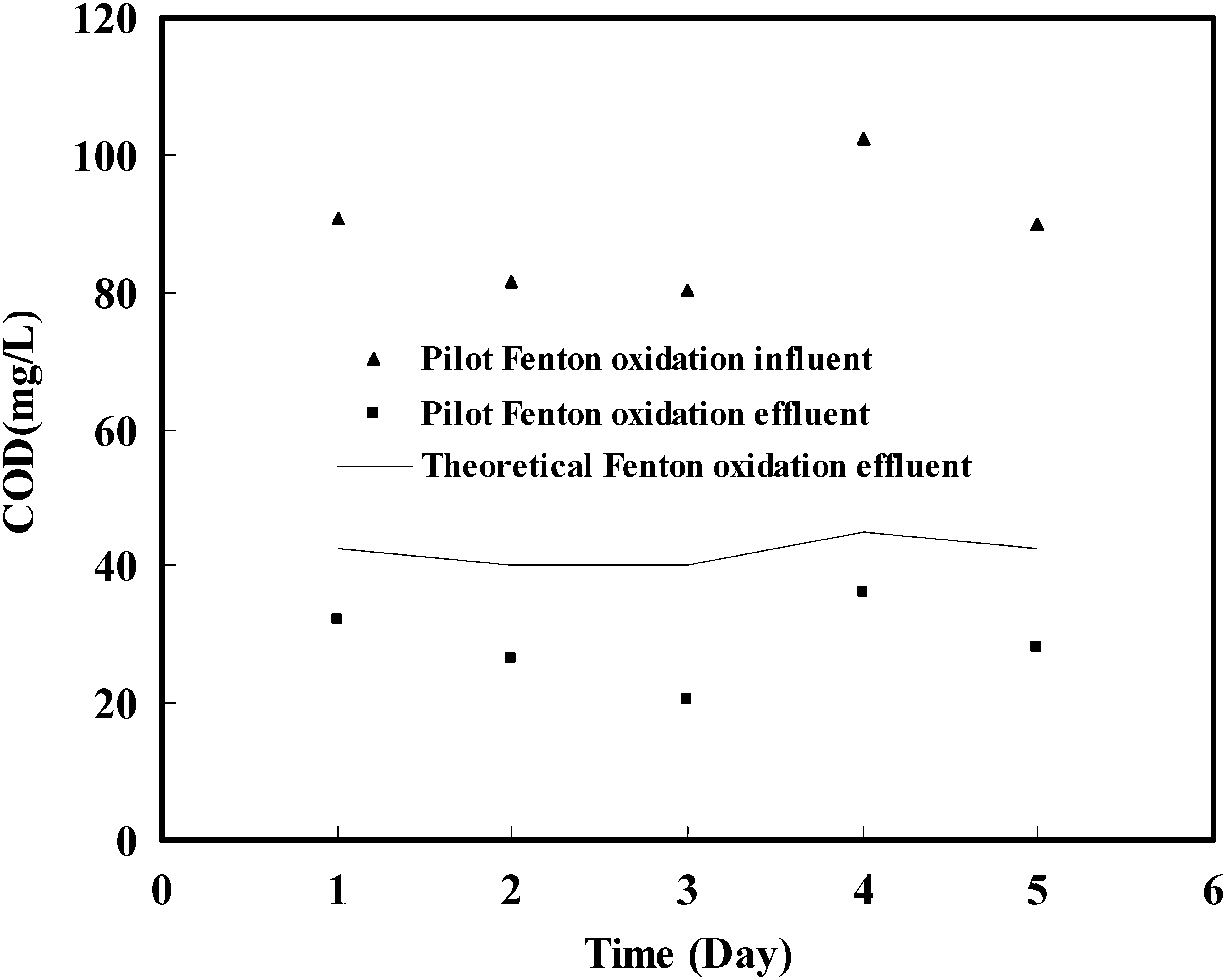
COD removal on pilot-scale Fenton's oxidation. Completely mixed flow-through reactor; pH = 3.5; 30% H2O2 dosage = 0.9 mL/L; H2O2/Fe2+ molar ratio = 8; residence time = 2 h.
BAF after Fenton's oxidation
As shown in Fig. 1, the effluent of Fenton's oxidation in the pilot-scale system flowed into BAF for further biological degradation. The key operating conditions are shown in Table 2. The COD of the pilot system influent, Fenton's oxidation effluent, and the BAF effluent are shown in Fig. 5. According to Fig. 5, the Fenton's oxidation removed about 60% COD. The wastewater with COD of about 30 mg/L was further treated in the subsequent BAF. The COD after BAF was decreased to about 10 mg/L, meaning more than 60% COD removal through BAF as well as a more than 85% COD removal efficiency with Fenton's oxidation combined with BAF process. Further, very low COD in the treated water may prevent the biofouling of the potential deionization unit. Without pretreatment of Fenton's oxidation, little COD was removed through BAF. After Fenton's oxidation, the biodegradability may be improved so that the wastewater can be easily treated in the following BAF column.

COD removal on pilot-scale system including Fenton's oxidation combined with BAF. Conditions are as shown in Table 2. BAF, biological aerated filter.
After about 2-week operation, the biomass density on the packing materials at different BAF depths was analyzed and the results are shown in Fig. 6. It may be seen from Fig. 6 that, under the testing conditions, the biomass was concentrated at the top layers of the packing materials. With the depth increasing from 0.35 to 0.70 m, the biomass density significantly decreased from 54 to 22 nmol P/g packing material. Very little decrease was observed from 0.70 to 1.70 m. This implies that the major biological degradation occurred at the top layers of the BAF column. As such, BAF can be more efficiently used. In this case, the H2O2 dosage of Fenton's oxidation was cut down to test the BAF performance.
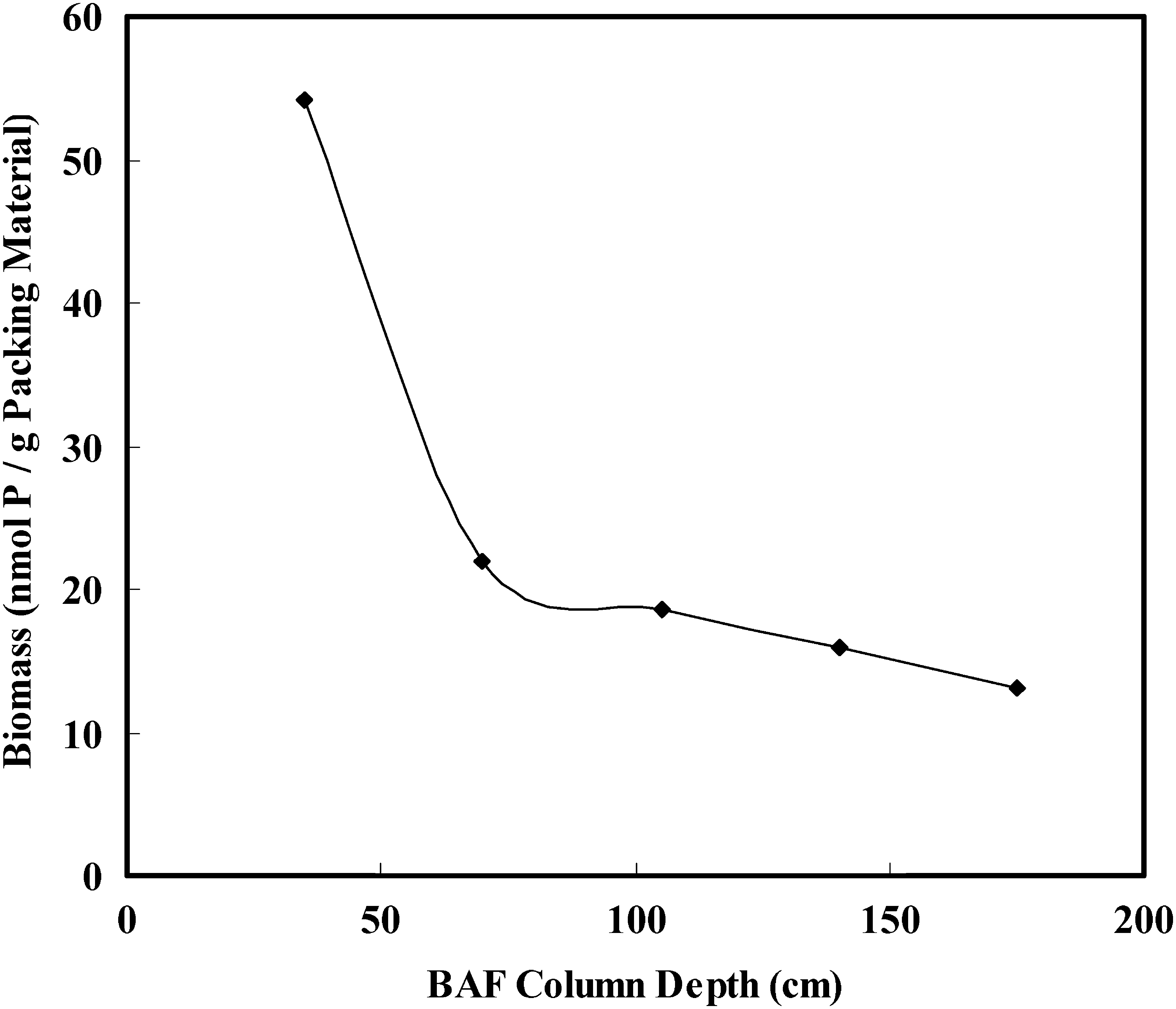
Biomass density in BAF.
Generally, the high operating cost of the Fenton's oxidation comes from the costly reagents. To reduce the operating cost, the dosages of Fenton's oxidation reagents were decreased to evaluate the performance of the system. In this study, the H2O2 dosage of Fenton's oxidation was reduced after every 6 days, when a steady BAF effluent was achieved. The pH for Fenton's oxidation was pH 3.5. The Fe2+ dosage was accordingly decreased to maintain the H2O2/Fe2+ ratio at 8. The results are shown in Fig. 7.
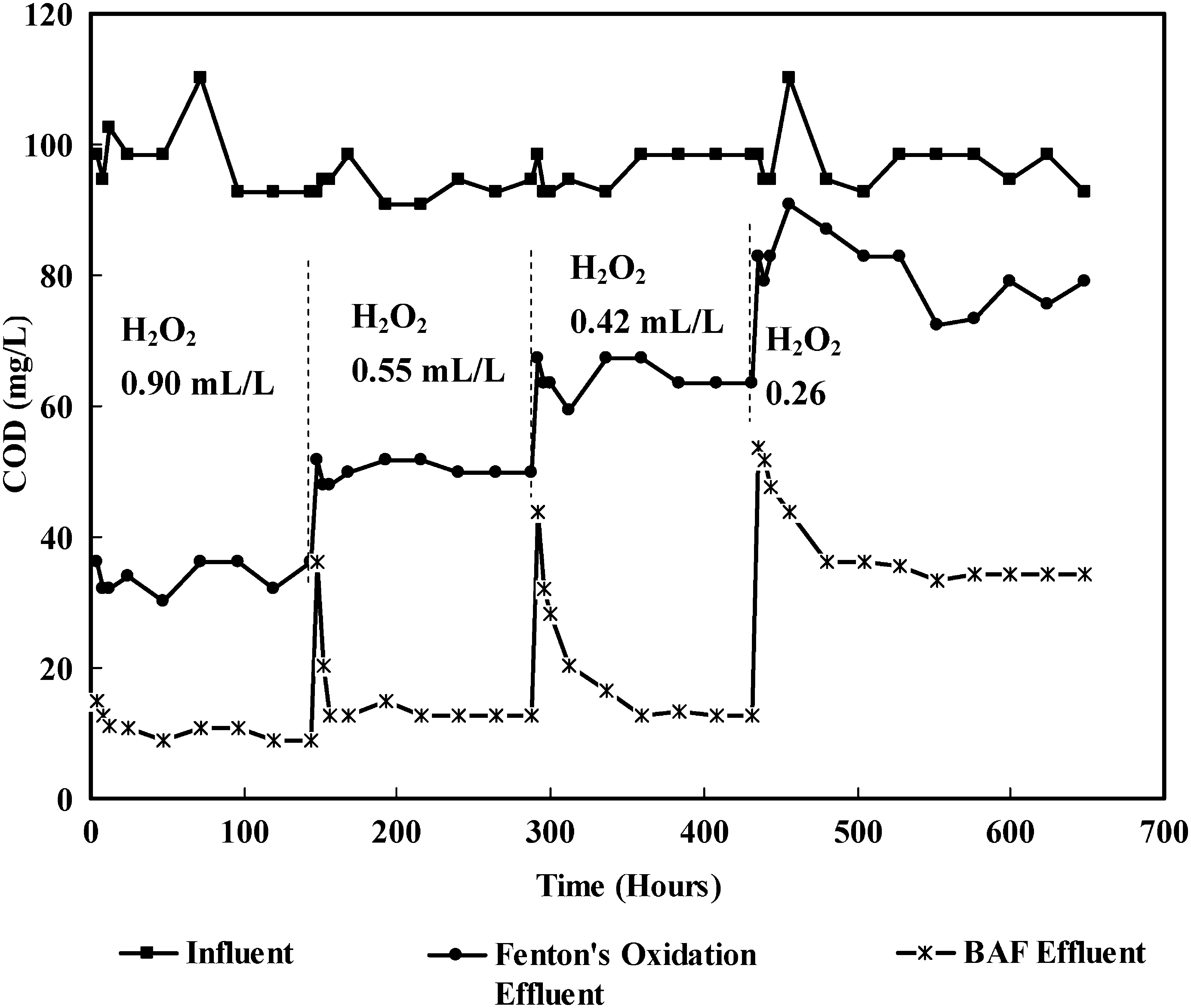
COD removal on pilot-scale system at different H2O2 dosages. Conditions are as shown in Table 2.
As shown in Fig. 7, the average COD of BAF effluent was about 10 mg/L during the first 6 days when the H2O2 dosage was 0.90 mL/L. From day 7 to 12, the H2O2 dosage was 0.55 mL/L. It may be observed from the figure that the COD after Fenton's oxidation immediately increased after H2O2 dosage was decreased, but about 1 day was taken to achieve a steady BAF effluent. The average BAF effluent COD was about 13 mg/L, which shows an insignificant increase when compared with the effluent when higher H2O2 dosage was applied. It took about 2 days to reach a steady BAF effluent after the H2O2 dosage of Fenton's oxidation was decreased to 0.42 mL/L at the 13th day. The average COD of the BAF effluent at steady state was about 13 mg/L, similar to when higher H2O2 dosages were used. At the 19th day, the H2O2 dosage was further decreased to about 0.26 mL/L. Not more than 20% COD was removed by Fenton's oxidation. COD removal was achieved on BAF. A steady BAF was achieved in 2 days, resulting in a COD decrease from 80 to 34 mg/L, meaning a 57% removal.
Table 3 shows the COD removal through the Fenton's oxidation combined with BAF when different H2O2 dosages were applied. It may be observed from Table 3 that the best BAF effect was achieved at 0.42 mL/L of 30% H2O2, which represents less dosage than on sole Fenton's oxidation. Under these conditions, Fenton's oxidation only removed about 33% COD of the wastewater, and the BOD/COD ratio was increased to more than 0.4, meaning feasible biodegradability. After Fenton's oxidation, the BAF functioned effectively and the final effluent COD was about 13 mg/L, meaning an 80% COD removal through BAF. Thus, the dosages of Fenton's oxidation reagents may be significantly reduced without affecting the final effluent quality. To the best of our knowledge, no previous publication has reported that with a combination of biological processes, the dosages of chemicals used for Fenton's oxidation are decreased so that the operational cost may be feasibly reduced.
Summary
The optimized 30% H2O2 dosage was about 0.9 mL/L for the Fenton's oxidation of citric acid production effluent on a batch reactor at a pH of 3.5 and an H2O2/Fe2+ molar ratio of 8. Under these conditions, about 75% COD has been removed within 2 h. The COD removal in Fenton's oxidation may be described with a pseudo-first-order kinetics. The pilot-scale study using both Fenton's oxidation process and BAF indicated that the H2O2 dosage of Fenton's oxidation may be lowered to 0.42 mL/L only without affecting the final effluent quality. Under these conditions, Fenton's oxidation removed about 33% COD of the wastewater. After Fenton's oxidation, the BAF effectively functioned for COD removal, with a more than 85% removal by the combined process. Thus, by combination of partial Fenton's oxidation and biological process, the dosages of oxidation reagents have been significantly reduced.
The study provides a technically feasible way to use AOPs in combination with biological processes. Small amount of chemicals can be used in AOPs for partial COD removal only. After oxidation, the biological processes may be used to further decrease the organic pollutants to very low levels.
Footnotes
Acknowledgment
This research was supported by Chinese Water Special Project 2008ZX07313-005.
Author Disclosure Statement
The authors declare that no competing financial conflicts exist.