




Abstract
Abstract
Stabilized leachate generated from an aged sanitary landfill is typically classified as nonbiodegradable. The ion exchange technique has been rarely used for the treatment of stabilized landfill leachate, particularly for the removal of color and nonbiodegradable substances (measured as chemical oxygen demand [COD]). Thus, this study was undertaken to examine the effectiveness of anion-exchange resin (i.e., INDION FFIP MB) in removing color and COD from stabilized semi-aerobic landfill leachate in Malaysia. To predict the performance of the process, the effects of anion exchanger dosage, shaking speed, contact time, and pH on pollutant removal efficiency were investigated. Adsorption of color and COD was realistically explained through Langmuir and Freundlich isotherms. Adsorption kinetics mechanism was studied using reaction-based models. The anionic resin efficiently removed 91.2% color and 69.4% COD at pH 3 and removed only 69.4% color and 60.3% COD at pH 9. The color and COD adsorption data were fitted to the Langmuir and Freundlich isotherms. The monolayer adsorption capacity was found to be 15.2 Pt-Co/g for color and 3.7 mg/g for COD. Pseudo second-order model (R2>0.99) sufficiently described the adsorption kinetics, which indicates that the adsorption process was controlled by chemisorptions.
Introduction
The characteristics and nature of the contaminants in landfill leachate show significant changes with the increase in landfill age. Leachates of solid waste materials in landfills are formed due to such factors as the inherent moisture of solid waste materials, rainwater percolation through waste materials, and biochemical decomposition of organic waste materials. The major components of leachates are insoluble liquids, such as oil and fats, and fine particles in the form of suspended solids and organic and inorganic salts (Salem et al., 2008). In the early settlement phase (i.e., acidogenic phase), solid waste typically contains high amounts of biodegradable and nonbiodegradable materials, especially volatile fatty acids. In the later stages (i.e., methanogenic phase), the leachate normally has high molecular weight of refractory compounds (i.e., humic substances and fulvic-like fractions), which are not easily degraded. In this phase, the leachate has high strength of chemical oxygen demand (COD), ammonia, color, and a low 5-day biochemical oxygen demand (BOD5)/COD ratio of <0.1 (Christensen et al., 2001; Kurniawan et al., 2006).
In the last few decades, landfill leachate treatments have received significant attention in the municipal areas of Asian countries. In general, the treatment of landfill leachate is a very complicated and expensive operation requiring multiple approaches (Ozturk et al., 2003). Several wastewater treatment processes have been applied for treating landfill leachate: biological treatment (Uygur and Kargi, 2004), coagulation and flocculation (Aziz et al., 2007), reverse osmosis (Enzminger et al., 1987), adsorption (Aziz et al., 2004), air stripping (Ozturk et al., 2003), oxidation processes (Bashir et al., 2009; Mohajeri et al., 2010), membrane processes (Di Palma et al., 2002), and ion exchange (Majone et al., 1998; Bashir et al., 2010).
Ion exchange involves a reversible interchange of ions between the solid and liquid phases. For example, solid ion-exchange particles exchange their mobile ions with similarly charged ions from the surrounding medium; they are classified into natural inorganic particles (zeolites) and synthetic organic resins, which are developed from high-molecular-weight polyelectrolytes (Helfferich, 1962; Cheremisinoff, 2002).
The ion-exchange treatment process is capable of successfully removing metal impurities to meet the strict discharge standards in developed countries (Kurniawan et al., 2006). Synthetic ion-exchange resins are widely and effectively used for removing various pollutants from water and wastewater, including Cr from industrial effluents (Cavaco et al., 2007); NH3-N and
However, to date, the ion exchange technique has been rarely used for the treatment of semi-aerobic stabilized landfill leachate, particularly for the removal of color and nonbiodegradable substances (measured as COD). The reason is that most ion-exchange resin applications focus on water purification, metal ion extraction, and ionic substance removal (Zagorodni, 2006). The application of ion-exchange resins for NH3-N and heavy metal removal for the treatment of landfill leachate has already been studied (Majone et al., 1998; Bashir et al., 2010). In this study, we aim to examine the effectiveness of the available synthetic resins, that is, INDION FFIP MB as an anionic resin, for treating color and COD from stabilized semi-aerobic leachate. To investigate the process variables (i.e., dosage, contact time, shaking speed, and pH), suitable isotherm models and kinetics coefficients of the anionic exchangers for the removal of color and COD are used.
INDION FFIP MB was selected because of its known characteristics, such as its ability to work as a strong base anion exchanger. It can be used in chloride or hydroxide form and can be applied over a wide range of pH levels and temperatures. The matrix is polystyrene cross-linked divinylbenzene, which is the most popular matrix (Helfferich, 1962). The anion matrix carries quaternary ammonium groups [-N (CH3)3] containing polar groups that are largely effective for the removal of many synthetic and natural organic substances that contain weak acids, such as humic and fluvic substances (Li and Sengupta, 2004). The ion-exchange resin, which removes the above-mentioned substances that particularly contribute to the presence of COD and color in mature landfill leachate, has the ability to remove these pollutants efficiently.
Materials and Methods
Site description
The Pulau Burung landfill site (PBLS) is situated within the Byram Forest Reserve (5°24′ N, 100°24′ E) in Penang, Malaysia; the forest reserve is ∼20 km southeast of Penang Island. In 1991, the site was developed as a semi-aerobic sanitary landfill by establishing a controlled tipping technique. Later in 2001, it was further upgraded by employing controlled tipping with leachate recirculation (Aziz et al., 2004). Although the total area of the landfill site is 62.4 ha, only 33 ha of the site is currently operational, receiving 2200 tons of solid wastes daily (Aziz et al., 2010). According to Aziz et al. (2010), PBLS produces a dark black-green colored liquid, which can be categorized as stable leachate with high amount of COD (2345 mg/L) and low BOD5/COD ratio (0.124).
In general, semi-aerobic landfills are suitable for tropical weather conditions in Asia such as in Malaysia, where leachate treatment and management are significant issues. Thus, a semi-aerobic landfill is classified as an anaerobic or an aerobic landfill. To some extent, semi-aerobic landfills have advantages such as enhanced aerobic biodegradation of organic matter, reduced contamination load of leachate, and cost effectiveness in comparison with aerobic landfills (Aziz et al., 2004; Chong et al., 2005; Huang et al., 2008; EPCC, 2009). Further, compared with anaerobic conditions, semi-aerobic conditions help reduce global warming by lowering the generation of CH4 while increasing the concentration of CO2. The global warming potential of CH4 is about 25 times more than that of CO2 (JICA, 2005; EPCC, 2009). Read et al. (2001) reported that the methane generated in landfills accounts for >45% of the total landfill gases and poses considerable problems to owners and operators of anaerobic landfill sites.
Leachate sampling and characterization
Raw leachate samples contained separately in 20 L plastic containers were collected from the aeration pond at the PBLS every month from February 2008 to January 2009. In this study, the samples were taken from the aeration pond due to the effectiveness of the aeration process in eliminating the biodegradable organic matter, resulting in the enhancement of the performance of the ion exchanger. According to Kurniawan et al. (2006), leachate should be subjected to a biological treatment before ion exchange. In accordance with the Standard Method of Water and Wastewater Examination (APHA, 2005), the samples were transported immediately to the Environmental Engineering Laboratory and stored in a dark, cold room at 4°C prior to experimental use to avoid biological activities and changes in the samples. The characteristics of PBLS leachate are presented in Table 1.
BOD5, 5-day biochemical oxygen demand; COD, chemical oxygen demand; FAU, formazin attenuation units; TNT, Test 'N Tube method; TSS, total suspended solids.
Characteristics of the anion ion-exchange resin
The available synthetic anion ion-exchanger resin, INDION FFIP MB, which was supplied by Ion Exchange (INDIA) Ltd., was used in this study due to its above-mentioned characteristics. The selected resin and its physicochemical properties are presented in Table 2. Prior to use, the anionic exchanger was washed thoroughly with distilled water to remove the adhering dirt; after washing, filtration using GC-50 filter (pore size of 0.45 μm; Advantec Toyo Kaisha Ltd.) paper and vacuum pump was conducted, and the exchangers were dried at room temperature (Bashir et al., 2010).
Properties given by the manufacturer.
Batch study
The adsorptions of the color and total COD via anionic exchange resin were studied using the batch technique. The conditions for experimental optimization were adsorbent dosage, contact time, shaking speed, and pH level. All batch experiments were performed by shaking 100 mL of raw leachate (unfiltered) in an orbital shaker. The optimization of the media performance was achieved by monitoring the influence of one factor at a time on an experimental response. This optimization is called the one-variable-at-a-time method. Whereas only one variable is varied, others are maintained at a constant level (Bezerra et al., 2008).
Different conditions of anionic dosage (5–50 cm3, each 1 cm3=1.328 g), contact time (15–180 min), shaking speed (0–400 rpm), and pH level (2–11) were investigated during the study to determine their influence on the process. The initial leachate pH was adjusted to the desired value using 5 M sulfuric acid or 5 M sodium hydroxide. After each run, the media were filtered using GC-50 filters (pore size of 0.45 μm; Advantec Toyo Kaisha Ltd.) before measuring the color and COD. Color concentration was measured using the Hach color method (Hach, DR/2010) set to 465 nm wavelengths, whereas COD concentration was measured using a DR/2010 spectrophotometer (Hach Company) set to 620 nm wavelengths. All tests were conducted in accordance with the standard methods for the examination of water and wastewater (APHA, 2005).
Equilibrium studies
In this study, adsorption isotherms were used to describe the performance of the media and the relationship between the adsorbent (resin) and the dissolved adsorbate (pollutants) in the solution. The following equation expresses the equilibrium state for the above-mentioned relationship in this experiment (Droste, 1997):
where C0 and Ce (mg/L for COD and Pt-Co/L for color) are the liquid-phase concentrations of COD and color at the initial and equilibrium stage, respectively; qe (mg/g or Pt-Co/g) is the amount of adsorption at equilibrium; V (L) is the volume of the solution; and m (g) is the mass of the dry sorbent used.
The percentage of pollutant removal is calculated as follows:
where C0 and Ce (Pt-Co/L or mg/L) are the liquid-phase concentrations of color and COD at the initial and equilibrium stages, respectively.
Results and Discussion
As illustrated in Table 1, PBLS leachates have considerable amounts of COD (2336 mg/L) and color (5095 Pt-Co), low amount of BOD5 (147 mg/L), and a very low BOD5/COD average ratio (0.055). Due to its low BOD5/COD ratio and the high strength of NH3-N (mg/L), PBLS leachate can be classified as a highly stabilized leachate. In general, the presence of a high amount of color in the landfill leachate is caused by the presence of a high amount of organic substances (measured as COD) related to suspended solids and turbidity (Aziz et al., 2007).
Optimum conditions
Adsorbent dosage
The adsorbent resin dosage is an important parameter for analyzing the quantitative uptake of pollutants. The retention of the pollutants was examined in relation to the amount of adsorbent. The results of the removal of color and COD using anionic resins are shown in Fig. 1. The shaking speed, contact time, and initial pH level were 200 rpm, 90 min, and 8.59, respectively. The dosage of the anionic-exchanger adsorbent varied from 5 to 50 cm3. The percentage of pollutant removal increased with increasing dosages of the anionic resin. The best results were obtained using a dosage of 35 cm3, where 71% color and 64% COD were removed. The anionic exchanger used in this study carries Cl− ions, which are exchanged with negative ions and organic compounds containing weak acid functional groups. Jorge et al. (2002) reported that color could be removed by ion-exchange resins. However, the extent of adsorption of these colored impurities depends on their molecular weight, ionic charge, pH level, and hydrophobicity; more hydrophobic compounds are retained in the resin matrix, and those with higher charges are fixed in the ionic part of the resin.

Effect of anionic ion exchange resin dosages on color, COD removal, and pH. COD, chemical oxygen demand.
In general, a stabilized leachate contains high amount of polar and nonpolar organic materials that cannot be completely removed by the exchange processes. Thus, the removal of organic compounds using anionic exchanger occurs in two mechanisms: physical adsorption (nonpolar attractions) and ion exchange (polar attractions). These mechanisms were illustrated by Tan and Kilduf (2007) and Li and Sengupta (2004) as follows:
i) Ion exchange involves counterion displacement from the anionic resin phase and electrostatic interaction between the positively charged quaternary ammonium functional group of the exchange resins and the negatively charged carboxylic or sulfonic groups. ii) Physical adsorption involves Van der Waals interactions between the nonionic head and the ion exchanger's hydrophobic polystyrene matrix.
Contact time
The effects of contact time on the study parameters are shown in Fig. 2. The contact time for the anionic resins (resin dosage of 35 cm3; solution volume of 100 mL; shaking speed of 200 rpm) varied from 15 to 180 min. As shown in Fig. 2, color removal and COD reduction rapidly increased in the first 30 min. Between 30 and 90 min, the removal and reduction rates showed a slow increase; beyond 90 min, the rates remained constant. The rapid adsorption of pollutants, particularly color and COD, via anion resin was due to the surface site, which is initially obtainable for sorption, being extremely larger than the concentration of the pollutants; accordingly, the rate of adsorption was particularly high. However, with increasing coverage, the fraction of sorption sites in the merged surface rapidly decreased, and the ions had to compete among themselves for the sorption site. This competition causes the slowdown of the removal rates (Sheha and El-Zahhar, 2008).
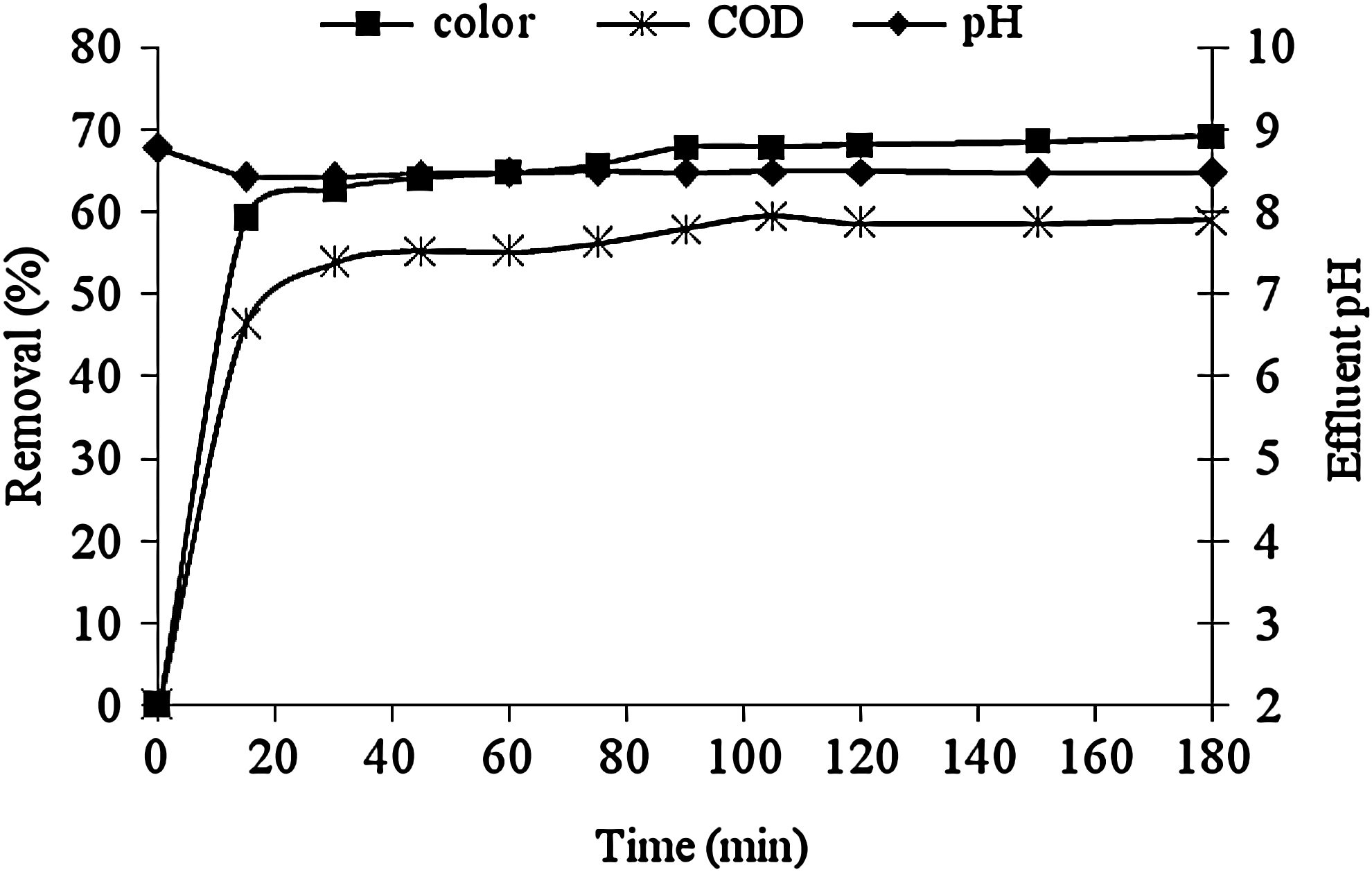
Effect of contact time on color, COD removal and pH.
Shaking speed
The effects of shaking speed on color and COD removal are illustrated in Fig. 3. The effects were studied using 35 cm3 of anionic exchanger resin with a contact time of 90 min and different shaking speeds (0–400 rpm). The results showed that the removal of the two pollutants increased when the shaking speed increased up to 150 rpm; at higher speeds, the removal rate remained constant. According to Chabani et al. (2007), the resistance of the boundary layer surrounding the adsorbate weakens at strong agitation rates.
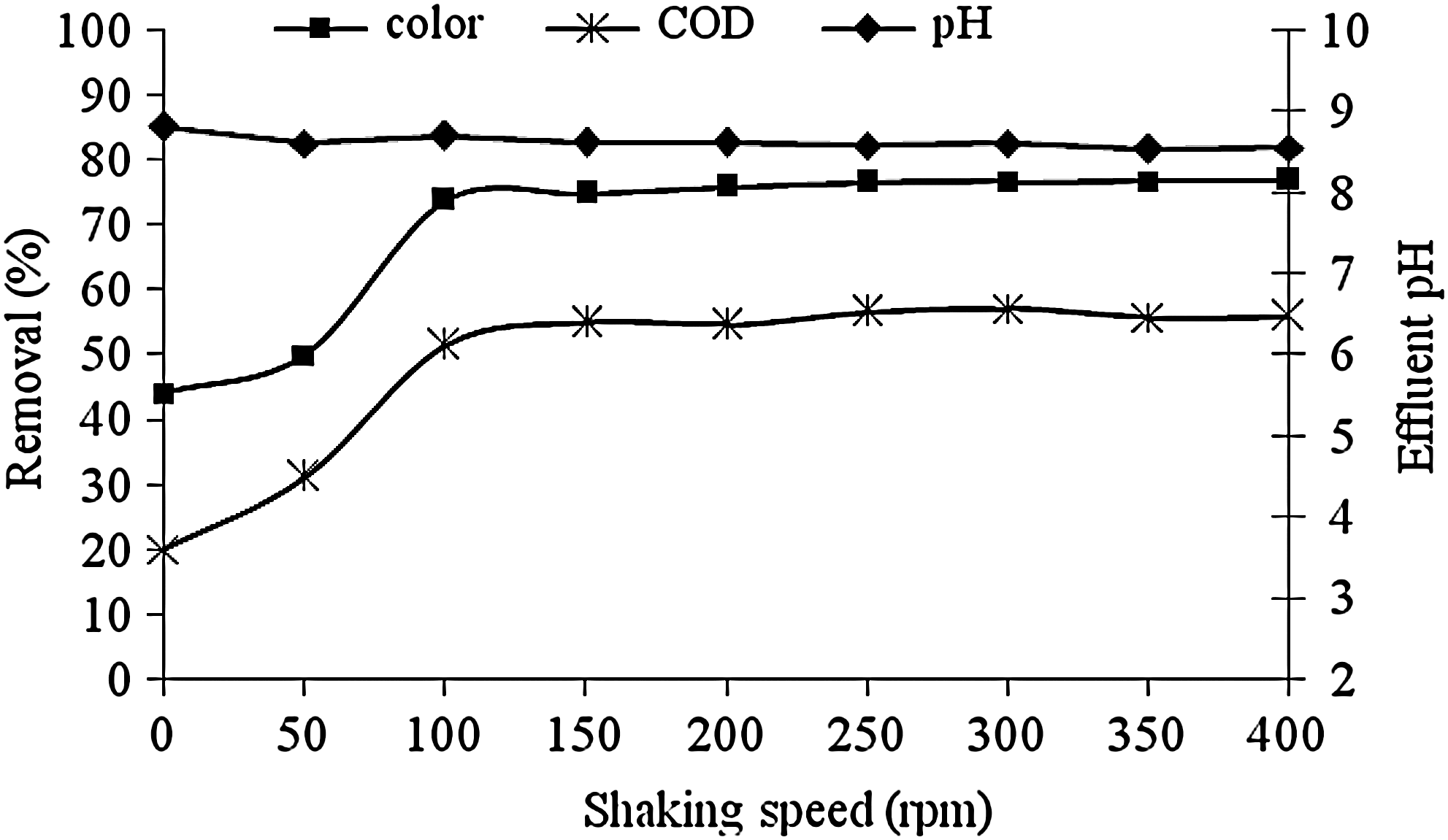
Effect of shaking speed on color, COD removal and pH.
pH
The initial pH level strongly influenced color and COD removal. In Fig. 4, the percentage of color and COD reduction increased from 66.5% and 60.3% at pH 9 to 91.2% and 69.4% at pH 3, respectively. In general, the precipitation of solids corresponding to humic acids increases at lower values of pH, which in turn leads to the increase in the removal efficiency of color and COD (Rodriguez et al., 2004). According to Sheha and El-Zahhar (2008), the pH level of the solution plays an important role in the percentage of a pollutant's removal due to its influence on the surface properties of the applied resins and the degree of ionization. The difference between the initial and the final pH level was not significant (Fig. 4). This small change is mainly attributed to the removal of pollutants especially ammonia. Normally higher ammonia removal causes more decrease in the effluent pH value.
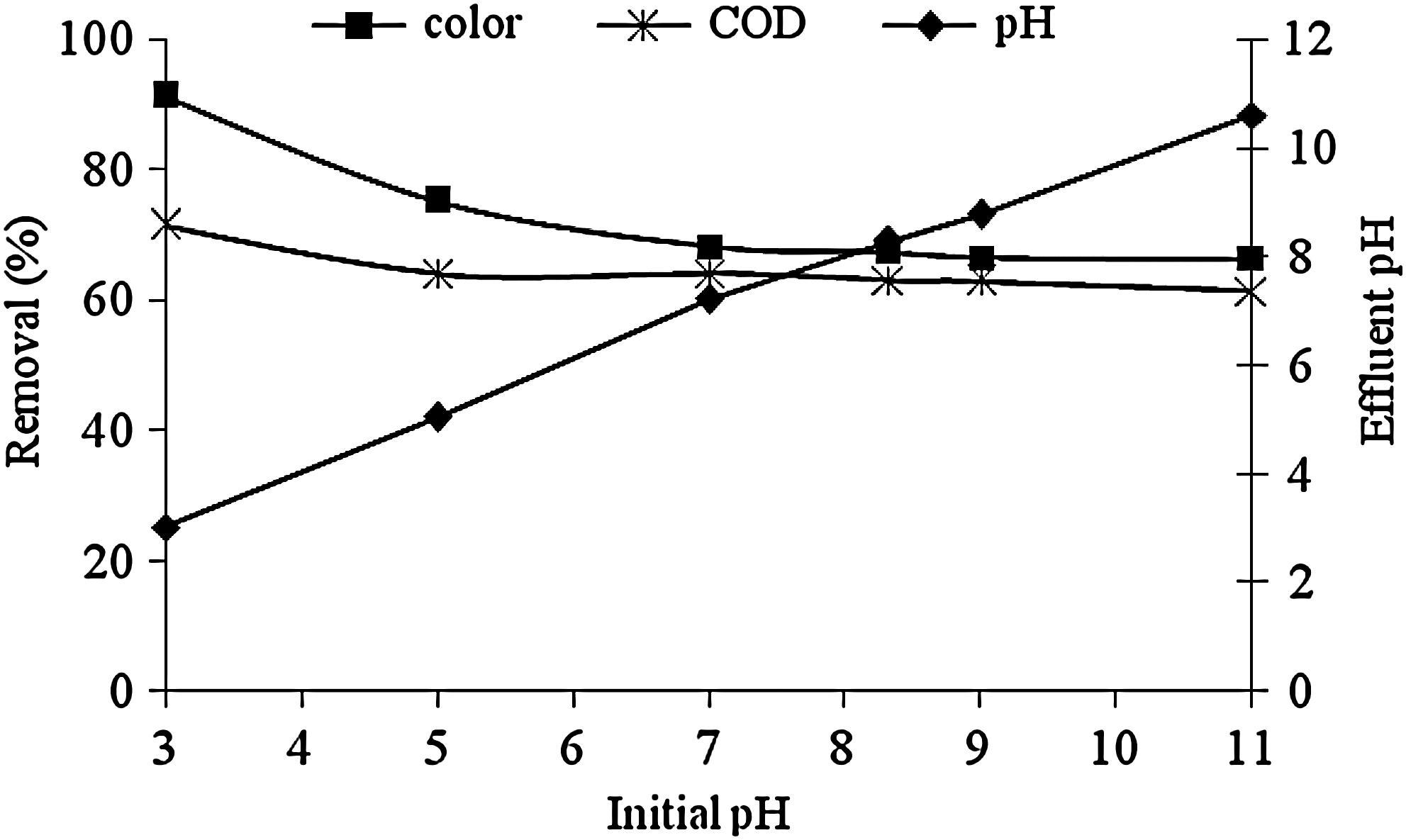
Effect of initial pH on color and COD removal.
Isotherm analysis
Ion exchange is similar to adsorption, and the mass transfer from fluid to solid phase is common in both processes. Both are essentially diffusion processes. Most of the mathematical theories and approaches have been developed originally for sorption rather than for ion exchange. Nevertheless, these theories and methods are adequate for describing ion exchange. The applicability of a basic theory depends more on the mode of operation than on the particular mechanism of solute uptake (Zagorodni, 2006). Therefore, the equilibrium isotherms in this study were analyzed using the Langmuir and Freundlich isotherms, which are the most common isotherm models for describing the adsorption characteristics of adsorbents used in water and wastewater treatments (Hasany et al., 2002; Chabani et al., 2007; Kocaoba, 2007).
The Langmuir isotherm theory assumes monolayer coverage of adsorbate over a homogenous adsorbent surface. A basic assumption is that sorption takes place at specific homogenous sites within the adsorbent.
The Langmuir isotherm is as follows:
where Ce is the equilibrium liquid-phase concentration of COD (mg/L); qe is the equilibrium uptake capacity (mg/g); and Q (mg/g) and b (L/mg) are the Langmuir constants. A straight line was obtained when 1/(qe) was plotted against 1/Ce. Q was evaluated from the slope, whereas b was determined from the intercept (Fig. 5). The equilibrium data were fitted to the Langmuir isotherm. The constants together with the R2 value are listed in Table 3. As shown in Table 3, the capacities for color and COD adsorption on the anionic resin were 15.20 Pt-Co/g and 3.74 mg/g, respectively. The characteristics of the Langmuir isotherm can be expressed using the equilibrium parameter RL (Isa et al., 2007):
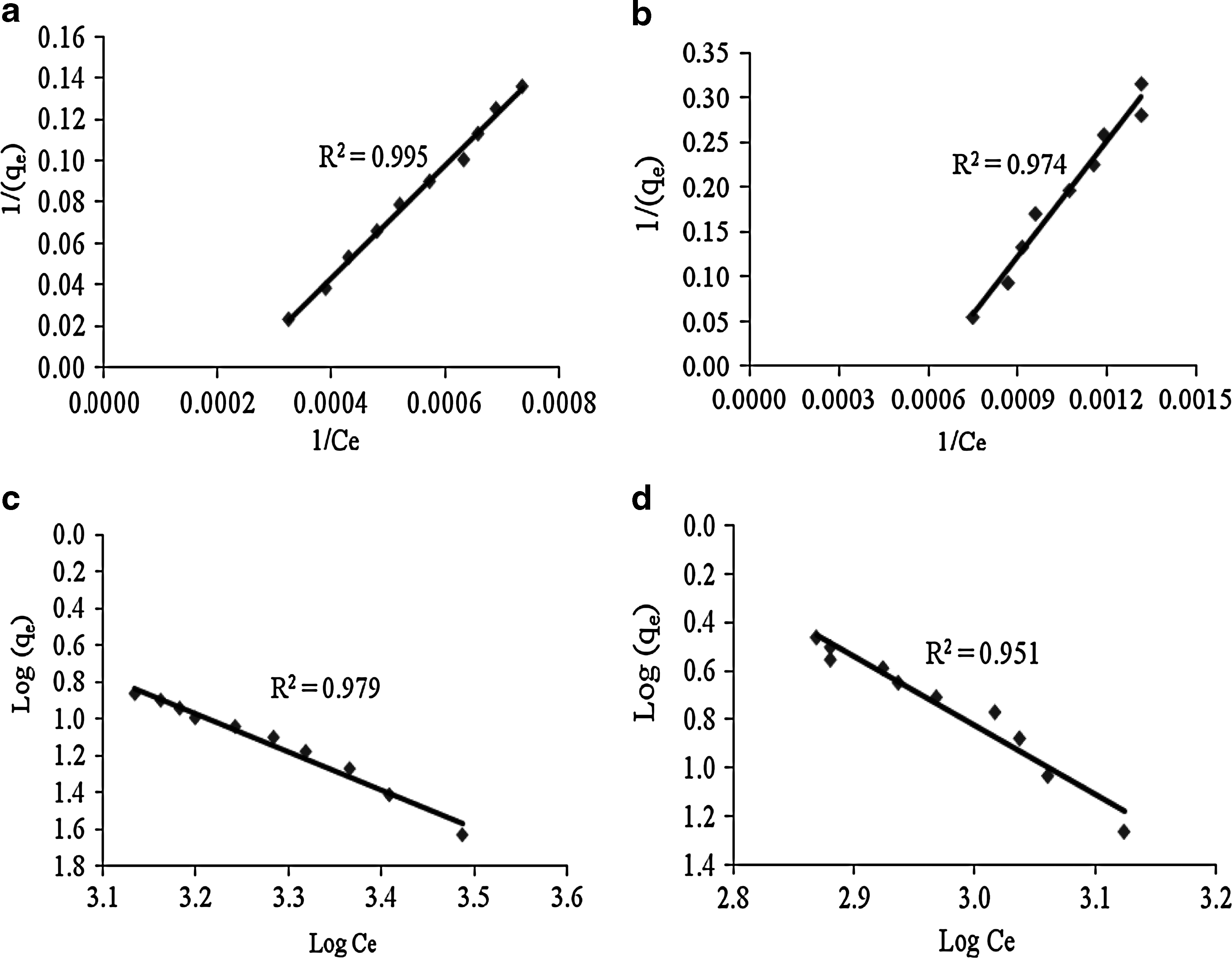
Langmuir isotherm and Freundlich isotherm for color and COD adsorption onto anion resin (contact time, 90 min; shaking speed, 150 rpm; influent pH, 8.36; influent concentration of color, 5440 Pt-Co/L; influent concentration of COD 2347 mg/L):
where b is the Langmuir constant, and C0 is the initial pollutant concentration (mg/L). The value of RL indicates whether the isotherm is unfavorable (RL>1), linear (RL=1), favorable (0<RL<1), or irreversible (RL=0). The RL values for adsorption of color and COD on the anionic resin were 0.433 and 0.407, respectively, indicating that the adsorption is a favorable process.
The Freundlich isotherm is an empirical equation that assumes the adsorption process to take place on heterogeneous surfaces.
The Freundlich isotherm is expressed as follows:
where Ce is the equilibrium liquid-phase concentration of COD (mg/L); qe is the equilibrium uptake capacity (mg/g); K is an indicator of the adsorption capacity in mg/g (L/mg); and 1/n is the constant indicator of the intensity of the adsorption. The slope of 1/n, ranging between 0 and 1, is a measure of the adsorption intensity or surface heterogeneity; it becomes more heterogeneous as its value nears 0. A value of 1/n<1 indicates a normal Langmuir isotherm, whereas 1/n>1 is indicative of cooperative adsorption (Tan et al., 2008). The plot of log qe versus log Ce (Fig. 5) gives a straight line with a slope of 1/n. The value of K was calculated from the intercept value. The values of K, 1/n, and the linear regression correlation (R2) for the Freundlich model are given in Table 3.
The adsorption intensities were derived from the Freundlich coefficient, where the 1/n values of color and COD were 2.07 and 2.85, respectively. For 1/n>1, the adsorption constant increases with an increase in solution concentration, which probably reflects the increase in the hydrophobic character of the surface after the formation of a monolayer (Aziz et al., 2004). The results indicate that the adsorption of color and COD was reasonably explained by the Langmuir and Freundlich isotherms. However, the Langmuir model yielded the best fit, as the R2 values were relatively high (close to unity). This is confirmed by the high value of R2 for color (0.995) and COD (0.974) in the case of Langmuir compared with that of Freundlich, where R2 was 0.974 for color and 0.951 for COD.
Adsorption kinetics
The experimental efficiency is controlled by the kinetics of adsorption. Several kineticmodels are available for predicting mechanisms involved in the adsorption process (Chabani et al., 2007). According to Hameed (2009), the Kinetic modeling was normally used to investigate the mechanism of adsorption and the potential rate-controlling processes such as mass transfer and chemical reaction. In this study, the adsorption kinetics of color and COD on anionic resins was investigated via the most commonly used kinetic models, that is, pseudo-first-order and pseudo-second-order models (Chabani et al., 2007; Shao et al., 2008).
The pseudo-first-order model is illustrated as follows:
The pseudo-second-order model is expressed as
where qe and qt are the amount of pollutants adsorbed at equilibrium (mg/g for COD or Pt-Co/g for color) and at time t, respectively, and k1 (min−1) and k2 (g/mg min) are the equilibrium rate constants of the pseudo-first-order and pseudo-second-order models, respectively. Figure 6 shows the linear plots of the pseudo-first-order and pseudo-second-order models. Table 4 shows the values of k1, k2, qe, and R2 for the models. As shown in Table 4, the correlation coefficient (R2) for the pseudo-second-order kinetics model is extremely high and is close to unity, which is contradictory to that for the first-order-kinetics models.
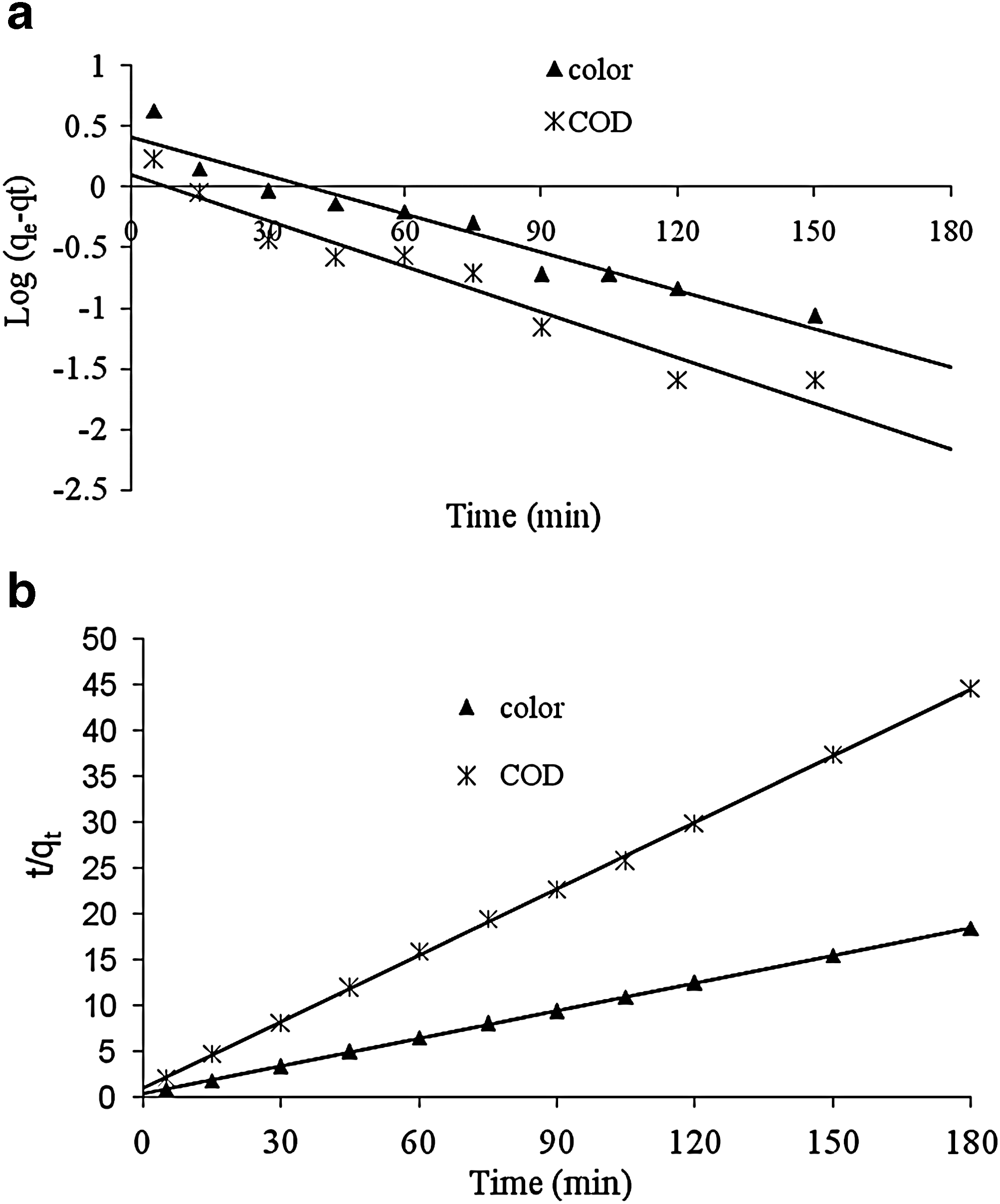
Kinetic models for color and COD adsorption onto anion resin (dosage, 35 cm3; shaking speed, 150 rpm; influent pH, 8.67; influent concentration of color, 5260 Pt-Co/L; influent concentration of COD 2550 mg/L):
The high correlation coefficient (R2) values indicate that the model successfully described the adsorption kinetics of the parameters. Further, the equilibrium sorption capacities (qe) calculated from the pseudo-second-order models were observed to be in good agreement with the experimental values (Table 4). Therefore, the sorption reaction by the pseudo-second-order kinetics model was more favorable, indicating that the adsorption process for color and COD was controlled by chemisorptions (Isa et al., 2007).
Process performance and limitations
Biological treatment processes are generally not appropriate for the treatment of landfill stabilized leachate, which contains high amount of nonbiodegradable refractory organic compounds. Further, the existence of high strength of NH3-N in the stabilized leachate, which has been identified as very toxic to microorganisms, typically leads to the inhibition of the biological degradation process (Christensen et al., 2001; Kurniawan et al., 2006). Physico-chemical treatment processes have been found to be very suitable for the removal of refractory matters from stabilized leachate (Kurniawan et al., 2006).
In this study, the performance efficiency of some physico-chemical treatment processes used for the treatment of color and COD from stabilized landfill leachate has been investigated. The efficiency of coagulation-flocculation processes for removing color from stabilized leachate had been studied (Aziz et al., 2007) using aluminum(III) sulfate (alum), ferric(III) chloride, ferrous(II) sulfate, and ferric(III) sulfate as coagulants. The results indicated that ferric chloride was better than the other coagulants, with a color removal efficiency of 94% at an optimum dose of 800 mg/L at pH 4. Amokrane et al. (1997) indicated that the percentage of COD removal obtained through this process is generally 10%–25% for young leachates and 50%–65% for stabilized leachate. The optimal coagulant dose was 0.035 mol/L of ferric chloride and the optimal pH was 5.
Calli et al. (2005) found that COD treatment efficiency using ammonia-stripping processes at optimum operation condition (i.e., pH 11 and temperature 20°C) is relatively low, with a removal of <15%. This indicates that ammonia-stripping treatment is not effective for the removal of nonbiodegradable organic substances.
The filtration of PBLS stabilized leachate via carbon-mineral composite column filter resulted in 86.4% COD removal (Halim et al., 2010). Similarly, Foul et al. (2009) investigated the adsorption of color and COD by a mixture activated carbon and limestone (15:25 by volume), resulting in 86%, 95%, 86%, and 48% removal of color, iron COD and ammoniacal nitrogen, respectively. According to Ozturk et al. (2003) Struvite precipitation (Mg:NH4:PO4=1:1:1) was applied to an-aerobically pretreated raw landfill leachate effluent and resulted in COD removal efficiency of 50%. The implementation of electrochemical oxidation for Pulau Burung stabilized leachate treatment resulted in 59.2% color and 49.3% COD removal at optimum conditions, that is, current density 75 mA/cm2, electrolyte concentration 2,000 mg/L and reaction time 218 min (Mohajeri et al., 2010). Compared with that of other processes, the performance of using anion-exchange resin in stabilized leachate treatment can be considered adequate, obtaining 91.2% color and 69.4% COD removal. However, the method has a number of drawbacks, including its inadequacy in NH3-N removal and requirement for high amount of media. Further, the residual amounts of color and COD in the effluent were (450 Pt-Co/L) and (715 mg/L), respectively. These amounts were incidentally above the limits allowed by Malaysian laws (100 Pt-Co/L for color and 400 mg/L for COD), as stipulated by the Environmental Quality (Control of Pollution from Solid Waste Transfer Station and Landfill) Regulations 2009 under the Laws of Malaysia—that is, the Malaysia Environmental Quality Act 1974. It can be concluded that anion resin should not be employed as a final treatment but is better suited as a post or pretreatment process.
Conclusions
In this paper, the adsorption efficiency of color and COD from stabilized landfill leachates was studied using anionic-exchange resin (INDION FFIP MB). The experimental results showed that 66.5% color and 60.3% COD were removed at pH 9, whereas 91.2% color and 69.4% COD were removed at pH 3. Adsorption equilibrium data were fitted to the Langmuir and Freundlich isotherm models, with the former yielding the best fit as R2 values were relatively high (close to unity). The kinetics data were fitted to the pseudo-first-order and pseudo-second-order kinetics models. The adsorption kinetics was found to follow closely the pseudo-second-order kinetics model (R2>0.99). Thus, although the results indicated that anion-exchange resin has a huge potential for use in the treatment of color and COD from stabilized leachate, combining it with other treatment techniques is necessary because anion resin is not capable of treating stabilized leachate cost-effectively to meet effluent discharge standards alone.
Footnotes
Acknowledgment
The authors wish to acknowledge the University Science Malaysia (USM) for the financial support it extended under the USM fellowship scheme.
Author Disclosure Statement
The authors declare that no conflicting financial interests exist.