




Abstract
Abstract
Inorganic and organic pollutants continue to pose major problems in receiving water bodies. To overcome such problems, a new composite adsorbent material combining excellent properties of activated carbon, zeolite, and low cost adsorbents, that is, limestone and rice husk ash, was fabricated. The study also determined the capability of the new composite media to remove contaminants from semiaerobic stabilized landfill leachate. The process of identifying the optimum composition of the new adsorbent was carried out using batch technique. Further, isotherm study and regeneration of the media were investigated. Results indicated that there was favorable adsorption by both Langmuir and Freundlich isotherms. However, Langmuir isotherms were slightly better fitted for ammonia, chemical oxygen demand (COD), and color removal in terms of regression coefficients (R2). According to the Langmuir model, adsorption capacity of ammonia, COD, color, and iron reached 37.59 mg/g, 22.99 mg/g, 43.67 Pt-Co/g, and 0.12 mg/g, respectively. In addition, adsorption efficiency relative to fresh media, adsorption capacity for regenerated media to ammonia, COD, color, and iron reached 149.45%, 60.94%, 47.52%, and 75.0%, respectively.
Introduction
Biological treatment is a highly favored treatment system, because it is economically and technologically simpler compared with others. Biological processes are generally preferred for the treatment of leachate with high biodegradable value (biochemical oxygen demand [BOD]/chemical oxygen demand [COD] ratio). However, these processes cannot effectively treat old leachate, which mainly contains recalcitrant matter and varied substances such as ammonia that inhibit biological activity. According to Aziz et al. (2004a) and Bashir et al. (2010), high concentrations of ammonia can slow down the biodegradation process. The biodegradable organic content of the leachate tends to decrease, because a landfill stabilizes with the passage of time. With the decreased effectiveness of biological processes, physicochemical processes could be viewed as more appropriate options (Renou et al., 2008; Aziz et al., 2010).
One of the most popular physicochemical treatment processes for stabilized landfill leachate is adsorption via activated carbon (AC) or other adsorbents, such as zeolite, activated alumina, or low-cost adsorbents (e.g., rice husk ash, and peat). The complex combination of organic and inorganic pollutants in landfill leachate can be treated with adsorbents that can remove various pollutants, including organic and inorganic species. Given that ACs are highly effective adsorbents for removing organic pollutants in the aqueous or gaseous phase, they are, thus, widely applied in the purification of water and air (Leboda, 1992, 1993).
Previous studies have shown that AC have a higher adsorption effect on organic matters compared with zeolite (Abu foul, 2007; Halim et al., 2009). In particular, AC can remove ammonia steadily, whereas zeolite can only cut the ammonia peak value of the influent. Accordingly, the composite process of zeolite and AC can efficiently remove ammonia and organic matters in micro-pollutant raw water. Composite materials have also been developed for many purposes, such as improving adsorptive properties or producing low-cost adsorbents (Hadjar et al., 2004). Previous studies have indicated that limestone, a low-cost adsorbent, could effectively remove ammonia and metals from leachate (Aziz et al., 2001; 2004a, 2004b). Rice husk, an agricultural waste, has been used as an adsorbent for many organic and inorganic pollutants (Mahvi et al., 2004; Chuah et al., 2005).
According to Ono and Yashima (2000), zeolite has a hydrophilic surface with ability to adsorb cation ion substances such as ammonia. However, AC is more suitable for the adsorption of organic substances due to its hydrophobic surface (Okolo et al., 2000). As a result, Z-C composites with controlled zeolite phase and varied carbon content can efficiently remove organic compounds (such as COD and color) as well as ion substances (such as ammonia and iron) from landfill leachate simultaneously.
In line with the above, the objective of this study is to produce new composite materials for removal of inorganic substances (such as ammonia) and organic compounds (measured as COD) from stabilized leachate treatment simultaneously. The leachate sample used for the experiment was collected from the Pulau Burung Landfill Site (PBLS) in Penang, Malaysia. Aziz et al. (2004a) indicated that COD and ammonia levels in this landfill site reached up to 3,450 and 1,909 mg/L, respectively, with a BOD5/COD average ratio of about 0.15. Due to these characteristics, PBLS leachate has been classified as stabilized leachate (Halim et al., 2009; Aziz et al., 2010; Bashir et al., 2010; Ghafari et al., 2010; Mohajeri et al., 2010). Typically, biological treatment has several limitations when it comes to the treatment of stabilized landfill leachate owing to the presence of high molecular weight or refractory compounds (humic substances and fulvic-like fractions) that are not easily degradable, the presence of substances toxic for microorganisms such as NH3-N, which typically leads to inhibit the biological degradation process, and the limited availability of necessary nutrients for microbial growth (Li et al., 1999; Zouboulis et al., 2009). Therefore, physicochemical processes are recommended for the treatment of PBLS stabilized leachate (Aziz et al., 2010; Ghafari et al., 2010).
The specific aim of this research is to develop a composite adsorption material consisting of AC and zeolite. Also, low-cost adsorption materials, such as limestone and rice husk carbon (RHC), were used as partial replacements for AC and zeolite. To achieve the main objective of this work, the optimum mixture for the above-mentioned adsorption materials should be determined based on organic substances (measured as COD) and ammonia removals.
Materials and Methods
Leachate sample
Leachate samples were collected every month during the period April 2006 to May 2007 from the PBLS situated within the Byram Forest Reserve at 5°24′ N, 100°24′ E in Penang, Malaysia. Samples with leachate ages of 5 years or more were collected from the active detention pond, placed in a 30-L plastic container, transported to the laboratory, and stored at 4°C. Chemical analysis was performed according to the Standard Methods for the Examination of Water and Wastewater (1992) during the next 2 days. All chemicals used for analytical determinations were of analytical grade.
Adsorbent materials
This study used limestone chips purchased at about RM 40 per ton from a marble factory. AC and zeolite were purchased locally at about RM 4000 and RM 400 per ton, respectively. The RHC waste was obtained from a rice mill at Nibong Tebal. Media density was determined conventionally (i.e., weight/volume of media). Using a ceramic ball mill, all media were ground to obtain a particle size of less than 150 μm. Adsorption materials were classified as main adsorbent, low-cost adsorbent, and hydrophobic-hydrophilic adsorbent.
Ordinary Portland cement (OPC) was chosen to bind all adsorbents together in a single medium. The right amount of OPC was determined using a modified version of the attrition measurement procedure used by Toles et al. (2000). Next, 10 g of composite media particles (1.18–2.36 mm in diameter) were placed in 100 mL raw leachate. The mixture was stirred at maximum speed (350 rpm) for 5 h at room temperature and then filtered through a 1.18 mm sieve before being washed with distilled water. The media that did not pass the sieve were quantitatively transferred to a preweighed glass watch. Samples were kept at 110°C for 2 h and then allowed to cool to room temperature to obtain the final weight. Percent attrition refers to the percent ratio of the difference between the initial and final weight of the media. It was modified to suit the real conditions of this study. An adequate amount of binders was used to produce strong media that are capable of resisting break during batch study, especially in the particle size effect experiment. One aim of this experiment is to obtain the minimum OPC amount that can produce the lowest attrition percentage.
Optimum ratio
The optimum ratio of hydrophobic and hydrophilic media was determined based on their adsorption properties toward ammonia and COD. Batch adsorption study was performed at pH 7 and at 5-h contact times to identify the adsorption properties that produce the optimum ratio (i.e., the ratio that achieves the maximum removal of both contaminants). The preceding section describes the necessary steps to determine optimum ratio.
(a) Optimum ratio for hydrophobic media—AC to RHC. The main hydrophobic media was partially replaced by low-cost adsorbent RHC. The minimum percentage of AC that achieved the highest COD removal was considered the optimum mixture for this media.
(b) Optimum ratio for hydrophilic media—zeolite (Z) to limestone (L). Zeolite, as the main hydrophilic media, was partially replaced by limestone as a low-cost adsorbent. The optimum mixture was determined at the highest removal of ammonia and at a minimum percentage of zeolite in the mixture.
(c) Optimum ratio of the combined hydrophobic–hydrophilic media–ratio. The optimum ratio of the hydrophilic and hydrophobic media was determined based on the removal patterns of both ammonia and COD. The composite media was tested in batch adsorption study for leachate treatment. This step was carried out to ascertain the best media for the removal of ammonia and COD.
Composite media preparation
The optimum ratios of the adsorption media, AC, zeolite, RHC, and limestone were blended together. OPC was used as a binder, and about 60% by media weight of distilled water was added. The mixture paste was allowed to harden for 24 h and then submerged in water for a curing period of 3 days. The composite media were then crushed and sieved to obtain the desired particle size (1.18–2.36 mm).
Composite media characterization
The composite media were characterized as illustrated in Table 1. The Brunauer, Emmett, and Teller (BET) surface area measurements were obtained from nitrogen adsorption isotherm at 77 K using a Flowsorb II-2300/Micromeritics Surface Area Analyzer (±5% accuracy). Iodine number and methylene blue number were determined according to the standard methods described in ASTM D4607-86 and ASTM D3860-89a, respectively (ASTM, 2005a, 2005b). Specific gravity was determined using Micromeritics AccuPyc 1330 gas pycnometer. Attrition measurements were based on the procedure given in a previous study (Toles et al., 2000). Next, 1 g of media particles were placed in 100 mL 0.07 M sodium acetate −0.03 M acetic acid buffer (pH: 4.8). The mixture was stirred at 250 rpm for 48 h at room temperature and then filtered through a 50-mesh sieve before being washed with distilled water. The media that did not pass through the sieve were quantitatively transferred to a preweighed glass watch. Samples were kept at 104°C for 2 h and were allowed to cool at room temperature. Afterward, the final weights of the media were obtained.
BET, Brunauer, Emmett, and Teller; CEC, cation exchange capacity.
Porosity and water adsorption were determined according to British Standard and were calculated using the following formula:
where P is porosity, %; A is water absorption, %; Wssd is the weight of sample in saturated surface dry condition in air, g; Wssw is the weight of saturated sample in water, g; and Wd is the dry weight of the specimen after 24 h in an oven at 100°C±5°C, g.
Cation exchange capacity (CEC) for composite adsorbents is normally determined using ammonium acetate procedure (Chapman, 1965). In this study, exchangeable cations in the product were replaced by NH4+ using a 1 M ammonium acetate solution. This process was repeated thrice. The sample was subsequently washed with 80% ethanol to remove excess salt. The NH4+ included in the samples was then replaced with 10% KCl solution. This process also was repeated thrice.
Leachate analysis
In this part of the experiment, the concentration of ammonia was measured by Nessler Method (Method: 8038) using a Hach's DR2010 spectrophotometer, with the spectrophotometer set at 425 nm wavelength. Reactor digestion closed reflux colorimetric method for high range determination was used to determine COD. The APHA Platinum-Cobalt standard method for true color was used to determine color parameter in raw and treated leachate samples; total iron was determined using the phenanthroline method (APHA, 2005).
Batch adsorption experiment
Batch adsorption study was performed using 5 g of media and 100 mL raw leachate or 50 g/L of media concentration at an optimum condition described in a previous study (Halim et al., 2006). Adsorption isotherm tests were also carried out in the reaction mixture consisting of a 100-mL leachate solution with varying composite media weights. Media regeneration was performed using a 0.5-M sodium chloride solution at pH 11–12; the pH level was adjusted using 1 M sodium hydroxide solution (Du et al., 2005). Batch adsorption studies were conducted for both fresh and regenerated media for recovery comparison.
Results and Discussion
Media preparation
The optimum composition of hydrophobic adsorbent materials, such as AC and RHC, were determined by varying the ratios of both materials. Figure 1 shows that the optimum percentage for hydrophobic materials consists of 50% AC and 50% RHC, where the removal percentage of COD remained constant (although the percentage of AC increased). In other words, about 50% of AC could be replaced by RHC at maximum COD removal. Figure 2 indicates that the limestone-zeolite mixture or hydrophilic materials attained the maximum removal rate, whereas the percentage of zeolite increased to 75%; thus, only 25% of zeolite could be replaced by limestone for maximum ammonia removal. The limestone-zeolite mixture was considered hydrophilic media, and the AC-RHC mixture was considered hydrophobic media. Both COD and ammonia removal rates were considered in determining the optimum ratio of hydrophobic-hydrophilic materials.
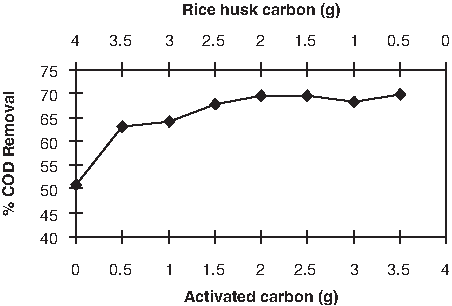
Optimum replacement of activated carbon (AC) by rice husk carbon (RHC) waste in 4 g activated AC-RHC mixture for hydrophobic media preparation at pH 7 and 200 rpm shaking speed.
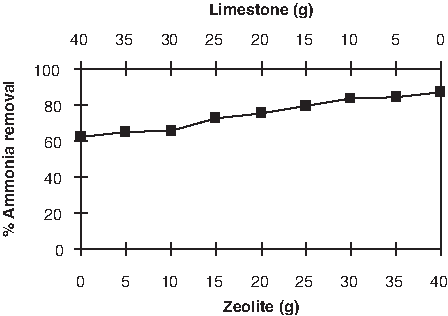
Optimum replacement of zeolite by limestone in 40 g zeolite-limestone mixture for hydrophilic media preparation at pH 7 and 200 rpm shaking speed.
Figure 3 shows that increasing the amount of hydrophobic media also increased the amount of COD removals, whereas the rate of ammonia removal decreased; contrary results have been found for hydrophilic media. Based on Fig. 3, the ratio of hydrophobic to hydrophilic adsorbent materials was selected as 1:7 to improve ammonia and COD removal. Ammonia was chosen to test hydrophilic media due to its property of solubility in aqueous solutions, whether in ammonia or ammonium forms. Zeolite, a main material for hydrophilic media in this study, is an ion exchanger with a high affinity to ammonium ions (Semmens et al., 1981; McVeigh, 1999). Almost organic contaminants present in wastewater are typically hydrophobic and could be removed effectively by AC adsorption. Therefore, in this study, COD removal was used to determine the optimum ratio of AC and RHC in the hydrophobic adsorbent material group.
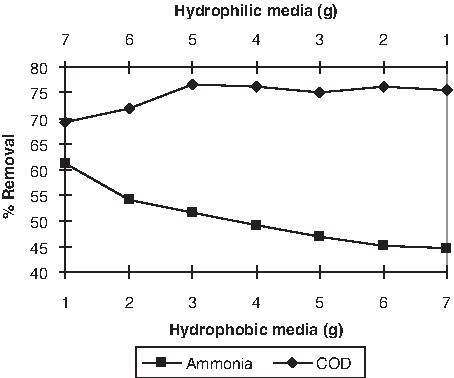
Optimum ratio of hydrophobic-hydrophilic adsorbent at pH 7 and 200 rpm shaking speed.
As was mentioned, OPC was chosen as a binder due to its compatibility with the adsorption media, especially limestone, zeolite, and RHC that contain silicate. At the same time, OPC is an adsorption medium. In fact, a previous study used hardened paste made of Portland cement as a low-cost adsorbent for the removal of arsenic from water (Kundu et al., 2004). A previous study showed that fly ash, slag, OPC, and related cement blends could remove phosphate ions from an aqueous solution (Agyei et al., 2002). Figure 4 shows that the OPC binder has an optimum percentage of 30. After considering all optimum ratios or percentages, the composition of new media was decided at 45.94% zeolite, 15.30% limestone, 4.38% AC, 4.38% RHC, and 30.00% OPC used as a binder. The physicochemical characteristics of the resulting composite media are presented in Table 1.
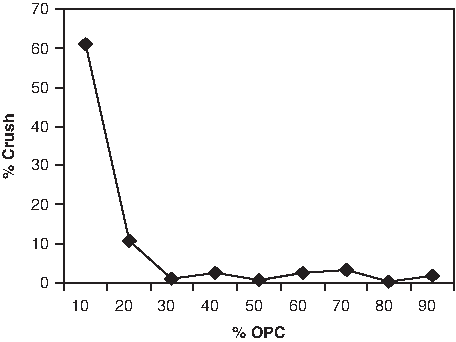
Optimization amount of binder, percentage of ordinary Portland cement (OPC) in composite adsorbent media at pH 7 and 350 rpm shaking speed.
Semiaerobic landfill leachate treatment
The leachate characteristics of a semiaerobic landfill site (Pulau Burung, Penang, Malaysia) are listed in Table 2. According to pH (>5) and BOD5-COD ratio (<0.1), the leachate sample could be classified as stabilized. Figure 5 indicates the removal rates of ammonia, COD, color, and iron from landfill leachate at various dosages of the proposed composite adsorbent material. At a dosage of 575 g/L, the color and iron removal rate reached 98%, whereas ammonia and COD removal rates reached 70% and 65%, respectively.
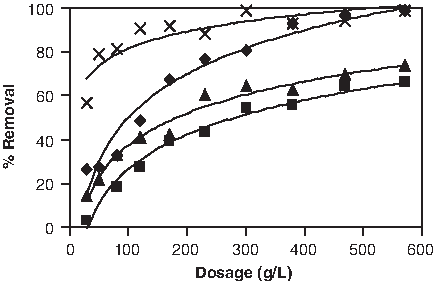
Effect of composite adsorbent dosage toward ammonia (▲), COD (■), color (♦), and iron removal (×) from landfill leachate.
COD, chemical oxygen demand.
Adsorption isotherms
Adsorption isotherms are essential in describing how the concentration of adsorbates interacts with composite media (Hussain et al., 2006); these are also important in optimizing the use of composite media as adsorbent. Both the Freundlich and Langmuir models were used to evaluate the experimental results in this study. The Langmuir adsorption model is based on the assumption that maximum adsorption corresponds to a saturated monolayer of solute molecules on adsorbent surfaces as in
The Langmuir equation can be described by the following linearized form:
where Ce (mg/L) is the liquid-phase concentration of the parameter at equilibrium; qe (mg/g) is the amount of adsorption at equilibrium; and b (L/mg) is the Langmuir constants. The linear plot of specific sorption (1/qe) against the reciprocal of equilibrium concentration (1/Ce) indicates that the adsorption is in accordance with the Langmuir model (R2>0.9). The adsorption capacity Q and energy of adsorption b were determined from the slope and intercept of the plot. These are presented in Table 3.
Unit of KF was (mg/g) (mg/L) n .
Freundlich isotherm model
The Freundlich isotherm (Choy et al., 1999; Chiou and Li, 2002) is a special case for heterogeneous surface energy, in which the energy in the Langmuir equation varies as a function of surface coverage strictly due to variation of the sorption. The Freundlich equation is given as
where KF is an indicator of the adsorption capacity, and 1/n is the constant indicative of the adsorption intensity. A linear form of the Freundlich expression will yield the constants KF and 1/n as in
Based on the above, KF and 1/n can be determined from the intercept and slope of the linear plot of log qe versus log Ce. The magnitude of the exponent 1/n gives an indication of the favorability of adsorption. Values of n>1 for all parameters (Table 3) represent favorable adsorption (Chiou and Li, 2002).
Regeneration
The composite media used were regenerated by 0.5-M sodium chloride solutions at a pH level of 12, which was adjusted using sodium hydroxide. Researchers found that regeneration solution adjusted to pH > 11 can improve regeneration efficiency and save on the volume of regeneration solution required (Koon and Kaufman, 1975; Hlavay, 1982; Du et al., 2005). In this study, the exhausted composite adsorbent materials were reused in adsorption experiments to be compared with fresh media in terms of maximum adsorption capacity. Based on maximum adsorption capacities of regenerated and fresh composite adsorbent materials, it can be seen that higher adsorption capacities were achieved for pollutants via fresh media, except ammonia (Table 4). The increase in ammonia adsorption capacity via regenerated media comparing with the fresh media was due to the CEC (CEC is defined by the number of equivalents of fixed charges per quantity of media and indicates the theoretical quantity of cations that can be adsorbed by the media). However, the CEC of regenerated media was higher than that of fresh media (Table 4). According to Jorgensen and Weatherley (2003), the presence of organic matter, such as humid acid, in the solution could have increased the ammonia removal by zeolite adsorption. They suggested that the presence of organic substances could reduce surface tension in the aqueous solution, which induced the aqueous phase to enter the macropores on the zeolite surface. The higher CEC value for the regenerated media indicates that the number of cation exchange sites increased during the regeneration process. Generally, fatty or carboxylic acids, such as acetic acid, propionic acid, and butyric acid, are the main organic substances presenting in landfill leachate. Normally, fatty or carboxylic acids are produced during the degradation of fat, protein, and carbohydrate (Albaiges et al., 1986; Schultz and Kjeldsen, 1986).
Regeneration process was not effective for organic compounds such as carboxylic or fatty acid due to poor COD adsorption capacity for regenerated composite adsorbent. Remaining carboxylic acid on composite adsorbent could react with regeneration solution to form exchangeable sites as follows:
where alkyl group (R-) in carboxylic acid salts (R-COONa) acting as a hydrophobic side was adsorbed on composite adsorbent via Van der Waals's interaction, whereas hydrophilic side (-COONa) was ready for ion exchange process for ammonium ions as follows:
This phenomenon indicated that there were the additions of cation exchangeable sites onto the surface of composite adsorbent media after regeneration, which makes more exchangeable sites, provided, and will then increase the CEC. The addition of exchangeable sites onto composite adsorbent was derived from carboxylic organic acids in landfill leachate components. In other words, organic acid that existed in landfill leachate increased the exchangeable sites of regeneration composite adsorbent, thus increasing the CEC.
Conclusions
In this study, composite adsorption media were produced using AC, zeolite and low-cost media (i.e., limestone and RHC) for treatment of semiaerobic stabilized landfill leachate. The final composition of the proposed composite media for optimum leachate treatment consisted of 45% zeolite, 15.31% limestone, 4.38% AC, 4.38% RHC as adsorbents, and 30% OPC used as binder. Both the Langmuir and Freundlich isotherm studies indicated that these media show favorable adsorption. According to the Langmuir model, the adsorption capacity of ammonia, COD, color, and iron reached 37.59, 22.99, 43.67 and 0.12 mg/g, respectively. Adsorption efficiency relative to fresh media adsorption capacity for regenerated media to ammonia, COD, color, and iron reached 149.45%, 60.94%, 47.52%, and 75.00%, respectively. The composite media exhibited excellent combination adsorption properties toward organic (COD) and inorganic contaminants (such as ammonia) in the leachate.
Footnotes
Author Disclosure Statement
The authors declare that no conflicting financial interests exist.