




Abstract
Abstract
This study investigates the variations in fluid viscosity as water was continuously added to a mixture containing methanol and a common groundwater liquid contaminant. Three different liquid contaminants were considered, namely benzene, toluene, and trichloroethylene. Each methanol-contaminant mixture (50%–50% by volume) was initially a single-phase solution, but partitioned into a two-phase liquid–liquid system after the total water content of the system reached a critical value. After the mixture partitioned into a two-phase system, fluid viscosities of each liquid phase were determined as more water was added to the system. A modified falling-ball viscometer was used to determine the viscosity of each mixture. Results from the viscosity experiments showed that in the single-phase region, the observed mixture viscosity increased with increasing total water content. In the two-phase region, the observed viscosity of the aqueous phase increased with increasing total water content, and then the viscosity decreased after reaching a maximum value. The observed viscosity of the nonaqueous phase decreased initially with increasing total water content, and then the viscosity remained relatively invariant as more water was added to the system. The viscosity variation in the aqueous phase was observed to be much more significant than the viscosity variation in the nonaqueous phase. The observed aqueous phase viscosity can range from 0.95 centipoise (pure water) to a maximum of approximately 1.7 centipoise. Finally, a viscosity model was used to compare the experimentally observed viscosity against the model-derived viscosities. In the single-phase region, modeling results showed that the average absolute deviation errors were fairly small for the three systems considered in this study (ranged between 2.35% and 5.12%). In the two-phase region, the errors were relatively higher in the aqueous phase (ranged between 7.78% and 10.63%) than in the nonaqueous phase (ranged between 3.33% and 6.20%).
Introduction
A ternary-phase diagram describes the equilibrium-phase partitioning behavior of a three-component liquid–liquid system (e.g., Peters and Luthy, 1994; Falta, 1998; Hayden et al., 1999; Lee and Peters, 2004; Lee, 2008a; Lee and Ha, 2009). Detailed descriptions on the various types of ternary-phase diagrams can be found in the work of Treybal (1963). Figure 1, adopted from the work of Lee (2008a), is an example of ternary-phase diagram. The shape of a ternary-phase diagram is an equilateral triangle, and each side of the triangle represents a component. Within the triangle, the binodal curve separates the single-phase region from the two-phase region. Any composition within the single-phase region results in a single-phase solution. Likewise, any composition within the two-phase region results in a two-phase liquid–liquid system. For example, point
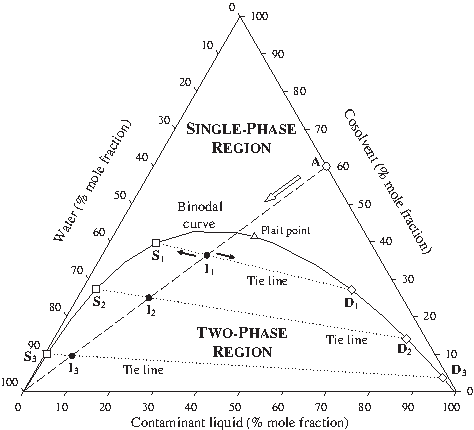
Sample ternary-phase diagram.
Fluid viscosity is an important parameter in governing its flow behavior in a porous medium. As an alcohol-enhanced contaminant mixture migrates through the subsurface and encounters water, the mixture viscosity will change and consequently affects the movement of the contaminant mixture. The mixture viscosity variation is typically neglected in fate and transport mathematical models. This is partly due to the fact that relatively little experimental data are available in literature involving alcohol-enriched contaminant mixtures containing water. In this study, the fluid viscosity variations as water was continuously added to three different predetermined fixed-quantity alcohol-enriched contaminant liquid mixtures (50%–50% by volume) were experimentally measured. Methanol was the cosolvent considered in this study, along with the three aforementioned common subsurface contaminant liquids. A modified falling-ball viscometer was used to determine the viscosity value of each mixture. In the two-phase region, the viscosity of each liquid phase was independently determined by mixing the composition represented by a tie line end point (such as
Materials and Methods
Modified falling-ball viscometer
The viscosity of each mixture was measured with the modified falling-fall viscometer described in the work of Lee (2008b). Figure 2, adopted from the work of Lee (2008b), is a drawing of the modified falling-ball viscometer. The glass tube has an outer diameter of 1.05 cm and a height of 22.2 cm. The falling ball used in all viscosity experiments is a 0.635-cm (1/4 inch)-diameter stainless-steel spherical ball, with a density of 8.02 g/cm3. The glass tube and the stainless-steel ball are commercially available from Gilmont® Instruments (Barrington, IL). A second metal spherical ball (not supplied by Gilmont Instruments) has a diameter of 0.5 cm and a density of 6.68 g/cm3. A glass cap was used to seal the glass tube after it was filled with the target liquid(s). The viscometer leveling apparatus described in the work of Lee (2008b) was also used; it is critical that the falling-ball viscometer be placed in an exact vertical position for accurate and reproducible experimental results (Feng et al., 2006). For the falling-ball viscometer used in this study, the following equation yields the viscosity of a liquid by observing the descent time of the falling ball to travel a fixed vertical distance of 10 cm (Fig. 2):
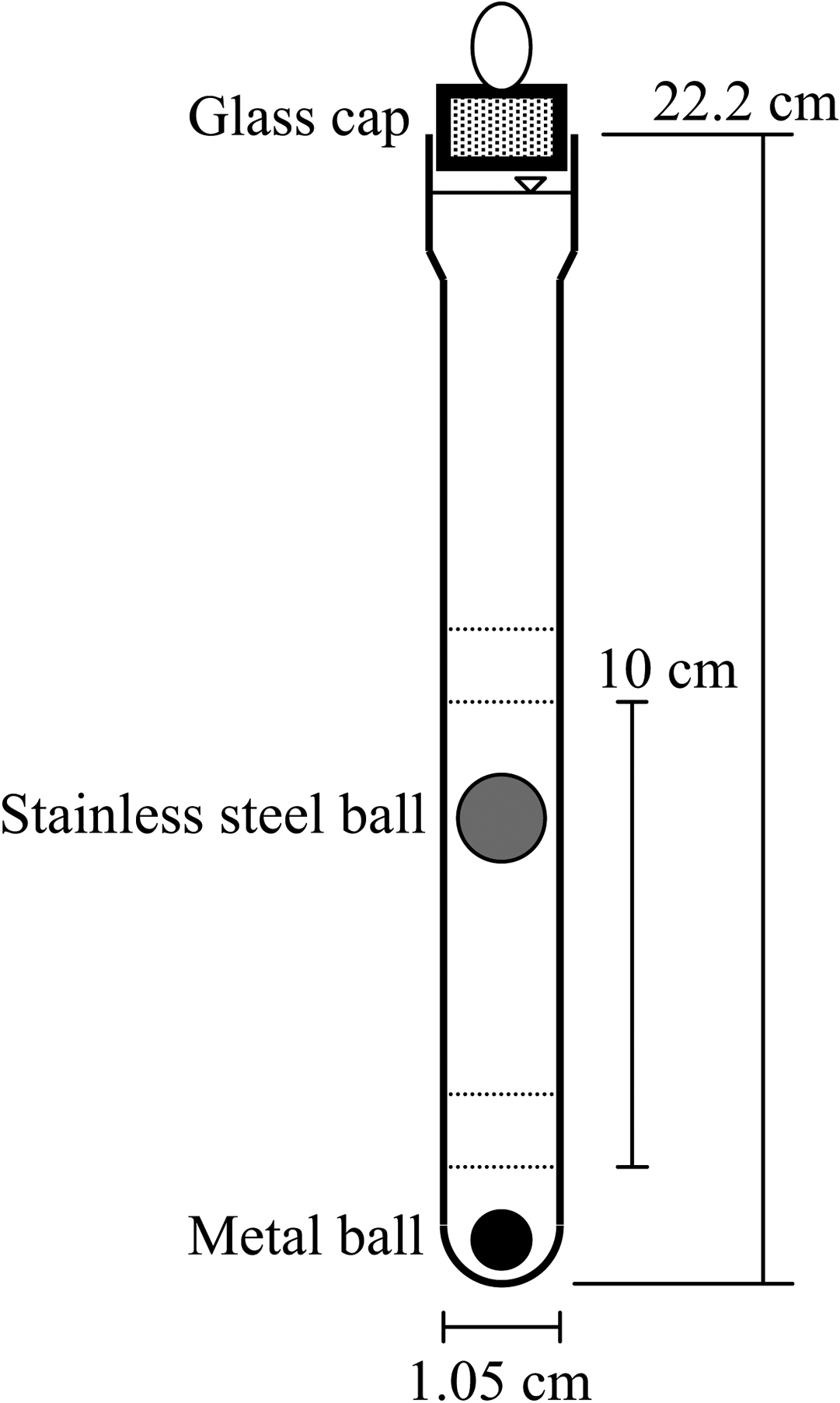
Modified falling-ball viscometer. This figure is not drawn to scale.
where ρB is the density of the falling ball, ρFL is the density of the liquid, μ is the liquid viscosity (in centipoise [cP]), t is the descent time for the falling ball to travel a fixed vertical distance, and K is the overall viscometer constant. A detailed derivation of eq. (1) can be found in the work of Lee (2008b).
Viscosity experiments
For each viscosity experiment, the glass tube was filled with predetermined amount of target liquid(s) totaling 6.7 mL. Next, the metal ball was inserted into the glass tube, followed by the stainless-steel ball. The glass cap was then immediately placed on top of the glass tube to minimize volatilization. The glass tube was then securely attached to the leveling apparatus. If the target solution contained two or three liquid compounds, an external magnet was used to move the metal ball up and down the glass tube numerous times to assure that the resulting single-phase solution was well mixed. To begin each experiment, the metal ball was moved upward with an external magnet, which also pushed the stainless-steel ball upward. When the stainless-steel ball was near the top of the glass tube (but still in the liquid phase), the magnet was removed, thus allowing both balls to fall downward. Because of the smaller diameter of the metal ball relative to the stainless-steel ball, the metal ball falls to the bottom of the glass tube at a much higher rate relative to the falling rate of the stainless-steel ball. Thus, the addition of the metal ball allowed repeated time-of-descent measurements for the same mixture without flipping over the glass tube. A stopwatch was used to determine the descent time of the stainless-steel ball over a fixed length of 10 cm through the lower half of the viscometer as indicated in Fig. 2. The time-of-descent observations were then repeated for the same mixture until four consistent consecutive falling ball descent times were recorded. The average of the four falling ball descent times was used for liquid viscosity calculation. Next, the glass cap was removed and approximately 2 mL of solution was withdrawn from the glass tube using a 3-mL BD™ disposable syringe with a 1.5-inch needle (www.bd.com). The solution volume within the syringe was determined by reading the syringe markings. The mass of the solution inside the syringe was determined by measuring the difference in syringe mass before and after liquid withdrawal. The density of each target liquid mixture was calculated by dividing the syringe liquid mass by the syringe liquid volume.
Overall viscometer constant
The overall viscometer constant K can be determined from eq. (1) by measuring t for a standard liquid with known viscosity and density values. Using HPLC-grade methanol as the standard liquid, the viscometer constant was determined as K=0.186 cP cm3/(g min). Using this K value, the observed viscosity values for the pure compounds of this study are presented in Table 1. It should be noted that the laboratory temperature was approximately 21°C. Also note that the HPLC-grade methanol and the ACS-grade TCE were obtained from Fisher Scientific (www.fishersci.com). The ACS reagent–grade benzene and the ACS reagent–grade toluene were obtained from the Sigma-Aldrich Company (www.sigmaaldrich.com). Distilled water was used in all experiments when water is a component.
Material safety data sheet.
Kumagai and Yokoyama (1998).
Lide (2004).
Weask (1968).
Weask (1989).
cP, centipoise.
Results and Discussion
Validation of tie line end points (first system)
For the first ternary system (methanol, TCE, and water), a set of published experimental equilibrium-phase separation data (black hexagons) along with corresponding tie lines (dotted lines) is shown in Fig. 3a. This set of phase separation data was obtained from the work of Sørensen and Arlt (1979), which were conducted at a temperature of 20°C. The first task of the study was to validate or reestablish the published phase separation data points. This was accomplished by mixing the composition represented by a tie line end point and then visually observing the resulting mixture to determine whether the mixture was a single-phase solution or a two-phase liquid–liquid system (Lee and Ha, 2009). If the resulting mixture for a particular composition was a two-phase liquid–liquid system, then the original published tie line was extended slightly, and a new mixture was prepared along with a new visualization experiment to determine the new tie line end point. The phase visualization experiments were repeated until the resulting mixture was determined a single-phase solution. The phase visualization experiments were repeated for all critical tie line end points. The resulting phase separation data points from this study are also presented in Fig. 3a as white squares and white diamonds. Each white square represents the aqueous phase composition and the corresponding white diamond represents the nonaqueous phase composition. Note that there are two binodal curves generated in Fig. 3a. The thicker binodal curve was generated based on the tie line end points from the Sørensen and Arlt's (1979) dataset (black hexagons), and the thinner binodal curve was generated based on the observed phase separation points from this study (white squares and white diamonds). Each binodal curve was generated using the method described in the work of Lee (2010). It should be noted that all binodal curves in this study were generated using this method. As shown in Fig. 3a, the two binodal curves are similar. Minor differences between the binodal curves may be attributed to factors such as laboratory conditions and/or the quality of the chemical compounds used.
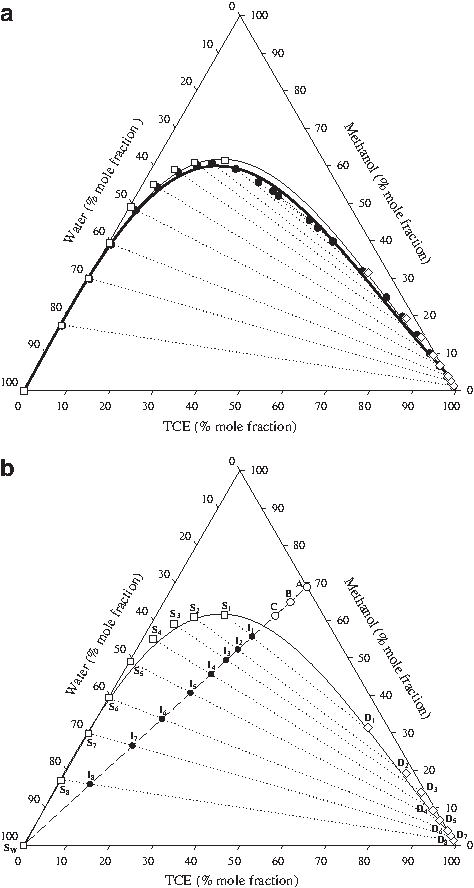
Total composition of the ternary system (first system)
Figure 3b shows the phase separation data points from this study along with modified tie lines based on the Sørensen and Arlt's (1979) dataset. As described earlier, the primary goal of this study was to determine the viscosity variations as water was continuously added to a fixed-quantity cosolvent-contaminant liquid mixture. An initial mixture with volume fractions of 50% methanol and 50% TCE was considered. These volume fractions translated to initial mole fractions of 69.0% methanol and 31.0% TCE, and this composition is indicated on the ternary-phase diagram of Fig. 3b as point
Viscosity and density variations (first system)
The viscosity of point
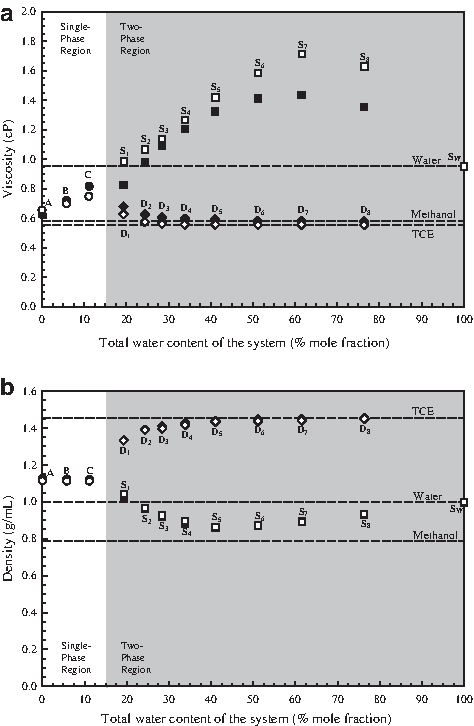
Figure 4b shows the observed density (white symbols) from this study as well as the calculated density (black symbols) based on the following estimation equation:
where ρ1, ρ2, ρ3 are the pure densities for the three liquids, and V1, V2, V3 are the added volumes of the three liquids. The circles represent densities in the single-phase region. In the two-phase region, the squares and diamonds represent the aqueous phase and nonaqueous phase densities, respectively. Each dashed line represents the density of the corresponding pure liquid. Note that the experimentally determined densities are very similar to the estimated densities. In the single-phase region, the density of the mixture remained relatively invariant as more water was added to the system. In the two-phase region, the nonaqueous phase density increased with increasing total water content, whereas the aqueous phase density initially decreased (until near the point
Second system results
Figure 5a and b follow the same logic and description as Fig. 3a and b, respectively, except that the contaminant liquid is toluene (second system). The equilibrium-phase separation dataset in Fig. 5a (black hexagons) along with corresponding tie lines were obtained from the work of Tamura et al. (2001). Their experiments were conducted at a temperature of 25°C. However, note that the Tamura et al. (2001) dataset does not provide enough data points for accurate modeling of the binodal curve. Therefore, six additional equilibrium-phase separation data points were visually determined in this study. These six data points are presented in Fig. 5a as white hexagons, and they are used for the modeling of both binodal curves. An initial mixture with volume fractions of 50% methanol and 50% toluene was considered. These volume fractions translated to initial mole fractions of 72.6% methanol and 27.4% toluene, as indicated by point

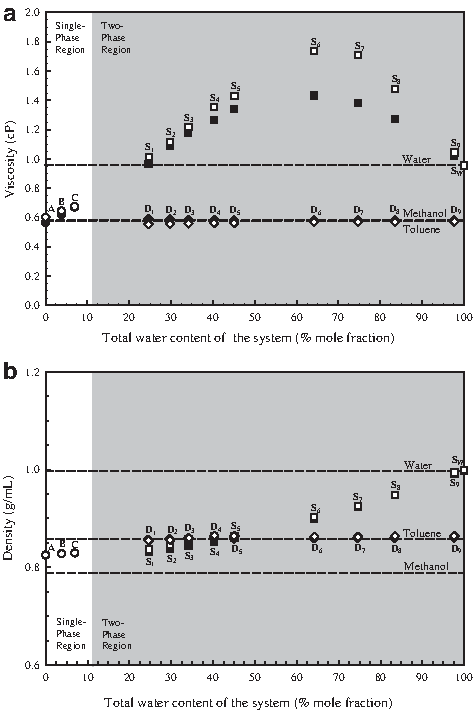
Third system results
Figure 7a and b also follow the same logic and description as Fig. 3a and b, except that the contaminant liquid is benzene (third system). The phase separation dataset in Fig. 7a (black hexagons) along with corresponding tie lines were obtained from the work of Sørensen and Arlt (1979). Their experiments were conducted at a temperature of 30°C. Again, the thicker binodal curve was generated based on the Sørensen and Arlt's (1979) dataset, and the thinner binodal curve was generated based on the dataset of this study. Note that the Sørensen and Arlt's (1979) dataset contained enough data points covering the entire range of the binodal curve, and thus no additional data points were needed for accurate modeling of the thicker binodal curve. However, four additional equilibrium-phase separation data points (white hexagons) were visually determined in this study to provide a more accurate modeling of the thinner binodal curve. Point
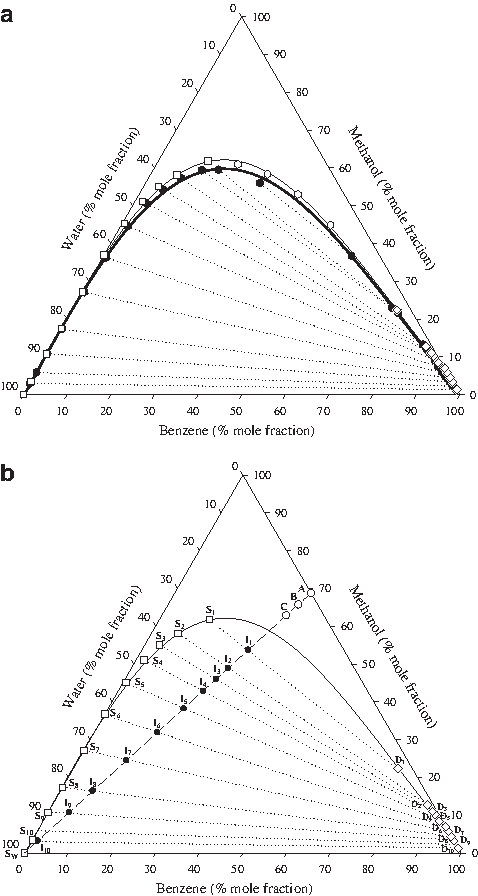
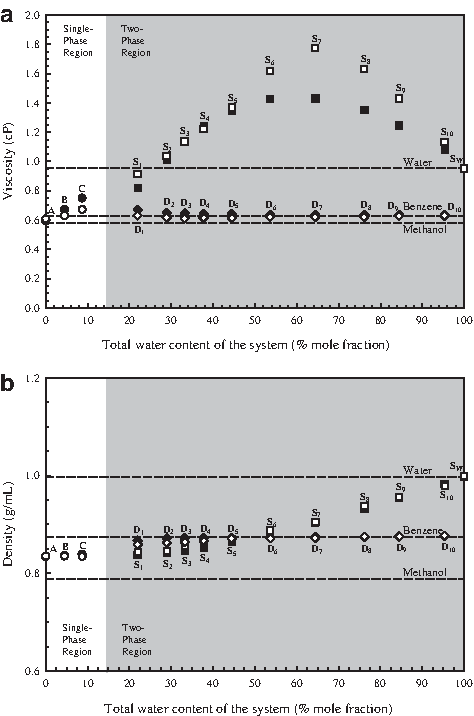
Viscosity modeling
The viscosity model of Teja and Rice (1981) was used to estimate the viscosity of each mixture. The model is as follows:
where superscripts r1 and r2 refer to the two reference fluids, and the remaining variables in eq. (3) are defined as
where Vc is the critical volume, Tc is the critical temperature, ω is the acentric factor, M is the molecular weight, x is the mole fraction, ψij and is a binary interaction coefficient.
The usage of this model for a ternary mixture requires temperature-dependent viscosity data of two reference liquids (r1 and r2). For the first system, the two selected reference liquids for the single-phase region are methanol and TCE. In the two-phase region, the two selected reference liquids for the aqueous phase are methanol and water, and the two selected reference liquids for the nonaqueous phase are methanol and TCE. For the second system, the two selected reference liquids for the single-phase region are methanol and toluene. In the two-phase region, the two selected reference liquids for the aqueous phase are methanol and water, and the two selected reference liquids for the nonaqueous phase are methanol and toluene. For the third system, the two selected referenced liquids for the single-phase region are methanol and benzene. In the two-phase region, the two selected reference liquids for the aqueous phase are methanol and water, and the two selected reference liquids for the nonaqueous phase are methanol and benzene. It should be noted that the reference liquid viscosities are needed at a temperature equal to T=T1(Tc/Tcm), where T1 is the experimental temperature equal to 294.16 K (21°C). To estimate the viscosities of the reference liquids at various temperatures, the method of Lewis-Squires was used (Poling et al., 2000):
where μk is the known liquid viscosity at a temperature equal to Tk.
Teja and Rice (1981) reported that the binary interaction coefficient ψij is equal to 1.0 for a mixture of methanol and TCE, 0.99 for methanol and toluene, 1.0 for methanol and benzene, and 1.34 for methanol and water. Note that it is not possible to conduct experiments to determine the binary interaction coefficient for an immiscible binary mixture such as TCE and water. Thus, for the immiscible binary mixtures, a maximum value of 1.37 reported by Teja and Rice (1981) was assumed.
Values of Tc, Vc, and ω for benzene, methanol, toluene, and water were obtained from the work of Poling et al. (2000). For TCE, the values of Tc and Vc were obtained from the work of Dean (1992), and the value of ω was estimated from the following correlation (Lyman et al., 1990):
where Tbr=Tb/Tc, Tb is the boiling temperature, and Pc is the critical pressure. For TCE, the value of Tb was obtained from the work of Lide (2004) and the value of Pc was obtained from the work of Dean (1992).
The modeling results are presented in Figs. 4a, 6a, and 8a as black circles in the single-phase region and as black diamonds (nonaqueous phase) and black squares (aqueous phase) in the two-phase region. Note that a similar modeling trend is apparent in all three figures. In the single-phase region, the model shows an increase in viscosity with increasing total water content. In the two-phase region, the Teja and Rice's (1981) model-derived viscosities matched the experimental viscosities fairly well in the nonaqueous phase, and the model was capable of capturing the general viscosity variation trend in the aqueous phase region. To determine the deviation of the model-derived viscosities, the following average absolute deviation (AAD) equation was used:
where N is the number of samples, μcal is the model-derived viscosity, and μobs is the experimentally observed viscosity. For the first system, the calculated AAD for the single-phase region is 2.35%. In the two-phase region, the calculated AADs are 6.20% and 10.63% for the nonaqueous and aqueous phases, respectively. For the second system, the calculated AAD for the single-phase region is 3.26%. In the two-phase region, the calculated AADs are 3.87% and 8.12% for the nonaqueous and aqueous phases, respectively. For the third system, the calculated AAD for the single-phase region is 5.12%. In the two-phase region, the calculated AADs are 3.33% and 7.78% for the nonaqueous and aqueous phases, respectively.
Conclusion
Viscosity experiments were conducted to study the mixture viscosity variations as water was continuously added to a common groundwater liquid contaminant enriched with methanol (50%–50% by volume). Three common groundwater contaminants were considered, namely benzene, toluene, and TCE. Initially, at low water contents, the resulting mixture was a single-phase solution. As the total water content surpassed a critical value, phase separation occurred and the ternary mixture formed a two-phase liquid–liquid system. In the single-phase region, experimental results showed that the mixture viscosity increased with increasing total water content. In the two-phase region, the nonaqueous phase viscosity initially decreased with increasing total water content and then remained relatively invariant as more water was added to the system. The aqueous phase viscosity increased rather significantly with increasing total water content, eventually reaching a maximum value before a decrease in viscosity was observed. The viscosity model presented by Teja and Rice (1981) was used to compare the experimentally observed viscosities against model-derived viscosities. Modeling results showed that the average absolute deviation errors were fairly small in the single-phase region for the three systems considered in this study. In the two-phase region, modeling results showed that the errors were relatively higher in the aqueous phase than in the nonaqueous phase. As viscosity is a key parameter in governing the movement of a fluid in porous media, the variation in mixture viscosities observed in this study emphasizes the need to account for viscosity variability in subsurface contaminant fate and transport mathematical models involving alcohol-enriched contaminant mixtures.
Footnotes
Acknowledgment
This study was partially funded by a grant from the National Science Foundation (0820983).
Author Disclosure Statement
The authors declare that no conflicting financial interests exist.