




Abstract
Abstract
Deterioration of indoor air quality due to the airborne bacterial consortia is a widespread environmental problem. The main objectives of this study were to (1) determine dominant bacteria using real-time polymerase chain reaction in the indoor air of a medical nursing institute; (2) evaluate the feasibility of applying the synergetic effect of combining nano-Ag/TiO2 as photocatalyst and ultraviolet light irradiation to enhance the disinfecting capability of a full-scale bacterial treatment equipment. The predominant bacteria existing in the air of a Taiwanese nursing institution were identified as Acinetobacter baumannii, Burkholderia cepacia, Escherichia coli, Klebsiella pneumoniae, and Pseudomonas aeruginosa. Thus, using an air purification device such as the nano-Ag/TiO2+ultraviolet light irradiation system to maintain the air quality is of great importance to reduce infectious diseases in the nursing institution. The average bacterial restraining rate for the five sampling points is 57.3%, indicating that the proposed equipment can restrain or disinfect bacteria effectively under the operational conditions for carrying out the study. The efficiency of the proposed equipment to disinfect air has been demonstrated on-site in the medical nursing institution. Results will provide valuable information to be referenced by planners and engineers for designing a full-scale commercialized device to implement the proposed indoor air quality control system in the future.
Introduction
Air purifiers can be installed either in air ducts as an integral component of the central heating ventilation and air conditioning (HVAC) system or in individual rooms as stand-alone units. A commercial air pollution control systems currently in use generally includes the following component units: filtration, electrostatic precipitation, ozone generators, germicidal light (ultraviolet [UV]), and negative air ionization (Zhao and Yang, 2003; Grinshpun et al., 2007; Yu et al., 2008). The system is effective in removing non-biological airborne pollutants but may not achieve effective bacterial retention or disinfection.
During the last decade, photocatalyses are becoming more popular to draw significant global interest (Chen et al., 2009). Titanium dioxide (TiO2) is the most widely used catalyst; it is considered to be an ideal catalyst for photocatalytic oxidation applications (Mo et al., 2009; Chen et al., 2010; Paz, 2010; Zhong et al., 2010). Numerous reports on the mechanisms of photocatalytic process for disinfecting air have been published in literature (Strini et al., 2005; Salvad-Estivill et al., 2007; Mo et al., 2009; Chen et al., 2010). However, not much research has been carried out on the photocatalytic disinfection of airborne bacteria in polluted indoor air despite its capacity and great potential to protect public health.
In recent years, another efficient way to improve the kinetics of photocatalyses is the addition of transition metals such as silver (Ag+) to the TiO2 catalyst (Arabatzis et al., 2003; Sobana et al., 2006; Li et al., 2010; Liu et al., 2010). Nano-scale silver clusters release atomic Ag(0) that is as effective as chemical species Ag(I) ions to rapidly kill bacteria and fungi. Besides, the nano-scale silver-doped TiO2 photocatalyses (nano-Ag/TiO2) particles have attracted much interest due to their antibacterial and biomedical applications (Kubacka et al., 2008; Mo et al., 2009). Although there is extensive literature on the use of Ag+ ion doped TiO2 for photocatalytic degradation of organics, its application for photocatalytic disinfection of indoor air with bacterial pollutions has not been fully studied (Shie et al., 2008), especially for on-site indoor air disinfection for our living environment such as museum, nursing institutions, schools, and other public areas.
Adding photocatalyst units to commercial HVAC for enhancing the bacterial retention capability of the modified HVAC system has been proposed in this research; the efficiency of the combined HVAC and photocatalyst system has been evaluated in this study. Specific objectives of this study include (1) evaluating the concentration levels of airborne bacterial particles in the medical nursing institution selected for carrying out this research, (2) determining the dominant bacterial using real-time polymerase chain reaction (PCR), and (3) evaluating the feasibility of applying the synergetic effect by combining the photo-catalytic nano-Ag/TiO2 and UV light to enhance the disinfection of indoor air in the full-scale medical nursing institute.
Materials and Methods
Description of the building and experimental conditions
The medical nursing institution selected for this study is located in central Taiwan; it accommodates patients in vegetative state, patients terminally ill with cancer, and patients with dementia, among the others. An acceptable indoor air quality and thermal comfort should be provided to prevent nosocomial infections. There is one investigative room in the first story of the nursing institution. The dimensions of this room are 1,160 cm by 340 cm with a clear ceiling height of 300 cm.
All five sampling points (i.e., A, B, C, D, and E) are 90 and 180 cm above the ground between two adjacent beds (Fig. 1). Indoor air samples for determining the biological and nonbiological contaminants in the medical nursing institution were collected at 10:00 a.m. to 10:48 a.m. Sampling at multiple locations will provide sufficient data for analyzing biological contaminants (i.e., bacteria), nonbiological contaminants (i.e., CO, O3, PM2.5, and PM10) (Yang and Heinsohn, 2007; TEPA, 2009), total bacterial counts (colony forming unit/cubic meter [CFU/m3]), bacterial restraining or disinfecting rate, and indoor RH. All tests were performed in triplicate.

Schematic diagram of air sampling points. All five sampling points (i.e., A, B, C, D, and E) are 90 and 180 cm above the ground between two adjacent beds.
CO and O3 concentrations were measured with AirBoxx IAQ Monitor (KD AirBoxx). Particle (i.e., PM2.5 and PM10) samples were collected on Teflon and Teflon-impregnated glass fiber filters using portable battery operated samplers (Minivol portable air samplers, AIRmetrics, Springfield, OR). The ambient air flow rate was adjusted to 5 L/min based on ambient temperatures and pressures for individual periods of 22–23 h. The samplers, cylindrical in shape with a diameter of 15 cm and a height of 74 cm, weigh about 7 kg. They are battery operated to run unattended for 24 consecutive hours. Filters and batteries were changed once per day in the field (Reist, 1993).
The multi-stage multi-orifice impinger was used for enumerating the total bacterial counts following the procedures described in Standard Methods (Yang and Heinsohn, 2007; TEPA, 2009). Air sampling for bacterial count was conducted for 1 min using an impactor method air sampler with 400 holes (MAS-100; Merck, KGaA). The impaction speed of the airborne microorganisms on the agar surface using MAS-100 was 11 m/s that corresponds to the stage-5 of Andersen six-stage sampler (stage-5 is 5.28 m/s and stage-6 is 12.78 m/s). The cut-off diameter of the sampler was 0.6 μm so that fungal spores (>2 μm) and bacterial spores (1 μm) were collected with reasonable efficiency. The optimal number of colonies on a typical Petri dish is between 50 and 100. To determine bacterial counts, the standard method agar such as Tryptic Soy Agar with addition of cycloheximide to inhibit fungal growth was used. After incubation for 48±2 h at 30±1°C, the number of colonies grown on each plate was counted and converted to CFU by applying the positive hole correction that is a rectification to calculate total number of colonies on the plate (Macher, 1989; Yang and Heinsohn, 2007; TEPA, 2009). The indoor RH was measured with the CompuFlow® Model 8585/8586 thermo-anemometer.
Statistical analysis
Data analyses were performed using the SAS program (Version 9.0) executed with a personal computer. Relationships between total bacterial counts and other measured items such as CO, O3, PM2.5, PM10, and RH were examined by carrying out simple regression analyses and multiple regression analyses. Dependent variables used in the statistical models, that is, total bacterial counts and variations, are the independent variables in the regression analysis of total bacterial counts.
Bacterial sampling for identification of bacteria and real-time PCR
Identification of the bacteria species that may exist in the wards is useful to prevent nosocomial infection. The colony morphology was observed, and the strains, which might cause nosocomial infection, were picked for Gram stain characterization. Moreover, the bacteria species were further identified using clinical microorganism examination. Airborne bacteria for the real-time PCR analyses were collected with an air sampler (Airport MD8; Sartorius) in each ward; they were collected onto gelatin membranes (3 (m pore size 80 mm diameter; Sartorius). The gelatin membrane was then dissolved in the phosphate buffer (pH 7.0), and genomic bacterial DNA was extracted from the phosphate buffer by using the BuccalAmp™ DNA Extraction Kit (Epicentre) according to the manufacture's protocol. Afterward, the quantity of total airborne specific species was assessed by using the real-time PCR. Genomic bacterial DNA extracted from pure cultures was used as the standard to construct the calibration curve (An et al., 2006; Hogg et al., 2008).
Each real-time PCR test was performed in a 15 μL volume using the StepOne Plus™ real-time PCR from Applied Biosystems. The final volume of 15 μL volume comprised 0.2 μL 10 μM of each primer (Table 1), 7.5 μL Power SYBR® Green PCR Master Mix (Applied Biosystems), 1 μL template DNA, and 6.5 μL sterilize super pure water. The quantity of the specific bacteria in an unknown sample was determined based on the calibration curve. The real-time PCR amplification procedure consisted of 10 min at 95°C, followed by 40 cycles of 15 s at 95°C, and 1 min at 60°C. Fluorescence data were acquired at the end of each PCR cycle. Subsequently, the melting curve analysis was performed immediately by increasing the temperature to 95°C for 15 s, cooling to 60°C for 1 min, and then to 94°C for 15 s. Fluorescence was measured continually during the melting curve cycle.
Bacterial restraining equipment for commercial applications
The medical nursing institution is installed with a Fan Coil Unit system that consists of fan, duct system, heating and cooling coils, filters, controls, ventilators, and a packaged outside/return air damper. The air quality control equipment with bacterial restraining unit to be installed in this study was a fixed full-covering type (FF type) for complete air cooler coverage (Fig. 2). In most duct systems, the air is delivered to the building from the positive pressure side of the blower and returns to the negative side. Hence, the bacterial restraining unit was installed on the positive pressure side in this study so that the air is disinfected before it is delivered to the room. After the air quality control equipment was turned on, the indoor air quality parameters including ambient RH and total bacterial counts were monitored.
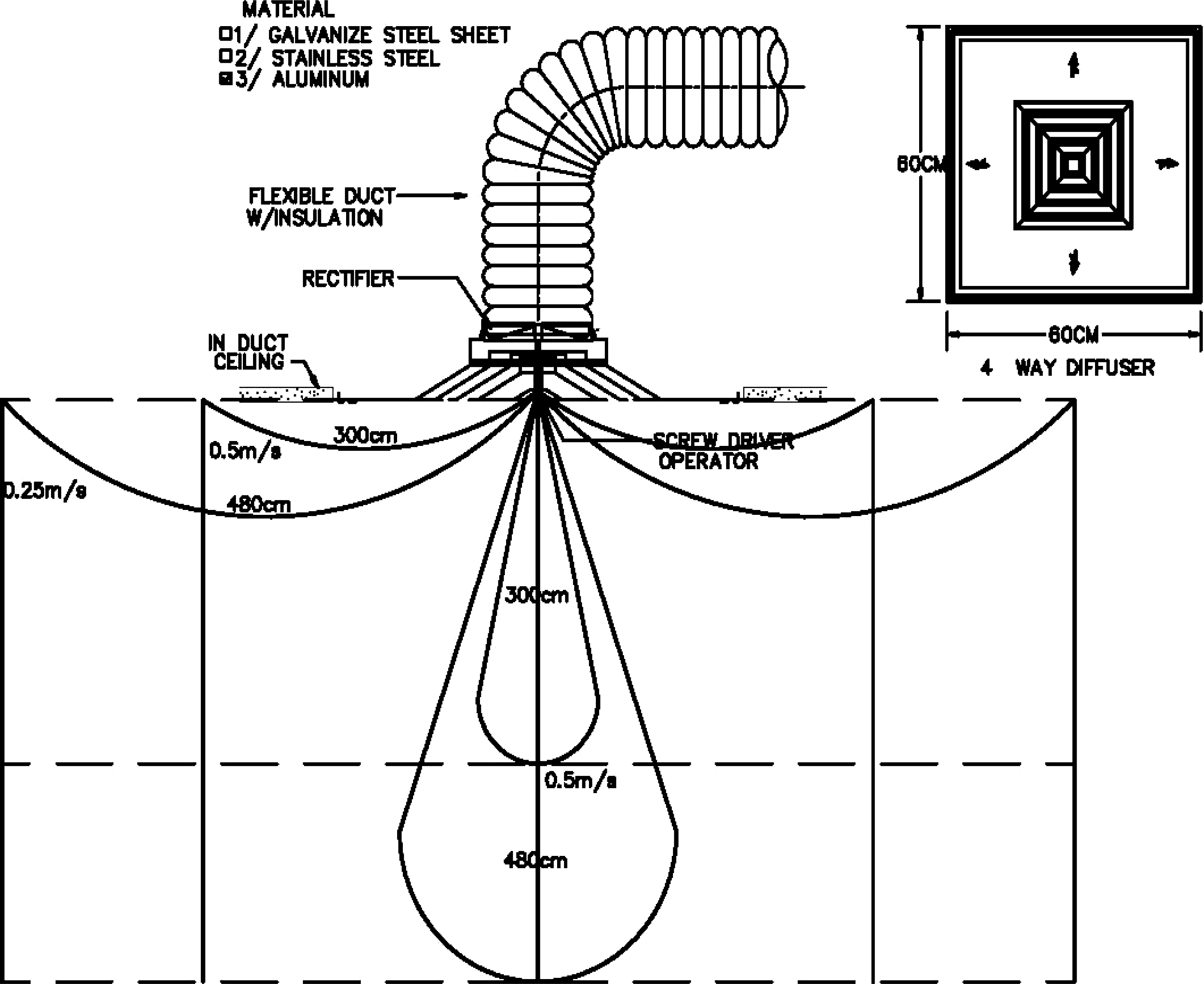
Schematic diagram of the fixed full-covering type of air quality control equipment.
The new bacterial restraining equipment is based on the combined disinfecting power of nano-Ag/TiO2 photocatalyst and UV-A light irradiation for improving the indoor air microbiological quality. As shown in Fig. 3, it includes the following components: nano-Ag/TiO2 photocatalytic filter, UV-A lights, and cross-flow fan (2.7m3/min). This modified unit adopts the design similar to that of honeycomb monolith photocatalytic reactors, which has the advantages of low pressure drop and high surface area to volume ratio. The Ag-TiO2 nanocomposites were prepared using a photoreduction-thermal treatment method (Zhang et al., 2008). Briefly, a suspension was prepared by mixing P25 powder (Degussa) and 1 M AgNO3 (Merck Chemicals) aqueous solution (700 mg/10 mL) in a round-bottom flask. The suspension was then irradiated with a high pressure mercury lamp (100 W) under stirring. The resulting Ag-TiO2 nanocomposite was recovered by filtration, rinsed with deionized water several times, and finally dried at room temperature in the dark. Nano-Ag/TiO2, which was coated on the surface of 60 cm (length) by 10 cm (width) fabric filters, was activated with an external 18-W UV light source (UV-A) of 365 nm (Zhang et al., 2008). The thickness of the nano-Ag/TiO2 layer was 1 nm to allow the entire catalyst surface to be illuminated evenly by the UV light. A reflector was placed behind the light sources to direct all UV light onto the catalyst.
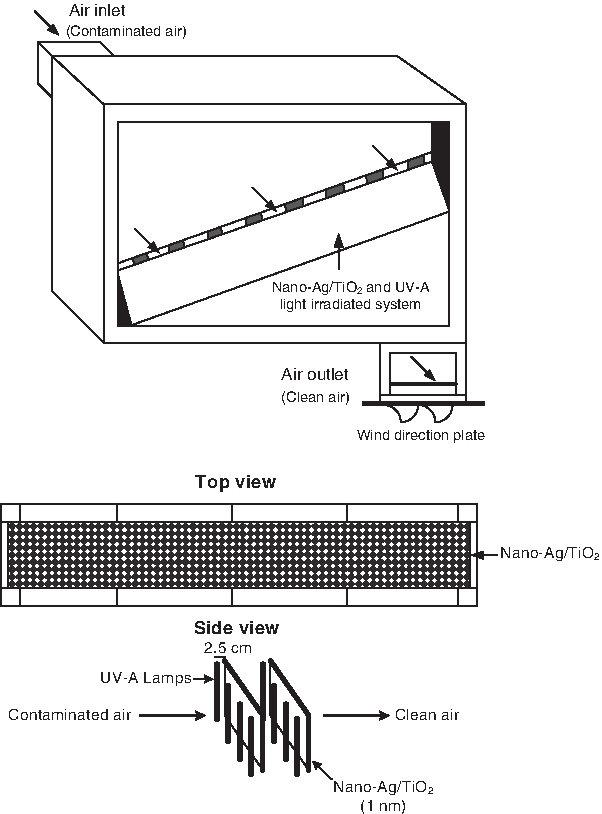
Schematic diagram of bacterial restraining equipment in market.
Results and Discussion
Indoor air quality investigation
The indoor air contains a complex mixture of bioaerosols such as fungi, bacteria, and allergens, as well as non-biological particles including products in the medical nursing institution. To date, little work has been done to investigate the interactions and associations between particles of biological and nonbiological origin; however, such interactions could affect pollutant behavior in the air and ultimately the effect they have on health. In this full-scale investigation, nonbiological particles were evaluated, the results show no statistically significant associations between the bacterial counts and CO, O3, PM2.5, and PM10, (Fig. 4), but they are correlated with RH (Fig. 5). The average indoor bacterial count in the medical nursing institution is 985±49 CFU/m3, with the highest and lowest bacterial counts being 1,298±76 and 530±40 CFU/m3, respectively. The average bacteria count has exceeded the indoor air quality (IAQ) recommended level of 500 CFU/m3 in Taiwan. The results demonstrate that a well-designed air-conditioning system should be considered to provide indoor air of biologically acceptable quality.

Variations in

Variations in
Identification of bacteria and real-time PCR
The results reveal that the indoor air of the medical nursing institution contains bacteria that may cause nosocomial infection. They are Acinetobacter baumannii, Burkholderia cepacia, Escherichia coli, Klebsiella pneumoniae, and Pseudomonas aeruginosa. These bacterial species belong to multidrug-resistant organisms and may cause pneumonia, sepsis, meningitis, endocarditis, liver abscess, peritonitis, urinary tract infection, wound infections, or eye infections (Fournie and Richet, 2006; Liu et al., 2007a, 2007b; Jang et al., 2009; Towner, 2009). In addition, Enterobacter cloacae, methicillin-resistant Staphylococcus aureus, Proteus mirabilis, Serratia marcescens, and Stenotrophomonas maltophilia are also found in the indoor air of the nursing institution.
The results of real-time PCR in this study show that the predominant bacteria in the room of the nursing care institution are A. baumannii, E. coli, and K. pneumoniae; quantities of these bacteria were monitored during each sampling period. The average densities are 1.6×10¹⁰–5.9×10¹¹ cells/m3 for A. baumannii, 1.3×10⁷–5.3×10¹¹ cells/m3 for E. coli, and 1.7×10⁷–2.1×10¹⁰ cells/m3 for K. pneumoniae. The observed variations of bacterial densities may be caused by the activities of patients, care staffs, or visitors. The amounts of these bacteria are necessary to be monitored, as these bacteria may cause nosocomial infection, and, therefore, the prompt methods to improve indoor air quality and decrease infections can be carried out. Using real-time PCR to quantify the specific bacteria in this research is useful to evaluate the indoor air quality and the predominant bacteria existing in the nursing care institution. The patients who have already been infected might transmit these nosocomial bacteria to ambient air and their surrounding objects such as air, beds, apparatus, among the many others. After contacting these objects, another person may carry these microorganisms to infect the ambient air and surrounding objects at a different location. Thus, the air quality should be improved by using an effective method such as the combination of nano-Ag/TiO2 and UV irradiation to prevent infections in the nursing institution.
Bacterial restraining rate by nano-Ag/TiO2 photocatalyst
The synergistic effect of UV-A light irradiation and nano-Ag/TiO2 catalyst in the nursing institution has been demonstrated by the on-site studies. If only the 365 nm UV-A light (without the nano-Ag/TiO2 as photocatalyst) is used alone, the UV irradiation is incapable of restraining or disinfecting the airborne bacteria (data not shown). This observation is consistent with those reported by Yu et al. (2008). Table 2 indicates that the FF type has the most significant bacterial restraining rate of 62.4%, and the average bacterial restraining rate is 57.3% for samples collected from the test site using FF type equipment under similar conditions at 90 cm of sampling height. Our results indicate that approximately 62.4% and 78.9% of the average restrained bacterial rate were observed at sampling heights of 90 and 180 cm, respectively, for the FF Type air quality control equipment (Fig. 6) and that higher sampling heights lead to increasing bacterial restraining rate. This reveals that (1) higher initial counts of total airborne bacterial lead to increasing bacterial restraining rate; (2) patients or personnel can get relatively fresh air from any locations of the room as long as the air quality control is in operation.

Variations in total bacterial counts at sampling locations with different height versus type of air quality control equipment on August 7, 2009.
CFU, colony forming units.
Vohra et al. (2006) reported that the TiO2 photocatalysis with UV-A light has proven to be a highly effective process for complete inactivation of airborne microbes. Approximately 100% of bacterial restraining rate is observed in Vohra et al. (2006), but only 62.4%–78.9% of bacterial restraining rate is observed in this study. Among several possible explanations for this observation, the most probable reason is that some bacteria are intrinsically more resistant to UV light than other species (Cerf, 1977; Corbella et al., 2000; Kuo et al., 2004; Mohantv and Kay, 2004; Liu et al., 2006, 2007a, 2007b).
In E. coli as an example, when air quality control equipment were turned off, the E. coli concentration was generally between 4.5×10⁷–5.3×10¹¹ cells/m3. After 24 hr of operation, the indoor air bacterial concentration can be maintained at 1.2×10⁷–3.7×10¹⁰ cells/m3 for the FF Type air quality control equipment. Previous research results indicate that the photocatalyses process enhanced with Ag/TiO2 photocatalyst and UV-A light irradiation is effective for inhibiting a range of microorganisms such as B. cereus (bacterial spores), E. coli (gram-negative bacteria), Sta. aureus (gram-positive bacteria), A. niger (fungal spores), and MS2 Bacteriophage (virus) (Vohra et al., 2006). Yu et al. (2008) reported that the combination of negative air ionization and photocatalytic oxidation (with the Degussa P25 TiO2 as photocatalyst) was the most efficient method for removing aerosolized E. coli (restrained bacterial rate=36.4%), Candida famata (restrained bacterial rate=59.8%). Results from this study demonstrate that the combination of nano-Ag/TiO2 and UV-A light irradiation can significantly improve the efficiency of bacterial restraining in the medical nursing institution.
Conclusions
Studies on air quality, colony counts, and bacteria species in the medical nursing institute were investigated. Further, the application of nano-Ag/TiO2 as photocatalyst and UV light irradiation to enhance the bacterial restraining equipment for disinfecting indoor air has been investigated in this study. Conclusions obtained from this study include the following:
1. Results show that statistically there are no significant associations between the airborne bioaerosols and constituents such as CO, O3, PM2.5, and PM10, but the total bacterial count is correlated with RH. 2. The predominant bacteria existing in the air of the nursing institution have been identified as A. baumannii, B. cepacia, E. coli, K. pneumoniae, and P. aeruginosa. 3. In this study, approximately 62.4% and 78.9% of average restrained bacterial rate was observed at different sampling heights of 90 and 180 cm, respectively, for the FF Type air quality control equipment; higher sampling heights lead to increasing bacterial restraining rate. 4. The photocatalyst-containing air cleaner can effectively restrain or disinfect airborne bacteria to improve the indoor air quality. Thus, it can be applied in nursing care institutions, hospitals, and other public areas, where airborne bacteria are of great concern.
Footnotes
Acknowledgments
The National Science Council of Taiwan supported this research through grant No. NSC 99–2811-E-167–003. These supports are gratefully acknowledged.
Author Disclosure Statement
No competing financial interests exist.