




Abstract
Abstract
Lead dioxide (PbO2) is a new form of lead corrosion product discovered in the drinking water distribution systems. It is formed via the chlorination of lead-containing plumbing materials. In this study, we investigated the adsorption of free chlorine (HOCl/OCl−) on PbO2 to explore the loss of free chlorine in the bulk solution and the reactivity of adsorbed free chlorine in the presence of PbO2. Our results indicated that adsorption reached equilibrium in approximately 6 h and ionic strength did not significantly affect adsorption. Langmuir adsorption isotherm provided good fittings of the experimental data. Maximum adsorption capacity of PbO2 was dependent on the solution pH value, with the maximum occurring at pH 8, which can be explained by electrostatic interactions between free chlorine and PbO2 surfaces. Both carbonate and phosphate buffers inhibited free chlorine adsorption, and phosphate was a stronger inhibitor. Adsorbed free chlorine was found to maintain its oxidation ability. Our results indicated that the presence of PbO2 may induce a loss of free chlorine in the bulk solution because of adsorption. Nevertheless, adsorbed free chlorine remains active and may exhibit disinfection capability. This is the first study to show that free chlorine can act as an “adsorbate” in the distribution system and this reaction should be considered in the redox transformation of corrosion products.
Introduction
A series of electrochemical reactions in drinking water can lead to the formation of lead corrosion products on the surface of LCPMs. Pb(II) solids including cerussite (PbCO3) and hydrocerussite (Pb3(CO3)2(OH)2) were considered to be the solid phases controlling the plumbosolvency and lead release in the drinking water distribution system (Schock, 1980, 1989; Schock and Gardels, 1983; Davidson et al., 2004). However, tetravalent lead corrosion product (PbO2) was recently discovered in some distribution systems wherein free chlorine was used as the disinfectant (Schock et al., 1996, 2001; Renner, 2004). Laboratory studies have verified that PbO2 can be formed via the chlorination of Pb(II) solids (Edwards and Dudi, 2004; Lytle and Schock, 2005; Liu and Korshin, 2008; Zhang and Lin, 2011). Because of its low solubility, PbO2 is considered a good passivating layer preventing lead release from underneath materials (Lytle and Schock, 2005).
In a recent study on the chlorination of hydrocerussite and cerussite by Liu and Korshin (2008), it was found that free chlorine consumption exhibited a lag phase followed by a rapid loss accompanying by the formation of PbO2. Although Liu and Korshin (2008) proposed an autocatalytic oxidation mechanism for PbO2 formation to explain this unusually rapid loss of free chlorine, it is noted that the amount of PbO2 formed was not determined to verify the reaction stoichiometry. Considering the common interactions between soluble species and solid phases, adsorption of free chlorine on the PbO2 surfaces, which has not been studied in the past, may also contribute to the loss of free chlorine in the bulk solution phase. If such adsorption is significant, it must be considered when investigating the kinetics and mechanism of PbO2 formation from the chlorination of Pb(II) solids. In addition, the loss of free chlorine may be problematic as free chlorine is commonly used to provide disinfectant residual to prevent microbial regrowth in the drinking water distribution system (AWWA, 1999).
The main objective of this study was to characterize the adsorption of free chlorine on PbO2 to understand the fate and reactivity of free chlorine when PbO2 is present. Both adsorption kinetics and adsorption isotherms were studied. In addition, the effects of solution pH, ionic strength, and buffer type and concentration on free chlorine adsorption were investigated.
Experimental Protocols
Chemicals
PbO2 was prepared by oxidizing 1 mM Pb(NO3)2 solution by 1.1 mM of HOCl according to the procedures described by Lin and Valentine (2008). HOCl solutions were prepared by diluting an ∼4% NaOCl stock solution (Sigma-Aldrich). Analytical-grade KI (Merck) was used as the source of iodide. NaHCO3 (Nacalai Tesque) and Na3PO4·12H2O (Merck) were used to prepare pH buffer. Analytical-grade KNO3 (Sigma-Aldrich) was used to adjust ionic strength. The solution pH was adjusted using 1 N HCl and NaOH. All solutions were prepared by ultrapure water obtained from a Millipore DirectQ system.
Potentiometric titration
The potentiometric titration was used to determine the point of zero charge (pHpzc) of the synthesized PbO2 particles. The solution used was prepurged with nitrogen gas to remove carbonate ions. During the course of the experiment, the solution was continuously stirred to ensure a homogeneous suspension. The titration procedure was adopted from that used by Lu et al. (1996). Briefly, 0.1 N HCl or NaOH was added to a 100 mL PbO2 suspension at 25°C in the presence of a gentle stream of nitrogen gas, and the equilibrium pH was recorded after each addition of HCl and NaOH. The PbO2 loading employed was 1 g/L.
Adsorption experiments
All adsorption experiments were conducted using 25-mL gas-tight polyethylene vessels at a constant ambient temperature of 25°C. After filling the experimental solution containing the desired loading of PbO2 and free chlorine, the vessels were sealed and covered by aluminum foil to prevent light-induced free chlorine decay. The vessels were placed on a shaker rotating at 200 rpm to ensure a complete mixing during the course of the experiment. The adsorption kinetics was investigated using solutions with pH values ranging from 6 to 10 buffered by either carbonate or phosphate. The variation of pH value before and after each experiment was found to be within 0.2 pH units. The residual free chlorine concentration in the aqueous phase was measured as a function of time using filtered samples obtained by passing the solutions through a syringe filter equipped with a 0.2 μm pore size PTFE membrane (Titan). To account for the natural decay of free chlorine, a blank sample without the addition of PbO2 was prepared. The adsorbed free chlorine was determined by the difference in residual free chlorine between the blank and the PbO2-containing sample. For isotherm experiments, the adsorbed free chlorine concentration at equilibrium was determined using different initial free chlorine concentrations. The effects of ionic strength (0.01–0.05 M KNO3), pH (6–10), and buffer type and concentration (0.5–8.0 mM carbonate [CT] and phosphate) on free chlorine adsorption were also investigated. To study the reactivity of adsorbed free chlorine, free chlorine concentrations in unfiltered samples after reaching equilibrium were measured in selected experiments and compared against those measured in blank samples.
Analytical methods
Free chlorine concentration in the stock solution and experimental solution was measured using the DPD-FAS method and iodometric method, respectively, following the procedures described in the Standard Methods (APHA, AWWA, and WEF, 2005). Images acquired by a JEOL 6700F field emission scanning electron microscopy (FE-SEM) were used to determine the morphological feature of the synthesized PbO2. The X-ray diffraction (XRD) pattern was acquired by a Siemens XRD D5005. The specific surface area of PbO2 was measured by the seven-point N2-BET using a NOVA 4200e surface area analyzer. The precalibrated pH meter (F-51, Horiba) was used to measure solution pH.
Results and Discussion
Characteristics and point of zero charge (pHpzc) of synthesized PbO2 particles
Figure 1 shows the SEM image and XRD pattern of the synthesized PbO2 particles. The SEM image indicated that the synthesized PbO2 were aggregates consisting of small particles and the XRD pattern suggested that the synthesized PbO2 was plattnerite (β-PbO2). The surface area of the synthesized PbO2 was 17 m2/g. The potentiometric titration curves in the presence of 0.1 M and 0.01 M KNO3 are shown in Fig. 2, in which the y-axis represents the adsorbed hydrogen ions concentration on the PbO2 surfaces determined using the following equation:


Potentiometric titration curves of PbO2 in the presence of 0.01 and 0.1 M KNO3.
where Ca and Cb (M) represent the concentration of added acid and base, respectively.
The pHpzc of the synthesized PbO2, which occurs at
Adsorption kinetics
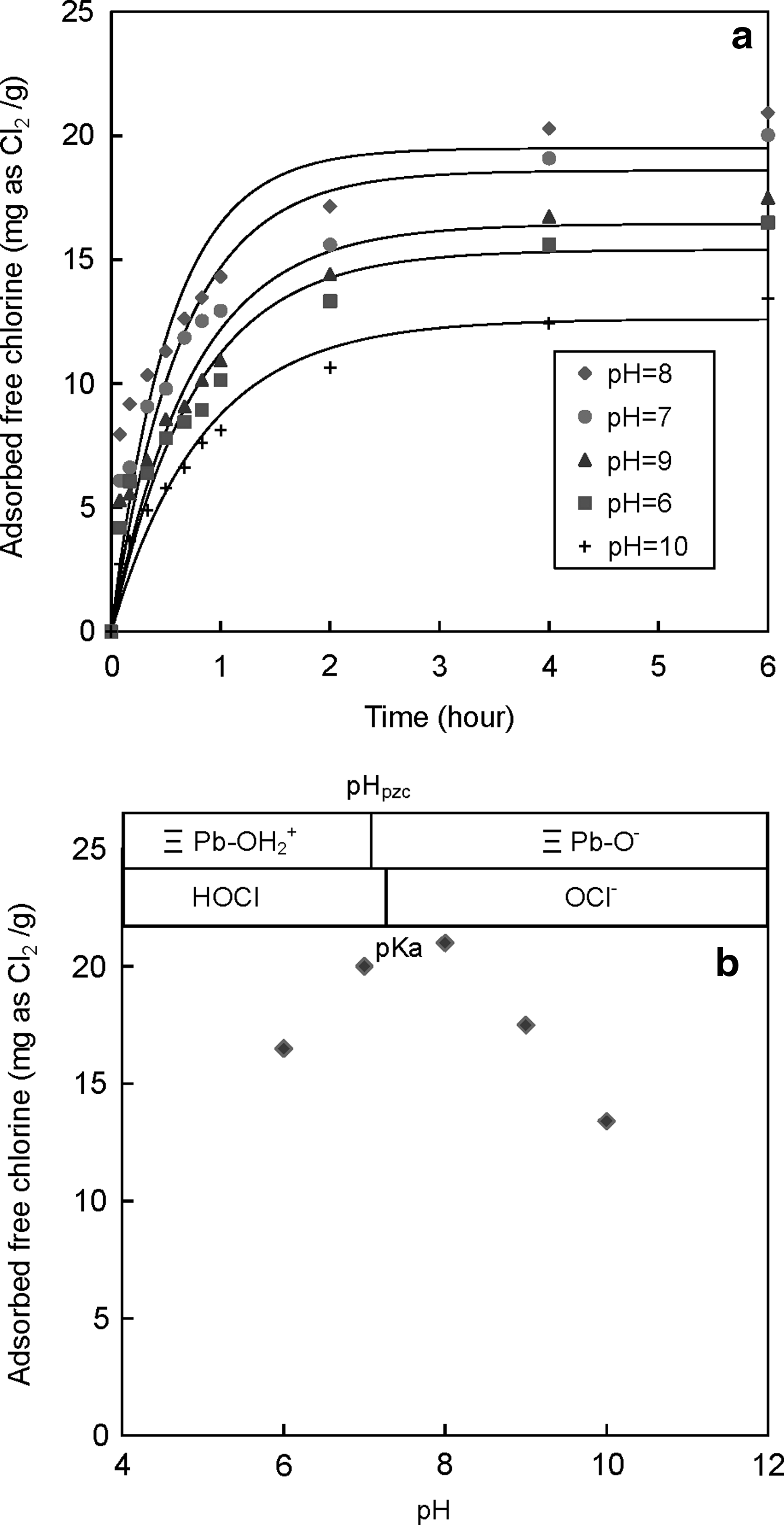
The adsorption of free chlorine as a function of time using solutions with pH values ranging from 6 to 10 is presented in Fig. 3a. The adsorption equilibrium was reached in about 6 h. The amounts of adsorbed free chlorine at 6 h as a function of pH are shown in Fig. 3b. Approximately 60% of the total adsorbed free chlorine was adsorbed in the first hour for all pH values. The rate of adsorption and the total adsorbed free chlorine were the highest at pH 8 followed by those at pH 7, 9, 6, and 10, which could be explained by the electrostatic interaction between free chlorine and PbO2 surfaces as discussed later. The pseudo-first-order and pseudo-second-order kinetics shown in Equations (2) and (3), respectively, were employed to simulate the adsorption kinetics (Ho and McKay, 1999; Ho, 2004).
where qe and qt (mg as Cl2/g) represent the amount of free chlorine adsorbed at equilibrium and at time t (h), respectively; k1 (h−1) and k2 (g/[mg as Cl2·h]) represent the pseudo-first-order and pseudo-second-order rate constants, respectively.
Table 1 shows the results of the least-square fittings of experimental data to Equations (2) and (3). The R2 for the pseudo-first-order kinetics (0.88–0.96) were higher than those for the pseudo-second-order kinetics (0.75–0.92). In addition, the values of qe obtained using the pseudo-first-order model were more consistent with the experimentally determined values (qe,exp). These results suggested that the pseudo-first-order model provided a better simulation for the kinetics of free chlorine adsorption on the PbO2 surfaces. The use of the pseudo-first-order kinetics to model the adsorption of free chlorine as a function of time is demonstrated in Fig. 3a.
Values in parentheses are 95% confidence level. qe,exp represents the amount of adsorbed free chlorine measured at equilibrium. Experimental conditions: PbO2=120 mg/L; pH 6–10; initial free chlorine=4.2 mg/L as Cl2; CT=4 mM; temperature=25°C.
Effects of pH on the adsorption isotherm
The isotherm study was conducted by determining the aqueous and adsorbed free chlorine concentrations when equilibrium was reached using different initial free chlorine concentrations. Figure 4 shows the isotherm data obtained for pH 6–10. The Langmuir adsorption isotherm and Freundlich adsorption isotherm shown in Equations (4) and (5), respectively, were used to fit the experimental data.
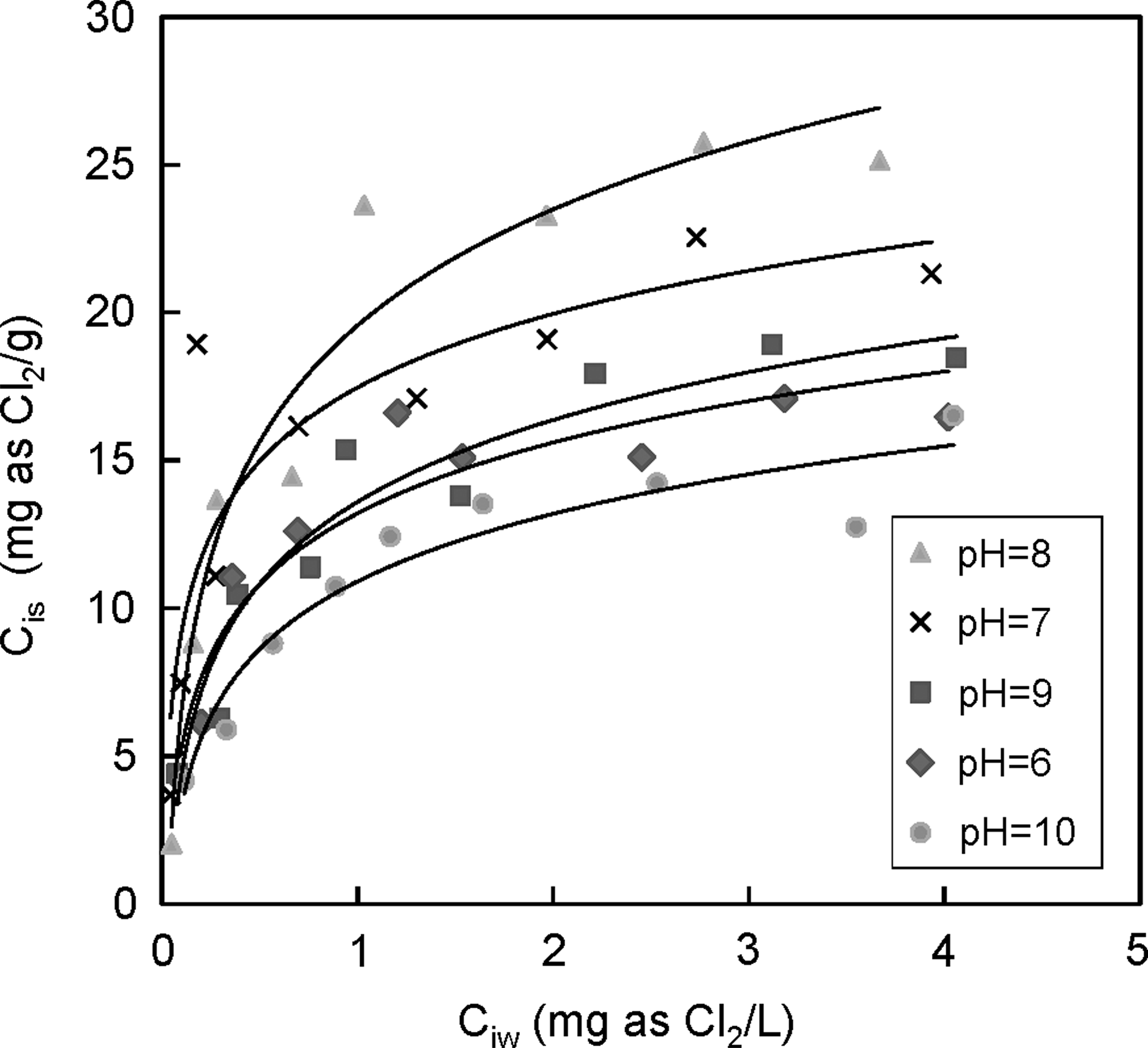
Effects of pH value on adsorption isotherm. Experimental conditions: PbO2=80 mg/L; initial free chlorine=0.8–6 mg/L as Cl2; CT=4 mM; temperature=25°C. The lines represent modeling results using the Langmuir adsorption isotherm.
where Cis represents the amount of free chlorine adsorbed on PbO2 (mg as Cl2/g), Ciw represents the aqueous free chlorine concentration (mg as Cl2/L), Cis,max represents the adsorption maximum for free chlorine (mg as Cl2/g), KiL represents the Langmuir adsorption constant (L/mg as Cl2), KF represents the Freundlich adsorption constant ([mg as Cl2]1−n·L n /g), and n represents Freundlich exponent.
The least-square fittings of experimental data to Equations (4) and (5) are summarized in Table 2. The R2 for the Langmuir adsorption isotherm (0.93–0.99) were slightly higher than those for the Freundlich adsorption isotherm (0.86–0.93), indicating that the former provided a slightly better description of the experimental data. The use of the Langmuir isotherm to model the experimental data is also shown in Fig. 4. The adsorption maximum showed the following sequence: pH 8>pH 7>pH 9>pH 6>pH 10, which was consistent with that for the adsorption rate determined in the kinetic study. The pKa of HOCl is 7.5 (Stumm and Morgan, 1996), which is very close to the pHpzc of the PbO2 used in this study (pH 7.4). Thus, the surface charge of PbO2 and the net charge of free chlorine species (HOCl and OCl−) shift almost synchronously as a function of pH, that is, when the solution pH becomes more acidic than pH 7.4, the PbO2 surfaces become more positively charged and HOCl becomes the dominant species of free chlorine; when the solution pH becomes more basic than pH 7.5, the PbO2 surfaces are more negatively charged and OCl− becomes the dominant form of free chlorine. Considering the electrostatic interaction between free chlorine and PbO2 surfaces, it is expected that the maximum adsorption would occur at a pH between 7.4 and 7.5, wherein a minimum electrostatic repulsion exists. A decrease in the adsorption maximum would be expected when the pH is deviated either more acidic or basic from this optimal pH value. Our experimental results (Fig. 3b) were consistent with this trend, suggesting that electrostatic interaction between free chlorine and the PbO2 surfaces played a crucial role in the adsorption process.
Effect of ionic strength
Figure 5 shows the adsorption of free chlorine as a function of time in the presence of different ionic strengths, with KNO3 ranging from 0.01 to 0.05 M. The adsorption kinetics and adsorption capacity were similar for all ionic strengths employed, although a slightly higher adsorption was found in the presence of 0.05 M KNO3. The differences in the adsorbed free chlorine at equilibrium among the three ionic strengths employed were less than 15%, which may result from experimental errors. As physical sorption is known to be significantly affected by the ionic strength (Stumm and Morgan, 1996), our results suggested that free chlorine was most likely to be chemisorbed on the PbO2 surfaces. The specific interactions between the free chlorine species (HOCl and OCl−) and the PbO2 surfaces were proposed in the following equations:

Effect of ionic strength on adsorption of free chlorine on PbO2. Experimental conditions: PbO2=120 mg/L; initial free chlorine=6.1 mg/L as Cl2; pH=7; CT=4 mM; temperature=25°C.
≡ PbIV OH can be protonated to be
Effects of buffer type and concentration
Figure 6 shows the adsorbed free chlorine concentration as a function of carbonate and phosphate buffer concentrations at pH 7. The adsorbed free chlorine decreased with the increasing concentration of both buffers, and phosphate showed a stronger inhibitory effect than carbonate. It should be noted that phosphate has been shown to inhibit the reductive dissolution of PbO2 because of its adsorption on the PbO2 surfaces (Shi and Stone, 2009a, 2009b). Based on the dissociation constants for carbonate (pKa1=6.4 and pKa2=10.3) and phosphate (pKa1=2.1, pKa2=7.2, and pKa3=12.3) (Stmm and Morgan, 1996), the dominant species of carbonate and phosphate at pH 7 are

Effects of carbonate and phosphate buffer concentration on adsorption of free chlorine on PbO2 at equilibrium. Experimental conditions: PbO2=120 mg/L; initial free chlorine=6.1 mg/L as Cl2; pH=7; temperature=25°C.
Reactivity of adsorbed free chlorine
The reactivity of adsorbed free chlorine was investigated at pH 7, 8, 9, and 10 by comparing the free chlorine concentration determined using unfiltered samples against those measured in blank samples without PbO2. The ratio of free chlorine concentration measured in the unfiltered sample and that in blank sample was defined as the recovery of free chlorine in the presence of PbO2. It should be noted that although PbO2 is a strong oxidant, it did not interfere with free chlorine measurement by the iodometric method at neutral or basic solution. It was previously reported that no more than 1.5% of PbO2 was reduced by iodide in 30 s at pH 7 and 8 in the absence of free chlorine (Zhang et al., 2010).
The results of free chlorine recovery experiments are shown in Table 3. The recoveries ranged from 90% to 105%, suggesting that the adsorbed free chlorine maintained its strong oxidation ability. Additional desorption experiments conducted by adjusting the final pH to 4 showed that 70% of the adsorbed free chlorine was released from the PbO2 surfaces in 20 min. Our results indicated that PbO2 may induce a loss of free chlorine in the bulk solution because of adsorption. This is most likely to occur in households where lead service lines are used and chlorinated drinking water sits in these pipes stagnantly overnight. Nevertheless, the adsorbed free chlorine can provide disinfection capability that might be beneficial for preventing microorganism regrowth at this solid–water interface.
Experimental conditions: PbO2=120 mg/L; initial free chlorine=4.2 mg/L as Cl2; adsorption period=6 h; CT=4 mM; temperature=25°C.
Summary
The adsorption of free chlorine on PbO2 was studied at difference pH values, ionic strengths, and buffer types and concentrations. The kinetic study showed that the adsorption equilibrium can be reached in about 6 h and the pseudo-first-order kinetics can be used to describe the adsorption rate. At equilibrium, the adsorption can be successfully described by the Langmuir adsorption isotherm. For the pH range investigated in this study (pH 6–10), it was found that the highest adsorption occurred at pH 8, which can be well explained by considering the electrostatic interaction between free chlorine species and PbO2 surfaces. Ionic strength did not significantly affect the adsorption process. Both carbonate and phosphate buffers showed inhibitory effects on the free chlorine adsorption and phosphate was found to be a stronger inhibitor. The adsorbed free chlorine can maintain its oxidizing ability as evidenced by >90% recoveries of free chlorine in unfiltered samples. Our results suggested that the presence of PbO2 may decrease the free chlorine concentration in the bulk solution because of adsorption. However, the adsorbed free chlorine, which was conventionally thought as the wall loss of disinfectant, maintained its strong oxidation ability and may provide disinfection capability.
Footnotes
Acknowledgment
This work was supported by the National University of Singapore (R-288-000-054-133).
Author Disclosure Statement
No competing financial interests exist.