




Abstract
Abstract
Arsenic (As) accumulation in rice grains is a threat to human health and marketability of rice products. In an effort to minimize As uptake by rice grains, field experiments were conducted to investigate As accumulation in rice grains of three cultivars in monosodium methanearsonate-treated soil under saturated and flooded water management practices. Results indicated that As concentrations in rice grains were cultivar-dependent and influenced by water management. Soil flooding would substantially enhance the As accumulation with a great variation among cultivars. Extractable As in the soil was positively correlated with sodium dithionite-sodium citrate-sodium bicarbonate solution-extractable Fe, suggesting a strong association of As with ferric (hydr)oxide. Additional laboratory studies showed a strong affinity of synthetic ferric (hydr)oxide with monosodium methanearsonate. This study demonstrated that selection of less As-responsive rice cultivars and use of saturated water management in paddy fields could be an effective means to minimize As accumulation in rice grains.
Introduction
Health concern of
The interactions of As species with naturally occurring minerals in soil have strong influences on the As bioavailability and mobility in the environment. Ferric (hydr)oxide-based sorbents have been used to remove aqueous As for drinking water treatment because of the strong affinity between As and ferric (hydr)oxide (Gu and Deng, 2007; Sylvester et al., 2007). Hossain et al. (2009) found the application of ferrous iron to pot-culture rice plants could decrease As uptake by rice grains and increase grain yields, while the addition of phosphates led to reduced rice yield and increased As contents in grain and straw. However, the interactions of organic As such as MSMA with ferric (hydr)oxide in paddy soil are largely unknown and little studied in terms of organic As phytoavailability and uptake. Understanding such interactions would be critical to minimize As uptake by rice plants in the fields containing elevated MSMA. In contrast to most recent studies focusing on inorganic As, this study was to investigate and compare As uptake by rice cultivars in the soils with elevated MSMA. The objectives were focused on evaluating As uptake of three rice cultivars in MSMA-elevated soil under two water management conditions, and testing the hypothesis that iron (Fe) redox transformation controls the MSMA-As solubility and extractability in soil.
Materials and Methods
Experimental procedures
The study site was at the USDA-ARS Dale Bumpers National Rice Research Center located near Stuttgart, Arkansas. Soil at the site was Dewitt silt loam (fine, smectitic, thermic Typic Albaqualf). Selected physiochemical properties of the pretreated soil were listed in Table 1.
Average of the composited samples. More data can be found at Yan et al. (2008).
As, Arsenic.
The experiment was conducted in 2009, consisting of 1.8-×1.5-m plots arranged in split-split plot design where soil As levels were main plots and water management practices sub-plots. Within each sub-plot, three rice cultivars were completely randomized in each of the four replications or blocks. Three rice cultivars (Zhe 733, Cocodrie, and Rondo) were selected according to their straighthead susceptibility (resistant-Zhe 733, intermediate-Rondo, and susceptible-Cocodrie) (Yan et al., 2008; Yan and McClung, 2010). Soil As treatment included low and high As levels. Low As level was the native soil that is common in the southern rice belt where As-containing chemicals have never been applied, while high As level was the soil that had been applied with MSMA in alternate years since 1980s for rice straighthead disease evaluation (Yan et al., 2005). Prior to planting, the high As soil was applied with MSMA at a rate of 6.7 kg MSMA/ha to bring total soil As to ∼20 mg/kg. Predetermined amount of the MSMA solution was sprayed on the soil surface and incorporated into 20-cm soil depth by a fine tiller as described by Yan et al. (2005). Weed control and nitrogen fertilization (46-0-0) followed a recommended procedure (Yan et al., 2005). Each selected cultivar was then drill-seeded in six rows each 2 cm deep at a seeding rate of 65 kg/ha−1 (Slaton and Cartwright, 2001). Field water management included flooded and saturated water practices. In the flooded practice, water stand was maintained all the time during the growing season from about the five-leaf stage to full maturity, while the saturated practice maintained soil moisture at or above the field capacity. When the soil surface became naturally dry or soil moisture dropped below the field capacity, the field was irrigated up to 10 cm of water stand. The irrigation water (pH ∼7.0, <2 μg As/L) was primarily from rainfall collected in a reservoir near the study site.
Sampling procedures
Soil samples were collected bi-weekly from each plot starting from the time of seed planting. Each time, at least 100 g of soil was taken individually from the center and four corners of each plot at 10-cm soil depth where most rice roots distribute. The collected samples were composited per plot, then air-dried, ground to pass a 0.25-mm sieve, and stored at 4°C prior to analysis. At maturity, rice grains were harvested per plot, oven-dried for 12 h at 65°C, and then crushed, separated from the husk, ground into powder, and stored at room temperature prior to analysis.
Analytical procedures
All chemicals used in this study were of at least reagent grade. Nitric acid (HNO3, trace metal grade), hydrochloric acid (HCl), potassium phosphate dibasic (K2HPO4), sodium hydroxide (NaOH), sodium bicarbonate (NaHCO3), sodium citrate (Na3C6H5O7·2H2O), iron(II) sulfate heptahydrate (FeSO4·7H2O), hydrogen peroxide (H2O2, 30%), and inductive-coupled plasma (ICP)
Total As analyses
About 1.0 g of soil or rice powder was digested with 10 mL of concentrated HNO3 and 5 mL 30% H2O2 in a microwave oven digester (Ethos EZ; Milestone Co.) for 20 min at 180°C. The digested solution was filtered through a Whatman 40 filter paper, diluted with deionized water to 25 mL, and filtered again through a 0.45 μm syringe filter prior to analysis.
Sodium dithionite-sodium citrate-sodium bicarbonate solution extractable As, Fe, P analyses
1.0 g of soil was extracted by 15 mL of sodium dithionite-sodium citrate-sodium bicarbonate solution (DCB) solution overnight at room temperature (Liu et al., 2004). The extracted solution was filtered through a Whatman 40 filter paper and a 0.45 μm syringe filter before analysis.
The digested or extracted solutions were prepared in duplicate and analyzed within one week. The concentrations of Fe and P in the solutions were determined by an ICP-optical emission spectrometer (Varian Vista-PRO). A graphite furnace atomic adsorption spectrometer (Varian, 220F) was used to analyze As in soils, while ICP/mass spectrometers (VG Axiom high-resolution and ICP-mass spectrometer; Perkin-Elmer Elan) were used for determining As in rice flour. A standard rice flour (NIST, SRM 1568a) and a standard Montana soil (NIST, SRM 2711) were included in the extraction and analytical procedures for data quality control/assurance (QC/QA), with spiked recovery being in the range of 93%–98%.
To test the hypothesis that the iron redox status in soil controls As availability to rice plants, ferric (hydr)oxide was synthesized by oxidizing ferrous irons in the presence of MSMA to assess its ability to immobilize MSMA. The immobilized As by ferric (hydr)oxide was determined by the extraction using DCB, K2HPO3, or HCl solutions, respectively. The procedures were as follows: (i) transferred 10 g of Fe as FeSO4 and 0.1 g of As as MSMA into a 1-L beaker; (ii) dissolved the solids with 300 mL Millipore water (18.2 MΩ·cm), and bubbled the solution with air for 24 h; (iii) neutralized the solution to pH 7.0 with NaOH solution, and diluted to 500 mL with Millipore water; (iv) filtered the solid using a Whatman 40 filter paper and washed the solid with 20 mL Millipore water three times; (v) oven-dried the solid at 70°C overnight; (vi) weighed 0.50 g of the solid in three centrifuge tubes containing 15 mL DCB, 0.5 M K2HPO3, or 1.0 M HCl, respectively, and shook the tubes for 24 h; (vii) filtered the suspensions with 0.45 μm syringe filter and measured As in the filtrates. The As:Fe ratio of 0.1:10 was selected to mimic the As:Fe ratio in the field soil.
Results and Discussion
As in rice grains
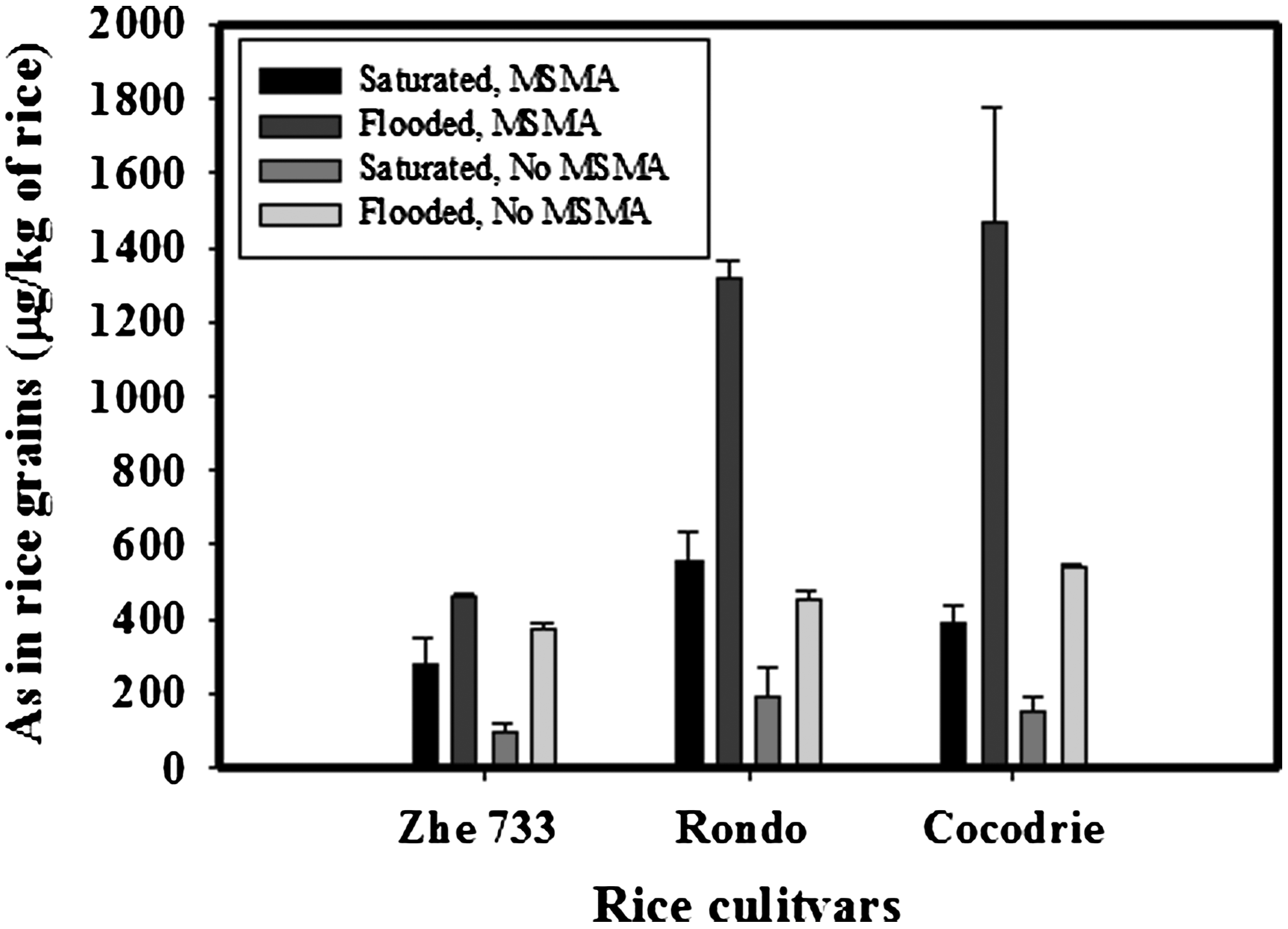
Total As concentrations in grains of the three selected rice cultivars as influenced by soil As levels and water managements were presented in Fig. 1 and analysis of variance in Table 2. The analysis of variance results in Table 2 indicated that the most significant factor affecting the As accumulation was water management practice (p<0.003), followed by soil MSMA level (p<0.008). Rondo and Cocodrie had statistically similar As contents (p<0.98), while Zhe 733 contained much less As (p<0.07 or 0.12), suggesting a cultivar-dependent resistance to elevated As in soil. Higher As level in the soil (18.3±1.2 μg As/g), in all cases, resulted in a significantly higher As content in grains as compared with the native soil (5.0±0.3 μg As/g) (p<0.008). Rondo or Cocodrie was found to be more susceptible to elevated soil As level, while Zhe 733 was less susceptible. Data were consistent with the survey showing the As content range of 5 to 710 μg/kg among 204 rice cultivars (Zavala and Duxbury, 2008). Under the two water management practices, significantly higher As concentrations in the grains were measured in the flooded than the saturated soils regardless of the As level and cultivar (p<0.003). In addition, Rondo and Cocodrie showed a consistent behavior in response to flooded water management in both MSMA-treated and native soils, while Zhe responded more strongly to flooded water management in the native soil. In the flooded conditions, the soil might be in a more reduced status (Takahashi et al., 2004). This implied that soil redox reactions, especially iron transformation from ferric to ferrous forms as induced by flooding, might enhance the As release from solid phases, thus increasing As availability for rice uptake. Preliminary field data also found that As content in rice grains was positively related to the straighthead rating (the higher the rating, the more severe the symptom) and negatively related to the grain yield for Rondo and Cocodrie (data not shown).
Fcalculated, the quotient of the square of standard deviations; Fcritical, tabulated F value; α, significant level; p, probability; MSMA, monosodium methanearsonate.
Relationships among soil As, Fe, and P
In an effort to confirm our speculation that As solubility be closely associated with ferric (hydr)oxide in the soil and the redox status of iron species control the As availability to rice plants, soil samples were analyzed for DCB-extractable As, Fe, and P. As shown in Fig. 2, DCB-extractable As in the soils was found positively correlated with DCB-extractable Fe. Total As concentration in the native soil was measured at 5.0±0.3 μg/g; while the As in the MSMA-treated soil was 18.3±1.2 μg/g. The strong positive correlation between DCB-extractable As and Fe indicated that As in the soils was closely associated with amorphous ferric (hydr)oxide. When soil iron was reduced as induced by the flooded water management practice, the As associated with the solid phase of ferric (hydr)oxide would be released into the aqueous phase, leading to the enhanced As uptake by rice plants. In addition, data in Fig. 2 also implied that the presence of relatively high As concentrations in the soil would lead to more DCB-extractable Fe. This was consistent with the findings by Violante et al. (2007, 2009), where arsenate was found strongly to retard the crystallization of goethite and hematite, leading to the formation of more poorly crystalline and relatively soluble precipitates.
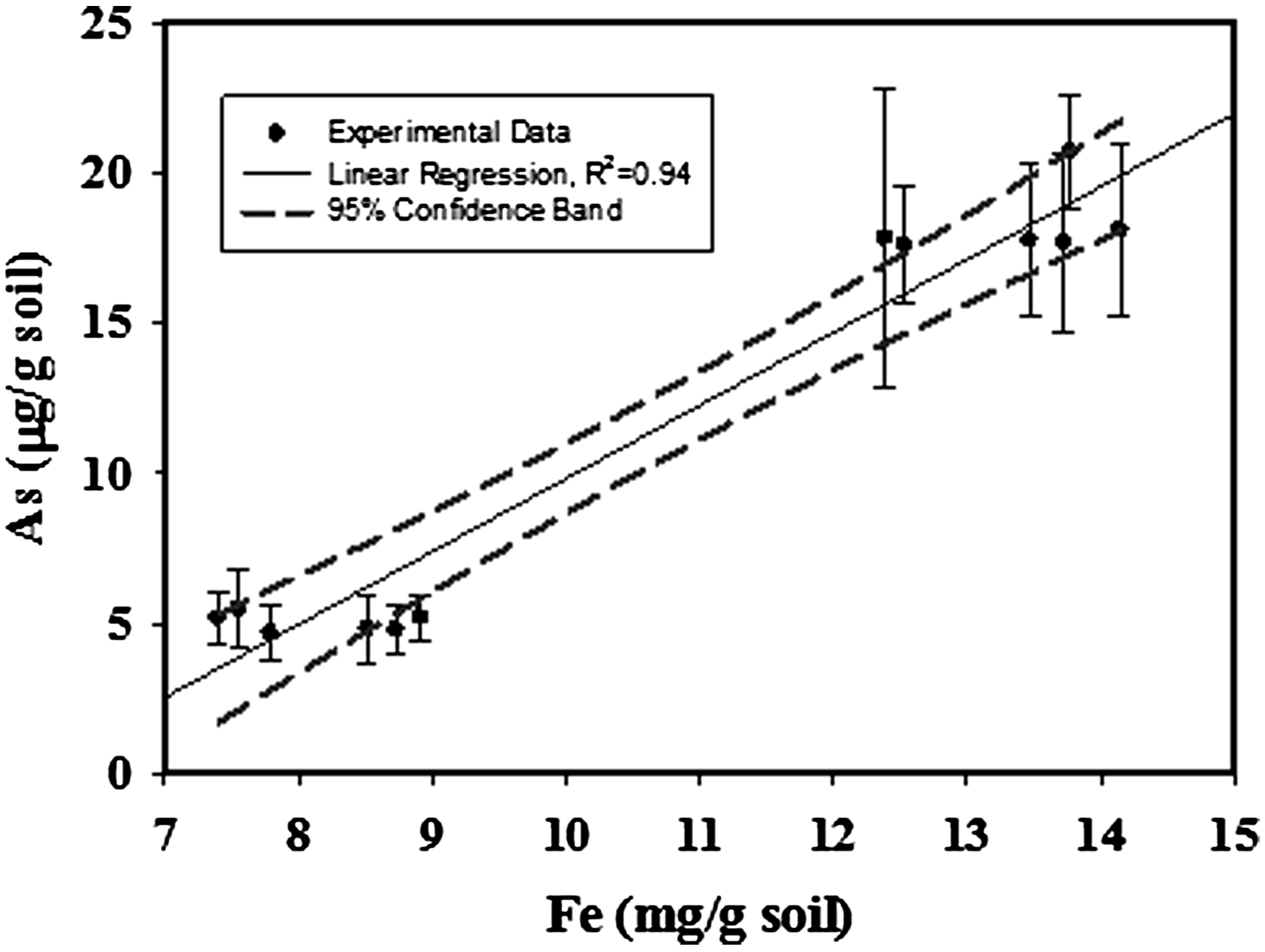
Correlation between DCB-extractable Fe and As in soil (each point represents average of six samples; error bars are standard deviations). DCB, sodium dithionite-sodium citrate-sodium bicarbonate solution.
Measurements of DCB-extractable As, Fe and P presented in Fig. 3 illustrated that there was a positive correlation between P and Fe (Fig. 3a), and DCB-extractable P concentrations were generally higher in the soils with high As and lower in the soils with low As (Fig. 3b). It is well known that formation of ferric (hydr)oxide due to changes in soil redox conditions is an important process controlling soil P solubility and availability (Manahan, 1991). Under oxidized conditions, soluble P can be easily immobilized through sorption by ferric (hydr)oxide and/or formation of relatively insoluble iron phosphate. As a result of ferric reduction to ferrous form under reduced conditions, insoluble iron-associated P fraction could be released into the aqueous phase, facilitating plant P uptake. The positive correlations among Fe, P and As suggested that there was no apparent inhibition between As and P for sorption by ferric (hydr)oxide in the soil. It was reported that arsenate has similar adsorptive behavior as phosphate due to their structural similarities as well as acid dissociation constants (Zeng et al., 2008). Zhang et al. (2008) demonstrated that monomethylarsonate, arsenate, and phosphate had comparable affinities to goethite. It is therefore not surprising that the soil As, Fe, and P were closely related and the formation of ferric (hydr)oxide/iron phosphate controlled the solubility or availability of both P and As in the soils. Whether phosphate application could reduce As accumulation in rice plants is dependent on experimental conditions. Abedin et al. (2002) reported that there was no significant difference in As concentrations in plants due to phosphate application. However, Liu et al. (2004) found that phosphate addition to hydroponic rice plants (CDR22) significantly decreased As concentrations in iron plaque and increased As concentrations in the shoots.

Correlation between DCB-extractable P and Fe
Interactions of MSMA with ferric (hydr)oxide
The adsorption of inorganic

As extracted from synthetic ferric (hydr)oxide by selective extraction procedures (each bar represents average of duplicate of samples; error bars are standard deviations).
Conclusions
This field study has demonstrated that As concentration in rice grains depends on soil As level, cultivar, and water management. Among three cultivars studied, Zhe 733 is less responsive, while Rondo and Cocodrie are more responsive to elevated MSMA-As in the soil. Water flooding could lead to enhanced As uptake by rice plants, which is linked to reduced conditions that induce the reductive dissolution of ferric (hydr)oxide and the mobilization of As from solid phase. Formation of ferric (hydr)oxide under the water-saturated management practice is able to immobilize soluble As in the soil, reducing As availability to rice plants. Results suggest that a significant reduction of As accumulation in rice grains could be achieved through appropriate selections of As-less responsive cultivars and saturated water management practices, which would minimize human health risk of oral
Footnotes
Acknowledgments
This research was funded by the USDA-NIFA through the grant No. 0215149 to Lincoln University of Missouri. Authors would like to thank Tiffany Sookaserm, Yao Zhou and Biaolin Hu for sample collection and preparation, Brandid Clark and Joy Pyles for their assistance in sample analyses. Contribution from the Cooperative Research Program, Lincoln University of Missouri, No. 2010002.
Author Disclosure Statements
No competing financial interests exist.