




Abstract
Abstract
The use of tributyltin (TBT) has been banned in Korea since 2003. In this study, changes in butyltin compound concentration from 1992 to 2009 were examined by area. The number of ships, which greatly influences butyltin compound contamination, continuously increased, but butyltin compound concentration decreased. Results indicated that the regulation of TBT is effective in Korea. The increase in the concentration was caused by military and coast-guard ships, ballast water, and the illegal use of materials. According to port distribution characteristics along the Korean coasts, the level of butyltin compound contamination was high along the west and south coasts in 1992, whereas it was high along the south and east coasts since 2006. We found that overall butyltin compound concentrations decreased in Korea, but concentrations remained high in some regions.
Introduction
Following Korea's TBT ban, many nations have monitored changes in the concentration of butyltin and have introduced new antifouling agents as TBT alternatives. Germany banned the use of TBT on small ships (below 25 m in length) in 1989. Subsequently, several species of fish were analyzed from 1993 to 2003 to investigate the declining effects of TBT. Fish that were sampled at the Elbe River in Prosen, Germany, bore a TBT concentration of 68 ng Sn/g in 1993, but its concentration levels had decreased to 14 ng Sn/g in 2003 (RÜdel et al., 2007). In China, a neighbor of Korea, when butyltin compounds (ΣBTs, Sum of butyltin compounds) in mollusks from the Bohai sea were measured from 2002 to 2005, no decreases were observed from 2002 to 2004, but its decrease started from 2005 (Yang et al., 2008). After these regulations were enacted, declines were investigated in many countries.
Since 2003, the worldwide interest regarding the concentration of butyltin compounds in the marine ecosystem has diminished. However, the illegal and partially legal use of TBT continues to threaten the marine environment and will pose a serious threat to the ecosystem in the future.
The first purpose of this study was to examine and verify changes in butyltin compound pollution in the Korean Peninsula from 1992 to 2009. The second purpose was to clearly determine that all regions of Korea have been polluted by butyltin compounds, as verified by their average concentration in the marine environment from 2006 to 2009. The third purpose was to analyze the spatial distribution of butyltin compounds on the west, south, and east coasts for effectively controlling butyltin compounds on all Korean coasts.
These results have been the basis for utilizing as an indicator to track butyltin compound pollution in Korea after the proscription of the TBT use in the hopes of completely ending the ecological threat from butyltin compounds.
Materials and Methods
Chemicals
High-performance liquid chromatography (HPLC)-grade toluene was purchased from J.T. Baker. Dibutyltin dichloride (DBT, 96%) and tributyltin chloride (TBT, 96%) were purchased from Aldrich Chemical, Inc.; triethyltin chloride (TET, 98%) was purchased from Merck; and monobutyltin trichloride (MBT, 95%) was purchased from Johnson Mattery Alfa Products. These standard materials were used without further purification.
Methanolic stock solutions that contained 1000 ppm of tin were prepared weekly in a 25-mL volumetric flask and stored in a dark room at 4°C. Working solutions were prepared daily from these stock solutions. Sodium tetraethylborate (NaBEt4) was obtained from Aldrich, with which solutions were prepared daily by dissolving 0.2 g in 10 mL of deionized water. HPLC-grade methanol and hexane were obtained from Fisher.
Seawater-sampling site
Changes in the butyltin compound concentration were measured at the sites from which we sampled in 1992. To improve sampling accuracy, two to five additional neighboring sites were included. There were 46 samples, including 18 fishery harbors, 24 big harbors, and four harbors that dock coast-guard and military ships (Table 1). Fishery harbors are ports where small ships (<25 m) are concentrated, allowing the study of use of antifouling agents on small ships. Big harbors are typically located near industrial areas where large ships frequently enter and exit the dock. Thus, antifouling agent pollution is expected to be high. For ports docking coast-guard ships and military vessels, we believe that an analysis of this region was necessary, since they fall under the exceptional clause of noncommercial ship in the IMO's TBT ban regulation. Samples were taken from 2006 (June 18–21) to 2009 (July 19–23). Two liters of seawater was drawn from a depth of 20 cm and stored in polyethylene bottles. All samples were maintained in a deep freezer (−20°C).
F, fishery harbor; B, big harbor; MC, military ship and coast-guard ship harbor.
Extraction method
We used the sampling method from 1992 in 2006 and 2009 to obtain consistent results (Choi et al., 1993). A 250-mL sample was taken in the extraction procedure. When NaBEt4 was used as an ethylation reagent, ethylation/extraction of the butyltin compounds could be performed in seawater in a single-step procedure. A 250-mL borosilicate volumetric flask was used for this operation, into which 1.0 mL hexane and 1.0 mL NaBEt4 (0.2 g per 10 mL) were added successively and agitated vigorously on a magnetic stirrer at 2000 rpm for 1 h. Once the agitation period ended, the organic phase was transferred into a vial for injection into the gas chromatograph–flame photometry detector (GC-FPD). The efficiency of the extraction method was monitored using TET as an internal standard: 2.0 μL of each aliquot was injected in the GC-FPD.
Measurements on instruments
For the butyltin compounds, a Hewlett Packard 5890 II gas chromatograph, equipped with a split/splitless injector, fused silica capillary column (Ultra-1, 25 m, 0.32 mm i.d., and film thickness 0.52 m), and an FPD, was used with a 610-nm cutoff interference filter of 250°C at hydrogen and air-flow rates of 145 and 193 kPa/cm2, respectively. The temperature of the injection port was set to 300°C. Helium, at 103 kPa, was used as the carrier gas in the splitless mode for 90 s. The column temperature was programmed to hold at 60°C for 1 min and then ramp to 280°C at 10°C/min. Retention times were 4.5 min for the internal standard, TET; 6.6 min for MBT; 8.4 min for DBT; and 10.1 min for TBT (Jiang et al., 2000; Hoch and Schwesig, 2004).
Recovery rates and limits of detection
For analysis of the recovery, 80 ng Sn/L of the butyltin compounds was added to the standard sample and to the real seawater sample, using a matrix. Replicate analyses of spiked matrices (n=3) demonstrated adequate precision with good recovery and repeatability. The mean recoveries (relative standard deviation [RSD]) were 94.6±1.5% for MBT; 94.3±2.9% for DBT; and 95.8±1.2 for TBT. The calibration curves were evaluated at 5, 10, 20, 50, and 100 ng Sn/L, and all showed good linearity (R2>0.999). The limit of detection was calculated using the regression analysis per the Environmental Protection Agency. The detection limit for mono-, di-, and TBT was 3.4, 2.5, and 5.3 ng Sn/L, respectively.
Results and Discussion
Concentrations of butyltin compounds in the entire country
The concentrations of butyltin compounds in 1992, 1996, 2006, and 2009 are shown in Fig. 1. The results for 1996 were cited from the experimental results of other research groups at the same site (Choi et al., 1997; Kim and Park, 2001). The average ΣBT value was 40.0 ng Sn/L (n=10) in 1992, 93.1 ng Sn/L (n=6) in 1996, 46.9 ng Sn/L (n=46) in 2006, and 24.8 ng Sn/L in 2009 (n=46). The decrease in the butyltin compound concentration in 2006 and 2009 is likely related to the Korean government's ban on using TBT, which was enforced in 2003.
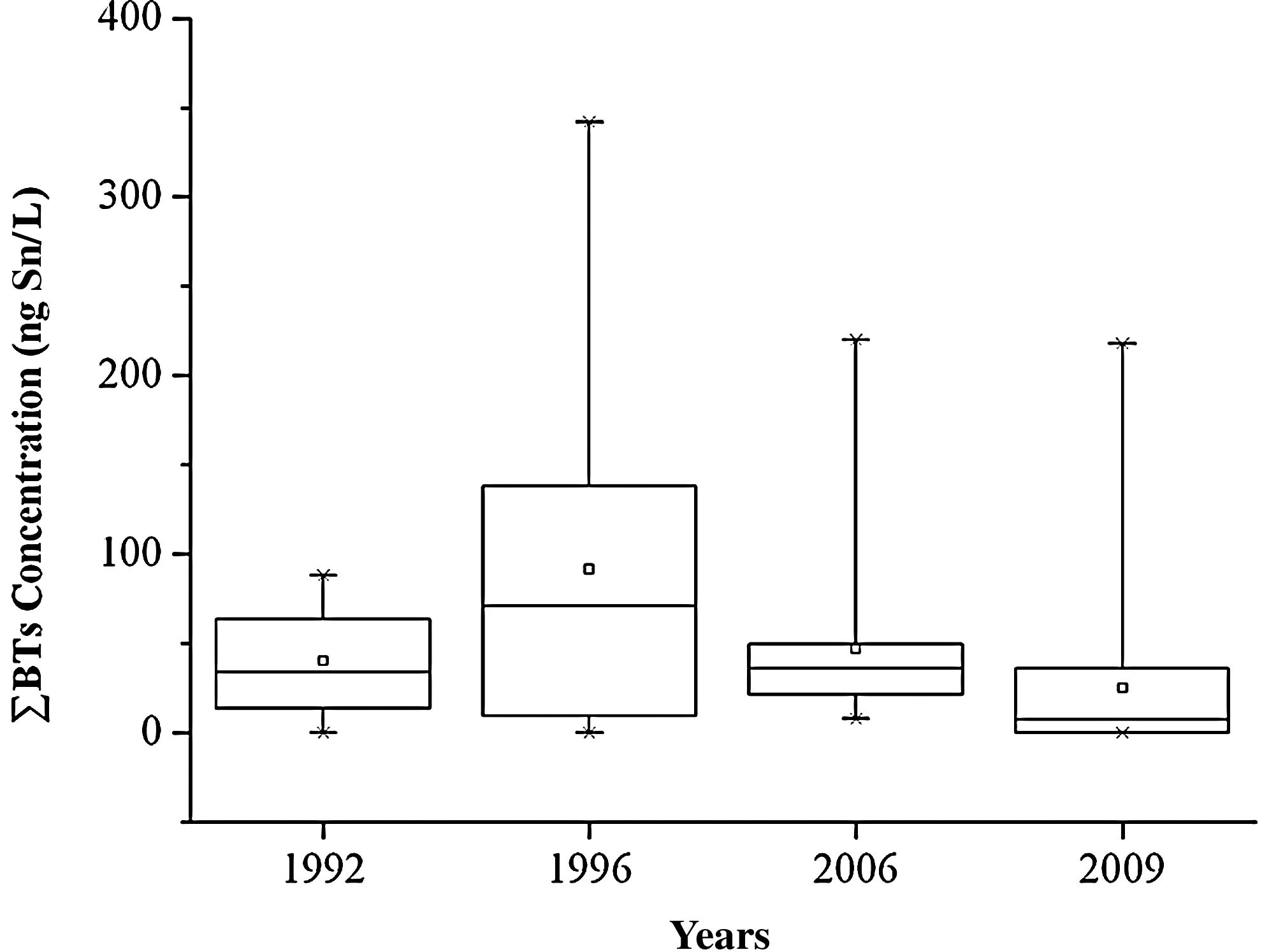
Comparison of the mean butyltin concentration each year.
Given that the primary source of antifouling agent pollution is ships, the size (total ton) and number of ships that enter a harbor have a significant effect on the pollution levels in that harbor. Therefore, the number of incoming vessels in the harbors from 1992 to 2009 was acquired from the Shipping and Port Internet Data Center (SP-IDC), and compared with antifouling agent concentration levels (Table 2) (SP-IDC, 2010). Among the 10 harbors, the Ganghwa harbor is a very small harbor without traffic data. In addition, there was no database in the 1992 results, except for the one for Busan. The last row in Table 2 shows that the number and total tons of ships entered in the harbors have increased since 1996. The entire results for 1992 are not known, but the results for the major harbor in Korea, Busan (increase in total tons from 135 billion ton in 1992 to 193 billion ton in 1996), indicate that the total tons increased from 1992 to 2009. Based on all results, the number and total ton of ships that entered the harbors in Korea continuously increased.
Data are expressed as total tons (number of ships).
n.d., no data available.
Accordingly, increase in the contamination of butyltin compounds during the period of 1992–1996 in Fig. 1 was caused by the increase in the total tons of ships as well as in the use of TBT. Although the total tons increased in the 2006, the decrease in the concentration of butyltin compounds can be seen as a positive effect of restricting the use of TBT.
Concentrations of butyltin compounds for regional groups
Figure 2 demonstrates butyltin compound concentrations in 1992, 2006, and 2009, respectively. The mean concentration over the whole area had a decreasing pattern of TBT concentration in Fig. 1, but some areas yielded the opposite pattern.

Concentrations of butyltin compounds in the Korean coast in 1992, 2006, and 2009 (tributyltin [TBT], ■ dibutyltin [DBT], □; monobutyltin [MBT], ).
Among the 46 sites, the concentration decreased in 36 sites, indicating that the contamination has decreased in many areas since TBT was banned in 2003. To examine the decrease pattern, the change in the contamination in Masan (M3) was studied. The results based on the contaminant concentration of Masan (M3) in 1996, which was measured in another study, showed the same pattern as that in Fig. 1. The ΣBT concentration increased from 1992 to 1996 and started decreasing in 2003, when the ban became effective (Fig. 3). It is expected that other areas with decrease patterns will show the same decrease pattern as that of Masan (M3).

Change of butyltin concentration each year in Masan (M3). N.D., not detected.
However, 10 of the 46 sites showed increase patterns. The causes of the increase are classified into three categories as follows: the legal TBT use of noncommercial ships (military and coast-guard ships), contamination due to ballast water, and illegal TBT use.
First, increases in the ΣBT concentration values in Donghae (D4) and Sokcho (S1) were identified, where warships are at anchor. Coast-guard and military ships are commonly anchored in this site, and the International Convention on the Control of Harmful Anti-Fouling System on Ships has a exception for the TBT use on noncommercial ships. Therefore, although it is not certain, if TBT was used on these ships, it can be a factor for increase of TBT (IMO, 2001).
Second, ballast water may cause the ΣBTs to increase. In the United States, all the ships that dock at the harbor are required to submit a ballast water report, but the same is not true in South Korea. Therefore, the accurate ballast water uptake and discharge in South Korea cannot be estimated. However, Choi et al. (2009) estimated the ballast water from the major harbors in South Korea, considering the ship size, ship type, and cargo volume, and announced that Busan and Ulsan discharge more ballast water than the other harbor cities do (Choi et al., 2009). Accordingly, it seems that the increase in the ΣBT concentration in Ulsan (U1) and Busan (B3) was caused by ballast water, and a large volume of ballast water was discharged at the time of sampling in these areas. If TBT is illegally used or the TBT that has been used in the past continues to leach out from the ballast water tanks in the ships, the harbor where the ship is anchored will be contaminated. Special attention must be paid to foreign ships, because it is not certain whether TBT is banned in their countries. Contamination of TBT in harbor by blast water was researched by Hua and Liu (2008) by sampling ballast water from ships and measuring concentration of butyltin compounds in 2004. Accordingly, 35 ng Sn/L of TBT and 32–93 ng Sn/L of ΣBTs were detected from ballast water (Hua and Liu, 2008). From this result, it follows that constant spouting of ballast water that is contaminated by antifouling agents can act as a polluting factor in harbors.
Third, the illegal use of TBT may cause ΣBTs to increase. If a ship that illegally uses TBT docks in a harbor for a long time, the contamination will become even more severe. This cause, which is longer residence time, is applicable to Incheon (I3), Ulsan (U5), Yeosu (Y3), and Yeosu (Y5). They are sheltered locations where ships are at anchor for a long time. Especially, U5 ΣBT concentration was also high: 151.2 ng Sn/L in 2006 and 217.7 ng Sn/L in 2009 (Fig. 2). We believe that this is influenced by the sheltering of these locations for ships, as well as a longer residence time. Gonzalez et al. (2006) researched high TBT concentrations at harbors where ships dock for a substantial period of time, and argued that they are probably a factor. However, ΣBT concentrations increased in Masan (M1 and M2), where the ship residence time is not long. This also seemed to be because of the illegal use of TBT. Takeuchi et al. (2004) studied the illegal use of TBT and reported that TBT was continuously used due to its low cost and good performance.
Checking concentrations of each site, TBT and butyltin compounds clearly decreased at many sites, but there are still some sites where high concentration and increasing concentration of butyltin compound location are detected.
Spatial distribution of butyltin compounds in the Korean coast
The Korean coasts are geographically classified into the west, south, and east coasts. The biggest affecting factor of the contamination by antifouling agent is the number of ships that entered harbors. The number of ships is closely related to the regional characteristics. The west coast is adjacent to China, and the freight volume is increasing continuously according to the increase in the trade between Korea and China. The south coast that faces the Pacific plays a role of an import/export route of Korea, and has had large-scale harbors for a long time. Therefore, big harbors in Korea are located along the south and west coasts. The east coast is close to Russia, but trade with the country is not active, and has small fishery harbors to collect fishery resources. As shown in Table 2, the size and number of ships used the harbors along the south and west coasts (Incheon harbor on the west coast and Busan and Ulsan harbor on the south coast) are superior to those of other harbors.
The Korean west and south coasts also draw attention regarding antifouling agent contamination due to geography. These areas are the representative rias coasts, where the contaminants can stay for a long time after the occurrence of contamination. Accordingly, contamination of the west and south coasts that is caused by diverse materials, including antifouling agents, is being studied (Choi et al., 1997; Kim and Park, 2001).
Table 3 shows concentrations of butyltin compounds depending on the Korean coastal area between 1992 and 2009. In 1992 (before the ban of TBT), antifouling agent contamination occurred on the south and west coasts. The ΣBT concentration was 35.0 ng Sn/L on the west coast and 40.8 ng Sn/L on the south coast. Meanwhile, it was only 7.1 ng Sn/L on the east coast. This result proves that the antifouling agent contamination was focused on the south and west coasts for above-mentioned reasons. However, the results for 2006 (after the TBT ban) were a little different. The ΣBT concentration was highest at 54.7 ng Sn/L on the south coast, but it was higher on the east coast (43.5 ng Sn/L) than on the west coast (38.6 ng Sn/L). This is due to the increase of the TBT use in the Donghae and Sokcho Harbor. As mentioned above, it seems that this increase was caused by the use of butyltin compounds by military and coast-guard ships and the illegal use of it by small ships.
Data are expressed as average±standard deviation.
MBT, monobutyltin; DBT, dibutyltin; TBT, tributyltin.
In 2009, the concentrations of butyltin compounds were highest on the south coast (38.2 ng Sn/L), followed by the east coast (26.3 ng Sn/L) and the west coast (7.0 ng Sn/L). In particular, ΣBTs on the west coast significantly decreased (2006: 38.6 ng Sn/L, 2009: 7.0 ng Sn/L), and the frequency of detection on the west coast abruptly decreased from 100% in 2006 to 25% in 2009. These results indicate that the harbors on the west coast are effectively controlling the use of TBT, and the change to new antifouling agents, except butyltin compounds, is expected.
Comparison with other countries
Table 4 demonstrates the comparison of butyltin compound concentrations between Korea and other countries' studies to evaluate relative pollution levels in the Korean bays. Comparisons were made in three cases; Case 1—before 2003; Case 2—after 2003; and Case 3—from this experiment.
n.d., no data available; N.D., not detected.
Before 2003, in Canada, Marmelona and Pelletier (2003) reported the measured values were below the detection limit at several sites (St. Lawrence Estuary), and the concentrations were generally low. On the other hand, in China, yet, big harbors and shipyards were severely polluted, bearing ranges of TBT and ΣBTs of N.D.–425.3 ng Sn/L and N.D.–1273.0 ng Sn/L, respectively, before 2003 (Bin et al., 2001).
Even after the ban on the TBT use in 2003, results from Spain (Rodríguez-González et al., 2006) and Italy (Berto et al., 2007) indicated that high concentrations of butyltin compounds persisted. Most sites at which high concentrations of butyltin compounds were detected had big harbors or shipyards. This supports that the issue of high concentrations of butyltin compounds post-2003 exists in not only Korea but also other countries. In conclusion, there is a little difference of butyltin compound contamination between Korea and other countries. A country or regional groups that faced with this problem will require strict control on big harbors and shipyards.
Conclusions
The butyltin compound concentrations of 10 major bays in Korea were examined in 1992, 2006, and 2009. The results showed that ΣBT concentration has been decreasing on the Korean coast according to the TBT ban since 2003. Of the 46 sites, the butyltin compound concentration decreased at 36 sites, but increased at 10 sites. The causes of the increase were divided into three groups: (1) exempted TBT use by noncommercial ships such as military and coast-guard ships, (2) contaminated ballast water discharged from ships, and (3) illegal TBT use. In a spatial distribution of contamination in the Korean coast, the contamination was severe on the south coast due to the geographical condition (rias coast) and increases in the size and number of ships entering the harbors. Based on results, it is clear that the ban on the TBT use in 2003 has been effective for many sites in Korea, but a few big and fishery harbors along the Southern and Eastern coast have detected butyltin compounds. The butyltin compounds used as antifouling agents should be monitored all over the world as well as Korea.
Footnotes
Acknowledgment
This work was supported by the research fund of Hanyang University (HY-2009-N).
Author Disclosure Statement
No competing financial interests exist.