




Abstract
Abstract
Although uncoupling metabolism is a possible measure to reduce sludge generation during the activated sludge process for treating organic wastewater, the fate of the chemical uncoupler in the activated sludge system and its residual toxicity have not been widely studied. In this work, 2,4,6-trichlorophenol (TCP), a typical metabolic uncoupler, was used as an example to investigate the distribution and persistence of chemical uncouplers in an activated sludge system treating municipal wastewater. In addition, the cytotoxicity of residual TCP in the effluent was also evaluated using Vero cells. Results showed that ranges of residual TCP in the effluent were 0.5–1.0, 0.9–1.4, and 1.3–2.4 mg L−1 when the TCP in the feed was 2, 4, and 6 mg L−1, respectively. TCP concentrations in the sludge phase significantly exceeded those in the water phase, due to the accumulation effect of sludge on TCP. TCP was biodegraded to some extent during the operating process, and the degradation efficiency increased with the number of operating cycles. About 0.07 mg g−1 sludge (dry weight) in the cell interior is a critical concentration for efficient inhibition of excess sludge generation. Although the acute cytotoxicity of TCP at concentrations less than 2.0 mg L−1 in the effluent was relatively low, concentrations greater than 2.5 mg L−1 had a significant effect on the morphology and proliferation of Vero cells. Accumulative and chronic effects of trace TCP in effluents on the ecosystem should be further studied. Dosages of more than 4 mg L−1 TCP (corresponding to 2.5 mg L−1 residual concentration) for sludge reduction in sequencing batch reactors treating municipal wastewater is not recommended due to acute toxicity.
Introduction
Many chemicals, such as chlorinated and nitrated phenols and tetrachlorosalicylanilide, have been identified as uncoupling factors for sludge metabolism. These chemical uncouplers, at low concentrations, were found to reduce sludge generation by 20%–80% in the activated sludge process, but only had a slight effect on organic pollutant degradation (Euan et al., 2000; Chen et al., 2002; Zheng et al., 2008). However, chemical uncouplers such as chlorinated and nitrated phenols are generally persistent organic pollutants, are difficult to biodegrade (Morville et al., 2006; Tian et al., 2010), and have an acute or chronic toxic effect on humans and ecosystems (Peter et al., 1990, 2000). Although the concentration of chemical uncouplers used in activated sludge systems is usually low, they may still be present in the effluent due to their persistence, and, thus, damage the ecosystem and human health. Therefore, before the practical application of chemical uncouplers in the biotreatment system, their fate in the activated sludge system and the potential harm of residual uncouplers in the effluents should be assessed.
Aquatic organisms and photogenic bacteria are commonly used to evaluate the biotoxicity of water samples. However, the use of aquatic organisms is time consuming and nonsensitive; and photogenic bacteria are not sufficiently homologous to the human body to assess the toxic effect of pollutants in humans (Liao et al., 2010). Mammalian cells are sensitive to chemicals and a better proxy for human toxicity than bacteria (Bousse, 1996). Vero cells from African green monkey (Cercopithecus aethiops) kidney cells are homologous with human cells and are readily cultured. As stated in the British Standard 6920-2.5 (2000), healthy Vero cells have a triangular shape, but tend to “round-off” if poisoned by nonmetallic products (BS 6920-2.5, 2000). Testing the composite toxicity of chemicals, such as pentachlorophenol and perfluorooctanoic acid, using Vero cells is, therefore, possible by observing cell morphology or proliferation (Freire et al., 2005, 2008). Therefore, in vitro assessments using mammalian cells, including Vero cells, in ecotoxicology and environmental toxicology are currently used to provide information on the risk evaluation of new chemicals or environmental samples.
In a previous study, 2,4,6-trichlorophenol (TCP), which is a typical uncoupler, was found to reduce sludge yield by about 37%, 52%, and 62% at a concentration of 2, 4, and 6 mg L−1; but it only decreased chemical oxygen demand (COD) removal efficiency by about 3%, 5%, and 9% in a sequence batch reactor (SBR) for treating organic wastewater (Chen et al., 2006; Zheng et al., 2008). Therefore, in the present work, TCP was used as an example to study the fate and residual toxicity of chemical uncoupler in an activated sludge system (SBR) for treating municipal wastewater. The experimental results will provide useful information for determining the feasibility of chemical uncouplers, such as TCP, in the activated sludge process to reduce sludge production from a safety point of view.
Experimental Protocols
Activated sludge system
Three SBRs with a working volume of 1.0 L were used to study the fate and residual cytotoxicity of the chemical uncoupler in the activated sludge system for treating municipal wastewater under uncoupling metabolic conditions. The systems were inoculated with aerobic activated sludge from the Quyang municipal wastewater treatment plant (Shanghai, China). In addition, 1 L wastewater from Quyang municipal wastewater treatment plant with a COD of ∼600 mg L−1 (if COD concentration in raw wastewater was below 600 mg L−1, glucose was supplemented to maintain COD at about 600 mg L−1) was fed into the aeration tanks. One operating cycle was 8 h, including 10 min for the fill phase, 6 h for the aeration phase, 1.5 h for the settling phase, and 20 min for the drawing phase. The dissolved oxygen level in the aeration tanks was maintained at 3–4 mg L−1 by aeration, and the mixed liquid suspended solid (MLSS) level of the three reactors was maintained at about 2500 mg L−1 by withdrawing the excess sludge. After running for 7 days (21 cycles), 2,4, and 6 mg L−1 TCP as the metabolic uncoupler were, respectively, fed into the three tanks during the filling phase and run for a further 54 days (162 cycles).
Determination of TCP distribution in the activated sludge system
To determine the distribution of TCP in the activated sludge system during the operating periods, TCP in the water phase, sludge surface, and interior were analyzed according to the modified method of Jesus et al. (2009). A 10 mL supernatant sample, a 0.5 g raw sludge (dry weight), and a 0.5 g broken sludge (dry weight) sample, which was ultrasonically treated for 30 min at 150 W (SK3300HP, Shanghai, China), were extracted, respectively, using 10 mL methanol; and the TCP in the extract was then tested by HPLC equipped with a C8 reverse-phase column and a diode-array detector (UV 280 nm). The mobile phase consisted of two solutions: (A) H2O+3% CH3COOH, and (B) methanol+3% acetic acid. The volumetric proportion was 50:50. The TCP in the sludge interior can be calculated as follows:
where TCPbroken and TCPsurface represent extracted TCP from the broken and raw sludge biomass, respectively.
Cytotoxicity assessment of residual TCP in the effluent
Vero cells (ATCC CCL-81), isolated from African green monkey kidney, were used to evaluate the potential toxicity of residual TCP in the effluent to human health. The cells were inoculated in 100-mm culture dishes with Eagle's minimum essential medium (Gibco, Grand Island, NY), supplemented with 7% fetal calf serum (Gibco), penicillin (100 IU mL−1), and streptomycin (100 g mL−1); and they were then incubated at 37°C in an incubator humidified with 5% CO2. When cells were at the exponential growth phase, the monolayer was washed once in phosphate-buffered saline. After cell dissociation using 0.25% trypsin-EDTA (Gibco), exponential cells were inoculated at a density of 1×10⁴ cells mL−1 (or 6×10⁴ cells mL−1 to analyze the inhibition ratio of cell proliferation by MTT [(3-4,5-dimethylthiazol-2-yl)-2,5-diphenyltetrazolium bromide]) into 24-well tissue culture plates (Corning, NY); and the new medium just mentioned, but containing different TCP concentrations such as those in the effluent (1, 1.5, 2.0, 2.5, and 5 mg L−1), was added. After culturing for 24 h, the cell morphological changes were observed by phase contrast microscopy (Olympus IX71; 40×); and the inhibition ratio of cell proliferation was determined by MTT colorimetric method (Bio-Rad Model 550). Details of these testing methods can be found in the standard methods of BS-6920 and Ahmad's method (BS 6920-2.5, 2000; Ahmad et al., 2006). The experiments on cytotoxic effect were performed at least thrice, and each dose group within an experiment was assayed using triplicate wells. The MTT data were expressed as mean±standard deviation. The data were statistically analyzed using SPSS software 15.0. Statistical significance was evaluated via one-way analysis of variance with Bonferroni method as the post hoc test. The level of statistical significance employed in all cases was p<0.05.
Results and Discussion
Distribution and persistence of TCP in the SBRs for treating municipal wastewater
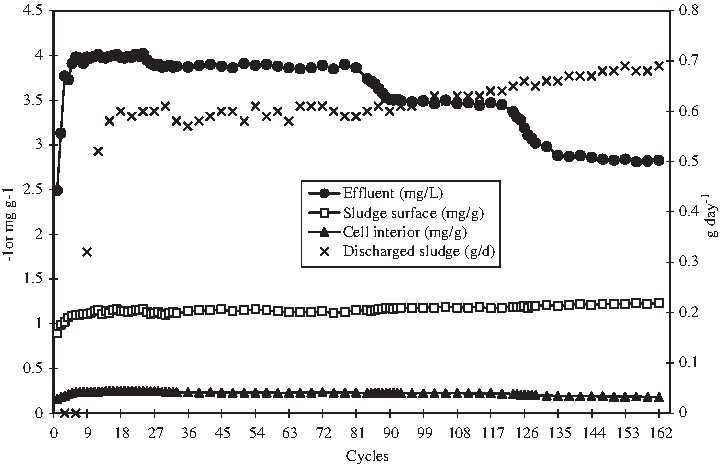
To assess the potential risk of residual chemical uncoupler, the distribution and persistence of the chemical uncoupler in the activated sludge system, as well as the residual concentration in the discharged sludge and the effluent, should be clarified first. In previous studies, 2, 4, and 6 mg L−1 TCP as chemical uncoupler was found to reduce sludge yield (Yobs) from about 0.24 of the control to 0.16, 0.11, and 0.09, but with only slight inhibition of COD removal efficiency of 3%, 5%, and 9%, respectively, compared with the control (Chen et al., 2006; Zheng et al., 2008). Therefore, in the present experiment, 2, 4, and 6 mg L−1 TCP were fed to the SBRs at the filling phase, respectively; and their distribution in the SBR systems during each operating cycle and the residual concentration in the discharged sludge and effluent are shown in Figs. 1–3. When TCP was fed at 2, 4, and 6 mg L−1, the ranges of residual TCP concentration in the effluent (water phase) were 0.5–1.0, 0.9–1.4, and 1.3–2.4 mg L−1, respectively; whereas in the sludge phase (including surface and interior), residual TCP ranges were 0.6–0.7 mg g−1 dry sludge, 1.0–1.2 mg g−1 dry sludge, and 1.3–1.5 mg g−1 dry sludge, respectively. The concentrations of residual TCP in the sludge phase were much higher than in the water phase, indicating that TCP could be accumulated by activated sludge through adsorption and absorption. This may be because chemical uncouplers such as chlorinated and nitrated phenols are usually lipophilic weak acids, and cellular tissue generally has a stronger capability of concentrating lipophilic matter (Sikkema et al., 1994).
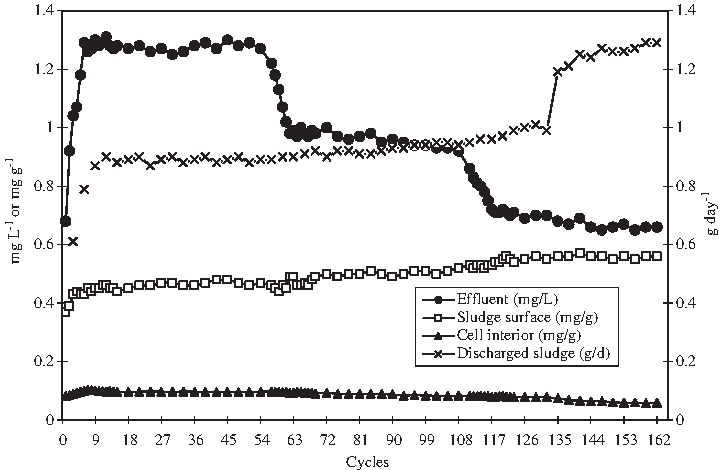
2,4,6-Trichlorophenol (TCP) distribution and discharged excess sludge in the reactor with feed of 2.0 mg L−1 TCP in the different operating cycles.

TCP distribution and discharged excess sludge in the reactor with feed of 4.0 mg L−1 TCP in the different operating cycles.
TCP distribution and discharged excess sludge in the reactor with feed of 6.0 mg L−1 TCP in the different operating cycles.
The results in Figs. 1–3 also show that with an increased number of reacting cycles, residual TCP in the effluent decreased step by step, regardless of feeding concentration; whereas TCP content on the sludge surface and interior increased and decreased, respectively. According to the residual concentration in the water phase and sludge phase of each cycle, the average ratio of residual TCP (including that in the effluent, and the discharged and residual sludge) to feed TCP during the 162 operating cycles was about 55%, 42%, and 47% when the feeding TCP was 2, 4, and 6 mg L−1, respectively. This implies that a part of TCP could be degraded in the activated sludge system, but not completely even in the 2 mg L−1 concentration. Generally, the residual concentration of TCP in the sludge phase should increase as the number of operating cycles increase, due to the accumulation effect of sludge on TCP, if the TCP biodegradation efficiency was constant during all operating cycles. However, the experimental results showed that residual TCP concentration was less in later periods than in early periods (see Figs. 1–3), thus indicating that the degradation efficiency of the sludge to TCP might be enhanced in later periods due to long-term enrichment of TCP degrading bacteria. This may result in a decrease in sludge reduction efficiency.
Many reports had indicated that TCP can be biodegraded in anerobic conditions, but it is more difficult to degrade in aerobic-activated sludge (Kennes et al., 1996; Vallecillo, 1999; Gavin et al., 2005; Aguayo et al., 2009). In the present experiment, TCP was found to be degraded in the aerobic-activated sludge system to some extent. This might be due to the anoxic conditions during the operating cycles of SBRs, such as the settling and discharging stages.
Role of TCP in the cell interior in the reduction of activated sludge
To maintain MLSS at about 2500 mg L−1, the amount of discharged excess sludge per day from the three SBRs increased slowly with the number of reacting cycles (Figs. 1–3). They were generally maintained at 0.8–1, 0.7–0.8, and 0.5–0.7 g dry sludge per day in the reactors with 2, 4, and 6 mg L−1 TCP, respectively, except for the later periods in the reactor with 2 mg L−1 TCP. The total discharged sludge from the three reactors during 162 cycles was about 61, 39, and 32 g, respectively. In addition, it can be seen that during the later operating cycles, the amount of discharged excess sludge sharply increased in the reactor with 2 mg L−1 TCP to maintain MLSS in the reactor at about 2500 mg L−1 (Fig. 1). One of the reasons for this may be the number of TCP-degrading bacteria, which are not sensitive to TCP, increasing after long-term enrichment, thus resulting in a significant reduction of the effect of uncoupling metabolism, hence the increase in sludge yield. However, before this sharp increase in discharged sludge, the TCP concentration in the water phase had significantly decreased to less than 0.7 mg L−1, but the discharged excess sludge did not immediately increase significantly. Only when the TCP concentration in the cell interior significantly decreased to less than 0.07 mg g−1, the discharged excess sludge sharply increased (Fig. 1). These results imply that the TCP concentration in the cell interior, not in water phase, directly determined the inhibition efficiency of sludge generation.
Generally, hazardous chemicals do not interfere with the metabolism of microbes unless they enter the cell interior (Verrengia Guerrero et al., 2002; Ren et al., 2010). TCP should first be absorbed onto the cell surface and then enter the cell interior to interfere with anabolism. Therefore, there is a balance of TCP concentration between the water phase and the cell interior. When the TCP concentration in the cell interior decreases due to enhancement of biodegradation efficiency during the later operating cycles, cells will uptake more TCP from the outer environment, thus resulting in a decrease in TCP concentration in the water phase. However, when TCP in the water phase decreases to a certain concentration, it cannot provide enough TCP to supplement degraded TCP in the cell interior, thus resulting in a decrease in TCP concentration in the cell interior and a weaker inhibition effect on anabolism of bacteria (non-TCP sensitive bacteria). Thus, the decrease in TCP concentration in the water phase is the result of the decrease in TCP concentration in the cell interior, and low TCP concentration in the cell interior is likely a reason for the increase in excess sludge generation. A low level of TCP in the cell interior (0.07 mg g−1 in this study) seems a critical value that efficiently inhibits excess sludge generation in the SBR for treating municipal wastewater. The level could vary depending on the culture or seed sludge used as well as operational conditions. To efficiently reduce excess sludge generation, the dosage of TCP in the SBR for treating municipal wastewater may have to be maintained at a concentration of 0.07 mg g−1 or more in the cell interior in this study. However, as degradation efficiency increases with the number of operating cycles, the dosage to maintain TCP more than the critical concentration in the cell interior should increase step by step, which will result in increased costs and potential harm to ecosystems. The interchange of two types of chemical uncouplers with different chemical structures may be a feasible measure to avoid serious biodeterioration of chemical uncouplers by activated sludge during long-term operations.
Cytotoxic effect of residual TCP in the effluent
The experimental results indicated that residual TCP concentration in the effluent ranged from 0.5 to 1.0, 0.9 to 1.4, and 1.3 to 2.4 mg L−1 when the dosage of TCP was 2, 4, and 6 mg L−1, respectively. To assess the potential harm of such TCP concentrations in the effluent on the ecosystem and human health, the cytotoxicity of the upper limit concentrations of residual TCP in the effluent, such as 1.0, 1.5, and 2.5 mg L−1 were tested using Vero cells by observing morphological changes and proliferation inhibition. Figure 4 shows the morphological changes in Vero cells inoculated at 1×10⁴ cells/mL and exposed to different concentrations of TCP. Cells grew and adhered well with a triangular shape in the negative control (Fig. 4a). The number of morphological changed cells at low TCP concentrations (1 and 1.5 mg L−1; Fig. 4b, c) was almost identical to the control group, as there were also a few rounded-off or dead cells in the negative control. More rounded-off or floating cells occurred when the TCP concentration reached 2.5 mg L−1; and when the TCP concentration was increased to 5.0 mg L−1, the number of rounded-off and suspended cells significantly increased (Fig. 4d, e). In the positive control, all the cells were rounded off (Fig. 4f). The ratio of morphologically changed cells after exposure to different concentrations of TCP was preliminary estimated by counting cells from 5 fields of view similar to that seen in Fig. 4. The average ratio of morphologically changed cells in the negative control was about 4.7%, and this ratio in the samples with 1.0, 1.5, 2.5, and 5.0 mg L−1 TCP was 5.4%, 6.3%, 10.9%, and 23.1%, respectively. These results implied that 1.0 and 1.5 mg L−1 TCP showed almost no toxicity to Vero cells. However, up to 1.5 mg L−1 and especially 5.0 mg L−1 had a more significant effect on cell morphology, thus suggesting some cytotoxicity to Vero cells.

Morphology change of Vero cells exposed to different concentrations of TCP. 1×10⁴ cells mL−1 were inoculated into 24-well tissue culture plates with Eagle's minimum essential medium containing 7% fetal calf serum, penicillin (100 IU mL−1), streptomycin (100 g mL−1), and different TCP concentrations. After culturing for 24 h, the cell morphological changes were observed by phase contrast microscopy (Olympus IX71, 40×). White points in the photos refer to suspending or “rounding off” cells.
Although the method of observing morphological changes in Vero cells is more sensitive, it is dependent on qualitative assessment, such as microscopic observation. This produces several problems: (1) discriminating differences in the morphological changes in cells exposed to different concentrations of chemicals is difficult; (2) precisely defining and counting morphologically changed cells is difficult; and (3) observational results are readily disturbed if cells are in a poor condition. Therefore, this method is just for the preliminary determination of the biotoxicity of trace organic chemicals (BS 6920-2.5, 2000). In the experiment, MTT analysis was used to verify the results obtained for morphological changes. Absorbance measurements were carried out at a seeding density of 6×10⁴ cells mL−1 in Eagle's medium at different TCP concentrations (1, 1.5, 2.0, 2.5, and 5 mg L−1). In general, the higher the optical density (OD) is, the higher the number of living cells. The cell relative inhibition rate (RIR) directly reflects proliferation inhibition and, hence, cytotoxicity of TCP. Generally, cytotoxicity can be divided into six classes according to different RIR, that is, class 0, 1, 2, 3, 4, and 5 when the RIR is ≤0%, 24%, 49%, 74%, 99%, and 100%, respectively (Pizzoferrato et al., 1985). The RIR of the control group without TCP and the blank control group without cells was 0% and 100%, respectively. The RIR of TCP in Vero cells can be obtained by the following equation:
The results of three parallel experiments are shown in Table 1. The RIR values were not stable and fluctuated when the concentration ranged between 1 and 2 mg L−1, and the value was close to zero. When the TCP concentration reached 2.5 and 5 mg L−1, the RIR significantly increased to about 5%–20% (p<0.05). Generally, the cytotoxicity ranged between class 0 and 1; the toxicity of organic chemicals is considered either negligible or low (Pizzoferrato et al., 1985). These results verify that the acute cytotoxicity of TCP less than 2.0 mg L−1 is relatively low; however, at concentrations more than 2.5 g L−1, TCP has significant acute cytotoxicity. Of course, the in vitro experimental results cannot represent the real case of TCP in the ecosystem. In fact, many reports have indicated that the accumulative effect of trace TCP would result in chronic toxicity or carcinogenic effects (Peter et al., 1990, 2000). Therefore, to finally determine the ecological and human health risk of TCP less than 2 mg L−1 in the effluent, the accumulation and transformation characteristics of such concentrations of TCP in the natural environment should be studied, and long-term composite biotoxicity tests, including its degrading products, should be carried out.
Different small superscript letters indicate significant difference of RIR among different TCP concentrations (p<0.05).
OD, optical density; RIR, relative inhibition rate of Vero cells; TCP, 2,4,6-trichlorophenol.
In addition, although the amount of discharged sludge was less than that of the normal activated sludge process, the TCP concentration in the discharged sludge was much higher than that in the effluent; therefore, discharged sludge should be disposed of correctly to avoid a potential impact on the ecosystem. Anerobic digestion of the sludge containing TCP with a long retention time for TCP degradation may be an alterative method, but the cost may be increased.
Summary
According to the experimental results and discussions just mentioned, the following conclusions can be made:
(1) Ranges of residual TCP concentrations in the effluent (water phase) 0.5–1.0, 0.9–1.4,, and 1.3–2.4 mg L−1 when the feeding TCP was 2, 4, and 6 mg L−1, respectively. The concentration of TCP that accumulated in the sludge phase significantly exceeded that in the water phase, due to the enriching effect of sludge biomass on TCP.
(2) TCP was likely partially degraded by activated sludge, due to enrichment of TCP-degrading microorganisms, and the degradation efficiency increased with the number of operating cycles. 0.07 mg g−1 (sludge dry weight) in the cell interior was likely a critical concentration in this study for efficient inhibition of the excess sludge generation.
(3) Although the acute toxicity of TCP at a concentration less than 2.0 mg L−1 in the effluent was relatively low, concentrations greater than 2.5 mg L−1 had significant acute cytotoxicity. Accumulative and chronic toxicity of TCP at concentrations less than 2.5 mg L−1 in the natural environment should be further evaluated by long-term testing.
(4) A dosage of more than 4 mg L−1 TCP (corresponding to 2.5 mg L−1 residual concentration in the effluent) for sludge reduction in SBR for treating municipal wastewater is not feasible, due to acute toxicity. In addition, the economic aspects of chemical uncoupler to reduce excess activated sludge should also be analyzed.
Footnotes
Acknowledgment
The authors thank China Natural Science Foundation for supporting this work (Nos. 20677043 and 40871217).
Author Disclosure Statement
No conflicting financial interests exist.