




Abstract
Abstract
A novel rosin Gemini surfactant, bisquaternary ammonium salt (BQA) of rosinate, was synthesized in high yield and purity. First, rosin reacted with ethanol to produce ethyl rosinate. Then the ethyl rosinate was modified with fumaric acid. Also, triethylamine reacted with epoxy chloropropane to synthesize epoxy quaternary ammonium salt (QAS). Finally, the epoxy QAS was reacted with the modified rosinate to prepare the Gemini surfactant, BQA of rosinate, at the following conditions: the intermediate and the modified rosinate mole ratio of 3:1, reaction temperature of 82.5°C, and reaction time of 8.5 h. Gravimetric analysis showed that its BQA content was 90.9% (w/w) of the product. The chemical structure of the BQA was conformed by high-performance liquid chromatogram, Fourier transform infrared spectroscopy, and nuclear magnetic resonance analysis. As a BQA Gemini surfactant, it has good surface activities and antifungal activity to most of the tested wood decay or mold fungi. Besides these great properties, its raw material is renewable. Herein, the BQA of rosinate will be a great Gemini surfactant alternative in related industries.
Introduction
Rosin comes from soft wood and is known as green petroleum. It is a pretty important raw material for the chemical industry (Satturwar et al., 2004; Ren and Li, 2005; Botham et al., 2008; Liu et al., 2010). Resin acids are the main components of rosin. They have one carboxyl group and two double bonds in their chemical structures (Song, 1994; Liang and Ye, 2000). There have been some studies concerning rosin and dehydrogenated rosin derivatives. Some of dehydrogenated rosin derivatives have good surface activities (Pletney, 2001; Ding, 2006; Zhao et al., 2007; Yu et al., 2008). However, dehydrogenated rosin is usually used as a medical intermediate and it is too expensive to prepare surfactants. Some rosin-based Gemini cationic surfactants have been synthesized, but normally 2 mole resin acids were used to produce 1 mole Gemini product (Han et al., 2009; Jia et al., 2010). When rosin was used to prepare surfactants, normally the products could not be obtained in high yield or purity, because rosin is a mixture of many weak carboxylic acids. Herein, a novel bisquaternary ammonium salt (BQA) of rosinate was synthesized and its chemical structure was identified. Besides this, its surface activities and antifungal activity to some wood decay or mold fungi were also evaluated.
Experimental Section
Materials
The raw material, gum rosin, was obtained from Guangdong, China, and was of industrial grade. Others reagents, such as fumaric acid, p-hydroquinone, alcohol, epoxy chloropropane, and triethylamine, were of analytical grade.
Synthesis
Industrial grade gum rosin was used as a raw material to prepare a rosin Gemini surfactant. Its main components are resin acids. During the preparation process, rosin reacted with fumaric acid in order to introduce two strong carboxylic acid groups to modify rosin. Although the major resin acid of rosin is abietic acid, it turned into levopimaric acid under heat as well as other resin acids, and then the Diels-Alder reaction occurred. So, levopimaric acid was used to show the reactions here.
 (1)
(1)
First, according to Equation (1), rosin reacted with ethanol to produce ethyl rosinate with zinc oxide as the catalyst. When rosin was heated up to 180°C, alcohol was added dropwise within 1 h and the molar ratio of rosin to alcohol was 1:3. The reaction mixture was stirred at this temperature for another 2.5 h. Through this reaction, the weak carboxylic group was esterified.
 (2)
(2)
Then the ethyl rosinate was modified with fumaric acid referring with Equation (2) under nitrogen with p-hydroquinone as its antipolymerized agent. When the rosinate was heated up to 230°C, fumaric acid was added until the molar ratio of rosin to fumaric acid reached 1:1.2. This reaction mixture was stirred for 3 h at this temperature. The modified rosin was a yellowish glassy solid at room temperature. To remove surplus fumaric acid and p-hydroquinone, the modified rosin was ground, washed with distilled water for many times, and oven-dried at 103°C±2°C. Theoretically, the acid value of the pure modified rosinate was 299 mg KOH/g. The acid value of this product was 292.6 mg KOH/g, indicating that the ethyl rosinate was almost completely conversed. Through this reaction, two identical strong carboxylic acid groups were introduced into this product.
 (3)
(3)
Also, triethylamine reacted with epoxy chloropropane according to Equation (3) in the mole ratio of 1.2:1. Triethylamine and epoxy chloropropane were dissolved in isopropanol. The reaction mixture was heated to 50°C and stirred for 5 h. The solvent was evaporated to give the raw product as a viscous yellow liquid. To remove the surplus epoxy chloropropane, the raw product was washed with ether and then oven-dried under vacuum at 25°C for 12 h. The product was the epoxy quaternary ammonium salt (QAS) and its yield was 90.1%.
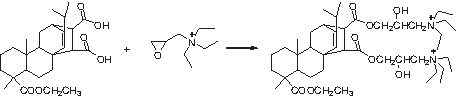 (4)
(4)
Finally, the epoxy QAS reacted with the modified rosinate and the Gemini surfactant BQA of rosinate was prepared referring with Equation (4) at the conditions as follows: the epoxy QAS reacted with the modified rosinate in the mole ratio of 2:1, reaction temperature of 82.5°C, and reaction time of 8.5 h. The yield of the crude product was about 93%.
All reactions were performed under nitrogen.
Characterization
QAS in water could react quantitatively with sodium tetraphenylborate and be precipitated from water. This product was analyzed with this gravimetric method to calculate its content.
High-performance liquid chromatography (HPLC) was performed on an HPLC2000, which was made by Shanghai Tianmei Scientific Equipment Co. Ltd. Its separation column was C18 and its mobile phase was methyl alcohol and water (95:5, v/v).
The chemical structure of this rosin derivative as a BQA was also identified by Fourier transform infrared spectroscopy (FTIR) and 1H and 13C nuclear magnetic resonance (NMR) analysis. FTIR analysis was performed on a Magna 560 FTIR spectrometer, which was made by Nicolet Company, and the KBr press method was used. 1H NMR and 13C NMR analyses were carried out with a DRX-400 spectrometer, which was made by the Bruker Company, with D2O as its solvent and tetramethylsilane as its interior standard.
Surface activity
Emulsifying power
About 0.1 g product was dissolved in 100 mL distilled water. Then 40 mL of the solution and 40 mL benzene were mixed in a measuring cylinder with the plug. The mixture was vibrated violently for five times, and then the time was recorded when 10 mL water was separated from the mixture.
Foaming power
It was measured with modified Ross–Miles method (ISO 696). After 500 mL of a solution of the substance to be tested have flowed down from a height of 450 mm onto the surface of the same solution, the volume of foam formed was measured.
Surface tension
The maximum force was measured, which is necessary to act vertically on a ring, in contact with the surface of the liquid being examined placed in a measuring cup, to separate it from this surface, or on a plate with an edge in contact with the surface, to draw up the film that has formed. The relationship between the force and the concentration was plotted and its critical micellar concentration (CMC) was calculated (ISO 304).
Antifungal activity
Most quaternary ammonium salts have good antifungal activity. Herein, the antifungal activity of the product was also tested by dipping 8-mm-diameter filter paper discs into water prepared with 0.8, 1.6, and 3.2 mg of the product per milliliter of water. The discs were soaked in these solutions and air-dried prior to use. Additional discs dipped in water served as controls. The discs were then placed on the surface of potato dextrose agar (PDA) in plastic Petri dishes previously inoculated with actively growing mycelium or spore of Irpex lacteus, Phanerochaete chrysosporium, Trametes versicolor, Gloeophyllum trabeum, Chaetomium globosum, Aspergillus niger, and Paecilomyces variotii. The fungi were inoculated in the plates by mixing a suspension of mycelium and spores of a given fungus with cooled but still molten PDA. The discs were placed on the plates after the agar had solidified and cooled. Each product concentration was replicated on three discs and the plates were incubated at 28°C for 2–7 days, depending on the growth rate of the test fungus.
Results and Discussion
During gravimetric analysis, 1.03 g product was dissolved in distilled water. Then, sodium tetraphenylborate was overdosed into the solution with stirring for 30 min to precipitate all QAS. Theoretically, 1.4 g sediment could be formed for pure mono-QAS of rosinate and 1.87 g for pure BQA of rosin. In this experiment, 1.7 g sediment was obtained, indicating that BQA was the main component of the product. Hypothetically, all QAS in the product existed as BQA, and its content was 90.9% in the product.
HPLC analysis spectrum is shown in Fig. 1. There was one very sharp peak at 5.318 min and this component took up 91.13% of the product. Considering the result of gravimetric analysis, this component is BQA of rosin and its yield after all the processes was 85%.
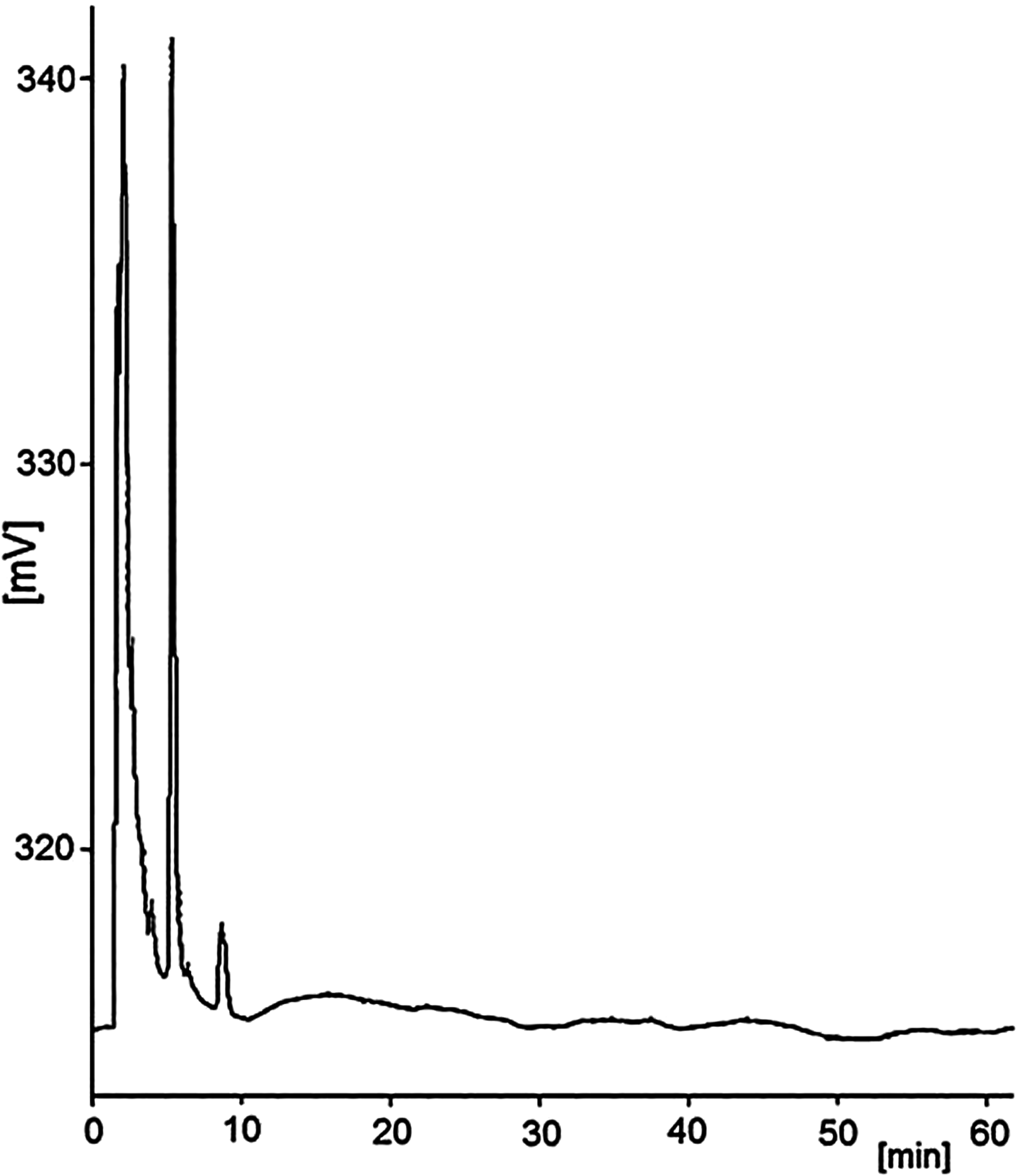
High-performance liquid chromatography analysis of the product.
FTIR spectra of all intermediates and the product are shown in Fig. 2. Through FTIR analysis, the following data were obtained:

Fourier transform infrared spectroscopy spectra of all intermediates and the product. 1, rosin; 2, ethyl rosinate; 3, modified ethyl rosinate; 4, QAS intermediate; 5, final product.
In the spectrum of rosin (1): 3400 cm−1 (O–H stretch), 2860–2930 cm−1 (C–H stretch), 1690 cm−1 (carboxylate C=O stretch), 1380–1450 cm−1 (bending vibration of C–H).
In the spectrum of ethyl rosinate (2): 2860–2930 cm−1 (C–H stretch), 1720 cm−1 (ester C=O stretch), 1380–1450 cm−1 (bending vibration of C–H), and no peaks at 3400 cm−1 (O–H stretch), which indicates that rosin was mostly esterified by alcohol.
In the spectrum of the modified ethyl rosinate (3), the peak for hydroxy (3400 cm−1) was increased, indicating that the modified rosinate was synthesized successfully.
In the spectrum of the epoxy QAS (4): 1320–1350 cm−1 (C–N stretch). The peak for the hydroxy (3400 cm−1) was caused by fractional ring opening. There were special peaks for ester (C=O) and C–N, which indicates that the QAS intermediate was well synthesized.
In the spectrum of the final product (5): 3400 cm−1 (O–H stretch), 2860–2930 cm−1 (C–H stretch), 1720 cm−1 (carboxylate C=O stretch), 1380–1450 cm−1 (bending vibration of C–H), 1320–1350 cm−1 (C–N stretch). Compared with the spectrum of the modified ethyl rosinate, no peaks for free carboxyl group COOH was found and there was a peak for the C–N (1320–1350 cm−1), which indicates that most of the modified ethyl rosinate reacted with the QAS intermediate (Li et al., 2010).
1H NMR and 13C NMR spectra and the data are shown in Table 1. In 1H NMR spectrum, there were strong peaks around 3.1–3.6 ppm, which were caused by 28 hydrogen atoms of N+–C–H. In 13C NMR spectrum, the strong peak at 6.81 ppm was caused by the carbon atoms of methyl groups in N+–CH2–CH3, and the strong peak at 54.40 ppm was caused by the carbon atoms of methylene groups in N+–CH2–CH3 (Prinz et al., 2002). Results of 1H NMR and 13C NMR analyses all conform that it is the structure of the target, the rosin Gemini surfactant (Fig. 3).

Structure of rosin Gemini surfactant.
1
Surface activity
As a Gemini surfactant, the surface activities of the product were measured.
During the experiment of measuring emulsifying power, it took 36 min to separate 10 mL water from the mixture of the product aqueous solution and benzene. So the emulsifying power of the product was 36 min.
After flowing from the height of 450 mm, the product aqueous made abundant foam. Its foaming power was 319 mL at 3 s, 300 mL at 3 min, and 286 mL at 5 min. This foaming power was great and stable (Xia et al., 2009).
Relationship between the force and the concentration of the product is shown in Fig. 4. Its CMC was 3.9×10⁻⁴ mol/L and the force γ was 39.18 mN/m. Both CMC and the force were much lower than those of cetyl trimethyl ammonium bromide (Yang et al., 2007).
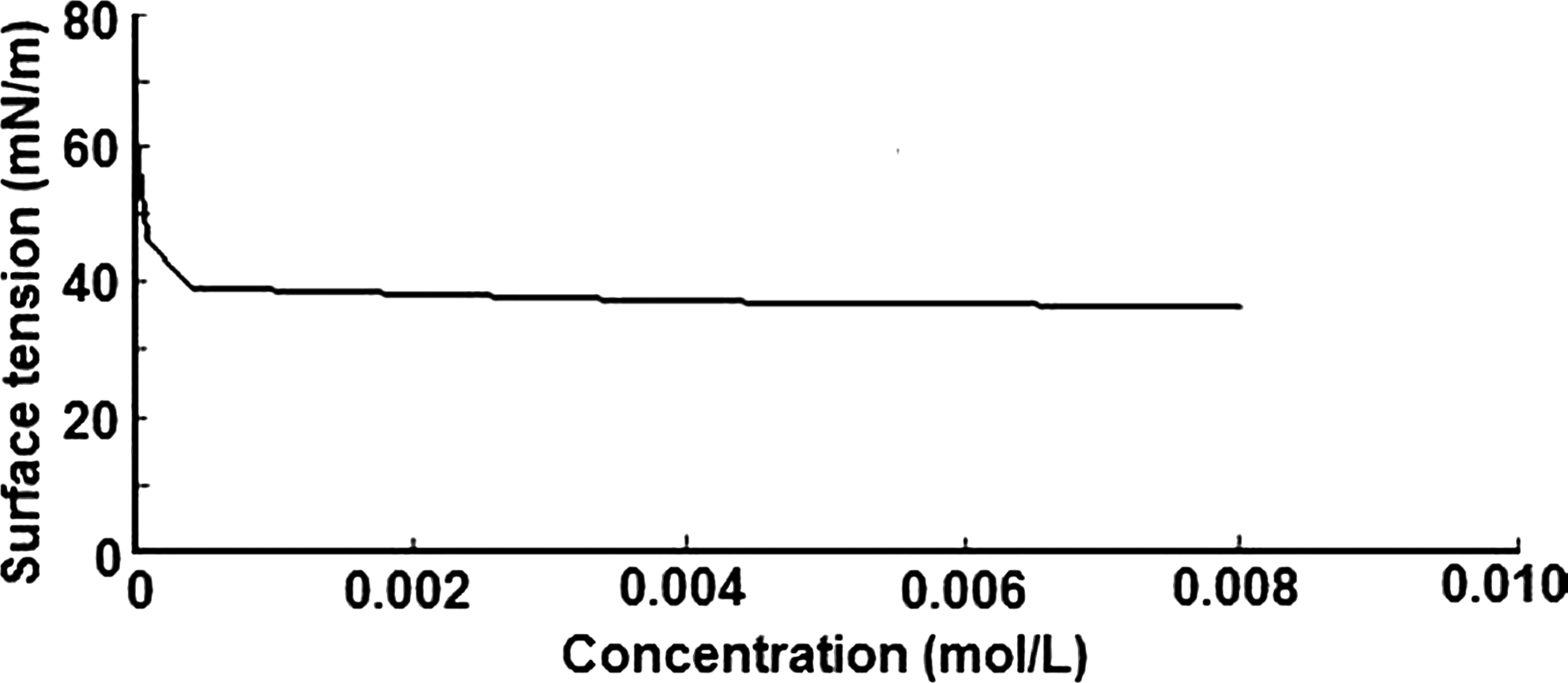
Relationship between the force and the concentration of the product.
Antifungal activity
The antifungal activity of the product to some wood decay or mold fungi is illustrated in Table 2. The product showed good bioactivity to most of the tested fungi, especially to T. versicolor, P. chrysosporium, and C. globosum.
Conclusions
A novel rosin Gemini surfactant was synthesized with rosin as its raw material. HPLC analysis showed that the purity of the product was 91.13% and the yield of BQA was 85%. The chemical structure of this rosin derivative as a BQA, i.e., a Gemini surfactant, was also conformed by FTIR and 1H and 13C NMR analyses. As a Gemini surfactant, the surface activities of the product were measured. The emulsifying power of the product was 36 min. The foaming power of the product could reach 319 mL at 3 s, 300 mL at 3 min, and 286 mL at 5 min. Its CMC was 3.9×10⁻⁴ mol/L. The product also has good antifungal activity to most of the tested wood decay or mold fungi. Based on its great properties and the preparation method from rosin resulting in high purity and high yield, the rosin Gemini surfactant could have a promising future.
Footnotes
Acknowledgments
The authors are grateful for the support of National Nature Science Foundation of China (No. 31070487) and the Scientific Research Foundation for the Returned Overseas Chinese Scholars, State Education Ministry (No. 2009-1001).
Author Disclosure Statement
The authors declare that no competing financial conflicts exist.