




Abstract
Abstract
An iron-amended anaerobic sequencing batch reactor, fed with synthetic sewage, was used to evaluate the factors influencing iron reduction–induced phosphorus precipitation from a simulated septic system. Results revealed that soluble phosphate could be effectively removed from the reactor when the added amorphous ferric oxyhydroxide (α-FeOOH) was increased from a molar ratio of 1.5 to 3. Whereas cycle time, substrate concentration, and temperature did not have a noticeable effect on iron reduction and the subsequent phosphorus removal, agitation was found to be an important factor, enabling better contact between α-FeOOH and the microorganisms during phosphorus removal. Precipitates collected from the reactor were analyzed by scanning electron microscopy (SEM), energy dispersive X-ray spectroscopy (EDS) and X-ray diffraction (XRD). Results demonstrated that the precipitate was mainly vivianite [Fe3(PO4)2·8H2O], which suggests that phosphorus was removed through iron reduction–induced precipitation. This paper provides insights into phosphorus removal from septic sewage using a novel approach.
Introduction
In a conventional wastewater treatment plant, phosphorus is removed by polyphosphate accumulating microorganisms and requires alternating cycles of anoxic and oxic processes. However, a septic system is strictly anaerobic, so polyphosphate accumulation is not possible. Given this, an approach involving biochemical precipitation to enhance phosphorus retention in anaerobic environments may prove to be a promising strategy. The approach combines iron reduction technology, which has been successful in the remediation of soils and sediments contaminated with metals, radionuclides, and organics (Fredrickson and Gorby, 1996), with a subsequent precipitation reaction. Iron reduction technology relies on dissimilatory iron reducing bacteria (DIRB) to reduce Fe(III) to dissolved Fe(II) by oxidizing different organic substrates or H2 under anaerobic conditions (Lovley 1991; Francis et al., 2000; Lovley and Anderson, 2000). DIRB have been used in municipal wastewater treatment to remove ammonia from food processing (Ivanov et al., 2004), to treat fat-containing wastewater (Ivanov et al., 2002), and in particular, to remove phosphate from anaerobically digested sludge (Stabnikov et al., 2004; Ivanov et al., 2005; Ivanov et al., 2008) and reject water (Guo et al., 2009; Guo et al., 2010; Ivanov et al., 2009).
Using iron reduction technology and acetate as the main electron donor, Ivanov et al. (2005), reported the following reaction:
This reaction illustrates that solid Fe(III) can be dissolved quickly and reduced to Fe(II) in an anaerobic environment, because of the presence of iron reducing bacteria (IRB). Once Fe(III) is reduced to Fe(II), phosphate will combine with Fe2+ to form a precipitate called vivianite [Fe3(PO4)2·8H2O] (Fredrickson et al., 1998):
Vivianite can be recovered by settling and then used as an iron supplement in calcareous soils (Eynard et al., 1992).
IRB are ubiquitous in the environment and have been found in anaerobic sludge from publicly owned treatment works (Ivanov et al., 2004). Therefore it is reasonable to expect that IRB are present in a septic tank and to explore the application of iron reduction technology for phosphorus removal from a septic tank. This study investigates the feasibility of phosphorus removal from septic systems through the use of vivianite precipitation by iron reduction. To mimic septic tanks, an anaerobic sequencing batch reactor (ASBR) was employed. ASBRs have been used in studies of nonfat dry milk synthetic wastewater (Sung and Dague, 1995), sucrose wastewater (Wirtz and Dague, 1997), dairy wastewater (Dugba and Zhang, 1999), and low-strength synthetic wastewater (Rodrigues et al., 2004). ASBR systems operate according to the following cyclic steps: feed, reaction, settling, and discharge (Dague et al., 1992). These cyclic steps closely mimic the inputs (i.e., toilets flushing, laundry effluent, and drainage) to an on-site wastewater system. This research evaluates factors such as iron dosage, agitation rate, cycle time, substrate concentration, and temperature on phosphorus removal.
Materials and Methods
Seed sludge and iron source
Seed sludge was sampled from a three-year-old residential septic tank in Dunstable, Massachusetts. The material was a homogenized mixture of the accumulated sludge, scum, and the interlayer liquid. The characteristics of the obtained mixture are listed in Table 1 (Cheng et al., 2010). Amorphous ferric oxyhydroxide (α-FeOOH) was prepared by neutralizing 0.4 M FeCl3 solution to a pH of 7 by NaOH. The resulting slurry was then washed thoroughly, suspended again in deionized (DI) water, and added as an external iron source (Lovley and Phillips, 1986). The iron (Fe3+) concentration of the α-FeOOH suspension was determined using the 3 M HCl extraction method (Fredrickson et al., 1998).
Extractable=soluble+nonsoluble
TSS, total suspended solids; VSS, volatile suspended solids; P, phosphorous; FeT, total iron (FeT=Fe2++Fe3+).
Experimental setup
A bench-scale ASBR (Bioflo 110, New Brunswick Scientific Co., Edison, New Jersey) with a 5 L working volume was used to mimic a conventional septic tank. The reactor was equipped with a pH/oxidation reduction potential (ORP) monitor and a temperature control system. By using peristaltic pumps, sequencing batch operations were carried out as follows: feeding, 20 min; reaction, varied to produce different cycle time; settling, 20 min; and withdrawing, 20 min. The effluent was replaced by synthetic sewage in each cycle, and the replaced volume was 2.5 L. Agitation was provided by a motor-driven mixing blade. The ASBR was fed with synthetic household sewage. Based on the work of Cubas et al. (2004), each liter of synthetic sewage was prepared with: 56 mg sucrose; 182 mg starch; 54 mg cellulose; 333 mg meat extract; 82 mg vegetable oil; 250 mg NaCl; 7 mg MgCl2·6H2O; 4.5 mg CaCl2·2H2O; 200 mg NaHCO3; 85 mg commercial detergent; 16 mg K2HPO4; 1 mL trace metal solution; and 10 mL vitamin solution. The resulting total chemical oxygen demand (COD) was ∼800 mg/L; soluble COD ∼400 mg/L; and P ∼28.5 mg/L. Following Cheong an Hansen (2008), each liter of trace metal solution was prepared with: 50 mg H3BO3; 50 mg ZnCl2; 30 mg CuCl2; 500 mg MnSO4·H2O; 50 mg (NH4)6Mo7O24·4H2O; 50 mg AlCl3; 50 mg CoCl2·6H2O; and 50 mg NiCl2. All the chemicals were purchased either from Sigma-Aldrich Co., or Fisher Scientific Inc.
Since half of the contents in the reactor were replaced by the synthetic sewage at the beginning of each cycle, the concentration of each species from the synthetic sewage was half of the previously described concentration (i.e., influent P to the reactor ∼14.25 mg/L). During the start-up period, α-FeOOH was supplemented at 38.5 mg Fe3+/L (added Fe3+/initial soluble P, molar ratio of 1.5, as in vivianite). Once the reactor reached a stable state, a higher iron dosage (77 mg Fe3+/L, added Fe3+/initial soluble P, molar ratio of 3.0) was used. The total operating time of the reactor was 208 days. During the operating time, various factors were studied, including the effects of iron dosage, agitation, cycle time, and temperature and substrate concentration. See Table 2 (Cheng et al., 2010) for detailed information on the reactor running conditions.
HRT, hydraulic retention time.
Analytical methods
COD, pH, bicarbonate alkalinity (BA), total suspended solids (TSS), and volatile suspended solids (VSS) were analyzed according to standard methods (APHA et al., 1998). Soluble contents were obtained after filtering the samples through glass-fiber filter papers (Gelman A/E, Ann Arbor, Michigan) and measured in the same way as the nonfiltered samples. Specifically, ferrous iron (Fe2+) was determined using Hach Method 8146, the 1,10-phenanthroline colorimetric method. For that, the sample was pretreated with HCl and measured immediately to minimize its oxidation to ferric. Total iron (FeT, or Fe2++Fe3+) was determined, using Hach FerroVer Method 8008.
Scanning electron microscopy
Sludge samples from the ASBR were fixed overnight in glass vials in 0.1 M sodium cacodylate (pH 7.4), containing 2.5% glutaraldehyde at 4°C. The fixed samples were washed twice in a 0.1 M cacodylate buffer solution (pH 7.4), postfixed with 2% osmium tetroxide for 2 h at 4°C and rinsed twice with DI water. The samples were then dehydrated through a graded ethanol series and placed on 100-mesh, carbon-coated copper grids (SPI, West Chester, PA). Specimens for scanning electron microscopy (SEM) observation were coated with gold before being examined by a field-emission scanning electron microscope (JSM-7401F, JEOL, Japan). The EDS analysis was performed with the same SEM equipped with an energy dispersive spectrometer (EDAX, Inc., Mahwah, NJ).
X-ray powder diffraction
Precipitates were collected from the bottom of the reactor after 208 days of operation. Mineralogical characterization was performed on the precipitate by X-ray powder diffraction (XRD), using a Rigaku Ru300 with CuKα radiation (Japan). The diffractometer was operated at 50 kV and 300 mA. Sludge samples were washed twice by oxygen-free DI water, dried and ground in a high-purity nitrogen atmosphere. The samples were then finely pressed as powder in a glass holder and the XRD patterns were collected over a 2θ from 8° to 80° at a scan rate of 3°/min.
Results and Discussion
ASBR start-up with iron amendments
Very little soluble iron was detected in the seed sludge. Most iron was found in the precipitate, and the majority of it (36.6 mg/L), was Fe2+ (see Table 1). The remainder (2.2 mg/L), was Fe3+. For P, 28.75 mg/L was soluble and 43.5 mg/L was in the precipitate. Given that most iron reduction is associated with DIRB in an anaerobic environment (Lovley and Phillips, 1986), these numbers indicate the potential existence of iron-reducing bacteria and the occurrence of iron reduction. The EDS analysis (Table 3) revealed that the major component of the seed sludge was C, followed by O, Ca, Si, P, Al, Cu, Mg, Na, Ti, K, S, and Fe, which suggests that the majority of the seed sludge was organic matter. The XRD analysis showed that the major mineral composition in the seed was quartz (see Fig. 1).

X-ray diffractograms of the precipitates and seed sludge.
During the first 10 days of run 1 (R1), there was a net gradual increase in Fe2+ production and P removal. After 10 days, the concentrations of both species reached a stable state (see Fig. 2). Soluble Fe2+ in the effluent reached ∼22 mg/L, the same as the soluble FeT concentration, which suggests that all the soluble Fe existed as soluble Fe2+. Since the initial soluble Fe2+ concentration in the seed was only 0.5 mg/L, the data showed that the Fe(III) added had been reduced to soluble Fe2+. During the same time period, phosphorus concentration had dropped from 28.5 mg/L in the reactor to 17 mg/L. This finding demonstrated that the remaining soluble Fe2+ was not available to form vivianite. Some researchers (Fredrickson et al., 1998; Zachara et al., 2001), have reported chelation of Fe(II) by organic acids after iron reduction, while others (Liu et al., 2001) have reported adsorption to the microbes. Although P was gradually removed during this 10-day operation, the effluent P concentration was still higher than the influent P concentration due to the initial P concentration in the seed sludge. During R1, pH changed from above 7 to below 7, and bicarbonate alkalinity steadily increased. This is consistent with the chemical reaction #1 shown in the Introduction. The ORP dropped to a level (−420 mV), which is more favorable for anaerobic reactions. A reduction–oxidation (Redox) condition is critical for both Fe(III) reduction and vivianite formation under anaerobic conditions. The critical Eh for Fe(III) reduction was found to be 300 mV at pH 5 and between 300 mV and 100 mV at pH 6 and 7 (Gotoh and Patrick, 1974; Patrick and Henderson, 1981). The favorable Eh for vivianite formation was reported to be between −100 mV at pH 5 and −350 mV at pH 7 (Lemos et al., 2007). The effluent soluble COD concentration started to decrease, suggesting biological reactions were happening but at a slow pace. Based on the observed changes in pH, alkalinity, ORP, and soluble COD, which are all good indicators of the occurrence of biological reactions, the observed phosphorus removal strongly suggests an iron reduction–induced mechanism involving DIRB and the possible formation of vivianite.
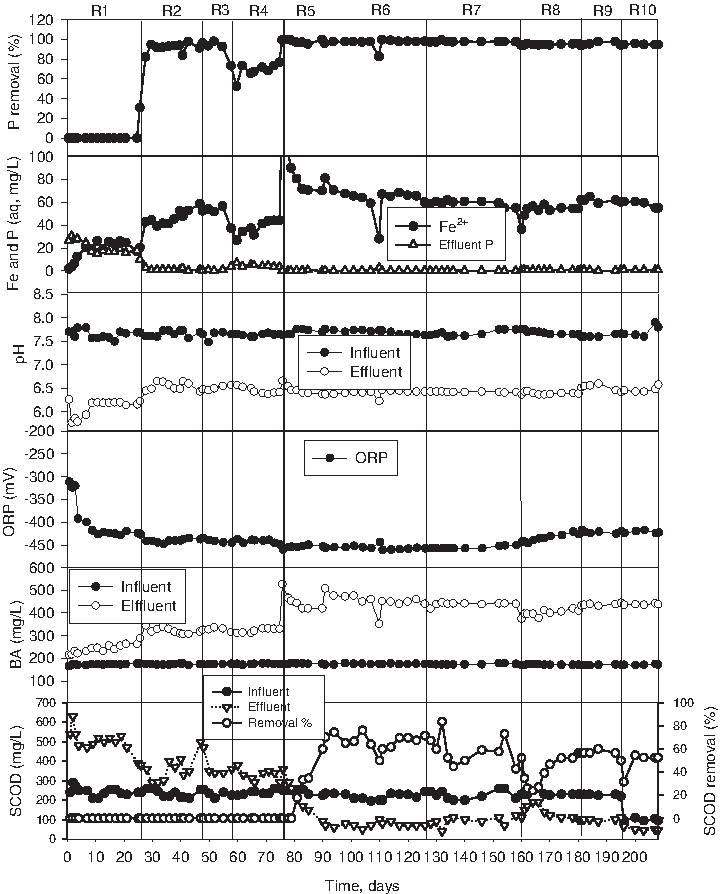
Operation of the anaerobic sequencing batch reactor (ASBR) to study the influencing factors.
Various influencing factors
Iron dosage (R1 and R2)
After a 26-day run for R1, the iron dosage was increased to 77 mg/L for R2. As a result, the soluble P removal immediately increased to ∼92% and quickly reached a new stable state. In the reactor, the net soluble Fe2+ concentration was increased from ∼22 mg/L in R1 to 42 mg/L in R2 and then gradually increased to ∼53 mg/L toward the end of R2. By comparing the P removal in R1 to the P removal in R2, it was found that the addition of iron at a molar ratio of 3 (Fe(III)/P) achieved nearly complete P removal. Different levels of iron addition have been reported for optimum P removal within different applications. For phosphorus removal from the returned liquor of a municipal wastewater treatment plant, Ivanov and others (2005) reported an optimal mass ratio of 4 for added Fe(III)/initial phosphate. To achieve more than 95% removal of phosphate in a study of anaerobic digestion of activated sludge with an initial phosphate concentration of 1000–3500 mg/L, Stabnikov and others (2004) reported an optimal mass ratio of 2 for added Fe(III)/removed dissolved phosphate. In this study, it appears that an Fe(III) dosage based on a molar ratio of 3 in Fe(III)/P was necessary for almost complete P removal. Several factors may have contributed to the high Fe(III) demand. In addition to the previously mentioned Fe(II) chelation (Zachara et al., 2001) and adsorption to the microbes (Liu et al., 2001), Fredrickson and others (1998) reported that supersaturation of Fe(II) was necessary for vivianite formation.
Sulfate-reducing bacteria, DIRB, and denitrifying bacteria use sulfate, ferric iron, or nitrate, respectively, as electron acceptors for anaerobic respiration. It is known that some sulfate-reducing bacteria are also able to reduce Fe(III) (Coleman et al., 1993). The sulfate-reducing bacteria, Desulfotomaculum reducens share physiological properties with metal-reducing groups of bacteria and are able to reduce Fe(III) as the only or terminal electron acceptor (Tebo and Obraztsova, 1998). However, in this study only a small amount of sulfate (0.5 mg/L), was added as part of the mineral solution. Therefore even if the sulfate-reducing bacteria were present, they would be out-competed by the DIRB.
Greater soluble COD removal was obtained in R2 than in R1, illustrating that the addition of more iron (III) not only improved phosphorus removal, but also improved carbon oxidation. Similar findings were reported by Azam and Finneran (2009) in their work quantifying the mineralization changes of seven different 14C-labeled carbon compounds in Fe3+-amended septic material.
Agitation (R3, R4 and R5)
Agitation varied from 50 rpm in R3 to 0 rpm in R4 to 100 rpm in R5. Both P removal and net soluble Fe2+ production increased with agitation rate (see Table 4). Phosphorus removal was 91% in R3 (50 rpm), but removal efficiency dropped to 70% in R4 (0 rpm) and went up to 98% in R5 (100 rpm). Similarly the net soluble Fe2+ produced was 53 mg/L in R1 (50 rpm), dropped to 37.4 mg/L in R4 (0 rpm), and went up to 60 mg/L in R5 (100 rpm). At the end of each cycle at 0 rpm, 50 rpm, and 100 rpm, respectively, the net soluble Fe2+ concentration was 49%, 69% and 78% of the Fe(III) added. The remaining P was 30%, 9% and 2% of what was added to the reactor. Therefore, sufficient contact between DIRB and the Fe(III) source is critical for dissimilatory Fe(III) reduction (Lovley, 1991; Caccavo, 1999; Das and Caccavo, 2000) and subsequent P removal.
The rates of P removal and the net soluble Fe2+ production within a one-day operation cycle showed that the highest P removal rate and the greatest soluble Fe2+ consumption rate at each agitation frequency happened during the first hour of the cycle. The removal and consumption rates increased with agitation frequency (Table 5). This finding demonstrated that P was mostly removed during the first hour of each operation cycle by reacting with the Fe2+ remaining from a previous cycle. The remaining P was removed at a decelerating rate, while the soluble Fe2+ was reproduced at an accelerating rate. These reactions were repeated when a new cycle started.
Negative values represent ferrous consumption.
Cycle time (R6, R7 and R8)
The effect of different cycle times was examined. Although no significant difference was observed on phosphorus removal and net soluble Fe2+ production, the soluble COD removal efficiency decreased from 66% to 60% and then to 42% when the cycle time changed from 3 days to 2 days to 0.5 days, respectively (see Fig. 2). When the cycle time was 0.5 day, the reactor was fed twice a day. Since all anaerobes (including iron-reducing bacteria) are slow-growing microbes, they were not able to take up the extra food within a short period of time. Therefore, there was an initial dip in the soluble COD removal efficiency. After a few cycles, however, the soluble COD removal efficiency went up to 57%. The cycle time studied mimicked the discharge frequency to the septic tank. The result demonstrated that P could be effectively removed independent of the discharge frequency.
Temperature and COD (R9 and R10)
When the temperature was decreased from 30°C in R8 to 18°C in R9 and R10, no significant change in net soluble Fe2+ production and phosphorus removal was observed. Similarly, no effect was observed when the influent soluble COD concentration was decreased from 200 mg/L to 100 mg/L in R10. By examining the changes in the soluble COD concentrations in the influent and effluent under all the operation conditions, it became clear that carbon oxidation occurred right after the reactor started running, but it took the system almost 80 days to completely degrade the organics that came with the seed, illustrating that the anaerobic process (including iron reducing bacteria [Guo et al., 2010]), is a slow process. According to reaction #1, it shows that theoretically it only requires ∼10 mg/L of COD to completely reduce 77 mg/L of Fe3+ to soluble Fe2+. So this finding demonstrates that electron donors in the septic wastewater are unlikely to be the limiting nutrient for Fe(III) reduction.
Other considerations
Zhang et al. (2010) examined several parameters, such as pH, through thermodynamic modeling on chemical phosphorus removal using FeCl3·6H2O. They found that the most phosphorus removal from anaerobic supernatant was achieved at neutral pH with an iron amendment. Szabo et al. (2008) reported that pH was not a sensitive indicator of phosphorus removal efficiency under the typical operating range of wastewater treatment plants. In this study, the system pH was closely monitored and found to be neutral. Therefore, pH was not studied as a controlling factor.
Adsorption of phosphate ions to the iron hydroxide added was reported during chemical phosphorus removal (Zhang et al., 2010). In the unamended control experiment where no external Fe(III) was added, no P removal was found after 10 days of reaction (Cheng et al., 2009). In a killed control (by autoclaving the seed sludge), a P removal of 30% was observed when Fe(III) was added at a molar ratio of 1.5 indicating that adsorption could contribute to the total P removal (data not shown; since the soluble Fe2+ was only 0.5 mg/L in the seed sludge, chemical removal through vivianite can be ruled out). Therefore, adsorption of phosphate ions to the microbial flocs might be another mechanism for the P removal observed.
Precipitates analysis
The precipitates collected from the bottom of the ASBR when it was emptied after 208 days of operation were mostly brownish round or spherical particles, from 2 mm to 3 mm in diameter, with dark blue spots on the surface. There were also some individual dark blue particles (Fig. 3A). SEM images were taken from the same sample, and the image revealed crystal-shaped precipitates and massive microbes as shown in Fig. 3B.

Images of the precipitates collected from the bottom of the ASBR as observed by
From a study of the SEM-EDS data (Table 3 and Fig. 4), it is evident that P and Fe accumulation occurred in the precipitates. Furthermore, the P and Fe contents were 8.6 and 9.3 times higher in the precipitates than in the seed. The major components in the precipitates were C, O, P, and Fe and the molar ratio among Fe, P, and O was approximately 1:2.5:5. Compared to the theoretical molar ratio in vivianite (3:2:16 or 1:0.67:5.3), the precipitates had higher P content. Probably one major reason for these differences is P adsorption, which made P content artificially higher.
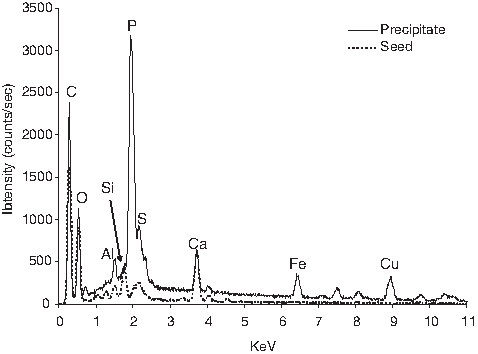
Energy dispersive X-ray spectroscopy analysis of the precipitates and seed sludge.
The XRD patterns (Fig. 1) revealed that quartz (SiO2) was a major mineral in the seed sludge; and vivianite was identified as a newly produced major solid phase in the precipitates (where quartz still remained). In addition, since all soluble Fe existed as Fe2+, it likely that the precipitate formed will be vivianite.
Fredrickson and others (1998) have reported the formation of several distinct products including magnetite (Fe2O3), siderite (FeCO3), vivianite (Fe3(PO4)2·8H2O), and green rust (
During the entire experiment, the influent P was added at ∼28.5 mg/L to replace half of the reactor volume. The P accumulated in the precipitate can be roughly estimated through a mass balance calculation. The data suggested that most of the P added had been captured in the reactor (Fig. 5). Most of the total P discharged came from the first 26 days of operation when the P was only partially removed.
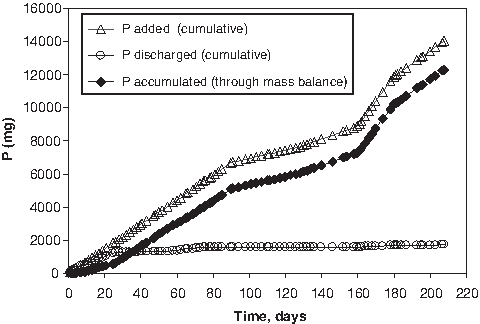
Estimated P accumulation in the precipitate.
Iron reduction–induced phosphorus precipitation not only removes phosphorus but also generates vivianite, which can be collected and used as an iron supplement in calcareous soils (Eynard et al., 1992). The cost associated with this technology is the Fe(III) supply and agitation. Existing on-site septic tanks can be retrofitted easily to implement this technology if phosphorus is an issue. It is low cost, low maintenance, and recommended for use in small communities to achieve the best benefits for the cost involved. Another widely studied and relatively well established P removal technology is called struvite crystallization (Wang et al., 2005a; Wang et al., 2005b). The technology is more complicated and has a high capital and operational costs as it requires, for example, reactors, skilled operators, and chemical supplies. The application of iron-induced P removal in a septic system is new, and discharging wastewater with high Fe2+ concentrations is not desirable. Thus more field data and further studies to determine the optimum iron dosage based on the phosphorus concentration and agitation rate are needed to fully understand the potential of this technology.
Conclusions
Soluble phosphorus can be effectively removed from a septic system through iron amendment. Removal was greatly improved when the iron addition was increased from an Fe(III)/initial soluble P molar ratio of 1.5 to 3. Among the various factors studied, agitation was found to have played the most important role in enhancing phosphorus removal. It was also found that phosphorus could be effectively removed independent of discharge frequency, temperature, and the influent organic concentration. The precipitates collected from the ASBR reactor were identified primarily as vivianite, suggesting that phosphorus was removed through iron reduction–induced phosphorus precipitation. Additional findings included improved carbon oxidation when the iron dosage was increased and the possibility that adsorption of P was another mechanism that contributed to total P removal.
Chemical Notations
Footnotes
Acknowledgments
This project was funded by the Cooperative Institute for Coastal and Estuarine Environmental Technology (CICEET). The author would like to acknowledge the work of Dr. Xiang Cheng, then a visiting student from the Harbin Institute of Technology (China) and now an instructor at Beijing Forestry University, who conducted the experimental work. The author also would like to thank Dr. Earl Ada at the Campus Materials Characterization Lab of the University of Massachusetts–Lowell for his assistance in collecting the SEM and EDS data; Dr. Scott Speakman at Massachusetts Institute of Technology for his assistance with the XRD patterns; Professor Kevin Finneran at Clemson University for overseeing the entire research effort; and Professor Clifford Bruell at the University of Massachusetts–Lowell for technical editing.
Author Disclosure Statement
No competing financial interests exist.