




Abstract
Abstract
This article describes a study of the adsorption conditions of Cu(II) ions onto polyacrylamide-grafted rubberwood fiber. Preparation of the adsorbent was carried out via graft copolymerization of acrylamide (Am) onto rubberwood fiber (RWF), using ceric ammonium nitrate as an initiator. Fourier transform infrared spectroscopy was used to confirm the formation of PAm-g-RWF. Various variables affecting the adsorption capacity such as pH of the solution, adsorption time, initial metal ion concentration, and temperature were investigated. Cu(II) was removed by PAm-g-RWF up to 92% from an initial concentration of 10 mg/L at pH 6.0. Kinetic adsorption data can be described by the second-order equation. Equilibrium parameters for adsorption isotherms of the metal ions on the grafted fiber were obtained using the Langmuir and Freundlich models, and the Langmuir model was found to be in better correlation with the experimental data with a maximum adsorption capacity of 142.85 mg/g. Thermodynamic parameters such as enthalpy change (ΔH°), free energy change (ΔG°), and entropy change (ΔS°) were calculated; the adsorption process was spontaneous and endothermic. The results showed that PAm-g-RWF developed in this study could be an economical and effective adsorbent for application in removal of copper ions from water and wastewater.
Introduction
Fibrous adsorbents, which have large specific surface areas and high adsorption rates, are increasingly used in removal of toxic metal ions and enrichment recovery of traces of elements from aqueous solution.
Chemical modifications on fiber adsorbents have shown great promise in improving their physical and chemical properties and also in significantly increasing their adsorption capacity and selectivity by forming many reactive groups on the polymer chains. Grafting of functional group-containing chains onto fiber surface can provide a larger number of functional groups and structures (O'Connell et al., 2008). Rubberwood is a natural polymer that has gained special importance, because it is cheap and plentiful. Chemical compositions of this wood have shown that its main components are cellulose (67.0%) and lignin (26.0%). Cellulose fiber of rubberwood, a linear-chain polymer with a large number of hydroxyl groups, is a highly abundant natural resource. Cellulose as a bioaffinity carrier exhibits good chemical stability, mechanical strength, recoverability, high reproducibility, and low cost (Klemm et al., 2002).
In the present study, a new adsorbent material has been prepared from rubberwood fiber for the removal of Cu(II) from aqueous solutions. Rubberwood fiber was modified with acrylamide (Am) to introduce amide functional groups to enhance its adsorption ability for metal ions. The main objective of this study is to assess the effectiveness of PAm-g-RWF in the removal of Cu(II) by determining the maximum adsorption capacity. Langmuir and Freundlich adsorption isotherm models were used to fit the equilibrium isotherm. The adsorption kinetics were determined using pseudo-first-order and pseudo-second-order models. The thermodynamics of Cu(II) adsorption and adsorption mechanisms were also considered.
Experimental
Materials
Rubberwood fiber (RWF) was kindly supplied by Merbok MDF Sdn. Bhd. with an average length of 2.36 mm. The major components of this fiber are cellulose and lignin. RWF was washed with hot distilled water and acetone several times to remove dust and any other impurities. It was then dried in an oven at 60°C to make its weight constant. Am monomer and ceric ammonium nitrate [(NH4)2Ce(NO3)6] were purchased from Fluka. Acetone and nitric acid were obtained from BDH. Copper(II) sulfate was purchased from Fluka.
Preparation of adsorbent
Grafting was carried out by adding 5 g of fiber to distilled water (80 mL) and mixed with solutions of 15 g of Am monomer in 50 mL distilled water and 0.5 g ceric ammonium nitrate in HNO3 (initiator). The solution was stirred at 50°C in a water bath for 4 h. After grafting, the sample was filtered, washed with distilled water for several times, and air dried. The dried grafted product was extracted with distilled water using a Soxhlet extractor for 48 h to remove the ungrafted poly(acrylamide). After extraction, the sample was washed with distilled water to remove impurity and air-dried. A general scheme for the preparation of adsorbent is given in Fig. 1.
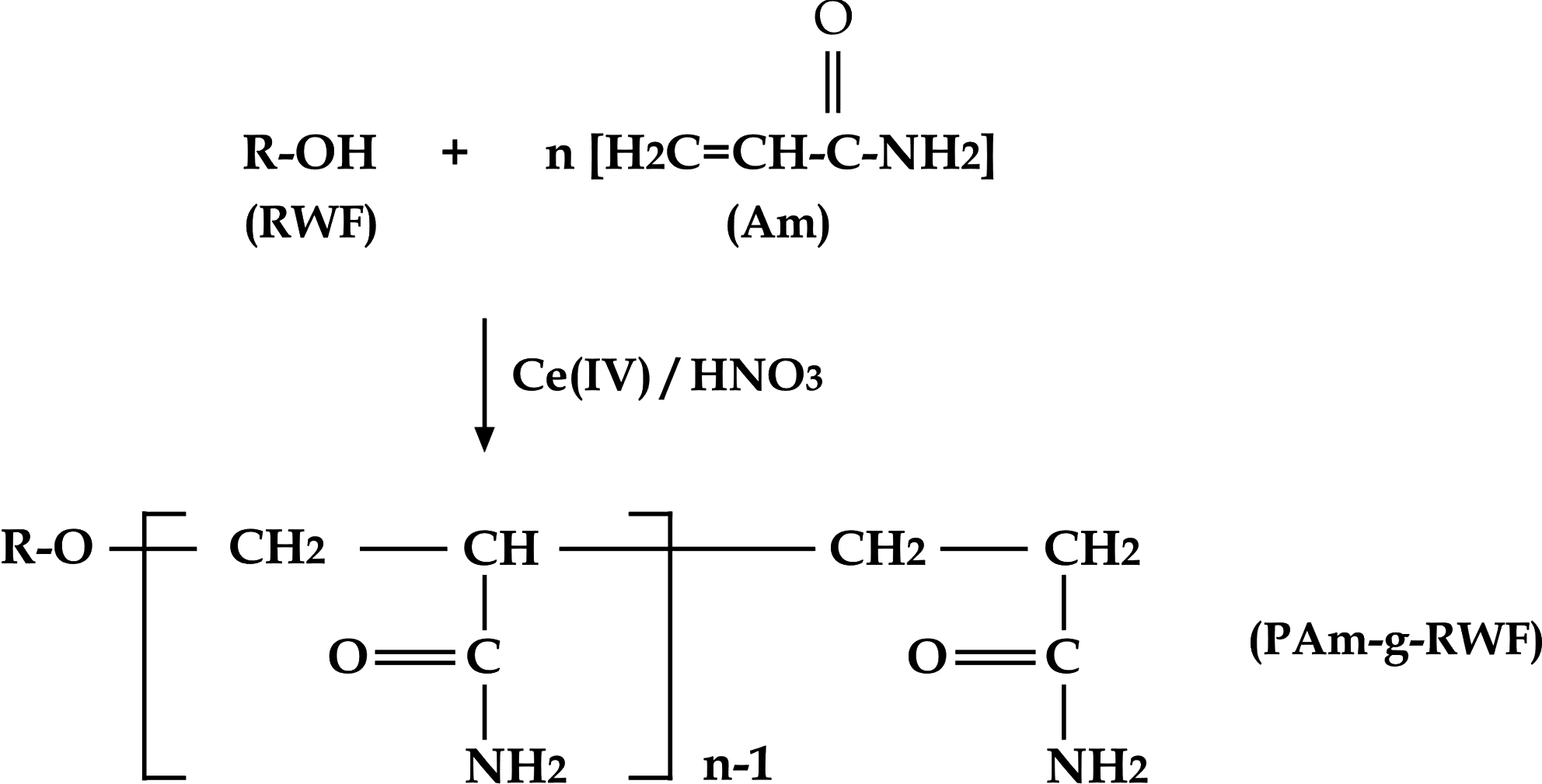
The proposed reactions for the grafting of rubberwood fiber with PAm. PAm, polymerization of acrylamide.
Fourier transform infrared analysis
The change in chemical structure of rubberwood fiber as a result of graft copolymerization with Am monomer and functionalization was characterized using Fourier transform infrared (FTIR) spectroscopy. The infrared spectra of the polymer was recorded by model spectrum 100 series (Perkin-Elmer) FTIR spectrophotometer.
Adsorption experiments for Cu(II)
The stock solution of 1000 mg/L Cu(II) was prepared by dissolving a weighed quantity of CuSO4·5H2O in distilled water. All the required working solutions were prepared by diluting in distilled water. Batch experiments were conducted to determine the effects of pH, contact time, initial Cu(II) concentration, and temperature on the adsorption of Cu(II). The effect of pH on adsorption was investigated in the pH range 4.0 to 6.0 at 30°C. The pH adjustment was done by adding H2SO4 or NaOH into the solutions with known initial metal ion concentrations. For Cu(II) adsorption kinetics studies, 0.1 g of adsorbent was contacted with 25 mL of Cu(II) solution of varying concentrations in a flask and continuously stirred in a water bath maintained at different temperatures (30°C, 50°C, and 70°C). At the end of the predetermined time intervals, the adsorbent was filtered through a paper filter. The residual concentration of Cu(II) in the filtrate was determined using Inductively Coupled Plasma Atomic Emission Spectrometry (ICP-AES) model Perkin Elmer 1000. Adsorption isotherm experiments were also carried out by contacting 0.1 g of the adsorbent with 25 mL of varying concentrations of Cu(II) from 5 to 500 mg/L. The mixtures were agitated in a flask for 2 h, which was sufficient time to reach adsorption equilibrium at various temperatures (30°C, 50°C, and 70°C). The pH of the solution was adjusted to an optimum pH 6.0. After stirring for 2 h, the adsorbent was separated by filtration, and the residual Cu(II) concentration in the filtrate was determined using ICP-AES.
Metal uptake
The amount of copper adsorbed, qe (mg/g), and the percent adsorption of copper (%A) were calculated using the following equations:
where C0 and Ce are initial and final copper concentrations (mg/L), respectively, V is the volume of solution (L), and m is the weight of the adsorbent (g).
Results and Discussion
Adsorbent characterization
The change in chemical structure of rubberwood fiber as a result of graft copolymerization with Am monomer and functionalization was characterized using FTIR spectroscopy. Infrared spectra of fiber and grafted fiber are shown in Fig. 2. The adsorption bands found at 670 cm−1 were from the β-glucosidic linkage. Compared with the ungrafted RWF (Fig. 2a), a sharp peak appeared in PAm-g-RWF at 1650 cm−1 (Fig. 2b), corresponding to the stretching of the carbonyl (C=O) of the amide group in Am. For the grafted polymer a new band at 828 cm−1 was also observed, which indicates the (C–H) stretching vibrations in the Am molecule. The presence of the peak at 1736 cm−1 in the RWF spectrum could be due to the carbonyl (C=O) stretching vibration of the carboxyl groups of hemicellulose and lignin in the fiber (Abu-Ilaiwi et al., 2004). The ratio of the band intensity at 1650 cm−1 to the band intensity at 1215 cm−1 increased by grafting because of the increase due to incorporation of CONH2 groups onto the fiber. Both IR spectra of the ungrafted and the grafted RWF exhibited absorption band at 3400 cm−1 due to hydroxyl group stretching vibrations from the RWF structure.
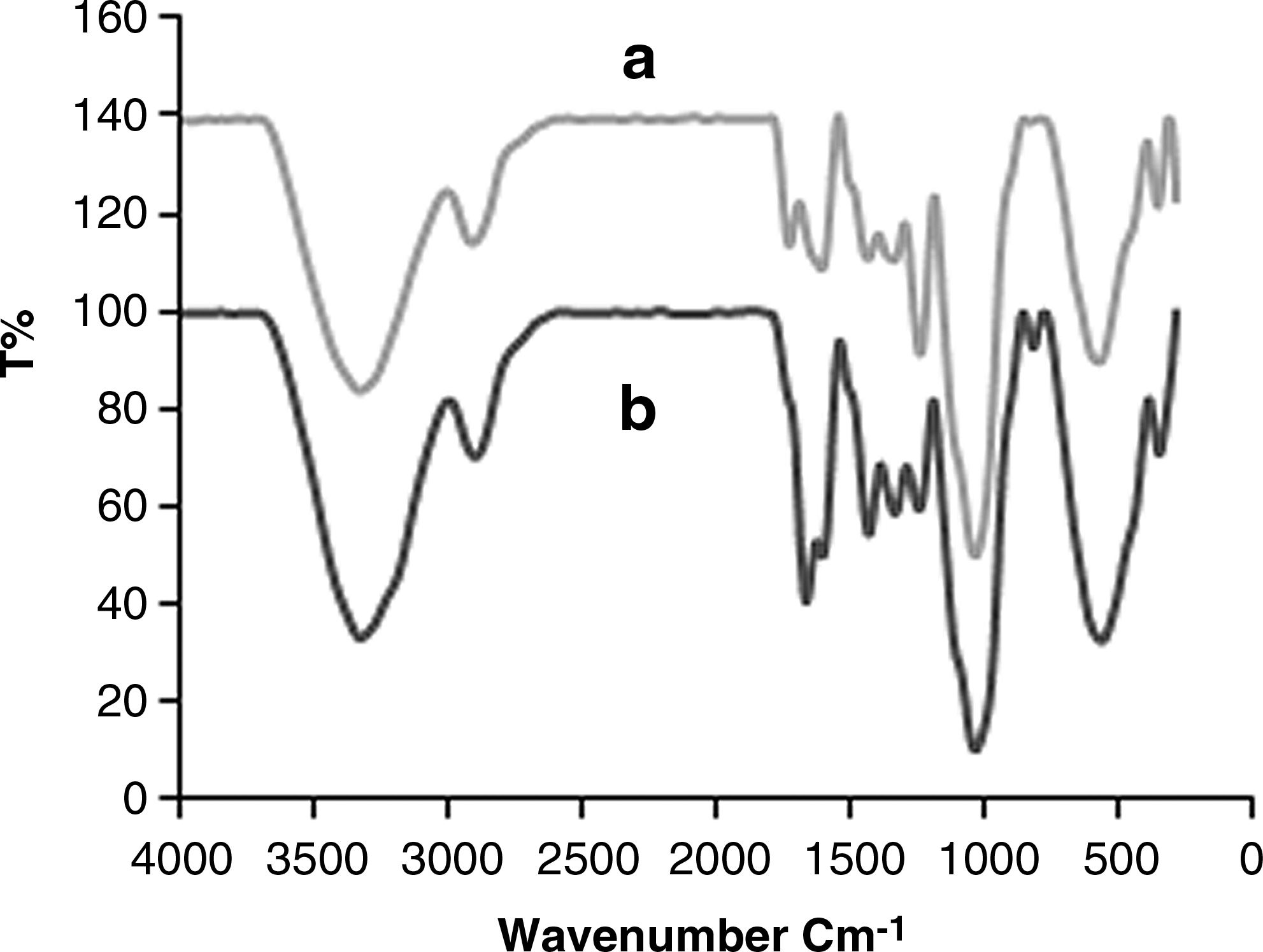
Infrared spectra of
Effect of pH on Cu(II) adsorption
The solution pH is one of the most important factors that control the adsorption of metal ions. The effect of pH on the adsorption capacity of Cu(II) by PAm-g-RWF was evaluated within the pH range of 4.0 to 6.0, as shown in Fig. 3. The amounts of copper adsorbed at pH 4, 5, 5.5, and 6 were 0.00, 0.57, 0.80, and 1.00 mg/g, respectively. It can be observed that the adsorption of copper increased with increasing pH, and the percentage of adsorption increased from 0% at pH 4.0 to 81% at pH 6.0 at 30°C. The increase of copper removal with pH may be explained by the increase in negative charge at the surface of the adsorbent, which makes the adsorption of the positively charged Cu(II) easier. The electrostatic attraction force between the adsorbent surface and adsorbate ions increases. At lower pH values, there is excessive protonation of the adsorbent surface, resulting in a decrease in the adsorption of copper ions. According to (Reddy et al., 1997) more than pH 6, copper starts to precipitate as Cu(OH)2 due to the high concentration of OH− ions in the solution, so the adsorption experiments at these pH values could not be performed well. Therefore, experiments were carried out in the pH range 4.0 to 6.0. Figure 3 also shows that at pH 6.0, the percentage removal of Cu(II) by the grafted fiber was almost doubled in comparison to that of ungrafted fiber.
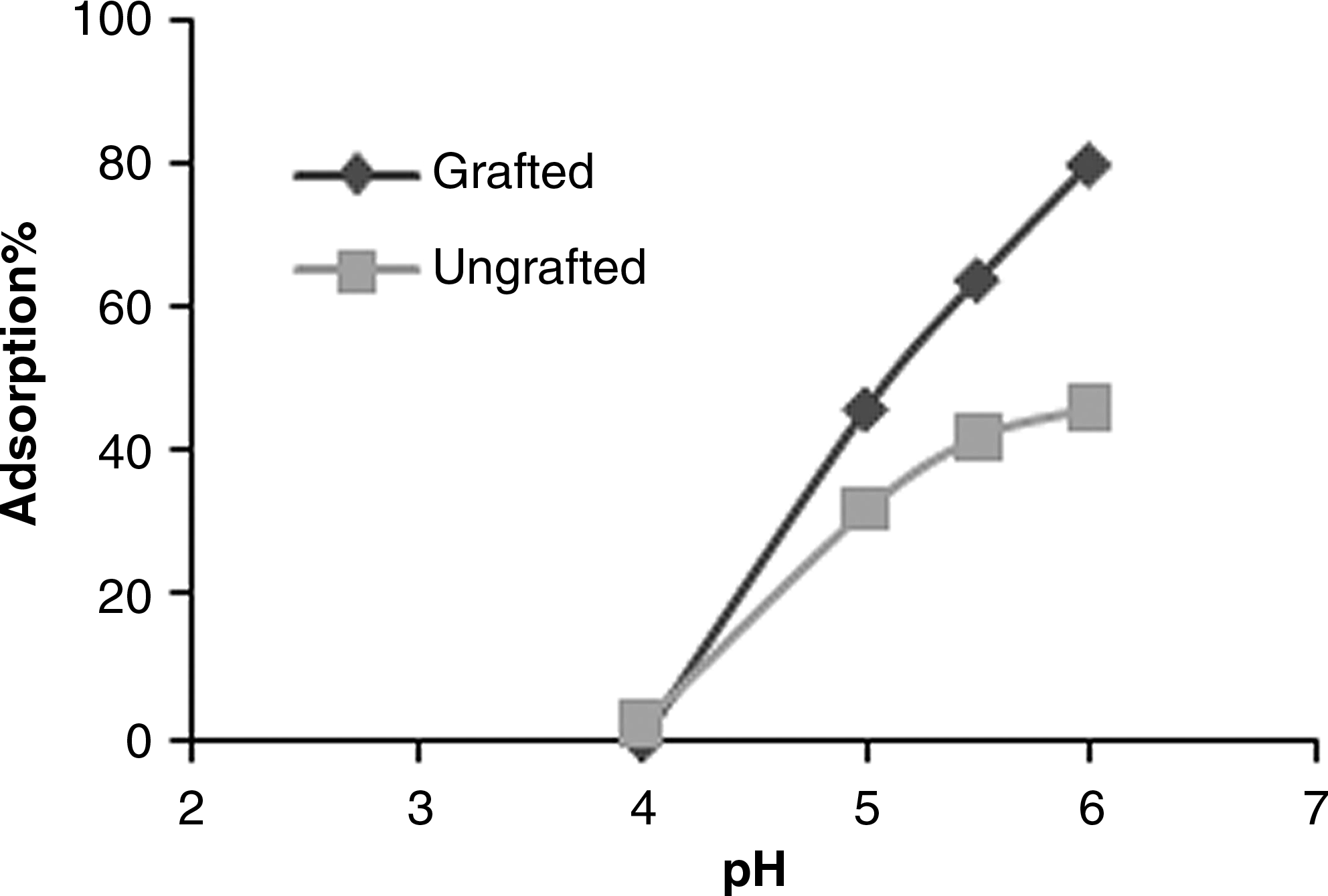
Effect of initial pH on the adsorption of Cu(II) by PAm-g-RWF and ungrafted fiber. Concentration, 5 mg/L; temperature, 30°C; adsorbent dose, 0.1 g/25 mL; contact time, 2 h.
Effect of contact time and initial Cu(II) concentration
A series of contact time experiments for adsorption of Cu(II) were carried out at different concentrations. The obtained results concerning the influence of time on the rate of Cu(II) uptake at various concentrations 5, 15, and 25 mg/L, at 30°C are shown in Fig. 4. It was found that the adsorption capacity of Cu(II) on the adsorbent increased and achieved a constant value at the time about 2 h. As contact time increased, metal uptakes increased initially and then became almost constant. The first phase is related to external surface adsorption of copper, which occurs instantaneously. The second phase is the gradual adsorption stage before the copper uptake reaches equilibrium. The rapid metal uptakes were certainly related to the availability of active sites on adsorbent surfaces (Bhattacharrya and Gupta, 2006).

Effect of various initial concentrations on adsorption of copper by PAm-g-RWF: Temperature, 30°C; initial pH, 6.0; adsorbent dosage, 0.1 g/25 mL.
It is clear from Fig. 4 that the adsorption of Cu(II) increased from 0.95 to 5.16 mg/g with an increase in initial concentration from 5 to 25 mg/L. This is attributed to the fact that the driving force, which depends on the concentration gradient, increases with the increasing initial Cu(II) concentration (Noeline et al., 2005).
Adsorption kinetic studies
Adsorption kinetics describes the relationship of solute uptake rate of the adsorption and the adsorption time. The results obtained for adsorption of Cu(II) onto PAm-g-RWF at different concentration and contact time were analyzed by using the first-order Lagergren equation and the pseudo-second-order rate equation, which are shown below as equations (3) and (4), respectively (Ho and McKay, 2000; Wua et al., 2009).
In these equations, qe and qt are the amounts of metal ion adsorbed (mg/g) at equilibrium and at time t, respectively. The parameter k1 (min−1) is the rate constant of the pseudo-first-order adsorption process, and k2 (g·mg−1·min−1) is the rate constant of the pseudo-second-order adsorption process. Kinetic parameters of these models for different concentrations and also different temperature were calculated from the slope and intercepts of the linear plots of ln(qe − qt) versus t and t/qt versus t (Figs. 5 and 6) and are given in Table 1. Table 1 shows that the values of the coefficient of determination R2 for the pseudo-second-order model were more than 0.998 at different concentrations and different temperatures, so this model provided the best agreement with the experimental data for the adsorption of Cu(II) ion. In addition, the calculated qe values from the pseudo-second-order kinetic model were much closer to the experimental values of qe than to those of the pseudo-first-order model. So, the pseudo-second-order kinetic model fits the experimental data for adsorption of Cu(II) by PAm-g-RWF better than the pseudo-first-order model in this study.
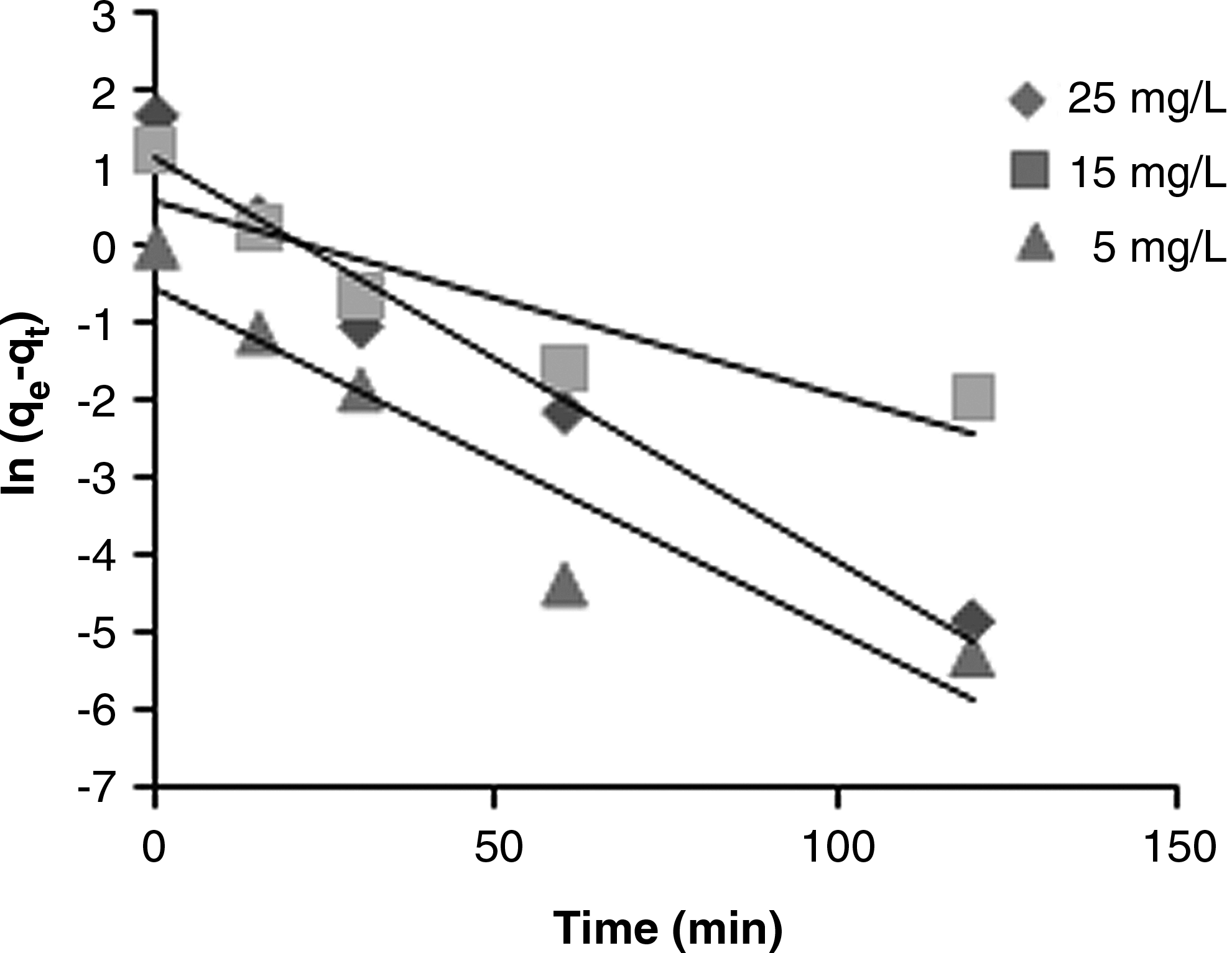
Pseudo-first-order plots of copper adsorption.
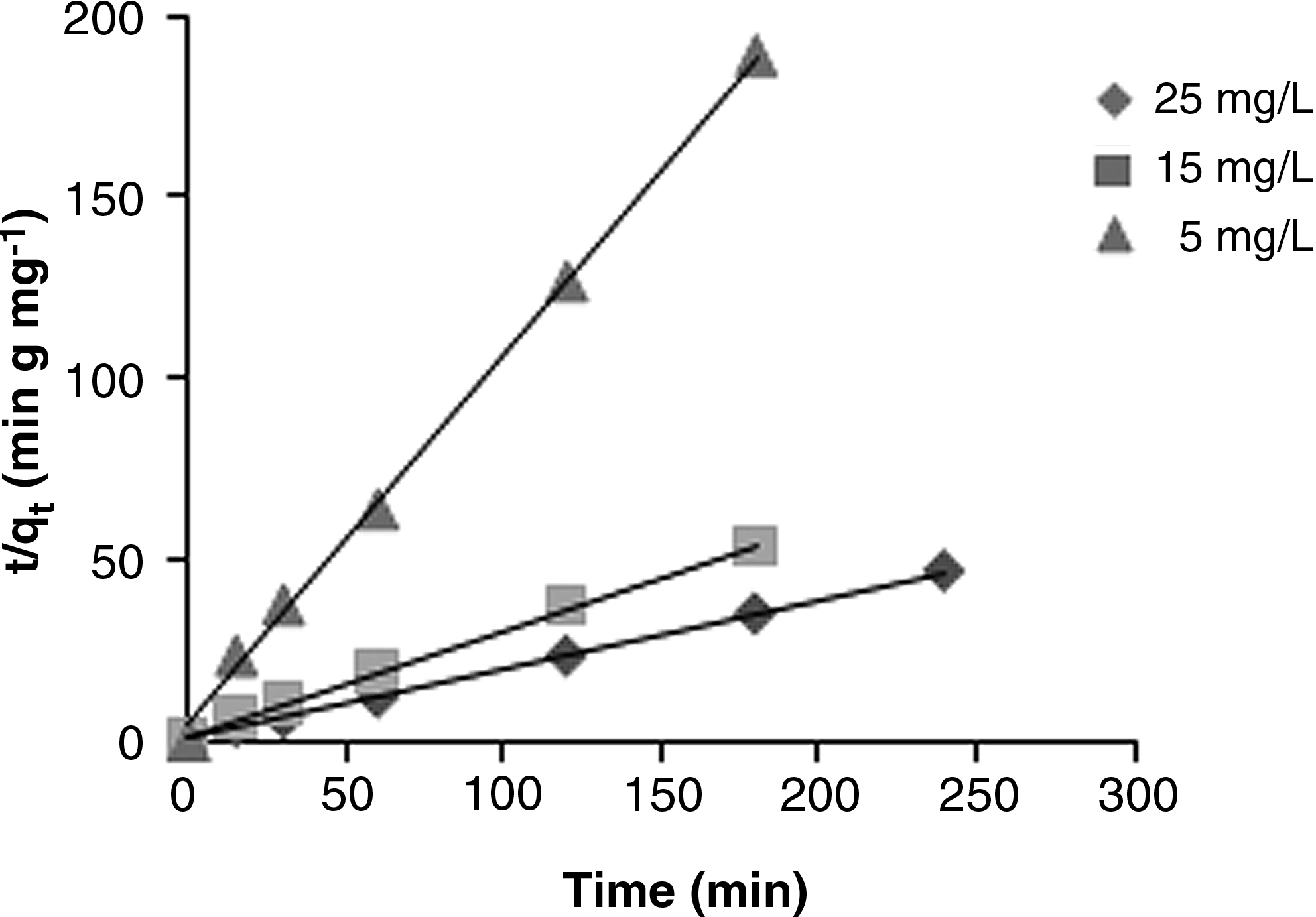
Pseudo-second-order plots of copper adsorption.
Temperature: 30°C.
Metal concentration: 25 mg/L.
Adsorption isotherms
The adsorption isotherm provides a relationship between the concentration of metal ions in solution and the amount of metal ions adsorbed onto the adsorbent when both phases are at equilibrium (Kara et al., 2004). The distribution of metal ions between liquid and solid phases is generally described by using the Langmuir, Freundlich, and Dubinin-Radushkevich adsorption isotherm models. Among these, the Langmuir and Freundlich adsorption models are commonly used to analyze and fit experimental data. The Langmuir adsorption isotherm is based on an assumption of monolayer coverage of the adsorbate on the surface of adsorbent, and the Freundlich isotherm is based on multilayer adsorption and applicable to highly heterogeneous surfaces. These relationships can be expressed by the following equations,
where qe (mg/g) is the amount of copper adsorbed at equilibrium, Ce (mg/L) is the equilibrium concentration of adsorbate, and Qm (mg/g) and b (L/mg) are the Langmuir constants related to the maximum adsorption capacity of metal ions and energy of adsorption. The KF and 1/n are Freundlich constants related to adsorption capacity and intensity of adsorption, respectively. The Langmuir and Freundlich isotherm parameters at different temperature were calculated from the slope and intercept of linear plots of Ce/qe versus Ce and ln(qe) versus ln(Ce) (not shown), and are given in Table 2.
The Langmuir model fits better than the Freundlich isotherms, which is evident from the fact that the values of R2 for the Langmuir model were higher than for the Freundlich model. In addition, the adsorption capacities calculated from the Langmuir isotherm were much closer to the experimental values of qe than those of the Freundlich isotherm, which indicate that the Cu(II) adsorbed by PAm-g-RWF formed a monolayer coverage on the surface of the adsorbent.
The type of the Langmuir isotherm can be predicted in terms of an equilibrium parameter (RL), which is defined by the following equation, according to (Hall et al., 1966),
where b (L/mg) is the Langmuir constant and C0 (mg/L) is the initial concentration of Cu(II). The value of RL indicates the conditions of favorable adsorption, 0<RL<1; unfavorable adsorption, RL>1; linear adsorption, RL=1; and whether the adsorption process is irreversible if RL=0. The calculated values of the dimensionless factor RL for copper ions adsorption onto PAm-g-RWF, indicating favorable adsorption of copper due to all the values obtained, were less than 1, and greater than 0 for the initial copper concentration range from 5 to 500 mg/L. According to (Mohanty et al., 2006), if the value of n from the Freundlich isotherm is greater than 1, it indicates favorable adsorption of metal ion on the surface of adsorbent. The values of n obtained in this study are given in Table 2, indicating that Cu(II) ions are favorably adsorbed by PAm-g-RWF.
Comparison of PAm-g-RWF with various adsorbents
The comparison of adsorption capacity for Cu(II) using PAm-g-RWF with other reported adsorbents is given in Table 3. The Langmuir isotherm maximum adsorption capacity Qm of Cu(II) adsorbed by PAm-g-RWF was found to be 142.8 mg/g, which is higher compared with the capacities of some other adsorbents, as reported earlier. Therefore, considering the low cost of this natural adsorbent, it can be used as a potential adsorbent for treatment of wastewater containing copper.
Effect of temperature and estimation of thermodynamic parameters
The effect of temperature on the adsorption characteristics of Cu(II) was investigated by determining the adsorption isotherms at 30°C, 50°C, and 70°C to obtain the thermodynamic parameters that were evaluated using the Van't Hoff equation:
where ΔS° and ΔH° are entropy (kJ/mol K) and enthalpy (kJ/mol) change of adsorption, respectively, R is universal gas constant (8.314 J/mol K), and T is the absolute temperature (K). Kd is a equilibrium constant obtained by multiplying Langmuir constants Qm and b (L mol−1). The values of ΔH° and ΔS° parameters can be calculated from the slope and intercept of the linear Van't Hoff plot of lnKd versus 1/T (not shown).
The Gibbs free energy change (kJ/mol) of the adsorption process is related to the equilibrium constant by the classical Van't Hoff equation:
The calculated thermodynamic parameters ΔH°, ΔS°, and ΔG° are given in Table 4.
The value of ΔH° was found to be positive, and also the adsorption capacity of adsorbent increased with increasing temperature, which shows the adsorption reaction of Cu(II) on PAm-g-RWF was endothermic. The positive ΔS° value corresponds to an increase in the degrees of freedom of the adsorbed species. The negative values of ΔG° indicate that the adsorption process is feasible and spontaneous at all temperatures studied. The decrease in the value of ΔG° with increasing temperature shows that the reaction is favorable at a higher temperature (Haron et al., 2009).
Conclusions
1. Rubberwood fiber can be converted into an adsorbent with high adsorption capacity by grafting with Am monomer.
2. The Cu(II) adsorption increases as the solution pH is increased from 4.0 to 6.0.
3. The adsorption equilibrium for Cu(II) can be well described by Langmuir isotherms with maximum capacities of 142.85 mg/g.
4. The kinetic data fit very well to the pseudo-second-order kinetics model.
5. The positive values of the change in enthalpy suggest an endothermic nature of the process, and the negative values of the change in free energy indicate the feasibility and spontaneous nature of the process.
6. Polyacrylamide-grafted rubberwood fiber could be successfully used as low-cost adsorbents for the removal of Cu(II) ions from aqueous solutions.
Footnotes
Acknowledgment
The authors are grateful to the Department of Chemistry, Faculty of Science, Universiti Putra Malaysia, for the laboratory facilities.
Author Disclosure Statement
No competing financial interests exist.