




Abstract
Abstract
Start-up of autotrophic ammonia oxidation process for removal of nitrogen from low C:ANN ratio (<1) wastewaters is complicated due to needs of specific inoculation material and strict process control. Anaerobic ammonium oxidation (Anammox) process was started up from zero at 26°C in moving bed biofilm reactor by using the reject water as a feed medium and source of anammox bacteria. Efficient nitrogen removal process was observed for 270 days (average total nitrogen [TN] removal rate 0.5 kgN/(m3d); TN removal efficiency 80%). The highest TN removal rate of 1 kgN/(m3d) was obtained with a hydraulic retention time of 0.75 days and the influent NO2−:NH4+ molar ratio of 1.2. Polymerase chain reaction detected uncultured Planctomycetales bacterium clone P4 from the biofilm. Scanning electron microscopy observations indicated that the biofilm was dominated by cocci-like and spherical bacteria while filamentous bacteria were lacking. The start-up method studied could be used in wastewater treatment system for removal of ammonia from anaerobic digester effluent.
Introduction
Moving bed biofilm reactor (MBBR) using biofilm carriers with high surface area for biomass detainment has been proved to be economically feasible configuration for autotrophic nitrogen removal (Rusten et al., 1994) because of lower volume reactors needed than in case of conventional activated sludge reactors.
Total nitrogen removal rates (TNRRs) by the Anammox process ranging from 0.12 up to 26 kgN/(m3d) have been reported in literature (Ni et al., 2010), depending on reactor type. A TNRR of 26 kgN/(m3d) with total nitrogen removal efficiency (TNRE) being about 65% has been obtained in an up-flow fixed-bed column biofilm reactor system after 247 days of operation. High density of Anammox microorganisms (more than 70% of total bacterial biomass) and a short hydraulic retention time (HRT) with proper NO2−:NH4+ molar ratios in the influent were critical factors for such high volumetric TN removal rate (Tsushima et al., 2007).
As the growth rate of Anammox organisms is very low (doubling time around 11 days) (Strous et al., 1998), inoculation with biomass containing Anammox organisms is generally considered inevitable for shortening the start-up period. Inoculation of biofilm reactors with Anammox bacteria has been performed using an anaerobic (Tsushima et al., 2007), sequencing batch reactor (Strous et al., 1998; Ni et al., 2010) or nitrifying/denitrifying (Gaul et al., 2005) sludge. In addition, Anammox biomass from natural sources (like sea bottom sediments) (van de Vossenberg et al., 2008) can be used as inoculate.
In the present study we have chosen a strategy of enriching Anammox bacteria directly from reject water on blank biocarriers using the substrate itself as inoculum without performing a traditional inoculation procedure (addition of sludge or carriers with pre-established Anammox biomass). Considering the implementation of Anammox biofilm technology in a full-scale wastewater treatment facility, it can be difficult to acquire a sufficient amount of pre-established Anammox biofilm for inoculation. The objectives of this study were to enrich Anammox bacteria on blank biocarriers during a reasonable time, evaluate TNRRs and TNREs, and overcome inhibitory factors occurring during the process start-up, adaptation, and stable operation phases. Bacterial communities were described by the polymerase chain reaction (PCR) and biofilm morphology by scanning electron microscopy (SEM) observation. If proven successful, this cost-effective enrichment method can be used in practice to start up nitrogen removal facilities.
Materials and Methods
Anammox bacteria enrichment from reject water in MBBR
A plexiglass reactor with a 20-L active volume was operated at a constant temperature (26°C±0.5°C) and maintained by means of a water jacket connected with a thermostat (Assistant 3180).
A peristaltic pump (Seko P4) was used for maintaining a continuous flow. No internal substrate recirculation was applied. No membrane fiber impermeable to bacteria was used to prevent bacteria from going to the effluent. The reactor contents were mechanically stirred at 100–200 g. NaNO2 was supplemented to tap water and to reject water containing NH4+ (with an average NO2−-N:NH4+-N molar ratio of 1.2) during the preparation of the MBBR substrate. Influent pH ranged from 7 to 8.5. To maintain anoxic conditions the reactor was sparged once per 2 weeks with 99% Ar. The composition of reject water is shown in Table 1.
WWTP, wastewater treatment plant.
The Anammox biofilm was let to develop onto blank carriers from microorganisms naturally present in the feed (reject water) containing sufficient amounts of nutrients needed for Anammox bacteria (Zekker et al., 2011). Ring-shaped polyethylene carrier elements (Bioflow 9) were used as support material for the biofilm. The carriers occupied about 50% of the reactor liquid volume. The specific surface of the biocarriers was 800 m2/m3, each element having a diameter of 1.25 cm and a height of 0.9 cm.
Analytical methods
Samples from the influent and effluent were collected simultaneously and analyzed promptly. Based on APHA (1985) (method number added) concentrations of NH4+-N (417B), NO2−-N (419), NO3−-N (nr 418A), COD (508C), BOD7 (507), and HCO3− (403) were measured. The biomass wet weight of the biofilm was measured by weighing the carriers before and after the biomass was removed. pH was measured with a pH meter (Evikon) and the total organic carbon (TOC) concentration by Dr. Lange test kits.
Polymerase chain reaction and denaturing gradient gel electrophoresis
Fingerprinting of Anammox communities was conducted via the PCR with a wide-range primer set Eub27f-Eub1492r (Lane, 1991), and the second PCR round by Planctomycetes-specific primer Pla46f (Neef et al., 1998) coupled with Anammox-specific primer Amx368r (Schmid et al., 2003). PCR amplification for Eub27f–Eub1492r included a touchdown and was carried out according to the following thermocycling parameters: 1 cycle for 5 min of initial denaturation at 94°C; 10 cycles at 96°C for 30 s, at 52°C for 1 min, and at 72°C for 2 min; 25 cycles at 94°C for 30 s, at 50°C for 1 min, and at 72°C for 2 min; and single final elongation at 72°C for 7 min.
For the second round 1 μL of the product from the first round was used as template.
PCR amplification for Pla46f-amx368r was carried out according to the following thermocycling parameters: 1 cycle for 5 min of initial denaturation at 94°C; 35 cycles each at 94°C for 45 s, at 58°C for 1 min, and at 72°C for 1 min; and single final extension at 72°C for 7 min.
The gene sequences were amplified in a Mastercycler Personal thermocycler (Eppendorf). All the PCR reagents used in this study were purchased from Fermentas UAB, Lithuania.
The PCR products were analyzed by the INGENY PhorU System (INGENY) for denaturing gradient gel electrophoresis (DGGE). Pla46f primer was used with GC-clamp added to the 5′-end. One primary band was found in each DGGE analysis.
The PCR products were loaded on a 30%–65% denaturing gel and run for 17 h at 90V at a constant temperature of 60°C. The gels were stained with an ethidium bromide solution in 1× Tris-acetate-acetic acid-EDTA (TAE) buffer to observe the bands by UV transillumination, after which the bands were excised for the future reamplification and sequencing.
Sequencing
The PCR products were sequenced by the BigDye® Terminator v3.1 Cycle Sequencing Kit (Life Technologies Corporation). The Sequences were compared with database sequences via Basic Local Alignment Search Tool (BLAST) and compared with the GenBank accessions. Further analysis was carried out with MEGA software version 5.0 with the neighbor-joining method. Number of bootstrap replications was 500.
SEM observations
Micrographs were taken by an SEM Hitachi Tabletop Microscope TM-1000. The SEM images were taken at 5 and 15 kV primary electron energy in a standard backscattered electron imagemode.
Results and Discussion
Anammox enrichment and process performance in MBBR
The MBBR operation can be divided into three periods with a total duration of 450 days. The MBBR showed high-average TNRRs (0.5 kg N/[m3d]) and TNREs (85%) after a considerably long adaptation period of Anammox organisms (Fig. 1a, b). During the high-efficiency period there was only one major upset in TNRE on day 332, when it fell below 50%.

MBBR start-up (period I, days 0–109)
Loading rate of nitrogen fed into the MBBR was adjusted according to TNRE. For the first 79 days of period I the HRT was kept 1.5–2 days to ensure biofilm growth and the attachment of Anammox bacteria from reject water onto the interior surface of carriers. Minor TNRRs were detected during the first 60 days. During the next 19 days an average TNRR of 0.014 kg N/(m3d) with a simultaneous removal of both NH4+ and NO2− were observed. After the first signs of TN removal (with an efficiency of 10%–20%) (days 61–79), HRT was decreased at once to 0.75 days in order to achieve higher TNRR. At the end of period I (day 109) the TNRR reached 0.02 kgN/(m3d).
MBBR adaptation (period II, days 110–180)
Between days 110 and 168 the TNRR was below 0.1 kg N/(m3d), increasing to 0.2 kg N/(m3d) at the end of the period, resulting in a TNRR of 0.07 kg N/(m3d) as an average for the whole period II. The period involving adaptation of the biofilm to higher NO2− concentration was enough to increase the TN loading rate (TNLR) to 0.3 kg N/(m3d) on day 167 (Fig. 1b). The increased TNLR resulted in an increase in TNRE from 17% to 35% during the period. After around 160 days, the color of the biomass changed from light brown to the characteristic red of the Anammox bacteria along with an increase of biomass concentration.
MBBR operation with high efficiency (period III, days 181–450)
A stable TNRE over 70% with an average TNRR of 0.5 kg N/(m3d) was achieved by day 181, gradually increasing the TN concentration in the influent (from 60 to 120 mg/L).
A TNRE of 90% was achieved on day 242. The maximum TNRR achieved after the 308th day of the operation was around 1 kg N/(m3d) (Fig. 1b) after which an episode of inhibition occurred (discussed below).
As biomass wet weight throughout the period increased (Table 2), the TNRR also increased until the biomass wet weight detected was 5.96 mg/per carrier. After that the TNRR started to decrease. A combination of high TNLR and higher biomass wet weight resulted in a decrease of the TNRR. A biofilm with a higher concentration of biomass on it generally contains a higher inert fraction decreasing the volumetric activity of the biofilm. Consequently, it is necessary to maintain a higher concentration gradient to achieve a high TNRE. Biofilm wet weight influences the TNRE if the anoxic zone in the biofilm is narrow limiting the space for Anammox microorganisms, but protection against inhibitory factors is maintained.
TN, total nitrogen; HRT, hydraulic retention time.
From day 350 onward the biofilm reactor operation strategy involving about 2.5 times longer HRT with higher substrate concentration was applied to improve the diffusion of the substrate into the biofilm by increased residence time of the influent. TNRRs 0.5–0.7 kg N/(m3d) were achieved.
Stoichiometry
Data on which stoichiometrical ratios were calculated had been taken from Fig. 1b. Lower production of NO3− (0.11) and a higher removal of NO2− (1.14) as the ratios of the removal of NH4+ (1) in the high efficiency period as compared to the conventional Anammox stoichiometrical ratio (1.32:0.26:1) presented by Jetten et al. (1997) indicate the presence of heterotrophic denitrifying bacteria on biocarriers (Table 2). Small denitrifying activity in the Anammox biofilm ensures NO3− utilization (Zhang et al., 2010). Influent and effluent TOC concentrations 12 mg/L and 9 mg/L, respectively, indicated low consumption of recalcitrant organics by denitrifying bacteria in biofilm and influent low COD:TN ratio 0.1–0.8 ensured the autotrophic microorganisms' dominance.
Overcoming process disturbance caused by high influent TN concentration
During the MBBR performance between days 181 and 450, an episode of significant decrease in the TNRRs (down to 0.03 kg N/[m3d]) occurred as a result of a high TNLRs (1.1 kg N/[m3d]). Consequently, the concentration of NO2− in the effluent increased above 100 mg/L and brought about low TNRRs as reported also by Zhang et al. (2010). Afterward, the TNLRs were decreased twice and the process was restored. During the next phases of our process, the maximum TNRR of 0.74 kg N/(m3d) was achieved on day 449, showing recovery from the inhibition occurred.
For overcoming inhibition between days 326 and 339, a higher influent NH4+:NO2− ratio (1.2) was used to lower the nitrite loading rate into the reactor to avoid inhibition.
SEM microstructural studies
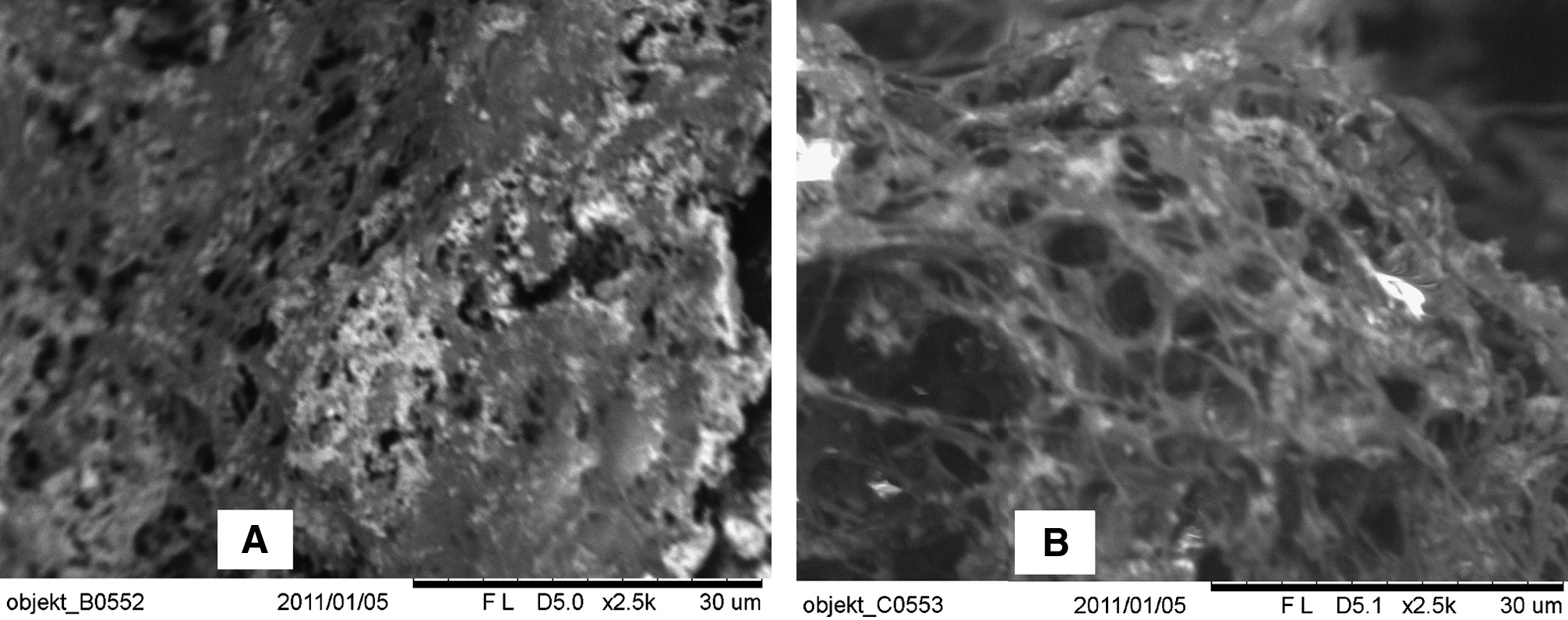
The Anammox biofilm cultivated for 270 days and for 450 days (Fig. 2A, B) both contained similar structure interspaces inside the biofilm, ensuring a sufficient diffusion of the substrate. The biofilm did not contain filamentous bacteria but cocci-like and spherical bacteria (Anammox bacteria).
Results of amplification of PCR and DGGE
The nested PCR and the following DGGE performed with Anammox-specific primers resulted in the detection of 323-bp DNA sequence belonging to uncultured Planctomycetales bacterium clone P4 (99% sequence similarity to GenBank ID: DQ304521) (after a 6-month process) (Fig. 3). P4 had the same sequence as described by (Quan et al., 2008).

Phylogenetic neighbor-joining tree, reflecting the relationships between some known Anammox bacteria and the 323-bp identified sequence of uncultured Planctomycetales bacterium clone P4 (GenBank ID: DQ304521.2), based on 16S rRNA genes amplified using Planctomycetales-specific primers. Numbers at the nodes are percentages of bootstrap values. Branch lengths correspond to sequence differences as indicated by the scale bar. The GenBank accession numbers are indicated.
The phylogenetic neighbor-joining tree (Fig. 3) was constructed to show a phylogenetic relationship between the Anammox microorganism detected from the system and other Anammox microorganisms, including Brocadia anammoxidans and Candidatus Kuenenia stuttgartiensis.
The results of the present work indicate that Anammox biomass can be enriched from wastewater on blank biocarriers. Biofilm system tolerance to high substrate concentrations was one of the main benefits achieved by a relatively long enrichment period.
Conclusions
1. Enrichment of Anammox bacteria on MBBR biocarriers directly from reject water was successful in ensuring a relatively stable process for over 1 year of the operation period with a few short-term process failures.
2. Coexistence of Anammox bacteria and denitrifying bacteria improved effluent water quality in terms of inorganic nitrogen removal.
3. Stoichiometrical ratio of NO2−removed:NO3−produced:NH4+removed of 1.14:0.11:1 was determined to be suitable for achieving an average 80% of total nitrogen (TN) removal efficiency.
4. Deterioration of biofilm reactor performance can be overcome in a short period on account of the benefits of long-time-grown biofilms used.
5. Uncultured Planctomycetales bacterium clone P4 was detected from the biofilm and its relationship to Brocadia fulgida was shown on the phylogenetic neighbor-joining tree constructed.
Footnotes
Acknowledgments
The study was supported by the Estonian target-financed research project Processes in Macro- and Microheterogeneous and Nanoscale Systems and Related Technological Applications (SF0180135s08), and by the Archimedes Foundation programs (SLOKT11027T, SLOKT11119)
Alvo Aabloo is acknowledged for his support with SEM technique.
Author Disclosure Statement
All the authors confirm that no competing financial interests exist between them.