




Abstract
Abstract
Three bacterial species, namely, Bacillus licheniformis, Gordonia terrae, and Virgibacillus halophilus, were isolated from a composting aquaculture waste mixture (condensed molasses fermentation solubles and rice bran) bulked with sawdust. All isolates were thermophilic bacteria with cellulase activity. Inoculation of the compost pile with the isolated bacteria shortened the composting time by one third compared with the uninoculated condition. The quality of the compost product was assessed based on the germination percentage of Chinese cabbage (Brassica paruchinensis) in different combinations of mature compost and peat. The highest germination percentage, 99%, was obtained in the 25% compost/75% peat mixture. These results suggest that the fast conversion of aquaculture food wastes into biofertilizer by means of inoculation with thermophilic bacteria is a potential technological approach for facilitating the recycling of natural resources and reducing the impact of untreated organic waste on the environment.
Introduction
Composting is very popular in Taiwan and Asian countries as a means of recycling agricultural by-products and poultry, livestock, industrial, and municipal wastes (Lin et al., 2011b). Such wastes are commonly mixed with various biological materials, and the resulting organic mixture is then inoculated with the appropriate microorganisms, with the production of biofertilizers as the end product. These biofertilizers can then be used not only to return nutrients directly to the soil but also for a multitude of other purposes (Chang and Yang, 2009).Various commercial wastes can be composted. These materials include condensed molasses fermentation solubles (CMS) (Chien and Chen, 2007) and rice bran (Ludwig and Tackett, 1991). Sawdust is usually used as a bulking agent for moisture adjustment in the compost (Hanajima et al., 2006).
Although a variety of microorganisms survive during the composting process, most of those used to date have been mesophiles that can only be used under mesophilic conditions. These types of microorganisms are not appropriate for biofertilizer preparation at higher temperatures (over 50°C). Some studies have demonstrated the efficacy of thermophiles inoculation on compost (Nakasaki et al., 1996; Sundberg et al., 2004; Tang et al., 2004; Zhao and Wong, 2010). Given that some composting materials, such as rice bran, maintain a high temperature in a compost pile when mixed with other materials for composting (Khyami-Horani, 1996), the inoculation of such compost piles with thermophilic bacteria would appear to be a feasible strategy (Chang and Yang, 2009).
In the study reported here, we isolated thermophilic bacteria from the composting process and investigated the effect of these bacteria on the maturity and quality of compost as biofertilizer. The germination of Chinese cabbage (Brassica paruchinensis) seeds in various combinations of compost-amended peat was subsequently assessed to examine the usability of the compost.
Materials and Methods
Composting, sampling, and chemical analyses
Composting materials, namely, CMS and rice bran, were collected from an aquaculture farm in southern Taiwan. Sawdust was purchased from the local market. The main ingredients of CMS contained sucrose, glucose, amino acids, minerals, vitamins, and other carbohydrates. The composting reactor consisted of wooden cylinders (diameter 53 cm; packing height 60 cm) filled with a mixture of sawdust (1 kg dry weight), rice bran (2 kg dry weight), and CMS (1 L). The composting pile was turned every day to enhance the composting process and avoid the formation of anaerobic compartments. The mixture was allowed to mature for 30 days. The temperature was continuously measured at depths of 15 cm in the composting pile. Chemical properties of the compost samples (pH, total organic carbon, total nitrogen, ammonium, and nitrate) were analyzed by standard methods (USEPA, 1995). Temperature, pH, moisture content, carbon to nitrogen ratio, and electrical conductivity of the initial compost mixture were 25°C±0.6°C, pH 7.4±0.2, 52%±3.2%, 32±1.5, and 3.39±0.02 dS/m, respectively. The variation of moisture content in the compost pile along the composting period was stable at 53%±1.8%.
Isolation and characterization of pure bacterial cultures from compost
To obtain pure bacterial cultures from the composting material, we took samples while the composting temperature was over 60°C and suspended these in sterilized water. Aliquots of 0.1 mL at selected dilutions were then pipetted onto Petri dishes containing various selective media and spread using a sterilized bent glass rod. The media included nutrient agar, potato dextrose agar, and carboxymethyl cellulose agar. The cultivating temperature was controlled at 45°C. Colonies appearing on these media were used for further testing. Their enzyme activities were analyzed as previously described (Zhang et al., 2006), and they were identified by the Food Industry Research and Development Institute (FIRDI) in Taiwan. Cell lysis, DNA extraction, and PCR amplification were as described by LaMontagne et al. (2002). A phylogenetic tree was constructed using the neighbor-joining method (Saitou and Nei, 1987), and the topology of the phylogenetic tree was evaluated by bootstrap analyses of the neighbor-joining dataset using the SEQBOOT and CONSENSE options from the PHYLIP package.
Biofertilizer preparation
The effect of inoculants on the conversion of the organic waste into biofertilizer was investigated. The waste was inoculated with a mixed inoculant comprising the three isolated thermophilic bacterial strains (the concentration of each strain in 2×10⁸ cells/g-dry material) at the start of fermentation. The ratio was approximately 6×10⁸ microbial cells per gram of dry raw material. Uninoculated compost samples were used as the control. The composting process was then allowed to proceed for a constant period without addition of inoculants.
Germination assays
A bioassay consisting of the germination of Chinese cabbage (B. paruchinensis) seeds in the compost was used to determine the germination percentage of the compost, which is considered the most important biological parameter related to compost maturity (Warman, 1999). Commercial growing media (Lisons Chemical Company, Taiwan) routinely used at the nursery were used as the control (substrate: peat, particle size <20 mm). The growing substrate for Chinese cabbage was divided into five groups: 100% compost (40 g compost), 75% compost/25% peat, 50% compost/50% peat, 25% compost/75% peat, and 100% peat (40 g peat). The weight of growing substrate was indicated as fresh weight. Each test included 100 Chinese cabbage seeds. A 10-mm primary root was taken to define germination. The seed germination percentages in the different substrates were determined on day 5, 10, and 15, respectively. The analysis was performed at least in triplicate. The t-test was used to compare means, and variance was determined by the ANOVA method (SPSS 13.0 for windows).
Results and Discussion
Three thermophilic strains were isolated from the composting aquaculture wastes. These were identified in a BLAST comparison in the NCBI database, with 16S rRNA similarity in the range 97.5%–99.2%, as Bacillus licheniformis, Gordonia terrae, and Virgibacillus halophilus. The phylogenetic tree analysis of these thermophilic isolates (Fig. 1) clearly illustrates that isolates 1, 2, and 3 are closely related to the species B. licheniformis (GU967449), G. terrae (EU590659), and V. halophilus (AB243853), respectively. The morphological and physiological characteristics of the isolates were analyzed and are given in Table 1. B. licheniformis is Gram-positive and a motile rod that grows under both aerobic and anaerobic conditions at temperatures ranging from 35°C to 70°C. In our study, B. licheniformis showed significantly high growth rates (1.73 h−1) and cellulase, catalase, and oxidase activities. These characteristics of the isolated B. licheniformis are similar to those of the B. licheniformis examined by Khyami-Horani and Ryckeboer (Khyami-Horani, 1996; Ryckeboer et al., 2003). G. terrae is a Gram-positive, nonmotile bacteria that can grow only under aerobic conditions at temperatures ranging from 25°C to 65°C. It possesses cellulase activity (142 units/L). G. terrae has been found in hot synthetic compost (Dees and Ghiorse, 2001). Diogo et al. (2010) revealed that the genus Gordonia possesses nitrogenase reductase and suggested that Gordonia is involved in the nitrogen metabolic reaction of compost. V. halophilus is Gram-positive and a motile rod that is unable to survive under anaerobic conditions. This microbial species can grow at temperatures of 30°C–65°C and has cellulase, catalase, and oxidase activities. V. halophilus can grow in both the absence of NaCl and the presence of 18% NaCl (An et al., 2007), and the maximum specific growth rate (0.85 h−1) is lower than that of B. licheniformis and G. terrae. In general, Virgibacillus sp. is positive for nitrate reduction and glucose oxidation, but negative for glucose fermentation (Chen et al., 2009). The Virgibacillus might involve in the energy process of glucose oxidation utilized in biochemical processes in the compost based on its physiological characteristics and composting materials (CMS). Since the V. halophilus possesses cellulase activity, the mechanism for enzymatic cellulose hydrolysis functioned by Virgibacillus should involve synergistic actions by endoglucanase, exoglucanase, and β-glucosidase (Zhang et al., 2006).

Neighbor-joining phylogenetic tree, based on 16S rDNA sequences, showing the positions of isolates 1, 2, 3, and related taxa. Numbers at nodes are the percentages of occurrence in 1000 bootstrapped trees; only values greater than 70% are shown. Bar, 0.1 substitutions per nucleotide position. The outgroup strain used to root the tree was Staphylococcus aureus (HQ260332).
Most importantly, all three bacterial strains isolated showed cellulase activity (142–432 units/L), which favors the degradation of sawdust and rice bran. To date, there have been no reports of G. terrae and V. halophilus possessing cellulase activity. Since cellulose in compost is difficult to decompose rapidly, our results indicate that the composting process could be accelerated through the addition of these cellulose-degradable bacteria to the compost material. After inoculation of the sterile compost pile with B. licheniformis, G. terrae, and V. halophilus, the compost temperatures increased rapidly during the composting process, beginning at room temperature, peaking on day 7 (65°C), leveling off for 3 days, and then decreasing gradually (Fig. 2). It is generally accepted that when the temperature in compost decreases, the compost has reached the stable stage. In comparison, the temperature of the uninoculated compost slowly increased to 62°C on day 21. When the sterile compost, inoculated with three isolated thermophilic bacterial strains, has reached the maturity stage (the 18th day), the bacterial composition of the sterile compost included the mesophilic bacteria (5×10⁵ cells/g-dry raw material), B. licheniformis (2×10⁶ cells/g-dry raw material), G. terrae (8×10⁶ cells/g-dry raw material), and V. halophilus (2×10⁷ cells/g-dry raw material). To confirm the activity or survival of these isolated strains in the compost, we determined their cell numbers on day 7. Results indicate that their population densities in the compost ranged from 3×10⁹ to 9×10¹⁰ cells/g-dry raw material, and their species were re-checked by molecular techniques. Apparently, the composting period was shortened by approximately one third when the three strains of thermophilic bacteria were inoculated in the compost. Similar results have been reported in other studies (Nakasaki et al., 1996; Chang and Yang, 2009). The most likely explanation of our results is that these inoculating bacteria can survive in a wide range of temperatures and have varied oxidation activity in the compost.
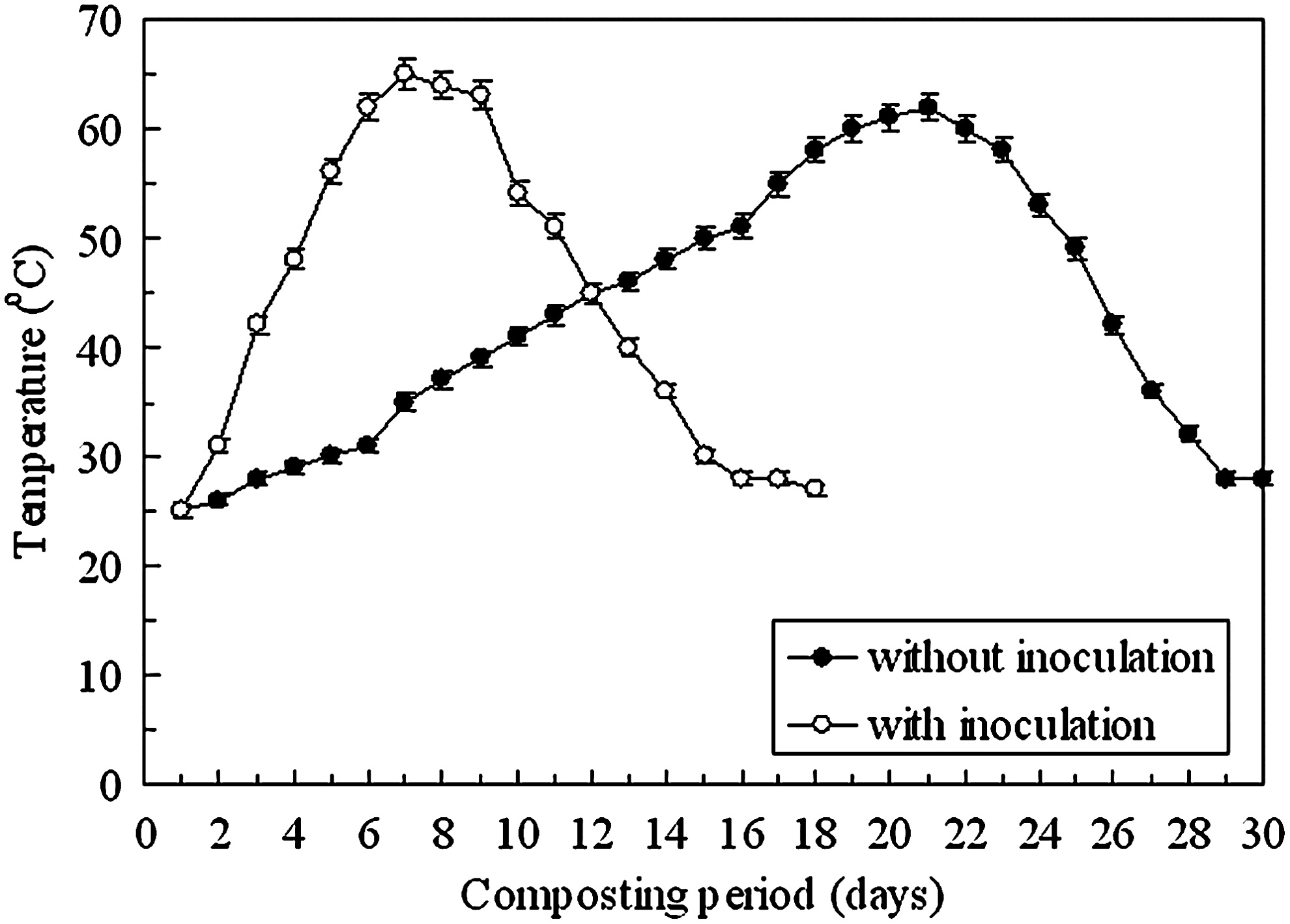
Temperature profiles during the composting of aquaculture wastes inoculated or uninoculated with the three isolated thermophilic bacteria. Results are means of triplicate experiments (SD is indicated with error bars).
Germination assays with Chinese cabbage seeds was performed to evaluate the compost quality. The highest germination percentages were obtained in the 25% compost/75% peat mixture (30 g peat:10 g compost), namely, 85%, 92%, and 99% germination after 5, 10, and 15 days of cultivation, respectively (Table 2). Conversely, the highest percentage for the uninoculated compost product was 83% germination after 15 days of cultivation. Ostos et al. (2008) suggested that there was an optimal mixed ratio of compost and peat with optimal nutrient ingredients that would favor initial radicle growth and that, conversely, a high concentration of compost or peat would be unfavorable to radicle growth due to the environmental condition of high osmotic pressure or poor nutrients. The study of Tiquia and Tam used Chinese cabbage seeds to examine the compost maturity of a spent pig litter/sludge mixture and found that the optimal germination percentage was 88% (Tiquia and Tam, 2000). These results suggest that the biofertilizer produced by fast composting is a potentially beneficial and useful material.
100% compost (40 g compost), 75% compost/25% peat, 50% compost/50% peat, 25% compost/75% peat, and 100% peat (40 g peat) during 15 days of cultivation (SD is standard deviation of 100 samples).
Thermophilic bacteria with cellulase activities were isolated from composting material consisting of CMS, rice bran, and sawdust. The inoculation of these composting aquaculture wastes with the three isolated thermophilic strains accelerated the degradation of these organic materials and successfully converted them into biofertilizers. Thus, fast composting through the inoculation of the appropriate bacteria has the potential to shorten the composting period. The quality of the compost obtained by our fast composting process was assessed to be satisfactory based on the results of germination assays with Chinese cabbage seeds.
In this study, we have successfully demonstrated the advantageous utilization of thermophiles to enhance the conversion of waste into biofertilizer. A previous study of similar innovative treatment technology, proposed by Lin et al. (2011a) for the treatment of diesel contaminated soil, indicated that the presence of thermophiles in composting material should have a potential to treat petroleum-related contaminants utilizing food waste thermophilic composting processes. Both studies have demonstrated the added benefits of utilizing thermophiles. These findings were significant, because most previous studies for biological treatment were carried out under mesophilic conditions, but a few were carried out under thermophilic conditions. Future research in the application of thermophiles are warranted and may open up promising scientific contributions.
Footnotes
Acknowledgment
This work was supported by the National Science Council (NSC) of Taiwan, under Contract No. NSC-96-2313-B-157-002-MY3.
Author Disclosure Statement
No competing financial interests exist.