




Abstract
Abstract
Although land application of degraded water onto turf is a promising approach in arid and semiarid areas to reduce the use of fresh water for irrigation, there are two risks to be considered: potential nitrate contamination to groundwater and salt accumulation in the soil. A combined mass balance design approach has been proposed earlier by the authors to reduce these two risks. However, limited information is available to test and improve the method. An 18-month study was conducted to investigate the environmental impacts of land application of degraded water onto two typical Texas soils with different grass cover using the combined mass balance approach. The study was implemented by lysimeters irrigated by degraded water from a natural waste treatment system. No significant nitrate contamination to the groundwater was found in either type of the soils through 1½ year of monitoring. Salt was found to accumulate, but the soil salinity was in the range of grass tolerance to soil salinity.
Introduction
Land application of degraded water is an environment-friendly treatment and disposal approach, and has environmental, economical, and social benefits (Duan and Fedler, 2007). However, degraded water land application may cause adverse environmental effects due to potential nitrogen contamination to groundwater and nearby surface water (Duan and Fedler, 2007) and potential soil degradation (Duan et al., 2010b; Hayes et al., 1990; Rhoades and Loveday, 1990; Shainberg, 1990); accordingly, it was questioned by some researchers (Dukes and Ritter, 1998). For example, George et al. (1987) documented that high nitrate concentrations were once found in the groundwater under the wastewater land application site at Lubbock, TX, with concentrations up to 35.9 mg/L.
An effort is being taken by Texas Tech University for more than 10 years to develop an innovative and sound design method for degraded water land application with an aim to reduce its adverse impacts. A combined mass balance approach including water balance, nitrogen balance, and salt balance was proposed, detailed, and investigated at municipal wastewater treatment plant at Littlefield, TX (Duan and Fedler, 2009; Duan et al., 2010a, 2011). The field study of wastewater land application at a semiarid area designed by this approach demonstrated that water was saved by more than 50% compared with original design approach (Duan and Fedler, 2009), potential nitrogen contamination to beneath groundwater was not found (Duan et al., 2010a), no adverse impact of wastewater land application on soil properties was observed (Duan et al., 2010b), and salt was found to accumulate with soil salinity much lower than the threshold for Bermuda grass assuming a 10% yield reduction (Duan et al., 2011). Although the field research displayed that combined mass balance design approach had been successful in clay loam and sandy clay loam soils with Bermuda grass growing irrigated with secondary wastewater effluent, there is a great need for this proposed design approach to be investigated in different soil types growing different plants irrigated with different degraded waters to gain more data for the improvement of this promising design approach.
The objective of this study were (1) to investigate the environmental impacts of land application of a degraded water onto two typical Texas soils in terms of potential nitrate contamination to groundwater and soil salt accumulation designed by combined mass balance approach, and (2) to conduct water mass balance, nitrogen mass balance, and salt mass balance to identify the potential improvement of this design approach.
Materials and Methods
Experimental design
The study was conducted on campus of Texas Tech University, Lubbock, TX. Six lysimeters containing natural undisturbed clay soil cores with St. Augustine grass growing from Harris County near Houston in Texas were installed inside of the greenhouse so that the growth conditions for the grass were close to its original place. Another six lysimeters containing natural undisturbed loamy sand soil cores with Bermuda grass growing from Midland in Texas were installed outside due to similar semiarid climate in Lubbock to Midland. All 12 soil cores with grasses were taken from the turf soil surface down to 305-mm depth. All lysimeters were buried into soil with their tops flush with the ground or soil surface (Fig. 1). The physical and chemical properties of both typical Texas turf soils are listed in Table 1.
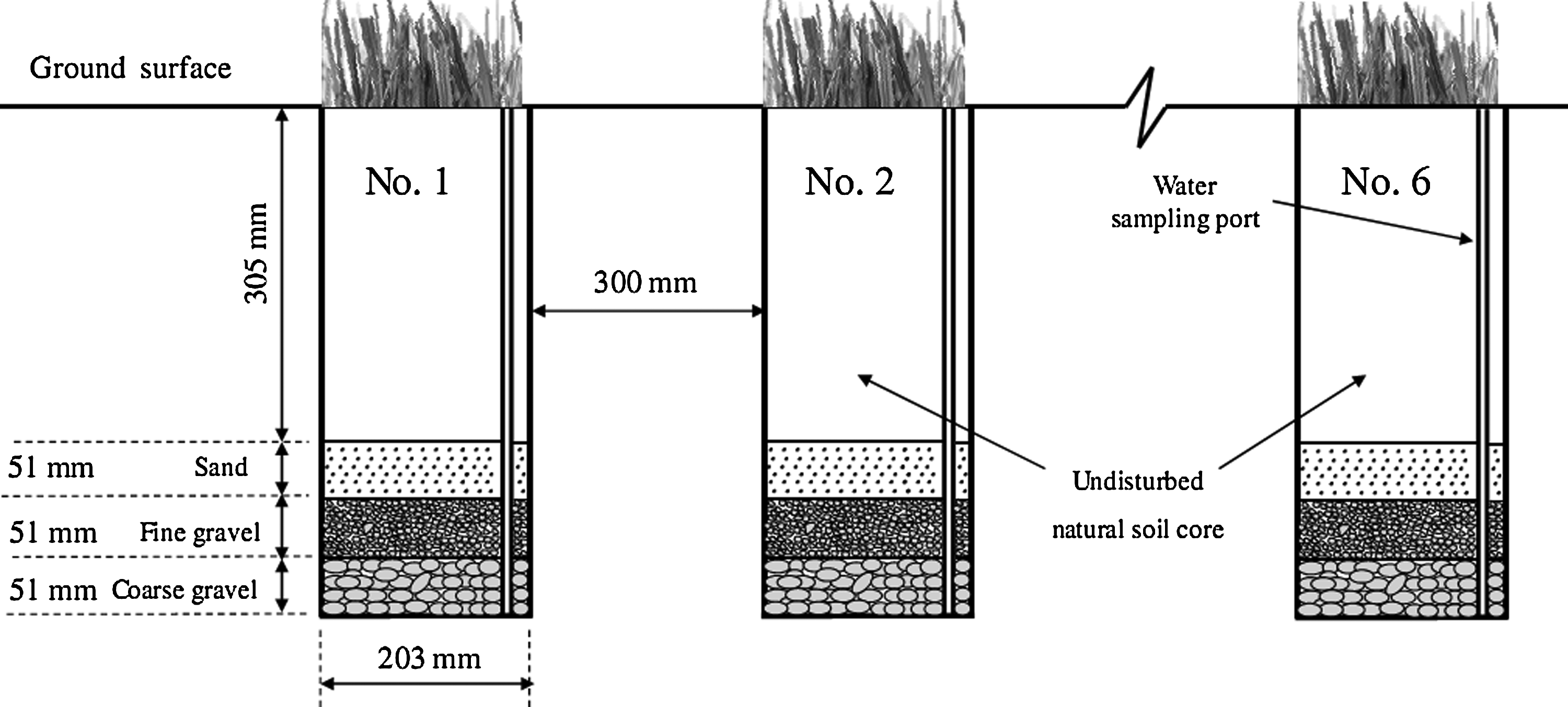
Side view of installed lysimeters (No. 3–5 were omitted in the figure).
ECe is electrical conductivity of soil saturated paste extract measured at 25°C.
Irrigation schedule predetermined by mass balance approach
Initially, all 12 lysimeters were randomly and sufficiently irrigated with tap water by hand to flush down salts and other unstable constituents in soils to the bottom from June 2005 to August 31, 2006. The data collection started from September 1, 2006, and ended on February 27, 2008. During the study, the water was irrigated by hand according to irrigation schedule every 2 or 3 days. The irrigated water was from the effluent of the natural waste treatment system in the greenhouse. Before irrigation, Miracle-Gro water soluble all purpose plant food was added into the irrigated water to satisfy nutrient requirements of grass. The final total nitrogen (TN) concentrations in the irrigation water were around 25 mg/L, which falls into the range of TN concentration in typical secondary effluent from a natural wastewater treatment system located at west Texas (Duan and Fedler, 2010).
The combined mass balance approach was used in irrigation scheduling as introduced by Duan and Fedler (2009). The land-applied degraded water was utilized to satisfy the need of plant growth and salt leaching in those lysimeters. Evapotranspiration (ET) used in the general irrigation scheduling was predetermined or adopted from the manual Mean Crop Consumptive Use and Free Water Evaporation for Texas, written by Borrelli et al. (1998). Precipitation used in irrigation schedule predetermination for the loamy sand soil was the 30-year average with data collected from the National Climatic Data Center. For both soils, the leaching was designed as zero in June, July, and August, 25 mm in October, November, and December, and 13 mm in the remaining months. The designed annual leaching fractions were 11% and 17% for the clay soil and the loamy sand soil, respectively. Those leaching fractions are much higher than the minimum leaching requirements for salt leaching. Although the leaching was set as zero in the summer, the accumulated salts in the soil in the summer can be flushed down in the other seasons. The predetermined irrigation schedule is shown in Table 2.
Water and soil sampling
Leachate was approximately monthly collected (Table 3) with hand pump (2006G2 pressure-vacuum hand pump; Soilmoisture Equipment Corp.). The volumes of leachate were measured, and the subsamples were transported to lab for quality analysis. Six soil core samples with the diameter of 50 mm were taken from soil surface to the 305-mm depth at Midland site and Harris site for lab analysis. At the end of the study, all lysimeters were pulled out of the ground for soil property analysis.
Data analysis
The water samples were analyzed for TN (Hach Company, 2007a), nitrate-nitrogen (Hach Company, 2007b), and ammonia-nitrogen (Hach Company, 2007c) with Hach methods (Duan et al., 2010a). Water electrical conductivity (EC) was measured for salinity, and the applied and leached salt mass was calculated following the method developed by Duan et al. (2011). Soil was analyzed for EC with the recommended method in Methods of Soil Analysis (Sparks, 1996).
Water mass balance, nitrate balance, and salt balance were implemented based on the detailed descriptions (Duan and Fedler, 2009; Duan et al., 2010a, 2011). The comparison of variables' means was conducted by t-test at p<0.05 with the software package SigmaStat for Windows version 3.10 (Systat Software, 2004).
Results and Discussion
Water mass balance
The volume of irrigation, precipitation, and leachate were measured and expressed by depth (mm), and the volume of water loss due to ET was the difference between water input (irrigation and precipitation) and water loss due to leaching with an assumption that soil moisture changes were minor. More water was applied onto both soils in summer and fall (Fig. 2) because of higher ET. Water leaching is the primary controlling factor for nitrogen and salt leaching in degraded water land application systems. Overall, water leaching mainly occurred in fall and winter in the clay soil while it happened in spring, fall, and winter in the loamy sand soil (Fig. 2). As shown in Fig. 2 and Table 2, there were some discrepancies of leachate volume between measured values and planned values (data not shown). The total discrepancy in the clay soil was lower because the lysimeters with the clay soil were placed in the greenhouse with relative stable and controllable environmental conditions. The ET and precipitation predetermination in the design phase by conducting mass balance to schedule irrigation were based on the average values of multiple-year recorded environmental conditions. Therefore, the ET and precipitation happened in the research period definitely had deviations to the planned values since the environmental conditions in the research period had deviations to the multiple-year averages. However, statistically, the real cumulative water leaching after multiple-year practice of designed irrigation by mass balance approach is expected to approach the planned cumulative water leaching.
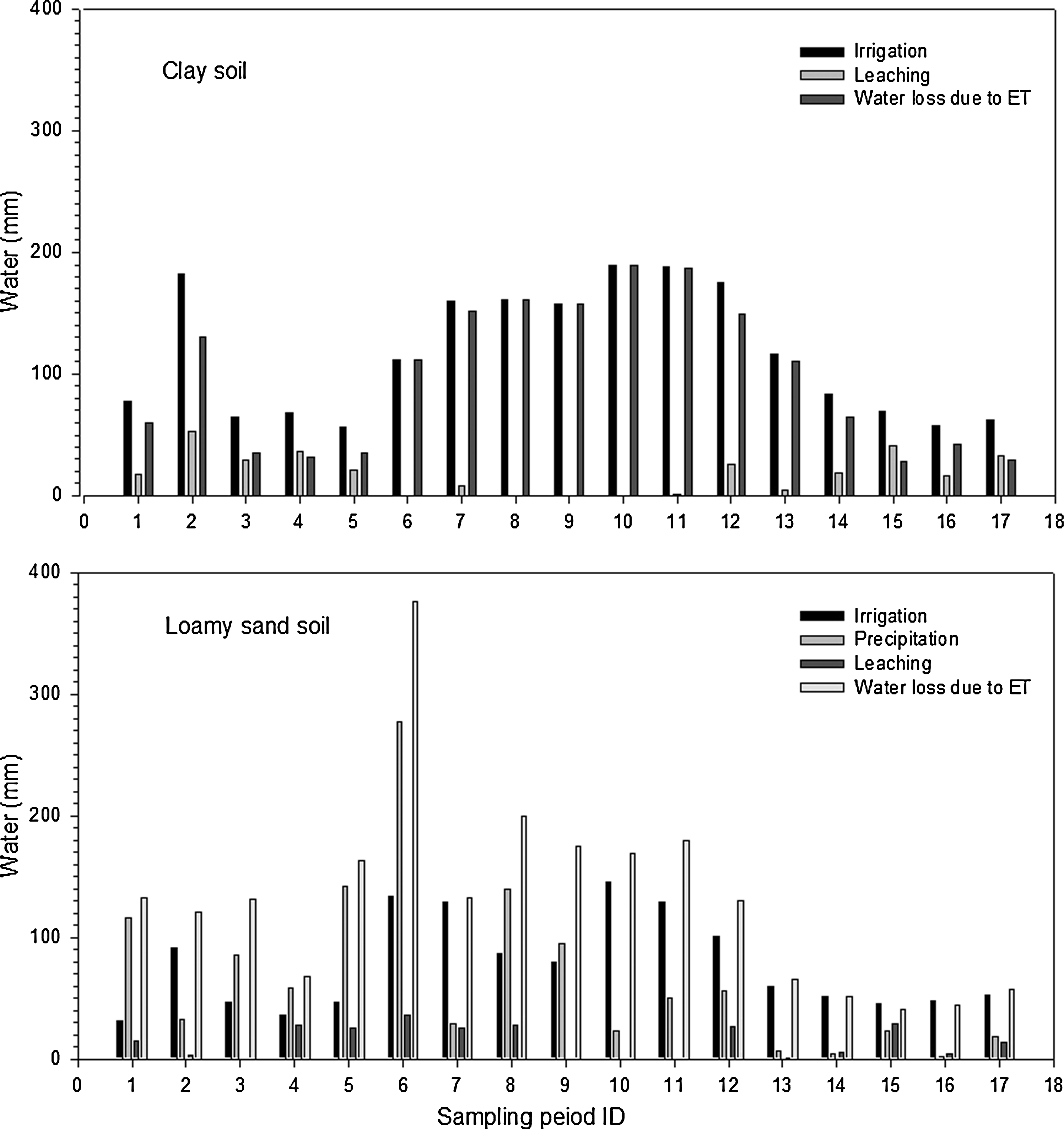
Water mass balance components. No precipitation onto clay soil. Sampling period IDs are defined in Table 3. ET, evapotranspiration.
Nitrogen mass balance
The applied TN, nitrate-nitrogen, and ammonia-nitrogen concentrations (Fig. 3) were 23–25, 0.4–1.8, and 0.02–1.60 mg/L, respectively. TN, nitrate-nitrogen, and ammonia-nitrogen were 0–11, 0–7.5, and 0–0.22 mg/L in the leachate of the clay soil, and 1–17, 0.2–10.8, and 0–0.18 mg/L in the leachate of the loamy sand soil, respectively. All nitrate-nitrogen concentrations except one in the leachate were below 10 mg/L, the U.S. Environmental Protection Agency's maximum contaminant level (USEPA MCL) for nitrate-nitrogen in public water supplies (Klocke et al., 1999; Wu et al., 2007). The exception was 10.8 mg/L of nitrate-nitrogen in the leachate of the loamy sand soil observed in January 2008. Therefore, there was no potential nitrate contamination to groundwater found in both soils in most of sampling periods.
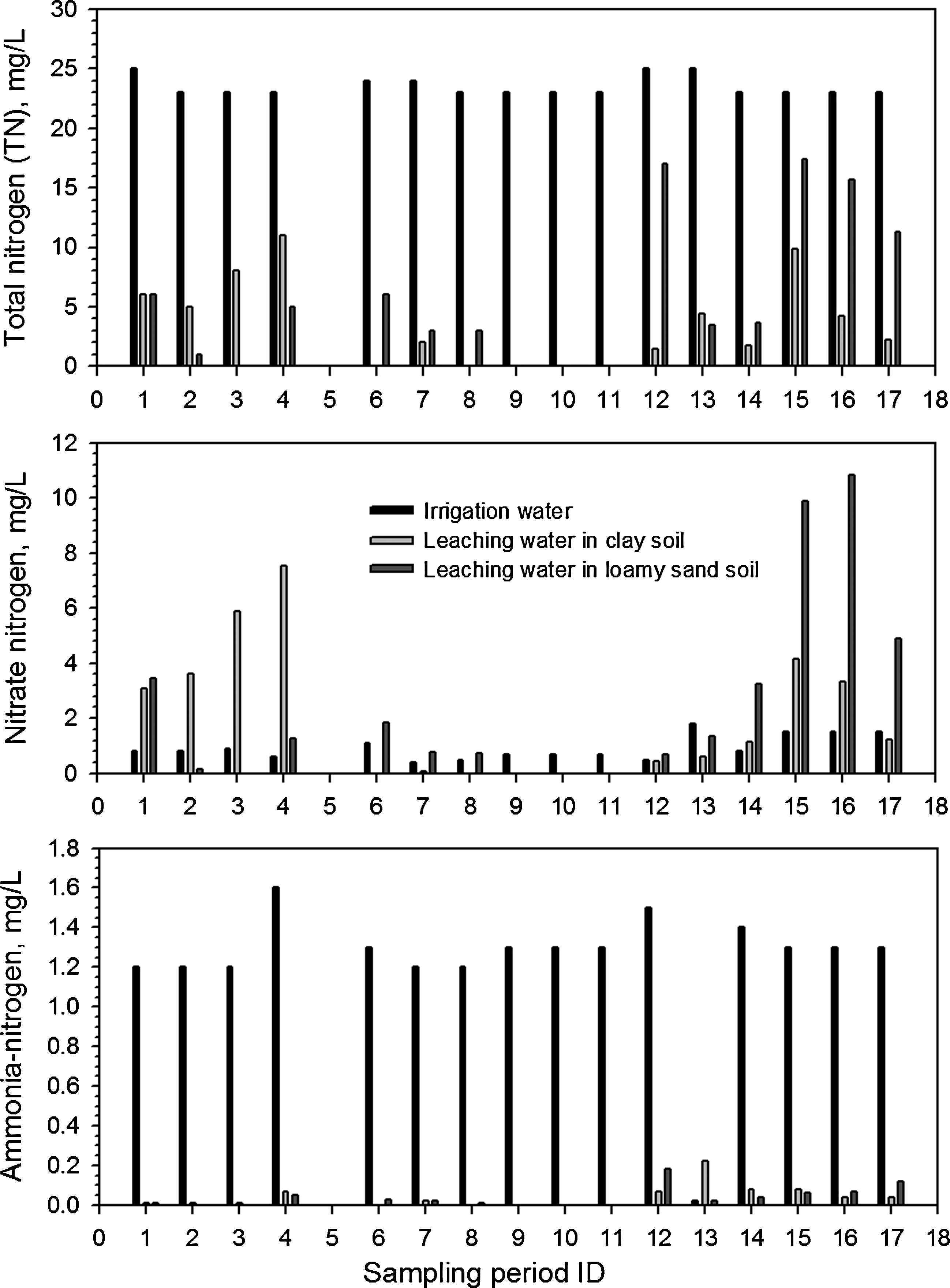
Nitrogen concentrations. No analysis result available in sampling period 5; no leaching water available in sampling period 6, 8, 9, and 10 in the clay soil and in sampling period 3, 9, 10, and 11 in the loamy sand soil. Sampling period IDs are defined in Table 3.
Most of nitrogen in the applied water was organic nitrogen. TN concentrations in the leachate were always lower than in irrigation water in both soils (Fig. 3). It shows that nitrogen immobilization by grasses and bacteria and denitrification occurred. Denitrification is the primary mechanism in the winter to remove nitrogen when plant nitrogen uptake is low or even zero. Nitrogen removal by denitrification depends on many environmental factors, including soil water moisture, carbon and nitrogen source, aerobic and anaerobic conditions, soil texture, and climatic conditions (Barton et al., 1999). In some sampling periods, the concentrations of nitrate-nitrogen in the leachate were higher than in the irrigation water. It was attributed to the net effect of nitrogen mineralization from organic-nitrogen to ammonia-nitrogen, nitrification from ammonia-nitrogen to nitrate-nitrogen, and denitrification from nitrate-nitrogen to N2 and N2O. Ammonia-nitrogen concentrations in the leachate were lower than in the applied water in all sampling periods except in sampling period 13. It shows that nitrification and immobilization to remove ammonia were faster than mineralization to produce ammonia.
The concentrations of TN and nitrate-nitrogen in the leachate in the loamy sand soil were higher in the winter of 2007 and spring of 2008 compared with those in the clay soil. It suggests that the combined nitrogen removal by nitrogen plant uptake and denitrification was higher in the clay soil than in the loamy sand soil. During those periods, St. Augustine grass was still green in the greenhouse, whereas Bermuda grass was dry and dormant, and higher denitrification occurred in the greenhouse due to more preferable environmental conditions than outside.
Nitrogen mass balance (Fig. 4) shows that nitrogen mass removal was higher than 74% in the clay soil, and higher than 82% in the loamy sand soil in all sampling periods except sampling period 15. The nonleached nitrogen included nitrogen loss in soil water due to immobilization, denitrification, and nitrogen storage in soil. Nitrogen mass balance illustrates that higher nitrate-nitrogen leaching happening in sampling periods 15 and 16 (Fig. 3) in the loamy sand soil was caused by low nitrogen removal efficiency in sampling period 15 (52%), which was the results of dry grass and low denitrification due to extreme dry and cold winter.

Nitrogen mass balance. No analysis result available in sampling period 5; no leaching water available in sampling period 6, 8, 9, and 10 in the clay soil and in sampling period 3, 9, 10, and 11 in the loamy sand soil. Sampling period IDs are defined in Table 3.
Salt mass balance and soil property change
The salinity was 1.147–1.847 dS/m with average of 1.578 dS/m in the applied water, 3.004–11.580 dS/m with average of 4.609, and 3.387–15.530 dS/m with average of 4.984 dS/m, respectively (Fig. 5). Salt concentration in soil water increased after degraded water was land-applied primarily caused by evapotranspiration (U.S. Salinity Laboratory Staff, 1954).

Salinity in applied water and leachate. No analysis result available in sampling period 5; no leaching water available in sampling period 6, 8, 9, and 10 in the clay soil and in sampling period 3, 9, 10, and 11 in the loamy sand soil. Sampling period IDs are defined in Table 3.
The leached salt mass was higher than the applied in four sampling periods (Fig. 6). Overall, salt mass balance shows that salt accumulated in both soils. Therefore, soil salinity needed to be evaluated for the grass growth. The tolerance to soil salinity is 4.0 dS/m with 10% yield reduction for St. Augustine grass (Agriculture and Natural Resources, University of California, Davis, 2009), and 8.5 dS/m for Bermuda grass (Ayers and Westcot, 1976). The average soil salinity in the whole soil profile at the end of the research was 3.833 dS/m (n=12) and 2.992 dS/m (n=12) in the clay soil and the loamy sand soil, respectively. It illustrates that the salt accumulation did not have negative impacts to grass growth. The average soil salinity at the start of the research was 0.5 dS/m (n=6) in the clay soil and 4.0 dS/m (n=6) in the loamy sand soil (Table 1). Soil salinity significantly increased (p<0.0001) in the clay soil, and had no significant difference between the start and the end (p=0.109) in the loamy sand soil. This could be attributed to texture difference. Due to its poor drainage ability, when clay soil was irrigated with water having higher salinity, soil sanity increased. When the initial salinity in loamy sand soil was higher than that in the irrigated water, the soil salinity had no increasing trend because loamy sand soil has good drainage ability.
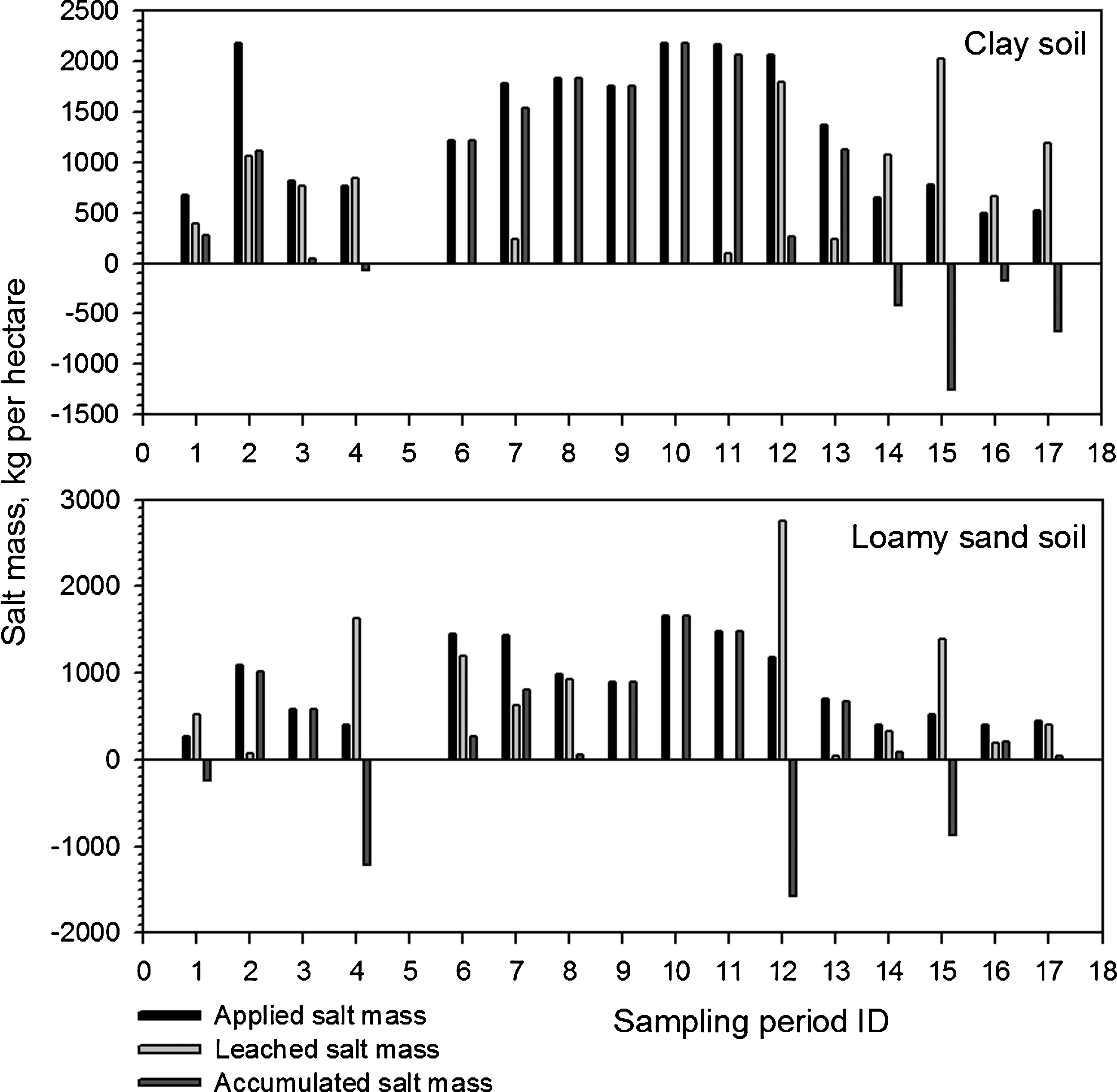
Salt mass balance. No analysis result available in sampling period 5; no leaching water available in sampling period 6, 8, 9, and 10 in the clay soil and in sampling period 3, 9, 10, and 11 in the loamy sand soil. Sampling period IDs are defined Table 3.
Conclusions
This 18-month study on the nitrogen and salt leaching in two degraded water land application systems designed by mass balance approach illustrated that nitrate-nitrogen in the leachate mostly did not exceed USEPA MCL, and salt accumulated in the soils but with soil salinity within the range of grass salt tolerance. Therefore, the feasibility of mass balance design method was confirmed in two typical Texas turf soils irrigated with degraded water. Appropriate management strategy needs to be proposed and practiced to control nitrate leaching under extreme cold and dry climate. Long-term investigation on soil salinity and salt accumulation in the soil are required to be conducted in the land application systems for the improvement of mass balance design method.
Footnotes
Acknowledgment
This research project was funded by Texas Onsite Wastewater Treatment Research Council of the Texas Commission on Environmental Quality, Austin, TX.
Author Disclosure Statement
No competing financial interests exist.