




Abstract
Abstract
Direct discharge of scattered rural sewage into surface water bodies with no efficient and economic treatment processes is one of the main reasons for the deteriorative aquatic environment in China. In this study, a simplified pilot-scale rural wastewater treatment system has been proposed. The system consisted of an anaerobic digestion tank (for organic substances pretreatment), an aerobic five-cell submerged biofilm reactor (for organic substances degradation), and a constructed wetland (CW; for nutrients removal and effluent quality control) in sequence. A five-step water-dropping aeration technique was incorporated in the biofilm reactor for oxygen replenishment with one pump, the only equipment applied in the system that involved in water elevation and effectively alleviated the oxygen stress in the CW for nutrient removal improvement. Effects of economic vegetation species (water spinach vs. water bamboo), packing media (coal cinder vs. gravel), and flow patterns (submerged horizontal flow vs. vertical flow) on CW performance were examined under continuous influent loading. Distributions of ammonia-oxidizing bacteria, nitrite-oxidizing bacteria (generally accumulated in the top [≤20 cm] front part of the CW), and denitrifying bacteria (mainly in the deeper part [>20 cm] of the CW) were explored for total nitrogen (TN) removal. The optimized system achieved 68.9%±15.8%, 68.6%±15.1%, 69.5%±14.6%, and 86.3%±12.2% of chemical oxygen demand, NH4+-N, TN, and total phosphorus (TP) removal efficiencies, respectively, during a 6-month operation with the effluent meeting the Chinese sewage discharge standard and were indicated to be of low cost, operation-friendly, and applicable for sewage treatment in Chinese rural communities.
Introduction
The conventional centralized wastewater treatment technologies, such as activated sludge or biological bed processes, are generally not feasible for rural domestic wastewater treatment (Zhang et al., 2009). The isolated locations of low population communities in the rural areas cause the wastewater difficult to collect, highly variable in daily flow rate, and to possess high N- and P-containing organic contamination. Currently, constructed wetlands (CWs) have been applied for wastewater treatment in small communities or rural regions in several countries (Mbuligwe, 2005; Kao et al., 2009). CWs integrate both ecological and biological technologies, require simple on-site construction, possess large buffering capacities, and are easy for operation and maintenance with low cost (Ye and Li, 2009). However, the aeration deficiency in CWs often caused low total nitrogen (TN; especially ammonia nitrogen [
The objectives of this work were to investigate the in situ feasibility of a compact rural wastewater treatment system. The system consists of an anaerobic tank, a simplified water-dropping aerated biofilm reactor, and a CW, in sequence. Subsurface CWs were applied because of their better solid filtration and BOD removal efficiencies than free surface ones and fewer problems induced from odors, insects, or public exposure (Yang et al., 2001). The effects of different vegetation (water spinach vs. water bamboo), packing media (coal cinder vs. gravel), and flow patterns (horizontal flow [HF] vs. vertical flow [VF]) on CW treatment were evaluated. The optimized system was operated and monitored for 6 months to provide supporting information for future application.
Experimental Protocols
Site description and system design
The pilot-scale wastewater treatment system (Fig. 1) is located at a village in southeastern China (31°49′N, 119°53′E) with a treatment capacity of 5 m3/day. The local area is characterized as subtropical monsoon climate with an average rainfall of 1177 mm and an annual average air temperature of 15.7°C. The continuous wastewater first entered the anaerobic tank (hydraulic retention time [HRT]=30 h; effective volume [V]=6 m×4 m×1 m [L×W×H]). The effluent was transported by a peristaltic pump to an elevated water tank (0.6 m×0.3 m×0.15 m [L×W×H], 4 m above the ground) and dropped by gravity onto five biofilm cells (V=0.8 m×0.5 m×0.5 m [L×W×H], packed with nonwoven fabrics) in sequence. The first cell had a water-dropping height of 1.3 m because of highest COD loading and all other four cells had 0.5 m height difference in between.
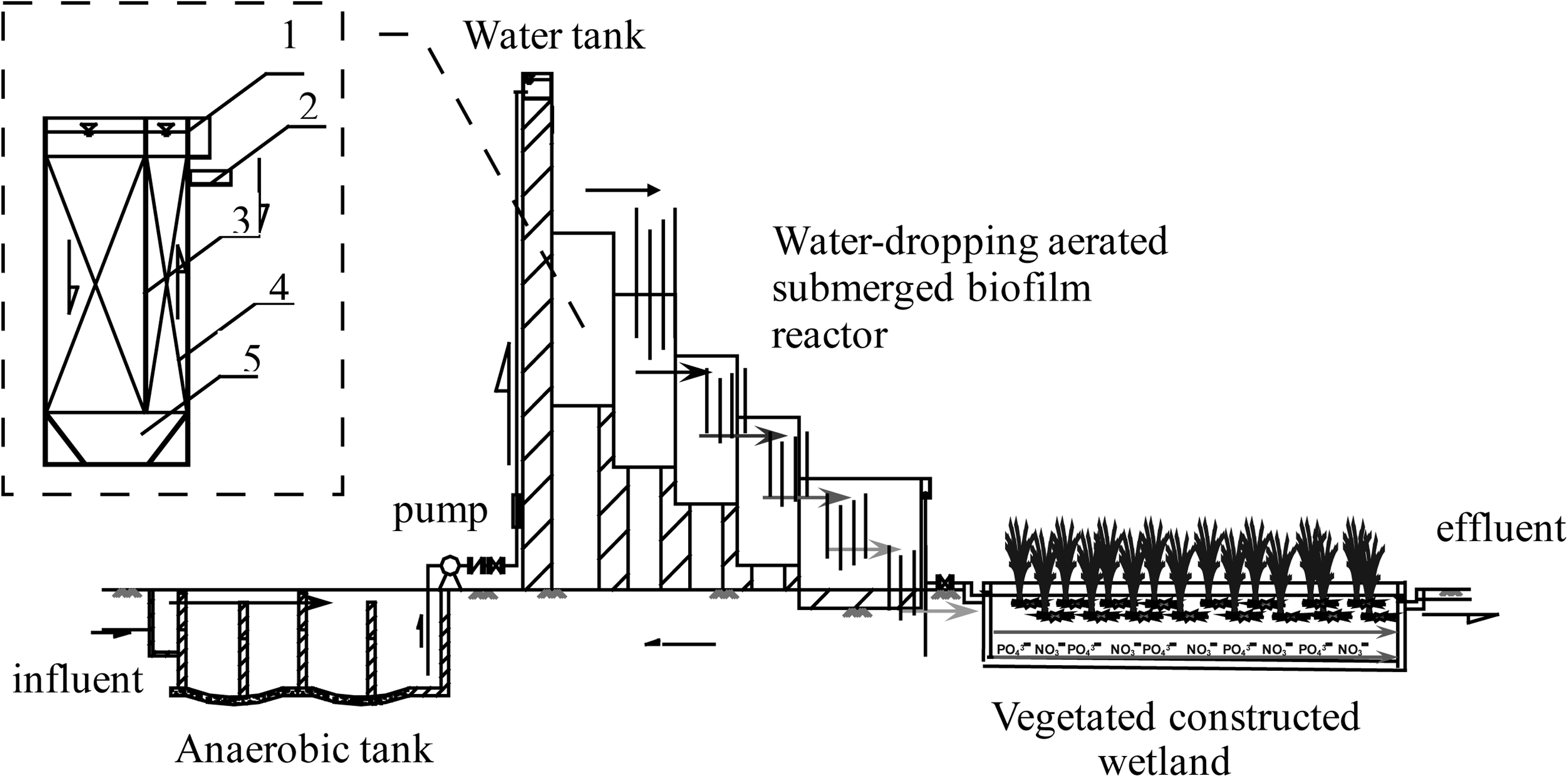
Schematic diagram of the compact rural wastewater treatment system. Arrows indicate the directions of wastewater flow. The detail of the single biofilm cell is in the dotted box. 1, V-notch weir; 2, water-dropping baffle; 3, baffle board; 4, packing media; 5, sludge hopper.
Four parallel CWs (V=3 m×0.6 m×0.8 m [L×W×H] each, HRT=48 h, water depth=0.6 m) were designed to continuously receive the effluent from the biofilm reactor with the hydraulic loading rate of 0.2 m3/(m2·day) each (Table 1 and Fig. 2). The CW constituted of three layers, the bottom layer of cracked bricks (3–5 cm) with a depth of 20 cm, the middle layer of cinder (3–5 mm) or gravel (10–15 mm) with a depth of 28 cm, and the upper layer of sand (∼1.5 mm) with a depth of 10 cm. An influent perforated pipepolyvinylchloride (PVC) manifold system (15 mm in diameter) was located either at the bottom of the perforated wall (for HF CWs; Fig. 2A) or on the top of VF CW (Fig. 2B) for even distribution. A subsurface-perforated effluent PVC manifold system (15 mm in diameter) was located at either the end and down to the bottom of the basin (for HF CWs; Fig. 2A), or in the middle (horizontally) and down to the bottom of the basin (for VF CWs, Fig. 2B). The CW bottom slope was 1% toward the outlet.
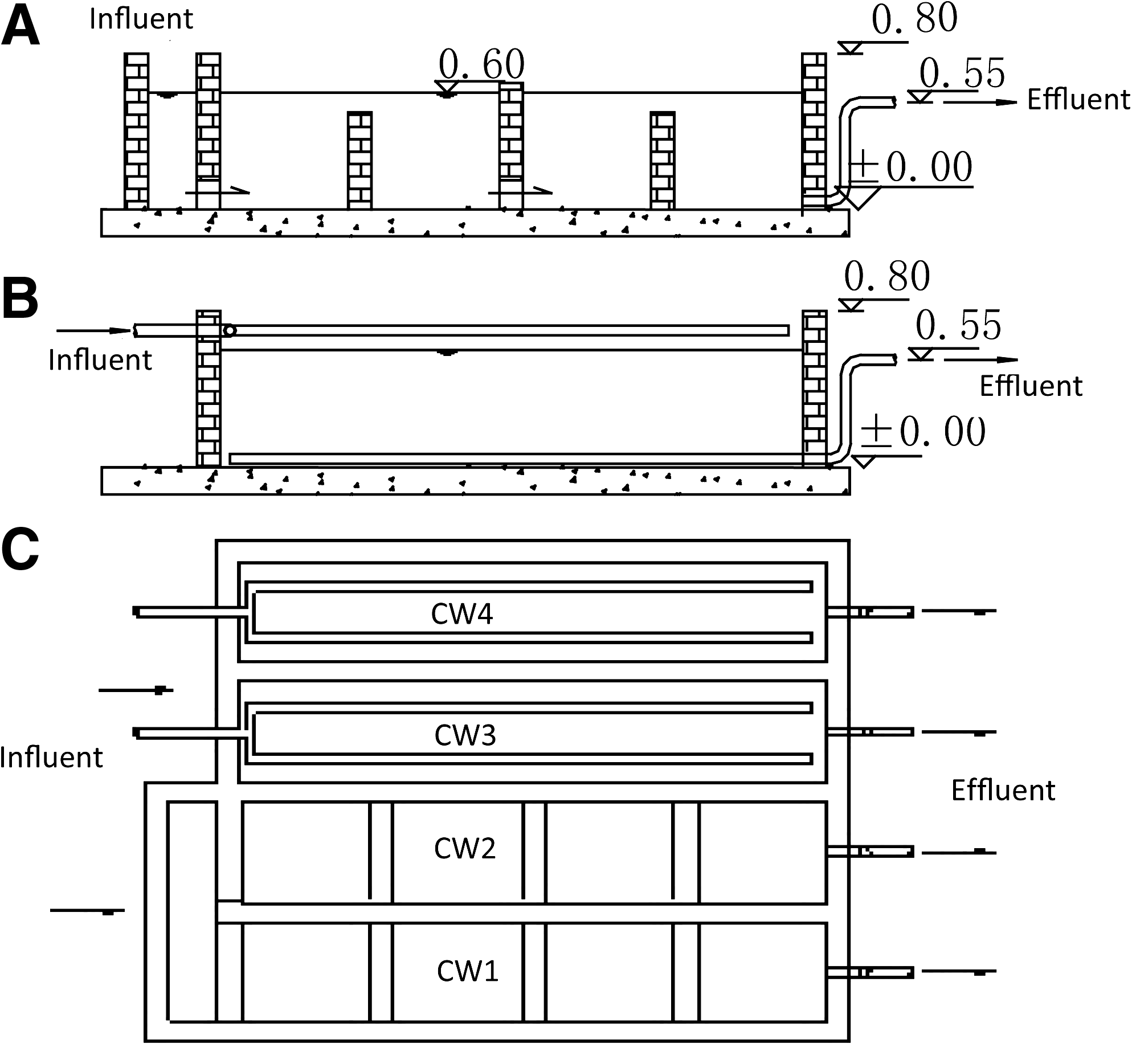
Sectional drawing of CW No. 1–2
Wastewater source and characteristics
The domestic wastewater was collected from the village sewage system. The water quality is summarized in Table 2.
The range of each item is given within parentheses (n=43).
COD, chemical oxygen demand; DO, dissolved oxygen; TN, total nitrogen; TP, total phophorus.
Sampling strategy and analytic methods
The samples were collected every 3 days from the inlet of the anaerobic tank and the outlets of the anaerobic tank, the biofilm reactor, and the CW. Dissolved oxygen (DO), COD,
The sediments were sampled from the different depths (5–10, 20, and 40 cm) and different parts (front, middle, and back end) of all four CWs. Ten grams sample was suspended in 100 mL sterile phosphate-buffered saline plus 30 glass beads for shaking (200 rpm, 30 min). The aliquot (1 mL) slurry was used for ammonia-oxidizing bacteria (AOB), nitrite-oxidizing bacteria (NOB), or denitrifying bacteria analysis. AOB and NOB densities were estimated via fluorescence in situ hybridization technique (Aoi et al., 2000). The probes applied for hybridization are summarized in Table 3. The hybridized sample was observed with epifluorescence microscopy for cell counting. The denitrifiers were quantified with the most probable number (MPN) method (Davidson et al., 1985). The basal medium used for cultivation of denitrifying bacteria was as follows (per liter): KNaC4H4O6·4H2O (20 g), KNO3 (2 g), K2HPO4 (0.5 g), and MgSO4·7H2O (0.2 g). Triplicates were made for each dilution and incubated (28°C–30°C) for 14 days before analysis. The denitrifier concentrations were determined by referring to Mecrady table.
Amann et al. (1990)
Wagner et al. (1996)
Mobarry et al. (1996)
Results and Discussion
Performance of anaerobic digestion and water-dropping aerated biofilm processes
The rural community sewage was first stabilized in the plug-flow anaerobic tank for COD bioavailability enhancement. SS settled with gravity. During the 6-month operation period, the removal efficiencies for COD, TN, and TP were 33.7%±21.4%, 28.4%±14.3%, and 33.1%±19.9%, respectively.
The oxygen was replenished in the biofilm reactor during the overflow of elevated digestion effluent between two cells, according to Fick's law and the two-film theory (Nielsen et al., 2003). About 2.3±0.8 mg/L O2 was replenished during each water-dropping aeration step, with DO at the inlets of the biofilm cells between 4 and 5.6 mg/L (data not shown).
The COD removal rates in the biofilm reactor fluctuated with the influent COD strength. During the 6-month operation period, 39.2%±27.3% of COD was removed. The biofilm process was not efficient in
Optimization of incorporated CW configuration
Impacts of vegetated plants on CW performance
CW vegetation would improve nutrient removal (Yang et al., 2007). In our study, water bamboo and water spinach were chosen because of their well-developed root systems for easy survival and economic value as local vegetables. During 5-month operation, the water bamboo-planted CW (CW No. 1) achieved better TN (58.3%±15.6%) and TP (85.5%±11.7%) removal efficiencies than the water spinach-planted ones (CW No. 2) (41.0%±13.6% and 76.0%±15.8%, respectively) (p<0.05; Fig. 3). The COD removal efficiencies were 47.6%±29.1% in CW No. 1 and 41.4%±23.1% in CW No. 2.

COD ): Influent; ( ): water bamboo-planted CW effluent; (
 ): water spinach-planted CW effluent. COD, chemical oxygen demand; TN, total nitrogen; TP, total phosphorus.
The better developed water bamboo root system probably supported higher nutrient removal efficiencies in CW No. 1 than CW No. 2. The plant roots have been found to help stabilize the bed structure, provide a huge surface area for microbial attachment, transport oxygen from the atmosphere into the rhizosphere, and maintain stable removal efficiencies during the winter seasons although plant uptake was not the main mechanism for nutrient removal (Yang et al., 2007; Ye and Li, 2009). The reported positive correlation of fine root mass with nutrient removal efficiency (Yang et al., 2007) suggested that the longer and more complex water bamboo root system (>20 cm, compared with water spinach roots of 8–12 cm) probably strengthened the root functions in CW, promoted ammonia oxidation in the deeper area, and benefited phosphorus adsorption onto bed media.
Impacts of bed media on CW performance
Cinder-containing CW No. 3 significantly (p<0.05) improved TP removal efficiency (59.5%±17.4%) compared with gravel-containing CW No. 4 (26.2%±13.2%) (Fig. 4). TN and COD removal efficiencies were close in both CW No. 3 (25.0%±12.6% and 20.8%±17.8%, respectively) and No. 4 (17.5%±9.5% and 33.2%±21.3%, respectively). Adsorption or precipitation of phosphorus to the media has been proved as the main pathways for phosphorus removal in CWs and the media with high Ca, Fe, or Al contents promote better phosphorus removal efficiencies (Ye and Li, 2009; Vohla et al., 2011). Therefore, the relatively higher porosity and bigger specific surface area in facile Fe-, Al-, and Ca-rich cinder probably contributed to better phosphorus adsorption rate than gravel.
COD ): Influent; (): cinder-containing CW effluent; (): gravel-containing CW effluent.
Impacts of flow pattern on CW performance
The treatment efficiencies in the subsurface HF CW No. 2 were generally better than the subsurface VF CW No. 3 (Fig. 5). About 26.5%±26.2% and 21.9%±17.4% of COD were removed in CW No. 2 and No. 3, respectively. Similarly, 34.7%±23.1% and 21.3%±14.8% of TN were removed in CW No. 2 and No. 3, respectively. The TP removal efficiencies were 68.9%±19.8% and 59.8%±18.4%, respectively. The VF CWs were reported to have higher BOD removal and nitrification rates even in the winter seasons because of better aeration conditions, whereas HF CWs could obtain higher denitrification rates for nitrogen removal under oxygen stress (Cooper, 2009). In our study, the continuous influence loading on the CWs for operation and maintenance simplification compromised the aeration advantages in the VF CW No. 3. The lowered COD concentrations and replenished DO in the biofilm treatment effluent made the CW aeration requirement not as critical as when CWs were used independently. Therefore, the longer HRT in the HF CW No. 2 would help in situ microbial nitrification and denitrification for TN removal and benefited COD degradation and TP adsorption or precipitation (Luederitz et al., 2001; Zhang et al., 2009).
COD ): Influent; (): horizontal flow CW effluent; (): vertical flow CW effluent.
AOB, NOB, and denitrifying bacteria distributions in CW
Microbial activities were reported to be the main mechanism for TN removal in CWs (Luederitz et al., 2001; Ye and Li, 2009). In our study, the AOB (2.1×10⁶ to 6.8×10⁷ cells/g dry weight) and NOB (1.6×10⁷ to 1.7×10⁸ cells/g dry weight) communities displayed similar profiles in all CWs (Fig. 6). The most abundant AOB and NOB were generally retrieved from the front part of CW sediments and the cell densities declined with the increase of depth and along the wetlands. Compared with AOB, NOB densities decreased more gently as the function of sediment depth or wetland length. The oxygen introduced by the influent, diffused from the atmosphere, and transported by the vegetation probably determined the most abundant aerobic AOB and NOB in the most aerated front end area and the top 20-cm layers.

The incorporated AOB ): 20 cm in CW No. 1 and 2; ( ): 40 cm in CW No. 1 and 2; (□): 5–10 cm in CW No. 3 and 4; (
 ): 20 cm in CW No. 3 and 4; (
 ): 40 cm in CW No. 3 and 4.
The denitrifying bacteria accumulated mainly in the lower depth (>20 cm) along the wetland (Fig. 6). The anaerobic metabolism characteristic regulated the most abundant denitrifier in the microaerobic or anoxic environment for denitrification. Relatively lower denitrifier cell densities were detected in the end part of the HF CW No. 1 and No. 2 than the front and middle areas, whereas the cell densities in the end part of the VF CW No. 3 and No. 4 were higher. The phenomena were probably caused by the availability of organic carbon in the wetlands. The evenly distributed influents on the whole surface of VF CWs provided more carbon source on their end parts compared with the HF ones and alleviated the possible low C:N ratio stress on denitrification (Ye and Li, 2009).
Operation of the combined system for rural wastewater treatment
CW No. 1 was finally adopted in the system for performance investigation. During the 6-month continuous operation, the system achieved satisfying wastewater treatment efficiencies under the stresses of fluctuating influent loading concentrations and temperature variations (Fig. 7). The effluent met the Chinese National Class I (Grade A) Sewage Discharge Standard during the stable operation period (from September to December 2007).The COD removal efficiency was 68.9%±15.8% when the influent COD was 106.6±48.8 mg/L. NH4+-N, TN, and TP were removed by 68.6%±15.1%, 69.5%±14.6%, and 86.3%±12.2%, respectively, which were generally higher than or comparable with those reported single or hybrid wetlands (Zhang et al., 2009).
COD ): Influent; (): effluent; ( ): removal efficiency.
The application of simplified submerged biofilm process, water-dropping aeration technique, and continuous CW feeding mode would lower the system operation and maintenance cost. No back flushing or sludge return was required except the monthly manual sludge discharge. The one-pump-involved water-dropping aeration technique provided the system adequate DO, a similar function as the VF CW in the reported two-stage VF-HF hybrid system but simpler operation (Vymazal, 2005), and prevented the possible low and unstable TN removal efficiencies in CWs or low COD removal efficiencies caused by oxygen stress or passive oxygenation (Ye and Li, 2009). The COD removal in the biofilm reactor reduced the organic loading stress on the following CW. The remaining COD still met the necessary carbon requirement for microbial activities.
Summaries
The optimized water bamboo-planted subsurface HF CW was adopted in a system with an anaerobic digestion tank and a simplified water-dropping aerated biofilm reactor for rural wastewater treatment. The single-pump-involved water-dropping aeration process alleviated the DO stress in the CW for nutrient removal enhancement. The system showed satisfying COD and nutrient removal efficiencies via continuously receiving rural sewage and the effluent generally met the Chinese National Class I (Grade A) Sewage Discharge Standard. Therefore, our proposed CW-containing system should be operationally friendly, economically sustainable, treatment efficient, and suitable for rural community wastewater treatment.
Footnotes
Acknowledgment
This work was funded by the National Natural Science Foundation of China under the project No. 50678035.
Author Disclosure Statement
The authors declare that no competing financial interests exist.