




Abstract
Abstract
Two kinds of carrier material, macroporous polyurethane and haydite, were loaded into two identical biological aerated filters (BAFs) to compare the efficiency of their microbial treatment of wastewater containing organic matter and ammonia nitrogen after they had been seeded with the same bacteria. Parameters affecting the removal performance by the BAF process, such as the carbon-to-nitrogen (C/N) ratio, ammonia nitrogen (NH3-N) loading rate, and hydraulic retention time (HRT), were investigated in detail. At different C/N ratios, NH3-N loading rates, and HRTs, the reductions in the overall NH3-N and chemical oxygen demand (CODCr) by the BAF supported by macroporous polyurethane were higher those of the BAF supported by haydite. This result was attributed to the macroporous structure of the polyurethane and its active chemical groups, which are not only suitable for the immobilization of microorganisms but also for the transmission of the substrate and products. Average efficiency of the BAF with macroporous polyurethane in removing total nitrogen was 48.1%, although which was cleared was lower than that of the filter with haydite. Therefore, macroporous polyurethane can be used as the carrier material in BAF bioreactors.
Introduction
In recent years, several technologies based on BAFs have been developed to treat various wastewaters, such as textile, landfill, oil field, and swine wastewaters (Westerman et al., 2000; Chang et al., 2002; Zhao et al., 2006; Wang et al., 2009a), and the wastewaters from slaughterhouses and pulp and dyeing industries (Kantardjieff and Jones, 1996, 1997; Wang et al., 2009b). Some BAF combination techniques have also been investigated for the treatment of formalin wastewater and the removal of nitrogen from low carbon-to-nitrogen (C/N) wastewater (Melián et al., 2008; Ryu et al., 2008). Most previous research has focused on the kinetics of the different wastewaters that can be degraded with BAF and the improvement of various dominant microorganisms (Mann et al., 1997; Tsuneda et al., 2002; Wang et al., 2006; An et al., 2010).
The selection of a suitable BAF medium is critical in the design and operation of the process if the required effluent standards are to be met. The characteristics of the filter medium affect a significant proportion of the initial investment and operational costs (Peladan et al., 1996; Westerman et al., 2000). The selection of the BAF medium will depend on many factors, including its resistance to microbial degradation, its mechanical strength, the type of fluid used, its surface characteristics, and its cost. The different packing materials, such as ceramic (Han et al., 2009), peanut shells (Ramirez-Lopez et al., 2010), lava, expanded clay (Wang et al., 2006), and polypropylene (Khoshfetrata et al., 2011), are usually made of natural organic and inorganic materials. Haydite is a typical kind of microporous material that is widely used in the field of wastewater treatment because of its high absorption capacity (Bottinoa et al., 2001; Liu et al., 2011), whereas polyurethane foam is a typical kind of macroporous material, which is also an efficient carrier for the immobilization of microorganisms in the fields of air and wastewater treatment (Ye et al., 2005; An et al., 2008; He et al., 2009; Zhou et al., 2010). The aim of this study was to compare the elimination of wastewater containing organic matter and NH3-N by two such reactors, one containing macroporous polyurethane foam and the other containing haydite. Some key factors affecting the efficiency of degradation of the organic matter and NH3-N in the BAFs, such as the C/N ratio, the NH3-N loading rate, and HRT, were also investigated in detail.
Materials and Methods
Wastewater characteristics
Throughout the experimental period, the BAFs were fed with synthetic wastewater with an organic carbon concentration ranging between 0.28 and 7.28 kg CODCr (m3 d)−1 and an NH3-N loading rate ranging between 0.04 and 1.04 kg NH3-N (m3 d)−1. The volumetric loads applied were gradually changed over time by changing the concentration of contamination in the influent. The water flow ranged from 5.0 mL min–1 to 16.7 mL min–1 and HRT, from 2 h to 6 h. The concentrated synthetic water contained ammonium chloride, sodium bicarbonate, and glucose as the main sources of nitrogen, inorganic carbon, and organic carbon, respectively, as well as other nutrients. The concentrated substrate solution was diluted to the desired concentrations with tap water before it entered the reactor.
Reactor description
The two parallel laboratory-scale BAF reactors were made of plexiglass. The reactors were packed with macroporous polyurethane (Fig. 1a) or haydite (Fig. 2a). The macroporous polyurethane was prepared according to the method described in our previous study (Li et al., 2005). The carriers were made into cubes of 10 × 10 × 10 mm and used as the stationary medium. The haydite medium was provided by Jingqiao Co. The characteristics of the media are listed in Table 1.
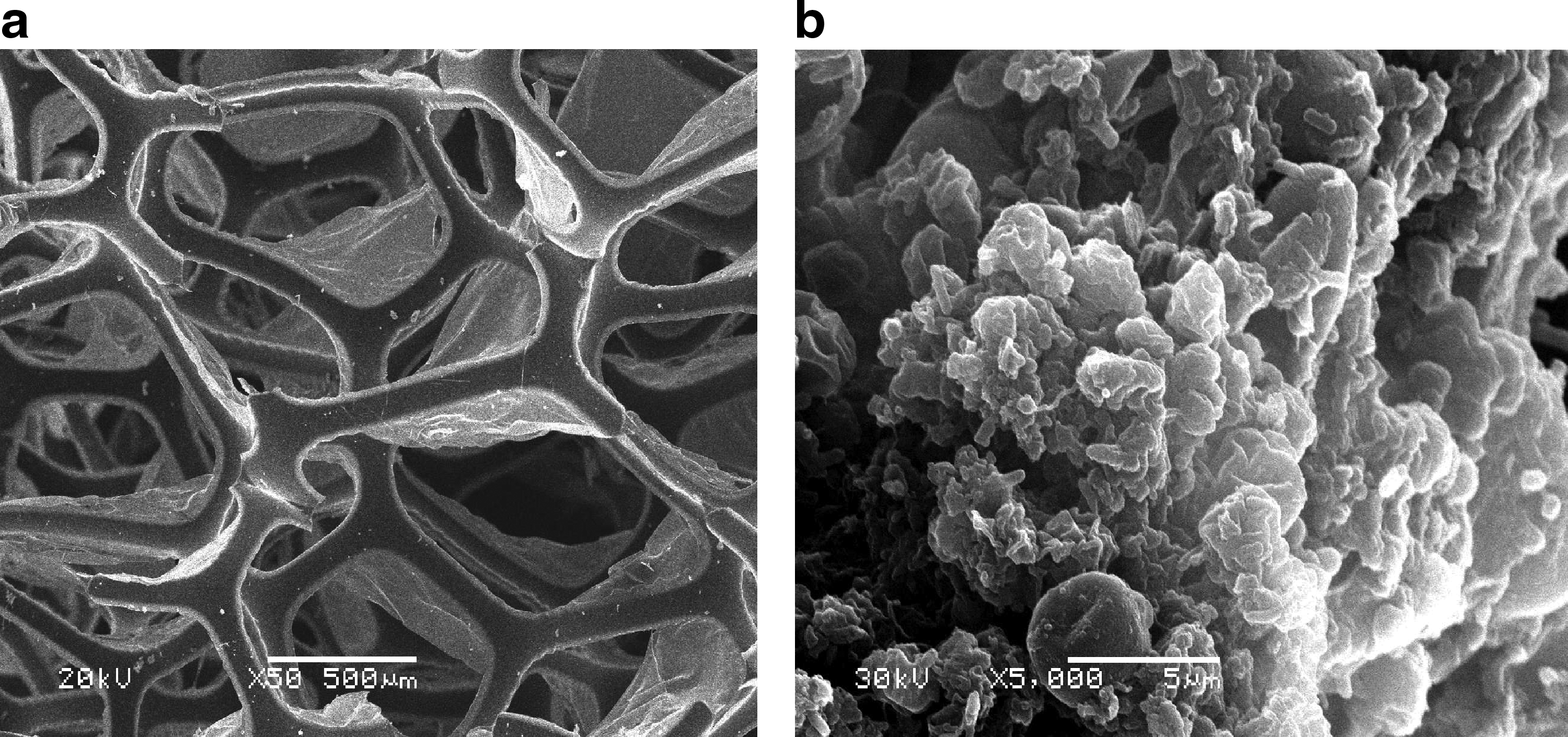
SEM images:
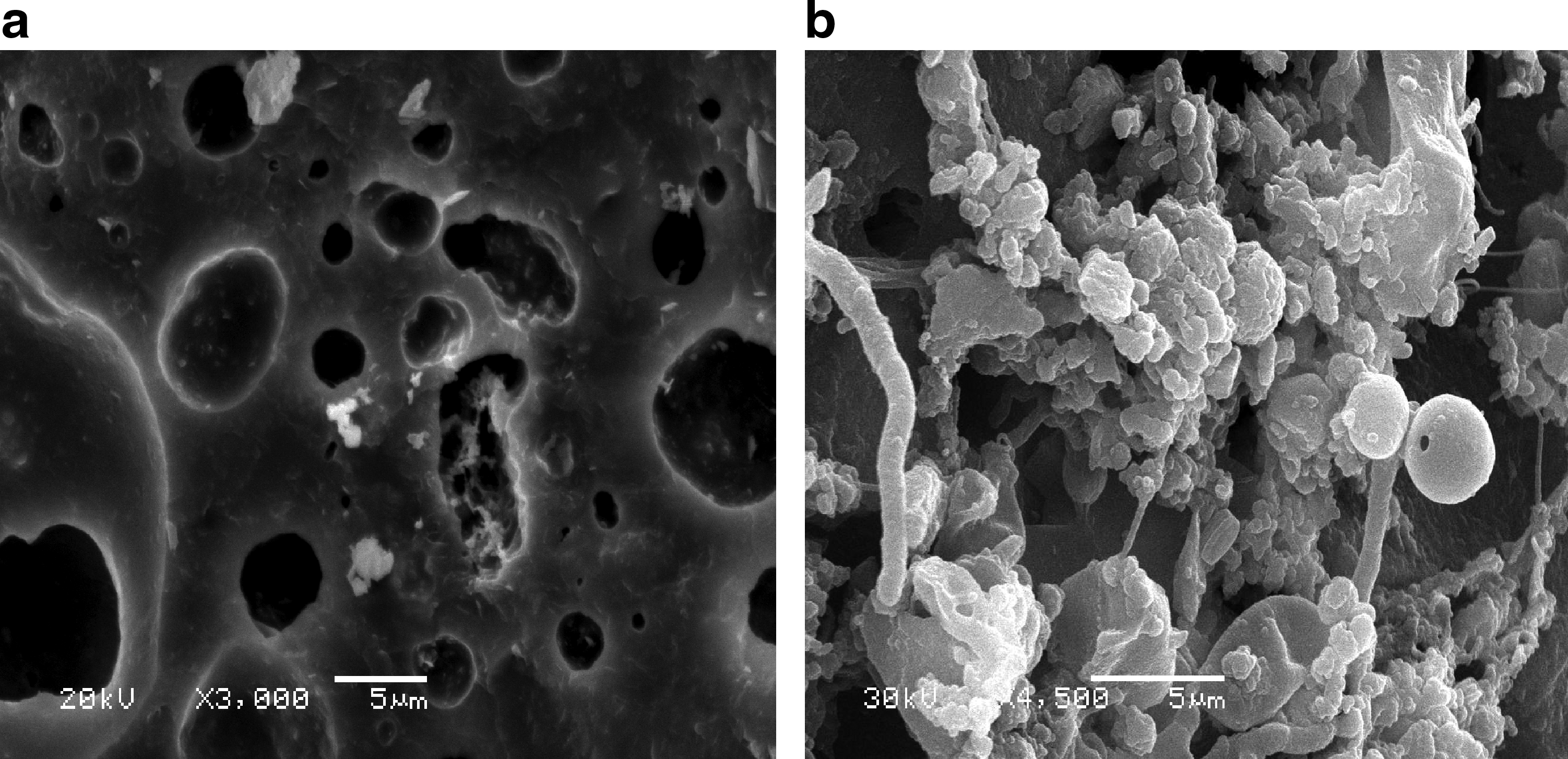
SEM images:
Each cylindrical plexiglass reactor had an upflow configuration, with a height of 500 mm and an in inner diameter of 90 mm. The medium reached 315 mm in height, with an effective volume of 2.0 L. Air was introduced into the reactors with an air diffuser, located 30 mm from the downside inlet, and the air flow rate was controlled with an air flow meter. The raw wastewater was pumped into the BAF with a peristaltic pump, entering at the base, and the treated effluent left near the top. The flow rate ratio of air to water was controlled at 5:1.
Analytical methods
All analyses and procedures were performed in accordance with standard methods. The CODCr was measured by the standard method based on potassium chromate (K2Cr2O7) oxidization and sulfuric acid digestion (SEPAC, 2002). NH3-N, NO3-N, and NO2-N were analyzed with colorimeters (HI93715, HI93728, and HI93708 instruments, respectively; Hanna Instruments). The pH was measured with a pH meter (HI9025, Hanna Instruments), and the dissolved oxygen (DO) concentrations were measured with a DO meter (HI9143, Hanna Instruments). After inoculation, biofilm formation in the BAFs was confirmed by scanning electron microscopy (SEM, HitachiS-450, Hitachi Ltd).
Start-up of BAFs
The seed bacterium was microorganism B350 BioBugs purchased from Bio-Systems Corporation (Beloit). The B350 BioBugs have been developed through extensive research, and include 14 strains of bacteria selected for their ability to perform under both aerobic and anaerobic conditions, with 30–50 billion microbes per gram.
The two BAFs were operated under the same conditions, and reached a steady state after operation for 6 weeks.
Results and Discussion
Enrichment culture of nitrifying bacteria
Nitrifying bacteria are typical autotrophic bacteria. If the substrate concentration of organic carbon in the solution is too high, it will increase the proliferation rate of the heterotrophic bacteria, so that the autotrophic nitrifying bacteria are inhibited and may not become the dominant bacterial group (Sumino et al., 1992). In this study, in the start-up phase, inorganic carbon was used as the sole carbon source to achieve an enrichment culture of nitrifying bacteria, allowing the nitrifying bacteria to become the dominant bacterial group, to improve the efficiency of ammonium nitrogen removal.
After 10 days, the efficiency of ammonia removal by the macroporous polyurethane BAF reached 50%, and after 16 days, the efficiency of ammonia removal by the haydite BAF also reached about 50%. After 40 days, the ammonia removal by the macroporous polyurethane BAF stabilized at about 97%, and that of the haydite BAF stabilized at about 93%. This confirmed that a nitrifying bacterial enrichment culture with good ammonia removal efficiency had been obtained. Figures 1b and 2b show that both carriers were loaded with large, oval-shaped, and rod-shaped nitrifying bacteria. The macroporous polyurethane BAF started more rapidly and achieved greater ammonia removal than the haydite BAF. This is because the macroporous polyurethane has a macroporous structure and active chemical groups, such as OH, COOH, CONH2, and NH2, distributed on the carrier surface, which are not only suitable for the immobilization of microorganisms (by both adsorption and covalence), but also allow good transmission of substrate and products. Carriers with macroporous structures also guarantee better three-phase mixing of air, wastewater, and carrier, and increase the three-phase mass transfer propulsion (Trinet et al., 1991).
Effect of the C/N ratio on CODCr, NH3-N, and total nitrogen removal
The two BAFs were operated at different C/N ratios of 3, 5, and 7, while the NH3-N loading rates was maintained at 0.52 kg (m3 d)−1, the organic loading rates were varied from 1.56 to 3.64 kg CODCr (m3 d)−1, and HRT was 4 h. Figures 3–5 show the performances of the two BAFs in the removal of CODCr, NH3-N, and total nitrogen (TN) at different C/N ratios.
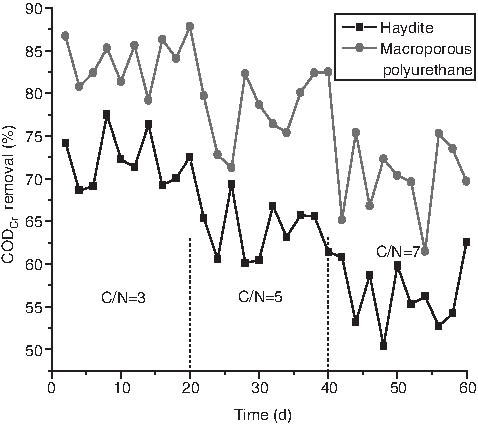
CODCr removal in the macroporous polyurethane BAF and haydite BAF at different C/N ratios. CODCr, chemical oxygen demand; BAF, biological aerated filter; C/N, carbon-to-nitrogen.
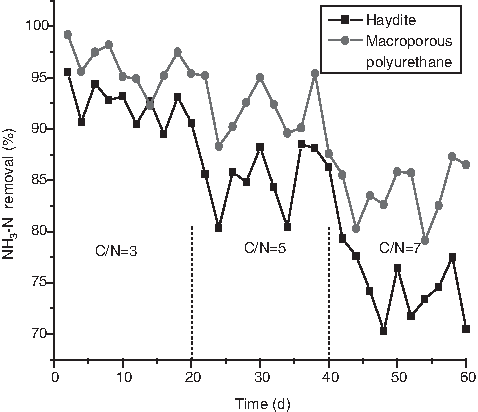
NH3-N removal in the macroporous polyurethane BAF and haydite BAF at different C/N ratios. NH3-N, ammonia nitrogen.
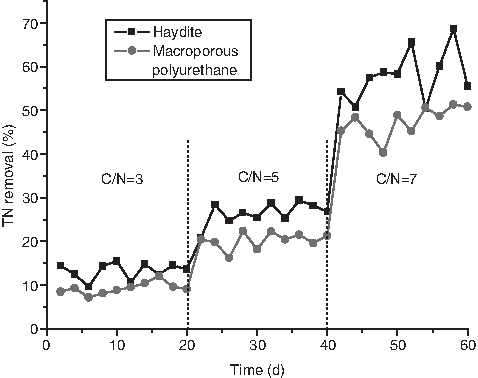
TN removal in the macroporous polyurethane BAF and haydite BAF at different C/N ratios. TN, total nitrogen.
From Fig. 3, it can be seen that the macroporous polyurethane BAF was slightly more efficient in CODCr removal than the haydite BAF at different C/N ratios. CODCr removal by the macroporous polyurethane and haydite BAFs was 61.5%–87.8% (on average, 77.4%) and 50.4%–77.5% (on average, 64.1%), respectively, at different C/N ratios. Both the BAFs were excellent in removing CODCr, but CODCr removal by both BAFs decreased markedly with increasing C/N ratios. When the C/N ratios were 3, 5, and 7, CODCr removal by the macroporous polyurethane BAF was 84.0%, 78.2%, and 70.0%, respectively, and removal by the haydite BAF was 72.1%, 63.9%, and 56.4%, respectively. These observations confirm that the C/N ratio affects the efficiency of CODCr removal. With higher C/N ratios but a constant NH3-N loading rate, the organic substrates were not fully degraded before they were discharged from the BAF.
As shown in Fig. 4, both BAFs displayed excellent NH3-N removal. NH3-N removal by the macroporous polyurethane and haydite BAFs was 79.1%–99.2% (on average, 90.5%) and 70.3%–95.5% (on average, 84.0%), respectively. When the C/N ratios were 3, 5, and 7, NH3-N removal by the macroporous polyurethane BAF was 96.1%, 91.6%, and 83.9%, respectively, and NH3-N removal by the haydite BAF was 92.3%, 85.2%, and 74.6%, respectively. These results indicate that when the C/N ratio was 7, NH3-N was not fully nitrified before it was discharged from the BAF compared with its nitrification at a C/N ratio of 3. This can be explained as follows. There is competition for the substrates, DO, and habitation area of the medium in the BAFs between the heterotrophic bacteria and autotrophic bacteria. The higher organic loading induced by an increase in the C/N ratio could favor heterotrophic bacteria over autotrophic bacteria (Liu et al., 2008). As a result, nitrification is inhibited and NH3-N removal decreases rapidly. From Fig. 4, it is also clear that the polyurethane foam BAF achieved greater NH3-N removal than the ceramic BAF. This is because the macroporous polyurethane has a large specific surface area, high porosity, and large pores, so the DO can be evenly distributed, and the medium is more suitable for the multiplication of nitrifying bacteria.
Different efficiencies for TN removal were observed in the two BAFs (Fig. 5) when the C/N ratio was increased from 3 to 7. When the C/N ratio was 3, the average TN removal efficiency was 9.3% for the polyurethane foam BAF and 13.2% for the haydite BAF. When the C/N ratio was 7, the average TN removal efficiency was 47.4% for the macroporous polyurethane BAF and 58.0% for the haydite BAF. These results show that below the low C/N ratio, the organic carbon required by the denitrifying bacteria was inadequate, whereas when the C/N ratio was increased, the denitrifying bacteria had sufficient organic carbon, and the TN removal efficiency increased (Ovez et al., 2006; Modin et al., 2007). From Fig. 5, it is also clear that the haydite BAF achieved slightly higher TN removal than the macroporous polyurethane BAF under the same operating conditions. This is because haydite has low porosity and a low packing density, which can provide a better microanaerobic environment for denitrifying bacteria, thus making the denitrification rate on the haydite BAF slightly higher than that on the macroporous polyurethane BAF, resulting in slightly higher TN removal rates.
Influence of the NH3-N loading rate on CODCr, NH3-N, and TN removal
The two BAFs were operated at different NH3-N loading rates of 0.04–0.52 kg (m3 d)−1, and the organic loading rates were varied from 0.28 to 3.64 kg CODCr (m3 d)−1, while the C/N ratio was maintained at 7 and HRT at 4 h. Figures 6–8 show the performances of the two BAFs in CODCr, NH3-N, and TN removal at different NH3-N loading rates.

CODCr removal in the macroporous polyurethane BAF and haydite BAF at different NH3-N loading rates.
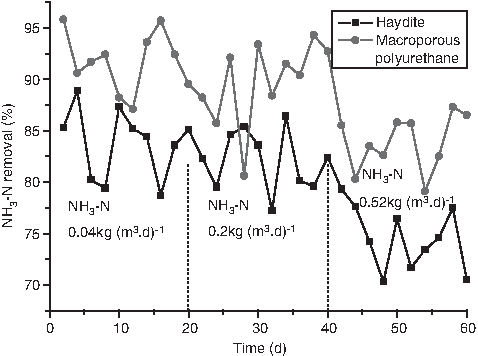
NH3-N removal in the macroporous polyurethane BAF and haydite BAF at different NH3-N loading rates.

TN removal in the macroporous polyurethane BAF and haydite BAF at different NH3-N loading rates.
Figure 6 shows the performances of the two BAFs in CODCr removal at different NH3-N loading rates. It is clear that an increase in the NH3-N loading rate resulted in a decrease in CODCr removal for a fixed C/N ratio. The average CODCr removal efficiency of the macroporous polyurethane was 92.5%, 82.4%, and 69.9% for NH3-N loading rates of 0.04, 0.2, and 0.52 kg (m3 d)−1, respectively, and the average CODCr removal efficiency of the haydite was 84.0%, 74.3%, and 56.4%, respectively. These observations confirm that the NH3-N loading rate at a constant C/N ratio affects the CODCr removal, because increasing the NH3-N loading rate produces a higher organic loading rate when the C/N ratio is constant, so the organic substrates are not fully degraded before they are discharged from the BAFs. We also found that the macroporous polyurethane BAF had a slightly higher CODCr removal efficiency than the haydite BAF at different NH3-N loading rates.
The data in Fig. 7 show NH3-N removal at different NH3-N loading rates, and indicate that a slight reduction in the NH3-N removal efficiency was induced by an increase in the NH3-N loading rate. The average NH3-N removal efficiency for the macroporous polyurethane BAF was 91.7%, 89.7%, and 83.7% for NH3-N loading rates of 0.04, 0.2, and 0.52 kg (m3 d)−1, respectively, and the average NH3-N removal efficiency of the haydite BAF was 83.8%, 82.1%, and 74.5%, respectively. These results are a consequence of the competition between the heterotrophic bacteria and autotrophic bacteria (Sarioglu, 2005). The increase in the NH3-N loading rate at a constant C/N ratio that resulted in higher organic loading favored the heterotrophic bacteria over the autotrophic bacteria. From Fig. 7, it is also clear that the macroporous polyurethane BAF showed slightly greater NH3-N removal than the haydite BAF.
As shown in Fig. 8, both BAFs showed excellent TN removal when the NH3-N loading rate was increased from 0.04 to 0.52 kg (m3 d)−1. TN removal by the macroporous polyurethane and haydite BAFs was 40.3%–58.8% (on average, 49.9%) and 50.4%–68.7% (on average, 56.4%), respectively. Different NH3-N loading rates did not greatly affect the TN removal efficiency. This is because the C/N ratio was maintained at 7, so with an increasing NH3-N loading rate, the organic loading also increased, providing sufficient carbon for the denitrifying bacteria, so both BAFs displayed excellent TN removal.
Influence of HRT on CODCr, NH3-N, and TN removal
The two BAFs were operated at different HRTs of 2–6 h, while the C/N ratio was maintained at 7, the NH3-N loading rate was varied from 0.31 to 1.04 kg (m3 d)−1, and the organic loading rate was varied from 2.17 to 7.28 kg CODCr (m3 d)−1. Figures 9–11 show the performance of the two BAFs in CODCr, NH3-N, and TN removal at different HRT.

CODCr removal in the macroporous polyurethane BAF and haydite BAF at different HRTs. HRT, hydraulic retention time.
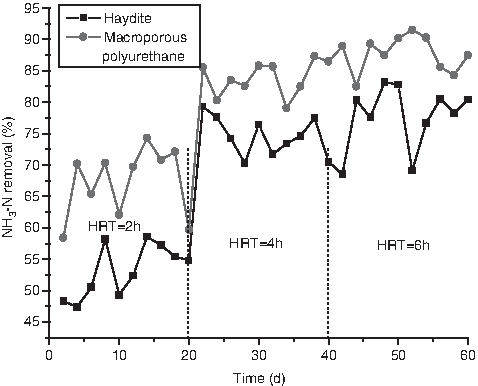
NH3-N removal in the macroporous polyurethane BAF and haydite BAF at different HRTs.
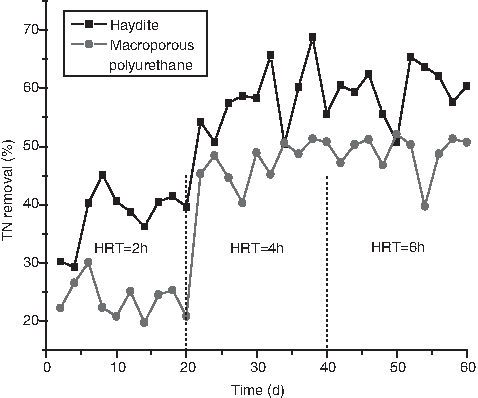
TN removal in the macroporous polyurethane BAF and haydite BAF at different HRTs.
Figure 9 shows that the macroporous polyurethane BAF was slightly more efficient in CODCr removal than the haydite BAF. Both BAFs both showed excellent removal of CODCr at HRTs longer than 4 h: 61.5%–80.6% (on average, 71.7%) and 50.4%–70.5% (on average, 60.9%), respectively. However, CODCr removal by the macroporous polyurethane and haydite BAFs decreased markedly when HRT was 2 h, and the two BAFs showed average CODCr removal of 43.1% and 37.2%, respectively. These results indicate that at shorter HRT, the organic substrates were not fully degraded before their discharge from the BAFs. Moreover, shorter HRTs led to a higher hydraulic loading, with consequent stronger scouring of the medium surface and lower biomass on it, resulting in less CODCr removal (Liu et al., 2008).
As shown in Fig. 10, both BAFs achieved excellent NH3-N removal when the HRT was longer than 4 h, with reduced NH3-N removal when the HRT was 2 h. NH3-N removal by the macroporous polyurethane and haydite BAFs was 79.1%–91.5% (on average, 85.8%) and 68.5%–83.2% (on average, 76.1%), respectively, when HRT was longer than 4 h. When HRT was 2 h, NH3-N removal by the macroporous polyurethane and haydite BAFs was 58.4%–74.3% (on average, 67.3%) and 47.4%–58.6% (on average, 53.2%), respectively. These results indicate that when HRT was short (2 h), NH3-N was not fully nitrified before its discharge from the BAFs compared with its nitrification when HRT was longer than 4 h. From Fig. 10, it is also clear that the macroporous polyurethane BAF achieved slightly higher NH3-N removal than the haydite BAF.
TN removal by the macroporous polyurethane BAF was not higher than that by the haydite BAF, as shown in Fig. 11. When the HRT was longer than 4 h, TN removal was 39.7%–52.1% (on average, 48.1%) and 50.4%–68.7% (on average, 58.9%), respectively. When HRT was 2 h, these values decreased to 19.7%–30.1% (on average, 23.7%) and 29.3%–45.1% (on average, 38.2%), respectively. These results indicate that when the HRT was 2 h, NO2-N and NO3-N were not fully denitrified before their discharge from the BAFs compared with their denitrification at HRTs longer than 4 h.
These observations confirm that HRT can affect the efficiency of CODCr, NH3-N, and TN removal. This can be explained as follows. First, when HRT was 2 h, the bacteria did not have sufficient time to metabolize those pollutants. Second, the hydraulic load increased as HRT decreased, and the impulsive force of the water and gas also increased with the increased hydraulic load. The enhanced impulsive force could force some biofilm out of the BAFs, lowering their removal efficiency.
Conclusions
1. Under the same operating conditions, the efficiencies of CODCr and NH3-N removal by the macroporous polyurethane BAF were higher than those of the haydite BAF, but the efficiency of TN removal by the haydite BAF was higher than that of the macroporous polyurethane BAF.
2. With an increase in the C/N ratio, the efficiencies of CODCr and NH3-N removal by the two BAFs decreased, and at the same time, the TN removal efficiency of the two BAFs increased.
3. At a constant C/N ratio and increasing concentrations of NH3-N and CODCr, the efficiencies of NH3-N and CODCr removal decreased, but the efficiency of TN removal did not change perceptibly.
4. With a reduction in HRT, the efficiencies of NH3-N, CODCr, and TN removal by the two BAFs all decreased.
The greater removal of NH3-N and CODCr in the BAF containing macroporous polyurethane is attributable to its macroporous structure and active chemical groups, which are not only suitable for the immobilization of microorganisms but also allow good transmission of the substrate and products. The average efficiency of the BAF with macroporous polyurethane in removing TN was 48.1%, although which was cleared was lower than that of the filter with haydite. Therefore, macroporous polyurethane can be used as the carrier material in BAF bioreactors.
Footnotes
Acknowledgments
The authors gratefully acknowledge the financial support of the Sustentation Program of Science and Technology of China (2006BRD01B03), the Key Research Program of Gansu Province (2GS064-A52-036-02, GS022-A52-082), and the Innovation Research Fund for Young Scholars of Lanzhou University (LZU200505).
Author Disclosure Statement
No competing financial interests exist.