




Abstract
Abstract
Biomass production, with its primary goal of producing energy or biochar on fertile agricultural land, is of questionable economic and environmental benefit if it has to compete with agricultural crops and thereby raise the price of food. We investigate the possibility of biomass production on contaminated land (BCL). BCL could improve both the economic and environmental outlook of bioenergy, as it would bring a positive economic return from contaminated land without replacing food crops. Large areas of contaminated land, such as former mining areas, would be more economical than small, fragmented, or high-value contaminated sites, such as those in former industrial belts of cities. High-biomass, high-value, and deep-rooted energy crops are particularly desirable for the dual benefits of economic return and pollution control through phytostabilization. To avoid contaminant entry into the food chain, plant uptake could be minimized by plant selection and by application of soil conditioners. The latter, however, would involve additional costs, which may reduce the economic feasibility of BCL. Moreover, with respect to the environmental effects of BCL, investigations must address effects of root exudates and decaying leaf litter on contaminant solubility, and effects of deep roots on the creation of macropores that could facilitate contaminant leaching. Detailed assessment of the value of contemporaneous phytostabilization, which occurs during BCL, is necessary to determine whether this technology is the best management option of a given site.
Introduction
Currently, biofuels have a high public profile, because they have the potential to partially replace fossil fuels. However, they displace agricultural crops and result in the clearing of indigenous forests. By heavily subsidizing crops for energy, some countries, such as the United States, have promoted the conversion of vast swathes of land from food to energy crops (Economist, 2007). The first effects were visible in 2006 when the corn price increased in Mexico owing to falling corn imports from the United States (Boddiger, 2007). In Germany, the price of beer rose after farmers switched from growing barley crops to rapeseed and corn for biofuels (CBC, 2007). Oxfam warns that the biofuel rush could harm the world's poorest people by raising food prices. The OECD/FAO (2011) estimated that by 2020, 12% of the global coarse grain production as well as 33% of the sugar production will be used to produce ethanol. Additionally, 16% of the global production of vegetable oil will be used to produce biodiesel. In 2007, the BBC reported that the rush by big companies and governments in Indonesia, Colombia, Brazil, Tanzania, and Malaysia to win a slice of the EU biofuel pie threatens to force poor people from their land (BBC, 2007). Much attention is given to renewable energies, which include biofuels. They are promoted under the label of sustainability. Sustainability is based on the principle that the requirements of the present must be satisfied without compromising the ability of future generations to meet their own needs (WCED, 1987). In his investigation, Friedemann (2007) argues that new technologies are required, because biomass production for biofuels is currently unsustainable. Not all countries are converting agricultural croplands to biofuel production. For example, South Africa has prohibited using staple crops, such as corn, for biofuels (Valentine et al., 2012).
The European Commission estimated that the European cereal production in 2020 will not only be able to meet EU internal food and bioethanol demands but also have a surplus for export (European Commission, 2007). The U.S. Agricultural Department had reported that only 19% of the corn production in 2007 was destined for human food and 22% for bioethanol production. It also stated that only 4% of the cereal production was destined for bioethanol production. The increase in cereal prices, in the year 2007, could also have been caused by other significant factors such as low cereal harvests, speculative practices on raw material global markets, increases in energy prices, and the dollar's devaluation against the euro.
Biochar, a form of charcoal that is added to soil, is attracting scientific attention because of its purported potential to offset global climate change (Lehmann, 2007). Biochar may also improve soil fertility by increasing the capacity of a soil to store water and nutrients and to immobilize pollutants (Novak et al., 2009). Cao et al. (2009), for example, showed that biochar strongly sorbs Pb and atrazine in soil. Although biochar, unlike bioenergy, is not currently under consideration for government subsidies, converting agricultural land to biochar production entails threats to food security similar to those encountered in converting the land to bioenergy production. However, biochar that is produced from agricultural wastes such as corn stover will not have such undesirable effects.
The task of balancing land requirements for food, biofuel, fiber, timber, soil organic carbon, biodiversity, and ecological services will become increasingly challenging because of Earth's increasing population. Consequently, it is important to investigate the possibility of biomass production on contaminated land (BCL) which is not suited for growing healthy food. Using such biomass for nonfood products would not only make profitable use of such land, but also improve soil quality. The strategy of BCL includes many processes (Fig. 1), which require optimization, so that BCL can return a profit while minimizing the environmental risks posed by the contaminants.
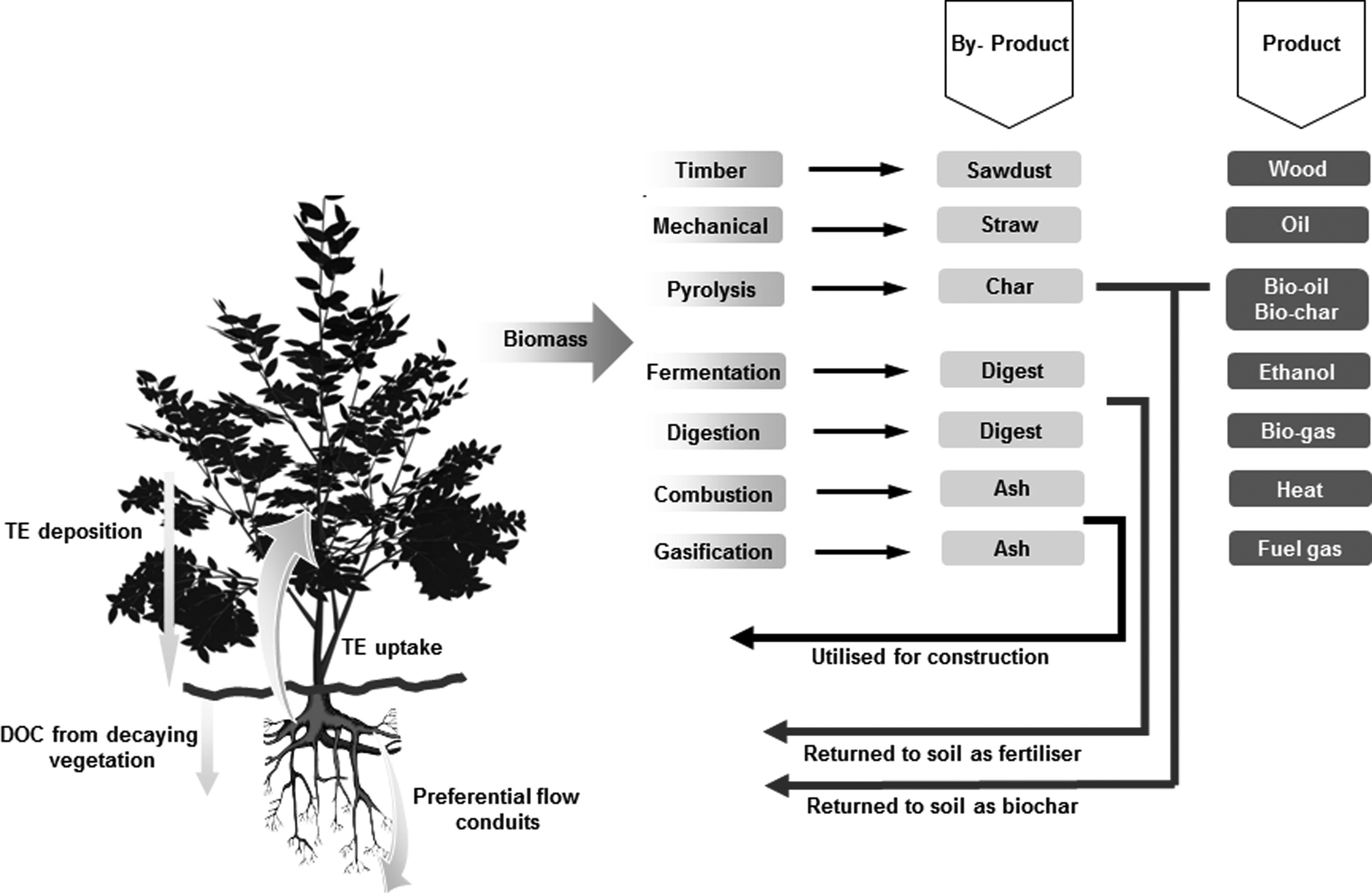
Scheme of possible products deriving from the biomass on contaminated land (BCL) and possible trace element (TE) pathways into the environment. DOC, dissolved organic carbon.
Contaminated Land: An Extensive But Underutilized Resource
Worldwide, some 22 million ha of land have been degraded by contamination (GACGC, 1995). In the European Union, potentially soil-contaminating activities have occurred on nearly 3 million sites (EEA, 2007b). Trace elements (TEs) are the most important contaminants at 37% of these sites (EEA, 2007a). In the United States, there are 1200 contaminated sites cited in the National Priority List for treatment. Approximately 63% of these sites include TE contamination (HWC, 1996). Although the extent of contaminated land in poor countries is difficult to assess because of the lack of published data, it is well documented that there are problems arising from increasing industrialization and lax environmental regulations. Table 1 lists areas worldwide that are contaminated with TEs. Poor countries also lack the wherewithal to remediate or secure contaminated land. Even rich countries can only afford to clean up the most contaminated sites. Germany is cleansing just 30% of the soils removed from contaminated sites in soil remediation facilities (SRU, 2004). The rest is stored, without further treatment, in waste-disposal facilities. The limited funds available for remediation have spawned interest in low-cost in situ treatment techniques, such as electrokinetic soil remediation and phytotechnologies (SRU, 2004). With the exception of phytostabilization, the effectiveness of these technologies has yet to be demonstrated on a large number of sites.
With the estimation of an area of 2 ha per site (Ashworth et al., 2005), 37.3% (EEA, 2009) of the total contamination is caused by TEs.
Includes also general chemical soil degradation.
With the estimation of an area of 2.6 ha per brownfield (Palmer et al., 2008).
TE, trace element.
Some contaminated land may be left untreated and be covered by concrete or buildings. On average, in the EU member states, the sealed area, the part of the soil surface covered with an impermeable material, is ∼9% of the total area. Soil sealing as a consequence of urbanization results in the loss of productive soil and creates a horizontal barrier between soil, air, and water, thus affecting aspects of the ecosystem such as groundwater recharge, mitigation of flood risks, and the maintenance of biodiversity (EEA, 1999).
Biomass Production on Contaminated Land: General Considerations
Lal and Pimentel (2007) proposed that bioenergy plantations could be established on agriculturally marginal or surplus lands, including degraded or drastically disturbed soils. Restoring degraded soils through biofuel plantations could be a win-win-win strategy. Uncontaminated fertile land would not be taken out of food production or cleared of indigenous vegetation. Moreover, using contaminated land for food biomass production could reduce the risks posed by the contaminants, fix carbon, increase soil fertility, and provide a biofuel feedstock for producing carbon-neutral energy. Furthermore, the increasing use of degraded soils for energy crops would reduce the need of using crop residues for biofuel production, which would find better use being reincorporated into the soil, thereby preventing soil degradation and increasing soil carbon.
The goal of BCL is to produce biomass for economic output and, simultaneously, to minimize environmental risks posed by the contaminants. This limits the selection of suitable bioenergy crops. Crops used for BCL should minimize contaminant propagation with erosion, leaching, and plant harvest. Traditional annual crops such as corn and soy, which have been used for biofuel production recently, are less suitable at mitigating negative environmental effects than deep-rooted plants, such as various tree species. They cause 50 times more soil erosion than sod crops such as hay (Sullivan, 2004), because the soil between the rows can wash or blow away. Furthermore, frequent soil tillage can become a source of contaminated-dust dispersion, which would result in a risk for the people working on-site and those living nearby.
The choice of crops should be based on the fate of the TEs, their potential biomass production, and ecological aspects such as providing a habitat for native animal species and avoiding the introduction of potentially invasive species. The uncontrolled spread of weeds, such as Miscanthus, that have been introduced for biomass production has already cost €10 billion in Europe (Hulme et al., 2009). Ideally, nonfood or fodder crops would be used so as to reduce the potential of TEs entering the food chain.
While large areas of contaminated land present human health risks from contaminants entering crops and groundwater, they are seldom contaminated to the point that plant growth is reduced. Dickinson (2000) pointed out that on many contaminated sites, weed competition and other soil factors may be more significant in plant growth than the presence of soil contaminants. Whether negative effects are expected depends largely on the TEs present and their total and available concentrations. Plant growth may be improved by fertilization. For this purpose, biowastes such as sewage sludge may be used on contaminated land that cannot be applied to uncontaminated agricultural land because they contain contaminants. Contaminant accumulation in the soil may be offset by removing the contaminants during harvest (Dickinson, 2000). Before BCL is applied on a large scale, a contaminant mass balance is required. Most contaminated lands do not produce any revenue, and thus even if the output only equals the input, the increased value of the soil is a positive benefit.
TEs in BCL
TE uptake thresholds in bioenergy crops
TE concentrations in food crops
The use of TE-contaminated soils for growing food crops or crops intended for human consumption is restricted, as it involves considerable health risks for the consumers because of the plants' TE accumulation. However, due to the lack of arable land or due to lack of controlling mechanisms, such soils are often cultivated. Table 2 gives the accumulation rates and translocation factors (TFs) for various plant species as a function of soil contaminant concentration. Although uptake and allocation of TEs in plants differ widely among genotypes (Florijn and Vanbeusichem, 1993; Dunbar et al., 2003), because of the lack of data, no distinction between cultivars in this compilation has been made. Tobacco (Nicotiana tabacum) accumulates Cd to relatively high levels compared to other species (Kayser et al., 2000; Wenger et al., 2002; Keller et al., 2003). Concentrations of Cd in field-grown tobacco leaves range from <0.5 to 5 mg Cd/kg and higher (Lugon-Moulin et al., 2004). Corn (Zea mays) can accumulate Zn in the shoots (Keller et al., 2003; Luo et al., 2005). Zinc concentrations of more than 1000 mg/kg have been found on highly contaminated soils without significant decrease in biomass (Wenger et al., 2002). Copper concentrations of ∼25 mg/kg were found in sunflower (Helianthus annuus) (Madejon et al., 2003; Fässler et al., 2010) and Pb concentrations of 12–79 mg/kg in pea (Pisum sativum) shoots (Cooper et al., 1999; Castaldi et al., 2009). The concentrations of Cd in potato (Solanum tuberosum) plants decreased in the order of roots>shoots>> tubers (Dunbar et al., 2003). In the tubers, TEs are mostly present in the skin and can thus be removed to a large extent by peeling (Dudka et al., 1996; Piotrowska and Kabata Pendias, 1997).
n.d., not determinable.
Besides the TE uptake through plant roots, the deposition of dust particles on leaves and stems plays a significant role in the transfer of TEs from soil to plants (Robinson et al., 2008). If a site is entirely vegetated, the stabilizing effect of plant roots will mitigate the generation of wind-borne dust and rain-induced redistribution of contaminated solid material from soil (Robinson et al., 2008). However, when a land is used for agricultural purposes, it may not be entirely vegetated; thus, a surface deposit of TEs on aerial portions of the plants is possible.
TE concentrations and allocation in various tree species
In contrast to the growth of food crops on contaminated soils for energy production, the use of nonfood plant species such as willow, poplar, and birch bear insignificant health risks to humans. Table 4 shows the TE accumulation, bioconcentration factors (BCFs), and TFs of tree species mainly used for biofuel/biomass production. Salix sp. and Populus sp. have been known for their rapid growth, and Betula pendula is a pioneer plant, grows quickly, and has a low demand on the soil nutrients. Hermle et al. (2006) investigated the interactions of young trees with metal-contaminated soil containing Cu/Zn/Cd/Pb at concentrations of 640, 3000, 10, and 90 mg/kg, respectively. Populus tremula, Salix viminalis, and Betula pendula exceeded metal concentrations of 5–10 mg/kg Cd, 15–20 mg/kg Cu, 150–200 mg/kg Zn. Concentrations of 0.6–4 mg/kg are considered toxic by Kabata-Pendias and Pendias (2001). Cadmium accumulation in the three above species decreased in the following order: P. tremula>S. viminalis>B. pendula. In contrast, there was little variation in Cu concentrations in aboveground parts of plants. They usually ranged between 2 and 20 mg/kg, regardless of both soil Cu concentrations (Wallnöfer and Engelhardt, 1984) and the type of soil (Baker and Brooks, 1989).
Various clones of Salix sp. and Populus sp. have been used for biofuel/biomass production and are known to accumulate, preferably, Cd and Zn. Mertens et al. (2007) investigated the uptake of Cd and Zn by Populus robusta, Quercus robur, Fraxinus excelsior, and Acer pseudoplatanus. The litter-fall Cd and Zn concentrations for poplar, in contrast to the other investigated species, were higher than the Cd and Zn concentrations in the sediment, which were ∼10 and 1200 mg/kg, respectively. For Salix, BCFs have been reported on a wide range of soils, including those with marginally elevated Cd concentration. In field studies, BCF reached values of up to 16.8 for woody stems and 27.9 for foliage (Table 2). Tissue concentrations of Cd tend to be higher in highly contaminated soils, but BCFs are lower, indicating that Cd transfer from soil to plant is less efficient in highly contaminated soils. BCFs are generally higher for foliage than for stems. However, as the tree ages, the proportion of the leaf biomass decreases, for example, in the 2nd year, the foliage accounts for ∼25% of the aboveground plant biomass; thus, the overall amount of Cd is usually higher in the stems (Dickinson and Pulford, 2005).
Pulford and Watson (2003) examined sycamore, birch, and willow trees, which had established sporadically on sites contaminated by waste from an explosives' factory and a chromium-processing works. They reported that Cr, Pb, and Cu accumulated mainly in the roots. This is in agreement with Castiglione et al. (2009) who observed that the Cu concentrations in various clones of Populus nigra and Populus alba were mainly in the roots. In the aboveground biomass, Hasselgren (1999) observed that Salix growing on sludge-amended plots had highest levels of Cu, Pb, and Cr in the stems, whereas Zn, Cd, and Ni occurred at the highest concentrations in the leaves. Mertens et al. (2007) found that the Cd and Zn concentrations in Populus sp. were lowest in the wood, followed by the bark, and highest in foliage. This had been indicated by previous research (Greger and Landberg, 1999; Klang-Westin and Eriksson, 2003; Pulford and Watson, 2003). This is also in agreement with the study of Unterbrunner et al. (2007). In their study, the lowest concentrations of Cd and Zn were generally found in the wood of the investigated tree species (Salix caprea, Salix purpurea, Salix fragilis, Salix sp., Populus tremula, Populus nigra, and Betula pendula). With few exceptions, the authors observed a general trend of Cd and Zn concentrations increasing from wood toward leaves (wood<bark<leaves). These findings indicate that a special attention has to be paid to the fate of TEs in the litter fall.
Implications of TE uptake and allocation in the management of BCL
Depending on the plants species used, bioenergy production can take different forms. Z. mays and sugarcane (Saccharum sp.), for instance, are sugar-rich plants, which can be anaerobically digested (fermented) to produce methane or ethanol. Woody energy species, such as Salix sp. and Populus sp., are cellulose- and lignin-rich species, and may be converted to energy through incineration (combustion) or gasification. Fermentation of cellulose would also be possible. However, the total energy input is higher than for corn ethanol (IEA, 2007), thus making it less feasible than combustion or gasification. In the case of oil-rich species such as the H. annuus, raps (Brassica napus), and white mustard (Sinapis alba), the energetically valuable oil is extracted directly from the seeds.
In the context of BCL, there are several environmental issues that have to be considered when converting the biomass to energy. During the anaerobic digestion of sugar-rich species, the organic matter of the plants is converted into methane, and thus the contaminant concentration in the residual digestion mix will rise. There are conflicting reports as to the severity of this effect. At high concentrations, TEs negatively affect the enzymes responsible for the breakdown of biomass. However, studies on water hyacinth (Eichhornia crassipes), channel grass (Vallisneria spiralis), and water chestnut (Trapa bispinnosa), grown or employed for phytoremediation of metal-rich acidic industry effluents, depicted that the biogas production was significantly higher from the slurry of these plants than from the control plants (Singhal and Rai, 2003; Verma et al., 2007). In contrast, Wong and Cheung (1995) showed that TEs decrease the production of biogas according to the degree of toxicity of the four metals tested. This was in the order of Cr>Ni>Cu>Zn. However, Cr uptake by plants is low (<0.5 mg/kg dry matter). Irrespective of the biogas yield, the fate of the digestate must be considered. After anaerobic digestion, the digestate could be applied as a fertilizer on the land where the plants were grown. This would return any TE to the soil, possibly in a different chemical form. The toxicity and environmental fate of these reapplied metals, therefore, needs to be carefully investigated.
In the case of woody species, TEs play a lesser role in the bioenergy yield, as the wood TE concentration is seldom so high as to influence the energy released by burning. The wood can be burned directly pressed into high-density wood pellets for home and business heating or into high-density wood logs for use in wood stoves and campfires (Neary and Zieroth, 2007). Particles are released during incineration. In wood produced on a contaminated land, these particles may have elevated concentrations of TEs and may pollute surrounding areas. Power stations that use a combination of fossil fuels or municipal wastes and wood pellets or only wood pellets would not be confronted by such problems, as they have installed filters to remove TEs from their fossil fuel or municipal waste emissions. Their use in decentralized heating, however, would be almost impossible, as it would require an installation of filters in houses and smaller businesses. This would create a great logistical and technological challenge that would subsequently increase the price of heating, and thereby makes it unattractive.
Alternatively, wood may be gasified. Fuel gas can be produced from biomass and related materials by partial oxidation to give a mixture of carbon monoxide, carbon dioxide, hydrogen, and methane with nitrogen if air is used as the oxidant. Alternatively, it can be produced by steam or pyrolytic gasification (Bridgwater, 2006). In this case, high concentrations of elements decrease the quality of the wood fuel. The inorganic ions are known to influence the thermal degradation of polysaccharides and lignin. It has been found that a number of ions (Na, K, Ca, Mg, Zn, Pb, and Cu) act as catalysts, resulting in a lowering of decomposition temperature and an increase in the char yield (von Scala, 1998; Adler et al., 2008). While this would be disadvantageous to the production of biofuels, it would also be advantageous for the production of biochar.
The concentrations of most inorganic ions are significantly higher in bark than in wood (Pulford and Watson, 2003; Unterbrunner et al., 2007). These tissues are slow to enter the decomposition cycle. Accumulated metals can, therefore, be immobilized in a metabolically inactive compartment for a considerable period of time, if the contaminated trees are not reused for other purposes, such as combustion, which accelerates the return of the TEs to the environment (Pulford and Watson, 2003). The bark of small-diameter stems can form a large proportion of the harvestable shoot biomass produced in short-rotation crops. Adler et al. (2008) suggested that the increasing length of the rotation period would improve the wood-fuel quality, because the proportion of element-rich bark would decrease with the increasing age of the shoot population. Old-growth forests have not only lower TE concentrations but also dense wood with high energy content, compared to wood from fast-growing plantations. In the latter cases, the wood is of low density and low calorie and is not even good enough to burn in a fireplace (Odum, 1996). Additionally, fast-growing plantations require much energy to plant, fertilize, weed, thin, cut, and deliver. In the case of old-growth forests or long-rotation plantations, the trees would be finally available for use after 20–90 years—a period that, according to Odum (1996), is too long for the industry and the consumers to be considered as a renewable fuel. However, the immense tree plantations for wood (industrial and for combustion) and paper with a yearly worldwide production of 3274 Mm3 and 323 Mt (von Barata and Fochler-Hauke, 2003), respectively, have harvesting cycles of ∼50 years, and nobody claims that this wood is not renewable. Moreover, longer rotation periods are less economically important in BCL, since the land is not producing revenue, and the trees have a phytostabilizing potential.
The use of vegetable oils, such as soya bean, palm, sunflower, peanut, and olive oil, as an alternative fuel has been around for 100 years, since the inventor of the diesel engine, Rudolph Diesel, first tested peanut oil, in his compression ignition engine (Shay, 1993). The accumulation of TEs in plants can affect the fatty acid composition of the plant (Bidar et al., 2008). Of even greater importance is the free fatty acid and moisture content, which are key parameters for determining the viability of the vegetable oil transesterification process (Shay, 1993). The uptake of TEs in the seeds of plants is usually low compared to the other plant portions (Fässler et al., 2010). In some cases, seed crops grown on contaminated land may be safely used as animal fodder or used for oil production (Murillo et al., 1999). However, measurements of sunflower oil have shown that it can contain significant amounts of Fe, Cu, Pb, Cd, and Ni, which pose reduced oil quality and endanger human health (Ansari et al., 2008; Ansari et al., 2009). Angelova et al. (2004) found that the oil obtained from rapeseed and sunflower growing near nonferous-metal works exceeded the maximum permissible concentrations for Pb, Cd, and Cu (Table 3). From rapeseed, 5% of the Zn, 25% of the Pb, 18% of the Cu, and 47% of the Cd were transferred into the oil during the oil extraction. In the case of sunflower seeds, the levels were 7%, 30%, 3%, and 2%, respectively. However, the production of sunflower oil methyl esters (SOME/biodiesel) is performed via alkaline-catalyzed transesterification of crude sunflower oil (Rashid et al., 2008). Due to the alkaline medium, the transport of metals into SOME/biodiesel is unlikely. Nevertheless, the oil quality and its TE content are subjects that have to be investigated before using oil-rich plants for BCL.
Environmental risks of BCL related to TEs
Risk of TE leaching
If water filtrates homogenously through the soil, the leaching of soluble cations is unlikely because of the high cation-exchange capacity of the soil. However, the presence of elevated TE concentrations at greater soil depths indicates the preferential transport of metals, either chelated by root exudates or humic substances (Robinson et al., 2009) or bound to mobile soil colloids. High soil pH can result in the solubilization of humic substances and can facilitate the downward mobility of metals via preferential flow pathways. Preferential water flow has significantly enhanced the transport of contaminants such as pesticides (Flury et al., 1995) and radionuclides (Bundt et al., 2000). In a study by Knechtenhofer et al. (2003), two main causes of preferential flow are described: (1) the fast flow through macropores such as earthworm burrows, root channels, and other biopores, or through cracks and fissures arising from aggregate formation or swelling–shrinking of expandable clay minerals; (2) the fingered flow through a homogenous soil matrix due to wetting-front instabilities initiated by differences in water content, wettability of solid surfaces, trapped air, textural boundaries, or by heterogeneous infiltration at the soil surface caused, for instance, by microtopography or by inhomogeneous distribution of hydrophobic plant litter. In the investigation of metal distribution in a shooting-range soil by Knechtenhofer et al. (2003), only the preferential flow paths below 20 cm played a significant role in the spatial distribution of Pb. The preferential flow paths below 20 cm are associated with roots surrounded by relatively wide root channels, which represent large macropores for water flow, in which the Pb may be transported as aqueous ions or bound by colloidal particles (Kretzschmar et al., 1999).
In dry climates, deep-rooted tree species would be more suitable, as they can continue to transpire after grasses have browned off, thus minimizing drainage. They would also help to control erosion, create an aerobic environment in the root zone, and add organic matter to the substrate, which would bind the contaminant. However, the roots of such trees might also create preferential flow pathways that actually exacerbate contaminant leaching. Knechtenhofer et al. (2003) showed which preferential flow was the main mechanism for the downward mobility of otherwise immobile elements. Vegetation with a high biomass production may also enhance TE mobility through the generation of organic compounds. Wang and Benoit (1996) demonstrated the importance of these factors in the Pb flux in a contaminated forest, showing that washout of mobile Pb-organocomplexes from soil could increase with increasing soil pH.
Re-entering of TEs through foliage and litter decomposition
During the growth and harvesting processes in BCL, the plant material might be dispersed via wind or water erosion. This possibility has raised a concern for the contamination of adjacent environments (Perronnet et al., 2000). In addition, the nonprofitable parts from crops would remain on site. In cases where such plant material contains high metal concentrations, a redistribution of the TEs may occur. The effect of the remaining plant biomass re-entering the soil can concentrate even more metals in the upper soil profile. Control measures should be taken, especially in cases where dispersion from wind and water is to be expected (Van Nevel et al., 2007).
Besides TE-contaminated foliage and litter dispersion, also the decomposition of this foliage and litter is of concern, as the speciation of the TEs released is not thoroughly researched. Biodegradation of plant residues in soil is part of the major process of the taking up of elements by plants during their life cycle. Biodegradation of organic residues rich in TEs is therefore hypothesized to play a key role in the cycling of potential pollutants in soil. Consequently, the study of the dynamics of metals and of organic matter in soils needs to be linked to each other (Boucher et al., 2005). Depending on the nature of the organic ligand, immobilization of metals, for example, in the case of humic substances, is possible, whereas in the case of fulvic-like substances, a mobilization could take place (Schnitzer, 1978; Stevenson, 1994).
Accumulation of litter on the forest floor is often evident near smelters (or other TE pollution sources), primarily as a result of suppressed litter decomposition (Strojan, 1978; Freedman and Hutchinson, 1980; Berg et al., 1991). The way in which the TEs entered the system influences their effect on the organic substrate decomposition. Cotrufo et al. (1995) and Khan and Joergensen (2006) showed that the influence of the TEs on the decomposition of organic substrates was lower when the metals were in an aged, contaminated soil. Spiking soil with 10 mmol/kg CdCl2 decreased the biodegradation of cellulose by ∼60% and that of rice straw by 65% after 8 weeks of in vitro incubation (Hattori, 1991, 1996). Most inhibition occurred in the first two weeks. This initial lag phase was ascribed to the time for the microflora to adapt to TEs present in the medium. It may also be due to the kinetically-limited specific adsorption of metals into the soil matrix, thereby reducing their bioavailability after 2 weeks.
Cotrufo et al. (1995) studied the decomposition of organic matter from two Quercus ilex stands with different metal loadings in soil and litter. They showed that contaminated litter decomposed ∼1.5-fold slower than noncontaminated litter, irrespective of soil pollution. Berg et al. (1991) stated that the presence of TEs caused a stronger reduction in decomposition of Scots pine needles during later stages of decay. Over a 2-year period, in vitro degradation of Cu- and Zn-contaminated and noncontaminated Scots pine needles was studied. The authors observed a 20% reduced weight loss for the contaminated needles, which mainly occurred after the first 6 months. In contrast, Boucher et al. (2005) observed that with respect to C mineralization, there was no significant difference between metal-rich and metal-free leaves of Arabidopsis halleri. It was observed that the in vitro decomposition time of the A. halleri leaf pieces (6–10 mm) amounted to only 60 days, and no weight loss could be detected. Earlier findings by Hattori (1996) were verified by Boucher et al. (2005). They noted that the first step of C mineralization corresponds to the biodegradation of easily biodegradable C. Hattori (1996) had also observed that the types of organic materials with maximum inhibition by Cd were not single substances, but complex substances. During this step, it is suggested that only low concentrations of TEs were in a free ionic form in the soil solution, with the result that there were no toxic effects toward the soil microflora. In the second stage of biodegradation, more resistant plant C, such as hemicellulose, cellulose, and lignin, was biodegraded. An inhibition of the decomposition of metal-rich litter suggests that TEs still associated with residual metal-rich leaf material associated with the cell wall render it more resistant to biodegradation (Boucher et al., 2005). Another explanation could be the need for various microorganisms to decompose complex substances. However, the low biodiversity, which is a characteristic of a heavy metal-contaminated soil, reduces the decomposition of complex substances. This aspect is discussed in the following section.
In all cases, noncontaminated litter had higher N concentrations, which could lead to higher rates of mass loss during the early stages of decomposition as shown by Berg et al. (1987) in the case of Scots pine needle litter. However, the N concentrations were not the limiting factor in neither the control nor in the contaminated litter. It can be assumed that the difference in N concentration for control and contaminated litter did not override the effect of TEs on the decomposition process. In the study by Berg et al. (1991), the lower lignin concentration in the control litter may be another factor causing a higher mass-loss rate. However, the mass-loss rate also tended to increase with time and decreasing distance from the smelter. The metal pollution thus affected and lowered the quality of the local litter, resulting in a lower decomposition rate in the late stages of decay. With respect to the study of Boucher et al. (2005), the influence of lignin could not be observed, as the decomposition time of 60 days was too short.
The results indicate that both the litter quality, including TE concentration, and the pollution level in the soil contribute to the reduced decomposition rates observed in metal-contaminated forest areas (Berg et al., 1991). Thus, an accumulation of litter as in the area of North France near the Auby Zn-smelter where Populus sp., Salix sp., and Betula sp. as well as some metalliferous plants are growing is to be expected. The high amount of biomass could be collected to avoid wind dispersal and used for the production of biogas. The digest could then be applied back on the area of origin. However, it is important to undertake an analysis of the bioavailability and the speciation of the TEs.
Availability of metals after litter decomposition
During the decomposition process, metals from the litter may be released through leaching and mineralization, or they may be enriched. Most short- and long-term studies have shown an enrichment of metals during the decomposition process. Nilsson (1972) found an increase of Cu and Zn concentrations during the degradation of spruce needle litter. Lead and Cu concentrations were found to increase more than Cd and Zn (Laskowski and Berg, 1993; Lomander and Johansson, 2001). This indicates that Cu and Pb are less mobile than Cd and Zn in the leaf litter. By contrast, Van Nevel et al. (2007) state that metals associated with organic matter are expected to be more mobile and bioavailable compared to metals adsorbed on mineral particles, because the organic matter decomposes in the soil, and thus releases the metals. Perronnet et al. (2000) reported that Cd and Zn associated with organic matter of Thlaspi caerulescens were highly available in soil. In their experiment, the leaves of T. caerulescens were incorporated into noncontaminated soil, where after Cd and Zn from these leaves exhibited a high mobility; Cd and Zn were transferred in large amounts to subsequent crops of rye grass (Lolium perenne) and T. caerulescens. Scheid et al. (2009), however, observed that the sorbed metals (Cu, Cd, Pb, and Zn) were strongly bound in the litter even after 2 years of decomposition.
Decreasing risks through soil conditioners
As this subject has been discussed in detail by Robinson et al. (2009), only a brief introduction into the matter will be given. BCL could employ naturally occurring or artificial soil amendments, such as liming material, phosphate, zeolite, bentonite, clay, Fe metal, Fe and Mn oxides, and organic matter, which reduce the solubility of some inorganic contaminants (Cheng and Hseu, 2002). These amendments reduce contaminant solubility by promoting the formation of insoluble precipitates or by enhancing the soil's capacity to bind them. The latter can be achieved directly through the addition of adsorbent material or indirectly by adjusting the soil's pH–Eh conditions to promote contaminant absorption onto the soil's matrix.
Chemical immobilization using phosphate amendments, such as mineral apatite, synthetic hydroxyapatite, and phosphate salts, reduces the solubility of cationic contaminants by the formation of TE–phosphate complexes (McGowen et al., 2001) and by increasing the number of negatively charged exchange sites (Bolan et al., 1999). Phosphate amendments such as hydroxyapatite are effective in reducing the solubility of Pb, Cd, Zn, Al, Ba, Co, Mn, Ni, and U. However, phosphate has been shown to promote the solubility of As and Cr (Seaman et al., 2001), possibly through reduced sorption of the oxyanions due to an increase in pH and competition from PO43−. A variety of inorganic and organic amendments have been used to reduce TEs to the less-soluble, less-toxic TE species. Bolan and Duraisamy (Bolan and Duraisamy, 2003) showed that organic amendments, such as animal and poultry manures rich in dissolved organic carbon, are effective in reducing Cr(VI) to Cr(III). Also, the addition of the bauxite residue, red mud, as demonstrated by Lombi et al. (2002), reduced the solubility of Cd, Pb, Ni, and Zn, but not Cu. The remedial action of this material was attributed to a rise in the soil pH and adsorption of the metals onto oxides of Fe and Mn. Liming has been demonstrated to be effective in reducing the solubility of TE cations in variable-charge soils. The effectiveness of raising the pH on metal immobilization also depends on the liming agent. Bolan and Duraisamy (Bolan and Duraisamy, 2003) found that Ca(OH)2 was less effective than KOH in immobilizing Cd2+ due to competition between Ca2+ and Cd2+ for adsorption sites.
Soil organic matter is an important parameter for TE retention in soil, and studies such as those conducted by Yuan and Lavkulich (1997), where the adsorption capacity of a soil for Zn was reduced by 72%, when 11% of the organic C content was lost, underline this fact. Therefore, organic soil amendments, such as compost, poultry litter, natural/commercial humic substances, or industrial sewage sludge, have often been applied on TE-contaminated soils to redistribute solved TEs to less-available fractions, thus reducing TE mobility and ameliorating TE toxicity to plants (Shuman, 1999). However, the application of organic amendments does not always have the desirable effect, as depending on their composition (humic acids, fulvic acids, humin, and nonhumic substances), they can either increase or decrease TE mobility. This apparent contradiction lies in the fact that metals interact with organic components in both the solid and solution phases of soil. Insoluble or solid organic matter can immobilize TEs through physical and chemical adsorption (Cheng and Hseu, 2002), whereas soluble organic matter can solubilize TEs and promote TE leaching, but render them unavailable for plant uptake (Robinson et al., 2009). Furthermore, the pH of the soil has to be adjusted in a pH range between 5.5 and 7 to carefully control the mobility of TEs. If the soil pH is lower than 5.5, then TEs become solubilized, whereas if it is above 7.0, humic substances could dissolve and subsequently increase metal leaching.
The addition of biochar to reduce the mobility and availability of TEs is also an option. Biochar properties vary greatly, depending on the production conditions (such as pyrolysis temperature). For instance, biochar produced below 400°C has a low pH, low CEC, and small surface area (Lehmann, 2007). The biomass used to produce biochar has also a significant influence. Mohan et al. (2007) observed that oak bark char had significantly adsorbed higher amounts of metal per unit surface area (0.5157 mg/m2 for Pb2+ and 0.213 mg/m2 for Cd2+) compared to pine bark char, oak wood char, and pine wood char. Under any production scenario, the CEC of freshly produced biochar is relatively low. Only aged biochar shows high cation retention, as in Amazonian Dark Earths (Lehmann, 2007). The pH value of biochar can vary, and this affects the mobility of various TEs once applied to the soil. The biochar used by Hartley et al. (2009) had a higher pH (9.94) than the ones used by Mohan et al. (2007), and as a consequence the mobility of As increased. Arsenic is known to be less mobile in acidic soils. Owing to the adsorption effect on iron-oxide surfaces, the role of pH in relation to As adsorption is important, especially on iron-oxide surfaces, where an alkaline pH causes desorption of As(V) and sometimes arsenite [As(III)] (Hartley et al., 2009). Consequently, before biochar is applied on a contaminated soil, the TE species and the biochar properties have to be known to avoid any possible risks.
Ecological Aspects
In the context of BCL, various ecological aspects have to be taken into account concerning the choice of farming system, plant species, and biodiversity of used areas. The farming system could be either monocultures or polycultures. Monocultures in bioenergy crops are especially vulnerable when inadequate soils or stress conditions, such as drought and pathogens, are present. These issues are important in any sustainable system to guarantee its economic and ecological stability (Schröder et al., 2008). For this purpose, a rotation-cropping schedule or a multispecies community is desirable. According to Hooper and Vitousek (1997), not only the species diversity but also functional characteristics should be taken into account in the management of an ecosystem.
The plant species selection should be site specific. They must be tolerant to metal pollution, combined with a low ability for metal uptake in and adapted to local climate, thus lowering amendments and water consumption. The use of local ecotypes would diminish these concerns and, moreover, would solve the problem of the introduction of invasive species, or the use of genetically modified plants and the effects on public opinion (Wolfe and Bjornstad, 2002). Many proposed biomass plants, such as the Eucalyptus or the Miscanhtus, are invasive species in some parts of the earth. Bioinvasion costs the United States (Bright, 1998) as well as other countries (Hulme et al., 2009) billions of dollars per year. For instance, Johnson grass, introduced as a forage grass, is now an invasive weed in many states. Another fast-growing grass, Miscanthus, is currently being proposed as a biofuel. It has been described as “Johnson grass on steroids” (Raghu et al., 2006).
Former mining areas or areas that have been the object of an environmental contamination through an accident are considered as potential areas for BCL. However, each area has to be evaluated differently such as in the case of the Guadiamar Valley. Following a breach in the dam of the Aznalcollar mine-tailing ponds in April 1998, the Guadiamar Valley was heavily contaminated by 2 hm3 of slurry and 4 hm3 of acid waters. A strip of some 62-km long and with a mean width of 500 m was contaminated by the spill waters, which had a high concentration of metals and metalloids in solution, in particular, Zn, Fe, Mn, Cu, Pb, Ni, Cd, and As. Approximately 4500 ha of agricultural land devoted to dry-land agriculture and fruit and olive tree orchards were affected by the pollution (Cabrera et al., 1999; Olias et al., 2005). Studies by (Madejon et al., 2004, 2006) found high TE accumulation in surviving trees, such as P. alba, Q. ilex, and Olea europaea, shortly after the mine spill. However, 7 years after the mine spill, there was only limited transfer of these elements to the aboveground parts of woody plants (Dominguez et al., 2008). Biofuel production would thus present a low risk of contaminants entering the food chain through plant uptake. However, parts of the land provide an ecological connection between the Sierra Morena in the north and the Doñana world heritage wetland area in the south, thus restricting its suitability.
Additionally, the production of BCL has to be balanced with the ecological benefits of leaving the vegetation in perpetuity. This becomes clear in some TE-contaminated areas, where a specific flora has developed (e.g., Galmei-Vegetation in Germany), and the ecological aspects of this development should be taken into account (Engelen and Holtz, 2000). According to some authors, the richness of flora growing in metalliferous soils is invaluable as a source of genetic base for research (Whiting et al., 2004; Brady et al., 2005). There is a trend to protect biodiversity that can meet the agricultural/industrial development in these kinds of soils (Dickinson et al., 2009). Vidic et al. (2009) showed that the genome size is related to the survival of species in TE-contaminated soils. The work showed that the tolerant species had small genomes in comparison with the nontolerant.
The species richness and plant composition affect the conservation and management of the land (Hooper and Vitousek, 1997). However, this at first appearing restriction can be used as an advantage in the case of BCL. It has been shown that a mixed planting of certain plant species may enhance or reduce metal uptake (Koelbener et al., 2008), and therefore have an influence in their adaptation to certain contaminated soils. As an example, Frerot et al. (2006) found that mixtures of one or two species of grasses with the Fabaceae Anthyllis vulneraria had positive effects on survival, growth, and regeneration of the plant communities in TE-contaminated soils in the Mediterranean region. In such cases, multifunctional plant communities within the BCL systems would facilitate not only the maintenance of essential ecological functions, but also the improvement of the final biomass yield.
The use of local ecotypes poses a logistic challenge, as the plants used for BCL should be available in large numbers (seeds, seedlings, or cuttings) and produce an easily accessible biomass. Therefore, a plant selection and multiplication program should be undertaken before BCL. The selection, especially for herbaceous species, which are important to stabilize the soil and reduce dust production, would occur through natural selection on site. The selection of plant species with large biomass, such as trees, could occur with pot trials with trees from the surrounding areas. After the selection, a multiplication could be undertaken in nurseries.
Biomass Production on Contaminated Land: Economic Considerations
A thorough economic evaluation of BCL would entail a detailed discussion of many intricate issues, and are beyond the scope of this article. The health costs, export risks (nontariff trade barriers), costs deriving from retiring the land, costs of rehabilitating the land, and costs of ecologic restoration are important to consider. There are, too, considerations of BCL profits derived from primary products, such as wood and biofuels. Moreover, there are secondary benefits such as carbon credits, environmental risk mitigation as well as site ecology, and cultural value. This article has considered such aspects only briefly.
Additionally, even an economic analysis of just the BCL revenues is difficult because of the many parameters that have to be taken into account: Of great importance are biological parameters (plant species, TE concentrations and species, and plant growth), infrastructure (area size, accessibility, and distance from processing plant), climate (irrigation and seasonal length), as well as economic conditions (oil price and market). A detailed analysis on one specific region has been made by Lewandowski et al. (2006). In their study, different economic estimation techniques were applied.
Location and size of BCL areas
The greatest drawback of producing BCL is the land's noncontiguous nature. Many contaminated sites are small and remote, thus making a large-scale production with a processing plant nearby economically difficult. However, some areas such as former mining areas and extensive agricultural lands can be considered as suitable sites to for BCL because of the large areas that normally imply the need of remediation. Phytotechnologies such as phytostabilization have been proposed to carry out the remediation of these areas (Mendez and Maier, 2008a, 2008b), but their primary objective is risk mitigation, rather than profitability. In this sense, BCL could contribute with economic returns.
Biofuel viability
Biomass is currently the only renewable source of fixed carbon, and thus is the only source in the long term for the production of transport fuels. Approximately 57.7% of the worldwide oil consumption is used for transportation activities (IEA, 2006). The market for biofuels is a wide and expanding field, particularly as China's expansion increases. Demand is also characterized by seasonal peaks: rising heating oil consummation during winter and greater gasoline demands in the summer. Although biofuels have a huge potential, their economic viability is highly dependent on both the oil price and on governmental subsidies, the price of oil in the world market being of crucial importance. The starting point, from which the production of biofuels becomes profitable, is known as the break-even point (balance point). In the European Union, the break-even point for different biofuels can be reached from US$ 75 to 80 per barrel of oil in relation to colza oil, US$ 90 per barrel in relation to bio-ethanol, US$ 100 per barrel to biodiesel, and US$ 155–160 per barrel to fuels attained by second-generation technologies. In the USA, the break-even point for bio-ethanol corresponds to oil prices ranging from US$ 40 to 50 per barrel. This means that its production is not economically favorable if oil prices are below US$ 40 per barrel. In the case of producing ethanol in Brazil, the break-even point oscillates between US$ 30 and 35 per barrel. For biofuels derived from vegetal oils, a technology in its incipient stage, the indicator is estimated to be about US$ 60 per barrel. The need to reduce the production cost of biofuels is urgent, as current prices rely heavily on government subsidies (Escobar et al., 2009). According to Yang et al. (2009), the subsidy rates in the USA, EU, and Brazil are 54%, 72.8%, and 23.3%, respectively. In the long term, these very substantial amounts may not be able to compete with sectors requiring a financial aid.
Carbon credits
Carbon credits or other incentives in mitigating greenhouse gas could be the key to unlocking biochar economic potential. The global carbon credit economy will eventually (and sooner rather than later) come to mirror the economy of physical transformations. Each carbon credit will represent 1 ton of carbon either removed from the atmosphere (through sequestration) or saved in the sense that it is not released, that is, a ton of carbon avoided. Since > 8,000,000,000 t of carbon are currently being added to the atmosphere each year through the burning of fossil fuels, this represents a possible annual 8 billion carbon credits, rising under business as usual to as much as 10 billion/year. At a price of US$ 10 per carbon credit, this represents a total pool of US$ 100 billion. If the price rises to US$ 100 per carbon credit (predicted by many), then the total would represent a pool of US$ 1000 billion or US$ 1 trillion—a very large pool of funds. At this point, the carbon credit economy would be comparable in size to the current fossil fuel economy (Mathews, 2008).
To use biochar for carbon credits, it must be certified as carbon negative. There is evidence that biochar may persist in soils over thousands of years. However, there are also reports about both the decomposition of biochar in the field and the biotic and abiotic degradation of biochar in laboratory settings, with rates varying according to the production procedure. As to the effects on other types of soil carbon, there is evidence of the beneficial effects of biochar on crop productivity, which in turn have positive impact on soil carbon sequestration. On the other hand, there is also evidence that, owing to stimulation of soil biological processes, biochar may actually lead to a loss of native soil carbon in boreal forests. As yet, the lack of sufficient experimental data makes it difficult to determine the application of whether biochar to soils is an adequate offset to CO2 emissions from burning fossil fuels (Reijnders, 2009).
Forestry
Forestry is unsuitable for the carbon-credit economy due to its duration. The maximum time that forestation projects are guaranteed by the organizations offering carbon offsets by forestation studied by Gössling et al. (2007) is 100 years (i.e., the assumed lifetime of a tree). This is a much shorter period than the time necessary to remove all fossil-fuel-derived CO2 from the atmosphere. Additionally, the wood and paper industry is an industry, which in contrast to biofuels and biochar, would give a positive economic return in ∼50 years from plantation. Thus, it is unsuitable for short-term financial outputs. Nevertheless, during the lifetime of the long-term plantations, the use of wood residues and complementary fellings that are available after applying environmental guidelines can be considered in terms of bioenergy production. This may avoid the fire risk in forest areas (European Environment Agency, 2010). After harvest, the wood intended for the market should not exceed regulatory values, such as the one proposed by Swiss legislation and EPF industry standards. They state that the wood intended for the market should not exceed concentrations of 50 mg/kg Cd, 90 mg/kg Pb, and 40 mg/kg Cu (ChemRRV, 2005; EPF). However, these values were seldom exceeded in the cited studies of this article (Table 2), thus making wood derived from BCL safe for the market.
Long-term development of BCL sites
BCL's main goal is to gain economic profit from nonsuitable agricultural soils while contemporaneously decreasing environmental risks or decrease the contamination levels in metal-contaminated soils. The number of plant species used in the rotations within a BCL system is site specific and depends on the initial TE concentration. These plant species should be metal tolerant, and at the beginning of the process, it should be assumed lower economics returns (Fig. 2). As the system develops, available and total metal concentration is decreasing in soil due to the uptaking in crops or the elimination of foliage and residual parts of the plants. As a result of successive harvests, the metal concentration in soil decreases, and this fact will allow the introduction of plant species with lower tolerance to metals, increasing the biodiversity of the rotations. Depending on the initial soil TE concentration, at a long term, the whole process may allow the introduction of food crops without any risk for population. Independent of the initial soil TE concentration and the possible long-term development of TE-contaminated sites, BCL will have provided a sustainable use of soil resources and alleviated the pressure put on the fertile land, which has to produce not only food but bioenergy as well.
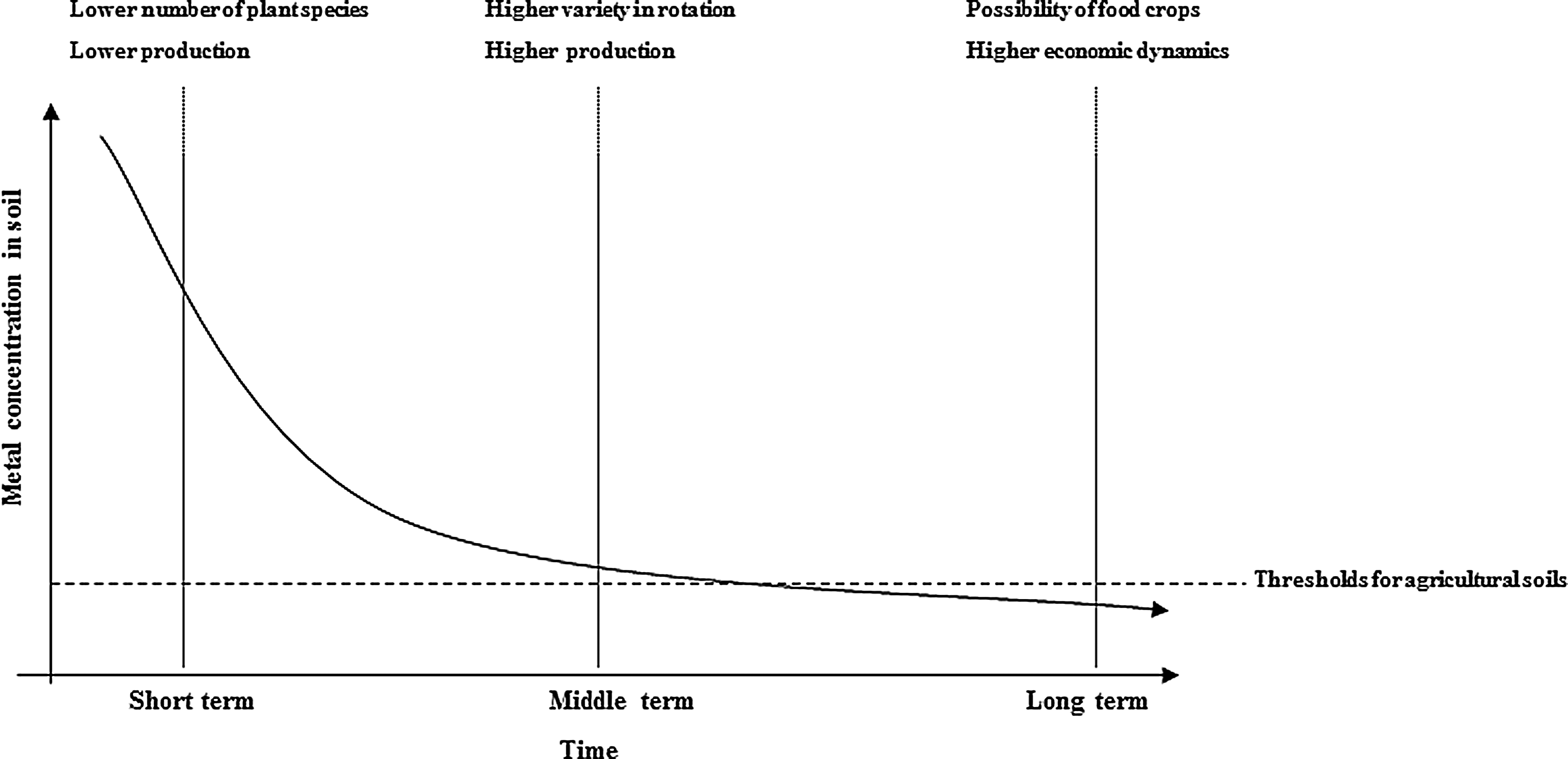
Example scheme in the BCL production chain.
Conclusions
The increasing demand for energy will make it necessary to explore the use of biomass. This, however, should not come at the cost of food production. There are many contaminated sites worldwide that are unsuitable for food production, thus making the production of BCL a worth-while option. The use of nonfood plant species would reduce the risk of contaminants entering the food chain. Long rotation periods, similar to the ones for wood and paper production, would reduce the concentrations of TEs in wood. A constant monitoring of these sites is, however, necessary to avoid the risk of TE distribution through TE leaching and soil erosion. Additionally, the fate of byproducts such as digestate (biogas production) and ash (combustion) has to be discussed. They could be applied on the areas of origin as fertilizer. However, a previous risk assessment has to be made to determine the possible toxicity and the bioavailability as to avoid any unnecessary risks. Although there are still many open subjects to be discussed and assessed, BCL gives the option to transform cost-intensive contaminated sites into sites that produce a positive economic return and would give the people living near these areas a new income.
Footnotes
Acknowledgment
We would like to thank the DFG (German Research Foundation) for financing Michael Evangelou and the Spanish Ministerio de Economia y Competitividad and UPCT (Ref. RYC-2010-05665) for funding Hector Conesa.
Author Disclosure Statement
No competing financial interests exist.