




Abstract
Abstract
Removal of heavy metals from mine tailing effluent has been a long-standing environmental management issue in the mining industry. This article aims to investigate molybdenum [Mo(VI)] removal by waste slag, which has not been fully tested. In this study, the removal efficiencies of Mo(VI) from aqueous solutions by desulfurization steel slag (DSS), converter steel slag (CSS), and cinder (CI) were examined and compared against that of loessial soil (LS). Results showed that the sorption isotherms fitted the Langmuir model well, and the Langmuir adsorption capacity (Q0) of the four sorption media generally complied with the following order: DSS>CSS>CI>LS. Adsorption reaction was found to follow the pseudo–second-order rate, and the adsorption of Mo(VI) was sensitive to pH values. The four adsorbents exhibited a significant Mo(VI) removal at low pH values (e.g., pH 3–4.5), but such adsorption decreased rapidly when pH was >5; little adsorption occurred when the pH value was >8. The competitive effect of PO43− and SO42− with Mo(VI) for adsorption associated with the four sorption media followed the order LS>CI>CSS>DSS, and moreover, the effect of PO43− on the adsorption of Mo(VI) was observed to be stronger than that of SO42−. Desorption capacity of the four sorption media generally complied with the following order: LS>CI>CSS>DSS.
Introduction
Recently, many relevant studies have been concerned about the removal of cations (e.g., manganese, iron, aluminum, and copper) (Daubert and Brennan, 2007; Zhong et al., 2007) and anionic complex species (e.g., cyanide, arsenate, and chromate) (Fathima et al., 2005). Because the main state of Mo in oxidization conditions is MoO42−, removal of MoO42− from wastewaters is of significant environmental importance. Adsorption seems to be an economical alternative for removing heavy metals from water, and in any circumstance, materials with low cost and long-standing nature are preferred. Consequently, adsorption via the use of recycled sorption media has been deemed an economic alternative for removing heavy metals from water.
Cinder (CI) is a solid waste generated from coal combustion in industry and district heating. In China, about 60 million tons of coal are produced per annum in Liaoning province. It is deemed an ideal material for the removal of pollutants with low cost in wastewater treatment due to the porous structure with rich oxides. Steel slag is a major waste product generated during the steel-making process. Angang is one of the main steel plants in Liaoning province, which produces more than 2 million tons of steel slag every year. These waste products have triggered a great potential for recycling both CI and steel slag as sorption media (e.g., adsorbents) to treat the mine tailing effluents. A few studies have investigated the adsorption characteristics of the slag for the removal of heavy metals and dyes from wastewaters (Ortiz et al., 2001; Ramakrishna and Viraraghavan, 1997); however, the adsorption characteristics of slag have not been fully studied. The removal of pollutants using these slags deserves further attention.
The main objective of this study was to compare the adsorption capacity of three recycled waste products (desulfurization steel slag [DSS], converter steel slag [CSS], and CI), and one natural soil (loessial soil [LS]) for the removal of Mo(VI). Batch experiments were performed in a laboratory to examine physicochemical properties, removal mechanisms, and engineering aspects. Various factors influencing the adsorption behaviors were studied, such as initial concentration, contact time, pH, and coexisting common ions. To assess the engineering feasibility, desorption characteristics of these sorption media were also examined.
Materials and Methods
Reagents
All chemicals were analytical grade, and distilled-deionized water was used throughout the study. Mo(VI) was added to suspensions using 1 mM stock solutions of Na2MoO4·7H2O. CI was obtained from a boiler room in Dalian University of Technology (Liaoning, China). DSS purchased from Ansteel Company (Liaoning, China) was a high-metallic iron content slag beneficiated using a conventional process. These recycled waste products were milled, rinsed, dried, and pulverized to a particle size <0.15 mm for testing. The materials were dried by a model DHG-9023A serious heating and drying oven (Shanghai Jinghong Laboratory Instrument Co., Ltd). Surface characteristics of adsorbents were measured using scanning electron microscopy (FEI Quanta 200). The major elements in materials were obtained by an X-ray fluorescence spectrometer (SHIMADZU Co.). Chemical information about functional groups in native and Mo-loaded materials was obtained using Fourier transform infrared spectroscopy with resolution of 4 cm−1 (FTIR, SHIMADZU Co.). The samples were diluted in KBr to a 0.1% material/(material+KBr) content, and the data were obtained for wave numbers in the range of 400–4000 cm−1 (Silverstein et al., 2005).
Batch experiments for molybdate adsorption
The pH value was measured by a model PHS-3C pH meter (Shanghai Precision & Scientific Instrument Co., Ltd). The initial pH of the mineral suspensions containing Mo(VI) was adjusted to the range of 2.0–10.0 using 1 M HCl or 1 M NaOH additions, and the changed total volume was <2%.
The point of zero charge (pzc) is one of the most important characteristics of an oxide surface, which corresponds to the pH value of the liquid surrounding oxide particles when the sum of surface positive charges balance the sum of surface negative charges. The pH of the point of zero charge (pHpzc) of the four materials was tested by the mass titration method, which demonstrated that the pH of the system will approach pH∞=(pK1+pK2) pzc/2 under the limiting conditions of “infinite” mass/volume ratio (Noh and Schwarz, 1988). In the experimental procedure, increasing amounts of the oxide were added to water to obtain suspensions with the following oxide contents: 0.01%, 0.1%, 1%, 5%, 10%, 20%, 30%, and 40% (w/w). In each case the solid concentration was calculated from the mass of dry solid. Bottles containing these suspensions were sealed under nitrogen, kept at constant temperature under nitrogen atmosphere in a glove box to avoid a possible reaction with atmospheric carbon dioxide, and are continuously stirred. The pH value of each oxide suspension was measured after 24 h contact time.
Adsorption isotherms were developed by adding the four materials (2 g/L, respectively) to Mo solutions (0–200 μM Mo) at pH 4±0.3. Sodium chloride (0.1 M NaCl) was used as a background electrolyte (Bostick et al., 2003; Xu et al., 2006) to obtain a constant ionic strength that allows comparison among different experiments. Adsorption kinetic tests were investigated by adding the four materials (2 g/L) to 50 ml Mo(VI) solutions (200 μM) with a 0.1 M NaCl solution at 20°C and pH 4±0.3. Because phosphate and sulfate are common anions in the wastewater, the effects of competitive anions were investigated by adding phosphate and sulfate stock solution to the suspensions (0–25 mM phosphate and sulfate) before adjusting the pH. At the end of the adsorption equilibration time, the suspensions were filtered through 0.45 μm pore size filters, and the residual molybdate ion was analyzed. All adsorption experiments were performed in triplicate. Only the mean values were reported in this article.
Batch experiments for molybdate desorption
In the desorption studies, the adsorbents used for the adsorption were separated from the solution by 0.45 μm pore size filters and washed with deionized water to remove residual Mo. Each of the batch desorption experiments were performed by adding the adsorbents of 2 g/L, and 50 mL deionized water to each 100 mL conical flask at 20°C. Then, HCl/NaOH (1 M) was added to reach the equilibrium pH 7.0±0.3, and the solutions were agitated for the equilibrium time. The same shaking and filtration procedures used in the adsorption studies followed in the desorption tests.
Metal measurements
The thiocyanate photometric method was used to determine Mo(VI) concentrations in aqueous solution (Andrade et al., 1998), which was performed by using a model 7504 PC UV/visible spectrophotometer with 1 cm glass cells (Shanghai Xinmao Instrument Co., Ltd). The principle for determining these measurements is based on a reduction reaction from Mo(VI) to Mo(V) by using stannous chloride in acid condition, and then Mo(V) can be treated to prepare the salmon-pink complex compounds by thiocyanate.
Adsorption isotherms
The fundamental physicochemical data used to evaluate the applicability of adsorption processes as a unit operation were usually described by isotherm models whose parameters express the surface properties and affinity of the sorbent (Xuan et al., 2010; Kalal et al., 2011). Four isotherm models were used to fit the experimental data, including Langmuir isotherm (Langmuir, 1918), Freundlich isotherm (Freundlich, 1906), Temkin isotherm (Temkin and Pyzhev, 1940), and Dubinin–Radushkevich isotherm (Dubinin and Radushkevich, 1947). The four adsorption isotherm models are shown by Equations (1–4):
where qe is the amount of metal ions adsorbed per unit mass of adsorbent (μmol/g), Q0 is the maximum adsorption at monolayer coverage (μmol/g), Ce is the equilibrium concentration of solute in the bulk solution (μM), b is the adsorption equilibrium constant related to the free energy of adsorption (L/μmol); k and n can be defined as adsorption capacity and intensity of adsorption, respectively. B=RT/γ, where γ is the Temkin constant related to heat of sorption (J/mol). A is the Temkin isotherm constant (L/g); β is a constant related to the mean free energy of adsorption per mole of the adsorbate (mol2/kJ2); ɛ is the Polanyi potential, which is equal to RT ln (1+1/Ce); R is the gas constant 8.314 J/[mol·K]; and T is the temperature (K). Qe is the equilibrium concentration of Mo on adsorbents (μmol/g), and Qm is the theoretical saturation capacity (μmol/g).
The Langmuir isotherm model predicts the solid surface saturation with monolayer coverage of adsorbate at high Ce values and a linear adsorption at low Ce values. The Freundlich isotherm is an experimental model that can be applied to nonideal adsorption on heterogeneous surfaces and for multilayer adsorption. The Temkin isotherm model evaluates the adsorption potentials of the adsorbent for adsorbates (Kalal et al., 2011). Dubinin–Radushkevich isotherm model estimates the characteristics porosity of the adsorbent and the apparent energy of adsorption (Horsfall et al., 2004).
The essential characteristics of the Langmuir isotherm model can be expressed in terms of a dimensionless constant, RL, defined by Hall et al. (1996) as Equation (5):
where C0 is the initial Mo(VI) concentration (μM), and RL is a positive number whose value reveals the feasibility of the sorption process. The process is irreversible if RL=0, favorable if RL<1, linear if RL=1, and unfavorable if RL>1.
The mean free energy change of adsorption (E) can be calculated using the following expression:
where E is the apparent energy of adsorption (kJ/mol). The adsorption type can be explained by ion-exchange if the magnitude of E is between 8 and 16 kJ/mol (Mahramanlioglu et al., 2002). If the values of E are <8 kJ/mol, the type of adsorption can be considered as physical adsorption (Seki and Yurdakoc, 2005). High values for E of 24.7±3.2 kJ/mol show that strong chemical bond formation occurs between adsorbate and adsorbent (Hasany et al., 2001).
Kinetic studies
Kinetic studies of Mo(VI) adsorption were performed to determine the time required to reach adsorption equilibrium. In the present study, two kinetic models including pseudo–first- and -second-order equations were analyzed. The pseudo–first-order model (Lagergren, 1898) is given by Equation (7):
where k1 (min−1) is the pseudo–first-order rate constant, and qe and qt (μmol/g) are the amounts of metal ion adsorbed at equilibrium and at time t (min), respectively. The values of k1 and qe are calculated from the slope and the intercept of the plots of ln (qe − qt) versus t, respectively.
The pseudo–second-order model (Ho and Mckay, 1998) is expressed by Equation (8):
where k2 is the pseudo–second-order rate constant of adsorption (g/μmol per minute). The values of k2 and qe were calculated from the plots of t/qt versus t.
Error analysis
To confirm the fit model for the adsorption system, the data must be analyzed using error analysis combined with the values of determined coefficient (R2) from regressive analysis. In this study, linear coefficients of determination and a nonlinear χ2 test, as described in the literature (Ho et al., 2005), were used.
Results and Discussion
Elements and surface structure of materials
The contents of major elements in materials used in experiments were mainly comprised of CaO, Fe2O3, SiO2, and Al2O3 (Table 1). The surface structure of DSS, CSS, and CI shown by using SEM micrographs (Fig. 1) indicate that, in general, CSS has a relatively smaller pore structure and DSS has relatively canalized surface structures providing ample void space to capture the heavy metals.
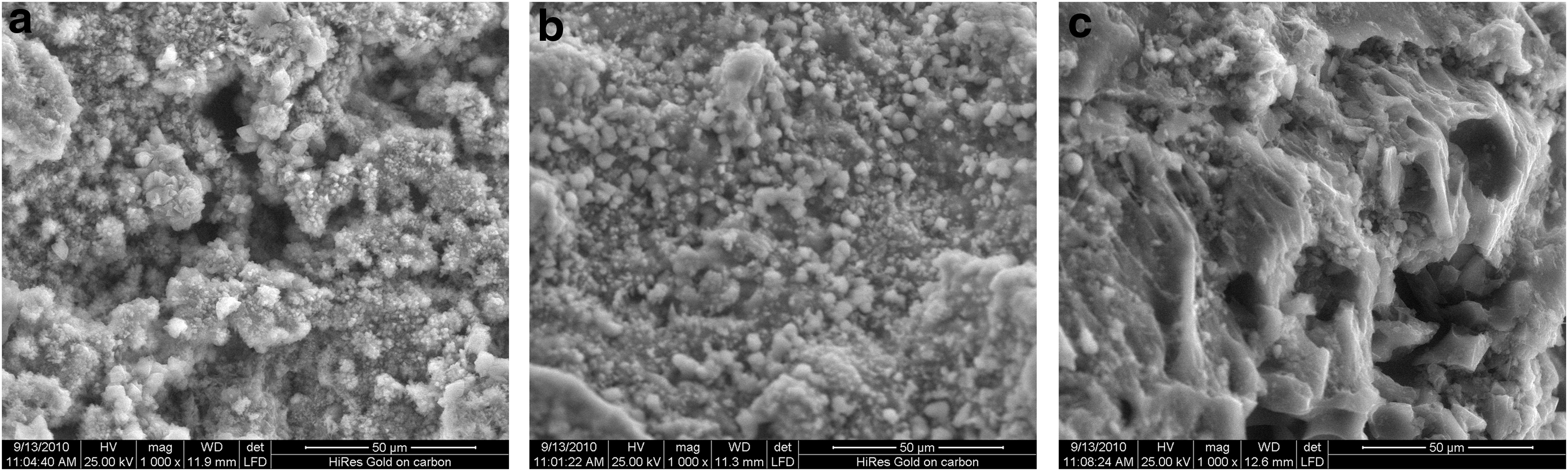
SEM micrographs of
Values are presented as percentages.
DSS, desulfurization steel slag; CSS, converter steel slag; CI, cinder; LS, loessial soil.
The sorption pattern of metals onto materials is attributable to the active groups and bonds present on sorption materials (Krishnani et al., 2008); therefore, FTIR spectroscopy was employed to identify the functional groups present in the four native sorbents and Mo-loaded sorbents in our study (Fig. 2). The spectra of the native sorbents and Mo-loaded sorbents show obvious differences in the impregnation of molybdenum. The bands at 3637.7, 3444.9, 3450.7, and 3435.2 cm−1 are characteristic of hydroxyl-stretching vibrations of mineral-layered aluminum silicates containing structural hydroxyl groups (Iqbal et al., 2009). The modification of the bands indicates that hydroxyl groups may be involved in coordination with metal ions (Gomes and Pinto, 2006). The bands that appear at 1419.6, 1381.0, and 1421.5 cm−1 correspond to C–O symmetric stretching modes of the CO32− ion (Mayo et al., 2004), and the band at 1622.1 cm−1 of CI can be assigned to deformation modes of the C–O asymmetric stretching (Wang and Wang, 2008; Iqbal et al., 2009). The peak at 1629.8 cm−1 corresponds to hydroxyl-bending modes of the hydroxides and hydrated phases present in the slag (Navarro et al., 2010). The presence of broad and weak overtone bands in the region of 1100–1800 cm−1 might be due to polymeric MxOy species (M: V, Mo, and W) (Busca et al., 1986). The band at 1030.0 can be assigned to hydroxyl vibrations of iron oxyhydroxides (Namduri and Nasrazadani, 2008), and their shift to 1084.0 cm−1 may be related to the M==O stretching of coordinatively unsaturated surface Mon+ ions (Mauge et al., 1988). Absorptions between 600 and 450 cm−1 are a common feature of different oxides such as Al2O3, Fe2O3, and MgO (Navarro et al., 2010). Consequently, the peak at 520.7 cm−1 of DSS disappeared, indicating an interaction between metallic oxides and Mo(VI) for the impregnation of Mo(VI) ions (Fig. 2).

FTIR spectra of four native [
Adsorption isotherms
The regression coefficients and constants for Langmuir, Freundlich, Temkin, and Dubinin–Radushkevich linear isotherms (Table 2) show that the regression coefficients (R2) of Langmuir are higher than that obtained from Freundlich isotherm. Moreover, χ2 values of Langmuir, Freundlich, Temkin, and Dubinin–Radushkevich for DSS are 0.023, 0.726, 0.084, and 0.158, respectively, indicating that the Langmuir model has a higher agreement with the adsorption process of Mo(VI). Consequently, the amount of Mo adsorbed increases until its concentration reaches saturation point. The difference in adsorption capacity can be interpreted in terms of the assumptions taken into consideration while deriving these adsorption models (Hasany et al., 2001).
The varying RL values associated with the adsorption of Mo(VI) on the four sorption media (Fig. 3) suggests that DSS has the most prevalent adsorption process. This can be justified because DSS has the smallest RL when picking up the same C0. The correlation coefficients of DSS, CSS, and CI for Dubinin–Radushkevich are above 0.95 (Table 2). The magnitude of E can be used to estimate the type of adsorption, so we can infer that the type of adsorption can be generally described as ion-exchange.
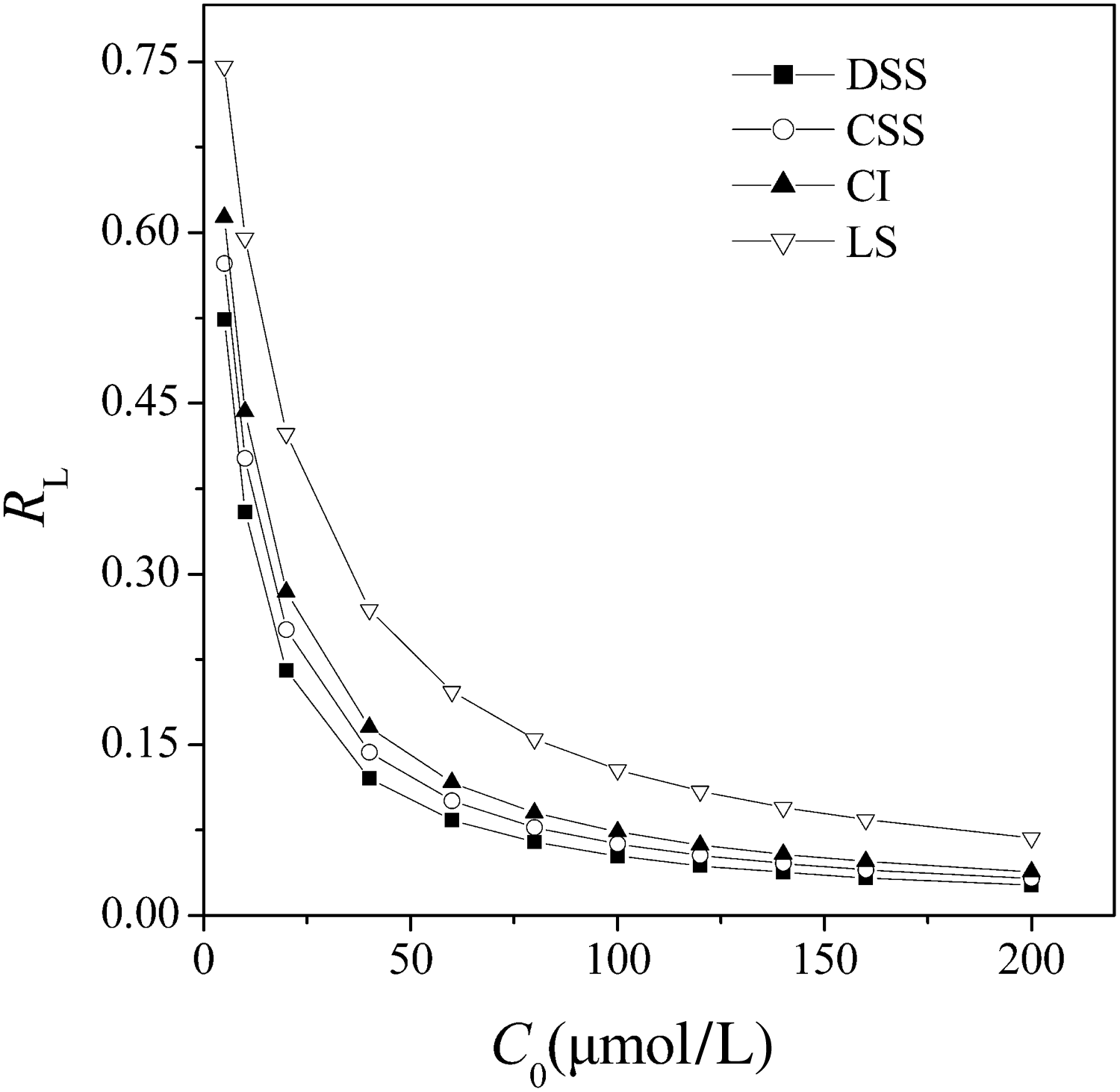
Varying RL values associated with the adsorption of Mo(VI) on the four sorption media. RL, the feasibility of the sorption process.
According to the Langmuir adsorption capacity (Q0; Fig. 4) the total amount of Mo(VI) adsorbed on the surface of the four different sorption media follows the order DSS>CSS>CI>LS. CSS has relatively smaller pore structure than CI, but the Q0 of CSS is larger than that of CI (Fig. 1), suggesting that the degree of porous structure is not the only factor that affects the removal mechanism of Mo. The ultimate performance may be attributed to the contents of Fe and Al oxides because they may acquire a positive charge at low pH (Bourikas et al., 2001), which can be also explained by the results of FTIR.
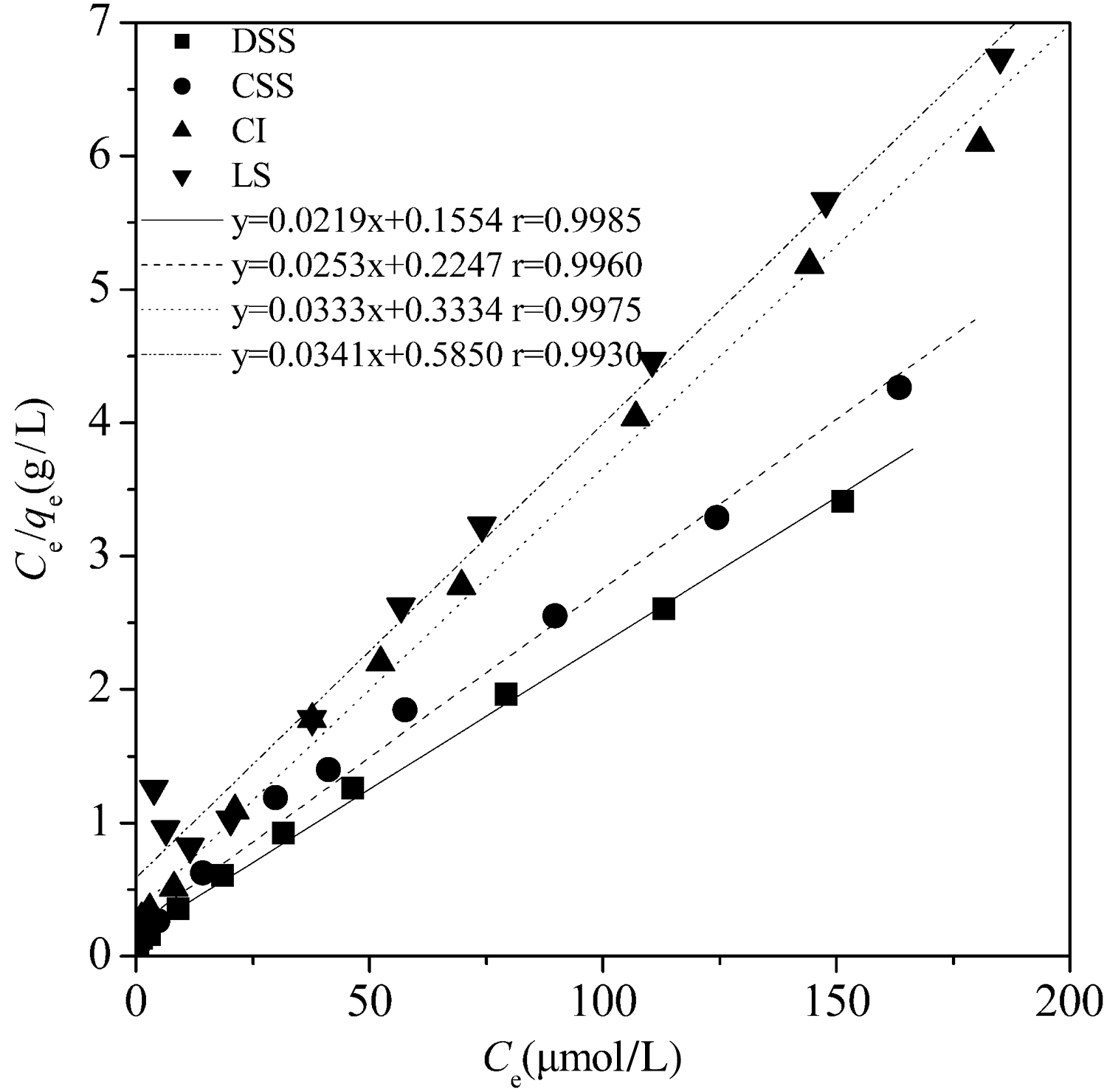
Langmuir isotherms for Mo(VI) on the four adsorbents. pH: 4.0±0.3. Ce, the equilibrium concentration of solute in solution (μM); Ce/qe, the equilibrium concentration of adsorbent in solution (g/L).
The maximum value of adsorption capacity (Q0) for Mo(VI) when using DSS was 45.67 μmol/g. A comparison of the Mo(VI) adsorption capacity of some adsorbents based on the values of Q0 (Table 3) is comparable to the values gained in previous studies (Xu et al., 2006; Kalal et al., 2011), albeit the other studies yielded quite different results (Yabe and Oliveira, 2003; Afkhami et al., 2009). The difference may be attributed to the higher surface charge of the iron ore and modified media.
Adsorption kinetic
The analysis of two kinetic models based on the four sorption media (Table 4) indicates that the calculated qe values are closer to the theoretical qe values obtained from the pseudo–second-order kinetic model. Moreover, the pseudo–second-order rate equation exhibits higher value of the coefficient of determination when compared to other kinetics equations. Consequently, the pseudo–second-order model is the best option to address the adsorption process of Mo(VI) through sorption media.
Experimental maximum values.
Calculated maximum values.
Effect of pH
The effects of varying equilibrium pH values on Mo(VI) adsorption over the four sorption media (Fig. 5) indicate that the maximum amount of Mo adsorption associated with CI, DSS, and CSS can be reached in pH range 4.0–5.0. Such a maximum removal can be due to the change of Mo(VI) to other species and the surface protonation of the sorbents. The pHpzc of the DSS, CSS, CI, and LS is 10.3, 11.5, 9.1, and 8.5, respectively; however, the speciation of molybdate anions are anionic polynuclear hydrolyzed species in pH range 2.0–4.6: Mo7O21(OH)33−, Mo7O22(OH)24−, Mo7O23(OH)5−, Mo7O246− (Namasivayam and Sangeetha, 2006). Consequently, the adsorbent surface is positively charged below the pHpzc, and anion adsorption occurs. The lower removal rate at pH<3.0 may be attributed to the higher concentration of Cl− anions, which compete with the molybdate anions for interaction with the adsorbent active sites (Elwakeel et al., 2009). The decrease in the removal at pH>5.0 is due to the lowering of surface protonation and competition of OH− (Namasivayam and Sureshkumar, 2009). Because the pH values were up to 8.0, the percent adsorption decreased rapidly toward a negligible level of removal efficiency by the end of the test (<10%). Other studies recorded similar observations (Bostick et al., 2003; Xu et al., 2006). The adsorption mechanism of molybdate at lower pHs can be explained by the proposed mechanism (Fig. 6).
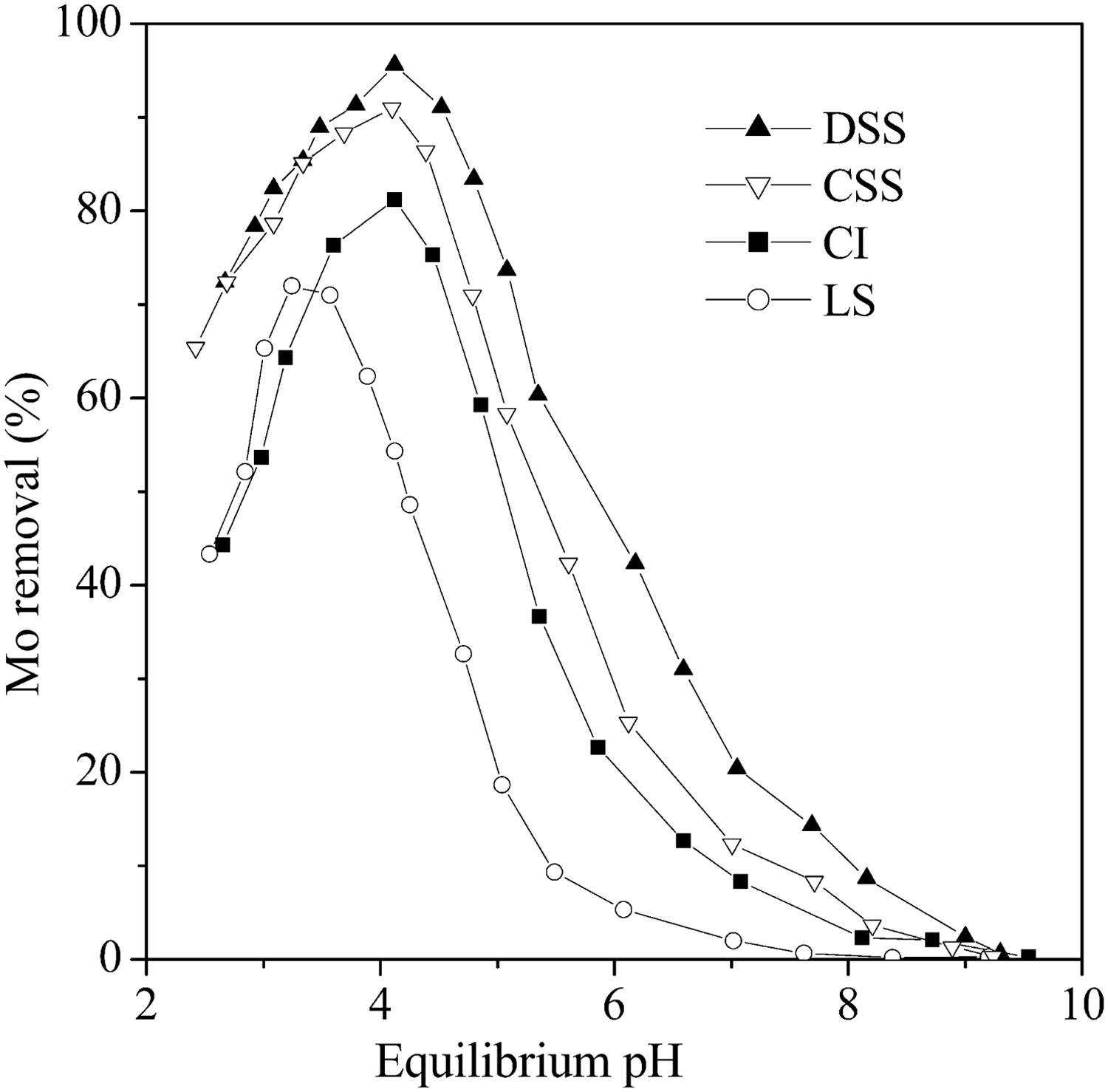
Effects of varying equilibrium pH values on Mo(VI) adsorption.
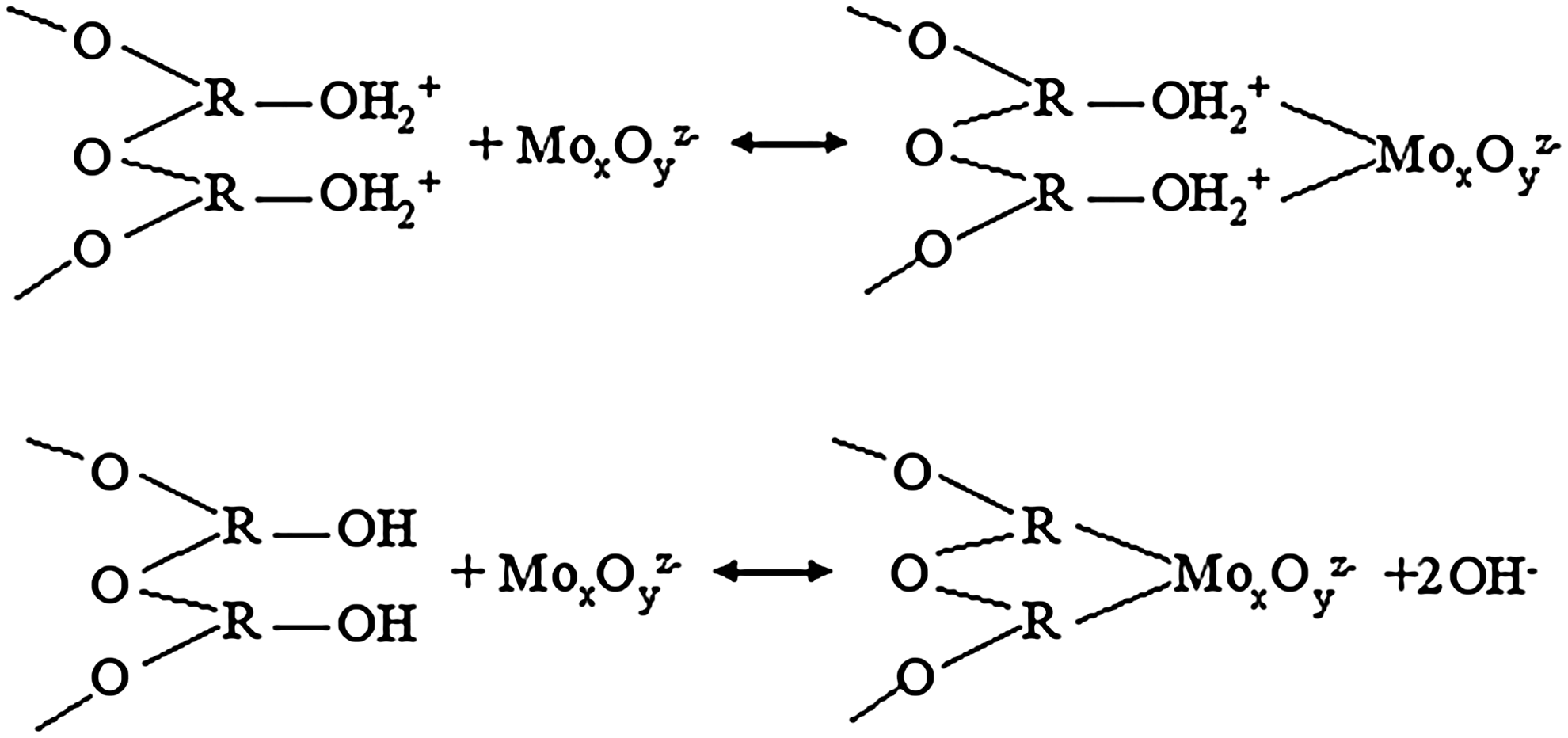
Proposed mechanism for Mo(VI) adsorption. R: Fe, Al; MoxOyz−: Mo7O21(OH)33−, Mo7O22(OH)24−, Mo7O23(OH)5−, Mo7O246−.
Competitive interactions
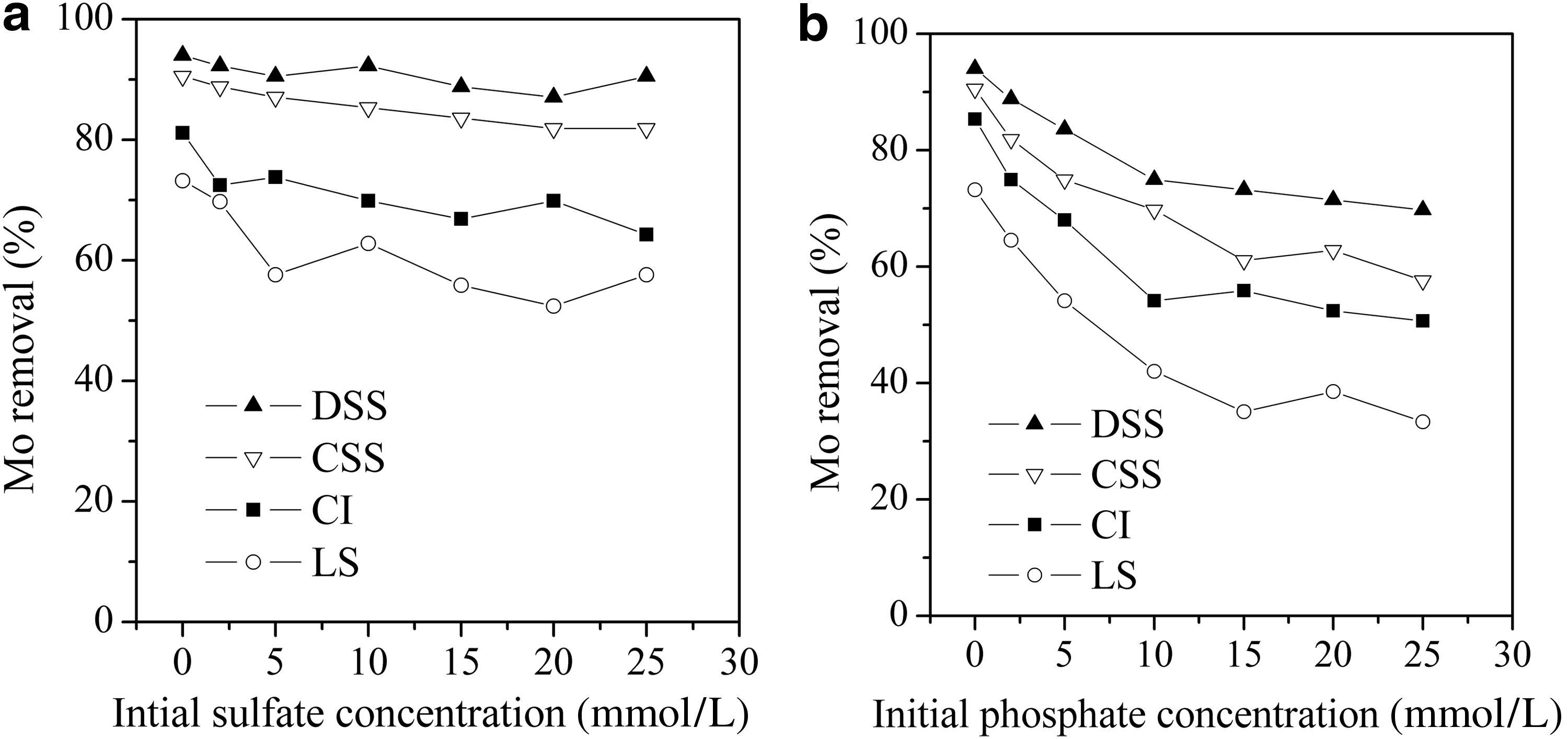
The effect of the presence of phosphate and sulfate on the adsorption of Mo(VI) associated with the four sorption media (Fig. 7) shows that the total amount of Mo(VI) adsorbed by the sorption media decreased with the increasing SO42− and PO43− concentrations in the solution. This indicates that the affinity of the sorption media for SO42− and PO43− is stronger than that for Mo(VI), which is similar to other studies (Namasivayam and Sureshkumar, 2009). Further, the binary anion systems of Mo(VI)/PO43− exhibit stronger competitive effects than Mo(VI)/SO42− on different sorption media (Fig. 8), possibly because the adsorbed PO43− on the surface of sorption media leans toward forming the inner-sphere surface complexes as compared to the outer-sphere surface complexes formed by SO42− (Xu et al., 2006). The competitive effect between PO43− and SO42− with Mo(VI) for the adsorption sites on the four sorption media follows the order LS>CI>CSS>DSS.
Competitive effect of
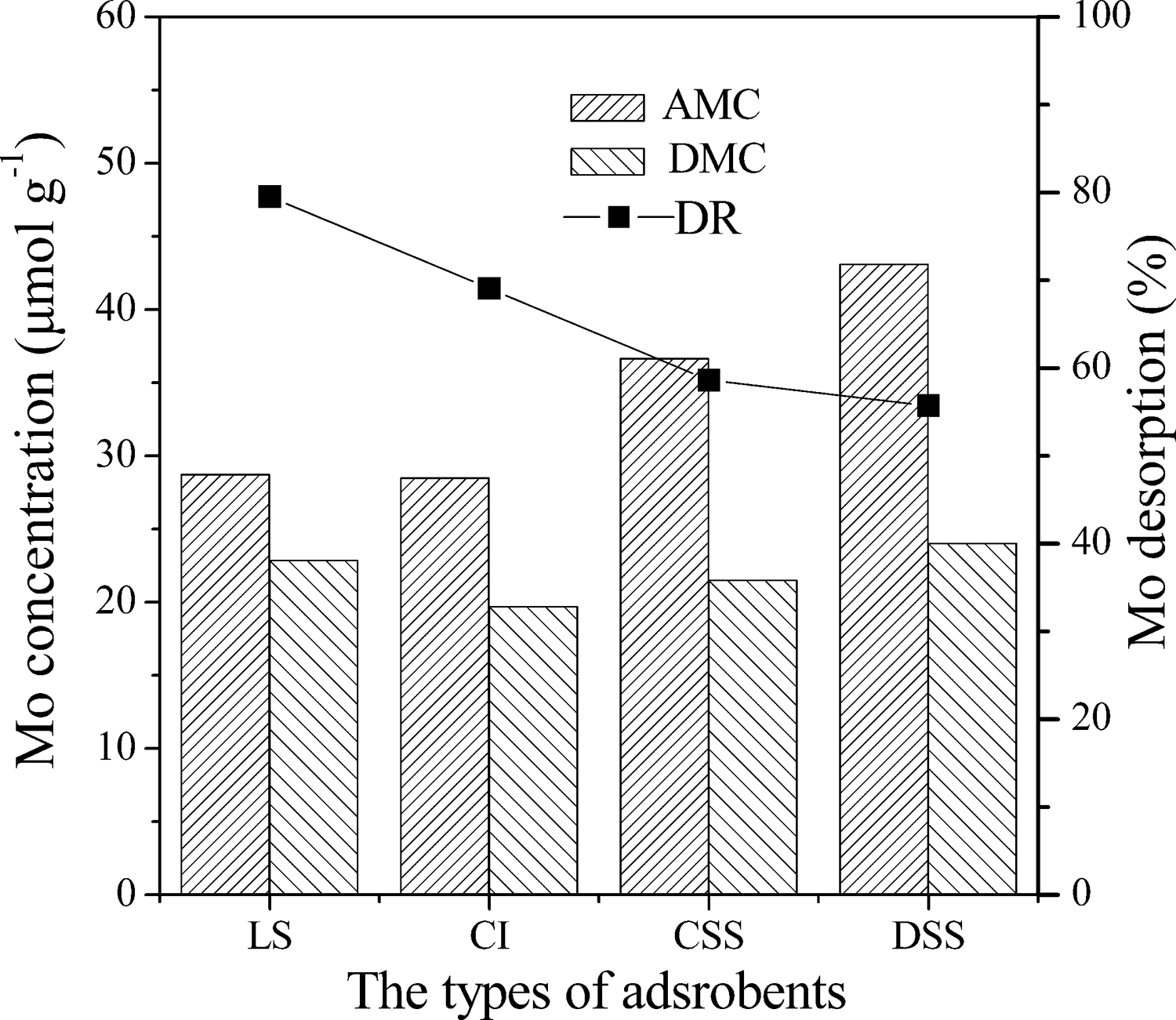
Adsorption–desorption rates of Mo(VI) on the four sorption media. AMC, the adsorption maximum capacity, DMC, the desorption maximum capacity; DR, desorption ratio.
Desorption studies
Desorption experiments were performed to evaluate the potential of adsorbents regeneration. The total amount of desorption of Mo(VI) on four different sorption media follows the order LS>CI>CSS>DSS (Fig. 8). Desorption of Mo(VI) may have resulted from the displacement of Mo(VI) from the adsorbent sites by OH− ions (Namasivayam and Sureshkumar, 2009).
Summary
The removal of Mo(VI) from aqueous solution by DSS, CSS, CI, and LS was investigated under a variety of conditions. The results suggest that the Langmuir isotherm model exhibits the highest agreement to the adsorption equilibrium data. According to the Langmuir adsorption capacity (Q0), the total amount of Mo(VI) adsorbed on the surface of the four different sorption media follows the order DSS>CSS>CI>LS. Adsorption process generally follows the pseudo–second-order kinetic model. The adsorption process of Mo(VI) changed with the pH levels, and the more adequate pH for Mo(VI) adsorption associated with the four adsorbents was found in a range between pH 3.0 and 4.5. The competitive effect of SO42− and PO43− with Mo(VI) for adsorption associated with the four sorption media follows the order LS>CI>CSS>DSS. Further, the effect of PO43− on the adsorption of Mo(VI) was observed to be stronger than that of SO42−. Desorption rate of Mo(VI) from the adsorbent surface follows the order LS>CI>CSS>DSS. Based on batch studies, DSS was found to be more effective than the other three materials for Mo removal at acid pH. The four materials in this article were found to be less effective in Mo removal compared with the previous studies, so their use as adsorbents for Mo removal may not be environmentally desirable, especially at neutral pH because of the low removal rate. Further studies should examine how to modify the material to improve the removal rate of Mo.
Footnotes
Acknowledgments
The authors are thankful for the assistance of Dr. Changwu Yu, Dr. Hui Zhang, and Dr. Hongxia Li in this research. The authors also acknowledge the financial support from the National Natural Science Foundation of China (No. 50979012) and the Geping Greenness aid action-123 Project. Constructive comments from anonymous reviewers are highly appreciated.
Disclosure Statement
No competing financial interests exist.