




Abstract
Abstract
Artificial aeration is one of the alternatives proposed in treating malodorous rivers. However, the contribution of aeration turbulence to endogenous N-behavior is still poorly understood. In this research, a recirculating ditch was used to investigate the effects of aeration on N-behavior in terms of aeration turbulence, dissolved oxygen (DO), and sediment oxygen demand (SOD). Specifically, the Reynolds number (Re) combining with fluid field distribution characterized the disturbance from aeration. Results showed that aerated turbulence played an important role in endogenous N-behavior and that Re may be an effective means for characterizing aerated-turbulence. There was a marked decrease of ammonium concentration in the overlying water with increased aeration disturbance. Nitrate concentrations and corresponding variation rates were positively correlated with Re both in bulk- and pore-water with temperature above 20°C. Comparatively, a run with a Re=1810 was deemed as the optimized aeration disturbance in this study. Grey relational analysis indicated that the effects of Re on the behavior of ammonium and total-N prevailed over DO and SOD. This research validated the feasibility of Re to characterize aeration turbulence and the necessity to optimize aeration conditions.
Introduction
Recently the remediation of river ecosystems has been gaining attention, and numerous river rehabilitation technologies have been developed (Huang et al., 2007; Jin et al., 2008; Liu et al., 2009; Wang et al., 2009). Amongst these technologies artificial aeration is recognized as one of the alternatives proposed in treating malodorous rivers. However, aeration oxygenation, like other widely-used methods, is also difficult to reduce the nitrogen levels below national consent standards in treating malodorous rivers. There is an urgent need for solving the aforementioned problem of nitrogen excess, for nitrogen (N) is known as a major source of river ecosystem health stress (e.g., stimulating algae growth) and a potential threat for human health (e.g., blue-baby disease).
As an important river in-situ remediation technology, artificial aeration has dual effects on the endogenous-N behavior from malodorous river sediments. On one side, oxygenation via aeration facilitates transformation of nitrogenous pollutants, for example, increasing dissolved oxygen (DO) level stimulates oxidation of ammonium to nitrate, and the resulting
Numerous studies concerning the effects of aeration on the endogenous-N behavior have been done mainly focusing on oxygen supply level from aeration (Li et al., 2003; Yu et al., 2007; Chen et al., 2008; Gu et al., 2008; Ruan et al., 2009; Zhang, 2009; Gin and Gopalakrishnan, 2010), and few related studies on aeration disturbance were done in the literatures. Additionally, cylindrical containers were mostly used to simulate river systems and thus the effects of fluid flow were disregarded in relevant studies (Li et al., 2003; Chen et al., 2008; Gu et al., 2008; Ruan et al., 2009; Gin and Gopalakrishnan, 2010). Moreover, the effects of aeration on the N-behavior from sediments were not consistently confirmed.
In this research, the effects of aeration on the endogenous-N behavior were investigated in terms of aerated turbulence, DO level, and sediment oxygen demand (SOD). Specifically, Reynolds number (Re) and fluid flow distribution were attempted to characterize the disturbance from aeration. The results of this study are of great significance for future work to optimize the application of aeration and solve the big challenge of nitrogen removal in treating malodorous river.
Materials and Methods
Sediment characteristics
All the sediments in this study were typically collected by a prismatical sampler from a small broken-ends streamlet with a length of 864 m and depth of 1–2 m. The river, named River Gongye, was within Taopu Town of Shanghai, in which the water quality was worse than the Class V of National Surface Water Quality Standard (the values of main indexes are: DO, ≥2 mg/L; chemical oxygen demand (COD)Cr, ≤40 mg/L; biochemical oxygen demand (BOD)5, ≤10 mg/L; NH3-N, ≤2 mg/L). The main physico-chemical properties of sediment are as follows: pH, 7.92; total nitrogen (TN), 7.78 g/kg; moisture content, 87.23%.
Experimental setup
Experiments were performed in a home-made recirculating ditch with dimensions 2 m long, 0.30 m wide, and a water depth of 0.60 m (Fig. 1). Two vertical aerator rotors mounted each side to provide for oxygenation, circulation, and mixing of the overlying water. The sediment layer of the simulated system consisted of 0.10 m depth of fluid mud, 0.2 m lime mud, and 0.05 m sand in sequence. Additionally, the overlying water from the river was siphoned into the system to avoid the disturbance to sediments as much as possible. The outer flank of the flume was covered with a gobo to prevent light penetration. Two sampling valves were set at fluid mud layer and lime mud layer, correspondingly.
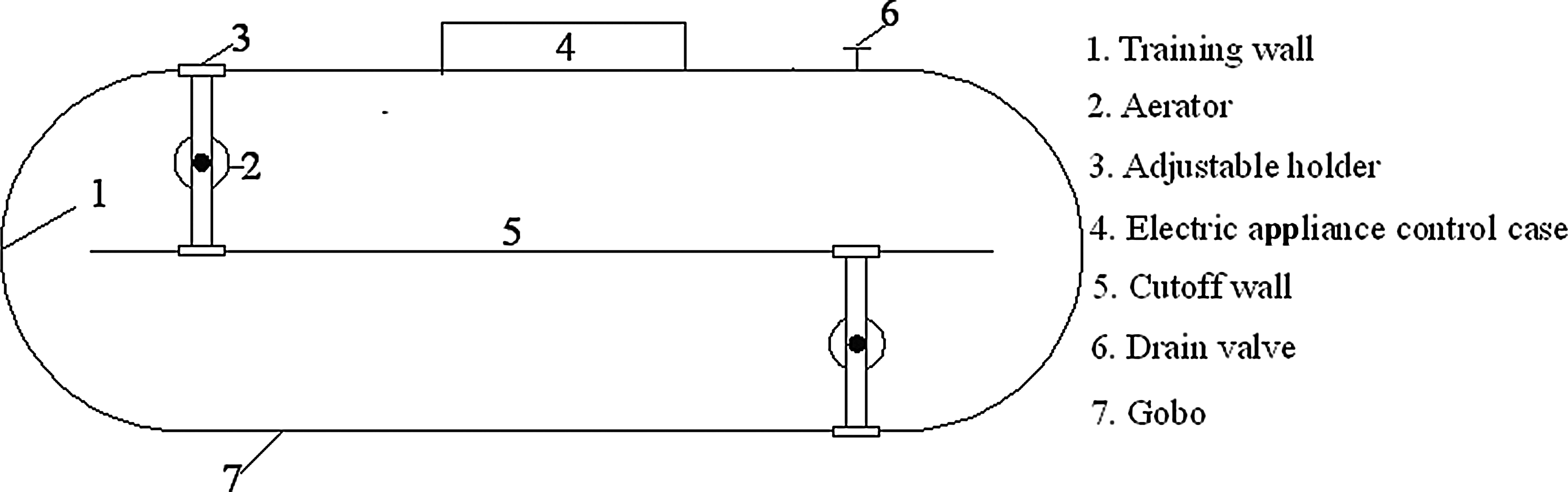
Schematic diagram of recirculating ditch.
The simulated system was operated at ambient temperature. Following each run, the overlying water and sediments were renewed. The operational conditions for the system throughout the study were shown in Table 1. The fluid flow velocities were manipulated by adjusting the aeration strength. Enough time was allowed to achieve a stable operation at each working condition. The variation rates of ammonium, nitrite, nitrate, and TN were defined as VR=(Ct−Ci)/Ci×100%, where VR is the variation rates of ammonium, nitrite, nitrate, and TN; and Ct and Ci are the concentrations of nitrogenous compounds in the overlying- or pore-water at time t and the initial stage, respectively.
DO, dissolved oxygen; SOD, sediment oxygen demand; Re, Reynolds number.
Sampling and analytical methods
The main physico-chemical properties of sediment, that is, pH, TN, and moisture content, were analyzed using standard methods (Bao, 2000). All chemical analyses of the overlying water and pore-water were performed in accordance with standard methods (APHA, 1998). The ammonium, nitrite, nitrate, and TN concentrations were determined colorimetrically. Fluid flow velocities were measured using a 10M-Hz ADV system (Channel Scientific Instrument Co.). The Re was calculated as Re=(UR)/v, where v is the kinematic viscosity, U is the averaged value of the velocity profiles in the testing cross-section, R means hydraulic radius. The measured sections were chosen at 0.3 m increments (streamwise) from one end of the system to the other end. At each section, the streamwise velocity components were recorded at a frequency of 20 Hz, for 1–5 min, at 0.1 m increments from 0.1 m (water depth) down to 0.5 cm above the sediments.
The DO measurement was conducted with the portable electrode (LDO™, HACH). The SOD was calculated as: SOD=([DO]t−[DO]i)×Q/Vs (mg O2/m2 per day), where [DO]t and [DO]i are the DO level in the bulky water at time t and the initial stage, respectively; Q is the flowrate; and Vs is the volume of sediments (Liu and Xu, 2002). The pore water from the surface sediments was obtained by centrifugation at 4000 g for 20 min. All water and sediment samples were determined in triplicate.
General grey reational analysis
The general grey reational analysis (GRA) is an impact evaluation model that measures the degree of similarity or difference between two sequences based on the grade of relation (Deng, 1989). The GRA contains six steps to generate the global comparison among the alternatives: (1) preparation of reference series and compared series, (2) normalization of reference series and compared series, (3) derivation of reference sequences and compared series, and calculations of (4) absolute grey relational grade (ɛij), (5) relative grey relational grade (γij), and (6) integrated grey relational grade (ρij). The rank ordering algorithm GRA can be applied to find out the ranking order of the order pairs, and thereby determine the corresponding degree of association.
In this study, two decision domains, namely the variation rate of ammonium, nitrite, nitrate, and TN in the overlying- and pore-water and the aforementioned parameters (including Re, DO, and SOD) are categorized for evaluation by using the order pair concept.
Results and Discussion
Characteristics of fluid fields of the simulated system
Two dimensional flow fields for the flume with different aeration disturbances were numerically simulated and analyzed by SURFER 8.0 (Fig. 2). The SURFER is a grid-based contouring and surface-plotting graphics program that can be used to create contour plots of output such as concentration and deposition, 3D surface plots of terrain, and vector plots of wind or fluid flow velocity. As shown in Fig. 2, the flow field distribution was basically in bilateral symmetry for every run. The comparison of fluid field distribution showed that the turbulence level was in the order of Run 3>Run 2>Run 4>Run 1, which was just in accord with the sequencing of Re. Although Run 4 was of the highest velocity, its turbulence degree was less than that of Run 2 and Run 3, which was mainly due to the lower operating temperature and thus the higher kinematic viscosity. This observation indicated that the Re may be an effective tool to characterize aerated-turbulences.

Profiles of flow field distributions of the simulated flume at Run 1
In addition, during the operation of the system, the turbulences of the two cross-sections (x=30 and 120 cm) were stronger than those of the other two sections (x=60 and 90 cm), which could be explained by the fact that the former two sections were closer to the aeration equipments. Comparatively, the cross-section (x=120 cm) was chosen as the major testing section in this study.
Variations of nitrogenous compounds with different aeration disturbances
Figures 3 and 4 illustrate the steady N-transforming behaviors of the system at four different aerated turbulences. Each column is the mean of the steady operation for each condition (i.e., constant fluxes of nitrogenous nutrients at the sediment-water interface). As shown in Fig. 3, all the ammonium levels of the pore water were higher than that of the overlying water, whereas all the nitrate levels demonstrated the opposite. This observation indicated that there were two complete reverse diffusion-based pathways for the ammonium and nitrate at sediment-water interface with aeration disturbance.
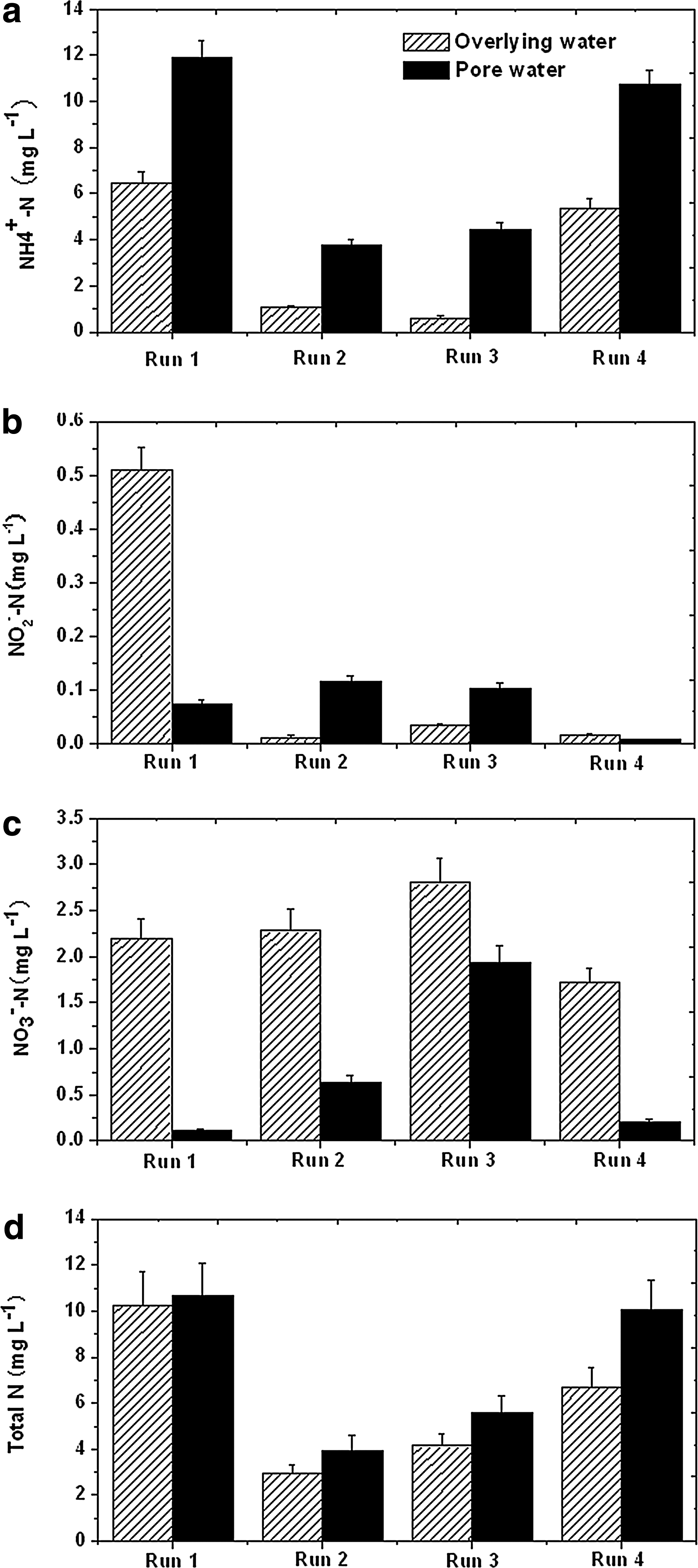
Concentrations of ammonium
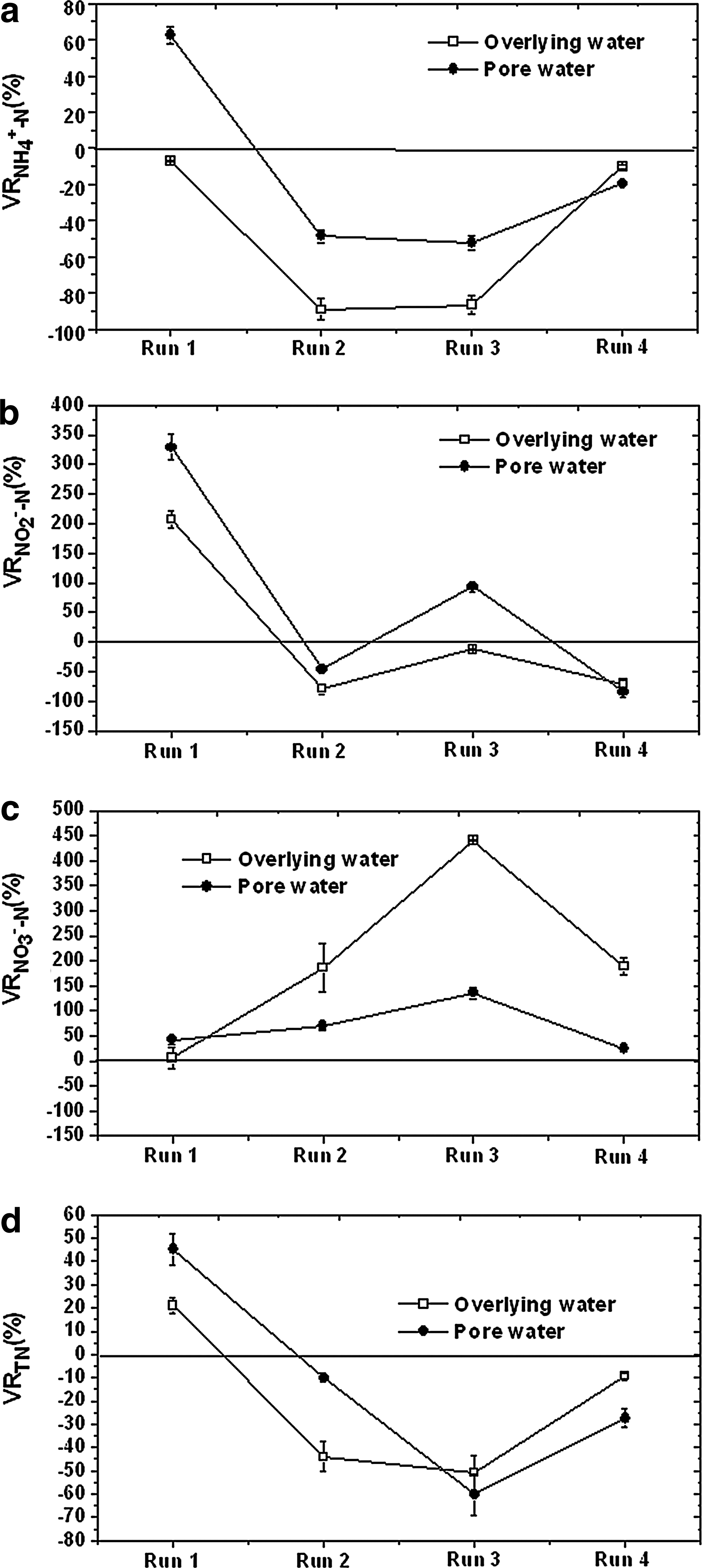
Variation rates of ammonium
Comparatively, there was a marked decrease of ammonium concentration in the overlying water with the increased aeration disturbances (
Additionally, the nitrite level in the overlying water was higher than that in the pore water at relatively low disturbances (Runs 1, 4), and the opposite tendency was observed with the increased disturbances (Runs 2 and 3, Fig. 3b). One exception was Run 1 with the highest nitrite concentration (0.51 mg/L) in the overlying water, which is mainly due to the limited DO diffusion favoring the nitrite-type nitrification process. The nitrate levels in the bulk water and pore-water were observed the highest at Run 3 (Re=2133), which demonstrated a similar tendency with the corresponding nitrate variation rate (Fig. 4c). Taken together, Run 2 (Re=1810) was deemed as the relatively optimized aeration condition in terms of the total-N level of the bulk water (Fig. 3d, 2.95 mg/L).
The N-transforming mechanism is an integration of numerous complex physical, chemical, and biological processes. In the literatures fairly disparate observations are found concerning the effects of aeration on the endogenous N-behavior. For example, experiments conducted by Li et al. (2003) and Ruan et al. (2009) showed that high-level DO (>5 mg/L) in the overlying water is essential to control the N-release from sediments, whereas Gin and Gopalakrishnan (2010) indicated that the nitrate-content in the overlying water increases notably under oxic conditions. Our research showed that even at DO of 6.18 mg/L the levels of ammonium and TN in the overlying water remained high (6.44 and 10.27 mg/L, respectively). These reported disagreements in the effects of DO on the N-release from sediments can be essentially attributed to the differences in aeration disturbances.
The effects of aeration turbulence on the N-behavior are mainly by DO flux and fluid flow. On one hand, aeration disturbance facilitates the DO delivery to sediments and then stimulate the biological nitrification process. A linear increase of nitrification activity was observed in the Re range of 1311–2133 with temperature above 20°C (Fig. 3c). The nitrate level at Re=1736 lower than at Re=1311 could be explained by the fact that the enhanced DO delivery to sediments was counterbalanced by the increased inhibition of nitrifying activity due to low temperature.
On the other hand, increasing aeration turbulence increases the sediments suspension and then eliminates mass transfer limitations. The increased mass transfer conditions promote higher DO concentrations at the sediment-water interface and deeper penetration of DO into the sediments. The higher DO level stimulates nitrification (
Correlations of the endogenous N-behaviors with Re, DO, and SOD
As an important river in-situ remediation technology, artificial aeration affects the N-transformation mainly in terms of Re, DO, and SOD. Hence, it is necessary to relate the N-behaviors to the above parameters for optimizing the aeration operation in treating malodorous rivers. The correlations of the endogenous N-behaviors with Re, DO, and SOD were investigated by means of the general GRA as described by Fu (1992). Table 2 summarizes the correlations of endogenous N-behaviors with Re, DO, and SOD using general GRA.
VR1 and VR2 denote the variation rate of nitrogenous compounds in the overlying water and pore-water, respectively. ɛij, γij, and ρij refer to the absolute grey relational grade, relative grey relational grade, and integrated grey relational grade, respectively. ρij=θ×ɛij+(1−θ)×γij; θ denotes the distinguishing coefficient and θ=0.5 is used in this study.
SOD, sediment oxygen demand; TN, total nitrogen.
The integrated grey relational grade of Re was found to be the highest for the variation rates of ammonium and TN in the bulk- and pore-water, and the corresponding reational order was Re>DO>SOD, indicating the effects of Re on the behavior of ammonium and total-N prevailed over DO and SOD. Similarly, Re was more closely related to the
Conclusion
The results presented in this paper show that aeration disturbance is closely related to the endogenous N-behavior from sediment, and the Re can be recognized as an effective means to characterize aeration disturbance. DO plays an important but not crucial role in the N biogeochemistry from sediment, and specifically the effects of aeration disturbance on the N-transformation needs to be considered. Taken together, there existed an optimized range in aerated turbulence for effective regulation of endogenous-N from malodorous river sediment. The aeration turbulence of Re=1810 is proposed as the optimal aeration condition in this study. This research provides a valuable starting point for integrating the N-behavior from sediment with aeration turbulence.
Footnotes
Acknowledgments
This work was carried out with the financial support from National Science and Technology Special Project on treatment and control of water pollution (No.2009ZX07317-006), National Natural Science Youth Foundation of China (No. 41101471) and Innovative research funds for Youth scholars from East China Normal University.
Author Disclosure Statement
No competing financial interests exist.