




Abstract
Abstract
Disposal of eggshell wastes has become one of the most serious problems for poultry industries. Efficient utilization of eggshell wastes for other application may solve this problem. This study uses eggshell as an additive to precipitate divalent lead cations [Pb(II)] from aqueous solutions in the pH range of 2–5. Owing to high CaCO3 content, eggshell precipitates Pb(II) to form lead carbonates, which will then settle on the surface of eggshell. Scanning electron microscopy and energy dispersive X-ray analysis of the eggshell exposed to Pb(II) solutions indicated the deposition of lead carbonates on the surface of the eggshell. On reducing the particle size of an eggshell from 750 to 100 μm, the Pb(II) removal efficiency of it increased from 30.7 to 99.6% at an initial Pb(II) concentration of 1045 mg/L. It was found through isotherm experiments that eggshell powder (100 μm) was capable of sorbing 577 mg Pb/g compared with 154 mg Pb/g by eggshell particles (750 μm). The biosorption isotherms were well represented by either Langmuir or Toth models. For eggshell powder, the rate of kinetics was fast with 35 min sufficient to achieve Pb(II) biosorption equilibrium.
Introduction
In the present study, divalent lead cations [Pb(II)] are used as model solute owing to its commercial importance and high toxicity. Lead has been widely used in the manufacture of storage batteries, pigments, automobiles, electroplating, and smelting. Effluents emanating from these industries are often comprised of high concentrations of lead, which has to be treated prior to discharge to avoid the adverse effects of lead on the environment. Currently, the discharge limit for lead is set at 0.1 mg/L according to National Environmental Agency, Singapore (NEA, 2008). Owing to its nonbiodegradability, lead is harmful to humans, plants, and animals (Gordon et al., 1979). In humans, lead poisoning can affect the gastrointestinal track and nervous system and can accumulate in bones, brain, kidneys, and muscles. Thus, there is a definite need to develop cheap and efficient techniques for the remediation of lead-bearing wastewaters. Even in the presence of some successful conventional techniques (Kurniawan et al., 2006), the research community is still looking for a cheap, environmentally benign, and practical technique for lead removal. Thus, this study is intended to showcase the potential of waste eggshells in lead remediation. The present study also focuses on the mechanism behind the performance of eggshell in Pb(II) removal and to optimize the operating conditions.
Materials and Methods
Chemicals and biosorbents
A stock of Pb(II) solution (5000 mg/L) was prepared from analytical grade lead nitrate (Sigma-Aldrich) using deionized water and serially diluted to prepare solutions of varying initial concentrations for experimental work.
Chicken eggshells were initially extensively washed with tap water to completely remove egg white and yolk. The resultant eggshells were dried naturally and subsequently grounded to produce eggshell particles of different sizes. Two average sizes were segregated using sieves, including eggshell powder (ESPW; 100 μm) and eggshell particles (ESP; 750 μm).
Methods
Biosorption experiments were carried out in 250 mL flasks at 25°C. Biosorbent (200 mg) was thoroughly mixed with 100 mL of Pb(II) solutions at 200 rpm for 3 h in an incubated shaker (LM-575RD, YIH-DER, Taiwan). The solution pH was initially adjusted and controlled using 0.1 M HCl or NaOH. Blank experiments (without biosorbent) were also conducted at same pH conditions to check for precipitation. After equilibrium achieved, samples were filtered through a 0.45 μm PTFE membrane filter. The filtrate was subsequently diluted and analyzed for metal concentration in inductively coupled plasma-optical emission spectrometry (ICP-OES; Perkin Elmer Optima 7300 DV; Perkin Elmer, Inc.). The pH edge experiments were conducted by varying solution pH in the range of 2–5 at fixed initial Pb(II) concentration of 1045 mg/L. Isotherm experiments were performed by varying initial Pb(II) concentrations in the range of 104–2090 mg/L at fixed pH conditions. For kinetic studies, at specific time intervals (in the order of 5–10 min), samples were withdrawn from Erlenmeyer flasks and analyzed for Pb(II) concentration.
To determine the major mechanism responsible for Pb removal, the ESP and ESPW samples before and after Pb(II) biosorption were dried, coated with thin layer of platinum, and analyzed by scanning electron microscopy (SEM) equipped with energy dispersive X-ray (EDX) analysis (JEOL, JSM-5600 LV).
Isotherm and kinetic modeling
To evaluate the isotherm data, two models were used, namely the Langmuir (two-parameter) model and the Toth (three-parameter). These models can be represented in their nonlinear form as
where Q is Pb(II) uptake (mg/g), Cf is the final Pb(II) concentration (mg/L), Qmax is the maximum Pb(II) uptake (mg/g), bL the Langmuir equilibrium constant (L/mg), bT is the Toth model constant (L/mg), and nT is the Toth model exponent.
Kinetics data were described using pseudo-first order model, which can be represented in their nonlinear form as
where Qt is the amount of Pb(II) sorbed at time t (mg/g), Qe is the amount of Pb(II) sorbed at equilibrium (mg/g), and k1 is the pseudo-first order rate constant (min−1). Although the model is only valid for linear sorption isotherms, it is often employed for nonlinear isotherms with relative success (Ho and McKay, 1998; Liu and Liu, 2008). All the model parameters were evaluated by nonlinear regression using the Sigma Plot (version 4.0; SPSS) software. The average percentage error between the experimental and predicted values was calculated:
where Qexp and Qcal represent experimental and calculated Pb(II) uptake values, respectively, and N is the number of measurements. All experiments were done in duplicates and the reported data were the mean values of two independent measurements.
Results and Discussion
Performance of ESP in lead removal
In the first part of study, experiments were performed with ESP for Pb(II) removal. The pH edge experimental results revealed that the biosorption performance of ESP improved with increasing pH in the pH range tested, that is, between 2 and 5 (Fig. 1). Removal efficiency of 3.3% at pH 2 by ESP increased to 30.7% at pH 5. Experiments were not conducted beyond pH 5 owing to lead hydroxide precipitation. In the examined pH range of 2–5, no precipitation of lead was observed in control experiments. The reason for good performance of ESP at pH 5 is due to two factors, namely metal speciation and mechanism of ESP removal. Chicken eggshell contains about 95% calcium carbonate in the form of calcite and 5% organic materials such as type X collagen, sulfated polysaccharides, and other proteins (Toro et al., 2007; Hernández-Hernández et al., 2008). Being the major constituent of ESP, calcium carbonate favors precipitation of metal ions as CaCO3 dissociates to calcium and carbonate ions. The solubility of CaCO3 in the eggshell may vary according to the pH of the solution. In solutions, carbonate species exist as H2CO3, HCO3−, and CO32−. Among these, HCO3− and CO32− could be responsible for the formation of insoluble metal carbonates. Considering that Pb exists in its divalent form (Pb2+) below pH 5, it is reasonable to observe that carbonate ions from ESP combine with Pb2+ to form lead carbonates. Owing to the presence of polysaccharides and other organic constituents, lead carbonates were then adsorbed onto the surface of ESP. Also there was a rapid rise in solution pH when ESP was in contact with Pb solution. For instance, the initial pH 5 rapidly increased to 7.9 within 15 min of contact. This pH drift is due to the following reaction (Lee et al., 1998):

Influence of equilibrium pH on lead removal efficiency of eggshell [initial Pb(II) concentration=1045 mg/L; temperature=25°C]. ESP, eggshell particles; ESPW, eggshell powder.
Scanning electron micrograph (Fig. 2a) illustrated that the surface of ESP was rough and contained protuberances. Through EDX analysis, it was observed that the protuberances were calcium carbonate and this was indicated through strong Ca peaks (Fig. 2a). After Pb biosorption, the Ca peaks were significantly decreased and strong Pb peaks were observed (Fig. 2b). Possible lead carbonate crystals were recorded in the SEM image of lead-loaded ESP (Fig. 2b), indicating the mechanism of microprecipitation of lead carbonate followed by adsorption onto ESP.
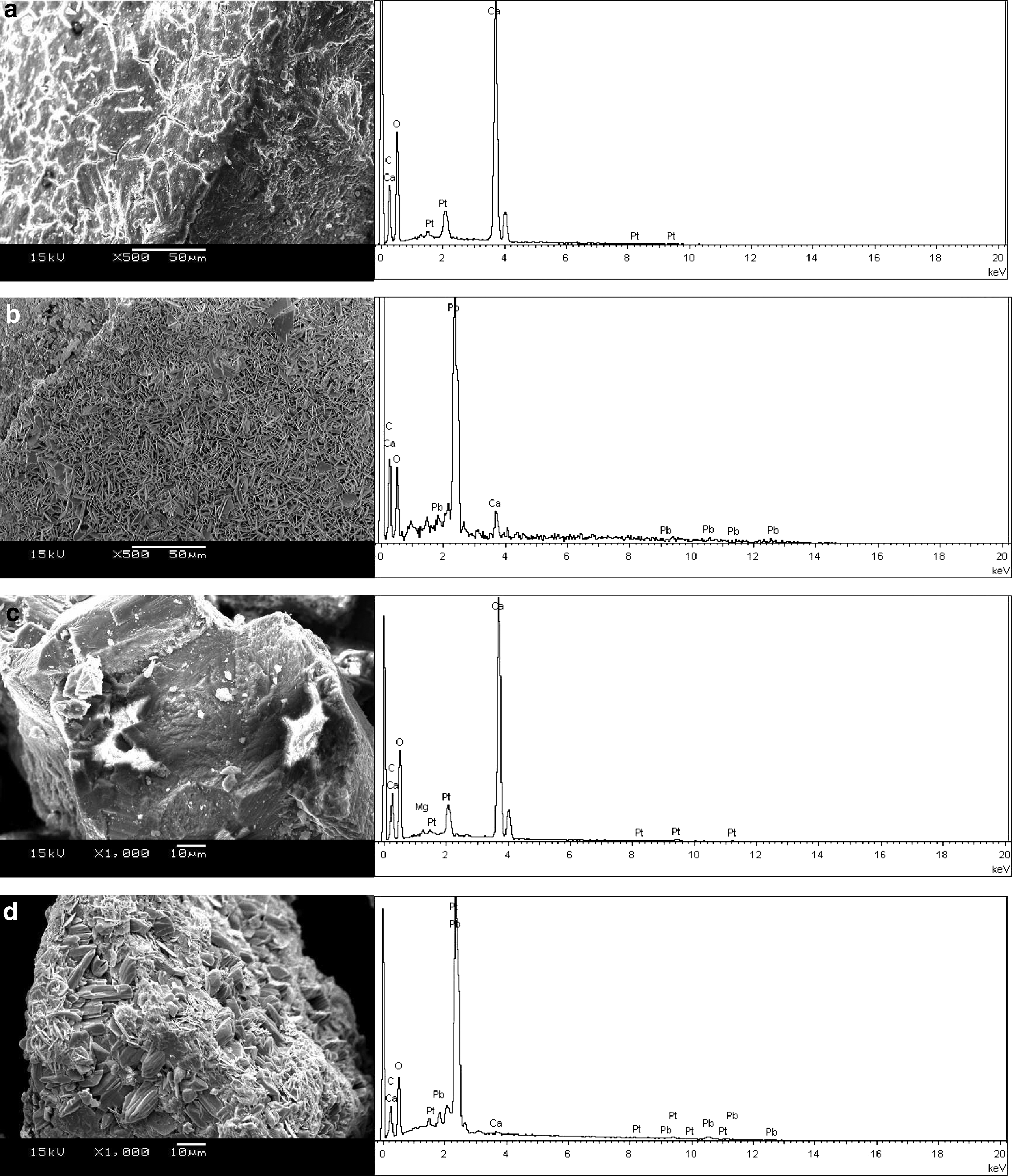
Scanning electron microscopy images and energy dispersive X-ray spectra of virgin ESP
Next, biosorption kinetic experiments were conducted to identify the equilibrium time and generate data for modeling to understand the sorption kinetics. The kinetic curves (Fig. 3) followed a general trend, namely rapid initial stage followed by slow attainment of equilibrium. The initial stage existed for 50 min and accounted for more than 94% of total Pb(II) removal. Of the different possible reasons, this initial quick phase was mainly due to the availability of high amount of carbonate for microprecipitation of Pb(II). As time progresses, the formation of metal carbonate would be difficult due to depletion of carbonate released from ESP. Thus, the initial rapid phase was followed by a slow phase that extended for 90 min to attain final equilibrium Pb(II) concentrations of 221 and 723 mg/L for examined initial Pb(II) concentrations of 523 and 1045 mg/L, respectively.

Kinetics of Pb(II) biosorption by eggshell at different initial Pb(II) concentrations (pH=5; temperature=25°C).
The ESP kinetic data for Pb(II) removal were modeled using the pseudo-first order model. Table 1 illustrates the model constants along with correlation coefficients and %-error values. Application of ESP kinetic data to pseudo-first order model resulted in good prediction of experimental data and equilibrium uptake values with high correlation coefficients and low %-error values. The kinetic data predicted by the pseudo-first order model in comparison with experimental data are presented in Fig. 3.
ESP, eggshell particles; ESPW, eggshell powder.
In an effort to evaluate the full capacity of ESP, isotherm experiments were conducted by varying initial Pb(II) concentrations in the range of 104–1045 mg/L at pH 5. Isotherm of H-shape, that is, very steep slope, was obtained (Fig. 4). This indicates the high affinity of ESP toward lead carbonate. A highest experimental uptake of 162 mg/g was obtained. Owing to nature of H-shaped isotherm, experimental data were modeled using the Langmuir and Toth models. However, it should be realized that these models offers no insights into the mechanism aspects of biosorption (Liu and Liu, 2008). Also, the models were originally developed to describe the gas–solid and, more recently, liquid–solid adsorptions. However, the applicability of the model for solid–solid adsorption system is relatively unknown. It should be noted that Langmuir model has frequently been used in biosorption literature to quantify and contrast the performance of different biosorbents. The model involves two easily understandable constants; Qmax, which indicates maximum biosorption capacity that the system can achieve and bL, which relates to affinity between sorbate and sorbent. The Langmuir model was able to describe the isotherm with correlation coefficient (R2=0.886) and %-error value (ɛ=0.14%). The Qmax and bL values were recorded as 154 mg/g and 0.55 L/mg, respectively. With an effort to further enhance the accuracy of predication, the Toth model was used. The model assumes an asymmetrical quasi-Gaussian energy distribution with a widened left-hand side, that is, most sites have sorption energy less than the mean value (Ho et al., 2002). Correlation coefficient was enhanced to 0.889 and %-error decreased to 0.04% while applying the Toth model. The model constants, Qmax, bT, and nT were recorded as 154 mg/g, 0.50 L/g and 0.988, respectively. The isotherm curves predicted by both the Langmuir and Toth models are shown in Fig. 4.
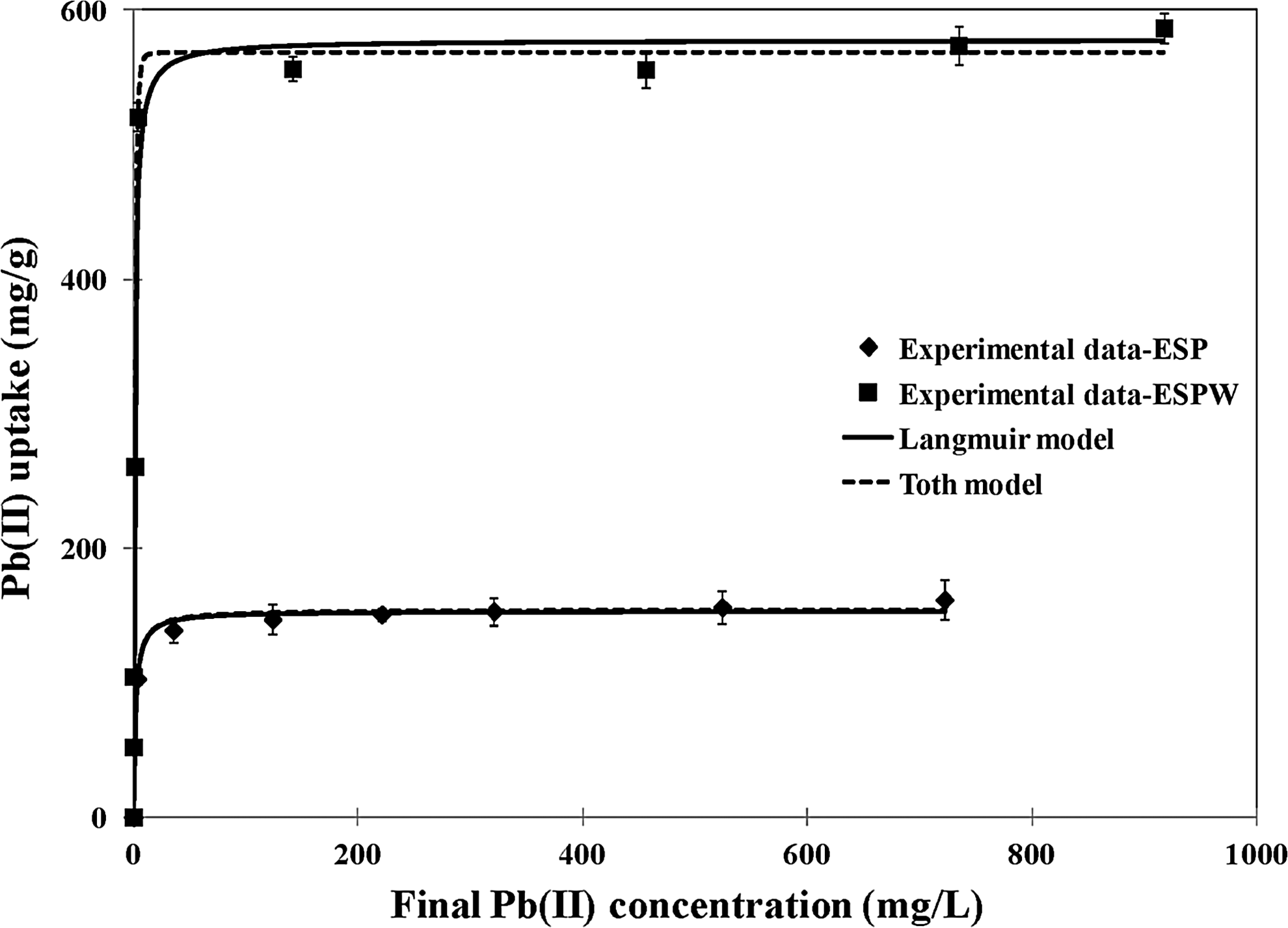
Pb(II) biosorption isotherms of eggshell (pH=5; temperature=25°C; initial Pb(II) concentration range for ESP=104–1045 mg/L; initial Pb(II) concentration range for ESPW=104–2090 mg/L).
To estimate the possibility of ESP reuse, desorption experiments were conducted. Through pH edge experiments, it was observed that maximum biosorption occurred in mild acidic conditions. Hence, desorption was attempted in strong acidic condition (0.01 M and 0.1 M HCl). Usage of acidic solutions is also based on the idea that acidic solutions are one of the common wastes in almost all industries and if biosorbents are employed in industrial wastewater schemes, these acidic solutions can be used to regenerate biosorbents. Very high Pb elution efficiency (98.9%) was observed with 0.1 M HCl. However, exposure of 0.1 M HCl damaged ESP and resulted in weight loss of 57%, making regenerated ESP unsuitable for subsequent biosorption cycle. The performance of 0.01 M HCl was mediocre with only 51.5% elution efficiency; however, the elutant was biomass friendly with only 12% ESP weight loss. The results clearly support the suggested mechanism, wherein the settled lead carbonates on the surface of ESP were strongly bonded and the strong acidic conditions were required to dissolve the lead precipitate. During this process, the dissolution of CaCO3 may also happen, which results in ESP weight loss, and this was confirmed in our experiments that more than 412 mg Ca/L was leached from ESP during desorption using 0.1 M HCl.
Performance of ESPW in lead removal
In the second part, ESPW was employed in lead removal at different pH conditions (Fig. 1). The results suggest that lead removal capacity of eggshell markedly increased owing to size reduction. At pH 5, ESPW exhibited 99.6% removal of lead at an initial Pb(II) concentration of 1045 mg/L. Solution pH affected the performance of ESPW, with acidic pH resulting in significant reduction in the lead removal capacity of ESPW (Fig. 1).
Similar to ESP, the EDX analysis indicated the strong presence of Ca in virgin ESPW (Fig. 2c). After lead biosorption, the Ca peak subsided and new Pb peak was observed (Fig. 2d). It is interesting to observe SEM image of lead-loaded ESPW (Fig. 2d), where lead carbonate crystals were prominent compared to rough surface observed in raw ESPW (Fig. 2c).
The rate of lead removal by ESPW was found to be very rapid wherein more than 90% of total lead removal occurred within 10 min (Fig. 3). Afterward, there were slower rates of uptake to about 35 min and no further significant adsorption were observed beyond this period, with final Pb(II) concentrations of 0.8 and 3.8 mg/L for the examined initial Pb(II) concentrations of 523 and 1045 mg/L, respectively. Pseudo-first order model predicted the ESPW kinetics data very well with high correlation coefficients and low %-error values (Table 1).
Lead biosorption isotherm for ESPW at pH 5 is presented in Fig. 4. The very steep H-shaped isotherm obtained implies the high affinity of ESPW for lead carbonate. Applying the Langmuir isotherm to ESPW-Pb(II) isotherm generated maximum uptake value of 577 mg/g and b-value of 0.938 L/mg, along with correlation coefficient of 0.958 and %-error value of 1.6%. Since the Langmuir model is able to predict the maximum biosorption capacity of any biomass under controlled conditions, comparison of biomass performance toward a particular ion is possible. In that way, efforts were made to compare the Pb(II) biosorption performance of eggshell with the reported performance of other biomasses in the literature (Table 2). It is clear that eggshell performance in Pb(II) biosorption was superior to most of the biosorbents. Application of the Toth model to ESPW-Pb(II) isotherm resulted in improved correlation coefficient (R2=0.971) and low error value (ɛ=0.05%). The calculated Toth model constants were in the magnitude of Qmax=568 mg/g, bT=0.40 L/mg, and nT=0.35.
Evaluation of ESP and ESPW in lead removal and their mode of application
Based on the results, it is clear that ESPW performed well compared to ESP. The small-sized sorbents provide larger surface area that is available for sorption and are easier to dissolve compared with the larger particles. While minimizing the particle size from 750 to 100 μm, the Pb(II) uptake capacity of eggshell was increased from 162 to 521 mg/g at an initial Pb(II) concentration of 1045 mg/L. Maximum Pb(II) biosorption capacity of ESPW was ∼3.6 times higher than ESP. Rate of Pb(II) removal kinetics by ESPW was fast with equilibrium attained in 35 min compared to 90 min by ESP. Desorption was possible with ESP; however regeneration was unlikely under examined conditions. In contrast, considering that ESPW was in powder form, desorption and subsequent reuse will not be practical. Summarizing the results based on performance, it can be concluded that ESPW appeared to be more advantageous than ESP.
Regarding the mode of application, biosorption can be effectively conducted in two modes, viz. batch and continuous. For rigid biosorbents that operate under ion-exchange mechanism, continuous flow packed columns are considered as effective configuration to utilize sorbent capacity for better effluent quality (Vijayaraghavan and Yun, 2008). Considering the mechanism of metal removal and chemical composition of eggshell, it is preferable to recommend batch mode for eggshell. Biosorption batch mode require a similar setup as that of established precipitation techniques, including a contact vessel, some mode of agitation (mechanical stirrers with attached impellers), piping and other peripheral equipments such as pH probes and level controllers (Atkinson et al., 1998; Vijayaraghavan and Yun, 2008).
Once the biosorbent is completely exhausted, ultimate disposal should be addressed. The metal-loaded ESPW can be separated from the treated solution and the filter cake formed can be mixed with suitable binders before landfill. Another way to approach disposal is to incinerate filter cake to obtain metal-rich ash. Either of these ways will lead to utilization of eggshell in only one biosorption cycle. However, considering eggshell wastes are continuously generated and common in any parts of the world, the supply of biosorbent for continuous running of the biosorption process can be ensured. Rather than going directly to landfills, it is preferable to have an intermediate step that utilizes the biosorption potential of eggshell wastes to remediate toxic heavy metal-bearing solutions.
Conclusions
In summary, this study demonstrated that eggshell wastes were identified as a potent biosorbent for the removal of Pb(II). Because of the presence of excess calcium carbonate, metal carbonates were formed, which were then adsorbed onto the surface of eggshells. With advantages such as low material cost, continuous supply, high removal efficiency, and fast kinetics, eggshell wastes seemed to be suitable as an excellent additive to develop a removal technique for decontamination of lead-bearing wastewaters.
Footnotes
Acknowledgments
The authors gratefully acknowledge the support and contributions to this project from the Singapore-Delft Water Alliance (SDWA). The authors would also like to thank anonymous journal reviewers who provided constructive comments in the improvement of this article.
Author Disclosure Statement
No competing financial interests exist.